
• siteprobathrooms

Splashback or Backsplash: Expert Guide for 2026

You're probably here because you've started collecting ideas for a kitchen or bathroom renovation and hit an annoying language snag. One supplier says backsplash, your Pinterest saves say backsplash, but every local tradesperson, showroom, and renovation quote in Victoria seems to say splashback. Then questions follow. Which material offers lasting durability? Where should it stop? Will a patterned tile look polished or chaotic once it hits a corner, power point, or vanity mirror?

That confusion is normal. The term is simple. The decision isn't.

In real renovation work, the splashback is one of those details that looks easy from a distance and becomes technical the moment you need it measured, cut, aligned, sealed, and installed neatly around fixtures. In kitchens, it deals with water, grease, heat, and daily cleaning. In bathroom renovations, it can shape the whole look of a vanity wall while also protecting plaster and paint in high-moisture areas. Get it right and the room feels finished. Get it wrong and even expensive materials can look poorly planned.

Splashback vs Backsplash Decoding the Renovation Lingo

The short answer is this. In Australia, splashback is the standard local term. Backsplash is the North American term. The Cambridge Dictionary entry for “backsplash” labels it as US usage, which lines up with how Australians speak and specify the item on renovation projects.

So if you're asking about splashback or backsplash, you're asking about the same thing.

In practical renovation terms, a splashback is the protective wall surface behind work areas. In kitchens, that usually means behind the cooktop, sink, and benchtop run. In bathrooms, it often means the wall finish behind a vanity or basin where regular splashing would otherwise mark or damage the wall.

Term Common region What it means Typical use
Splashback Australia, UK usage Protective wall surface behind wet or messy work areas Kitchens, bathrooms, laundries
Backsplash North America Same function, different regional wording Kitchens, bathrooms

The wording matters less than the function. The surface needs to do three jobs well:

  • Protect the wall: It stops water, grease, and day-to-day mess from reaching painted plaster or other less durable finishes.
  • Support cleaning: A good splashback makes wipe-down easier, especially around sinks, vanities, and cooktops.
  • Finish the design: It can either blend into the room or become the visual feature.

A lot of renovation mistakes start before installation. People choose a look first and only later ask how it ends at a shelf, window, or power point.
That's why this decision sits early in project planning. For modern bathrooms, new bathroom ideas, and kitchen upgrades alike, the splashback isn't a styling afterthought. It affects layout, material ordering, labour, and how tidy the finished room feels.

Key Considerations Before Choosing Your Material

Before comparing tile, glass, or stone, step back and look at the job the splashback needs to do in your home. A material that looks perfect in a showroom can become frustrating in a busy family kitchen or a compact ensuite if it doesn't match how the room is used.

Key Considerations Before Choosing Your Material

Start with the layout, not the finish

Homeowners often begin with colour. Project managers begin with edges, heights, returns, outlets, and joins.

A splashback across a simple straight run is one thing. A splashback that has to turn a corner, finish under open shelving, stop at a window reveal, or wrap around a shaving cabinet in a bathroom needs more planning. The more interruptions in the wall, the more important the installation detail becomes.

One reason this matters is material quantity. A standard kitchen splashback over a 3-metre run at 600 mm high covers about 1.8 m², while a full-height wall over that same width reaches about 7.2 m², which is roughly a 300% increase in coverage according to this measurement guide on splashback area calculation. That change affects how much tile, glass, or stone you need, and how much cutting and labour the installer takes on.
Use three filters before you choose

A quick decision framework helps.

  • Budget: Full-height features look strong, but they use more material and usually create more labour. If budget is tight, choose where to spend for impact.
  • Lifestyle: If you cook often, use oils, or have kids leaving toothpaste and soap marks everywhere, pick a finish that's easy to wipe and forgiving in daily use.
  • Aesthetic: Decide whether the splashback should be quiet or prominent. In designer bathrooms, a splashback can frame the vanity and mirror beautifully. In a minimal kitchen, it may need to recede.

Practical rule: Measure the wall you need to protect before choosing the material you want to admire.

Think like a builder for five minutes

If you want the room to feel organised, ask these questions early:

  1. Where does the splashback start and stop?
  2. Will the edge align with cabinetry, shelving, mirrors, or tall joinery?
  3. Are there outlets, tap penetrations, or trims that will interrupt the pattern?
  4. Is this a wet-prone bathroom zone that needs tougher detailing?

Many strong-looking new bathroom ideas either become refined or begin to fail at this stage. The best result usually comes from planning the shape and boundaries first, then selecting the finish.

A Detailed Comparison of Popular Splashback Materials

Some materials look good in photos but become annoying to live with. Others don't scream for attention, yet perform better year after year. The right choice usually comes down to how much mess the room sees, how much visual detail you want, and how precise the installation needs to be.

Splashback Material Comparison Guide

Material Average Cost Durability Maintenance Best For
Ceramic or porcelain tile $ to $$ Good Moderate, grout needs attention Most kitchens, bathroom renovations, feature patterns
Mosaic tile $$ Good Higher maintenance due to more grout lines Feature areas, designer bathrooms, niche detailing
Toughened glass $$ to $$$ High Easy Busy kitchens, clean modern finishes, areas behind gas hobs
Natural or engineered stone $$$ High Low to moderate depending on finish Premium kitchens, seamless luxury looks, modern bathrooms
Stainless steel $$ to $$$ High Easy Utility-focused kitchens, contemporary or industrial styling

Tiles suit the widest range of projects

Tiles remain the most flexible option because they can be subtle, bold, classic, or strongly contemporary without forcing the whole renovation in one direction. They work in kitchens and in bathroom renovations, especially where you want colour, texture, or pattern.
Ceramic and porcelain tiles are often the easiest entry point because they offer plenty of variation in shape and scale. Subway layouts feel familiar. Large-format tiles reduce grout lines and can look cleaner. Mosaic tiles create texture but also add many more joints, which means more visual busyness and more cleaning effort.

Tiles work well when you want:

  • Design flexibility: Easy to match with timber, stone-look joinery, or painted cabinetry.
  • Controlled spending: You can keep the field simple and spend more on trims or a feature section.

  • Bathroom detail: Vanity splashbacks, recessed shelving, and small wall areas often suit tile very well.

What doesn't work as well is choosing a busy patterned tile and treating installation as an afterthought. Patterns need a layout plan, not just a tile selection.
Toughened glass is hard to beat for easy cleaning

If low maintenance is high on your list, glass has a strong case. In a busy kitchen, toughened glass splashbacks are noted as highly heat-resistant and suitable behind gas hobs, while also being easy to clean because the surface is seamless and non-porous.

That combination matters. No grout lines means wipe-downs are quicker. The finish also reflects light well, which can help a tighter kitchen feel brighter.

Glass usually suits:

  • Minimal kitchens: Clean lines, little visual interruption.
  • Family use: Less scrubbing around joints and corners.
  • Simple colour statements: One consistent tone across the whole wall.

Its trade-off is aesthetic warmth. In some homes, glass can feel a little flat unless the cabinetry, benchtop, and lighting are doing enough around it.

Stone gives a premium, integrated look

Stone, whether natural or engineered, is usually chosen for visual continuity and a more architectural finish. If the benchtop continues up the wall, the room often feels calmer and more expensive-looking because there are fewer competing materials.

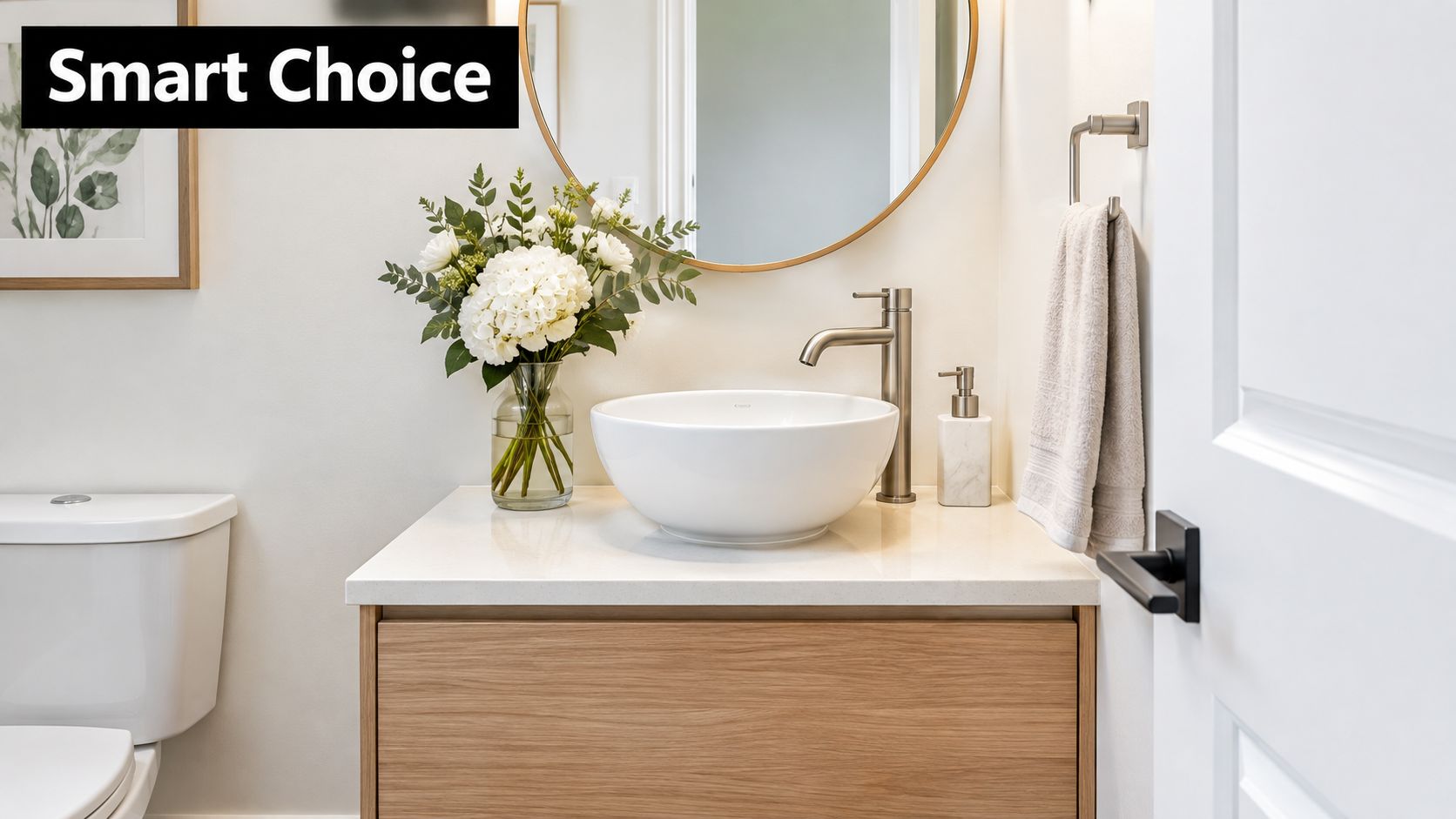
This can work beautifully in modern bathrooms too. A stone splashback behind the vanity can tie together basin, cabinetry, and mirror lighting in a very controlled way. That's often why designer bathrooms feel resolved. The material palette is disciplined.

Stone tends to suit homeowners who want:

  • A continuous appearance
  • Fewer joins
  • A premium feel without decorative fuss

The challenge is planning. Slab materials need accurate templates, clean cut-outs, and careful handling around taps, outlets, and edges. They don't forgive casual measurement.

If you're also comparing surfaces more broadly, this guide to kitchen benchtop materials helps frame how the splashback should relate to the rest of the kitchen.

Stainless steel is practical first, decorative second

Stainless steel is chosen for performance. It handles cooking zones well, wipes down easily, and gives a crisp, functional finish. In some homes that's exactly the right look. In others, it can feel too commercial unless balanced with softer elements like timber, warmer stone, or textured joinery.

It works best where function leads the design brief.

If the cooking zone gets heavy daily use, choose the material you'll still like after the fifth wipe-down of the day, not just the one that looked best under showroom lights.

Style Guide Matching Your Splashback to Your Home

A splashback doesn't need to shout to matter. Some of the best-looking rooms use it subtly. Others rely on it to carry the whole design. The difference is whether you want the wall finish to lead the room or support it.

Style Guide Matching Your Splashback to Your Home

When a quiet splashback works best

In a kitchen with strong cabinetry colour, a veined benchtop, or open shelving, the smartest move is often restraint. A plain tile, simple glass panel, or matching stone return can give the room breathing space. That approach works especially well in modern bathrooms too, where the vanity, tapware, and lighting already carry enough detail.

A restrained splashback usually suits:

  • Minimal interiors
  • Small rooms that need visual calm
  • Projects where the benchtop or vanity is already the hero

This is often the better route for homeowners chasing elegant rather than trendy.

When the splashback should become the feature

There are rooms that need a focal point. A bathroom vanity wall with soft joinery and simple fittings can come alive with a textured tile. A compact kitchen with plain cabinetry can get character from shape, tone, and grout contrast.

That's where new bathroom ideas often become more than mood-board styling. The trick isn't choosing a bold tile. It's making sure the boldness survives contact with the wall.

A patterned splashback near corners or returns needs a decision before installation starts. This tile layout guide notes that the pattern should be planned before the first tile is set, with installers choosing whether to wrap the pattern around corners or mirror it for symmetry. That single choice can be the difference between a designer finish and a result that looks accidental.

For broader visual inspiration, this collection of bathroom décor ideas in Australia is useful for seeing how splashback finishes can support the rest of the room.

The details that decide whether it looks premium

A feature splashback fails most often at the cut points.

Think about these trouble spots early:

  • Corners: The pattern needs to continue intentionally, not just stop and restart.
  • Power points: Poor placement can break a nice tile rhythm.
  • Tap fittings and spouts: In bathrooms, penetrations through feature tiles need exact setting out.
  • Edge trims: The wrong trim can cheapen a premium material very quickly.

Good design isn't only the material choice. It's how the lines land at the end of the wall.

If you want a feature look, keep the supporting elements disciplined. Busy tiles, loud stone, strong tapware finishes, and dramatic joinery all competing together rarely improve the room. The most polished designer bathrooms usually have one clear lead element, then everything else steps back.

Installation and Long-Term Practicality

Choosing the material is only half the job. The finish you live with depends just as much on how it's installed, how it ends, and whether the detailing matches the room's moisture and heat demands.

Installation and Long-Term Practicality

Where many installations go wrong

The common failures aren't always dramatic. More often, they're visual and practical problems that become obvious once the room is in use. Uneven tile cuts around outlets. A splashback height that feels arbitrary. Silicone lines that draw attention. Stone or glass panels that don't align neatly with cabinetry.

In kitchens without upper cabinets, this is especially important. Guidance for open kitchen layouts notes that the splashback should be at least 450 mm high from the countertop, and extend higher behind the cooktop for full wall protection. That's a functional rule, but it also affects how balanced the wall looks.

Kitchen and bathroom practicality aren't the same

A kitchen splashback deals with grease, steam, heat, and food prep. A bathroom splashback deals more with regular water contact, cleaning products, and how the finish sits against mirrors, vanities, and basin tapware.

That difference changes what matters on site.

  • In kitchens: Heat exposure, cooktop protection, and cleaning ease become the main issues.
  • In bathrooms: Moisture management, neat penetrations, and clean junctions around vanities matter more.
  • In both spaces: Alignment is everything. If the splashback doesn't line up with joinery or fixtures, it looks unresolved.

Why professional installation pays off

This is one of those parts of renovation where “close enough” is visible from across the room. Large panels need exact templates. Feature tiles need careful set-out. Bathroom walls need sound substrate preparation. None of that is glamorous, but all of it shows in the final result.

If you're planning a tiled finish, there's a useful breakdown here on installing large-format porcelain tiles, especially for understanding why flat walls, accurate spacing, and sequencing matter so much.

For Victorian homeowners, there's also a compliance mindset worth keeping. Waterproofing, substrate suitability, fixture penetrations, and finish durability shouldn't be guessed; working with experienced trades and registered builders unlimited becomes valuable, particularly on larger kitchen and bathroom renovations where multiple trades need to coordinate cleanly.

The nicest splashback in the showroom still fails on site if no one has properly resolved the edge, the outlet cut, and the transition to the next surface.

Long-term practicality comes from those decisions. Not from the sample board.

Your Perfect Splashback SitePro Bathrooms Can Help

The best splashback choice depends on the room, not the trend.

For a busy family kitchen, a low-maintenance surface with simple cleaning is usually the safest call. Glass often suits that brief well, especially if you want a clean modern look with minimal fuss. For a feature-led kitchen, tile or stone can work beautifully, but only if the wall layout has been planned properly around edges, outlets, and terminations.

For bathroom renovations, the decision is often more about balance than drama. A vanity splashback should protect the wall, suit the joinery, and support the rest of the material palette. In modern bathrooms, a subtle slab or restrained tile can feel more expensive than a louder feature that fights the mirror, lighting, and tapware. In designer bathrooms, the best outcome usually comes from one strong move executed cleanly.

For investment properties or practical updates, keep the finish durable, easy to maintain, and visually simple. That usually ages better and creates fewer maintenance headaches later.

SitePro Bathrooms helps homeowners across Highett and greater Victoria plan these decisions properly, from early layout thinking through to design, construction, and final installation. If you want a renovation team that can weigh design, durability, and budget without overcomplicating the process, contact SitePro Bathrooms to discuss your kitchen or bathroom project.

Frequently Asked Questions About Splashbacks

Is splashback the right term in Australia?

Yes. In Australia, splashback is the standard local term. Backsplash means the same thing, but it's the North American wording.

Does a splashback need to go full height?

Not always. The right height depends on the wall layout, nearby cabinetry, and how much protection the area needs. In some kitchens, full height gives a cleaner result. In others, a shorter run is enough if it ends neatly.

Are splashbacks only for kitchens?

No. They're common in kitchens and bathrooms. In bathrooms, they're especially useful behind vanities and basins where regular water splashing would otherwise mark painted walls.

What's the biggest mistake homeowners make?

Choosing the material before resolving the layout. Corners, outlets, trims, mirrors, and wall endings need to be planned first or the final result can look awkward.

Is professional installation worth it?

Usually, yes. Splashbacks look simple, but neat set-out, accurate cuts, substrate preparation, and clean finishing are what make the job last and look premium.

  • siteprobathrooms

Bathroom and Laundry Renovation

If you're in Highett looking at a tired bathroom on one side and a cramped laundry on the other, you're probably already feeling the same frustration most homeowners describe. The bathroom doesn't function well, the laundry steals circulation space, storage is poor, and every quick fix seems to make the whole area feel more awkward.

A combined renovation can solve that, but only when it's approached as a practical building project, not just a style exercise. The best outcomes come from getting the layout right, locking in selections early, and planning the build so your home stays as workable as possible while trades are on site.

Envisioning Your New Combined Bathroom and Laundry

A Highett homeowner usually gets to this point after years of working around the room. The washing machine blocks access. The bathroom feels tired. Damp towels, detergents, baskets, and daily traffic all compete for the same few square metres. In many older Victorian homes and weatherboard renovations, the problem is not total floor area. The problem is how that area was divided in the first place.

A combined bathroom and laundry renovation gives you a chance to reset the room around how your household lives. That matters in local homes where wet areas were often added to over time, with little thought given to storage, ventilation, circulation, or appliance depth. I see this often in Highett projects. The original layout may have worked for an earlier version of the house, but it falls short once you add modern appliances, family routines, and the expectation that the room should be easy to clean and pleasant to use.

Envisioning Your New Combined Bathroom and Laundry

Done well, a combined space can feel calmer and more useful than two separate rooms.

The key is to treat it as a practical redesign, not a simple update of tiles and tapware. One room needs to handle moisture, noise, storage, washing, drying, movement, and cleaning without becoming cramped. That means making early decisions about where the appliances sit, how the door swings, where the tall storage goes, and whether the room needs to serve family bathing, guest use, or both. Those choices affect everything that follows, including plumbing changes, waterproofing detail, joinery design, and the way you live through the build.

Homeowners usually want a few outcomes from this type of project:

  • Better use of limited space, with enough room to move around appliances and bathroom fixtures
  • Storage that keeps detergents, linen, hampers, and cleaning products out of sight
  • Strong ventilation and durable finishes that suit heavy moisture and daily wear
  • A room that feels visually ordered, even when the laundry is in use
  • A layout that suits the house, rather than forcing a generic showroom design into an older floorplan

There is also a Victorian trade-off that many guides skip over. Combining the spaces can free up area elsewhere in the home, but only if the new room is properly planned for noise, moisture control, and day-to-day access. If you have one main bathroom and no second toilet, the renovation sequence and temporary living arrangements matter. If the house has a narrow side passage, a rear extension, or an older timber floor, those site conditions can influence what layout changes are sensible and what should stay close to existing services.

That is why the best early vision is usually a practical one. Start by picturing a room that works on a rushed weekday morning, on a winter night with washing indoors, and on a weekend when guests are over. If the new space can handle those moments well, the style choices will sit on a much stronger foundation.

Defining Your Scope and Renovation Priorities

Once you decide to combine the bathroom and laundry, the next job is drawing a hard line between what the room needs to do and what you would like it to look like. That sounds simple, but many Highett renovations start drifting at this point. Homeowners choose tiles, tapware, and vanity styles early, then discover the washing machine door clashes with the vanity drawer, or there is nowhere practical to store linen, baskets, and cleaning products.

A clear scope prevents that. It also protects your budget when older Victorian homes throw up the usual surprises, such as uneven floors, dated plumbing locations, or walls that are not as straight as they looked before demolition.

Start with the essentials

Ask these questions before you request drawings or pricing:

  1. Who needs to use the room, and at what times
    A couple with staggered work hours will use the space differently from a family getting children ready for school. If grandparents visit often, or if this is the only bathroom in the house, access and ease of use matter even more.

  2. What is failing in the current setup
    Be specific. Poor exhaust, nowhere to fold clothes, tight clearance at the toilet, weak storage, an awkward shower entry, or a laundry zone that always looks messy are all different problems with different design responses.

  3. What items are required in the finished room
    This could be a walk-in shower, full-height storage, concealed appliances, a broom cupboard, a second basin, or room for a heat pump dryer. If it must be there for the room to work, put it in this category.

  4. What would improve the result if the budget allows
    Feature tiling, upgraded tapware finishes, custom shaving cabinets, underfloor heating, or higher-spec lighting usually sit here.

Clients who skip this exercise often spend too much on visible finishes and too little on the parts they use every day.

Build your brief before selections begin

The easiest way to define scope is to split your brief into two lists before you lock in products.

Required for the room to work Worth adding if budget allows
Waterproofing and detailing suited to a wet, high-use room Statement tiles
Storage for laundry items, linen, and cleaning products Feature lighting
Appliance access, ventilation, and serviceable joinery Premium mirrors or styling upgrades
Durable surfaces that clean up easily More custom decorative finishes
A layout that suits your daily routine Higher-end tapware or accessories

This sounds basic. It saves money.

It also gives your builder and designer something practical to price against. In a combined renovation, vague requests create the biggest variation risk. "Make it feel premium" is not a scope item. "Include a benchtop over the front-loader, a tall cupboard for the vacuum, and enough clearance to open the shower without blocking the machine" is.

For homeowners weighing up whether the combination will work in their floorplan, our guide to laundries in bathrooms and what makes them practical helps clarify what should be settled before design starts.

Match priorities to the house and the way you live

This matters more in Melbourne's older housing stock than many guides admit. A period home or mid-century home in Highett often has service locations, wall positions, and access constraints that make some ideas expensive for very little gain. Shifting every plumbing point can be done, but it only makes sense when the new layout fixes a real daily problem.

If you are living in the house during works, priorities need another filter. A room that looks polished in photos may still be wrong for your household if it leaves no place to sort washing, no backup storage, or no realistic plan for how everyone manages while the room is offline. For a one-bathroom home, I usually advise clients to protect function first, then spend on finish where it has lasting value.

Different households usually land in different places:

  • Families often need hard-wearing finishes, concealed storage, and enough bench or hamper space to stop the room looking cluttered by midday
  • Downsizers often care more about easy access, lower maintenance, and strong lighting
  • Owners preparing for sale usually benefit from broad appeal, simple styling, and a laundry zone that disappears neatly behind joinery

Lock the scope before demolition

One of the fastest ways to lose time and money is changing the plan after the room is stripped out. Once walls are open, every adjustment can affect plumbing, electrical rough-in, waterproofing setout, cabinetry sizes, and tile quantities.

The practical rule is straightforward. Finalise the layout, storage plan, fixture positions, and key selections before demolition begins. That does not mean every accessory has to be chosen on day one. It means the decisions that affect build sequence and service locations need to be settled early.

That discipline gives the project a far better chance of staying on budget and running to schedule. It also makes the build less stressful when you are trying to live around it.

Designing Smart Layouts for Combined Spaces

You notice layout mistakes fast in a combined bathroom and laundry. The washing machine door clips the vanity. Damp towels end up near clean clothes. One person steps out of the shower into the only spot where someone else can sort a load. On paper, the room looked efficient. In daily use, it becomes frustrating.

Designing Smart Layouts for Combined Spaces

A good combined layout fixes circulation, storage, and service placement at the same time. In many Highett homes, especially older brick veneers and weatherboards, the footprint is tight and the original wet areas were never designed for modern storage or larger appliances. Combining the spaces can work well, but only if the room is planned around how the household moves through it.

The first rule is simple. Protect clear floor area.

Every fitting competes for the same footprint. Appliance doors, shower screens, vanity drawers, towel reach, hamper access, and the path to the toilet all need room to operate without conflict. If two actions cannot happen comfortably at once, the layout still needs work.

When combining the rooms makes sense

A combined bathroom and laundry usually suits homes where the existing wet areas are undersized, awkwardly shaped, or wasting wall length on poor storage. It can also be a smart move in Victorian renovation work where keeping plumbing closer to its original location helps control complexity and preserves more of the surrounding structure.

It tends to work best when:

  • The room can be zoned clearly, with bathing on one side and laundry tasks on the other
  • Appliances can be screened by joinery, so the room still feels calm and intentional
  • There is enough bench or landing space for sorting, folding, or putting down a basket
  • The household routine is predictable, so bathroom use and laundry use do not clash morning and night

It works less well in homes with heavy overlap in daily routines, especially one-bathroom houses where multiple people need access at the same time. In those cases, a compact separate laundry often serves the household better than forcing two high-demand functions into one room.

The layout choices that matter most

Some decisions have an outsized effect on how the room feels.

  • Stacked appliances
    Stacking often gives back valuable width. That extra width can improve circulation, allow a better vanity, or create space for a tall linen cabinet.

  • Concealed appliance joinery
    Cabinetry around the washer and dryer keeps the room visually ordered and protects storage from looking like an afterthought. It also helps separate clean bathroom lines from the utility side of the room.

  • A proper bench
    Even a narrow surface changes how the room works. Without one, baskets end up on the floor, the vanity becomes a sorting table, and the room feels messy by default.

  • Wet and dry separation
    Keep laundry handling out of the shower exit path and away from the main splash zone. This matters for comfort, cleaning, and the life of your joinery.

  • Door and drawer clearances
    I check these carefully in every final setout. A layout can look fine in plan and still fail once the washer door, vanity drawer, and entry door are all opened in real life.

For practical examples of laundries in bathrooms, the useful question is not whether the room looks tidy in a photo. It is whether each task has a clear place to happen.

If the shower exit, appliance access, and vanity use overlap, the room will feel cramped no matter how good the finishes are.

Smart planning for Victorian homes

Victorian homes around Melbourne often come with quirks that affect layout decisions. Narrow rooms, off-square walls, raised floors, old window placements, and limited natural ventilation all change what will fit comfortably. In these houses, the best layout is usually the one that makes fewer ambitious moves and solves more daily problems.

That might mean keeping the toilet where it is and using the savings to build better joinery. It might mean recessing a shaving cabinet, switching to a cavity slider, or choosing a shower screen that keeps the walkway clearer. It might also mean accepting that side-by-side appliances are the wrong call if they steal too much circulation space.

A quick filter before you commit

Question Good sign Warning sign
Does the room feel easier to move through? Clear path between entry, vanity, toilet, and shower Appliances or doors interrupt the main path
Can storage be concealed and useful? Linen, detergents, hampers, and cleaning items all have a home Open shelves and bench tops carry the overflow
Can two tasks happen without conflict? Someone can shower while another person accesses storage or the toilet Daily routines regularly collide
Are the appliances visually controlled? Joinery or placement keeps the room balanced The machines dominate the view
Will the room be manageable during winter and heavy use? Ventilation, drying, and access have been planned properly Moisture and laundry handling are competing in the same corner

The strongest layouts usually look restrained because each decision is doing real work. Good proportions, disciplined storage, sensible fixture positions, and enough breathing room matter more than trying to fit every idea into one small footprint.

Budgeting Realistically for Your Renovation

Budgeting gets easier once you understand what you're paying for. In a combined renovation, cost isn't driven by one single item. It comes from a collection of decisions about scope, access, services, joinery, finishes, and how much reconfiguration the room needs.

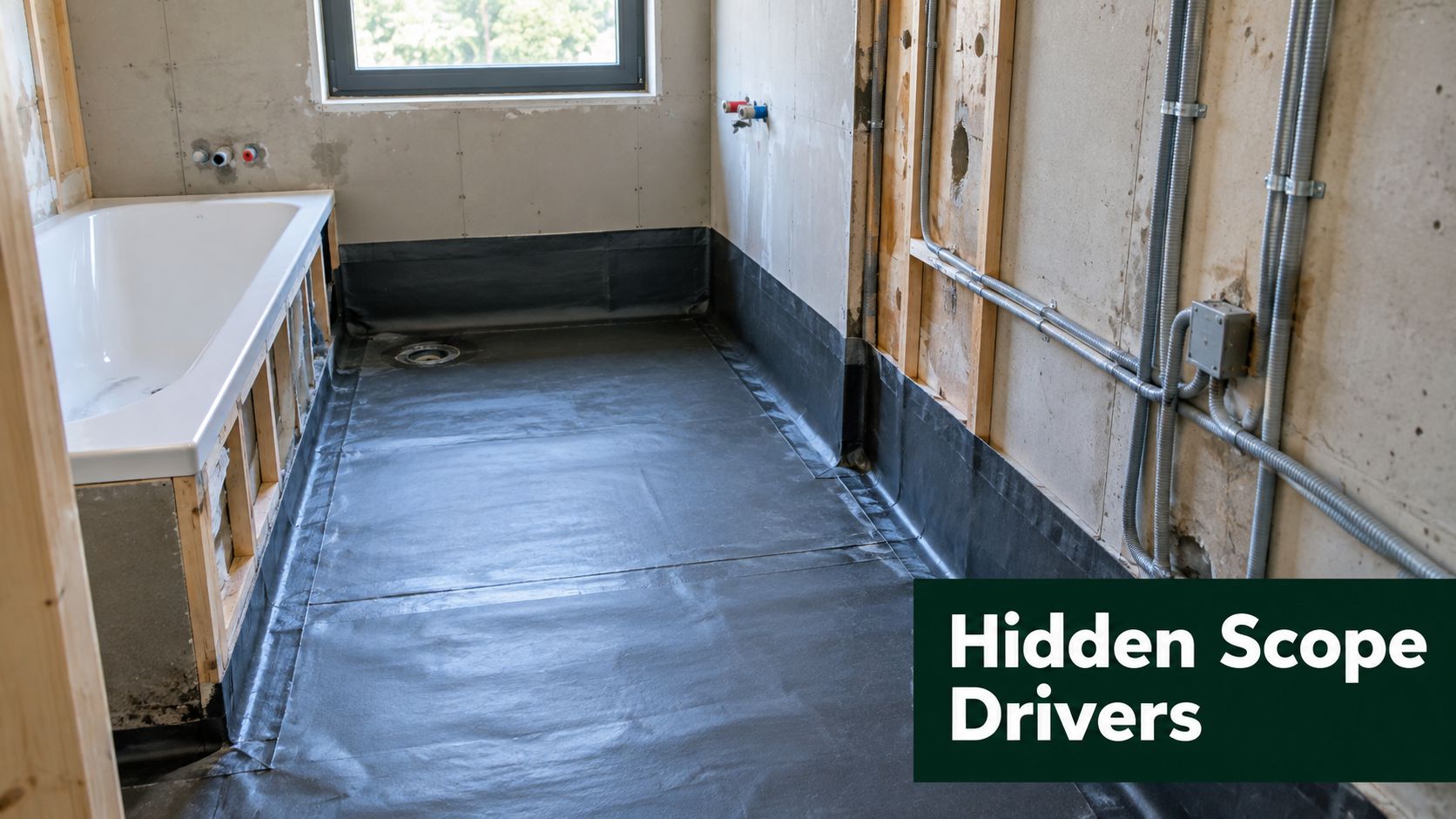
The first budgeting mistake is thinking visually. Homeowners often focus on tiles, tapware, and vanity style because those items are easy to picture. The larger financial impact often sits behind the walls, especially when plumbing changes, waterproofing requirements, electrical work, and custom cabinetry are part of the job.

The main cost drivers

Some projects stay relatively controlled because the layout remains close to the original. Others rise quickly because the room is being significantly reworked.

The usual pressure points are:

  • Service relocation
    Moving plumbing or electrical positions can add complexity, especially in a tight footprint.

  • Joinery level
    Off-the-shelf solutions and fully custom cabinetry don't land in the same budget range.

  • Tile scope and installation complexity
    Large-format tiles, full-height wall tiling, niches, and detailed set-outs take more labour planning.

  • Room condition
    Older rooms sometimes reveal substrate or framing issues once demolition begins.

  • Fixture and finish selection
    The look of designer bathrooms often comes from layered choices, not one feature item.

Where it's smart to spend

Not every line item deserves equal priority. Some elements should never be value-engineered too aggressively.

Spend to protect the structure first. Waterproofing, proper preparation, and compliant trade work matter more than prestige finishes.

A practical priority order looks like this:

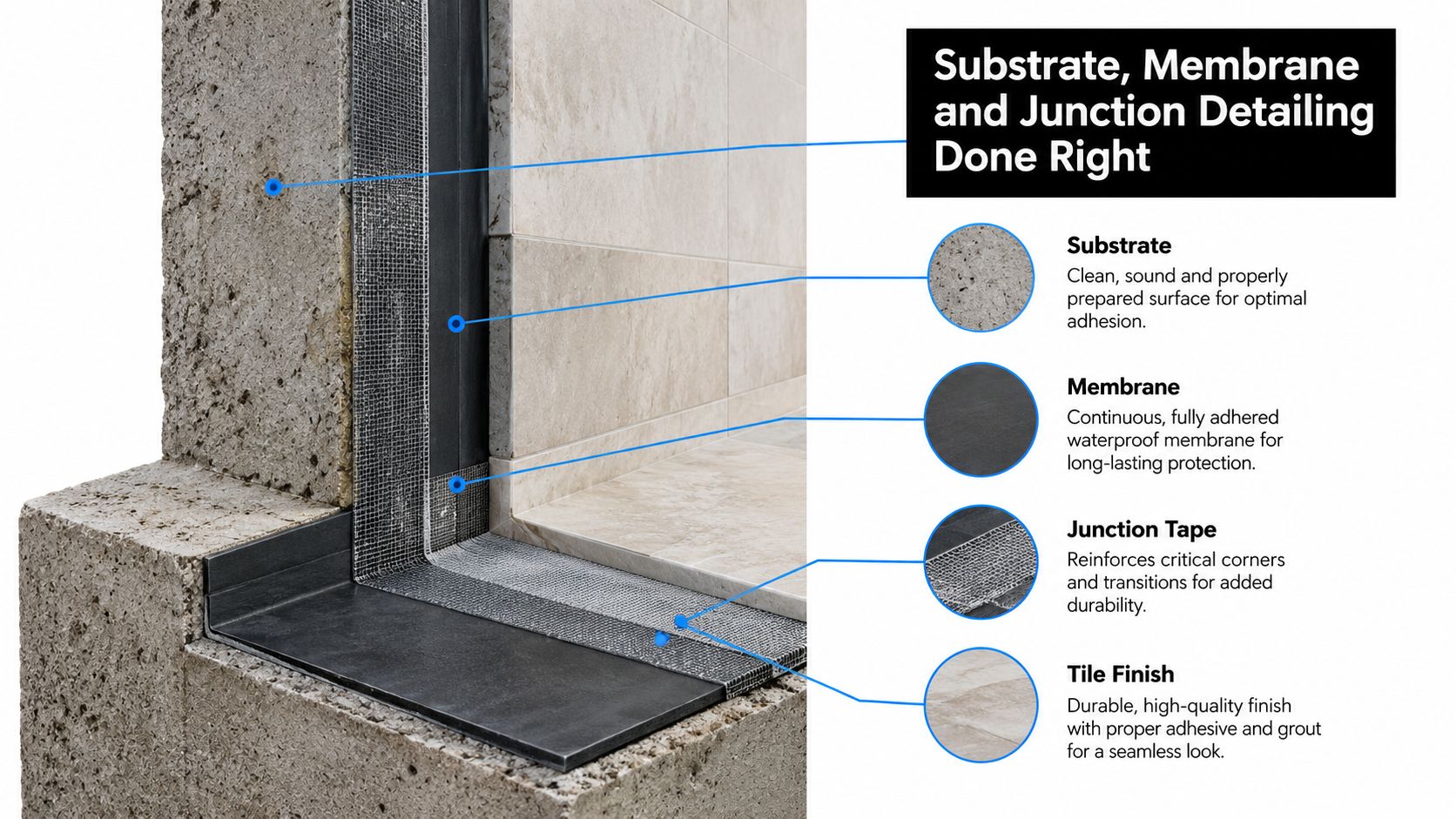
  1. Waterproofing and substrate preparation
  2. Plumbing and electrical done properly
  3. Layout and joinery that improve function
  4. Durable fixtures used every day
  5. Decorative upgrades after the core build is resolved

Sample Budget Allocation for a Mid-Range Bathroom & Laundry Renovation

Because every home differs, percentages are more useful than pretending one fixed figure suits all projects.

Expense Category Estimated Percentage of Total Budget
Demolition and site preparation 5 to 10
Plumbing and electrical works 15 to 25
Waterproofing and preparation 10 to 15
Tiling and installation labour 20 to 30
Fixtures, fittings, and appliances 15 to 25
Joinery, storage, and finishing items 10 to 20

These ranges aren't a quote. They're a planning tool that helps homeowners see where the budget typically gets distributed in a combined wet-area project.

How to compare quotes properly

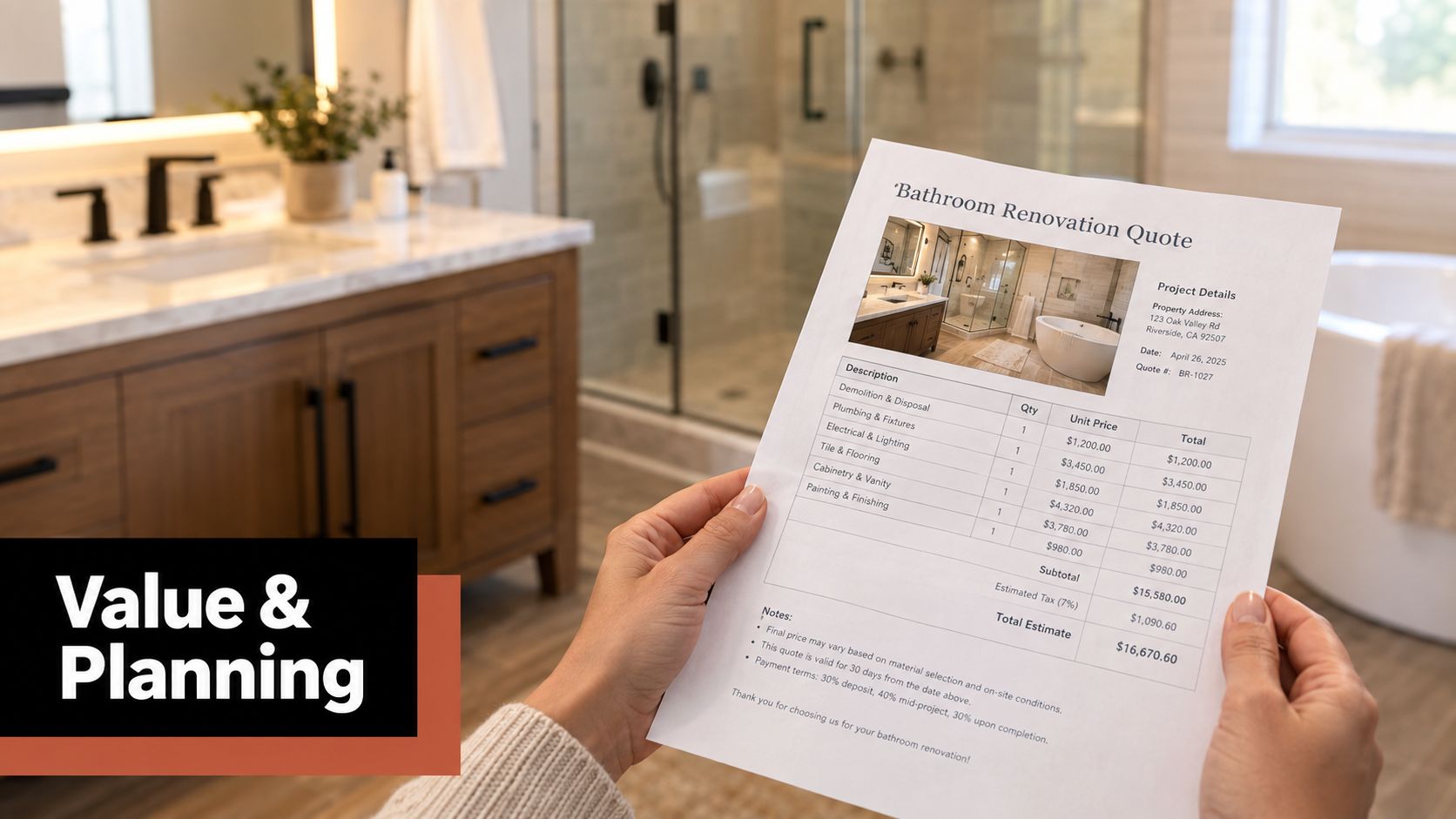
A cheaper quote isn't always better value. The important question is whether you're comparing the same scope.

Check for:

  • Demolition clarity so existing removal is properly defined
  • Service work detail including plumbing and electrical allowances
  • Waterproofing inclusion rather than vague wording
  • Tile labour assumptions especially if patterns, niches, or full-height walls are involved
  • Joinery detail so storage scope isn't left open-ended
  • Fit-off and final finishing including who installs what

If you're trying to sense-check your likely spend before getting formal pricing, a bathroom renovation cost calculator can help you frame the conversation with more confidence.

What causes financial surprises

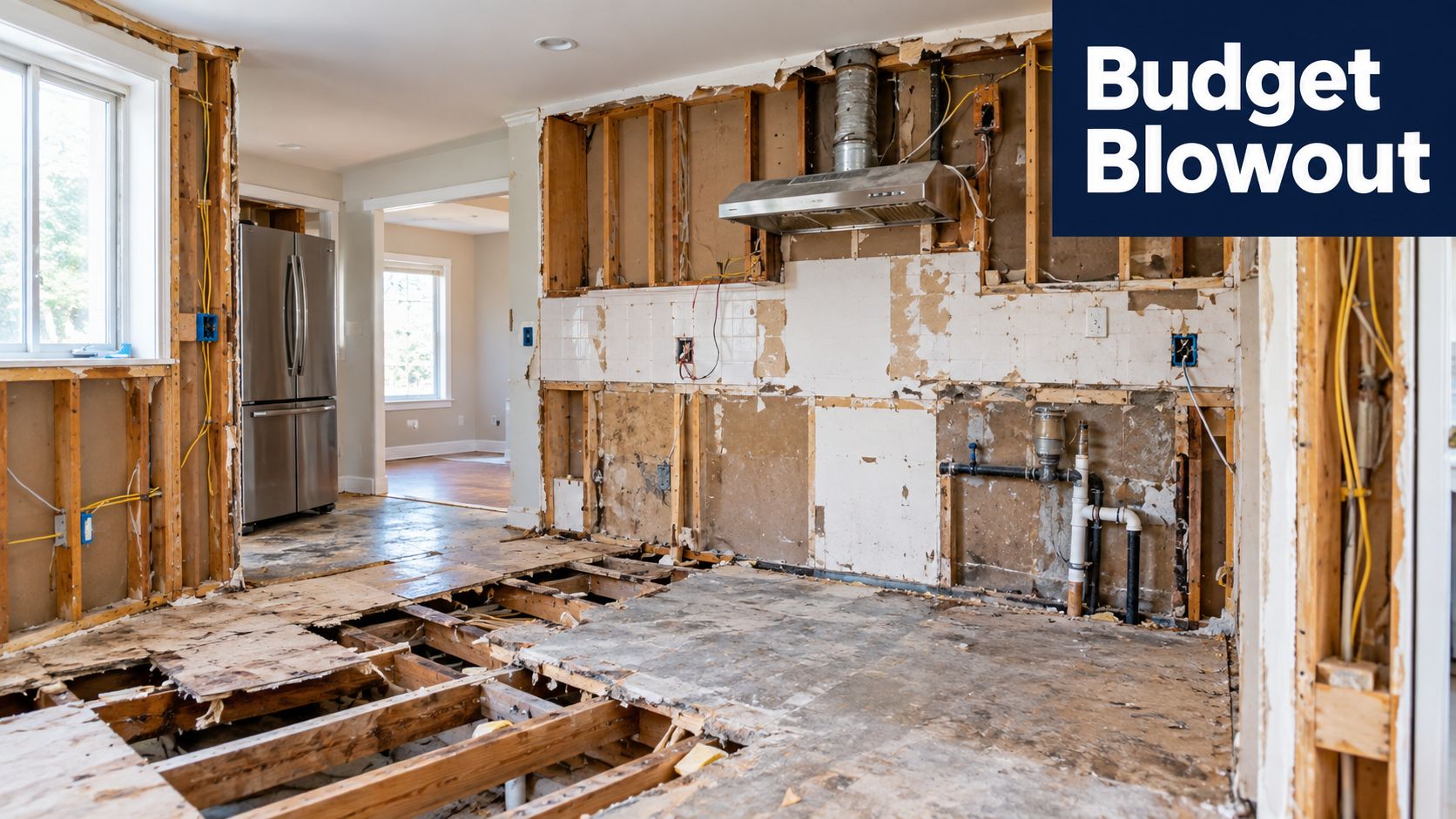
Most budget blowouts come from one of three things. The scope wasn't properly defined. Selections were made too late. Existing conditions were assumed rather than checked.

That's why experienced project planning matters so much. A room that combines bathroom and laundry functions has more moving parts than a cosmetic update. If the decisions are made early and documented clearly, the budget becomes far more manageable.

Navigating the Build from Demolition to Handover

For many Highett homeowners, the hard part starts once the drawings are approved and the room is out of action. A combined bathroom and laundry renovation affects daily routines fast. Showers, washing, storage, and access all tighten up at once, especially in older Victorian homes where space is already working hard.

That is why the build phase needs clear sequencing, realistic timing, and close supervision on site. In this kind of renovation, small mistakes early can create expensive rework later. A waste in the wrong spot, a wall out of square, or late tile changes can hold up several trades and make living through the job far harder than it needs to be.

Navigating the Build from Demolition to Handover

The correct build sequence

A well-run project follows a set order because each stage relies on the last one being finished properly.

  1. Final selections and confirmed scope
    Layout, fixtures, tiles, cabinetry, appliances, and measurements need to be signed off before site work begins. This matters even more in combined rooms, where a 20mm change can affect appliance clearance, vanity depth, or circulation space.

  2. Demolition
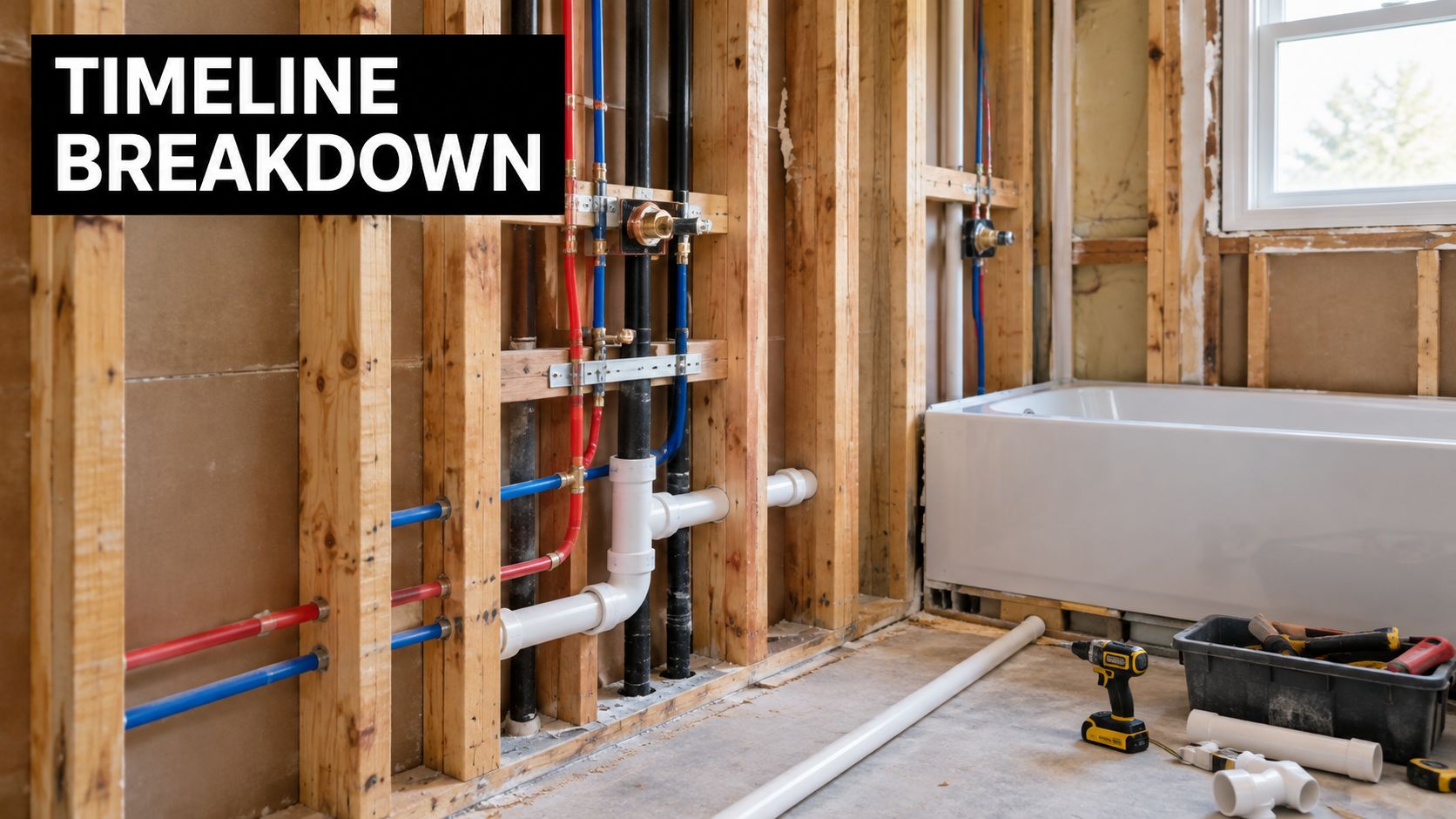
    Existing fixtures, wall linings, floor finishes, and redundant services are removed. In many Melbourne homes, this is also the point where hidden issues show up, such as water damage, uneven framing, or outdated plumbing that was never visible during planning.

  3. Rough-in plumbing and electrical
    Services are relocated and set to the approved plan. If the design includes moving the laundry zone, changing drainage falls, or adding extra power for appliances and heated rails, during this stage, those decisions either prove viable on site or necessitate adjustment.

  4. Waterproofing
    Wet areas are prepared and waterproofed to the required standard. For a bathroom-laundry combination, this stage needs careful attention because water exposure is coming from more than one source.

  5. Tiling and surface installation
    Set-out is checked before tiles go down. Good set-out avoids awkward cuts, keeps floor wastes where they should be, and makes the room look balanced rather than patched together.

  6. Fit-off
    Cabinetry, benchtops, screens, tapware, sanitary fixtures, mirrors, accessories, and appliances are installed. This is where early planning pays off. If measurements were checked properly, everything fits. If they were guessed, problems usually appear here.

  7. Final quality checks and handover
    The room is cleaned, tested, inspected, and prepared for use. We look at function as well as finish. Doors need to clear properly, drawers need to open past appliances, falls need to drain, and every fixture needs to do its job without compromise.

What often slows a combined renovation

Bathroom-only advice often misses this point. A combined renovation has more interfaces between trades, and that means more chances for delays if the job is not tightly managed.

The usual causes are practical. Appliances arrive late. Joinery is fabricated before final site measure. A tile selection changes after waterproofing details are set. In older brick veneer and weatherboard homes around Highett, we also regularly see walls and floors that are not straight enough for off-the-shelf assumptions. That does not stop the job, but it does mean the builder needs to pick up issues early and adjust before they affect the next trade.

Living through the renovation is part of the planning too. Some households can stay in the home if there is another toilet or shower available. Others are better off arranging temporary alternatives for part of the build. Speed and convenience do not always align. A faster program can mean fuller site access and less flexibility day to day. A staged approach can make family life easier, but it usually stretches the timeline.

If you want a clearer sense of what the construction program typically looks like, this guide on how long a bathroom remodel should take gives a practical breakdown.

Why oversight matters in Victoria

In Victoria, a combined wet-area renovation is more than a cosmetic update. It can involve waterproofing compliance, plumbing changes, electrical work, ventilation, and sometimes structural alteration if the layout is being improved.

Good oversight keeps those moving parts coordinated. It also protects the finish. I have seen projects where the design was fine, but the execution slipped because one trade worked from an old plan, selections were still changing mid-build, or defects were left for the next person to solve. That is how budgets drift and deadlines move.

The calmer projects are the ones where decisions are locked in early, site conditions are checked properly, and someone is responsible for the whole sequence from demolition to handover.

Your Renovation Questions Answered

A combined bathroom and laundry renovation in Highett usually raises the same practical questions once the dust starts. The better time to answer them is before the room is stripped out, while the layout, schedule, and day-to-day living plan can still be adjusted without cost blowouts.

Can we stay in the house during the renovation

Often, yes, if the house can still function.

A primary concern is access to basics. If this room includes your main shower, toilet, or laundry setup, you need a plan for every day of the build, not just the demolition week. In many Victorian homes, especially older brick veneer and weatherboard layouts, there is limited spare wet-area capacity. That makes staging attractive, but staging also extends the program and can increase labour time.

Before work starts, sort out:

  • Whether another toilet and shower are available
  • Whether a temporary laundry setup can work elsewhere
  • How children, shift workers, or older family members will manage access
  • Whether a shorter, more intensive build suits you better than a longer staged one

I usually tell clients to decide this early. Families cope better when they choose their trade-off upfront, rather than trying to change the construction sequence mid-build.

Why does 3D design matter so much

Because combined rooms punish guesswork.

A plan that looks fine on paper can still fail in use. Washing machine door swings, vanity depth, circulation space, towel access, and where you stand to sort clothes all matter more in a dual-purpose room. In many Victorian homes, the room is narrow, the walls are not perfectly square, and existing services limit where fixtures can move. That is why detailed design work before demolition saves money later.

Good 3D design helps test the room properly. You can see whether the layout feels cramped, whether storage is in the right spot, and whether the bathroom still reads as a bathroom rather than a laundry with a shower pushed into it.

How is dust and disruption managed

Occupied-home renovations are disruptive. Good site management keeps that disruption controlled.

The basics matter most:

  • Floor and access protection to adjacent rooms
  • Dust control during demolition and cutting
  • A clear plan for rubbish removal
  • Notice before water or power shut-downs
  • Trade timing that avoids long idle gaps

Homeowners do not need perfection. They need order, clear communication, and a site that is being managed properly from day to day.

Why work with a Registered Builder Unlimited

For a more involved wet-area renovation, proper oversight matters because several parts of the job are tied together. Plumbing rough-in affects cabinetry. Electrical locations affect mirror and storage choices. Waterproofing has to suit the final set-out, not a rough sketch that changed on site.

In Victoria, that coordination also matters for compliance and accountability. If the room is being reworked, as distinct from a tiling update within the existing footprint, you want one party responsible for the sequence, the trades, and the final result.

What should you do next

Start with the problems the room needs to solve. That usually means storage, circulation, drying space, appliance placement, and whether the room can support family life during the week without feeling cramped.

Then test the layout before anyone starts demolition. That is where smart decisions get made in a combined renovation.

If you want practical guidance specific to your Highett home, SitePro Bathrooms can help you shape the brief, refine the layout, and map out a buildable plan before construction begins.

  • siteprobathrooms

How to Remodel a Kitchen: Expert Guide

If you're staring at an ageing kitchen in Highett and wondering where to start, you're not alone. Most homeowners don't get stuck on tiles or tapware first. They get stuck on the bigger questions. How much should this cost, what needs approval, how long will the house be disrupted, and what mistakes turn a straightforward upgrade into an expensive mess?

That's the main effort in learning how to remodel a kitchen. It isn't choosing pretty finishes in isolation. It's getting the scope right, locking the design before demolition, understanding Victorian compliance, and building the room in the right order so the result works every day.

In this part of Melbourne, that local detail matters. Trades are often booked ahead, older homes can hide service issues, and changes made mid-build usually cost more than people expect. The best kitchen renovations don't start with demolition. They start with decisions.

Planning Your Perfect Kitchen Goals and Budget

The first question isn't what colour cabinets you want. It's why you're renovating.

A kitchen built for resale looks different from one built for a family of five. An investor usually wants durability, easy cleaning, strong storage and a layout that appeals broadly. A homeowner planning to stay put may care more about workflow, entertaining, appliance integration and the feel of the room at night. If you want a designer finish, that choice needs to be visible in the budget from day one.

Start with the job the kitchen needs to do

Most kitchen projects fall into one of three categories:

  • Cosmetic update. Keep the layout, improve surfaces, and freshen the space without moving major services.
  • Functional reconfiguration. Adjust storage, improve circulation, replace cabinetry and appliances, and make the room work better.
  • Full strip-out. Rebuild the kitchen with service changes, structural considerations, and a new layout.

That distinction matters because scope drives cost more than style does. A simple-looking kitchen can become expensive fast if the sink moves, extra power is added, or walls need changing.

Practical rule: If the renovation changes plumbing or wiring, treat it as a coordinated building project, not a surface makeover.

National Australian trade guidance places kitchen renovations in broad cost bands. A basic refresh often sits around AUD $10,000 to $20,000, a mid-range renovation around AUD $20,000 to $45,000, and a high-end transformation commonly exceeds AUD $50,000, according to Australian kitchen renovation cost guidance.

What those budget bands usually mean

A basic refresh generally suits owners keeping the footprint similar. Think new cabinetry fronts or replacement cabinetry in the same general layout, updated benchtops, splashback changes, and selected appliance swaps.

A mid-range renovation is where many Highett homeowners land. This is usually enough for a proper layout improvement, better storage, stronger finishes, and a cleaner result overall.

A high-end kitchen usually means more joinery detail, premium surfaces, custom storage, integrated appliances, and often some level of service relocation or opening the space to adjoining living zones.

For a more detailed local breakdown, see this guide to the cost of a new kitchen.

Budget for what you don't see straight away

The expensive decisions are rarely the decorative ones. Budget pressure usually comes from:

  • Service changes. Moving plumbing, waste, gas or electrical points.
  • Joinery complexity. Corner solutions, appliance housing, overheads to bulkheads, and custom pantry storage.
  • Site conditions. Uneven walls, damaged subfloors, hidden water issues, or dated wiring in older homes.
  • Late changes. A new appliance size after cabinetry is ordered can ripple through the whole job.

That's why realistic budgeting starts with measured drawings and a locked scope, not showroom browsing.

Sample Kitchen Renovation Cost Breakdown in Victoria (2026)

Expense Category Percentage of Budget Example Cost
Cabinetry and joinery 35% $14,000 on a $40,000 renovation
Benchtops 15% $6,000 on a $40,000 renovation
Appliances 15% $6,000 on a $40,000 renovation
Plumbing and electrical labour 15% $6,000 on a $40,000 renovation
Splashback, flooring, painting and finishes 10% $4,000 on a $40,000 renovation
Project management and contingencies 10% $4,000 on a $40,000 renovation

That table is a sample allocation, not a fixed pricing rule. In practice, one project will spend more on joinery, another on appliances, another on service changes. The point is to build the budget around priorities instead of hoping everything fits.

Where homeowners usually get it right

The smoothest projects start with a short written brief. It doesn't need to be fancy. It just needs to answer a few things clearly:

  1. Who uses the kitchen every day
  2. What isn't working now
  3. What must stay
  4. What must change
  5. What the spending ceiling is

That brief becomes the filter for every later decision. If your goal is family function, spending heavily on decorative extras while leaving poor storage unresolved doesn't make sense. If resale is the goal, broad appeal and durable finishes usually beat highly specific design moves.

A good kitchen budget isn't just a number. It's a decision-making tool. If that's solid, the rest of the project gets far easier.

Designing Your Space and Navigating Victorian Permits

A kitchen design only works when it solves movement, storage and service locations at the same time. Plenty of layouts look good on paper and fail the moment someone opens the dishwasher door, tries to carry groceries in, or realises the pantry blocks circulation.

That's why detailed design needs to happen before anyone lifts a hammer.

Detailed architectural kitchen floor plan blueprints with dimensions displayed on a wooden table with a pencil.

Build the layout around work zones

Forget chasing trends first. Start with the way the room is used.

A practical kitchen in Victoria should account for prep space, cooking access, cleaning space, storage reach, appliance swing, and clear walking paths. In older Highett homes, kitchens often need more attention to storage and circulation than people expect. A room can have enough square metres and still feel awkward because the joinery isn't planned around actual use.

Key design checks include:

  • Prep near the sink so food can move from washing to chopping without crossing the room.
  • Cooktop clearance so handles, heat and movement don't clash with walkways.
  • Pantry placement where groceries can be put away quickly.
  • Bin storage close to prep, not across the kitchen.
  • Lighting layers that cover task areas, not just the centre of the ceiling.

If you're refining shape and circulation, this overview of an L-shaped kitchen layout is a useful starting point.

Good design removes friction. You notice it in the first week of use, not just in the photos after handover.

Use drawings to prevent expensive assumptions

A proper design package should show more than cabinet faces. It should confirm dimensions, appliance locations, service points, clearances, and how the room ties into adjoining floors, walls and openings.

This is also where 3D design earns its keep. It lets you test the island size, check whether overheads feel too heavy, and see if the walkway beside the fridge will feel cramped. That's far cheaper than discovering the problem once cabinetry is on site.

In practical terms, a locked design should answer these questions before demolition:

  • Where exactly do power points go?
  • Are appliances integrated, freestanding, or semi-integrated?
  • Does the flooring run under cabinetry or stop at the kitchen line?
  • Will the splashback finish affect power point placement?
  • Are there bulkheads, beams, or ceiling inconsistencies to resolve?

Permits and compliance in Victoria

This is the part generic renovation guides often skip, and it's where budgets can unravel.

In Victoria, kitchen work can require licensed trades and may need building approval depending on the scope, especially when structural changes, plumbing, or electrical modifications are involved, as noted in Victorian kitchen renovation guidance. That matters in Highett because many homes involve some mix of older services, altered floor plans, and renovation layering from previous owners.

The practical takeaway is simple. If your kitchen project involves any of the following, pause and confirm compliance requirements early:

  • Structural work such as removing or altering walls
  • Plumbing changes involving sink moves or new appliance connections
  • Electrical changes such as added circuits, relocated power, or new lighting layouts
  • Ventilation upgrades where the exhaust path changes
  • Building fabric changes that affect surrounding works

A cheap quote that ignores compliance isn't cheap. It's incomplete.

What works in Highett homes

The best kitchen plans in this area usually respect the house rather than fighting it. In weatherboard homes, space planning often needs careful thought around wall alignment and hidden services. In brick homes and unit renovations, access, body corporate requirements and service limitations often affect what's practical.

That's why the design phase should produce two things. A kitchen that looks right, and a scope that can be built under Victorian requirements. If either one is missing, the job isn't ready.

Choosing Your Team Materials and Appliances

People often spend more time choosing splashbacks than choosing who will run the project. That's backwards. A strong team protects the build, the program, the compliance side, and the finish quality. Materials and appliances matter, but they only perform as well as the planning and installation behind them.

Choose the builder before you fall in love with finishes

For kitchen renovations that involve broader building scope, many owners want the protection of working with registered builders unlimited. In Victoria, that matters because project complexity can move quickly from cosmetic to structural. Once walls, services and approvals enter the picture, you want a builder who understands the whole chain, not just the cabinet line.

Ask direct questions when reviewing builders:

  • What's included in the quote. Is demolition included, rubbish removal included, disconnect and reconnect included?
  • Who coordinates licensed trades. You don't want finger-pointing between trades mid-job.
  • How are variations handled. Changes happen, but they should be documented clearly.
  • What information is needed before ordering joinery. This tells you how disciplined the process is.
  • Who is responsible for sequencing and site supervision. Kitchens fail when no one owns the critical path.

A polished estimate isn't enough. Look for scope clarity. If one quote seems much lower, check whether it has left things out.

Durable beats fashionable in the long run

Australian housing data consistently shows kitchens are one of the most important rooms for buyer appeal, and renovation decisions should prioritise layout efficiency, ventilation, and durable finishes handled by licensed trades for maximum value, according to Australian kitchen buyer-appeal guidance.

That's why material selection should start with wear, maintenance and fit for purpose.

A flat lay of interior design samples including wood veneer, stone countertop, white cabinet door, and handle.

For a deeper look at finish options, browse these kitchen cabinets materials.

What works well and what tends to disappoint

A practical way to assess materials is to ask what daily life will do to them.

Benchtops
Laminate can work well in tighter budgets and rental properties when the goal is durability and easy replacement. Engineered stone style surfaces are often chosen for consistency and low upkeep. Natural stone gives strong visual character but needs an owner who accepts variation and maintenance.

Cabinet finishes
Two-pack painted finishes can look sharp, especially in cleaner modern kitchens, but they need careful handling to stay pristine. Laminates and melamine-based options often perform better where impact resistance matters. Timber-look finishes can soften a modern kitchen and work particularly well in homes that also feature warm, modern bathrooms.

Splashbacks
Large-format splashbacks reduce grout lines and can make cleaning easier. Tiled splashbacks can add texture and detail, but they need to be chosen with restraint if the rest of the room is already busy.

On site, the best material choice is usually the one that still looks good after years of heat, steam, cleaning, and family traffic.

Appliances should match the way you live

Appliance mistakes are common because buyers focus on brands and forget the plan. The better approach is to decide what the kitchen needs to support.

Consider:

  • Cooking habits. A serious home cook needs stronger prep zones and ventilation planning than someone who mainly reheats and assembles.
  • Household size. Fridge volume and dishwasher capacity should match actual use.
  • Cleaning tolerance. Some finishes and appliance types show fingerprints and grime faster than others.
  • Energy use and practicality. Efficient, straightforward appliances often make more sense than feature-heavy models that don't get used.

The lessons from bathroom renovations carry across neatly. Whether you're planning kitchens, new bathroom ideas, modern bathrooms, or more detailed designer bathrooms, the same principle holds. Buy once for function first, then layer in style. The room will age better.

The Construction Timeline From Demolition to Completion

Once the design is signed off and selections are locked, the project becomes a sequencing exercise. Good kitchen renovations don't move forward because demolition starts fast. They move forward because each trade arrives to a site that's ready for them.

A standard kitchen remodel is often 6 to 12 weeks once construction starts, but planning, approvals and ordering can add several more weeks before that, according to kitchen remodel timeline guidance. The same guidance also warns against starting demolition before all material and design choices are finalised.

What happens first and why it matters

Demolition feels like progress, but it's only safe progress if the pre-construction work is complete. Before demo begins, the joinery should be approved, appliance sizes confirmed, service locations finalised, and key materials ordered.

If those decisions are still floating, the build usually stalls in one of three places. Rough-in changes, delayed cabinetry, or benchtop hold-ups.

The usual site sequence

Most kitchen builds follow a logical chain. The exact details vary by house, but the order matters.

  1. Site protection and demolition
    Existing cabinets, splashbacks, appliances and affected finishes are removed. Waste is cleared and hidden conditions are assessed.

  2. Preparation and rough-in
    Plumbers and electricians complete the service changes. If walls are being altered, this stage also deals with framing and related building work.

  3. Subfloor and surface readiness
    Floors and walls need to be true enough for joinery and finishes. Shortcuts taken will later manifest as crooked lines and awkward gaps.

  4. Flooring where required
    Depending on the design, flooring may go in before or after cabinetry. What matters is that the sequence matches the documented plan.

  5. Cabinet installation
    Base cabinets, tall units, wall cabinets and panels are set in place and aligned.

  6. Template and benchtops
    Once cabinets are fixed, benchtops are measured and then installed.

  7. Splashback, painting and fit-off
    Final finishes go on, appliances are installed, plumbing fixtures are connected, electrical fittings are completed, and defects are checked.

Living through the renovation

Homeowners often underestimate the temporary disruption. Even a well-run project changes your daily routine. You may need a temporary food prep area, a separate kettle and microwave setup, and a plan for meals when water or power is interrupted.

In occupied homes around Highett, the smoother projects usually have a site access plan from the start. That includes delivery timing, rubbish removal, parking for trades, and a clear decision on whether the family is staying in the house the whole time.

Set up a temporary kitchenette before demolition day. It sounds simple, but it makes the first two weeks much easier.

Where delays usually begin

Most delays don't come from one dramatic failure. They come from small decisions left unresolved too long.

Common examples include:

  • Appliances ordered after cabinet drawings are approved
  • Tiles selected after power point positions are already set
  • Late changes to island size
  • Stone selections made after cabinetry is installed
  • Unclear responsibility for trade coordination

If you want to know how to remodel a kitchen without turning the process into a rolling variation list, the answer is discipline before demo. Once the room is stripped out, every undecided item gets more expensive.

Inspiring Kitchen Transformations in Victoria

The most useful renovation examples aren't fantasy projects. They're ordinary Victorian homes with ordinary constraints. Tight footprints, dated layouts, awkward service locations, and clients trying to balance style with practical use.

Those are the projects that show what a kitchen renovation can really achieve.

A sophisticated white and navy blue kitchen featuring a large marble island with bar stool seating.

A family kitchen opened up for daily life

One common Highett scenario is the older family home where the kitchen feels cut off from the living area. The room itself may not be tiny, but the wall placement makes it feel separated and cramped.

In that kind of project, the problem usually isn't just dated finishes. It's poor flow. Parents cook facing a wall, kids crowd narrow walkways, and storage ends up scattered across adjoining rooms.

The solution is often less about adding luxury and more about reorganising function. A better island position, stronger pantry joinery, and a layout that opens sightlines into the living space can change the way the whole home works. Once the kitchen becomes part of the social zone, lighting, appliance placement and circulation all need to support that broader use.

The result is a room that handles weekday traffic better and feels more natural for entertaining. That's a stronger upgrade than surface-level styling alone.

A compact kitchen made to feel larger

At the other end of the market is the apartment or unit kitchen with very little margin for error. In smaller homes, one oversized appliance, one badly placed pantry, or one heavy run of overheads can make the room feel boxed in.

These projects reward restraint.

A successful compact kitchen usually relies on cleaner lines, careful storage planning, and finishes that reflect light without becoming sterile. Tall cabinetry can add serious utility, but only when balanced against visual weight. Integrated bins, considered drawer storage, and a splashback with minimal visual clutter often do more for the room than flashy details.

There's also a strong crossover here with bathroom design thinking. The same choices that lift compact ensuites often lift small kitchens too. Consistent tones, low-maintenance surfaces, neat junctions, and hardware that doesn't dominate the eye. That's why clients looking at kitchen work are often also thinking about bathroom renovations. The aim in both spaces is similar. Better function, a more refined feel, and fewer compromises in everyday use.

What these projects have in common

Different homes, different budgets, same core pattern.

  • The old problem was functional first. Bad storage, poor movement, weak layout.
  • The best fix came from planning, not decoration. Once the plan improved, the room looked better as a by-product.
  • The final result felt calmer. Better kitchens aren't just prettier. They reduce daily friction.

That's also why “before and after” photos can be misleading without context. The dramatic change usually didn't come from one hero feature. It came from dozens of decisions made properly in sequence.

The kitchens people remember most aren't always the biggest. They're the ones that feel easy to use from the first morning.

Common Kitchen Remodel Questions Answered

The questions below come up on almost every project, especially with homeowners trying to balance family life, budget, and compliance.

How long should I spend planning before work starts

Kitchen remodeling timelines often exceed initial expectations. A 2020 Houzz & Home study found the average kitchen remodeling project involved 8.3 months of planning time and 4.5 months of actual construction time, which underlines how important the pre-construction phase is, according to BLANCO's summary of the Houzz & Home study.

That doesn't mean every Highett kitchen will take exactly that long. It does mean rushed planning usually creates slower building.

Can I live at home during the renovation

Usually, yes, but it depends on your tolerance for disruption and the project scope. If the kitchen is your main food prep area, set up a temporary station elsewhere before demolition starts. If the work involves broader structural change or multiple wet areas at once, staying elsewhere may be more practical.

Is it cheaper to keep the existing layout

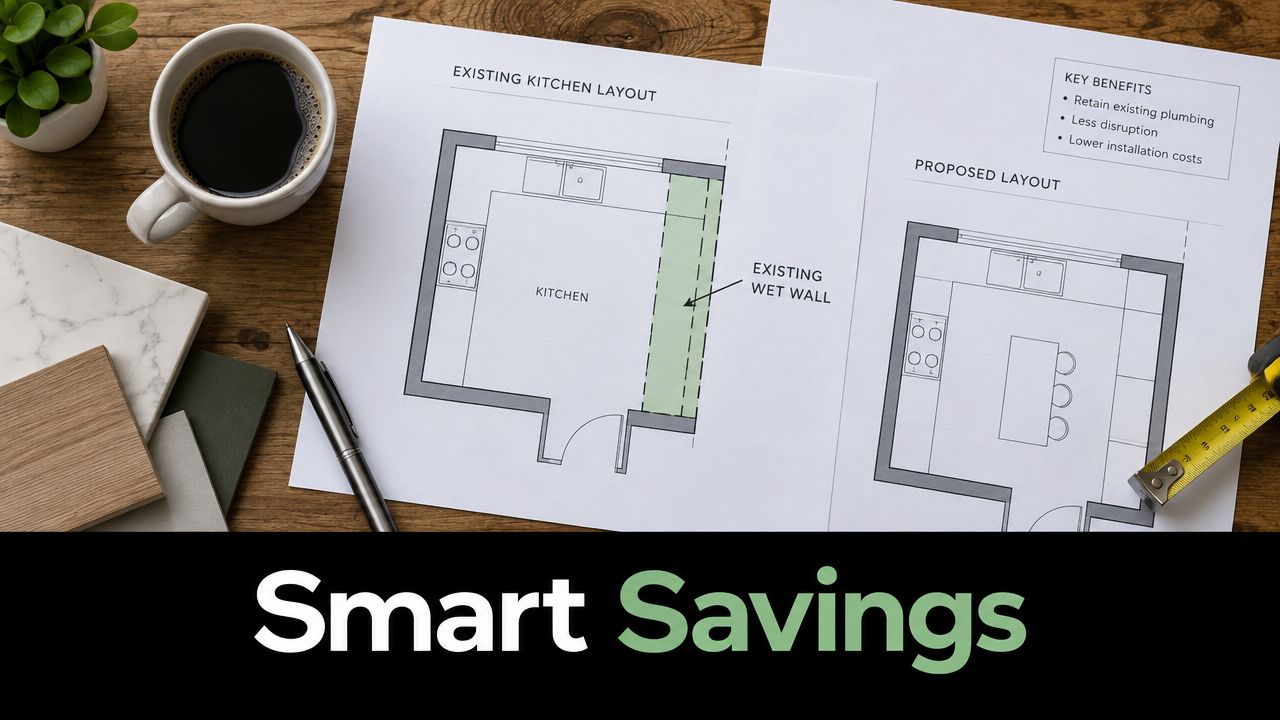
Often, yes. Keeping the sink, cooktop and major appliances in similar locations can reduce service work. But a cheap layout that stays awkward can be poor value if the kitchen still doesn't function properly at the end.

What causes the biggest budget surprises

The most common problems are hidden services, late design changes, and scope that looked cosmetic at first but turns into compliance-heavy work once walls open up. That's why proper investigation and a locked design matter so much.

Should my kitchen match my bathrooms

They don't need to match exactly, but they should feel related. Repeated tones, similar hardware language, and a shared approach to materials help the home feel more resolved. If you're planning both a kitchen and bathroom renovations, it's smart to consider them together so one space doesn't date the other.

Are high-end finishes always worth it

Not always. In many homes, practical layout improvements, durable cabinetry and better ventilation outperform expensive decorative upgrades. Premium finishes can be worth it, but only after the essentials are right.

What's the best first step if I'm serious about renovating

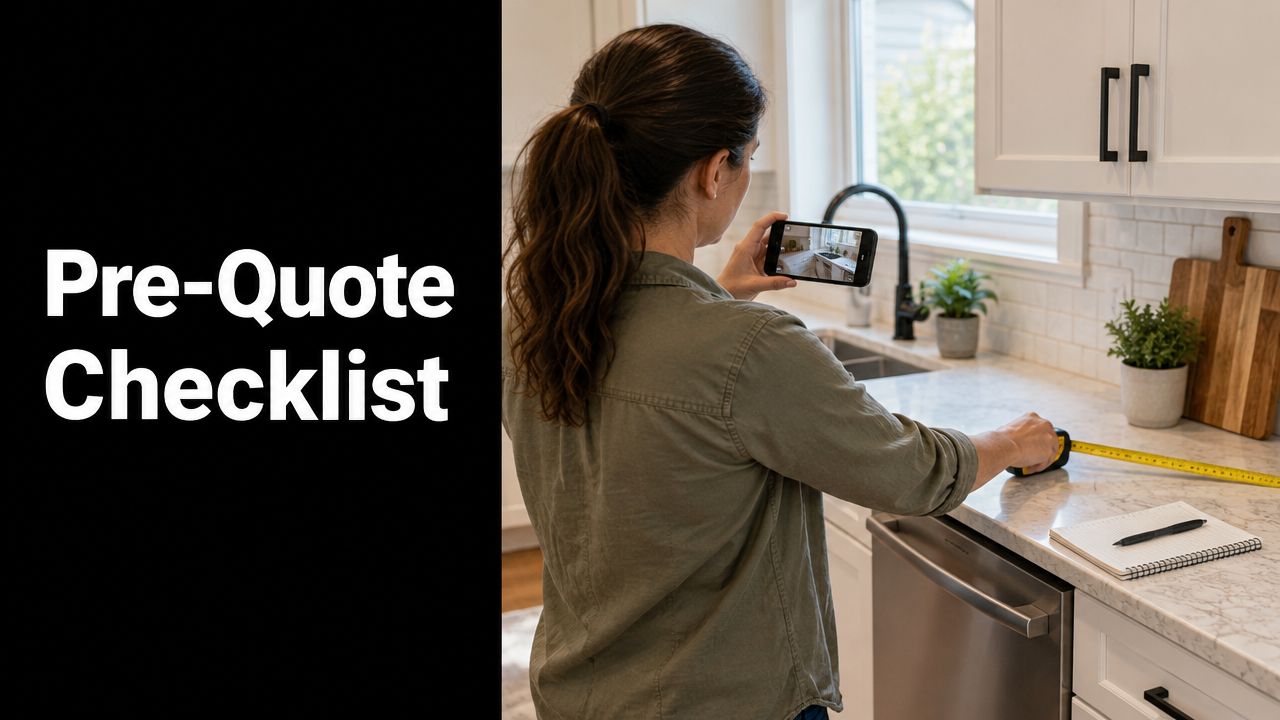
Get the existing kitchen measured properly and write a brief that states your priorities clearly. Include what isn't working, what you want to improve, and where you won't compromise. That gives the design and quoting process something solid to respond to.


If you're planning how to remodel a kitchen in Highett or greater Victoria, the smartest move is to begin with measured advice, not guesses. SitePro Bathrooms helps homeowners plan and deliver kitchens and bathroom renovations with clear design, coordinated construction, and local renovation experience managing the job from concept to handover.

  • siteprobathrooms

Bathroom Renovation Cost Melbourne: 2026 Price Guide

A standard full bathroom renovation in Melbourne typically lands between $20,000 and $40,000. Cosmetic updates can come in under $20,000, while premium projects regularly push past $40,000 once layout changes, higher-end finishes, and custom work enter the scope.

That's usually the point where homeowners get stuck. The ideas are clear enough. You want a bathroom that feels cleaner, works better, and doesn't date the property. What's harder is working out why one quote sits near the lower end and another climbs fast. In Melbourne, the gap usually comes down to scope control, material choices, and whether you're renovating for daily living, rental return, or long-term resale.

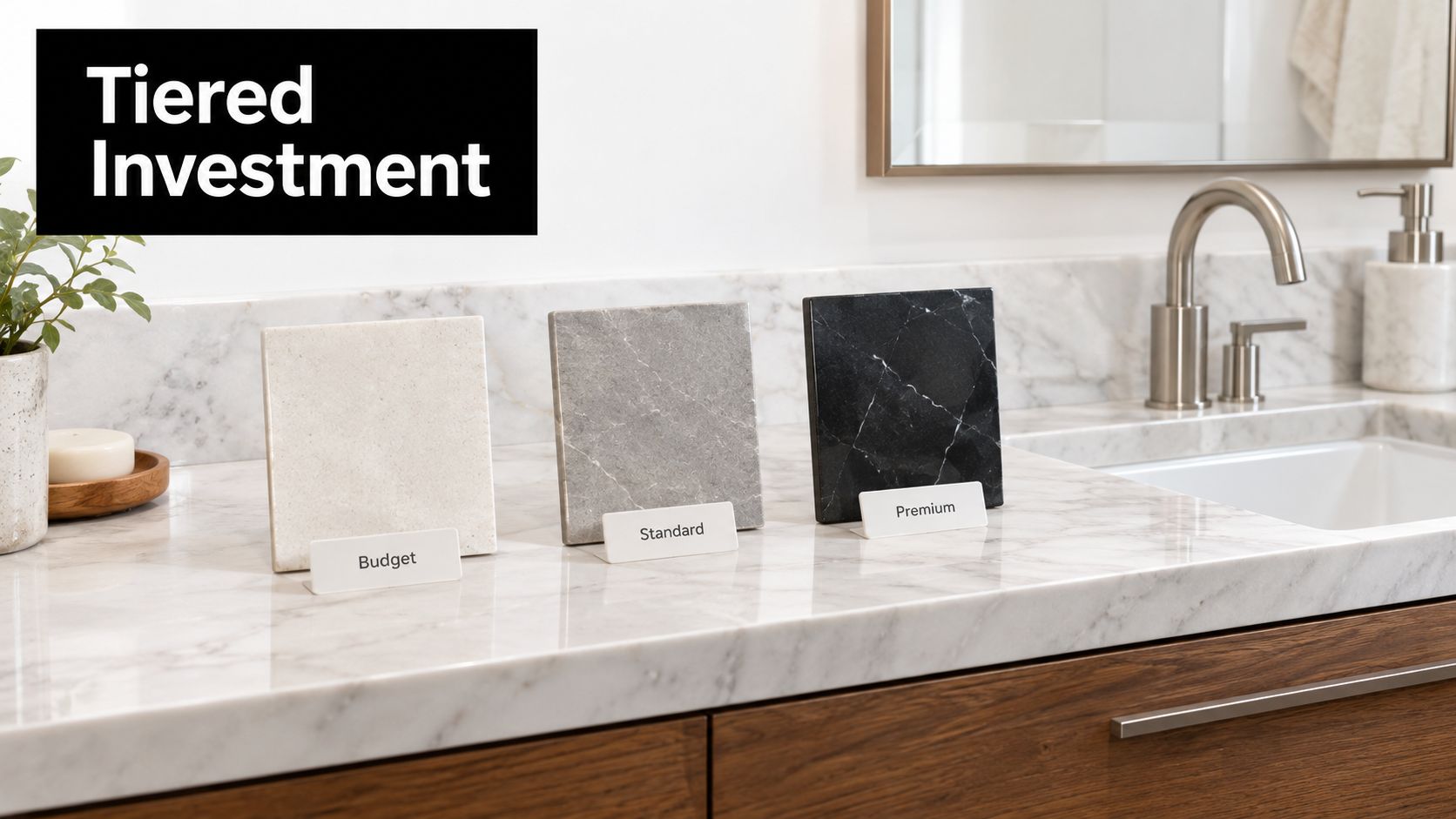
The most useful way to look at bathroom renovation cost Melbourne isn't just by broad price bands. It's by the decisions that push a project from budget to standard to premium. That's where value engineering matters. If you know which choices preserve function and appearance without adding unnecessary build complexity, you can get a far better result for the money.

What Is the Real Cost of a Melbourne Bathroom Renovation

A Melbourne bathroom renovation usually starts the same way. The room looks dated, storage does not work, the shower has seen better days, and the first quote feels manageable until the second and third arrive much higher. The gap is rarely random. It usually comes back to scope, product selections, site conditions, and how much of the existing bathroom can stay.

Bathrooms are small rooms with expensive trade density. Waterproofing, plumbing, electrical, tiling, glazing, joinery, demolition, waste removal, and fit-off all sit in a tight footprint, and each decision affects labour as much as materials. In Melbourne, access can add another layer. A ground-floor home in the suburbs is simpler to price than an apartment in Southbank with lift bookings, restricted delivery windows, and strata rules.

A conceptual design plan for a luxury bathroom renovation displayed on a desk with material samples.

For an early budget check, a bathroom renovation cost calculator for Melbourne projects helps narrow the likely range before you start comparing builder quotes.

The number clients ask for first

Clients usually want one figure. The more useful answer is a cost range tied to the decisions that change the build.

A bathroom that keeps the existing layout, uses standard-size fixtures, and avoids structural or service changes will usually stay in a more controlled price bracket. A bathroom that moves the shower, relocates the toilet, increases tile coverage to full height, or brings in custom joinery and premium fittings can shift upward fast. On paper, both are called a bathroom renovation. On site, they are very different jobs.

The practical Melbourne view

Cost planning works better when you look at value engineering, not just headline numbers. The question is not only what the renovation costs. The question is which choices improve function, presentation, and resale without adding build complexity that the property will never pay back.

For example, replacing a 1500mm custom vanity with a standard modular vanity often saves both joinery cost and installation time. Keeping floor waste and plumbing points where they are can avoid a chain of extra work under the floor and behind the walls. Using a reliable porcelain tile in a common size can cut labour compared with a handmade feature tile that needs slower setting-out and more wastage.

One choice can move the whole budget.

That is why two bathrooms of the same size can land at very different prices. One is a disciplined upgrade aimed at long-term use or rental return. The other is a full redesign with more labour, more risk, and more finish detail.

Understanding Average Costs for Different Bathroom Types

A Fitzroy investor and a family in Glen Waverley can both ask for “a new bathroom” and get quotes that are nowhere near each other. The reason is not just room size. It is the level of rebuild, the finish standard, and how many decisions add labour behind the walls as well as in front of them.

For cost planning, I break bathroom projects into three practical types. That makes it easier to value-engineer the job before selections start pushing the budget into the wrong tier.

Budget and cosmetic refresh

This tier suits bathrooms that still work but look tired, dated, or hard to lease. It is common in rental properties, first-home updates, and homes being prepared for sale where the goal is presentation and reliability rather than a full redesign.

Typical work at this level includes:

  • Keeping the existing layout so plumbing and drainage stay in place
  • Using standard-size fixtures such as modular vanities and stocked shower screens
  • Reducing finish complexity with simpler tile patterns, less custom joinery, and fewer special-order items
  • Targeting visible improvements like new tapware, vanity, shower screen, mirror, lighting, and repainting where full retiling is not justified

In small rooms, the smartest choice is not always a full strip-out. This small bathroom remodel cost guide is useful when you are weighing up whether a compact bathroom needs a complete renovation or a tighter, high-impact refresh.

A cosmetic bathroom can still add value if the scope is disciplined. The mistake is spending on premium fittings while leaving the room functionally unchanged.

Standard full renovation

This is the tier that suits most owner-occupiers who want the bathroom rebuilt properly and expect it to last. The room is stripped back, waterproofed, retiled, and fitted out with new fixtures and finishes that feel current without pushing into custom-builder territory.

A standard renovation usually keeps the project efficient in a few key ways. Layout changes are limited or avoided. Fixtures are good quality but still commercially available. Tile selection stays practical enough that labour does not blow out on cutting, set-out, or slow installation.

This level often gives the best value per dollar in Melbourne. It improves daily use, presents well at resale, and avoids many of the cost jumps that come with chasing a magazine-style finish in a mid-range property.

Premium designer overhaul

Premium bathrooms cost more because the build is more demanding, not because the tapware is expensive. Once a project includes structural changes, custom joinery, full-height feature tiling, frameless glazing, recessed niches, underfloor heating, stone surfaces, or detailed lighting plans, trade coordination gets tighter and labour increases.

These projects often include:

  1. Layout reworking to improve movement, storage, or access
  2. Higher-spec finishes that require more careful installation
  3. Custom-built elements such as bespoke vanities, shaving cabinets, or feature walls
  4. Extra service work for lighting, heating, ventilation, or relocated plumbing points

This is also where overcapitalising becomes a real risk. A premium bathroom can make sense in a long-term family home or a higher-value suburb. In an investment property or a modest resale market, the better decision is often to hold the layout, simplify the palette, and spend on durability where tenants and buyers will notice it.

As noted earlier, national pricing is often grouped into budget, standard, and premium bands. In Melbourne, those labels only become useful once the scope is honest. A “standard” bathroom with moved plumbing, custom joinery, and full-height feature tiles is no longer standard in build cost.

Where Your Money Goes An Itemised Cost Breakdown

Quotes feel vague when they arrive as one lump sum. They make more sense when you separate the room into trades, materials, and complexity. Bathrooms are expensive because several specialists work in a small footprint, and each stage depends on the last one being done correctly.

The cost drivers that shape most quotes

In Melbourne, builder quotes for bathroom renovations commonly sit around $2,300 to $4,600 per square metre, with waterproofing for an average bathroom often estimated at $500 to $750. Tile pricing also varies sharply, with wall tiles around $20 to $159 per square metre and floor tiles around $35 to $130 per square metre, based on Hipages bathroom renovation cost guidance.

That per-square-metre range matters because small bathrooms aren't automatically cheap. Compact rooms often require just as many trades and fixtures as a larger room, while difficult access, tight working conditions, and detailed tile layouts can still push labour up.

Sample Bathroom Renovation Cost Breakdown Melbourne

Item / Trade Typical Cost Range / % of Budget
Demolition and strip-out Varies by site condition, access, and disposal needs
Plumbing Higher when fixtures move, lower when layout stays the same
Electrical Depends on lighting plan, extraction, and power point changes
Waterproofing $500 to $750 for an average bathroom
Wall tiling $20 to $159 per square metre for tiles, plus labour
Floor tiling $35 to $130 per square metre for tiles, plus labour
Fixtures and fittings Broadly variable depending on specification
Vanity and cabinetry Standard units cost less than custom joinery
Shower screen and glazing Increases with custom sizes and detailed fitting
Builder coordination and project management Reflects scope, sequencing, and trade management
Overall renovation pricing Commonly $2,300 to $4,600 per square metre

The table above doesn't pretend every line can be fixed before inspection. It shows which parts are usually stable and which parts move depending on design choices.

Where projects usually drift upward

The biggest jumps tend to come from a handful of decisions:

  • Layout changes: Moving wastes and water points usually creates extra labour across multiple trades.
  • Heavy tile specification: Larger coverage, feature walls, difficult patterns, and premium materials all raise labour and material costs.
  • Custom vanity work: Off-the-shelf pieces are usually simpler to install than made-to-measure cabinetry.
  • Access problems: Apartments, narrow stair access, restricted parking, and body corporate rules can all slow the build.
  • Late selection changes: Swapping products after waterproofing, tiling, or joinery production has started can be expensive.

A bathroom quote is rarely just about products. It's mostly about how many decisions make the build harder.

This is also where working with a registered builder unlimited can matter in practical terms. When one licensed party coordinates demolition, waterproofing, plumbing, tiling, electrical, and finishing, there's usually better control over sequencing, responsibility, and compliance. That doesn't make every project cheaper. It often makes costs clearer and mistakes less likely.

Key Factors That Increase or Decrease Renovation Costs

Some bathrooms get expensive because the owner chooses expensive finishes. Others get expensive because the build itself becomes harder. Those aren't the same thing, and it helps to separate them before you lock in drawings or selections.

An assortment of interior design materials including marble, tile samples, and faucets displayed on a countertop.

Layout decisions

Keeping the existing layout is usually the strongest cost-control move available. The room may still be fully renovated, but the build stays more predictable when waste points, water lines, and major fixture positions remain where they are.

Moving the toilet, shifting the shower, or reworking the bath location usually triggers added plumbing work and often affects tiling, waterproofing, and floor preparation as well.

Material and finish choices

Not all finish upgrades cost the same. Some give a better visual lift than others without changing the build method much.

Consider the trade-offs:

  • Tile selection: A simpler tile in a clean format can still look high-end if the room is well detailed.
  • Joinery: Custom cabinetry gives flexibility, but standard sizes often work well in practical family bathrooms.
  • Tapware and fixtures: You don't need the most expensive option to get a sharp, modern result. Consistency often matters more than chasing statement pieces.

Design complexity

New bathroom ideas often look straightforward on a mood board but become expensive in construction. Recessed niches, frameless glass in awkward dimensions, full-height tiling everywhere, curved features, and mixed finishes all add labour pressure.

That doesn't mean they're wrong. It means they need to earn their place in the budget.

If a feature adds cost but doesn't improve use, maintenance, or resale appeal, it's usually the first place to review.

Building context

A freestanding house and an apartment can have very different renovation conditions. Apartments often bring stricter access windows, material transport issues, acoustic concerns, and body corporate rules. Older homes can reveal substrate problems, water damage, or non-compliant past work once demolition begins.

Permit and compliance issues

Straight replacement work is usually simpler than a renovation involving structural changes or broader building alterations. Once walls move or construction extends beyond a standard bathroom replacement, approvals and documentation can become part of the job.

That's one reason early planning matters. It's cheaper to identify approval risks before selections are finalised than after products are ordered.

Smart Cost-Saving Tips Without Compromising on Quality

A common Melbourne scenario looks like this. The room is tired, the budget is finite, and the first quote feels higher than expected. The answer is usually not to cheapen the whole job. It is to choose where the money earns its keep.

A hand touching a modern brushed nickel bathroom faucet on a white marble countertop near a sink.

Value engineering works best when it follows a clear order. Keep compliance and waterproof integrity protected. Keep the layout if it already works. Spend selectively on the items people touch, clean, and look at every day. That is how a bathroom stays in the right tier without drifting into unnecessary cost.

The biggest savings usually come from reducing change, not reducing quality. Moving wastes, chasing new pipe runs through a slab, resizing glazing, or ordering custom joinery can push a standard bathroom into a much more expensive bracket. By contrast, a well-planned like-for-like renovation often delivers a stronger result per dollar because the budget goes into better finishes and cleaner installation.

Cost-saving decisions that usually hold up

These are the choices that tend to improve value without creating problems later:

  • Keep plumbing points where they are if the current layout functions well.
  • Choose standard fixture sizes for vanities, screens, mirrors, and toilets to avoid custom labour.
  • Use feature finishes sparingly so one or two better selections carry the room.
  • Tile strategically by using full-height tiling only where it adds a practical or visual benefit.
  • Prioritise easy-clean products in family bathrooms, rentals, and ensuite upgrades.
  • Buy complete fixture ranges so finishes match properly across tapware, wastes, hooks, and shower fittings.

I often see owners save money successfully by pairing a simple tile with one stronger vanity or tapware selection, rather than trying to make every surface a feature. That approach usually looks more resolved, and it is easier to keep on budget.

False savings that become expensive later

The trouble spots are predictable:

  1. Cutting waterproofing or substrate preparation. Repairs after failure are far more expensive than doing it properly the first time.
  2. Mixing products from different ranges without checking finishes in person. "Brushed nickel" is not consistent across suppliers.
  3. Over-designing a small bathroom. Niches, trims, feature tiles, shaving cabinets, wall-hung fixtures, and custom glass all in one room add cost fast.
  4. Ordering purely on sale price. Long lead times, missing components, or poor after-sales support can stall the job.

Contingency also matters. Bathrooms in older Melbourne homes regularly hide water damage, out-of-level floors, or previous non-compliant work. If there is no allowance for that, a sensible renovation can feel like a blowout the moment demolition starts. A clearer view of sequencing helps owners understand where variations tend to arise, especially once walls and floors are opened up. This guide on how long a bathroom remodel should take explains the stages well.

Spend in order. Waterproofing and preparation first. Durable fixtures and finishes next. Visual extras last.

For investors and landlords, that usually means avoiding premium details that do not change rent, resale, or maintenance. For owner-occupiers, it often means putting the better spend into daily-use items such as the vanity, shower, lighting, and storage, while keeping the construction straightforward. That is the difference between a bathroom that looks expensive and a bathroom that delivers value.

Project Timeline Permits and Choosing the Right Builder

A Melbourne bathroom renovation usually goes off track before demolition starts. The common causes are late product selections, unclear scope, apartment access restrictions, and approval questions that were left until the trades were booked.

In practice, the build itself is only one part of the programme. Planning, quoting, ordering, and confirming site conditions often take longer than owners expect. Older homes in suburbs such as Brunswick, Preston, or Camberwell can also add time once demolition exposes floor levelling issues, water damage, or previous work that does not meet current standards.

A typical bathroom job moves through four stages:

  • Pre-construction planning: Site measure, layout confirmation, fixture and finish selections, and final scope approval.
  • Procurement and scheduling: Ordering materials, locking in trades, and confirming delivery dates before the room is stripped out.
  • Construction: Demolition, rough-in, substrate preparation, waterproofing, tiling, fit-off, glazing, painting, and final silicone.
  • Handover: Defect check, cleaning, compliance documents, and practical completion.

For a clearer breakdown of the sequence, this guide on how long a bathroom remodel should take shows where time is usually spent and where delays tend to happen.

Permits are not the same on every project. If you are replacing fixtures within the existing footprint, the path is usually simpler. If the work affects structure, changes openings, relocates major services, or sits inside an apartment with owners corporation rules, the approval process can become part of the critical path. That needs to be checked before products are ordered.

This is also where value engineering matters. Keeping the layout largely where it is does not just reduce plumbing cost. It can shorten decision-making, reduce approval risk, and make scheduling easier because fewer variables are introduced. On investor jobs, that often delivers better value than spending the same money on custom details that add complexity without improving rent or resale.

Choosing the builder has a direct effect on cost control. A good quote is not just a price. It should spell out what is included, what is excluded, who is supplying fixtures, how variations are handled, and what happens if concealed issues are found after demolition.

Ask direct questions:

  • Are licence and insurance current?
  • Do they handle bathroom renovations regularly, or only general building work?
  • Is waterproofing and compliance documentation included?
  • Are allowances realistic, or are provisional sums being used to make the quote look cheaper?
  • Who manages the schedule and client communication once work starts?

The cheapest quote often becomes the expensive one if key items were omitted at tender stage. We see that with disposal, floor preparation, electrical upgrades, and supplied-by-owner fixtures that arrive late or do not match the set-out.

If you want one team to manage design, planning, and construction, SitePro Bathrooms offers an end-to-end bathroom renovation service that includes 3D design, build coordination, and finishing.

Your Bathroom Renovation Questions Answered

What gives the best return for a Melbourne investment property

The best return usually comes from a controlled upgrade, not a luxury rebuild. Keep the plumbing layout where it is, choose durable fixtures in standard sizes, and aim for a clean, neutral finish that suits a broad tenant or buyer pool. Investors usually do better when the bathroom feels fresh, practical, and low-maintenance rather than overly personalised.

How do body corporate approvals affect an apartment bathroom renovation

Apartment renovations often involve more than your own lot. Access times, waste removal, waterproofing compliance, noise rules, lift protection, and notice periods can all affect the job. Get those conditions clarified before materials are ordered. If approvals are needed, treat them as part of the project programme, not as an afterthought.

Are designer bathrooms always worth the extra spend

Not always. Designer bathrooms can absolutely be worth it in the right home, especially when the rest of the property supports that finish level. They're less compelling when the renovation cost overtakes what the property can reasonably carry. A good design brief should separate must-haves from nice-to-haves before pricing starts.

How do you avoid costly mid-project changes

Lock the layout early. Finalise tile, vanity, tapware, glazing, and lighting selections before construction starts. Most expensive changes happen when clients decide on details after waterproofing, tiling, or joinery is already underway.

Can 3D design help with new bathroom ideas

Yes. It helps clients test layout, storage, and finish combinations before trades begin. That's especially useful when you're trying to balance modern bathrooms with practical limitations like tight footprints, awkward doors, or existing plumbing positions.


If you're comparing options for your own bathroom renovation cost Melbourne project, the most useful next step is to price the room based on scope, not guesswork. A clear brief, disciplined selections, and realistic allowances will tell you very quickly whether the plan is budget, standard, or premium.

  • siteprobathrooms

How to Renovate a Bathroom: Stress-Free Guide

A bathroom renovation typically begins with a consistent approach. This involves saving a few photos, picking a preferred tile, and assuming the most challenging work starts with demolition.

In Victoria, that's backwards.

The hard part is getting the decisions right before anyone lifts a tool. Bathrooms pack plumbing, electrical, waterproofing, drainage, ventilation, and finish work into one small room. That density is exactly why a bathroom that looks simple on paper can become expensive, slow, and stressful if the layout, fixtures, approvals, and trade order aren't locked in early.

If you're figuring out how to renovate a bathroom, think like a project manager first and a stylist second. Good results come from clear scope, disciplined sequencing, and realistic choices about where to spend and where to hold back. That's how you get bathroom renovations that look sharp, perform properly, and don't come back to haunt you with defects or rework.

The Pre-Renovation Playbook Planning Your Vision and Budget

A bathroom project usually goes off course before demolition starts.

I see it when a client says they want a simple refresh, then the first site check shows a tired subfloor, poor ventilation, old plumbing positions, and a layout that never worked properly in the first place. In Victoria, those early findings matter because they affect waterproofing, trade scope, timing, and sometimes whether extra approvals are needed. Good planning protects the budget long before tiles or tapware are chosen.

A woman sketching bathroom renovation floor plans in a notebook with a budget spreadsheet open on a tablet.

Start with the reason for renovating

Every strong brief starts with the problem, not the products.

A bathroom for a growing family needs durability, storage, and easy cleaning. An ensuite may prioritise comfort and better use of space. An older home may need the hidden work fixed first, especially if there are signs of movement, damp, or previous poor-quality renovations. Those are very different jobs, and they should not share the same budget logic.

Set the brief around decisions that affect the build:

  • Primary goal: better day-to-day function, updated appearance, accessibility, rental durability, or sale preparation
  • Must-haves: a bath, walk-in shower, more storage, better lighting, easier cleaning, or a double vanity
  • What stays and what changes: layout, plumbing locations, windows, doorway position, and wall locations
  • Property type: house, apartment, investment property, or period home with a higher chance of hidden issues

That last point matters in Victoria. Apartments can bring body corporate constraints. Older homes often uncover substrate damage, out-of-square walls, or outdated services once the room is stripped. If the brief ignores that risk, the budget usually wears the hit later.

Budget for the room you are actually building

Bathroom budgets are driven more by construction detail than by visible finishes.

Clients often focus on tile selection and tapware, but significant cost pressure usually comes from rectification, service changes, and labour-heavy work. Moving a toilet, changing shower falls, replacing damaged sheeting, correcting framing, or bringing old work up to current standards can shift a project from straightforward to complex very quickly.

A realistic budget should allow for:

  • Demolition and disposal: strip-out, protection of adjacent areas, and waste removal
  • Plumbing and electrical work: rough-in changes, new points, drainage adjustments, and fit-off
  • Substrate preparation and waterproofing: getting the room ready for finishes and wet-area compliance
  • Tiling and installation labour: often one of the biggest cost components in the room
  • Fixtures, joinery, and glazing: vanity, toilet, shower screen, tapware, mirrors, and accessories
  • A contingency: especially in older properties where defects are often hidden until demolition

One practical rule holds up on almost every job. If you keep the layout, you usually keep the budget under better control. Once plumbing points move, the labour, coordination, and risk all increase.

If you need to reduce costs without stripping the project back too far, our guide on how to renovate a bathroom on a budget sets out where to save and where it is smarter to hold the line.

Turn ideas into a buildable scope

Vague language costs money.

“Modern,” “luxury,” and “hotel feel” might help with inspiration, but trades cannot price or build from broad styling terms. They need clear selections and fixed decisions. Vanity width. Tile size. Tile height. Niche position. Shower screen type. Lighting layout. Door swing. Heated towel rail or not. These details affect material quantities, set-out, labour time, and the order each trade works in.

A buildable scope should record the room in plain terms:

  • the final layout
  • the fixtures being installed
  • the extent of tiling
  • storage requirements
  • lighting and power needs
  • items being retained
  • known issues that may need rectification once the room is opened up

That level of planning is what keeps a bathroom renovation under control. It gives the builder something clear to price, gives the trades something clear to execute, and gives the client a far better chance of avoiding budget creep halfway through the job.

Designing Your Dream Bathroom and Visualising the Result

A good bathroom design isn't a collection of nice products. It's a room where layout, light, storage, and finish selection all support each other.

That's the difference between bathrooms that photograph well and bathrooms that work well. The first impresses for a minute. The second still feels right years later.

A hand selecting interior design materials including marble tiles and stone samples for a home renovation project.

Layout does more work than style

Most new bathroom ideas live or die on layout. You can spend heavily on finishes, but if the vanity crowds the entry, the shower feels cramped, or storage is missing, the room won't feel resolved.

In compact bathrooms, every line matters. Door swing, vanity depth, shower screen placement, and the visual weight of tile all affect how open the room feels. In larger rooms, the risk is different. Too much empty space can make the bathroom feel cold unless the design creates zones and balance.

A few layout choices consistently hold up:

  • Keep movement clear: You should be able to enter and use the room without weaving around fixtures.
  • Place storage where it's needed: Vanity drawers, recessed niches, and mirrored cabinets reduce clutter.
  • Give the eye a focal point: Often that's the vanity wall, a feature tile, or a freestanding bath.
  • Design for maintenance: Tight gaps, awkward corners, and overly fussy detailing don't age well.

Materials must suit the way the room is used

Bathrooms are wet rooms, not showrooms. That changes how materials should be chosen.

A polished stone look might suit the brief, but the room still needs practical slip resistance, easy cleaning, moisture tolerance, and a tile format that works with the scale of the room. Large tiles can make a small room feel calmer. Smaller mosaics can help on floors where falls matter. Matte finishes often hide water marks better than glossy surfaces.

If you're choosing finishes, this practical guide on how to choose bathroom tiles helps narrow the options sensibly.

The best designer bathrooms don't look overloaded. They look edited. Every finish has a job, and nothing fights for attention.

Why 3D design saves real money

Clients often think visualisation is a luxury. It isn't. It's one of the cheapest forms of risk control in a bathroom renovation.

A 3D design exposes problems before demolition. You can test vanity width, mirror proportions, lighting placement, tile transitions, recesses, and fixture alignment while changes are still easy. That matters because on-site changes are rarely isolated. Move one item late and you may also affect rough-in positions, tiling, waterproofing details, and timing.

Here, modern bathrooms become buildable instead of aspirational. You stop guessing and start approving exact decisions. That's especially useful when more than one person is signing off on the room.

Navigating Permits and Hiring Your Renovation Team in Victoria

A bathroom can look like a straightforward room upgrade on paper. In Victoria, it often stops being simple the moment work affects plumbing, drainage, waterproofing, electrical services, ventilation, or any part of the structure. That is usually where budget risk starts, because approval requirements, trade licensing, and documentation are easy to underestimate until the job is already underway.

I tell clients the same thing early. Tile choices are the easy part. The harder part is making sure the work is lawful, properly sequenced, and signed off by the right people.

Know where approval risk actually sits

The approval path depends on the property type and the scope of work.

In a detached home, the process is often more direct, but structural changes, altered windows, moved drainage points, or major service changes can still trigger extra checks. In apartments, units, and other shared-title properties, you also need to deal with ownership boundaries, access rules, noise restrictions, waste removal, and body corporate or owners corporation approval where required.

That paperwork matters for a practical reason. If waterproofing fails in a house, the damage may stay within your lot. If it fails in an apartment, it can affect the ceiling below, common property, neighbouring walls, and an insurance claim that quickly turns into an argument about who approved what.

Victorian guidance for strata and shared-property renovations generally points to the same lesson. Get written approval before works start, and make sure the scope matches what was approved.

Hire for control, not just a lower quote

A bathroom renovation runs better when one party is clearly responsible for buildability, compliance, trade coordination, and defect prevention. Price still matters, but the cheapest quote can become the expensive one if key items are missing, trades are left to sort out conflicts on site, or no one owns the full outcome.

That is why builder selection deserves more than a quick check of gallery photos. Ask who is supervising the job. Ask who books and manages the licensed trades. Ask how variations are handled if demolition exposes rotten framing, damaged sheeting, old pipework, or non-compliant past work. Those are common findings in Victorian bathrooms, especially in older homes.

A good screening checklist is simple:

  • Registration and insurance: Confirm the builder and each trade are properly licensed or registered for the work they carry out.
  • Wet-area knowledge: Ask how the team handles substrate preparation, waterproofing, and required certifications.
  • Clear scope: The quote should state inclusions, exclusions, allowances, and what can trigger a variation.
  • Documentation: Fixtures, finishes, plans, and service locations should be recorded before site work begins.
  • Single-point responsibility: You want one accountable lead when questions arise and decisions need to be made quickly.

If you want a clearer explanation of that accountability model, read why using a registered builder matters for your bathroom renovation.

Watch the apartment and rental traps

Investors and landlords often focus on hard-wearing finishes, easy-clean surfaces, and a layout that tenants will not damage easily. That is sensible, but it is only half the job.

Rental properties and apartments need a clean paper trail. Keep records of approvals, waterproofing documentation, product selections, invoices, compliance certificates, and a clear note of what was changed. If the property is sold, re-let, refinanced, or subject to an insurance query, those records matter far more than people expect.

A bathroom that looks finished can still be poorly documented.

That distinction causes problems later, especially when maintenance issues appear months after handover. Good project management protects the room itself and the decisions behind it.

The Main Event Demolition and Trades Sequencing

A bathroom can look straightforward on the plan, then become complicated the moment demolition starts. In Victoria, that usually happens when old pipework sits where the new shower needs to go, the walls are out of square, or the floor is not suitable for the waterproofing system specified for the job. The room only comes together if the work is staged in the right order and each trade arrives to a site that is ready for them.

That sequence matters more in bathrooms than almost anywhere else in the house. Wet areas leave very little room for guesswork. If one stage is rushed or installed out of order, the trades behind it either stop or inherit a problem that costs more to fix later.

What actually happens once site work begins

Demolition should be controlled, documented, and selective. The job is to remove the old bathroom without damaging structural elements, adjoining finishes, or services that need to remain live elsewhere in the home.

Once the room is stripped back, the actual condition of the space becomes clear.

This is often where we find the issues that were hidden by tiles and plaster. Loose sheeting, previous water damage, patched-over plumbing work, termite damage in older homes, or floors that fall the wrong way all show up at this point. In many Victorian properties, especially older brick homes and apartments, those discoveries affect method, timing, and sometimes scope.

The required order of trades

Bathrooms are built in a strict sequence because every stage relies on the one before it being correct.

  1. Final set-out confirmation
    Fixture positions need to be locked in on site, not just on a concept drawing. Vanity width, toilet clearance, shower screen size, niche height, mixer positions, and tile set-out all need to work together before rough-in starts.

  2. Demolition and make-safe works
    Existing fixtures, linings, floor finishes, and redundant services are removed. The site is then cleaned up so the next trade can work accurately and safely.

  3. Plumbing and electrical rough-in
    New water, waste, power, lighting, and exhaust locations are installed while walls and floors are open. If the layout has changed, this is often where cost moves, because relocating services is labour-heavy and sometimes constrained by structure.

  4. Carpentry and substrate preparation
    Walls are straightened, noggings are added for grab rails or joinery where needed, floors are corrected, and sheet substrates are installed to suit the waterproofing and tile system.

  5. Waterproofing
    This is regulated work, not a finishing step. The substrate, bond breakers, junctions, penetrations, and drying times all matter. In Victoria, paperwork and compliance matter as much as appearance, especially if there is ever an insurance claim or a defect dispute.

  6. Tiling and floor grading
    Good tiling starts with set-out and falls, not tile colour. Shower floors need to drain properly, cuts need to be planned around focal points, and junctions need enough movement allowance to avoid later cracking.

  7. Fit-off and final installation
    Vanity, toilet, tapware, shower screen, mirrors, lighting, accessories, and fans are installed after the wet trades and finishes are complete.

A late change during rough-in rarely stays small. Move one mixer position and you may also be moving framing, waterproofing terminations, tile joints, and the shower screen measurement.

Where Victorian projects often get delayed

The delays are rarely caused by one dramatic problem. They usually come from several smaller issues stacking up. An apartment may need booked access and waste removal windows. A period home may have uneven framing that adds rectification work. A product may arrive late, which holds up measurement for joinery or screens. Waterproofing and curing times can also dictate the pace, regardless of how eager everyone is to push through.

Trade coordination is what keeps the program realistic. Sending the tiler in before the substrate is ready does not save time. It creates rework, arguments about responsibility, and a finish that never looks right.

Timing and cost, in practical terms

Programs vary with scope, access, and what the existing room reveals after strip-out. The table below works as a planning guide.

Phase Typical Duration Approx. Cost %
Planning, selections, approvals Varies by scope and product lead times Moderate early design and admin allocation
Demolition and site preparation Usually short but condition-dependent Smaller share than services and finishes
Plumbing and electrical rough-in Depends on layout complexity Significant technical allocation
Waterproofing and substrate preparation Depends on drying and inspection requirements Compliance-driven allocation
Tiling Labour-intensive and finish-critical One of the larger visible cost areas
Fixture fit-off and final detailing Usually staged near completion Moderate to high depending on fixture specification

Why bathrooms fail when the sequence is wrong

Bathrooms do not fail because one tile line is slightly off. They fail because moisture gets where it should not, drainage was not set correctly, fixtures were forced into a layout that was never resolved properly, or one trade had to guess what another trade intended.

That is why a well-run renovation feels calm on site, even when the room is fully stripped. The builder is not just booking trades. They are checking dependencies, handling site conditions, and making sure each stage is ready before the next one starts. In a Victorian bathroom renovation, that discipline is what turns a messy room into a compliant, durable finish.

The Finishing Touches That Define Your Space

You reach the last stretch of the renovation and the room finally looks close to done. This is also the stage where small specification mistakes become expensive, visible, and hard to ignore.

After waterproofing, tiling, and set-out are complete, fit-off gives the bathroom its finished character. Tapware, joinery, mirrors, shower screens, lighting, and accessories all start working together. If the early selections were disciplined, the room feels resolved. If they were made in isolation, the bathroom can still look disjointed even with quality products.

A modern chrome bathroom faucet sitting on a clean white sink next to a small potted plant.

Where the room gets its character

A good bathroom rarely relies on one standout item. The result comes from proportion, restraint, and consistency.

The vanity usually sets the tone first because it carries both storage and visual weight. From there, mirrors, tapware, towel rails, lighting, and shower framing need to suit the scale of the room. A narrow ensuite can be overwhelmed by chunky fittings. A family bathroom with generous wall space can look underdone if every item is too slight.

A few details have an outsized effect:

  • Tiles and grout: These set the visual pace of the room. Busy tile patterns or high-contrast grout can date faster than people expect.
  • Vanity and storage: Joinery needs to suit how the bathroom is used. Deep drawers often work better than cupboards for daily access.
  • Tapware and hardware: Finishes should relate to each other. Mixing too many metals usually reads as indecision, not design.
  • Lighting and mirrors: Face lighting matters more than decorative fittings. A bathroom that looks good in a showroom can still be poor to use at 6am.
  • Ventilation: In Victoria, this is not a cosmetic extra. Poor extraction shortens the life of paint, sealants, joinery, and even grout lines.

Spend money where changes are hardest later

The smartest budget decisions at this stage are usually practical ones.

If the layout is working, keeping plumbing positions largely in place often protects the budget and reduces risk. Money is often better spent on quality waterproof-compatible substrates, a well-built vanity, decent drawer hardware, effective exhaust ventilation, and fixtures that will still be serviceable years from now. Those items affect daily use and long-term maintenance more than a fashionable feature tile does.

I often warn clients about false economy here. Saving a small amount on the vanity internals, mirror size, screen hardware, or exhaust fan can leave a new bathroom feeling average within months. By contrast, a restrained material palette with better lighting, storage, and ventilation usually performs better and ages better.

Good value comes from protecting the expensive-to-replace elements and improving the parts you touch, clean, and use every day.

What dates a bathroom fastest

Bathrooms usually age poorly for predictable reasons. Oversized niches, overly busy feature walls, blue-white lighting, weak storage, and fixtures that are out of proportion with the room all tend to fall out of favour quickly.

Bathrooms that last well are generally quieter in their base finishes. They use durable surfaces, have enough storage to keep benches clear, and include lighting that is practical rather than purely decorative. The goal is not to make the room plain. The goal is to make sure it still feels balanced after the novelty of the new renovation has worn off.

In Victorian homes, there is another layer to this. Older properties often have walls that are not perfectly straight, tighter footprints, and existing windows or structure that limit ideal fixture placement. Good finishing choices account for those realities instead of fighting them. That is the difference between a bathroom that photographs well on handover day and one that still works properly, and still looks right, years later.

How SitePro Bathrooms Delivers a Smooth Renovation

A bathroom job usually goes off course long before demolition starts.

I see the same pattern across Victoria. Selections are half-made, drainage assumptions are wrong, body corporate approval is treated as an afterthought, and clients are told the room can be worked out on site. In a bathroom, that approach is expensive. The room is small, but every trade is working to tight tolerances, and one missed decision can affect waterproofing, joinery, glazing, tiling, and fit-off.

At SitePro Bathrooms, we run the project as a builder-led process from the beginning. That means the layout, product selections, site constraints, compliance issues, and trade handovers are checked before the room is opened up. It reduces avoidable variation costs and stops the common chain reaction where one late change pushes three other trades off program.

Why builder-led coordination matters

In Victoria, a bathroom renovation can involve more than replacing fixtures and tiles. Apartment work may need owners corporation approval. Older homes can reveal out-of-square walls, damaged subfloors, or legacy plumbing that does not suit the new design. If structural changes, major waterproofing scope, or service relocation are involved, the paperwork and sequencing need to be handled properly.

That is why one controlled workflow matters. The plumber needs confirmed set-out points before rough-in. The waterproofer needs stable substrates and compliant falls. The tiler needs final fixture positions, not guesses. If those decisions are made in the wrong order, the site becomes a problem-solving exercise instead of a planned renovation.

What clients can expect from our process

Our process is built to keep decisions clear and responsibility obvious:

  • Clear scope before work starts: We confirm what is being replaced, what is being retained, and where the risk sits if hidden conditions appear.
  • Selections locked in early: Tapware, vanity dimensions, tile sizes, drainage components, and shower screen details are resolved before rough-in where possible.
  • Permit and approval handling: We identify early if council, building, or owners corporation requirements may affect timing.
  • Trade sequencing with proper handovers: Demolition, plumbing, electrical, carpentry, waterproofing, tiling, painting, glazing, and fit-off are booked in the right order.
  • Single point of accountability: Clients are not left chasing separate trades for answers, delays, or defects.

That last point matters more than many clients realise. Bathrooms fail at the joins between trades. A nice design does not save a project if no one is checking substrate prep, waterproofing extents, tile set-out, or whether the vanity allowance matches the plumbing position.

We also plan for the Victorian realities that DIY articles rarely cover. Access restrictions in inner suburbs, limited parking for trades, apartment working hours, and longer lead times on selected fixtures can all affect the build. A well-run job allows for those constraints early, instead of pretending every bathroom follows the same timeline.

The result is a renovation that feels organised, well supervised, and easier to live through. Clients know what happens next, who is responsible, and where money is being spent. That is usually the difference between a bathroom project that stays under control and one that starts well but unravels once site work begins.

Bathroom Renovation FAQs

How long does a bathroom renovation usually take in Australia

A client will often ask this after seeing a fast before-and-after video online. The answer is that there are two timelines: the work on site, and the full project from first consultation to final handover.

On-site construction for a standard bathroom can be relatively quick if selections are finalised early, trades are booked properly, and there are no hidden surprises once demolition starts. The full process usually takes much longer. In Victoria, time is often lost before site works begin because fixtures are on backorder, apartment access rules limit working hours, owners corporation approvals are still pending, or the design has not been resolved well enough for trades to price and build with confidence.

The practical approach is to plan around the full project, not the shortest possible build window.

Is it cheaper to keep the same layout

Usually, yes.

Keeping the toilet, shower, and vanity in roughly the same positions can reduce plumbing changes, limit drainage work, and avoid unnecessary structural opening-up. That money can then go into better waterproofing details, stronger storage, improved lighting, or higher-quality fixtures.

There are exceptions. If the current layout wastes space, creates a cramped shower, or leaves no room for proper vanity storage, changing it can be money well spent. The question is whether the improvement in function justifies the extra work behind the walls and under the floor.

What's the biggest mistake homeowners make

Late selections cause more trouble than clients expect.

If tapware, vanity specifications, tile sizes, niche positions, shower screen details, or mirror cabinet dimensions are still undecided after demolition, trades start making assumptions. That is where costs creep up. A plumbing rough-in set for one vanity can miss the drawer configuration of the one eventually ordered. A tile set-out can look ordinary if the selected format changes after waterproofing is complete.

The fix is simple. Finalise the major selections before site work starts, and make sure they are documented clearly enough for each trade to work from the same plan.

Do I need approval for a bathroom renovation in Victoria

Sometimes, and in such instances, a simple bathroom upgrade can become more involved than people expect.

In Victoria, the approval path depends on the type of property and the scope of work. Plumbing and electrical work must be carried out by licensed trades. If structural work is involved, building permit requirements may need to be checked before anything is demolished. In apartments, units, and townhouses, owners corporation rules can affect waterproofing responsibilities, working hours, waste removal, and even where materials can be stored during the job.

That is why bathroom renovations should be reviewed at the start, not halfway through. Sorting out compliance early is far cheaper than stopping a job to fix paperwork, access issues, or trade sign-off problems later.

What should I check at handover

Treat handover like an inspection, not a formality.

Run every tap. Fill and drain the basin. Test the shower mixer, exhaust fan, power points, lighting, heated rails, and toilet flush. Look closely at grout lines, silicone joints, paint edges, tile cuts, and the falls to the waste. Open every drawer and door. Ask for the relevant certificates, warranty information, and care guidance for the finishes that have been installed.

A bathroom can look finished in photos and still have details that need attention in person.

Are modern bathrooms always the best choice for resale

No. Better resale usually comes from practical decisions, not trend chasing.

Buyers respond well to bathrooms that feel clean, bright, durable, and easy to maintain. Good storage, sensible lighting, straightforward cleaning lines, and quality wet-area detailing tend to age better than heavily styled rooms built around a short-lived look. In many Victorian homes, the best result is a bathroom that feels updated but still suits the age, scale, and character of the property.

A well-built bathroom outlasts a fashionable one.


If you want a bathroom renovation managed from concept through to handover, with 3D design, coordinated trades, and a registered builder overseeing the process, talk to SitePro Bathrooms.

  • siteprobathrooms

Cost to Renovate Bathroom Sydney: Bathroom Renovation Cost

In Sydney, bathroom renovation costs usually fall into three tiers: about $5,000 to $15,000 for a budget project, $15,000 to $35,000 for a standard full renovation, and $35,000 to $95,000 for a premium bathroom. In practice, many mid-market projects are planned around $15,000 to $18,000, but that number only holds if the scope stays controlled and the hidden work is manageable.

That's the part most homeowners are trying to work out when they search for the cost to renovate bathroom Sydney. You might be looking at sleek modern bathrooms, saving photos of new bathroom ideas, and wondering whether your taste matches your budget or whether the quote is going to jump the moment demolition starts.

That uncertainty is normal. Bathrooms look simple from the outside, but they're one of the most trade-heavy rooms in the house. Tiles, tapware and vanities get all the attention, yet budget pressure often comes from waterproofing, plumbing access, compliance, and whether you're replacing like for like or trying to reshape the room.

Embarking on Your Sydney Bathroom Renovation Journey

A Sydney homeowner often starts in the same place. Good-looking inspiration photos, a rough budget in mind, and the assumption that a bathroom is a small room so the numbers should stay manageable. Then the first site visit happens, the old tiles come off, and the actual cost starts to make sense.

A man holds a tablet displaying various bathroom design options inside a modern renovated bathroom space.

That gap between expectation and quote usually comes down to one thing. Homeowners price the bathroom they want. Builders price the bathroom that exists behind the walls, under the floor, and inside the current plumbing setup.

A new vanity, frameless shower screen and feature tiles are easy to picture. Compliance, waterproofing, floor preparation, waste connections, ventilation and access are not. Yet those are the items that often decide whether a project stays controlled or runs over budget.

This is why an "average cost" can be misleading at the start.

Two bathrooms of the same size can finish with a similar look and land at very different prices. One may be a straightforward like-for-like replacement with decent wall frames, accessible pipework and no sign of water damage. The other may need substrate repairs, updated drainage falls, electrical corrections, or extra work to bring waterproofing and installation up to current standard. On paper they look close. On site they are not.

The biggest cost difference often has nothing to do with the tile you pick. It comes from scope.

A realistic bathroom budget starts with the existing room, the layout you plan to keep or change, and the work needed to rebuild it properly.

Builder choice affects this early. A detailed quote should set out what is included, what is excluded, who is handling waterproofing and certification, and whether any allowance has been made for hidden rectification once demolition starts. Homeowners comparing prices should also understand why using a registered builder matters for your bathroom renovation, because the cheaper quote is not always pricing the same job.

The goal at this stage is not to chase the lowest number. It is to get clear on the actual work involved before selections, layout changes and provisional allowances start stretching the budget.

Understanding Sydney Bathroom Renovation Price Tiers

A homeowner in Sydney gets three quotes for what looks like the same bathroom. One builder prices a quick refresh. Another prices a full strip-out with proper rectification. The third has allowed for layout changes, certification, and higher-end finishes. The room has not changed. The scope has.

That is the right way to read price tiers. They are not just price bands. They reflect how much of the room is being rebuilt, how much risk sits behind the walls, and how far the design moves away from the existing layout.

Budget projects

The lower tier is usually a cosmetic update with strict limits on scope. It suits bathrooms where the layout stays put, the structure is sound, and the goal is to improve presentation rather than rebuild the room from scratch.

In practical terms, this level of project usually means:

  • keeping the toilet, shower and vanity in their current positions
  • choosing standard-size products instead of custom joinery or made-to-order screens
  • using straightforward tile formats that install faster and create less waste
  • limiting demolition so there is less chance of exposing hidden repair work

This tier can work well in an investment property, a secondary bathroom, or a room that is tired but still serviceable. It stops working once owners expect full waterproofing rectification, high-end finishes, custom storage, or a designer layout on a tight figure.

Standard full renovations

The middle tier is where a bathroom starts to be rebuilt properly rather than patched over. This is the bracket many Sydney homeowners are aiming for, even if they do not describe it that way at the start.

A standard full renovation commonly includes demolition, new waterproofing, new tiling, replacement fixtures, electrical and plumbing updates, and a cleaner overall finish. It may also allow for better storage, improved lighting, and a more usable shower arrangement if changes are modest.

This is also the range where professional discipline matters most. A quote can look competitive until you check whether it includes rubbish removal, substrate preparation, waterproofing certification, exhaust upgrades, tile trims, and fit-off of owner-supplied items. Those details are where jobs drift off budget.

Premium renovations

At the top end, cost rises because the work is harder to build, not just because the room looks better in photos.

Premium bathrooms often involve one or more of the following:

  • layout reconfiguration that moves plumbing and drainage points
  • large-format or natural stone tiles that need more careful preparation and installation
  • custom vanities, recessed niches, frameless glass, and detailed lighting plans
  • underfloor heating, upgraded ventilation, or higher-spec brassware and fixtures
  • rectification to older walls or floors so premium finishes can be installed properly

The labour component climbs fast at this level. Tighter tolerances, more product coordination, longer lead times, and a greater chance of custom fabrication all add cost before the room is even finished.

Where many homeowners sit

A lot of Sydney renovations sit between a light refresh and a fully customised bathroom. Owners usually want a room that feels new, functions better, and holds up over time. They do not always want a luxury fit-out, but they do want the job done properly.

That middle ground is where budgets often move. The layout stays mostly the same, then a wall-hung vanity is added. Tile selections step up. The old floor turns out to be out of level. Ventilation needs upgrading to meet current expectations. Each decision is reasonable on its own. Together, they change the tier of the project.

The useful question is not “What is the average bathroom renovation cost in Sydney?” It is “What standard of rebuild am I paying for, and what has the builder allowed for behind the finishes?” That is how you get a quote that reflects the actual job rather than a low number that grows after demolition.

Itemised Cost Breakdown Where Your Money Goes

A Sydney bathroom quote can look straightforward until demolition starts and the hidden work shows up. The visible selections matter, but the actual cost usually sits in labour, compliance, preparation, and the trade coordination needed to rebuild a wet area properly.

That is why two bathrooms with similar tiles and tapware can finish at very different prices.

The costs that are easy to underestimate

The line items that catch homeowners out are usually behind the finished surface. Waterproofing is one of them. It has to be applied to the correct areas, allowed to cure properly, and certified where required. If the substrate is poor or the falls are wrong, the waterproofing cost is not just the membrane. It includes the prep work needed before anyone can apply it.

Plumbing is another area that gets misunderstood. The visible fixture is the cheap part compared with the labour needed to isolate services, alter pipework, set wastes at the right height, and coordinate rough-in and fit-off with the rest of the build. Electrical work follows the same pattern. The final light or fan might look simple, but safe installation, testing, and compliance take time.

Beyond the main contract, there are extra costs homeowners should plan for. Waterproofing can run about $500 to $750, plumbing call-outs are commonly $60 to $100 plus hourly rates, and council permit fees can range from $500 to $1,000 for a basic renovation, as outlined in this Australian bathroom renovation cost breakdown.

In Sydney, approval costs vary by building type and scope. Many bathroom renovations do not need council approval, but strata approvals, waterproofing documentation, engineering advice, or compliance sign-off can still add professional fees that are easy to miss in an early budget.

What a proper quote should make clear

A useful quote should separate product allowances from labour and identify what is fixed, what is provisional, and what is excluded. If demolition, rubbish removal, substrate repairs, waterproofing, tiling, plumbing, electrical, glazing, painting, and certification are bundled into vague headings, the price is harder to trust.

Bathrooms fail at the joins between trades. One contractor finishes late, another returns to redo work, and the cost lands back on the client if the scope was not clear from the start.

If waterproofing, plumbing scope or permits are poorly described, you are not comparing quotes. You are comparing assumptions.

Typical Bathroom Renovation Cost Allocation

The exact split changes from project to project, especially in older Sydney homes where floors are out of level, walls are not square, or previous renovations have left non-compliant work behind. Still, this is a practical way to read where the budget usually goes.

Cost Component Percentage of Total Budget
Labour and trade coordination Largest share
Fixtures and fittings Moderate to high share
Tiles and surface materials Moderate share
Waterproofing and wet area preparation Compliance and substrate-related share
Plumbing and electrical work Technical and service-related share
Demolition, waste removal and site prep Early-stage project share
Permits and approvals where required Variable allowance
Contingency for hidden issues Protected reserve

Labour usually takes the biggest portion because bathrooms are trade-heavy rooms. A small footprint does not make them simple. The work is compressed into one area, and every stage depends on the one before it being done properly.

Where to spend and where to be careful

Spend money where failure is expensive to fix later. That means waterproofing, proper preparation, ventilation, and licensed trade work in NSW. A cheaper tile or standard vanity can still produce a good result. Failed membrane work or poorly set drainage usually means reopening the room.

Be careful with allowances for fixtures and finishes. Prime cost items often look reasonable on paper, then jump once real selections are made. The same applies to provisional sums for rectification work. If an older bathroom has damaged sheeting, rotted timbers, or unstable flooring, that work will not stay theoretical for long.

The value in a licensed builder is not the label itself. It is clear scope control, compliant work, realistic allowances, and enough experience to price the hidden parts of a wet area renovation before they become budget surprises.

How Scope and Layout Changes Affect Your Budget

A Sydney homeowner approves a bathroom quote based on a simple refresh. Then the old room is stripped out, the shower waste is in the wrong spot for the new layout, the toilet needs to shift, and the budget changes fast. That is how many bathroom overruns start.

Scope drives price more than square metres once a layout changes. A bathroom that keeps the same plumbing positions is usually far more predictable to price and build. Once you move services, you add demolition, new pipe runs, more trade hours, fresh set-out, and often extra compliance work before the room can be waterproofed and closed up again.

Broad per-square-metre guides can help with early planning, but they miss the part that catches people out. Industry pricing summaries such as this bathroom renovation cost guide only become useful when you separate a cosmetic update from a true reconfiguration.

Why layout changes cost more than they look

On plan, moving a vanity half a metre can look minor. On site, that can mean opening floors or walls, altering water and waste points, adjusting electrical rough-in, and resetting tile falls so the finished room still drains properly.

The expensive part is rarely the fixture itself.

It is the chain reaction behind it. A relocated shower can affect screed levels, floor waste position, waterproofing details, tile cuts, and shower screen sizing. Moving a toilet can be even more restrictive, especially in apartments or on concrete slabs where waste locations are harder to change without major work.

Changes that usually stay within a controlled budget

These choices tend to keep risk lower if the existing room is sound:

  • Replacing fixtures in the same position
  • Changing the vanity without shifting waste points
  • Upgrading tapware, tiles, mirrors, and screens
  • Improving storage and finishes without altering the room layout

This type of renovation still needs proper trade work, but it avoids the biggest pricing variable. Hidden service relocation.

Changes that often push the job into a higher price tier

These decisions usually increase cost, time, and uncertainty:

  • Moving the toilet, shower, or floor waste
  • Shifting plumbing into a new wall
  • Changing door locations or room boundaries
  • Converting a laundry, powder room, or spare room into a bathroom
  • Choosing fittings first and checking service access later

I tell clients to treat layout changes as construction decisions, not styling decisions. The drawing may look cleaner. The build becomes more complex.

The overlooked costs behind a new layout

A common issue arises when quotes no longer align with expectations. Homeowners often allow for new fixtures and tiles, but the extra spend usually sits in the background work:

  • Plumbing rework and drainage changes
  • Electrical relocation for lighting, power, and exhausts
  • New wall framing or patching after demolition
  • Waterproofing to suit the revised set-out
  • Floor levelling or screed correction to maintain falls
  • Certification, strata approvals, or other professional input where required

Those items are why two bathrooms with the same tapware and tile selection can land at very different totals.

If you are still testing ideas, a bathroom renovation cost calculator for Sydney projects can help you compare a keep-the-layout brief against a redesign brief before you ask for formal quotes.

How to quote a layout change properly

The best way to control cost is to lock the brief before pricing. If the layout is undecided, the quote can only be provisional in the areas most likely to move. That is where surprises start.

A realistic quote for a reconfigured bathroom should show what is included for demolition, service relocation, substrate repairs, waterproofing, and any approvals or consultant input that may be needed. If those items are vague, the total is not fixed in any practical sense.

The layout on the plan is cheap. Making it work on site is where the actual budget gets decided.

Example Sydney Bathroom Renovation Budgets for 2026

Budgets make more sense when tied to real decision-making. These examples show how different homeowners approach the same question and why the final number changes with scope.

A modern, bright bathroom with white cabinets, marble countertops, and a glass-enclosed shower with tiled walls.

If you want to test your own project against a broad planning range, a bathroom renovation cost calculator can help you frame the conversation before getting quotes.

Ensuite update with a controlled brief

A couple wants their tired ensuite to feel cleaner and more current. They don't need a dramatic redesign. They want sharper storage, better finishes, and a room that's easier to keep clean.

They keep the existing plumbing positions, choose standard-size fixtures, and avoid custom joinery. The result sits in the budget to lower mid-range tier, because the room gets a meaningful visual lift without the extra cost of layout rework.

This is the kind of job where discipline matters more than chasing trends. The room can look fresh and resolved if the selections are coherent.

Family bathroom overhaul with practical priorities

A family in an older house wants a full rebuild of the main bathroom. Their priorities are durability, storage, easy cleaning and a layout that works for daily use. They aren't trying to create a luxury showpiece, but they do want a proper renovation.

This type of project usually lands in the standard renovation range, especially when the room is stripped out fully and rebuilt with new finishes, updated plumbing connections, compliant waterproofing and a more practical fixture set. The value comes from balancing good daily function with finish choices that won't date too quickly.

Premium retreat with designer intent

Another homeowner is creating a high-end ensuite with a more refined, hotel-style feel. They want a stronger visual statement, custom detailing, and a reworked layout that feels more generous.

That brief pushes the project into the premium tier. Not because every product is extravagant, but because the room asks for more: layout adjustments, more exacting installation, and tighter coordination between trades to achieve the finish cleanly.

Premium bathrooms are built twice on paper. First in the design decisions, then on site in the technical details.

Often, designer bathrooms separate from standard projects in their specific demands. The room may still include the same core elements, but the labour, detailing and sequencing are less forgiving.

Managing Your Timeline and Renovation Budget

A bathroom budget doesn't fall apart in one dramatic moment. It usually drifts through rushed decisions, unclear inclusions, delayed selections, and hidden conditions discovered too late.

For a complete bathroom overhaul in Sydney, a practical budget often sits around AUD $17,000 to $30,000, and experienced industry guidance recommends a 10 to 20 per cent contingency buffer because demolition regularly exposes waterproofing failure, ageing pipework and other issues that must be fixed before the room can be rebuilt to standard, as noted in this Sydney bathroom renovation budgeting guide.

A person writing on a project Gantt chart timeline with a pen on a construction site office desk.

What helps a project stay on track

The best projects are organised before demolition starts. That means selections are mostly settled, the scope is documented properly, and the builder isn't waiting on basic product decisions while trades are booked.

A realistic process usually includes:

  • Clear early selections: Choose tiles, tapware, vanity style and fittings before work begins where possible.
  • Defined scope: Confirm what stays, what goes, and whether any layout movement is worth the added cost.
  • Allowance for unknowns: Older bathrooms often hide issues that no one can fully confirm until strip-out.
  • Trade sequencing: Waterproofing, plumbing, electrical and tiling each rely on the previous step being done correctly.

Where homeowners can save without cutting quality

Saving money doesn't mean stripping the project back to the point of regret. It means protecting the parts that matter and simplifying the parts that don't.

Useful ways to reduce pressure on the budget:

  • Keep the layout where possible: This is still the cleanest way to avoid major cost escalation.
  • Use standard-size products: Custom work adds labour and often waiting time.
  • Prioritise function over novelty: The rooms that age best usually have practical storage, good lighting and durable finishes.
  • Spend on the things you touch daily: Good tapware, well-designed storage and proper shower function matter more than one-off statement pieces.

For homeowners trying to control spend from the beginning, this guide on how to renovate a bathroom on a budget gives useful planning direction.

The budget line that should never disappear

Contingency often gets treated like optional padding. It isn't. In older properties, it's the part of the budget that keeps the project from stalling once concealed problems appear.

If the room opens up cleanly, great. If it doesn't, that reserve allows the work to be corrected properly instead of patched around.

Frequently Asked Questions about Bathroom Renovations

Do I need council approval for a bathroom renovation in Sydney

Sometimes, but not always. Simple like-for-like work is usually more straightforward than projects involving major changes. Approval needs depend on the scope, the property type, and whether the renovation affects building elements beyond the bathroom fit-out. If you're in an apartment, there may also be strata requirements to deal with before work starts.

Why is waterproofing such a big deal

Because bathrooms fail from behind the tiles, not from what you can see on handover day. Proper waterproofing protects the structure, supports compliance, and reduces the chance of expensive remedial work later. It's one of the areas where trying to save money usually costs more in the long run.

Should I manage individual trades myself

Some homeowners try it, but bathrooms are tightly sequenced jobs. The challenge isn't just booking trades. It's coordinating demolition, plumbing, electrical, waterproofing, tiling and fit-off in the right order while keeping responsibility clear if something goes wrong.

What makes quotes hard to compare

Inclusions. One quote may include demolition, waterproofing, allowances for compliance items and clear trade scope. Another may look cheaper because those items are left vague or excluded. The only useful comparison is line by line.

A successful bathroom renovation starts with realistic expectations, not optimistic pricing. If you want a quote that reflects the actual work, not just the pretty finishes, talk to SitePro Bathrooms for a personalized consultation and a clearer path from idea to build.

  • siteprobathrooms

Remodelling Bathroom Cost: A 2026 VIC Guide

A standard bathroom renovation in Victoria typically costs A$20,000 to A$35,000, but the full range is wider. A cosmetic update can sit around A$10,000 to A$20,000, while a premium designer bathroom can run A$35,000 to A$50,000+.

If you're standing in a tired bathroom in Highett, looking at cracked grout, a swollen vanity, old fittings and poor storage, you're probably asking the same question most homeowners ask first. What will this cost once the walls open up and the trades start?

That's the right question. Bathroom renovations look small on a floor plan, but they're one of the most trade-heavy spaces in any house. The room might be compact, yet the work still pulls in demolition, plumbing, waterproofing, tiling, electrical, ventilation, fit-off and final finishing. That's why remodelling bathroom cost in Victoria is rarely about tiles alone. Labour, compliance and layout decisions shape the number far more than many online guides admit.

Embarking on Your Bathroom Renovation Journey

A lot of bathroom projects start the same way. You don't wake up one morning thinking about waterproof membranes or plumbing rough-ins. You notice the shower leaks onto the floor, the vanity no longer suits the family, or the room feels stuck in another decade.

For some homeowners, it's a lifestyle issue. The bathroom doesn't function well before work, school drop-off, or evening routines. For others, it's a property decision. They know the room needs attention before leasing, refinancing or selling.

That pressure has become more common. In Australia, renovation activity climbed sharply through the early 2020s, and bathrooms remained one of the most frequently upgraded rooms because they combine daily utility with strong resale appeal. Market guides also show that full-scale bathroom work often starts around A$20,000 and can go beyond A$50,000.

Why homeowners get caught out

The surprise usually isn't that a bathroom costs money. It's where the money goes.

A homeowner may begin with a simple idea. Replace the shower, update the vanity, retile the floor, maybe make it look more like the modern bathrooms they've saved online. Then the quote lands and the number feels high. In most cases, that's because the visible finishes are only one layer of the job.

Bathrooms are expensive because they stack specialist work into a very small footprint.

In older Melbourne homes, that stack can get heavier. Once demolition starts, you may uncover uneven framing, outdated plumbing, moisture damage, poor ventilation or earlier work that doesn't meet current expectations. None of that is glamorous, but it matters more than the colour of the tapware.

The real starting point

If the layout stays broadly the same and you want a full, durable result, most homeowners should budget for the middle of the market, not the bottom. That means thinking in terms of a proper renovation rather than hoping for a bargain figure that won't survive first contact with trade labour and compliance.

A practical way to frame it is:

  • Cosmetic work: best for a bathroom that's tired but sound
  • Mid-range renovation: best for most family bathrooms that need full replacement
  • Premium renovation: best for layout changes, custom finishes and designer bathrooms

That's the point where planning starts to save money. Not by cutting essentials, but by making the right decisions early.

Typical Bathroom Remodelling Costs in Victoria for 2026

In Victoria, the cleanest way to estimate remodelling bathroom cost is by scope, not just by room size. National guidance places a basic cosmetic update at A$10,000 to A$20,000, a mid-range renovation at A$20,000 to A$35,000, and a premium bathroom at A$35,000 to A$50,000+. It also notes that the total can rise quickly once plumbing, waterproofing, tiling and electrical work are combined.

The three cost tiers most homeowners work within

Some bathrooms only need a refresh. Others need a complete strip-out and rebuild. The difference matters because the labour profile changes fast.

Tier Estimated Cost Typical Inclusions
Basic cosmetic update A$10,000 to A$20,000 Surface-level improvements, selected fixture replacement, limited layout change, simpler finishes
Mid-range full renovation A$20,000 to A$35,000 Full strip-out, new waterproofing, new tiling, replacement fixtures, vanity, shower, toilet, lighting, ventilation improvements
Premium or designer renovation A$35,000 to A$50,000+ Layout changes, premium finishes, custom joinery, feature lighting, larger-format tiles, upgraded shower or bath zone, more detailed design work

What each tier usually means in practice

Basic isn't the same as cheap. It generally suits bathrooms where the layout still works and the hidden structure is in decent shape. The goal is to improve appearance and function without turning the room inside out.

Mid-range is the bracket most family bathroom renovations fall into. This is usually the sweet spot for homeowners wanting a fresh room, better storage, reliable waterproofing and a finish that feels current without pushing into luxury detailing.

Premium is where the brief starts to change. The bathroom may become an ensuite retreat, a statement room, or part of a larger home upgrade. This is also where new bathroom ideas often move from inspiration to cost reality, especially when custom joinery, feature tile work or plumbing relocation enters the picture.

Why small bathrooms don't always mean small budgets

A compact bathroom can still cost more than expected because a lot of key costs don't shrink in proportion with floor area. Demolition still happens. Waterproofing still has to be done correctly. Trades still need to come through the room in sequence.

Practical rule: A small bathroom can use fewer materials, but it doesn't avoid the fixed labour and compliance steps that make bathrooms expensive.

That's why comparing your room to someone else's by square metres alone rarely helps. Two bathrooms of similar size can land in very different cost brackets depending on access, age, layout and finish level.

The Anatomy of a Bathroom Renovation Budget

The best way to read a bathroom quote is to stop thinking of it as one number and start reading it like a build sequence. Every line item represents a trade, a material package, or a compliance step that has to happen in the right order.

A laptop screen displaying a detailed project budget breakdown spreadsheet on a wooden desk with architectural plans.

If you want to sense-check your project early, a bathroom renovation cost calculator for Melbourne projects can help frame the budget before you start requesting formal quotes.

What sits inside a real renovation budget

When homeowners ask where the money goes, this is usually what they're paying for:

  • Demolition and removal
    Old tiles, fittings, sheeting, shower screens, vanity units and waste all have to come out safely and be removed from site.

  • Carpentry and preparation
    Walls and floors often need straightening, backing, repairs or adjustment before new materials can go in properly.

  • Plumbing rough-in and fit-off
    This covers the service work behind the walls and the final installation of fixtures.

  • Electrical and ventilation
    Lighting, power points, exhaust systems and any upgrades to the room's functionality sit here.

  • Waterproofing
    This is one of the most important stages in any Australian bathroom. If it's rushed or skipped, the nice-looking finishes above it won't matter for long.

  • Tiling and tile preparation
    This includes substrate preparation, tile laying, grout work, trims and finishing detail.

  • Joinery and vanity work
    Off-the-shelf vanities cost less. Custom cabinetry usually gives a better fit and storage result but pushes the budget up.

  • Fixtures and accessories
    Toilet, tapware, shower fittings, mirror, basin, bath, rails and hardware all add up.

  • Project coordination
    Good sequencing matters. Delays between trades cost time, and rushed handovers often cost quality.

Why bathrooms feel expensive even when they're small

Australian guidance puts a standard bathroom at about A$25,000 to A$35,000, and a key reason is that a bathroom is a high-trade-density space. Waterproofing, plumbing, electrical work, tiling and fit-off overlap tightly, and labour represents a major share of the total. It also notes that moving fixtures or altering plumbing layout materially increases spend because re-routing services, extra demolition and re-tiling are involved.

That aligns with what happens on site. A bathroom doesn't give trades much room to work, so every stage needs more precision. There's little tolerance for mistakes and no spare space to hide poor preparation.

What a homeowner should scan for in a quote

A quote should show enough detail that you can tell whether the builder has allowed for the full job or only the visible parts.

Look for these points:

Budget area What you want to see
Demolition Clear allowance for strip-out and waste removal
Waterproofing Explicit inclusion, not assumed or buried
Plumbing Whether fixtures stay in place or move
Electrical Lights, fan, power points and connection work
Tiling What surfaces are tiled and what finish is assumed
Fixtures Allowance level or nominated products
Joinery Custom, semi-custom or standard supply
Management Who coordinates the trades and defects process

If a quote looks low, check what's missing before you assume you've found value.

The cheapest quote often becomes the most expensive once variations begin. In bathroom renovations, omitted work doesn't disappear. It comes back later as a problem, a delay or a cost increase.

Key Factors That Drive Your Renovation Cost Up or Down

The total doesn't move randomly. A handful of decisions do most of the heavy lifting.

Some choices keep a project controlled and efficient. Others trigger a chain reaction across multiple trades. That's why two bathrooms with a similar footprint can finish far apart in final cost.

Keep the plumbing where it is if you can

The single biggest budget lever in many bathroom renovations is the layout. If the toilet, shower and vanity stay where they are, the project is usually cleaner, faster and easier to coordinate. Once you start moving them, the builder often has to open more of the room, reroute services and repair a wider area.

That's particularly relevant in Victoria because the labour side of the job often outweighs the savings you think you're making on fixtures.

Finish level changes the feel and the spend

There's nothing wrong with wanting a better-looking bathroom. In fact, many modern bathrooms get their impact from a few well-chosen upgrades rather than an all-out luxury spec.

Cost usually rises when you choose:

  • Larger or more complex tiles that demand more precise setting out
  • Custom vanities instead of standard units
  • Feature tapware and fittings with a higher finish level
  • Frameless glazing or statement baths that become focal points
  • Detailed niches, trims and lighting that increase installation time

The mistake is assuming every visible upgrade adds equal value. It doesn't. In many homes, better storage, better lighting and a cleaner shower layout improve daily use more than an expensive feature finish.

Older homes create more uncertainty

Highett and surrounding Melbourne suburbs have a broad mix of housing stock. Older bathrooms often hide the kinds of issues that don't show up in the first mood board.

These commonly include:

  • Moisture damage behind tiles or around the shower base
  • Out-of-square walls or floors that need correction
  • Previous patch-up work that has to be redone properly
  • Ventilation problems that contributed to mould or paint failure
  • Service access issues that slow down trade work

A bathroom renovation gets expensive fastest when the original room looked cosmetic, but the structure behind it wasn't.

Customisation versus restraint

Designer bathrooms are built on detail. Recessed storage, floating joinery, feature strips, special lighting and carefully layered materials can look excellent. But every custom move asks for more time, more coordination and often more risk control.

That doesn't mean you should avoid custom work. It means you should decide where it matters.

A restrained design usually spends money well in three places:

  1. Waterproofing and preparation
  2. A practical layout
  3. Durable finishes you won't regret in two years

The rest should support those priorities, not crowd them out.

Sample Budgets for Modern and Designer Bathroom Renovations

Examples help because they turn broad cost bands into real decisions. These aren't claims about a specific past project. They're realistic planning scenarios based on the cost ranges already discussed and the sort of choices Melbourne homeowners commonly make.

A modern, bright bathroom with double vanity, glass shower, and freestanding bathtub with gold hardware and accents.

If you're exploring higher-end inspiration, it helps to look at designer bathrooms in Melbourne with a practical eye. The question isn't just what looks good. It's which features justify their cost in your home.

The A$28,000 modern family bathroom

This is the kind of renovation many households should aim for first. The room is dated, the shower is tired, storage is poor, but the basic layout works. The smartest move is to keep the plumbing footprint largely intact and spend the money on a full rebuild with durable finishes.

The brief for a modern family bathroom usually looks like this:

  • A walk-in shower with simple, easy-to-clean detailing
  • A practical vanity with better drawer storage
  • Full waterproofing and fresh tiling
  • Updated lighting and ventilation
  • A more current look without drifting into overdesigned territory

The result feels completely new because the visible surfaces change, but the cost stays within a controlled range because the hidden services don't need major relocation.

A budget at this level usually leans on smart restraint:

Area Likely focus
Layout Mostly retained
Vanity Functional, clean-lined, not heavily customised
Tiles Durable and contemporary rather than highly specialised
Shower Better screen, fittings and drainage detail
Lighting Improved task and general lighting
Finish style Fresh, simple, low-maintenance

This is often the best-value category for families. It gives you the reliability of a full renovation and enough design improvement to feel modern without paying premium-room prices.

The A$55,000 designer ensuite

At the upper end, the job changes character. This isn't just about replacing what's there. It's about creating a room around experience, visual impact and custom detail.

A premium ensuite might include:

  • A freestanding bath
  • A larger frameless shower
  • Custom vanity joinery
  • Higher-end tile selection
  • Layered lighting
  • More sculptural fittings
  • A reworked layout for better flow

That's how a project pushes beyond the standard premium range and into a more bespoke build outcome. The price rises not because one item is outrageously expensive, but because many choices each add complexity.

Premium bathrooms cost more because almost every element asks more from the trades. More set-out. More finishing detail. More coordination.

The homeowner who gets good value here is the one who wants a genuine upgrade in daily use and design quality, not just a room full of expensive products.

Which example is right for you

If you're weighing new bathroom ideas, ask yourself three things:

  • Do I want a better bathroom, or a different bathroom?
  • Can I keep the layout and still solve the room's problems?
  • Will custom features improve how we use the space, or only how it photographs?

Those questions usually separate a strong mid-range renovation from a premium project that's worth its cost.

How to Save Money and Get Accurate Quotes in Melbourne

Saving money on a bathroom renovation doesn't mean chasing the lowest number. It means protecting the parts of the build that matter and trimming the parts that don't.

That starts with understanding where Victoria-specific costs often get missed. Australian guidance notes that many cost articles skip over local labour and compliance detail, even though licensed trades, plumbing relocation and waterproofing compliance are major cost drivers in Australian homes. It also highlights the value of asking what costs are usually missed in a first quote.

A person reviewing a detailed renovation cost estimate with architectural material samples on a desk.

Where to save without creating future problems

There are smart ways to cut cost, and there are false economies.

Smart savings usually include:

  • Keep the existing layout
    If the room functions reasonably well, this is often the best budget decision available.

  • Use simpler tile formats
    A clean porcelain tile can look sharp and reduce labour pressure compared with more intricate layouts.

  • Choose one feature, not five
    A statement mirror, vanity or wall tile can carry the design without forcing every finish into premium territory.

  • Prioritise storage and lighting
    These usually improve the room more than decorative extras.

  • Be careful sourcing your own fixtures
    It can work, but only if dimensions, lead times and compatibility are confirmed before site work begins.

For homeowners wanting a tighter plan, these budget bathroom renovation ideas for Melbourne homes are useful when the goal is controlled spending rather than stripped-back quality.

What usually goes wrong with cheap quotes

The low quote often wins because it feels simple. Then the problems start.

A quote may look attractive because it leaves out one or more of the following:

  • Detailed demolition allowances
  • Adequate waterproofing scope
  • Realistic tile preparation
  • Ventilation upgrades
  • Waste removal
  • Clear fixture allowances
  • Project management responsibility
  • Variation rules if hidden issues appear

That's where homeowners get caught. The quote wasn't wrong in arithmetic. It was incomplete in scope.

Why builder oversight matters

For full bathroom renovations, coordination matters as much as craftsmanship. A tiler can tile. A plumber can plumb. But a successful bathroom renovation depends on sequencing, accountability and one party taking responsibility for the whole room.

That's why many homeowners feel safer with a registered builder unlimited managing the project rather than a loose collection of individual trades. The issue isn't just convenience. It's clarity around scope, timing, defects and who owns the final result.

A good quote should clearly state:

Quote item Why it matters
Scope of works Shows exactly what is and isn't included
Product assumptions Prevents disputes about fixture level
Compliance items Confirms the job accounts for critical wet-area work
Timeline Helps you plan access and disruption
Variation process Reduces surprises if hidden issues appear
Warranty detail Clarifies post-completion support

Don't judge a bathroom quote by the bottom line first. Judge it by how well it predicts the real job.

That's the difference between a quote that sells a project and a quote that prepares you for one.

ROI, Resale Value, and Your Renovation Questions Answered

A bathroom renovation is partly a comfort decision and partly an asset decision. In suburbs like Highett, buyers and renters notice bathrooms quickly because they use them every day and because defects in wet areas can signal broader maintenance issues.

A well-executed renovation usually does two things at once. It improves how the home lives now, and it protects the property from looking tired against competing listings. That doesn't mean every upgrade needs to be luxurious. It means the room should feel clean, functional, durable and coherent with the rest of the home.

Where value usually comes from

The bathrooms that hold value best tend to get the basics right:

  • A layout that works
  • Storage that suits daily use
  • Reliable waterproofing and ventilation
  • Finishes that feel current but not trendy for trend's sake
  • Workmanship that looks neat in every corner and junction

Modern bathrooms usually perform well in the market because they appeal broadly. Designer bathrooms can also add strong appeal, but only when the spend matches the home and the suburb.

Common renovation questions

Do I need a council permit for a bathroom renovation in Victoria

Sometimes yes, sometimes no. It depends on the scope of work and whether structural changes or other approval-triggering work are involved. This is something you should confirm before build decisions are locked in.

How disruptive is a bathroom renovation

More disruptive than many people expect, because the room is out of service while multiple trades move through in sequence. The practical issue isn't only noise. It's access, dust control, scheduling and whether your household has another usable bathroom.

What's the difference between waterproofing and tiling

They are not the same thing. Waterproofing is the protective system behind the finished surface. Tiling sits over prepared substrates and waterproofed areas. Good tiles do not replace proper waterproofing.

Is a cosmetic update enough

Sometimes. If the bathroom is structurally sound, the layout works and there are no underlying moisture or compliance concerns, a cosmetic update may be sensible. If the room has deeper issues, surface improvements often just delay the proper renovation.

A good bathroom should still look good years later, not just on handover day.


If you're planning a bathroom renovation in Highett or greater Melbourne and want a quote that reflects the actual work involved, not just the showroom items, SitePro Bathrooms can help you map out a clear scope, realistic budget and finish level that suits your home.

  • siteprobathrooms

Affordable Kitchen Renovations Melbourne: 2026 Guide

A lot of Melbourne homeowners start in the same place. The kitchen still works, but only just. Doors are tired, storage is awkward, the benchtop has seen better days, and every quote online seems to swing between “cheap and cheerful” and “full custom luxury” with no clear middle ground.

That's where most budgets go off track. Not because people want too much, but because they don't get straight advice early enough about what drives cost in Victoria, what can stay, and what's worth upgrading. Affordable kitchen renovations melbourne projects aren't about chasing the lowest quote. They're about protecting the layout where possible, choosing finishes that give visual impact, and keeping compliance-heavy work under control.

Your Guide to Affordable Kitchen Renovations in Melbourne

A typical renovation conversation starts with a simple goal. Make the kitchen feel cleaner, lighter, easier to use, and better suited to daily life. The problem is that “new kitchen” can mean anything from painted doors and new handles to a full rebuild with new services, custom joinery, and structural alterations.

That difference matters more than is often appreciated. In Melbourne, a kitchen can look dramatically better without becoming a full strip-out. If the cabinet carcasses are still sound, the layout functions reasonably well, and the appliances are serviceable, a refresh can deliver far better value than ripping everything out on day one.

An L-shaped kitchen featuring off-white cabinetry, blue-grey laminate countertops, and a white freestanding oven appliance.

What most homeowners are really deciding

They're not choosing between “good” and “cheap”. They're choosing between scope levels.

Some projects need a proper remodel because the kitchen is failing functionally. Others only need a disciplined upgrade plan. The trouble starts when people price one option but expect the result of the other.

Practical rule: If you want an affordable result, decide first whether you're refreshing, replacing, or reconfiguring. Materials come second.

The same thinking applies across the house. Bathroom renovations follow similar budget logic. Modern bathrooms and designer bathrooms don't always come from expensive layouts or custom everything. New bathroom ideas often work best when the planning is tight and the finish selections are disciplined.

What works in the real world

Affordable projects usually share a few traits:

  • Existing footprint stays put: Sink, cooker and major services remain in their current positions.
  • Cabinet boxes are reused where possible: New doors, panels, hardware and paint can change the entire feel.
  • Visible finishes get priority: Benchtops, splashbacks, lighting and tapware shape the look more than hidden demolition does.
  • Builder input happens early: A proper site assessment catches service issues and compliance risks before selections are locked in.

That's the difference between a kitchen that looks fresh for sensible money and a job that burns budget in the walls and floor before the joinery even arrives.

What Affordable Really Means for Melbourne Kitchens in 2026

“Affordable” needs a proper definition, otherwise it's just sales language. Melbourne cost guides for 2026 put a cosmetic refresh at about A$8,400 to A$21,000, a budget renovation with flat-pack cabinetry at A$12,600 to A$26,250, and a mid-range kitchen at A$26,250 to A$47,250. The same Melbourne guide notes that most budget-to-mid-range projects fall between A$12,600 and A$47,250. You can review those ranges in this Melbourne kitchen renovation cost guide.

Those figures matter because they tie budget directly to scope. A homeowner chasing a full redesign on a cosmetic-refresh budget usually ends up disappointed. A homeowner who matches expectations to the right tier usually gets a better finish and fewer surprises.

Melbourne kitchen renovation budget tiers

Renovation Tier Typical Cost Range (AUD) Common Scope of Works
Cosmetic Refresh A$8,400 to A$21,000 Painting or refacing doors, new handles, updated lighting, simple splashback changes, laminate surface updates, limited appliance changes
Budget Overhaul A$12,600 to A$26,250 Flat-pack cabinetry, laminate benchtops, new sink and tapware, moderate finish upgrades, retained general layout
Mid-Range Renovation A$26,250 to A$47,250 Broader cabinet replacement, upgraded benchtops, more complete finish package, stronger appliance integration, higher fit-out quality

What each tier usually feels like

A cosmetic refresh suits kitchens that are dated but structurally serviceable. The carcasses stay. The layout stays. Money goes into what people see and touch every day. This is the bracket where careful colour selection, better lighting and sharper detailing do the heavy lifting.

A budget overhaul is where flat-pack cabinetry starts to make sense. You're replacing more, but still controlling cost by avoiding unnecessary design complexity and keeping the services where they are. For many households, this is the practical middle ground.

A mid-range renovation gives you more freedom on finish level and cabinetry quality, but it still isn't unlimited. It's where many homeowners start adding details that look great on paper but only make sense if the rest of the room justifies them.

A useful way to split the budget

One Melbourne-focused cost breakdown suggests a practical allocation where cabinetry and joinery take about 35% of the budget, appliances 20%, labour 20%, benchtops 15%, and lighting and finishes 10%. That breakdown appears in this kitchen reno cost planning guide.

This split is helpful because it shows where control really sits. Joinery and labour are the pressure points. If you reduce custom work and avoid unnecessary trade hours, you create room for finishes that improve the look and feel of the space.

For a closer look at how these price brackets translate into real project planning, see this guide on the cost of a new kitchen.

Planning Your Scope by Keeping Layout and Services Intact

The biggest budget decision usually happens before colours, handles or splashback tiles are chosen. It's the layout.

Once you start moving the sink, cooktop, gas point, oven location or power runs, the project changes category. What looked like an affordable update can quickly become a true remodel, and that shift often happens subtly. The client sees one relocated feature. The trades see new plumbing paths, electrical changes, patching, access problems, and compliance steps that weren't needed before.

A modern kitchen sink installation showing exposed plumbing pipes underneath a countertop in front of a window.

Why keeping services in place protects your budget

Australian renovation guidance is clear on this point. Cost blowouts are often driven by compliance and hidden trade work rather than cabinetry choice alone, and homeowners need a framework for deciding between a cheap refresh and a true remodel, especially when relocating plumbing, gas or electrical work can quickly wipe out value. That point is outlined in this Melbourne kitchen renovations guidance.

That lines up with what happens on site. Moving services can trigger work that isn't obvious in the showroom:

  • Plumbing changes: New pipe runs, altered waste positions, and extra opening-up works.
  • Electrical changes: Rewiring, new circuits, switch relocation, and updated connections.
  • Gas adjustments: Repositioning and testing by the relevant trade.
  • Repair works: Wall, floor and cabinet rectification after rough-in changes.
  • Compliance follow-through: Documentation and trade sign-off where required.

A better decision test

Ask a harder question than “Can this be moved?” Ask “Is moving this worth what it takes away from the finish budget?”

That question changes behaviour fast. If relocating the sink gives only a minor layout improvement but forces more trade work, most budget-conscious homeowners are better off refining the existing plan instead.

Keep the footprint unless the current layout is fundamentally broken. A smarter version of the same kitchen usually beats an expensive redesign with downgraded finishes.

When changing the layout can still be justified

Sometimes the old kitchen doesn't work. The fridge blocks circulation. The prep zone is useless. Storage is poor enough that the room fails every day. In those cases, reconfiguration may be the right move. But it should be a deliberate call made with a registered builder after the service implications are understood.

That's where professional assessment matters. A builder doesn't just price cabinets. They look at walls, service access, sequencing, compliance triggers, demolition realities, and what happens if the floor or substrate isn't as expected once the old kitchen is removed.

Where to Save and Where to Splurge in Your Kitchen

If the budget is tight, don't try to make every element premium. That approach usually produces a kitchen full of compromises. Make a few decisions well instead.

The strongest affordable kitchen renovations melbourne outcomes usually come from saving on hidden complexity and spending on visual surfaces and touchpoints. That's why refresh-style projects can work so well. Local guidance recommends repainting or refacing existing cabinets and pairing that with laminate benchtops and subway-tile splashbacks, because this avoids the most labour-intensive parts of a full strip-out. That advice is outlined in this budget-friendly kitchen renovation guide for Melbourne.

Save on the carcasses, not the look

If the cabinet boxes are square, stable and dry, replacing them all isn't always the best use of money. New doors, end panels, fillers and hardware can transform the room without paying for full demolition and custom joinery manufacture.

Many people frequently find better value than expected. The room reads as “new” because the visible surfaces are new.

  • Good saving move: Repaint or reface existing cabinets.
  • Poor saving move: Keep damaged carcasses that are already failing.
  • Worth spending on: Door fronts, handles and soft-close hardware if the base structure is sound.

Choose benchtops with discipline

A benchtop has a huge visual role, but it's still one line item in a larger budget. If choosing a premium surface forces cuts elsewhere, the room can end up unbalanced. A well-selected laminate can look clean, practical and consistent, especially in a budget or refresh project.

Where homeowners usually overspend is choosing a benchtop level that clashes with the rest of the kitchen quality. A practical kitchen with modest cabinetry often looks better with a smart laminate than with one expensive feature trying to carry the whole room.

For a deeper look at practical surface choices, this guide to kitchen benchtop materials is worth reviewing.

Splashbacks, lighting and hardware do more than people think

Subway tiles keep appearing in affordable projects for a reason. They're familiar, clean, and easier to work into many styles than heavily patterned or highly complex alternatives. They can suit traditional homes, compact units and more modern kitchens without forcing the rest of the palette.

On-site advice: If you need the kitchen to look sharper without blowing the budget, improve the splashback, handles and lighting before chasing expensive structural changes.

A few upgrades often punch above their cost:

  • Lighting: Better task lighting improves function and makes finishes look cleaner.
  • Tapware: One crisp tap can enhance a modest sink run.
  • Handles: This is one of the cheapest ways to shift the style of the room.
  • Appliance retention: If existing appliances still suit the design and work properly, keeping them can free budget for areas everyone notices.

The key is balance. Spend where the eye lands first. Save where labour or hidden complexity adds little day-to-day value.

Applying Budget Principles to Bathroom Renovations

The same budget logic that works in kitchens applies almost line for line to bathroom renovations. Keep the wet areas where they are if you can. Don't rip out serviceable components just because they aren't brand new. Spend on the parts that shape the finished look.

That's why new bathroom ideas need to start with plumbing positions, not tile samples. In bathrooms, moving the toilet, shower waste or vanity location can change the whole job. If the room already functions, a controlled upgrade often gives better value than a full redesign.

A modern, bright, small bathroom featuring a grey vanity cabinet, a white toilet, and minimalist wall decor.

How modern bathrooms stay on budget

Modern bathrooms don't need oversized layouts or custom everything. They need restraint. Clean tile selections, a standard-sized vanity that fits properly, and lighting that flatters the room will usually outperform a pile of expensive add-ons.

Designer bathrooms on a budget tend to rely on proportion and finish discipline rather than novelty. A simple mirror, a tidy vanity, consistent fixtures and a calm palette can produce a far more refined result than trying to force luxury into every corner.

Kitchen lessons that carry straight across

The crossover is simple:

  • Keep services in place: In bathrooms, this matters just as much as in kitchens.
  • Prioritise visible upgrades: Vanity, tapware, tiles, screen and lighting shape the result.
  • Use standard sizes where possible: Custom pieces have their place, but they're rarely the first answer on a budget.
  • Let layout earn its cost: Reconfigure only when the existing room clearly fails.

A well-planned bathroom and a well-planned kitchen often come from the same mindset. Protect the spend from hidden trade escalation, then apply the budget where the homeowner will feel the improvement every day.

How to Hire and Work With Registered Builders in Melbourne

Plenty of renovation problems start long before demolition. They start with vague quoting, poor scope definition, and hiring someone who prices the visible work but not the compliance and coordination behind it.

For kitchens and bathroom renovations, working with registered builders matters because the job isn't just about fitting products. It's about sequencing trades, understanding what triggers extra work, managing defects risk, and keeping the project organised from measure-up to handover.

A white hard hat and rolled architectural blueprints sit on a wooden table for construction projects.

What a proper quote should show

A one-line total isn't enough. If a quote doesn't show what's included, the owner can't tell whether they're comparing scope or just comparing missing items.

Look for detail around:

  • Demolition and removal: What's being removed, protected and disposed of.
  • Trades and services: Plumbing, electrical, gas, installation and finishing responsibilities.
  • Joinery and materials: What level of cabinetry, benchtops and hardware is included.
  • Exclusions: What the builder has not allowed for.
  • Variations process: How changes will be handled if site conditions shift.

What good builder communication looks like

Good builders don't just say yes to every idea. They push back when something doesn't suit the budget, the site or the compliance path. That's useful. It keeps the job honest.

A strong process usually includes clear site assessment, measured plans, finish discussions tied to budget reality, and visual planning before construction starts. For many homeowners, 3D design is a practical tool because it reduces expensive second-guessing once selections are being locked in.

A registered builder should make the scope clearer, not foggier. If every answer creates more uncertainty, the process is already heading the wrong way.

If you're weighing up builder credentials and why they matter in Victoria, this guide on why using a registered builder matters for your bathroom renovation is a useful place to start.

Registered builders unlimited and what that should mean to homeowners

Homeowners sometimes hear phrases like “registered builders unlimited” and assume it's just branding. It should mean something more practical. You want a builder who can assess the whole renovation properly, understand the trade and compliance implications, and manage the project end to end rather than treating it as a collection of disconnected tasks.

That's what lowers risk. Not flashy language. Clear scope, proper supervision, and decisions made before the walls are opened.

Start Your Melbourne Renovation with a Clear Plan

A good renovation budget doesn't start with a number pulled from the air. It starts with decisions. Are you refreshing or remodelling? Are the existing services staying put? Which finishes matter most to how the room will look and work every day?

That's how affordable kitchen renovations melbourne projects stay affordable without looking cheap. The outcome comes from controlled scope, sensible material choices, and a builder who understands where hidden cost lives in a Victorian renovation.

The clearest path to value

If you strip the process back, most successful kitchen and bathroom renovations rely on the same moves:

  • Lock the scope early: Keep layout changes to cases where they're essential.
  • Protect the trade budget: Hidden service work can consume funds fast.
  • Spend where it shows: Doors, benchtops, splashbacks, lighting, vanities and hardware shape perception.
  • Choose qualified oversight: Registered professionals help prevent expensive surprises.

These principles work whether you're updating a compact apartment kitchen, planning family bathroom renovations, or exploring new bathroom ideas for a more modern finish. They also help avoid overcapitalising. A tidy, functional result with durable selections usually ages better than a renovation built around one expensive statement feature.

A practical next step

Before requesting prices, write down three things. What must stay. What must change. What would be nice if the budget allows. That short list will improve every conversation you have with a builder.

Then get advice based on your actual layout, not a generic online allowance. If you want specific guidance for kitchens, modern bathrooms, or designer bathrooms in Highett and across greater Melbourne, contact SitePro Bathrooms for a no-obligation consultation and a project-specific quote. They handle end-to-end renovation planning, design and construction, so you can move forward with a clearer scope and a result that suits both your home and your budget.

  • siteprobathrooms

9 Bathroom Renovation Ideas Australia for 2026

Is your morning routine a cramped shuffle in a dated bathroom? You're not alone. Plenty of Australian homes still have bathrooms that work on paper but feel awkward in daily life. Storage is tight, ventilation is poor, and the layout often reflects an older way of living rather than how families use the space now.

That's why good bathroom renovations start with function, not just finishes. The best results come from choosing new bathroom ideas that suit the room size, the people using it, and the budget you're comfortable with. In Australia, renovation guidance commonly groups projects into three broad tiers: about $8,000 to $15,000 for a cosmetic refresh, $15,000 to $35,000 for a mid-range renovation, and $35,000+ for a high-end bathroom. One Australian industry source also cites the Housing Industry Association's average bathroom renovation cost at around $26,000, which is a useful benchmark when weighing a refresh against a full redesign (Australian bathroom renovation cost guide).

For homeowners in Victoria, that matters because labour, waterproofing, plumbing compliance, demolition, and tiling can take a bigger share of the budget than people expect. A small room doesn't always mean a cheap renovation. Fixed trade costs still apply, especially when the work needs to meet Australian Standards and local requirements, as noted in this Australian bathroom ideas guide for Victoria-focused planning.

If you're planning bathroom renovation ideas australia style, with a mix of practicality and design, these are the approaches that consistently deliver.

1. Spa-Inspired Wet Room Design

A luxurious modern walk-in shower with stone walls, a bench, and a rainfall showerhead in a spa-like bathroom.

A wet room can make a bathroom feel bigger, calmer, and more architectural. Instead of breaking the room into small zones with a shower base and bulky framing, the space reads as one continuous surface. That's why this style works well in contemporary Melbourne homes, coastal renovations, and designer bathrooms where the brief is clean and minimal.

It only works when the construction is right. In Victoria, where winter mornings are cold and bathrooms stay damp for longer, poor drainage and weak ventilation show up fast. If the falls aren't correct or the waterproofing is rushed, the room won't feel luxurious for long.

What makes it work

The most successful wet rooms keep the layout simple. A frameless glass panel, a linear drain, and one consistent floor tile usually give the best result. Moroccan-inspired feature tiles, stone-look porcelain, or textured neutral finishes can add character without making the room feel busy.

Practical rule: Treat a wet room as a technical build first and a style decision second.

A few trade-offs matter here:

  • Open feel: A wet room removes visual barriers and helps small or medium bathrooms feel more generous.
  • Higher build precision: The waterproofing, floor preparation, and drainage have to be planned early.
  • Better for low-clutter households: If everyone leaves products on the floor, the clean spa look disappears quickly.

In homes around Highett and Bayside, this style often suits clients who want a calm retreat rather than a family bathroom packed with storage.

Where people get caught out

The mistake is assuming a wet room is easier because it looks simpler. It isn't. It needs proper moisture management, a fan that clears humidity effectively, and materials that won't become slippery or tired-looking after heavy use.

Heated towel rails are worth considering in Melbourne conditions because they improve comfort and help towels dry faster. And before the floor tile is chosen, the plumbing and drainage positions need to be locked in. A 3D design process can assist with this, allowing you to sort out screen lines, drain placement, and circulation before the build starts.

2. Dual Vanities with Under-Mount Storage

A modern bathroom featuring sleek dual floating vanities, illuminated mirrors, a glass walk-in shower, and a freestanding tub.

If two people use the bathroom at the same time every morning, a dual vanity can remove a lot of friction from daily life. This isn't only about luxury. In family homes, it's one of the most practical modern bathrooms upgrades you can make when the room width allows it.

The best setups don't just duplicate basins. They build in storage underneath so the bench stays clear and each person has their own zone. Floating vanities in white oak, walnut, or a smooth painted finish work well because they keep the floor visible and make cleaning easier.

Better for families than oversized single vanities

A long single vanity with one basin can look tidy in photos, but it often underperforms in a busy house. Two stations usually function better than one oversized centre basin because both users get mirror access, power access, and bench space without crowding.

In Victorian homes, this is especially useful in larger family bathrooms and main ensuites where the room needs to do more than look good.

  • Cleaner routines: Separate stations reduce product sprawl and elbow clashes.
  • Smarter storage: Deep drawers below each basin are usually more useful than a mix of shallow cupboards.
  • Better lighting control: Motion-sensor vanity lighting can improve convenience during early starts and night use.

If the room can't comfortably support two users standing side by side, forcing in a double vanity often makes the whole bathroom feel compromised.

What to specify properly

Countertops need to be durable. Engineered stone alternatives, porcelain surfaces, and other hard-wearing benchtop materials are usually the safer choice in a busy bathroom than softer finishes that mark easily. Hardware should match the rest of the room, but function comes first. Soft-close drawers, practical divider inserts, and mirror positions matter more than decorative handles.

This layout also benefits from proper ventilation around the vanity zone. In humid bathrooms, mirrors fog, drawers hold moisture, and joinery ages faster when the air doesn't clear properly. That's one of those details clients rarely notice in the showroom but definitely notice after handover.

3. Sustainable and Water-Efficient Fixtures

A modern walk-in shower with a marble bench, glass partition, and pebble stone floor in a bathroom.

Water-efficient bathrooms used to look like a compromise. That's changed. Current Australian bathroom design guidance for 2026 points to practical specification choices that support performance without making the room feel stripped back, including 5-star WELS-rated taps and showerheads, smart exhaust fans, sensor lighting, touchless taps, and digital showers with preset temperatures.

That's a strong direction for bathroom renovations in Victoria, where efficiency and moisture control both matter. A bathroom should feel easy to use day after day. It shouldn't rely on wasteful fittings or poor ventilation to seem comfortable.

Where sustainable choices actually help

Good sustainable selections do more than save water. They can improve hygiene, reduce condensation problems, and make the bathroom easier to maintain. Touchless taps are useful in powder rooms and family homes. Smart exhaust fans help remove humid air before it turns into mould around silicone joints and ceilings.

For clients thinking long term, materials matter too. SitePro Bathrooms' guide to sustainable construction and eco-friendly materials is a useful starting point when you want the renovation to balance finish, durability, and environmental impact.

A practical specification list often includes:

  • Water-efficient tapware: Choose fittings that perform well under everyday use, not just on a product sheet.
  • Moisture control upgrades: Smart fans and well-placed ventilation are as important as the tile selection.
  • Hands-free convenience: Touchless fixtures can improve cleanliness in high-use bathrooms.

The trade-off to understand

Some homeowners focus heavily on visible eco features and ignore the basics. That's backwards. If the waterproofing, extraction, and product quality aren't sound, the renovation won't age well no matter how efficient the fixtures are.

The better approach is to build sustainability into the whole room. Efficient tapware, responsible materials, and strong ventilation should be part of the concept from the beginning, not extra items added right at the end.

4. Heated Floors and Towel Rails

A modern bathroom featuring a timber vanity, a stone vessel sink, and a walk-in glass shower.

Melbourne bathrooms can look polished and still feel miserable in winter. Cold tiles, damp towels, and a room that never quite dries out can ruin an otherwise good renovation. Underfloor heating and heated towel rails solve a real comfort problem, not just a design one.

This is one of the easiest upgrades to justify in a Victorian climate because you notice it every day. Clients usually think of it as a luxury item at first. Once they've lived with it, they tend to treat it as part of the bathroom's basic usability.

A comfort upgrade that earns its place

Electric under-tile heating suits many bathroom-only renovations because it can be installed within a standard bathroom build sequence. Hydronic systems can make sense when they're part of a wider whole-home heating strategy. Which route works best depends on the house and the scope of works.

Heated towel rails are even simpler. In compact bathrooms and apartments, they do double duty by warming towels and helping the room feel drier between uses.

A bathroom that looks high-end but stays cold and damp isn't finished properly for Melbourne living.

What to consider before you commit

These systems need planning with the electrician and tiler early in the project. Thermostat location, wall space for rails, and the tile layout all affect the final result. It's also worth thinking about how the room is insulated. Heat added to a poorly detailed bathroom won't perform as well as heat added to one that's been planned properly.

This idea works particularly well in:

  • Family bathrooms: Better comfort during early starts and winter school mornings.
  • Ensuites: Warm floors add noticeable comfort in smaller footprints.
  • Apartments: Towel rails can improve drying in rooms with less natural airflow.

For modern bathrooms, it's one of those additions that doesn't dominate the aesthetic but lifts the whole experience.

5. Large-Format Tiles and Minimal Grout Lines

Step into a small Melbourne bathroom with too many grout joints and the room can feel busy before you even turn the light on. Large-format tiles fix that fast. They give the eye fewer breaks, make walls and floors read as broader surfaces, and cut down the amount of grout that needs ongoing cleaning.

This look suits a lot of Australian homes, especially where bathrooms are compact and every visual decision affects how spacious the room feels. In Victoria, it also has a practical upside. Less grout means fewer joints holding moisture, soap residue, and mould in a damp room.

Bigger tiles look simple, but they need tighter planning

Large-format tiles only work well when the set-out is resolved early. Tile joints should line up with the vanity, shower niche, tapware, and screen edges where possible. If that planning is missed, the finished bathroom ends up with thin tile slivers, awkward cuts, and a layout that looks unsettled.

I usually advise clients to choose the tile after the room layout is close to locked in, not before. That gives the builder and tiler room to set out the space properly instead of forcing the room to suit a tile size that fights the design.

A strong result usually comes from a few clear choices:

  • Matte or low-sheen floor tiles: Better underfoot grip and a quieter finish visually.
  • Porcelain in light or mid tones: Helps the room feel brighter without showing every mark.
  • Consistent joint lines: Cleaner sightlines across the floor, walls, and shower area.
  • Full-height waterproofing and substrate prep: Larger tiles show defects quickly, so the base has to be true.

The trade-off is installation tolerance

Bigger tiles are less forgiving than standard formats. If a wall is out, you see it. If the floor falls poorly, you feel it. Lippage stands out more because the surface is cleaner and the grout joints are tighter.

That matters in older Victorian homes, where walls and floors are rarely perfectly straight once demolition starts. We often find that the best-looking large-format bathroom is the one that allowed extra time for screeding, straightening, and set-out before a single tile went down.

For homeowners considering this finish, our guide to installing large-format porcelain tiles explains what needs to happen behind the scenes for the result to look sharp and last well. It's also the kind of detail we test early in our 3D design process, because tile size affects everything from niche proportions to drain placement.

6. Statement Lighting and Mirror Features

Lighting changes how every bathroom finish reads. A tile that looks flat under harsh downlights can look warm and textured under layered lighting. A vanity that feels ordinary can become a focal point when the mirror and lighting are planned together.

Many bathroom renovations often fall short. The joinery and tapware get all the attention, but the lighting ends up being generic. That's a missed opportunity, especially in designer bathrooms where atmosphere matters as much as function.

Layer the light, don't rely on one fitting

A bathroom needs ambient light for the room overall, task light at the vanity, and a little accent lighting if you want depth. Backlit mirrors, wall sconces, and carefully placed ceiling lights usually give a much better result than one bright fitting trying to do everything.

Large framed mirrors also help compact rooms feel larger. Black-framed mirrors suit sharper contemporary schemes. Brass-rimmed arches and soft-edged mirrors work well in warmer interiors with timber, stone, or brushed metals.

The mirror isn't just a reflective surface. In many bathrooms, it's the visual anchor above the vanity.

Common wins and common mistakes

The biggest win is placing light where people need it most. Vanity lighting should flatter the face and reduce shadows. Warm white lighting usually feels more comfortable in bathrooms designed as retreat spaces.

The common mistakes are predictable:

  • Too much overhead glare: Bright ceiling-only lighting makes the room feel clinical.
  • Mirror too small for the vanity: The proportions look off immediately.
  • No night-time lighting option: A softer circuit or integrated mirror light makes a bathroom easier to use after dark.

For Australian homes chasing modern bathrooms that still feel warm, this is one of the most cost-effective upgrades in visual terms. Good lighting makes every other material look better.

7. Walk-In Showers with Niche Storage and Seating

A walk-in shower is one of the safest bets in bathroom renovation ideas australia searches because it solves both style and function in one move. It looks contemporary, improves access, and removes the visual heaviness of a boxed-in shower enclosure.

The version that performs best includes built-in storage and somewhere to pause. A niche keeps bottles off the floor. A compact bench or ledge adds comfort and can make the shower more practical for different ages and mobility needs.

Build storage into the structure

Freestanding caddies and corner baskets usually spoil a clean shower design. They collect grime and make a new build feel temporary. Recessed niches look more integrated and are easier to keep tidy when they're positioned to suit the plumbing and tile layout.

A seat can be subtle too. It doesn't have to turn the room into an accessibility fit-out. In many family and main bathrooms, a simple built-in bench makes shaving, washing children, or just using the space more comfortably much easier.

Useful details to get right include:

  • Tile selection underfoot: Slip resistance matters more in a walk-in shower because the floor zone reads as open.
  • Niche placement: It should be easy to reach without sitting directly in the water line.
  • Ventilation nearby: Open showers release more moisture into the room, so extraction needs proper attention.

Why this works well in Victoria

Bathrooms in Melbourne often need to balance compact footprints with daily practicality. A walk-in shower helps circulation, especially when paired with wall-hung vanities and frameless glass. It also suits the current move toward simpler layouts in smaller family bathrooms and ensuites.

The only caution is splash control. Open designs need enough room and the right screen placement, otherwise the floor outside the shower gets wetter than it should. In such scenarios, layout experience matters more than inspiration photos.

8. Timber Accents and Natural Materials

Bathrooms can become too hard-edged if every surface is glossy, cold, and uniform. Timber accents fix that. They add warmth, soften the acoustics a little, and stop a modern bathroom from feeling sterile.

This works especially well in Victoria, where many homeowners want a space that feels calm and residential rather than overly commercial. Timber-look finishes, natural stone, and textured materials suit both contemporary homes and period renovations that need a modern update without losing character.

Warmth without making the room high-maintenance

Timber vanities, timber-framed mirrors, and shelving details are often enough. You don't need to cover the whole room in timber to get the effect. Blackbutt tones, Tasmanian oak looks, and darker walnut finishes all work, depending on whether the palette is coastal, minimalist, or more dramatic.

Natural stone can also bring depth, but it requires realistic expectations. Stone needs care. Some clients love that. Others are better off with porcelain that gives a similar look with less maintenance.

A balanced material palette often looks like this:

  • Timber on joinery: Adds warmth where people see and touch it most.
  • Stone or stone-look surfaces: Good for texture and visual weight.
  • Modern fixtures in contrast: Matte black, brushed nickel, or warm metallic finishes stop the room feeling rustic.

What doesn't work

The common mistake is choosing beautiful natural finishes without planning for moisture. In bathrooms, every material needs to cope with steam, splashes, and cleaning products. Timber vanities should be properly sealed. Stone should be chosen with maintenance in mind. Floors often work better in timber-look porcelain than real timber because they're more stable and practical.

This style suits homeowners who want designer bathrooms with a more grounded, liveable feel. It's less about trend-chasing and more about creating a room that still feels inviting years later.

9. Compact Ensuite Design and Space Optimisation

A compact ensuite usually fails for one reason. The room is drawn to fit fixtures, instead of being planned around how people move.

In Victorian homes, that problem shows up all the time. Period renovations often inherit awkward door swings, narrow wall lengths, and plumbing positions that limit what can go where. Newer townhouses have a different issue. The footprint is tighter from the start, so every choice has to earn its place.

The best small ensuites feel calm because the layout is disciplined. Keep circulation clear from the door to the shower. Reduce visual interruptions. Choose fittings that suit the room instead of forcing full-size products into a space that cannot carry them well.

The layout carries the room

A corner or walk-in shower often gives better movement than a bulky rectangular enclosure. Wall-hung vanities can help, but only if the depth is controlled. I often see vanities selected for storage first, then regretted because they pinch the walkway and make the room feel cramped every day.

Door planning matters just as much. A cavity slider or an outward-opening door can recover usable space, but it needs to be resolved early with framing, services, and privacy in mind. In older Melbourne homes, that early coordination also helps avoid expensive rework once walls are opened up.

Storage should be built into the plan, not added as an afterthought. Recessed shaving cabinets, in-wall niches, and joinery above the toilet usually work harder than extra freestanding pieces.

In a tight ensuite, 20 or 30 millimetres in the wrong place can be the difference between a room that feels efficient and one that feels irritating.

Practical choices that hold up in small spaces

These are the moves that usually deliver the best result:

  • Use one clear focal line: Align the vanity, mirror, and shower screen so the room appears uncluttered when you enter.
  • Keep fixture projections tight: Shorter-depth vanities, toilets, and tapware placements improve movement.
  • Build storage upward: Vertical joinery adds function without taking up valuable floor area.
  • Use large mirrors carefully: They can improve light and apparent width, especially in ensuites with limited natural light.
  • Limit material changes: Too many tile breaks, trims, and feature finishes can make a small room feel chopped up.

Material selection still matters, but practicality comes first here. In Victoria's cooler months and humid periods, compact ensuites need reliable extraction and moisture-resistant finishes because steam builds up faster in a smaller volume of space. That is one reason I prefer simple detailing and easy-to-clean surfaces in these rooms. They age better and are easier to maintain.

For homeowners working through ensuite design ideas for Australian homes, 3D design is especially useful in compact layouts. A plan can look workable on paper and still feel wrong once you account for body movement, mirror position, towel reach, and how the room feels with the door open.

9-Point Comparison of Australian Bathroom Renovation Ideas

A comparison table is useful at this stage because good bathroom ideas can look equally appealing on Pinterest and still perform very differently once budget, layout, ventilation, and day-to-day use come into play. In Victoria, I'd also weigh each option against winter comfort, moisture load, and how much construction work the room can realistically accommodate.

Design Implementation complexity Resource requirements Expected outcomes Ideal use cases Key advantages
Spa-Inspired Wet Room Design High, requires professional waterproofing and drainage work Skilled trades, waterproof membranes, sloped substrates, ventilation Spa-like, open-plan bathroom, improved accessibility and perceived space Modern homes, compact bathrooms seeking luxury, aging-in-place conversions Unified look, easy cleaning, adds property value
Dual Vanities with Under-Mount Storage Medium, plumbing complexity and wider layout needed Two vanity units, additional plumbing runs, cabinetry hardware Improved morning flow and organisation, balanced symmetrical look Family bathrooms, master ensuites with sufficient width Reduces bottlenecks, increases storage, strong resale appeal
Sustainable & Water-Efficient Fixtures Low to Medium, mostly fixture upgrades, some plumbing rework WELS-rated taps and showers, dual-flush toilets, optional rainwater or greywater systems Lower water usage and bills, regulatory compliance and eco appeal Drought-prone regions, eco-conscious homes, cost-saving renovations Significant water savings, rebates may apply, market differentiator
Heated Floors & Towel Rails (Climate Comfort) Medium to High, electrical or hydronic installation and controls Heating mats or pipes, thermostats, electrician or plumber, insulation Consistent warmth, reduced condensation, improved comfort and luxury feel Cold climates, high-end bathrooms, homes with elderly or young children Improved comfort, helps reduce mould risk, feels like a premium upgrade
Large-Format Tiles & Minimal Grout Lines Medium, requires expert tiling to avoid lippage Oversized porcelain or ceramic tiles, precise substrate prep, skilled installers Continuous contemporary look, easier cleaning, visually larger rooms Contemporary renovations, open-plan bathrooms, bathrooms with underfloor heating Fewer grout lines, lower maintenance, polished professional finish
Statement Lighting & Mirror Features Medium, strategic wiring and fixture placement required Quality LED fixtures, smart mirrors, electrician, dimming controls Better ambience, stronger task lighting, clear visual focal points Luxury designs, hotel-style bathrooms, small spaces needing depth Mood control, energy-efficient options, improves design impact
Walk-In Showers with Niche Storage & Seating Medium to High, waterproofing, bench and niche construction Frameless glass, drainage upgrades, tiling, integrated seating, optional jets More comfortable showering, built-in storage, improved accessibility Master bathrooms, accessible designs, spa-like renovations Integrated storage, seating for safety, simpler cleaning
Timber Accents & Natural Materials Medium, careful material selection and sealing required Sustainably sourced timber, natural stone, sealants, skilled joinery Warm, natural finish with tactile quality and a more premium feel Transitional and contemporary homes, high-end renovations, local sourcing Natural warmth, sustainability signal, premium sensory appeal
Compact Ensuite Design & Space Optimisation Low to Medium, careful planning and bespoke solutions Compact fixtures, wall-hung systems, vertical storage, frameless glass Functional small bathrooms that feel more spacious and organised Apartments, rental properties, small ensuites and guest bathrooms Cost-effective, efficient use of space, improves market competitiveness

On site, the right choice usually comes down to what problem needs solving first. If the bathroom feels cold for half the year, heating may deliver more day-to-day value than an expensive feature wall. If the room is tight and hard to clean, larger tiles, a walk-in shower, or better storage will often outperform more decorative upgrades.

This is also where 3D design helps. At SitePro Bathrooms, we use it to test whether an idea that looks good in isolation still works once clearances, door swings, vanity depth, shower set-out, and storage access are all accounted for.

Bring Your Designer Bathroom to Life

A good bathroom renovation isn't only about choosing attractive finishes. It's about making sure the room works every day, in every season, for the people who use it. That means thinking carefully about layout, storage, ventilation, waterproofing, heating, and materials before any tile goes on the wall.

For Victorian homeowners, that practical side matters even more. Melbourne's cooler months and humid bathrooms can expose weak detailing quickly. A room that's poorly ventilated, awkwardly planned, or built around the wrong priorities can look impressive at handover and still become frustrating to live with. The opposite is also true. A well-planned bathroom, even without extravagant finishes, usually feels better because the basics are right.

That's where realistic budgeting matters. As noted earlier, Australian renovation costs are often grouped by clear tiers, from cosmetic updates through to high-end projects, and the final figure depends heavily on scope. In real bathroom renovations, a substantial part of the spend often goes into demolition, waterproofing, plumbing, tiling, electrical work, and compliance, not just the vanity, tapware, and tiles people first notice. That's one reason planning needs to start with what the room must do, then move into how it should look.

If you're weighing new bathroom ideas, start by being honest about the room you have. Is the issue storage, layout, ventilation, comfort, or all of the above? Do you want a family bathroom that handles daily traffic better, a compact ensuite that feels larger, or one of those designer bathrooms that balances warmth with clean lines? The right answer usually isn't the most dramatic one. It's the one that fits the house, the users, and the budget.

Registered builders unlimited who specialise in bathroom renovations bring value here because they can connect the design decisions to the construction detail. That's the gap many homeowners run into. The inspiration is easy to find. The hard part is knowing what will work in your room, in your home, and in Victoria's conditions.

SitePro Bathrooms is one option for homeowners who want that process handled end to end, from concept development and 3D design through to construction and finishing. A 3D design service is especially useful because it helps test layout, storage, tile set-out, and circulation before work begins. That reduces guesswork and gives you something more practical than a mood board.

If you're ready to move from inspiration to a workable plan, the next step is simple. Get the room assessed properly, define the scope clearly, and build the design around how you live. That's how modern bathrooms stop being ideas and become spaces that add comfort, function, and long-term value.

  • siteprobathrooms

Stunning Bathroom Renovation Before and After Gallery

You're probably standing in a bathroom that no longer works for the way you live. The shower sprays where it shouldn't. Storage is never enough. The tiles date the whole room, and every morning starts with some version of compromise.

That's why bathroom renovation before and after stories are so compelling. The change is immediate. You can see what's possible in one glance. In Australia, the renovation boom accelerated from 2020, and bathroom upgrades became one of the most common projects as homeowners focused on comfort, functionality, liveability and property value, as noted in this renovation trend summary.

The problem is that most galleries stop at the pretty photo. They rarely show why the room worked better afterwards, what had to be fixed behind the walls, or how the owners managed the disruption while the work was underway.

Beyond the Pinterest Board Real Bathroom Transformations

A good before-and-after project starts with frustration, not styling. In older Victorian homes, that frustration usually looks familiar. A cramped ensuite where the door collides with the vanity. A family bathroom with nowhere to put towels. A shower recess that has been resealed three times and still smells damp in winter.

The after photo matters because it proves the room can change. But the transformation usually comes from decisions you can't spot at first glance. Better layout. Better storage. Better lighting placement. Correct falls. Cleaner junctions. A room that's easier to clean and easier to use.

One of the easiest ways to judge whether a transformation feels real is to look at projects from homes like yours, in suburbs like yours. A local example such as this Sandringham bathroom renovation project is often more useful than a polished overseas image because it reflects the room sizes, housing stock and practical constraints Victorian homeowners face.

What the best after photos don't hide

The strongest modern bathrooms aren't just visually lighter and more refined. They solve a specific daily problem.

  • Small rooms need visual relief: Wall-hung joinery, clear shower screens and large-format tiles can reduce visual clutter.
  • Busy households need order: Storage has to be designed around what people keep in the room.
  • Older bathrooms need technical correction: If moisture damage, failed membranes or poor ventilation exist, finishes alone won't fix the problem.

A bathroom can look expensive and still perform badly. The rooms that age well are the ones planned from the substrate out.

That's the standard worth aiming for. Not just a nicer bathroom, but a room that feels calm at 7 am and still holds up years later.

Case Study The Compact Ensuite Makeover

The brief for this ensuite was simple on paper and hard in practice. The owners wanted it to feel larger, cleaner and easier to use, without the room physically becoming bigger. That's a common request in ensuite bathroom renovations, because the footprint is usually fixed and every millimetre matters.

A modern, compact ensuite bathroom featuring grey stone tiles, a wall-mounted vanity, and a glass shower enclosure.

Before the renovation, the room felt boxed in. The vanity sat heavily on the floor, the shower framing chopped up the sightlines, and the storage solution was really just a collection of products trying to compensate for a weak layout. Nothing was catastrophic. It was just frustrating, every day.

What changed in the layout

The most effective move was not adding more items. It was removing visual obstacles.

We shifted the room toward a simpler composition with a wall-mounted vanity, a more open shower enclosure and finishes that reflected light rather than absorbing it. In small ensuites, that combination does a lot of work. The floor area reads more clearly, cleaning becomes easier, and the room feels less busy even when the footprint stays the same.

A proper design phase is where these gains happen. Before any demolition, we tested placement, clearances and proportions so the owners could see how the room would function, not just how it would look. If you're planning a compact space, this guide to designing an ensuite is useful because the success of an ensuite almost always comes down to layout discipline.

The trade-offs that mattered

This project involved the kind of choices that separate a nice image from a good renovation result.

Decision What worked What didn't
Vanity style Wall-hung design opened up the room visually Bulky cabinetry would have made the room feel tighter
Shower screen Frameless or low-visual-weight glazing kept sightlines open Heavy framing would have segmented the room
Tile selection Calm, consistent finishes reduced visual noise Too many feature surfaces would have shrunk the space
Storage Drawers and mirrored storage kept essentials hidden Open shelves would have looked cluttered quickly

The owners were living in the home during the works, and that changed the planning conversation. In Melbourne homes, disruption is often the question that matters most. Guidance around bathroom makeovers regularly misses this point, but for lived-in homes, clear scheduling and communication with your builder are critical when you'll be without a usable ensuite, as discussed in this article on bathroom makeover disruption.

Practical rule: If the room is small, don't try to make it interesting by adding more. Make it better by removing friction.

Why the after feels different

The finished room didn't rely on a dramatic colour statement. Its strength was restraint. Better proportions, cleaner lines and hidden storage made the ensuite feel composed instead of cramped.

That's often the most satisfying kind of bathroom renovation before and after. The owners don't walk in and think about a feature tile first. They notice that the room finally works.

Case Study Reimagining the Family Bathroom

A family bathroom carries a different kind of pressure. It doesn't just have to look good after handover. It has to survive school mornings, late-night baths, wet floors, forgotten towels and constant use by people with different routines.

In this project, the original room had the usual signs of strain. The bath-shower combo was doing too much. Bench space was limited. Storage overflowed into nearby cupboards because the bathroom couldn't hold what the household used every day. The room wasn't short on fittings. It was short on logic.

A modern bathroom renovation featuring a double vanity, a glass walk-in shower, and a soaking tub.

Designing for traffic, not just style

The central problem was congestion. Two people couldn't comfortably use the room at once, and the cleaning burden was higher than it needed to be because the room had too many awkward surfaces and not enough integrated storage.

The redesign focused on separation of functions. A double vanity gave the room a proper preparation zone. A walk-in shower reduced the visual and practical clumsiness of climbing into a bath for daily use. A freestanding bath gave the family a dedicated place for bathing children or winding down, instead of forcing one fixture to cover every need.

Those choices only work when they suit the household. In some family homes, keeping a shower-over-bath arrangement is still the smart move if the room is tight and the users need flexibility. In this case, the space allowed for clearer zoning, so it made sense to divide those functions.

Materials that earn their keep

Family bathrooms need materials that can handle repetition. The right selection isn't always the most ornate one.

We leaned into finishes that were easy to wipe down, durable under regular use and unlikely to date quickly. Joinery had to conceal the visual noise of family life. Fixtures had to feel solid in the hand. Ventilation had to be treated as part of the design, not an afterthought, because a beautiful bathroom loses its appeal quickly if moisture lingers.

The design priorities looked like this:

  • Storage near the point of use: Drawers near the vanity, not linen stored elsewhere.
  • Surfaces with simple upkeep: Cleaner lines meant fewer grime traps.
  • Comfort under pressure: Enough room for more than one person to move without collision.
  • Lighting with purpose: Task lighting at the vanity, softer ambient light elsewhere.

When a family bathroom works well, people stop talking about it. The morning routine becomes smoother, and that's the real luxury.

The before-and-after shift

The most noticeable change after completion wasn't just visual scale. It was rhythm. The room no longer forced everyone into the same narrow corner of the plan.

A key distinction separates designer bathrooms from decorative bathrooms. Design isn't about adding a fashionable object and hoping it lifts the room. It's about matching the room to behaviour. In family bathroom renovations, that means understanding how people queue, where clutter builds up, what gets wet, and which surfaces become annoying to clean after the novelty wears off.

For homeowners collecting new bathroom ideas, this type of project is worth studying because it shows a principle that applies well beyond one house. The right family bathroom isn't the one with the most features. It's the one where every feature has a job.

Case Study The Luxury Master Bathroom Retreat

Luxury bathrooms fail when they confuse cost with atmosphere. A premium room isn't memorable because every finish is expensive. It's memorable because the room feels deliberate from the first step inside.

This master bathroom started as a standard, serviceable space with little sense of hierarchy. The layout was conventional, the lighting was flat, and the room didn't feel like a retreat. It did the basics, but it didn't create any experience around them.

A luxurious modern bathroom featuring a black freestanding bathtub and elegant marble wall tiles.

What makes a bathroom feel high-end

In this renovation, the mood came from composition. The bath was given presence, not just placement. Joinery was treated as furniture, not storage boxes. Lighting was layered so the room could feel bright during the morning routine and softer at night.

Natural stone, brushed brass tones, generous mirrors and custom cabinetry all played a part, but the key move was how those elements related to each other. Good luxury design doesn't rely on one statement piece. It relies on consistency.

A few principles guided the room:

  1. One focal point should lead the room
    In this case, the bath anchored the view and established the tone immediately.

  2. Texture should do more than colour
    Richness often comes from surface quality, depth and reflectivity rather than strong colour contrast.

  3. Storage must disappear into the architecture
    Nothing breaks a spa-like mood faster than visible clutter.

The details clients remember later

The most valued parts of a luxury bathroom are often not the ones people mention at the start of planning. They're the details they discover in daily use.

A well-positioned niche that doesn't interrupt the wall pattern. Joinery that operates silently and fits the room perfectly. Lighting that flatters rather than glares. Warmth underfoot. A vanity area where grooming feels composed instead of rushed.

Those are the moves that turn modern bathrooms into personal retreats.

Luxury is rarely about adding more items. It's about reducing compromise.

Where premium bathrooms can go wrong

There are a few repeat mistakes in high-end projects.

Common mistake Better approach
Prioritising statement finishes over layout Resolve circulation and fixture placement first
Overloading the palette Keep materials restrained and let texture carry the room
Treating lighting as a late selection Plan task, ambient and accent lighting together
Forgetting maintenance Choose premium materials that suit how the room will be cleaned and used

That's why the strongest bathroom renovation before and after results in this category don't feel theatrical. They feel settled. The room becomes quieter, more customized and more restorative.

For clients seeking designer bathrooms, that's usually the brief. Not to impress guests for ten seconds, but to create a room that supports slower, better moments every day.

Bringing Your New Bathroom Ideas to Life

The difference between a renovation that photographs well and one that performs well comes down to planning. New bathroom ideas are easy to collect. The hard part is filtering them through your room size, your building type and the way you live.

A professional interior designer sketching a modern bathroom layout plan on paper at a desk.

Start with the non-negotiables

Before choosing tiles, tapware or mirror shapes, define what the bathroom must do better than it does now.

Maybe the room needs safer access. Maybe storage is the problem. Maybe the shower leaks, the ventilation is poor, or the layout wastes space. Those are design issues, not just construction issues, and they need to be solved first.

For Victorian homeowners, there's also a compliance layer that can't be treated casually. Any bathroom renovation involving changes to plumbing, drainage or waterproofing is considered building work and requires a registered building practitioner. Waterproofing must comply with the National Construction Code and AS 3740, as explained in this summary of bathroom renovation compliance.

That requirement shapes the whole project. It affects who should do the work, how the work is sequenced and what should be documented during the build.

Think like a designer, not a shopper

Most problems in bathrooms don't come from bad products. They come from disconnected decisions.

Use this sequence instead:

  • Define the room's job: Ensuite, family bathroom, investment property or master retreat all demand different choices.
  • Map movement first: Doors, vanity depth, shower entry and circulation should be resolved before finishes.
  • Build storage into the plan: Don't assume baskets and accessories will solve poor joinery.
  • Choose finishes by maintenance level: The right surface depends on who will clean it and how often.
  • Protect the invisible layer: Membranes, substrate preparation, falls and ventilation are not optional upgrades.

If you're weighing delivery options, one practical route is an end-to-end service that includes design visualisation and coordinated construction. For example, why using a registered builder matters for your bathroom renovation sets out the compliance and accountability side of that decision, and SitePro Bathrooms also offers a 3D design stage that helps homeowners test layout ideas before construction begins.

What works in modern bathrooms right now

The most successful modern bathrooms aren't trend-heavy. They're edited.

Current preferences lean toward calmer palettes, integrated storage, generous mirrors, walk-in showers, cleaner junctions and fittings that feel refined without being fussy. But style only delivers lasting value when the room is durable.

A practical planning checklist helps:

Priority Why it matters
Waterproofing and substrate condition Protects the room from hidden failure
Ventilation Helps control moisture and maintenance issues
Layout clarity Improves everyday use more than any finish upgrade
Storage design Keeps the after photo looking good in real life
Fixture quality and fit Supports durability and comfortable use

Good bathroom renovations don't start with colour. They start with performance, then turn that performance into a room that looks effortless.

Your Bathroom Renovation Questions Answered

Most homeowners don't need more inspiration by this point. They need straight answers. These are the questions that come up in real consultations, usually after people have saved dozens of modern bathrooms and started wondering how the process works.

How long does a bathroom renovation take

The honest answer is that it depends on the scope, access, product selections and the condition of the room once demolition begins. A cosmetic update is very different from a full rebuild that changes layout, plumbing positions or fixes hidden defects.

The mistake people make is planning only for the best-case scenario. Older bathrooms can reveal damaged substrate, failed waterproofing or ventilation issues once opened up. That's why the build program should include sequencing, approvals where needed and clear communication about decision points.

A realistic program is more valuable than an optimistic one. It gives you a better chance of managing the disruption without frustration.

Can we stay at home during the works

Often, yes. But staying in the home and staying comfortable are not the same thing.

If the bathroom being renovated is your only bathroom, living through the works becomes much harder. If it's an ensuite and there's a second bathroom available, the disruption is more manageable. The right answer depends on who lives in the home, whether there are children, whether anyone works from home, and how much site activity the household can absorb.

A few practical considerations help:

  • Access to another bathroom: This is the first question to settle.
  • Dust and noise tolerance: Demolition, cutting and deliveries affect the home beyond the bathroom itself.
  • Daily routines: School mornings and work calls rarely pair well with unpredictable site access.
  • Decision availability: Someone needs to be reachable if an on-site issue requires fast approval.

Do I need a registered builder

If the renovation changes plumbing, drainage or waterproofing, this is not optional in Victoria. The registered practitioner requirement exists for a reason. Bathrooms fail most often in the hidden layers, not at the vanity top.

Homeowners sometimes focus heavily on finishes because they're visible and enjoyable to choose. But the long-term success of the room sits underneath them. If the technical work is weak, the after photo has a short shelf life.

What should I spend money on first

Start with the items that affect durability and daily use. Structure, waterproofing, drainage performance, ventilation and layout all come before decorative upgrades.

After that, spend where touch and repetition matter. Vanity storage, quality tapware, lighting placement and shower function will shape your experience of the room more than a fashionable accent ever will.

Will the renovation improve value beyond appearance

Yes, but the strongest gains usually come from function, not just styling. The best bathroom renovations improve water and energy efficiency as well as aesthetics. Choosing WELS-rated taps, showerheads and toilets can reduce household water consumption, while better ventilation can lower moisture-related maintenance. Those choices support lower running costs and can strengthen resale appeal, as outlined in this discussion of efficient bathroom upgrades.

What should I have ready before requesting a quote

You don't need a perfect brief. But you do need clarity on a few basics.

  • Know the main problem: Lack of storage, poor layout, leaks, dated finishes or all of the above.
  • Save examples with a reason: Don't just save images you like. Note what you like about them.
  • List who uses the room: A guest bathroom and a family bathroom should not be designed the same way.
  • Be honest about priorities: If durability matters more than visual drama, say so early.

The best consultation starts with a real conversation about how the room is failing now and what the new one has to do better.


If you're comparing bathroom renovation before and after ideas, look past the styling first. Ask what changed in the layout, what was fixed behind the walls, how the disruption was managed, and whether the finished room will still perform years from now. That's where the real value sits.