
If you're staring at a bathroom that feels tight, dated, or awkward to use, a wet room can completely change how the space works. Instead of boxing the shower into a cubicle, the room is designed as a fully waterproofed environment with level access, cleaner lines, and a more open feel. In a Highett home, that often means a bathroom that looks larger, feels more modern, and works better for day-to-day life.
That's a big reason wet rooms have moved well beyond niche designer bathrooms. The 2025 Houzz Bathroom Trends Study, referenced by NAR, notes that one in six renovated bathrooms now features a wet room, with demand tied to space efficiency, barrier-free access, and easier maintenance. For Victorian homeowners, that puts wet rooms squarely in the conversation for bathroom renovations that need to balance style, usability, and long-term value.
The appeal is obvious. Wet rooms suit compact floorplans, support age-in-place thinking, and fit the clean look many people want from modern bathrooms. The catch is that they only work when the technical side is handled properly. Waterproofing, falls to waste, drainage placement, ventilation, and heating all need to be resolved at design stage, not patched in once tiling starts.
Below are wet room bathroom ideas that work in real Victorian homes. Some lean minimalist, some feel warm and residential, and some are built around accessibility from day one. All of them come with trade-offs worth knowing before you commit, especially if you want a result that looks like a designer bathroom but performs like a properly built one.
1. Minimalist Wet Room with Seamless Flooring
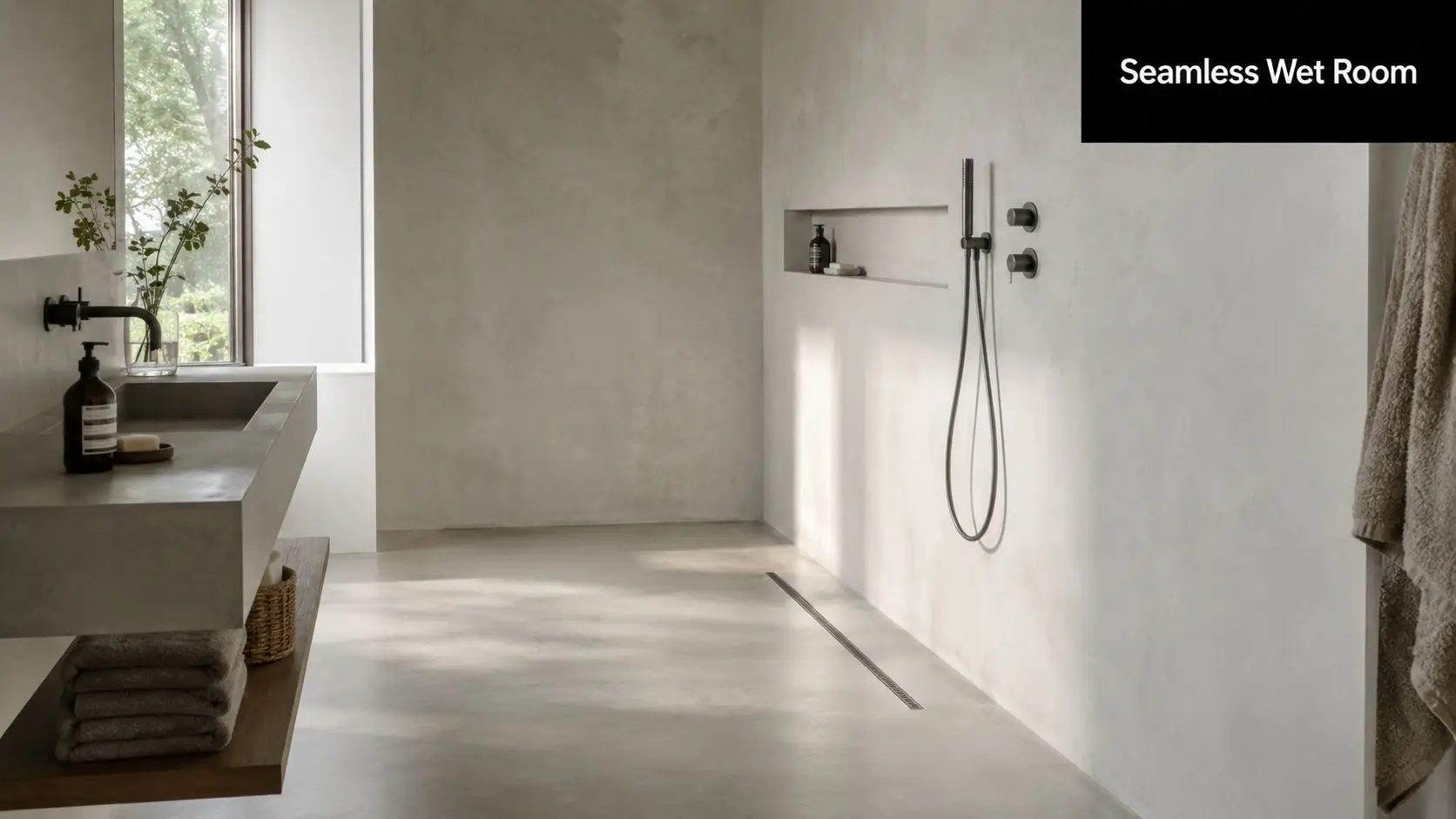
A continuous floor is one of the strongest wet room ideas for older Highett bathrooms that feel chopped up by shower screens, hob edges, and too many material changes. When the same tile runs through the whole room and the shower zone is defined by floor fall rather than a step or tray, the space reads bigger immediately.
This approach suits modern bathrooms because it removes visual clutter. A floating vanity, wall-faced toilet, recessed niche, and a linear drain can be enough to make a compact room feel calm instead of crowded. In a Victorian renovation, that matters more than people think because many bathrooms do not have spare floor area to waste.
What makes it work
The finish looks effortless, but the build isn't. The floor has to be formed correctly so water moves to waste without ponding, and the whole room needs thorough waterproofing because splash won't stay neatly inside one corner.
Practical rule: If you want the floor to look flat, the builder has to work much harder to hide the fall.
A few details usually separate a good result from a frustrating one:
- Use textured floor tiles: They keep the minimalist look but give better grip underfoot.
- Choose a drain early: Drain type affects set-out, tile cuts, and how neat the room feels.
- Keep junctions simple: Fewer trims, fewer level changes, and fewer materials usually look better.
- Think about winter comfort: In Melbourne conditions, underfloor heating can make an open shower zone feel much more inviting.
Large-format tiles are especially effective in this style because they reduce grout lines and help the room feel quieter visually. If you're comparing finishes, large-format bathroom tiles for a seamless wet room look are worth reviewing before you lock in the layout.
What doesn't work is chasing a minimalist look with cheap detailing. Misaligned falls, poor membrane work, and badly planned drain positions stand out fast in a stripped-back room because there's nowhere for defects to hide.
2. Natural Stone Wet Room with Spa Integration
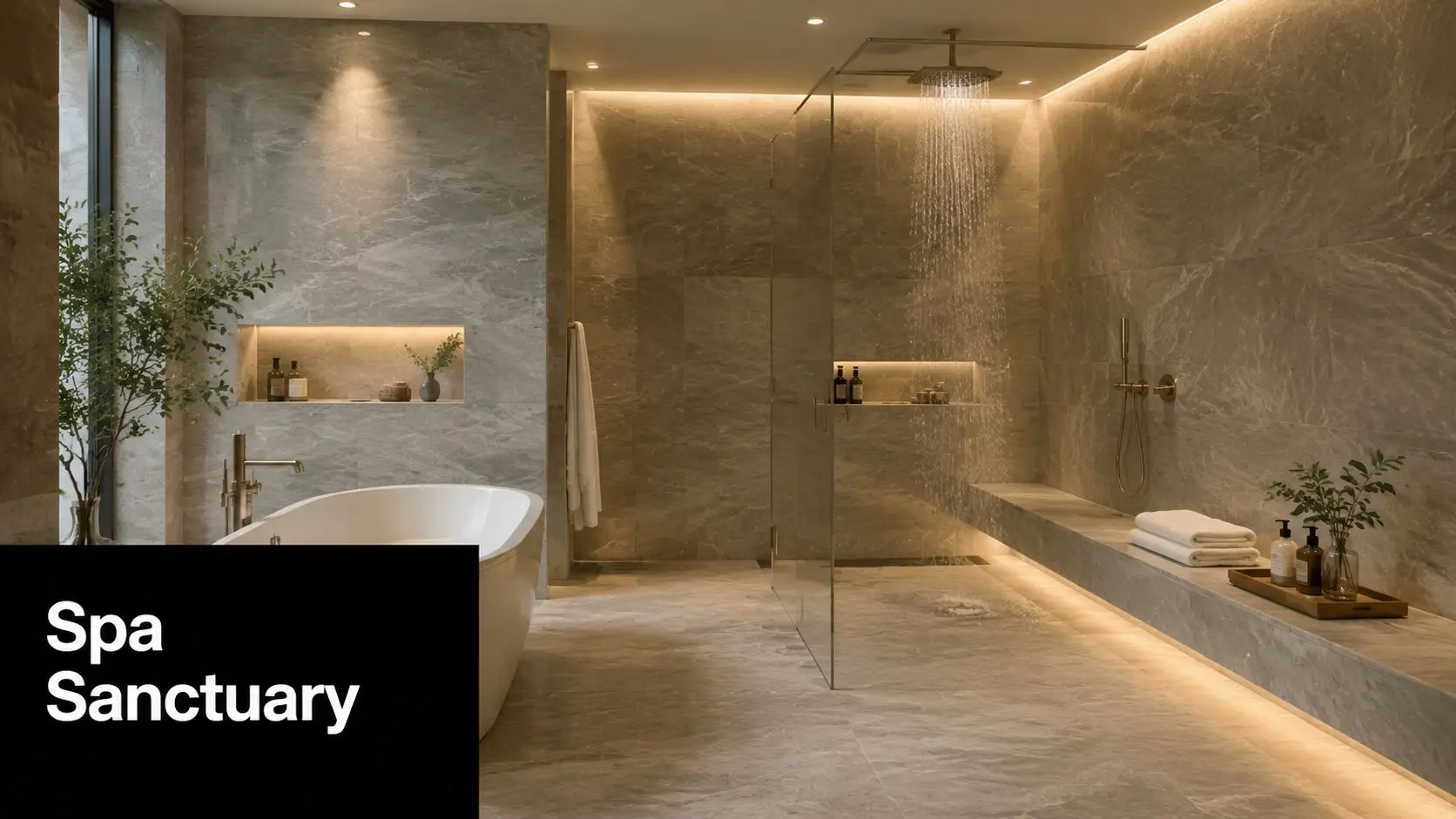
If you want the bathroom to feel like a retreat rather than a utility room, natural stone and spa features can take a wet room in that direction quickly. Think honed limestone, textured slate, or a marble-look palette paired with a rainfall shower, a heated towel rail, and a bench integrated into the wet zone.
This style suits bayside and premium family homes because it feels timeless when the material selection is disciplined. One feature wall can be enough. Covering every surface in bold stone usually pushes the room from calm to heavy, especially in bathrooms without abundant natural light.
Where the luxury budget actually goes
The main cost driver in a wet room isn't just the visible finish. It's the technical build behind it. Realtor.com's wet room cost guidance says a wet room will typically cost 25% to 30% more than a conventional bathroom with a separate shower enclosure, before higher-end fixtures are added, and luxury fixtures can add USD 10,000 to 25,000+ more.
That matters because stone and spa fittings magnify mistakes. If the substrate moves, the waterproofing is poor, or ventilation is weak, premium finishes won't save the room.
The most successful stone wet rooms usually share a few traits:
- Slip resistance comes first: Honed or textured finishes are often a better fit than highly polished stone.
- Thermostatic control matters: Premium shower fittings should deliver consistent temperature, not just a luxury look.
- Ventilation needs to match moisture load: More water output means more steam on walls, mirrors, and ceilings.
- Bench design has to be deliberate: A seat can feel resort-like, but only if drainage and waterproofing around it are handled properly.
A spa wet room should feel refined, not oversized and impractical. In many Highett homes, the smartest version is a restrained one with one standout material, one strong shower experience, and detailing that stays easy to clean.
3. Industrial-Chic Wet Room with Exposed Brick
Industrial wet rooms can look fantastic in renovated period homes, converted spaces, or houses where you want more character than a white-box bathroom delivers. Exposed brick, black tapware, concrete-look tiles, and steel-framed mirrors can create a strong Melbourne feel when they're balanced properly.
The key word is balanced. Too much raw material makes the room cold, dark, and hard to maintain. Too little and the style reads as a theme instead of a resolved design.
The heritage and moisture trade-off
Exposed brick is where a lot of homeowners get caught. Brick can be visually rich, but it isn't automatically wet-room friendly. In older Victorian homes, walls may need substantial preparation before they can safely sit inside a high-moisture space.
Wet rooms aren't forgiving of decorative decisions that ignore moisture management.
If you like this look, keep these decisions practical:
- Limit true exposed masonry to controlled areas: A feature wall outside the heaviest splash zone is often safer.
- Use stainless steel where possible: It ages better than finishes that can corrode or chip.
- Warm the palette with timber or softer lighting: Raw surfaces need something to stop the room feeling harsh.
- Check heritage constraints early: Older homes can require a more considered approach to wall treatment and layout changes.
An industrial wet room often works best when the shell is tough and the fittings are simple. Wall-mounted mixers, a frameless fixed panel if needed for splash control, and concealed storage stop the room from feeling cluttered.
What usually doesn't work is chasing an urban warehouse look in a small suburban bathroom without enough light. Dark brick, dark floors, and black fittings can compress the room quickly. If your bathroom has limited daylight, use the industrial style as an accent rather than the whole story.
4. Accessible and Universal Design Wet Room
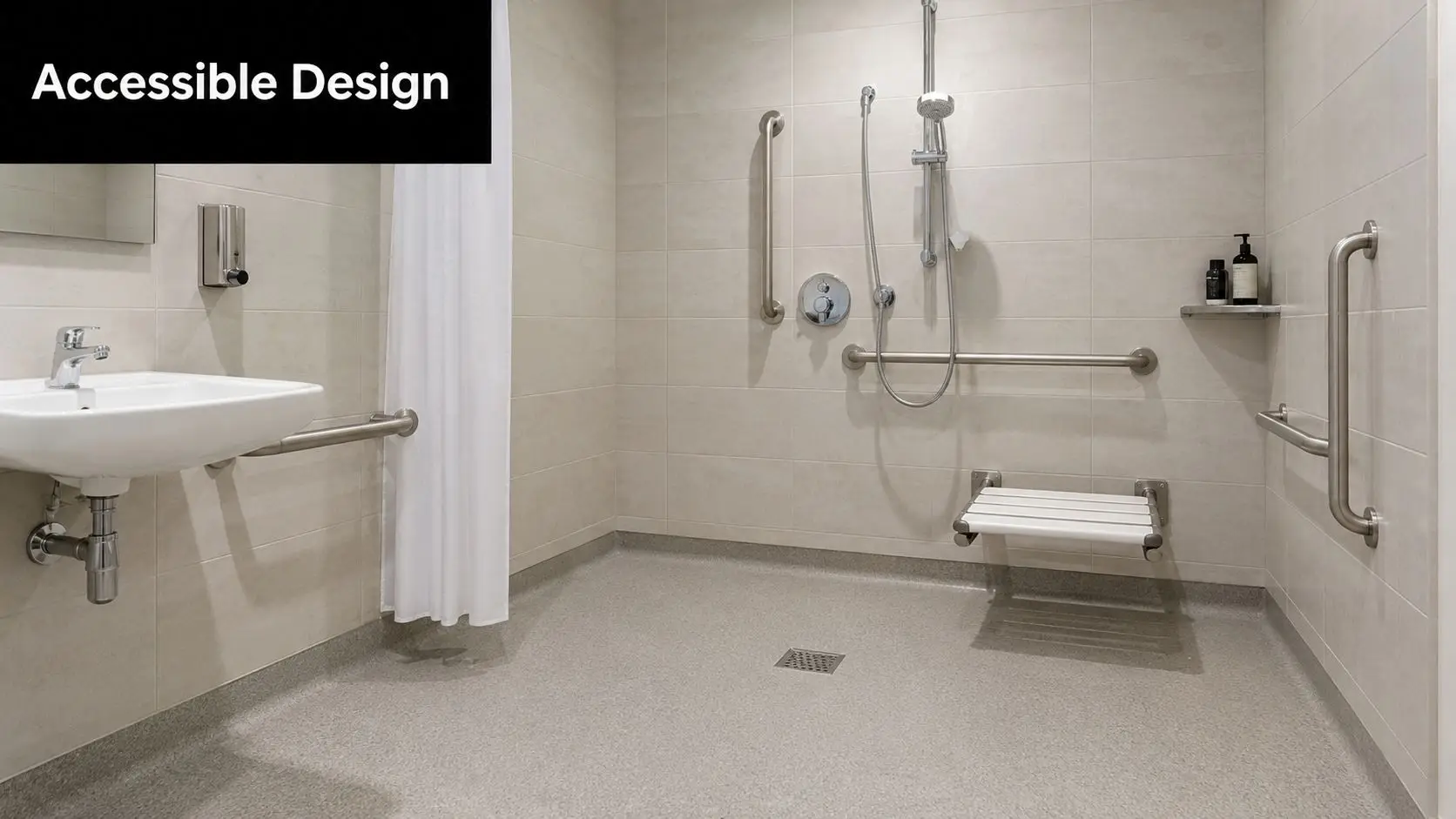
A Highett wet room often needs to serve more than one stage of life. I see this with local families who want a bathroom that works for older parents now, gives kids room to move safely, and still looks like part of a well-finished home rather than a care facility.
That is why universal design suits Bayside renovations so well. Many homeowners are planning for longer-term living, and a level-entry wet room makes that easier without locking you into a clinical look. In practical terms, it means getting the layout right from the start so the room remains usable if mobility changes later.
AS1428 is a useful reference point, but the standard only helps if the design is built around it. Clear floor space, comfortable turning room, reachable controls, and support-ready wall framing all need to be resolved before waterproofing and tiling begin. In a typical Highett renovation, that can also mean checking whether an older subfloor allows the falls, drainage position, and recessing needed for a flush shower entry.
The local trade-off is usually space. Many bathrooms in this part of Melbourne were not originally planned as accessible rooms, so every millimetre matters. A builder may need to shift a doorway, widen circulation beside the toilet, or use a fixed screen carefully so splash control does not come at the cost of access. Victorian winters matter too. If the room is more open, underfloor heating and well-placed heating can make daily use far more comfortable, especially for older occupants.
For Australian guidance, use the Victorian Building Authority information on building and renovating. It is a better fit for a Victorian project than generic overseas advice, and it reinforces the value of using registered professionals who understand local compliance, waterproofing, and layout constraints.
A strong universal-design wet room usually includes:
- Level access: No raised hob or lip to interrupt walking or mobility aids.
- Slip-resistant flooring: Choose a tile finish that stays safer underfoot when wet.
- Reinforced walls: Future grab rails can be added without opening finished walls later.
- Clear fixture placement: Mixers, niches, and shower controls should be easy to reach from standing or seated positions.
- Contrast where it helps: Subtle visual definition at the floor, walls, and fittings improves confidence without making the room look institutional.
The mistake is treating accessibility as an add-on after the finishes have been chosen. The best results come from resolving drainage, structure, circulation, heating, and support points early, then wrapping the room in materials that still feel calm, refined, and suited to the rest of the house.
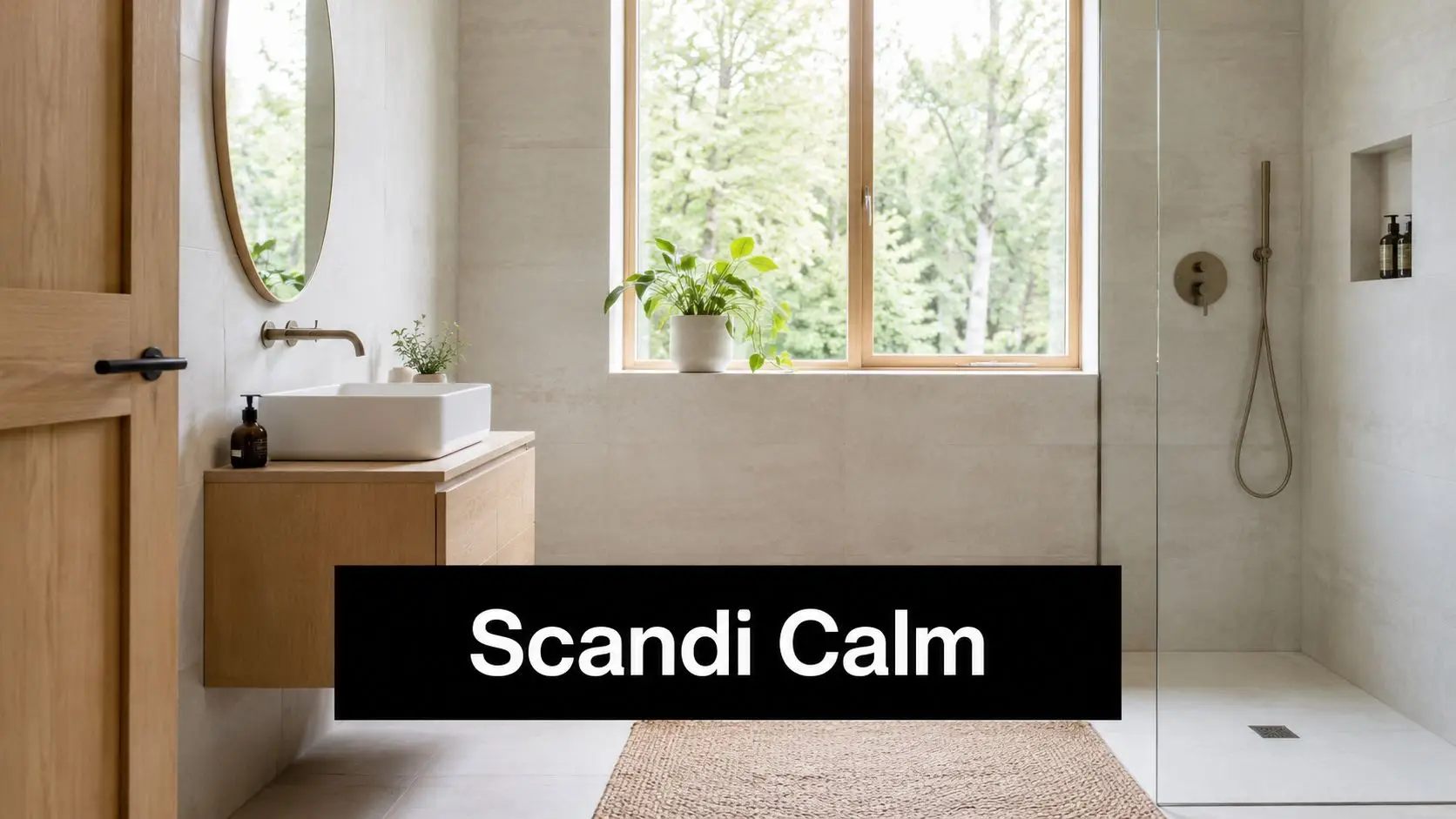
5. Scandinavian Minimalist Wet Room with Light Wood
Scandinavian-inspired wet rooms are popular because they soften the hard edges that can make open bathrooms feel sterile. Pale tiles, light timber, brushed metal, soft white walls, and simple joinery create a calm room that still feels warm enough for everyday family life.
This look works particularly well in Highett homes where the bathroom doesn't get a flood of natural light. A lighter palette reflects what light you do have, and the timber tones stop the room feeling flat.
How to keep timber-looking spaces practical
The trick is restraint. You don't need a full timber-clad bathroom to get the effect. A vanity in oak or ash tones, a timber-framed mirror, and a niche shelf detail can carry the style without overcomplicating the maintenance.
Use matte finishes where possible. They reduce glare, hide water spotting better than highly polished surfaces, and suit the relaxed feel of Scandinavian design.
A few combinations tend to age well:
- Pale stone-look porcelain with oak-toned joinery
- Off-white wall tiles with a light grey floor
- Brushed nickel tapware instead of high-gloss chrome
- Textured towels and soft lighting rather than decorative clutter
This style also suits underfloor heating and good layered lighting. A wet room can feel exposed in winter, so warmth underfoot and softer ambient light help the room feel comfortable, not just visually clean.
What doesn't work is mixing too many pale finishes with no contrast at all. The result can feel washed out. One darker note, such as a charcoal drain, a warm bronze fitting, or a stone vanity top, usually gives the room enough definition.
6. Compact Wet Room for Small Bathrooms and Ensuites
Small bathrooms are where wet rooms can be either brilliant or disappointing. Done properly, they remove the visual and physical bulk of a shower cubicle. Done badly, they leave the whole room wet after every shower and make storage even more difficult.
That's why compact wet room design has to be ruthless about planning. Every fitting needs a reason to be there, and every millimetre of wall space should earn its keep.
Small-space moves that actually help
Wall-hung vanities and toilets free up the floor visually, which makes the room read larger. Recessed niches work better than bulky corner caddies. A fixed glass screen can be useful in tight rooms if it controls splash without cutting the space in half.
In a compact wet room, layout matters more than luxury fittings.
If you're working with an ensuite or narrow footprint, these choices usually pay off:
- Keep the vanity slim: Deep vanities often cause more circulation problems than people expect.
- Use mirrors generously: They bounce light and make a narrow room feel less boxed in.
- Build storage into the walls: Recessed shaving cabinets and niches are more efficient than add-on storage.
- Ventilate aggressively: Smaller rooms trap moisture faster, especially during winter.
For compact layouts, it helps to review small ensuite design ideas that prioritise space and function before fixing plumbing positions. The best small wet rooms often come from smart planning rather than expensive materials.
One more reality check. Not every small bathroom should become a full wet room. Sometimes a curbless open shower with tighter wet-zone control is the better answer if you need the rest of the room to stay drier between uses.
7. Warm Contemporary Wet Room with Timber and Warm Tones
If all-white bathrooms leave you cold, a warm contemporary wet room can feel far more liveable. Think soft neutrals, clay tones, warm timber, brushed brass or bronze fittings, and stone with natural variation rather than high-contrast veining.
This style suits family homes because it feels inviting. It also bridges the gap between modern bathrooms and older Victorian houses that still have some period character elsewhere in the home.
Warmth needs discipline
The room should feel layered, not busy. Warm-toned bathrooms go wrong when every finish competes for attention. Terracotta floor tiles, walnut joinery, cream walls, brass fixtures, patterned stone, and feature lighting can sound beautiful individually and chaotic together.
A more controlled approach works better:
- Pick one hero tone: Timber, clay, or stone. Not all three at full strength.
- Use clean lines: Warm materials look more contemporary when the forms stay simple.
- Choose lighting carefully: Warm lighting supports the palette, but it still needs to be bright enough for practical use.
- Seal moisture-sensitive finishes properly: Warm textures only last if they're suited to a wet environment.
This type of room often benefits from natural light, but it can also work well in darker spaces if the lighting plan is strong. Wall lights beside the mirror, soft ceiling lighting, and under-vanity glow can make the room feel considered rather than dim.
A warm contemporary wet room is one of the easiest wet room bathroom ideas to personalise. It can lean coastal, refined, or luxurious without losing the practical benefits of level access and open planning.
8. Multi-Generational Wet Room with Flexible Features
A common Highett brief is straightforward. Make the bathroom safe for grandparents, practical for kids, and still polished enough that it does not feel like a retrofit. A wet room suits that brief because the room can stay open, level, and easier to adapt as the household changes.
This approach is particularly relevant across Bayside, where more families are reworking their homes to support older parents, teenagers, or a longer-term stay from adult children. In renovation projects around Highett, that often means one bathroom has to serve very different users across the same week, not at some distant future point.
The design has to work now. It also needs enough foresight to avoid another renovation in a few years.
A good multi-generational wet room usually includes:
- Level access into the shower area: Easier for young children, older relatives, and anyone recovering from injury.
- A hand shower on a rail: Useful for seated showering, assisted bathing, and routine cleaning.
- Reinforced walls for future grab rails: The room can change later without opening up finished tile work.
- Storage at different heights: Children can reach daily items, while adults still get practical vanity and mirror space.
- Circulation space that allows assistance: If one person needs help, the room should not become awkward or unsafe.
The trade-off is floor area. Flexibility sounds good on paper, but in a tight bathroom it can lead to a layout that serves every possible scenario poorly. The better approach is to prioritise your current household, then build in a few low-visibility allowances for later. Reinforcement in walls, sensible clearances, and a shower area sized properly from the start do more good than filling the room with specialist fixtures you may never use.
For Victorian homes, compliance and detailing matter as much as layout. If accessibility is part of the brief, the room should be checked against relevant requirements such as AS1428 clearances, gradients, and fixture positioning where applicable. Heating also deserves attention in Melbourne winters. An open wet area that works well in January can feel cold in July without underfloor heating, careful ventilation, or both. Practical planning like this has more impact than trend-driven features, though some homeowners combine flexible planning with smart bathroom technology used in modern construction and fit-outs to improve comfort and day-to-day use.
Done properly, a multi-generational wet room does not look clinical. It looks calm, well resolved, and ready for real family life in a Highett home.
9. Smart Wet Room with Technology Integration
Technology can improve a wet room, but only when it solves a real problem. Good examples include heated floors on timers, demisters for mirrors, humidity-sensing exhaust fans, digital shower controls, and lighting scenes that shift from bright task light to softer evening use.
In Victorian homes, the practical value is often comfort and moisture control rather than novelty. Open shower areas can feel cool in winter and stay damp if ventilation lags behind use, so smart systems can help the room perform better day after day.
Add technology where it reduces friction
A humidity-sensing fan is often more useful than voice control. A mirror demister can be more practical than an app-connected fitting that nobody uses after the first month. The smartest modern bathrooms usually prioritise reliability over gimmicks.
The technical side still matters. Wet rooms place electrical components in a moisture-heavy environment, so coordination between waterproofing, electrical rough-in, and fixture selection has to be tight.
A sensible smart wet room may include:
- Programmable underfloor heating: Better comfort for cold mornings.
- Humidity-responsive ventilation: Useful for enclosed or poorly ventilated rooms.
- Digital thermostatic shower control: Consistent temperature and easier operation.
- Task and ambient lighting zones: Better function without overlighting the room.
If you're interested in connected systems more broadly, how IoT is changing construction planning and coordination gives useful context for why early specification matters.
What doesn't work is filling a bathroom with proprietary gadgets that are hard to service later. Choose systems with straightforward controls, local support, and a clear reason to exist.
10. Outdoor-Inspired Wet Room with Natural Materials and Biophilia
A Highett wet room can take cues from the coast without slipping into a theme. Along the Beach Road corridor, that often means finishes that echo the local tea-tree and dune palette: sandy stone tones, muted greens, soft light, and materials that feel calm rather than glossy.
Done well, this style suits homeowners who want a bathroom that feels grounded and restorative. Done poorly, it can turn into a damp room full of high-maintenance surfaces.
The trade-off is straightforward. Natural materials add warmth and character, but wet rooms are hard on anything porous, absorbent, or poorly sealed. In Victorian homes, where winter mornings are cold and bathrooms often stay closed up for longer, I would always treat heating, extraction, and waterproofing as part of the design, not afterthoughts.
That matters even more if you want timber accents, planted niches, or textured stone. The room still needs correct falls to drain, a substrate prepared for continuous wet use, and a ventilation setup that clears steam quickly. For local guidance on wet area construction and compliance, the Victorian Building Authority sets out the baseline requirements through its building standards and practitioner guidance.
A restrained material palette usually works best here:
- Stone or stone-look tiles with a slip-resistant finish
- Curved edges or recessed shelving to soften the room
- Moisture-tolerant plants used sparingly, near light and away from constant spray
- Skylights or obscure glazing where privacy and orientation allow
- Warm floor heating to keep the space comfortable through colder Victorian months
Restraint makes the room feel more expensive.
A couple of well-placed ferns can work. A dense wall of greenery in an ensuite with weak ventilation usually becomes a cleaning job. The same goes for raw timber in splash zones. Use timber-look porcelain where direct water contact is constant, and keep real timber to vanities, battens, or areas that can dry properly between uses.
If you want the bathroom to feel connected to the outdoors, focus on texture, light, and temperature first. Those choices last longer in a Highett renovation than decorative styling alone.
10 Wet Room Design Comparison
If you are weighing up wet room bathroom ideas for a Highett renovation, the right choice usually comes down to how you live, who uses the room, and how much build complexity your budget can carry. Some designs look impressive in photos but need tighter detailing, more maintenance, or more floor area than homeowners expect.
This comparison focuses on practical outcomes. It also reflects what matters in Victoria, including winter comfort, slip resistance, ventilation, and accessible design decisions that may need to align with AS1428 principles.
| Design | Implementation complexity | Resource requirements | Expected outcomes | Ideal use cases | Key advantages |
|---|---|---|---|---|---|
| Minimalist Wet Room with Continuous Flooring | High, with precise set-downs, falls, and drainage detailing | Experienced waterproofers and tilers, premium membranes, linear or central drains, carefully selected floor tiles | Open, modern room that is easier to clean and feels larger | Compact ensuites, high-end renovations, accessible layouts | Reduces visual clutter, makes small rooms read larger, works well for step-free access when detailed properly |
| Natural Stone Wet Room with Spa Integration | Very high, often involving structural coordination and specialist installation | Natural stone, spa plumbing, underfloor heating or heated seating, strong extraction, stone sealing | Premium, retreat-style bathroom with a higher-spec finish | Main ensuites, larger homes, luxury renovations | Creates a high-end, relaxing feel, adds comfort in winter, suits homeowners prioritising long-term appeal |
| Industrial-Chic Wet Room with Exposed Brick | Medium, with careful treatment of porous surfaces and junctions | Brick or brick-look finish, concrete or porcelain tiles, corrosion-resistant fittings, specialist sealers | Hard-wearing bathroom with strong character and texture | Character homes, converted spaces, design-led renovations | Adds personality without overcomplicating the layout, hides wear reasonably well, pairs well with durable finishes |
| Accessible and Universal Design Wet Room | Medium to high, with careful planning around circulation, support rails, and fixture placement | Slip-resistant flooring, reinforced walls, certified rails, suitable drainage, possible OT input, strong ventilation | Safer bathroom that supports independent use now and later | Older residents, NDIS participants, family homes, long-term homes | Improves day-to-day safety, supports ageing in place, can be designed to look refined rather than clinical |
| Scandinavian Minimalist Wet Room with Light Wood | Medium, with attention to timber placement and moisture control | Light timber accents outside direct splash zones, pale tiles, quality waterproofing, good natural and artificial light | Bright, calm bathroom with a soft, restrained finish | Contemporary homes, smaller bathrooms, homeowners wanting a lighter interior feel | Keeps the room feeling airy, ages well visually, balances warmth with a clean layout |
| Compact Wet Room for Small Bathrooms and Ensuites | Medium, with tight space planning and precise fixture selection | Wall-hung fixtures, recessed storage, efficient drainage, clear shower zone planning, reliable extraction | Better use of a small footprint without making the room feel cramped | Apartments, small ensuites, granny flats, older homes with limited space | Gets more function from less floor area, improves movement through the room, often removes the need for bulky screens |
| Warm Contemporary Wet Room with Timber and Warm Tones | Medium to high, because mixed finishes need careful detailing in wet zones | Timber-look porcelain or protected timber joinery, warm-toned tiles, layered lighting, quality sealants and membranes | Inviting bathroom that feels less stark than a cooler minimalist scheme | Family homes, period homes, premium renovations | Creates a comfortable, lived-in feel, softens the look of larger bathrooms, suits daily family use |
| Multi-Generational Wet Room with Flexible Features | High, with more coordination around clearances and changing user needs | Adjustable fittings, generous circulation space, seating options, reinforced fixing points, well-considered storage | Bathroom that works across different ages and mobility levels | Multi-generational households, adaptable family homes, granny flats | Reduces the need for later alterations, supports changing access needs, makes the room easier for everyone to use |
| Smart Wet Room with Technology Integration | High, due to electrical coordination and careful product selection for wet areas | Smart controls, thermostatic mixers, lighting controls, sensors, licensed electrical work, dependable connectivity | More control over comfort, lighting, and water use | Newer homes, luxury renovations, homeowners who value convenience | Improves comfort and usability, can help manage heating and lighting efficiently, gives repeat users quicker setup |
| Outdoor-Inspired Wet Room with Natural Materials and Biophilia | High, with more attention to moisture management, cleaning, and plant suitability | Stone or stone-look surfaces, moisture-tolerant planting used sparingly, strong extraction, good daylight, careful material selection | Calmer bathroom with a natural, grounded feel | Larger bathrooms, premium homes, wellness-focused renovations | Uses texture and light well, creates a restful atmosphere, brings in natural character without relying on short-lived styling |
A comparison table helps narrow the style direction, but buildability should decide the final brief. In Highett homes, I would usually test each option against four filters first. Budget, winter warmth, cleaning effort, and who needs to use the room over the next ten years. That process usually rules out the wrong concept quickly and leaves you with a wet room that performs well, not just one that photographs well.
Start Your Bathroom Renovation With Confidence
A wet room can be one of the smartest upgrades you make to a Victorian home. It can open up a cramped layout, improve accessibility, reduce visual clutter, and give the bathroom a more refined, architectural feel. For many Highett homeowners, it also solves everyday frustrations that a standard shower enclosure never quite fixes.
That said, a wet room isn't a shortcut to better design. It asks more of the build than a conventional bathroom. The entire room has to be treated as a water-managed environment, not just the shower corner. If falls are wrong, drainage is underdone, ventilation is weak, or waterproofing is treated as a box-ticking exercise, the bathroom may look good on handover day and perform poorly over time.
That's why planning matters so much. The best results come from resolving the practical questions early. Who's using the room now. Whether ageing-in-place should be factored in. How much splash control the layout needs. Where heating should go for winter comfort. Whether natural materials are realistic for the way your household lives. These aren't minor details. They shape whether the room feels effortless or annoying to use.
For homeowners exploring new bathroom ideas, it also helps to be honest about priorities. Some wet rooms are mainly about luxury and clean aesthetics. Others are about accessibility and future-proofing. Some need to make a tiny ensuite feel bigger. Others need to support a multi-generational household. Once that purpose is clear, the design gets much easier to refine.
Good wet room design also depends on local knowledge. Victorian homes vary widely in structure, floor levels, ventilation constraints, and renovation potential. Local standards, practical heating choices, and experience with real bathroom renovations in Highett and greater Victoria make a difference when details need to be resolved properly rather than guessed on site.
If you want the finished result to look like a designer bathroom and perform like a professionally built wet area, work with qualified professionals who understand both design and construction. SitePro Bathrooms brings that end-to-end approach to bathroom renovations, from 3D planning through to construction and finishing. As registered builders unlimited, the team can help you shape modern bathrooms that are beautiful, durable, and designed for how your household uses the space.
If you're ready to turn these wet room bathroom ideas into a real project, contact SitePro Bathrooms to discuss your layout, your style, and the practical requirements behind a successful wet room.