
Bathroom Tiling Cost in 2026: A Highett & VIC Guide
You pick a tile at the showroom, multiply it by the floor and wall area, and the number looks manageable. Then the quote comes back higher than expected because bathroom tiling in Victoria is priced as a wet-area system, not just a tile supply rate.
That catches plenty of Highett homeowners out.
The visible tile is only one part of the cost. A proper bathroom tiling price can also include substrate correction, sheet or liquid waterproofing, screeding to falls, corner detailing, trims, movement joints, and the labour to cut neatly around wastes, tapware, niches, and fixtures. If the room is out of plumb, the floor is uneven, or there is damage from a previous leak, the work increases before the first tile goes down.
This is the part generic online calculators usually miss. They often start and finish with square metres and tile grade. Real bathroom quotes in Victoria need to account for compliance, the condition of the existing surfaces, and whether the bathroom can be tiled as-is or needs rectification first.
In practice, the cheaper quote is not always the cheaper job. If waterproofing is skimmed over, falls are poor, or the substrate is not prepared properly, the repair cost later is usually far higher than the saving upfront.
The useful way to assess bathroom tiling cost is to look at the full installed result. You are paying for a surface that bonds properly, drains properly, meets wet-area requirements, and still looks right years after handover.
Your 2026 Guide to Bathroom Tiling Costs in Highett
A homeowner in Highett picks a tile at the showroom, works out the wall and floor area, and expects the tiling cost to sit close to that number. Then the quote arrives with waterproofing, screeding, substrate repair, trims, and labour for detailed cuts around fixtures. That gap is where a lot of budget blowouts start.
Bathroom tiling cost is rarely just about tile selection. In Victoria, the all-in price depends on whether the room is ready to tile, whether the wet area needs new waterproofing, and how much prep is required to get a straight, durable finish. A bathroom with uneven walls, poor falls, or damage from an old leak will cost more to tile properly than a room with sound, tile-ready surfaces.
That is why tiling can shift the whole renovation budget.
A proper tiling allowance needs to cover more than visible finishes. It often includes:
- Wet-area preparation to suit Victorian compliance requirements
- Waterproofing and detailing at junctions, corners, penetrations, and shower areas
- Substrate correction where walls are bowed, floors are uneven, or sheeting needs replacement
- Screeding to falls so water drains correctly to the waste
- Labour for layout and cutting around niches, tapware, toilets, vanities, and floor wastes
- Trims, movement joints, grout, and adhesives suited to the tile type and room conditions
The tile is the part you see. The preparation and installation standard are what determine whether the bathroom performs properly.
Early budgeting gets easier once three decisions are clear.
How much of the room is being tiled
Floor-only tiling, shower-only tiling, and full-height wall tiling sit in very different cost ranges.Whether this is a full renovation or a retile over corrected surfaces
Demolition, rectification, and new waterproofing add scope before tiling starts.What finish standard you expect
A simple stacked layout with standard-size tiles is priced differently from large-format porcelain, herringbone patterns, mitred edges, or feature niches.
For Highett homeowners, the useful question is not “what do tiles cost per square metre?” The better question is “what will it cost to supply and install a compliant, long-lasting tiled bathroom in the condition my room is in?” That is the number that lets you budget properly.
Understanding Tiling Prices Per Square Metre
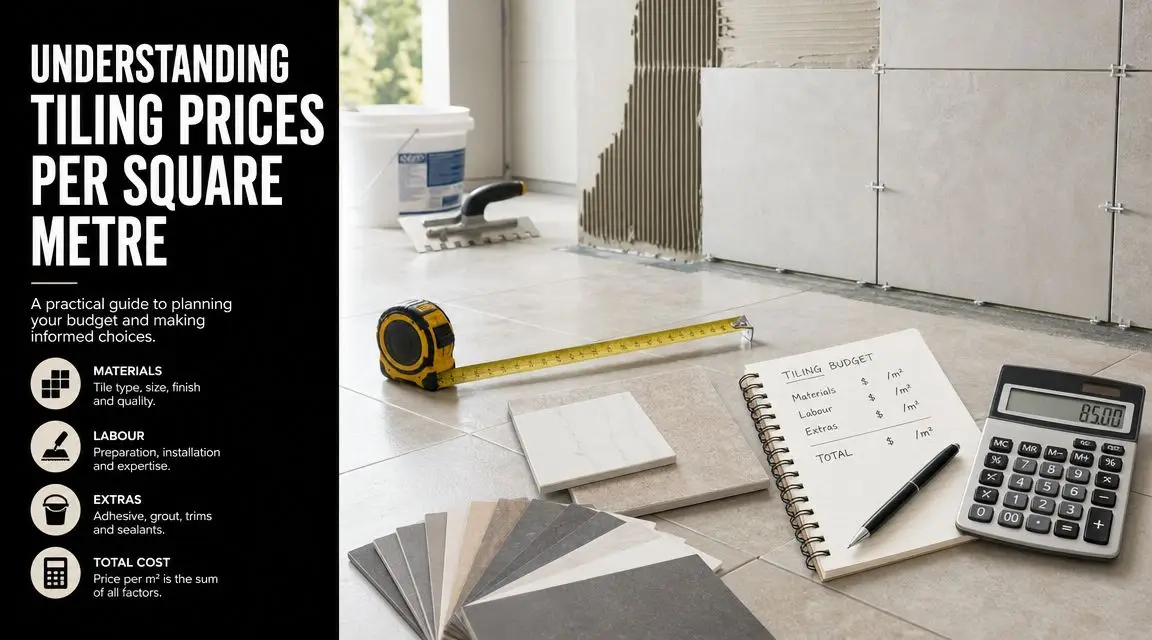
A Highett homeowner might walk into a tile showroom, choose a tile at a sharp retail price, then assume the bathroom budget is largely sorted. It rarely works that way. Per-square-metre pricing is useful for comparing tile products, but it does not tell you the all-in cost of getting a bathroom tiled properly in Victoria.
The first split to make is simple. There is a supply rate for the tile itself, and there is an installed rate for a finished bathroom surface. Those numbers are not close once you allow for cutting, setting out, adhesives, trims, grout, wastage, and the extra labour that bathrooms always involve.
Supply cost versus installed cost
Supply-only pricing usually follows the tile category and finish:
| Tile choice | What it usually means for budget |
|---|---|
| Basic ceramic | Lower material cost and often suitable for straightforward wall applications |
| Porcelain | Higher material cost in many cases, with better suitability for floors and wet areas |
| Large-format or specialty finishes | Higher product cost, plus more handling, more care during install, and tighter substrate tolerances |
Installed pricing changes for a different reason. It reflects how much labour and site work the tile choice creates.
A low-cost tile can still be expensive to install if it needs a lot of cuts, chips easily, or has shade variation that slows the set-out. A more expensive tile can sometimes install faster if the room is simple and the format suits the space.
That trade-off catches people out.
Why square metre rates can mislead in bathrooms
Open floor areas are one thing. Bathrooms are full of interruptions.
A tiler is working around tap penetrations, wastes, corners, nib walls, toilet pans, vanities, shower screens, niches, and often out-of-square walls. Two bathrooms with the same tile area can price very differently because one is a clean rectangle and the other is a tighter room with more detailing.
Large-format tiles are a good example. They can give a clean, high-end finish with fewer grout joints, but they also demand flatter walls and floors, careful handling, and cleaner layout decisions. If you are considering that look, it helps to understand the practical side of installing large-format porcelain tiles before you compare rates by square metre alone.
A practical way to use per-metre pricing
Use square metre rates as a screening tool, not as the final budget.
They are helpful for comparing one tile product against another and for getting an early feel for whether you are shopping in an entry-level, mid-range, or premium bracket. They are less useful for working out the full cost of a compliant bathroom tiling job, because bathrooms are priced by area and by complexity.
In real quotes, the labour rate per square metre tends to rise when the job includes:
- More cuts and edge detailing
- Smaller rooms with more fixtures packed in
- Patterned layouts or feature walls
- Large-format tiles that need flatter substrates
- Mitred corners, niches, or trimless finishes
- Higher wastage from layout matching or tile variation
The better budgeting question
The useful question is not the retail tile rate on the box. The useful question is what each square metre will cost once the tile is installed straight, drained properly, finished neatly, and backed by the preparation the room needs.
That is why online tile calculators regularly understate bathroom costs for Victorian homeowners. They measure area. They do not measure condition, detailing, access, compliance, or finish standard.
What a Professional Tiling Quote Actually Includes
A homeowner in Highett gets three tiling quotes for the same bathroom and the prices are miles apart. In most cases, the gap is not just margin. It is scope. One quote allows for demolition, substrate correction, waterproofing, trims, silicones, waste, and final detailing. Another may only cover laying tiles onto whatever surface is already there.
That is why a proper quote needs to show the full installed scope, not just a square metre rate and a total.
The line items that should be there
A bathroom tiling quote should break the work into clear parts so you can see what is being supplied, what is being prepared, and what is being installed. In Victoria, that matters because a wet area is not priced properly unless the quote deals with both finish and compliance.
A professional quote will usually include:
Demolition and waste removal
Removing old tiles, adhesives, bedding, damaged sheet substrate, and site rubbish. Disposal costs are real, especially where access is tight or the home is occupied.Substrate preparation
Floors and walls need to be flat, sound, and suitable for tiling. That can mean levelling, patching, replacing sheet substrate, correcting falls, or straightening walls before any waterproofing or tile laying starts.Waterproofing scope
This should be listed clearly, not buried inside a vague labour line. A proper quote identifies the wet areas being treated, the system being used, and who is responsible for that work.Tile laying labour
Set-out, cuts, alignment, junctions, penetrations, edges, and finishing around fixtures all sit in this part of the price. The quality of these tasks highlights a tiler's experience.Adhesives, grout, trims, and sealants
These materials affect performance and finish. Cheap quotes often leave trims or silicone work unclear, then add them later as variations.Final clean and finishing
Grout clean-up, silicone joints, checking edges, and leaving the bathroom ready for the next trade or handover.
If the quote is too brief, ask for it to be broken down. A one-line allowance makes it hard to compare one contractor with another, and it gives you very little protection if the scope shifts once work begins.
What cheap quotes often leave out
The lowest number can still become the highest final cost if the missing work appears later as variations.
The most common omissions are:
- Rectification of uneven or unsuitable surfaces
- A defined waterproofing allowance
- Tile trims, mitres, or exposed edge treatment
- Waste removal and disposal
- Responsibility for tile supply, breakage, and wastage
- Silicone sealing to corners and junctions
- Detailing around niches, floor wastes, and tap penetrations
These details matter more with larger tiles. Flatness tolerances are tighter, lippage is harder to hide, and the set-out needs more care around fixtures and corners. If you are considering installing large-format porcelain tiles, the quote should allow for the extra preparation and handling time rather than pricing them like a standard small-format wall tile.
A good bathroom tiling quote shows where the money is going, what condition the room is assumed to be in, and what happens if that assumption is wrong.
What to check before you accept the price
Read the quote as if you are checking for gaps, not just totals.
A useful quote answers these questions clearly:
| Quote question | Why it matters |
|---|---|
| Who supplies the tiles | Avoids disputes about lead times, breakage, shade variation, and wastage |
| What condition the quote assumes | Stops surprises if demolition reveals rotten sheeting, poor falls, or movement |
| What preparation is included | Shows whether flattening, patching, or substrate replacement has been allowed for |
| How waterproofing is handled | Confirms the wet-area work has been priced and assigned properly |
| What finish standard is included | Edge trims, mitred corners, niches, feature patterns, and layout centring all affect labour |
| What is excluded | Helps you compare quotes on a like-for-like basis before signing |
In practice, the best quote is usually the clearest one. It gives you an all-in picture of the tiling cost for your bathroom, including the hidden work that generic calculators skip and Victorian wet areas regularly need.
Key Factors That Raise or Lower Your Tiling Budget
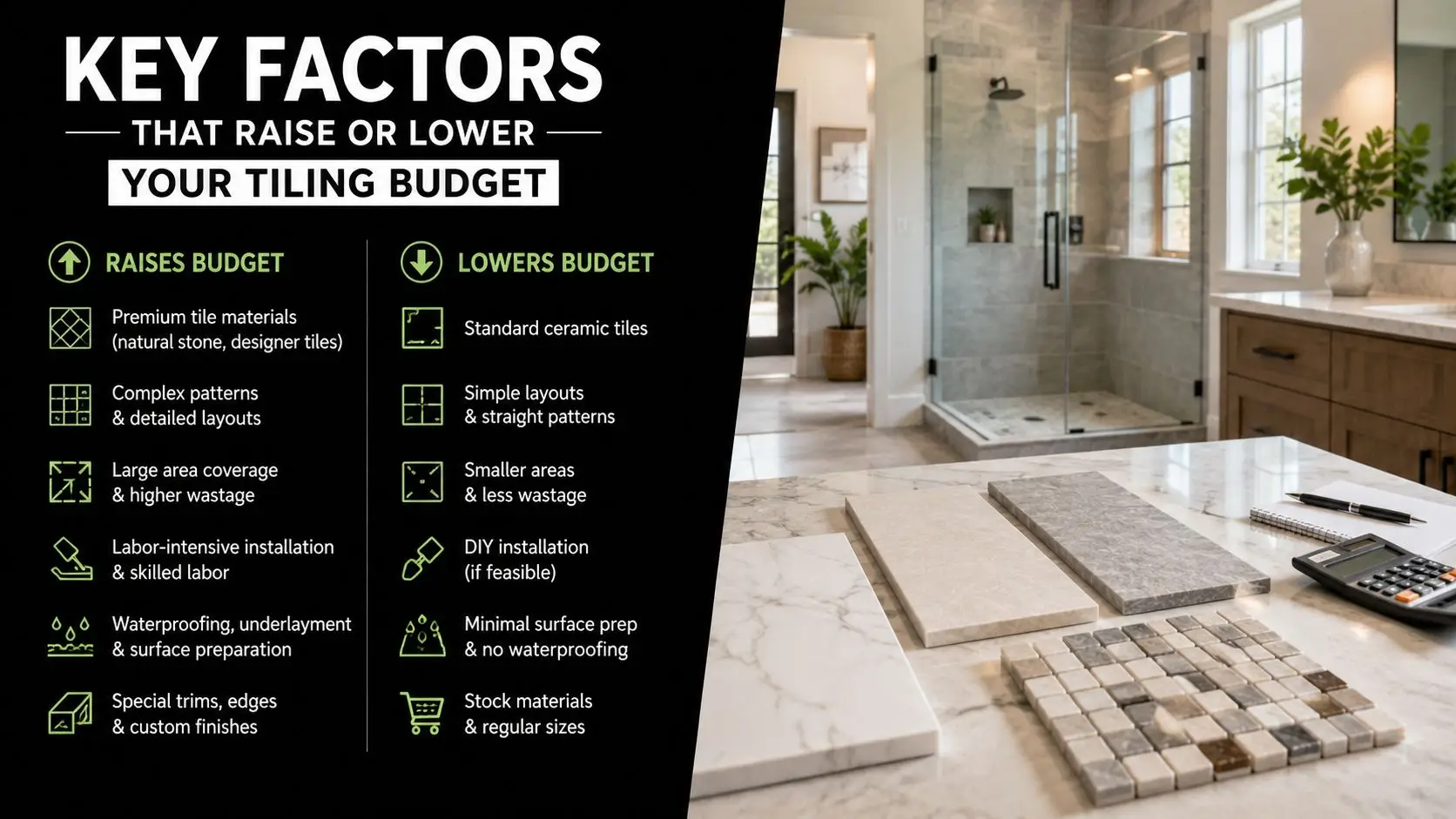
A bathroom can look straightforward on paper, then cost more once the old finishes come off. In Highett and across older Melbourne homes, the swing factor is often the condition underneath the tiles, not the tile you picked in the showroom.
That is why online tile calculators regularly miss the mark. They tend to price visible area. A real bathroom tiling budget in Victoria also has to allow for substrate correction, wet-area preparation, waterproofing, set-out, and the detailing needed to leave the room compliant and usable.
The biggest budget movers
If the price changes after inspection or demolition, these are usually the reasons.
Surface condition
Tiling goes faster, and gives a better result, when the room is straight, solid, and dry. If the floor is out of level, the falls are wrong, the walls are bowed, or the sheeting is not suitable, those issues need to be fixed before tiling starts.
This is one of the biggest cost variables because prep work is hard to see in a finished bathroom, but it controls the finish. Poor surfaces lead to lipping, bad drainage, cracked grout lines, and ongoing movement.
Waterproofing scope
Waterproofing is part of the job, not an optional extra. In a Victorian bathroom renovation, the quote needs to reflect the wet-area requirements, the number of junctions and penetrations, and how much area is being treated.
A simple room with standard shower detailing is quicker to handle than one with recessed niches, an awkward hob, multiple tap penetrations, or transitions into adjoining flooring.
Bathroom size and layout
Small bathrooms often cost more per square metre than larger ones. There is less room to work, more cutting around fixtures, and less tolerance for set-out mistakes. A compact room can still carry the fixed labour involved in protection, preparation, waterproofing, and clean-up.
That is one reason a small bathroom remodel cost in Melbourne can surprise homeowners during early budgeting.
Tile format and finish quality
Standard ceramic or porcelain in a practical size is usually quicker to install than large-format tiles, rectified edges, mosaics, or patterned layouts. The tighter the joints and the more visible the alignment, the more labour goes into the set-out and installation.
Finish expectations matter too. Centre lines, niche alignment, balanced cuts at corners, and tidy edge treatment all take time. Good tiling is not just sticking tiles to a wall. It is planning the layout so the room looks right when everything is in.
Features that add labour quickly
Area alone does not set the price. Detailing does.
These common items can lift the tiling budget even when the room size stays the same:
- Shower niches with internal falls, waterproof detailing, and clean edge finishing
- Feature walls where pattern alignment and cut placement are obvious at eye level
- Strip drains and custom falls that require tighter floor-setting accuracy
- Boxed services, nib walls, and hob walls that create extra corners and edge work
- Decorative patterns or mixed tile sizes that slow the set-out and increase cutting
If the room needs correction before tiling, the preparation work will often drive the cost more than the tile selection.
What helps keep tiling costs under control
The most cost-effective bathrooms are usually the ones that work with the room, not against it. Simple choices often produce the best value.
| Budget-friendly factor | Why it helps |
|---|---|
| Straightforward layout | Reduces difficult cuts and speeds up set-out |
| Standard tile sizes | Makes handling, cutting, and spacing more predictable |
| Sound, suitable substrate | Cuts down on rectification before waterproofing and tiling |
| Fewer custom details | Reduces labour on trims, corners, returns, and alignment |
| Practical fixture locations | Avoids extra penetrations and awkward finishing around fittings |
The cheapest quote is not always the lower-cost outcome. If preparation, waterproofing, or substrate repairs are underallowed, the room still needs that work done. A clear all-in quote usually gives a better picture of what the bathroom will cost to tile properly in Victoria.
Sample Tiling Budgets for Common Bathroom Sizes
Homeowners usually want a working number, even if it's only a planning range. The safest way to treat any early estimate is as a budgeting guide, not a fixed quote, because the final scope depends on what demolition and site inspection reveal.
The table below uses broad Victorian planning logic based on common bathroom types and the installed bathroom tiling cost ranges already discussed for standard work. It's intended to help you think in terms of project scale, not to replace a measured quote.
Estimated Tiling Budgets for Highett Bathroom Renovations 2026
| Bathroom Type | Tiled Area (Approx.) | Estimated Tiling Cost Range |
|---|---|---|
| Small powder room | Small floor area with limited wall tiling | Often toward the lower end of standard installed rates, but small-job labour premiums can make the effective rate feel higher |
| Standard family bathroom | Moderate floor area plus shower walls and selected full-height walls | Often sits in the middle of the standard installed range, depending on preparation and tile format |
| Master ensuite with premium detailing | Larger wall-and-floor coverage, more features, higher finish expectations | Often pushes above standard ranges once complex detailing, premium tiles, or extra prep are involved |
How to use these examples properly
A powder room can surprise people. It looks small, but fixed setup time still applies. Protection, cutting, transport, mixing, cleanup, and finishing don't shrink in proportion to the floor area.
A family bathroom is where many modern bathrooms sit. If the layout is straightforward and the tile choice is sensible, this is often the easiest room to budget with some confidence.
An ensuite with niches, feature walls, large-format tiles, or high-end trims moves closer to a custom installation. That's where the bathroom tiling cost starts to follow detail level more than room size.
The better way to estimate your own bathroom
If you're trying to plan your budget before requesting quotes, use these checks:
- Measure likely tiled surfaces, not just floor area
- Decide whether walls are full height or part height
- List every feature such as niches, benches, hobs, and feature patterns
- Assume older bathrooms may need more prep
- Compare the tiling spend to the full renovation spend, not in isolation
For very compact spaces, it also helps to look at how layout choices affect the whole renovation budget, not just the tiling package. This guide to small bathroom remodel cost is useful when the room is tight and every decision has a bigger cost impact.
How to Achieve a Designer Look Without Overspending

A common mistake is spending heavily on the tile you can see, then being forced to cut corners on the work underneath it. In Victoria, the better result usually comes from the reverse. Keep the waterproofing, preparation, falls, and finishing to a proper standard, then use tile selection and placement to create the visual impact.
That is how bathrooms stay on budget without looking cheap.
Spend in the areas that do the visual work
Most bathrooms do not need a premium tile on every surface. They need a clear focal point and a consistent background around it.
Good value choices often include:
- One feature wall behind the vanity or in the shower, instead of wrapping the full room
- A statement tile in a niche while the main wall tile stays simple and easier to lay
- A clean floor tile that supports the rest of the room rather than competing with it
- Matching field tiles in larger wall areas where repetition helps the room feel calm and more expensive
This approach controls both supply cost and labour time. It also reduces the risk of the room feeling busy once fittings, mirrors, lighting, and joinery go in.
Choose tile formats with the installation in mind
Homeowners often focus on the tile price per box. The labour side can shift the total just as much.
Small tiles, mosaics, and patterned layouts usually mean more set-out time, more joints, more cuts, and more finishing. Large-format tiles can create a cleaner look, but only if the walls are prepared properly and the tile size suits the room. A cheap quote can ignore that reality. A proper quote allows for the substrate work needed to get a flat, lasting finish.
If you are still weighing up style against practicality, this guide on how to choose bathroom tiles will help you narrow down finishes that suit both the room and the budget.
Where to simplify without losing the designer feel
These are the trade-offs I recommend most often:
Use one hero tile
Let one tile carry the look, then support it with a simpler wall or floor tile.Be selective with patterns
Herringbone, kit-kat, and mosaic finishes can look excellent, but they should be used in small areas where the detail earns its cost.Keep trims and edges neat
Straight lines, tidy junctions, and well-finished corners usually make a bathroom look more expensive than an extra feature tile does.Choose consistency over novelty
A restrained colour palette and repeatable tile size are easier to execute well and easier to live with long term.Do not cut the compliance items
The waterproofing system, screed falls, sheet preparation, and movement joints are part of the finished bathroom cost. They are not optional extras you remove to afford a better-looking tile.
A designer result usually comes from restraint, not from loading the room with costly materials and complicated patterns. In real projects around Highett, the bathrooms that age best are the ones with a solid base, a simple layout, and a few smart feature decisions.
How We Calculate Your Tiling Cost and Next Steps
The most useful tiling quote starts on site, not from a message with rough room dimensions. Bathroom tiling cost depends on what's being tiled, what sits underneath it, and what standard of finish you want.
A proper process usually starts with an inspection of the existing bathroom. The measurements matter, but so does everything around them. The condition of the substrate, access into the home, whether the room is occupied, the tile format you prefer, and whether the job is part of a full renovation all affect the final scope.
What should happen before you get a price
A transparent quoting process should include:
- Site measure and inspection so the quote reflects the actual room
- Discussion of finish level from practical family bathroom to high-detail modern bathroom
- Clarification of supply responsibilities so there's no confusion about owner-supplied tiles
- Itemised inclusions covering preparation, waterproofing, tiling, and finishing
If the project is a full renovation rather than a re-tile, the quote should also reflect builder coordination, sequencing, and compliance responsibilities. That matters when plumbing, electrical, carpentry, waterproofing, and final fit-off all interact.
Why itemised quotes matter
Homeowners don't need a long quote because they enjoy paperwork. They need it because hidden gaps create disputes and budget blowouts.
The clearest quote usually creates the smoothest renovation. Everyone knows what's included, what isn't, and what standard is being priced.
If you're planning bathroom renovations in Highett and want a measured, itemised proposal from a local team, SitePro Bathrooms can help. As a specialist renovation company and registered builders unlimited service provider for end-to-end bathroom projects, the team works through design, scope, construction, and finish with a clear quoting process. You can contact SitePro Bathrooms to arrange a consultation and get a personalized estimate for your space.
Your Bathroom Tiling Questions Answered
Is bathroom tiling usually charged by the square metre
Often, yes, but that only tells part of the story. Square-metre pricing is useful for broad budgeting, yet bathrooms also carry fixed labour, setup, compliance, and detailing costs that don't scale neatly with area. That's why two bathrooms with similar coverage can still price differently.
Why is the tile shop total so different from the renovation quote
Because the tile shop total is usually only the material purchase. A renovation quote may also include demolition, waste removal, substrate correction, waterproofing, adhesives, trims, grout, sealants, laying labour, and final finishing. In wet areas, that difference is normal.
Can I save money by supplying my own tiles
Sometimes, but only if the tile is selected properly and ordered correctly. Owner-supplied tiles can create delays if there are shortages, shade variation, damaged boxes, or the wrong format for the intended area. If you do supply your own tiles, confirm lead times, edge trims, slip suitability, and whether extra pieces are available if breakage occurs.
Is a small bathroom always cheaper to tile
Not necessarily. A small bathroom can have more cuts, tighter access, and more concentrated detailing around fixtures. Small jobs also still need setup, protection, waterproofing, and finishing. The room may be compact, but the trade sequence is still substantial.
Is it risky to tile over existing tiles
It can be. Sometimes the old surface isn't sound, sometimes levels become problematic, and sometimes the existing substrate or waterproofing is already the issue. Tiling over failed or suspect work doesn't remove the problem. It hides it. In many bathroom renovations, removal and proper rebuild is the safer path.
Do large tiles always cost more to install
Not always. Large-format tiles can require better substrate preparation and more careful handling, but they may also reduce grout joints and simplify the visual finish. Whether they save or cost more depends on the room shape, access, and how flat the surfaces are.
Should I choose mosaics for the shower floor
They can work well in the right application, especially where more joints help follow falls, but they are also more labour-intensive. They create more grout lines and usually take longer to install neatly. They should be chosen because they suit the floor and the design, not because they seem like a simple decorative add-on.
Why does waterproofing matter so much in the quote
Because bathroom tiling is only as good as the wet-area build-up underneath it. If the substrate and membrane aren't right, the finished tile surface won't protect the room properly. Waterproofing is not the place to trim the scope.
Do I need a registered builder or just a tiler
If you're doing isolated tiling work, a tiler may be the main trade you engage. If you're doing a full bathroom renovation, a registered builder matters because the project usually involves coordination across demolition, carpentry, waterproofing, plumbing, electrical, and final fit-off. For homeowners wanting one accountable party managing the full result, that builder-led approach is often the safer path.
How do I keep costs under control without ending up with a plain bathroom
Be selective, not cheap. Use a feature tile in a focused area. Keep the main field tile simple. Avoid patterns that add labour unless they genuinely improve the design. Prioritise clean set-out, good lighting, and proper detailing. That combination usually delivers a better result than spending heavily on every surface.
What's the best first step if I'm still in the ideas stage
Start with the room you have. Measure it, list what you want changed, and separate must-haves from nice-to-haves. Then get a site-based, itemised quote that reflects your specific bathroom, not a generic calculator result. That's when the bathroom tiling cost becomes clear and manageable.