

Best Bathroom Heated Towel Rail: 2026 Buyer’s Guide
A lot of people start looking at a bathroom heated towel rail after the same moment. It's a cold Highett morning, the shower's done its job, and the towel hasn't. It's still damp from yesterday, the room feels chilly, and what was meant to be a fresh start feels a bit second-rate.
That's why this choice matters more than it first appears to. In real bathroom renovations, a heated towel rail affects layout, electrical rough-in, wall framing, tile set-out, and how the room feels to use every day. It sits right at the intersection of comfort, compliance, and design. If you get it right, it feels effortless. If you get it wrong, you end up with a rail that looks good on the wall but doesn't suit the room, costs more to run than expected, or lands in the wrong spot for Victorian installation rules.
Why a Heated Towel Rail Is More Than Just a Luxury
The idea that a heated towel rail is just a decorative extra is fairly modern. Its roots go back to the early 20th century, when central heating became more common and bathrooms started using heated pipework and radiator-style forms as part of the room's actual heating setup. By the 1920s, cast-iron water-heated towel warmers, often called bath radiators, were already established, which is why they still make the most sense when they're treated as part of the bathroom plan rather than an afterthought, as outlined in this history of towel radiators and bath radiators.
That history still shows up in renovation work now. The homeowners who are happiest with the result usually aren't the ones chasing a “luxury item”. They're the ones solving a practical problem. They want towels to dry properly, less lingering dampness in the room, and a bathroom that feels considered rather than pieced together.
What changes in day-to-day use
A good rail improves the routine in small but noticeable ways:
- Towels dry between uses so they don't sit heavy and cold on the hook.
- The room feels more finished because the rail becomes part of the wall layout, not just another accessory.
- Storage pressure can ease in compact bathrooms because towels can hang and dry where they're used.
A bathroom heated towel rail works best when it solves a daily annoyance, not when it's chosen purely because it looks high-end in a showroom.
That's especially true in bathroom renovations where wall space is limited. In many modern bathrooms and designer bathrooms, every fitting has to earn its place. A rail can do that, but only if it matches the room, the power plan, and the way your household uses the bathroom.
Understanding the Types of Heated Towel Rails
Most homeowners are really choosing between electric and hydronic. The right answer depends less on fashion and more on what's happening behind the walls.
Electric rails
Electric rails are the most straightforward fit for many renovations. They're commonly used when you want a dedicated bathroom heated towel rail without tying it into a larger whole-home heating setup.
In practice, there are a few versions you'll come across:
- Hardwired electric rails are fixed into the electrical system and give the cleanest finish because there's no visible lead.
- Plug-in styles can suit some situations, but they're often less elegant in a fully renovated bathroom and can create placement limits.
- Dry-element and liquid-filled designs behave a bit differently in how they warm up and hold heat, but from a renovation point of view the bigger issue is usually safe location, cable planning, and access for installation.
Electric rails are also often chosen because they can be controlled independently. That matters if you only want heat in the bathroom at certain times rather than running a broader heating system.
Hydronic rails
Hydronic rails connect into a plumbing-based heating system. They make the most sense when the house already uses hydronic heating or the renovation includes a broader services upgrade.
For most standard bathroom renovations, hydronic introduces more coordination. You're dealing with pipe runs, plumbing access, and how that rail ties into the rest of the heating design. It can be a very tidy solution in the right home, but it isn't usually the simplest retrofit.
Heated towel rail comparison
| Feature | Electric (Hardwired) | Hydronic |
|---|---|---|
| Heat source | Mains electrical connection | Hot water from a hydronic system |
| Best fit | Renovations, retrofits, apartments, single-bathroom upgrades | Homes already using or adding hydronic heating |
| Installation trade-off | Requires electrical planning and compliant placement | Requires plumbing integration and broader system coordination |
| Control | Usually easier to run independently | Usually linked to the wider heating setup |
| Design flexibility | Often simpler to position where wall space allows | Depends on pipe routing and system layout |
| What can go wrong | Wrong location, visible cabling, poor wall prep | Overcomplicated install for a bathroom-only need |
What works in real renovations
If the project is a standard Victorian bathroom renovation, electric is often the more practical path because it's easier to integrate into the room without redesigning other services. If the rail is being included in a larger, high-spec project with coordinated heating throughout the home, hydronic can make sense.
The mistake is choosing the technology first and asking how to make it fit later. Start with the house, the bathroom layout, and the way the room will actually be used.
That's where a lot of new bathroom ideas either become practical or fall apart. A finish sample on a display wall doesn't tell you whether the system suits your renovation.
Choosing the Right Size and Heat Output
A rail that looks right on the wall can still disappoint on a cold Highett morning. I see that often in renovations where the homeowner expects one slim rail to dry two towels and warm the whole bathroom. Sometimes it will. Often it will not.
The first decision is the job you want the rail to do. If the goal is warm, dry towels, a smaller unit can be perfectly reasonable. If you want it to help heat the room as well, size needs to be based on the bathroom itself, not just the available wall space or the look of the rail.
Room volume matters, but so does heat loss. A compact ensuite with good insulation, no large window, and an internal wall position will usually need far less output than a larger family bathroom with an external wall, older glazing, and higher ceilings. That trade-off gets missed in a lot of showroom decisions.
In many Victorian homes, especially older ones, a heated towel rail is best treated as a comfort add-on rather than the primary room heater. That is the sensible expectation to set from the start.
What changes the result
A rail's real performance depends on the room around it:
- External walls lose heat faster in winter.
- Windows make a noticeable difference, especially if the glazing is older.
- Ceiling height increases the volume of air that needs warming.
- Insulation and draught sealing affect whether the warmth stays in the room.
- Towel load matters too. A rail carrying thick, folded towels will feel less effective than one with lighter towels spaced properly.
A larger rail is not always the better answer. Bigger units need enough clear wall area, need to suit the proportions of the room, and can push up running costs if they are used for long periods. In a tight bathroom, an oversized rail can also create practical issues around reach, cleaning, and the placement of mirrors, vanities, or shower screens.
That is why I usually weigh three things together:
- How many towels need to hang properly
- Whether the rail is expected to assist with room heating
- What the wall and bathroom layout can realistically accommodate
For homeowners planning modern bathroom renovations, style and practicality must align. A narrow designer rail may suit the palette and proportions, but if the room runs cold and the rail only holds one towel comfortably, the choice will feel wrong after the first winter.
Victorian compliance also affects the decision indirectly. If the rail is electric, the final position and wiring method have to work with bathroom electrical safety rules, which can limit where a larger unit can go. So the right size is not only about heat output. It also has to fit the room, the use case, and the installation rules without forcing compromises later.
Design and Placement in Modern Bathrooms
A bathroom heated towel rail shouldn't feel bolted on. In well-resolved modern bathrooms, it looks like it belonged there from the first sketch.
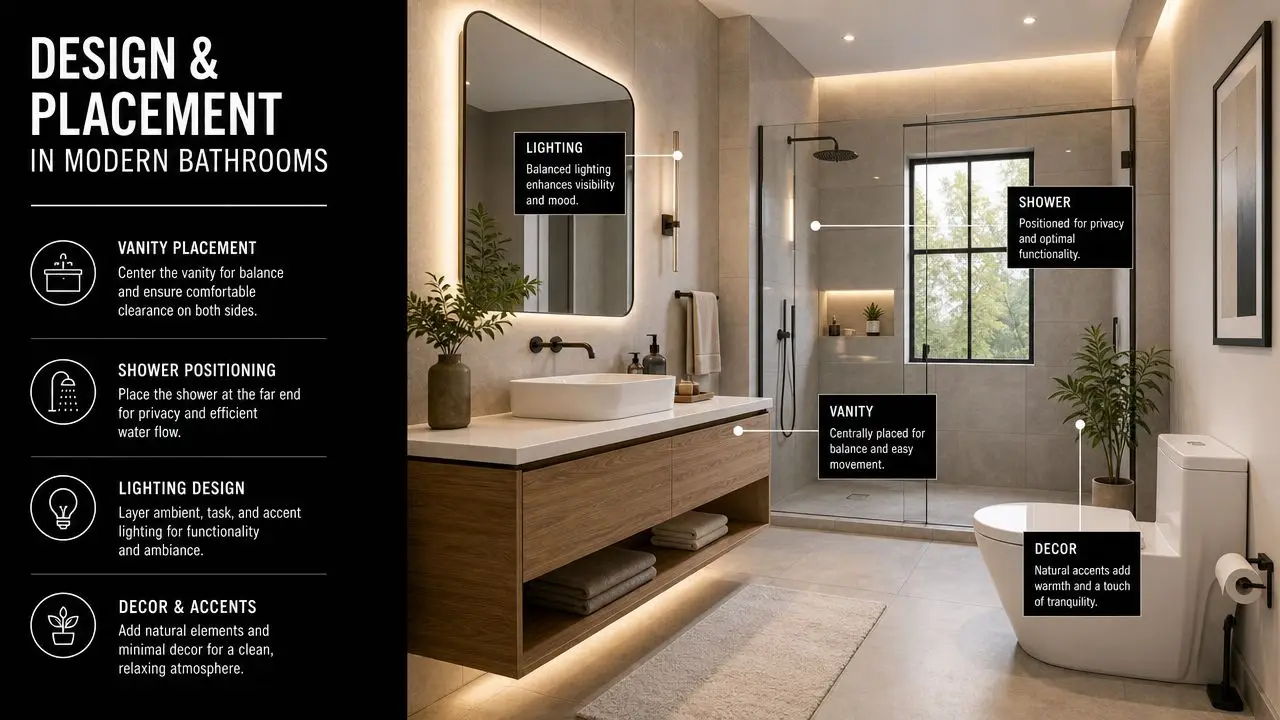
The design decision usually starts with shape and finish. Ladder styles remain popular because they're practical and easy to use. Vertical rails can work beautifully in tighter layouts where horizontal wall space is limited. Chrome stays versatile, while matte black and brushed brass often suit newer palettes and more obviously designer bathrooms.
If you're collecting inspiration for modern bathroom renovations, the rail should be considered alongside tapware, shower frame finish, vanity hardware, mirror lighting, and robe hooks. It's part of the composition, not a separate layer.
Placement that feels natural
The best position is usually close enough to the shower or bath that the towel is easy to grab, but not so close that it compromises safety, crowding, or overall wall balance.
Good placement often follows these principles:
- Reach matters. You want the towel close to the wet area, but not where it interferes with entry, exit, or cleaning.
- Sightlines matter. A rail can anchor a wall, but it shouldn't fight with the vanity, mirror, niche, or feature tile.
- Towel drop matters. Make sure the towel can hang freely without brushing the toilet, vanity edge, or floor.
What tends to work best
In practical terms, these placements usually age well:
- Near the shower return wall where towels are easy to access but the rail isn't the first thing you see.
- Adjacent to the vanity zone when the room needs balanced vertical elements.
- On a clear wall opposite the wet area in tighter bathrooms where circulation is more important than direct reach.
In small bathrooms, the right rail often does double duty. It warms the towel, fills an otherwise awkward section of wall, and reduces the need for separate towel storage.
Design mistakes worth avoiding
Some choices look good on a plan and disappoint in person:
- Overly wide rails on narrow walls can make the room feel cramped.
- Dark finishes in low-light bathrooms can disappear unless they connect with other fixtures.
- Rails behind doors often end up inconvenient, even if they technically fit.
- One tiny rail in a busy family bathroom can create more frustration than comfort.
A strong result comes from treating the rail as part of the joinery, lighting, and tile set-out discussion. That's how new bathroom ideas become rooms that still work properly once people are living with them.
Installation Rules for Victorian Bathroom Renovations
Generic advice usually becomes unhelpful. In Victoria, the rail can't just go wherever it looks good. Location, wiring method, wall preparation, and bathroom zoning all matter.
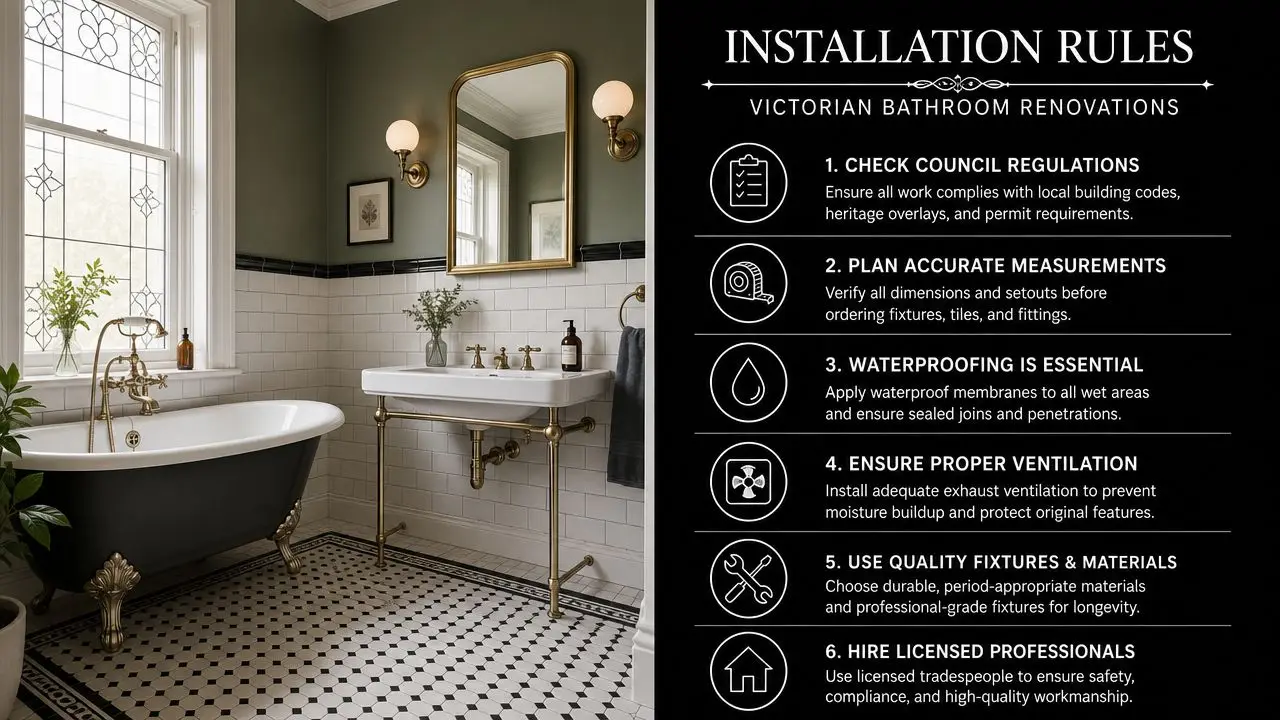
For electric heated towel rails, independent guidance recommends keeping them at least 60 cm away from water-contact areas such as bathtubs and showers, with placement preferably in zone 3, as explained in this electric towel rail installation and zoning guide. In practical renovation work, that single siting decision can affect tile layout, switch position, cable route, and whether the chosen rail is even suitable for the wall you had in mind.
The compliance mindset
Homeowners often ask whether a rail can sit “just next to” the shower or vanity. The answer depends on the exact room layout, the product, and the installation details. What matters is that the decision gets made before waterproofing and tiling are locked in.
The safe approach is simple:
- Keep electric rails away from direct water exposure.
- Plan the exact fixing point early so the electrician and builder can coordinate rough-in.
- Check the product's rating and installation method against the intended location.
- Don't assume a stylish product is suitable for every bathroom zone.
This is not a styling question first. It's a compliance question first.
Why pre-tiling planning matters
Once the wall is sheeted, waterproofed, and tiled, moving the rail becomes expensive. If the original position doesn't comply, you may need rework that affects finished surfaces and other fixtures.
Pre-tiling planning should cover:
- Cable path for a hardwired unit.
- Wall support so fixings land properly and don't rely on guesswork after tiling.
- Clearance from shower, bath, and vanity based on the actual site dimensions.
- Switching and control location so operation is convenient and compliant.
If the design also includes extra electrical work, details like downlights in a bathroom should be considered at the same time. Wet-area electrical planning works best when it's coordinated, not handled as a series of isolated decisions.
Who should do the work
A hardwired electric rail needs to be handled as part of a properly managed renovation. That means the electrical connection should be completed by a licensed electrician, while the overall works should be coordinated within the renovation by the appropriate qualified professionals.
For homeowners comparing bathroom renovations, this is one of the reasons working with registered builders unlimited or another suitably registered and appropriately licensed renovation team matters. The rail itself may look like a small fixture, but it crosses into bigger project issues: compliance, sequencing, and accountability.
Common installation mistakes
These are the problems that cause frustration most often:
- Choosing the wall before checking the zone.
- Leaving the decision until after tiles are selected.
- Forgetting wall depth and fixing points for concealed installations.
- Expecting the rail to sit right beside the shower because it seems convenient.
- Assuming any electrician can solve a poor layout decision after the room is finished.
A bathroom heated towel rail should never be the item that forces compromise late in the build. If the placement is right on paper and right on site, the room comes together cleanly.
Comparing Energy Use and Running Costs
A heated towel rail usually costs less to run than many homeowners expect, but only if it is chosen for the job it can do. In Highett bathrooms, the mistake I see most often is treating the rail like a room heater when it was really bought to dry towels and take the edge off a cold space.

Cost depends on wattage, how many hours it runs, and whether the bathroom already has decent heating and extraction. A low-watt rail on a timer can be a sensible addition. A larger rail left on all day, in a bathroom that already has other heating, is where the value starts to fall away.
What you are really paying for
Most households are not buying a heated towel rail to heat the whole bathroom. They are paying for three practical benefits:
- Drier towels between uses
- Less damp smell in cooler months
- A bit more comfort after showering
That can be worth it, especially in winter, but only if expectations are realistic. If the room itself feels cold because of poor ventilation, no ceiling heat, or a generally underpowered heating setup, the rail will not fix the bigger problem.
Where running costs get pushed up
Usage habits matter more than the product brochure.
Costs usually climb when:
- the rail runs for long periods without a timer
- the wattage is higher than the household needs
- the rail is used as the main heat source for the room
- towels are draped so heavily that drying is slow and the rail stays on longer
In practical terms, timed control is often the difference between a rail that feels worthwhile and one that becomes an annoyance on the power bill. For many Victorian renovations, I recommend deciding on the control method early, because a hardwired setup with the right switching arrangement is usually a better long-term result than relying on people to remember to turn it off.
The Victorian renovation angle that gets missed
Running cost should never be looked at in isolation from compliance and installation method. In Victoria, if the rail is hardwired, it needs to be planned and installed properly as part of the bathroom works. That affects not just safety and legal compliance, but also how easy it is to control the rail efficiently once the room is finished.
This is also one of the practical reasons to understand why using a registered builder matters for your bathroom renovation. Good coordination leads to better placement, proper rough-in, and controls that suit how the household will use the bathroom.
When a heated towel rail is good value
A rail generally makes sense when the household reuses towels, wants them dry by the next use, and does not want to rely on the rail to warm the entire room.
It makes less sense where:
- the bathroom already performs well without it
- the choice is driven only by appearance
- another heating or ventilation upgrade would solve the problem more effectively
That is the trade-off many design-focused articles skip. A bathroom heated towel rail can be stylish and useful, but in a Highett renovation it should still earn its place through sensible running costs, proper controls, and a compliant installation.
Key Questions to Ask Your Bathroom Renovator
The right conversation with your renovator will usually tell you more than a product display ever will. If they can answer these clearly, the project is probably being thought through properly.
Questions that reveal whether the planning is solid
- How will you confirm the rail location is suitable for the bathroom layout and wet-area rules?
- Will the wall need extra framing or fixing support before sheeting and tiling?
- Is this rail being chosen mainly for towel drying, room heating, or both?
- What controls will be used so it isn't left running unnecessarily?
Questions about sequencing
Some of the most expensive errors happen because the rail gets considered too late. Ask:
- When does the final rail position need to be locked in?
- Will the electrician rough in before waterproofing and tiling?
- How will the rail position affect tile set-out and other fittings on that wall?
- If the chosen model doesn't suit the location, when will that be picked up?
Questions about who is responsible
A bathroom renovation runs better when responsibilities are clear from the start.
- Who is managing coordination between builder, electrician, waterproofer, and tiler?
- Who checks compliance for the final installed location?
- If you're comparing contractors, what should you ask about why using a registered builder matters for your bathroom renovation?
A bathroom heated towel rail is a small item with oversized consequences. Ask the right questions early, and it becomes one of the most satisfying details in the room. Ask them too late, and it can turn into an avoidable compromise.
If you're planning a bathroom renovation in Highett or elsewhere in Victoria, the right heated towel rail choice comes down to three things: compliant placement, realistic performance, and a design that suits how you live.