
Blind Corner Pantry: A Modern Renovation Guide
You're probably looking at a kitchen plan right now and circling the same awkward spot everyone struggles with. The corner. It's where good layouts can become clumsy, where storage looks generous on paper but feels frustrating in daily use, and where one wrong choice can affect the whole renovation.
That's why a blind corner pantry matters more than people expect. It isn't just a cabinet detail. It's a planning decision that affects storage, movement, accessibility, and how the kitchen will feel years from now. In renovation work, that kind of decision sits in the same category as shower placement in bathroom renovations, vanity depth in modern bathrooms, or storage layout in designer bathrooms. Small move, big consequence.
Tackling the Dreaded Corner Cabinet
Most homeowners describe the problem before they know the name for the solution. They talk about the “black hole” cabinet. The shelf where roasting dishes disappear. The back corner where the slow cooker lives until Christmas. In older L-shaped kitchens, that space often becomes a compromise rather than useful storage.
The reason is simple. Corners are geometrically awkward. When two cabinet runs meet, they create a zone that's hard to access cleanly from either side. Historically, the blind corner became a standard response to that problem in L-shaped and U-shaped kitchens, and modern guidance still positions it as the higher-capacity alternative to a Lazy Susan in compact homes where every millimetre matters, as outlined in this corner cabinet design overview.
Why the corner becomes a design issue
A blind corner pantry works by pushing storage into that hard-to-use zone while keeping a clean cabinet line across the kitchen. That can be a smart move, especially if your priority is fitting more into a modest footprint. It can also be the wrong move if you value instant access over hidden capacity.
Renovation experience matters. A good designer doesn't ask only, “Can we fit storage here?” They ask how you cook, who uses the kitchen, and what the adjacent cabinetry needs to do.
Practical rule: If a corner solution looks efficient on a floor plan but creates awkward reaching, blocked doors, or poor drawer access, it isn't efficient in real life.
The same thinking applies across the home. In bathrooms, the most successful plans don't just chase features. They organise movement, storage and access so the space works every day. The same principle sits behind smart L-shaped kitchen layout planning.
When the blind corner starts to make sense
A blind corner pantry tends to suit homeowners who need to reclaim hidden volume without breaking up the overall layout. It's often chosen when the kitchen has to work harder, not just look better.
That's why this isn't a styling decision. It's a functional one. If you get it right, the corner becomes useful. If you get it wrong, you've built an expensive place to lose things.
What Is a Blind Corner Pantry System
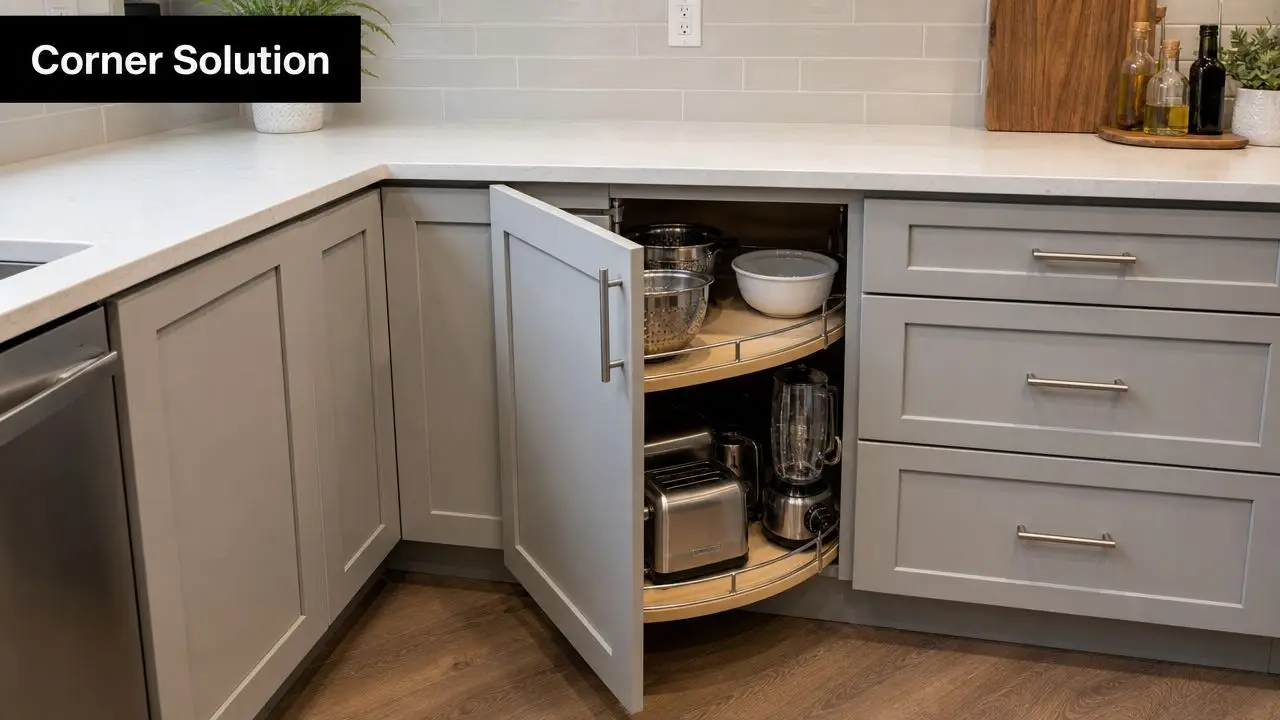
A blind corner pantry system is a cabinet arrangement that reaches into the corner but is accessed from one visible opening. Part of the storage sits behind the front cabinet line, which is why it's called “blind”. You can't see the full interior from the doorway, even though that hidden section is where much of the storage sits.
In practical terms, it's a way to capture more corner volume than many rotating shelf options. In kitchen design guidance, these layouts are commonly built around 24-inch-deep base units and widths of about 33 to 42 inches, and they're valued for storing bulky items such as large cookware, roasting trays, stand mixers, and small appliances, as explained in this blind corner base cabinet dimensions guide.
How the system works in plain language
Think of the cabinet as having a front room and a back room. The front opening gives you entry, but some of the storage sits deeper into the corner return. Without internal hardware, that back section can be awkward. With the right mechanism, it becomes much more practical.
The three common approaches are easy to picture:
Lazy Susan style trays
These use rotating shelves. They suit homeowners who want quick visual access to lighter items. You spin the shelf and bring contents forward rather than reaching into the corner.Swing-out systems
These move in two stages. The front baskets come out first, then the rear section follows into view. They're useful when you want more of the corner volume without leaving everything buried at the back.Pull-out shelves
These behave more like internal drawers. Shelves or baskets slide forward so you can load and unload items without bending deep into the cabinet. For many households, this feels the most intuitive day to day.
What works well and what doesn't
The cabinet itself isn't the whole story. The success of a blind corner pantry depends on what you put in it and how often you need it.
It tends to work well for:
- Bulky equipment like mixers, platters, and appliances you use weekly or seasonally
- Secondary pantry overflow rather than your most-used breakfast or lunch items
- Families who want volume and are happy to use hardware to improve access
It tends to work poorly for:
- Tiny loose items that get lost in deep storage
- Daily essentials you need in a hurry
- Households needing very easy reach access with minimal bending or twisting
A blind corner pantry can be excellent storage, but it's rarely effortless storage unless the hardware matches the way the kitchen is actually used.
Comparing Your Pantry Solution Options
The key question isn't whether a blind corner pantry is good or bad. The better question is whether it suits your kitchen habits. That matters even more in smaller homes, where losing usable access can hurt more than gaining extra volume helps. The broader planning issue is especially relevant as smaller kitchens become more common and “dead” corner space becomes more consequential, as discussed in this blind corner storage planning article.
Some households need every bit of capacity they can get. Others are better served by simpler, easier-access cabinetry around the corner. The right answer changes with the brief.
Side by side trade-offs
Here's the practical comparison most homeowners need.
| Blind Corner Hardware Comparison | ||||
|---|---|---|---|---|
| Mechanism Type | Best For | Accessibility | Capacity | Typical Cost |
| Basic blind shelf | Bulky, occasional-use items | Lower, requires reaching | Higher | Budget-friendly |
| Rotating shelf system | Smaller, lighter everyday items | Higher | Moderate | Mid-range |
| Swing-out organiser | Mixed pantry and cookware storage | Good | Good | Mid-range to premium |
| Pull-out shelf system | Households wanting easier retrieval | Good to very good | Good | Premium |
| Voided corner with adjacent drawers | Simplicity and easy use | Very high | Lower in the corner itself, often stronger in nearby cabinets | Varies by joinery design |
Which option suits which household
A basic blind corner gives you raw storage volume, but it asks more of the user. You need to bend, reach, and remember what's at the back. That's acceptable for platters or appliances. It's frustrating for food items you use constantly.
A rotating shelf system is often easier to understand and easier to live with if convenience comes first. The trade-off is shape. Round trays don't always use the full cabinet footprint cleanly.
A swing-out system is a middle-ground choice. It improves access without fully giving up the hidden volume that makes a blind corner attractive in the first place.
A pull-out solution usually feels the most premium in use. If the mechanism is well chosen and correctly installed, it can make a difficult corner feel organised rather than compromised.
If your corner will store everyday pantry goods, prioritise access. If it will store the big awkward items that otherwise clutter benches, prioritise capacity.
Don't ignore the alternative
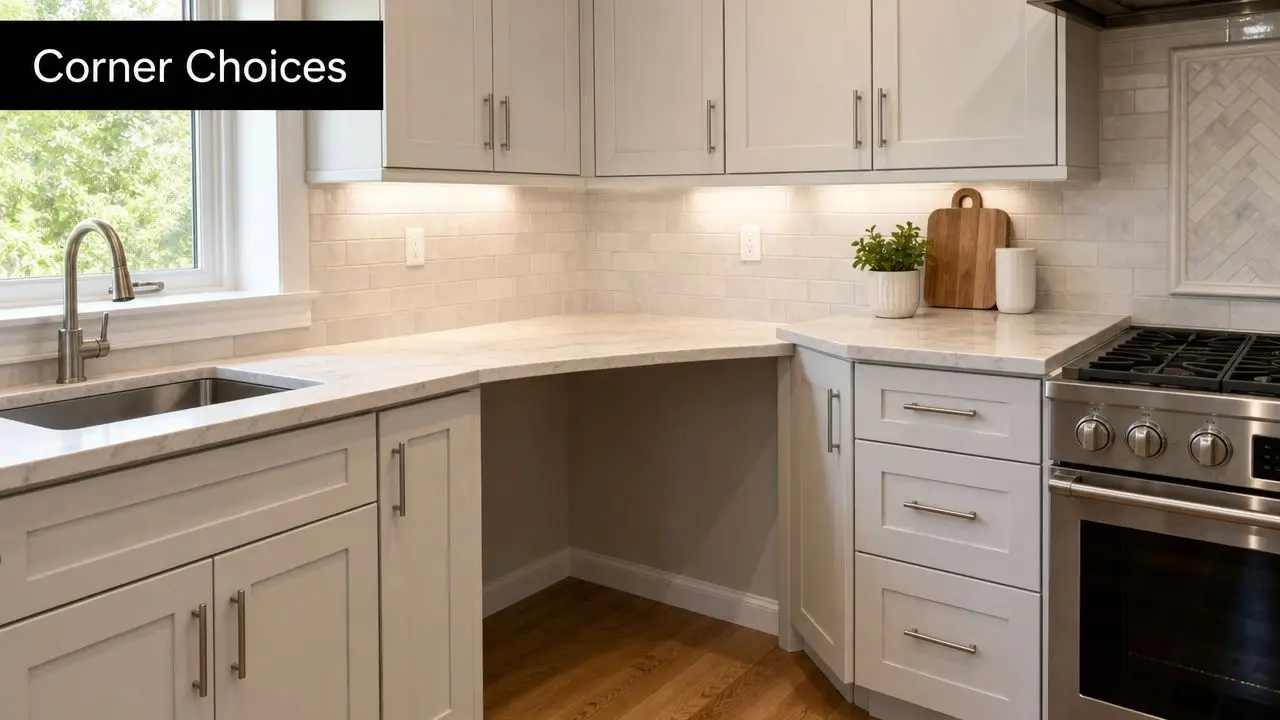
Sometimes the best corner cabinet is no corner cabinet at all. Voiding the corner and giving more width to adjacent drawers can produce a kitchen that functions better overall. This option is especially strong when the surrounding cabinets can do the heavy lifting more effectively than a specialised corner unit.
That is the primary trade-off. A blind corner pantry can win on storage. It doesn't automatically win on usability.
Design and Planning Considerations
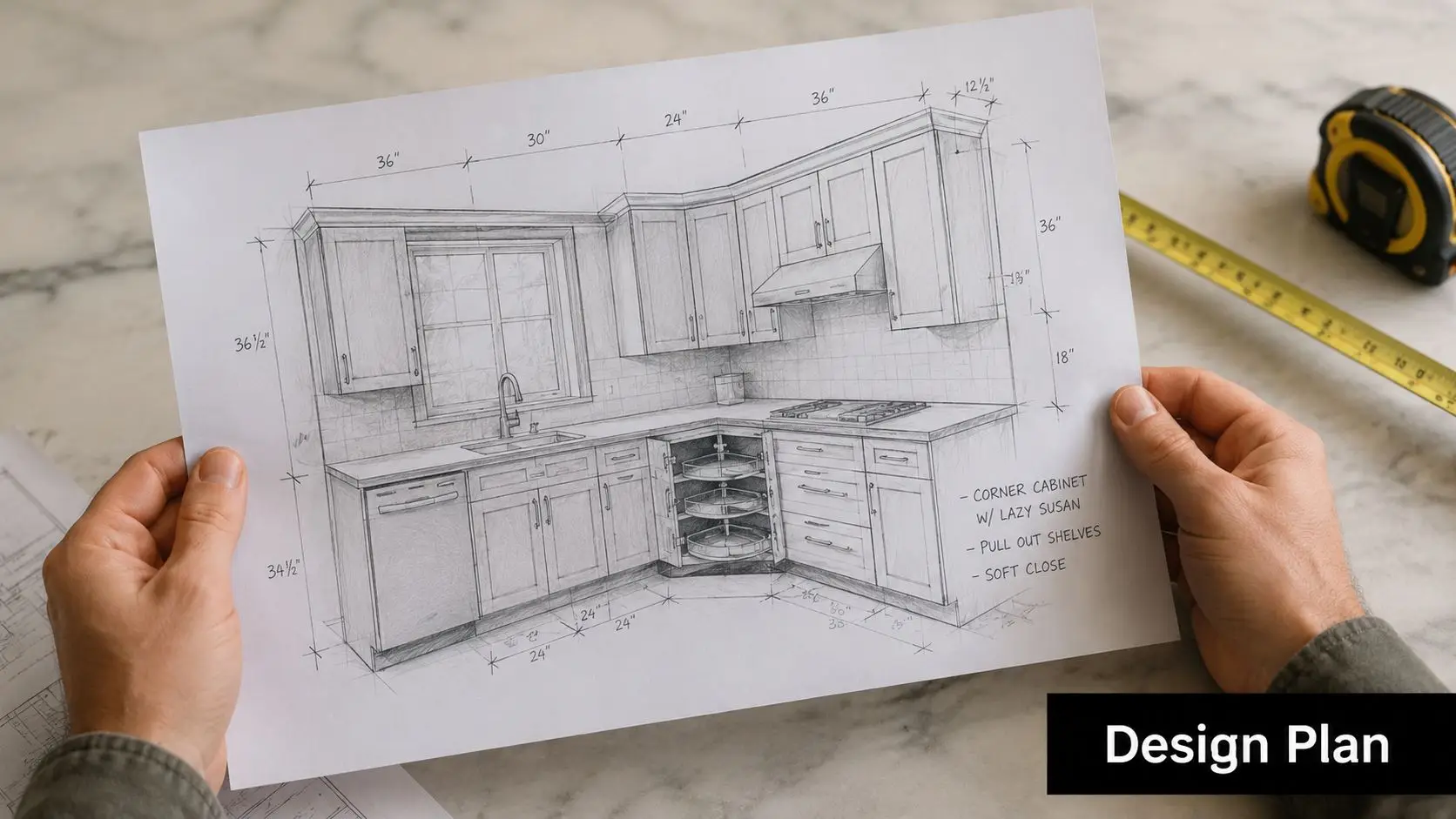
Blind corner pantries reward precise planning and punish assumptions. A drawing can look neat while an actual cabinet door clips a handle, fouls a return wall, or opens only halfway. This is one of those details that has to be resolved before joinery is ordered, not after installation begins.
A common mistake is measuring only the cabinet face. A blind corner tall unit often needs more room than its nominal width suggests. One listed European-made unit is 1150 mm wide, 2220 mm high, and 608 mm deep, but it requires 1250 mm x 608 mm of installation space to allow for practical clearance, as shown in this blind corner pantry size specification.
The measurements that matter most
The opening isn't the whole story. You also have to account for:
- Door swing clearance so the cabinet can open fully without clashing with nearby handles, walls or appliances
- Return wall depth because the blind section depends on what's happening around the corner
- Hardware movement path since internal trays and baskets need room to operate cleanly
- User standing space so someone can open, step, and unload the cabinet comfortably
A few centimetres can decide whether the pantry feels slick or annoying.
Why 3D planning helps
This is where detailed design earns its keep. In renovation work, I'd much rather solve a corner issue on screen than on site. Three-dimensional planning lets you test door arcs, benchtop overhangs, appliance handles, and circulation before anyone cuts material.
That level of planning isn't unique to kitchens. It's the same discipline behind well-resolved ensuites, compact powder rooms, and polished family bathroom layouts. If you've ever looked through different kitchen cabinet material options, you'll know the finish matters, but the geometry decides whether the space works.
The best renovation plans don't rely on “it should fit”. They prove it fits.
Practical layout checks
Before signing off on a blind corner pantry, check these points:
- Open the nearby appliances on the plan and see what happens when the pantry door is also open
- Map your storage categories so the corner isn't asked to perform a role it doesn't suit
- Confirm handedness early because corner systems are often left or right oriented
- Review handle choices since oversized hardware can create clearance conflicts in tight corners
Good planning gives you a pantry that feels intentional, not improvised.
Installation Durability and Cost
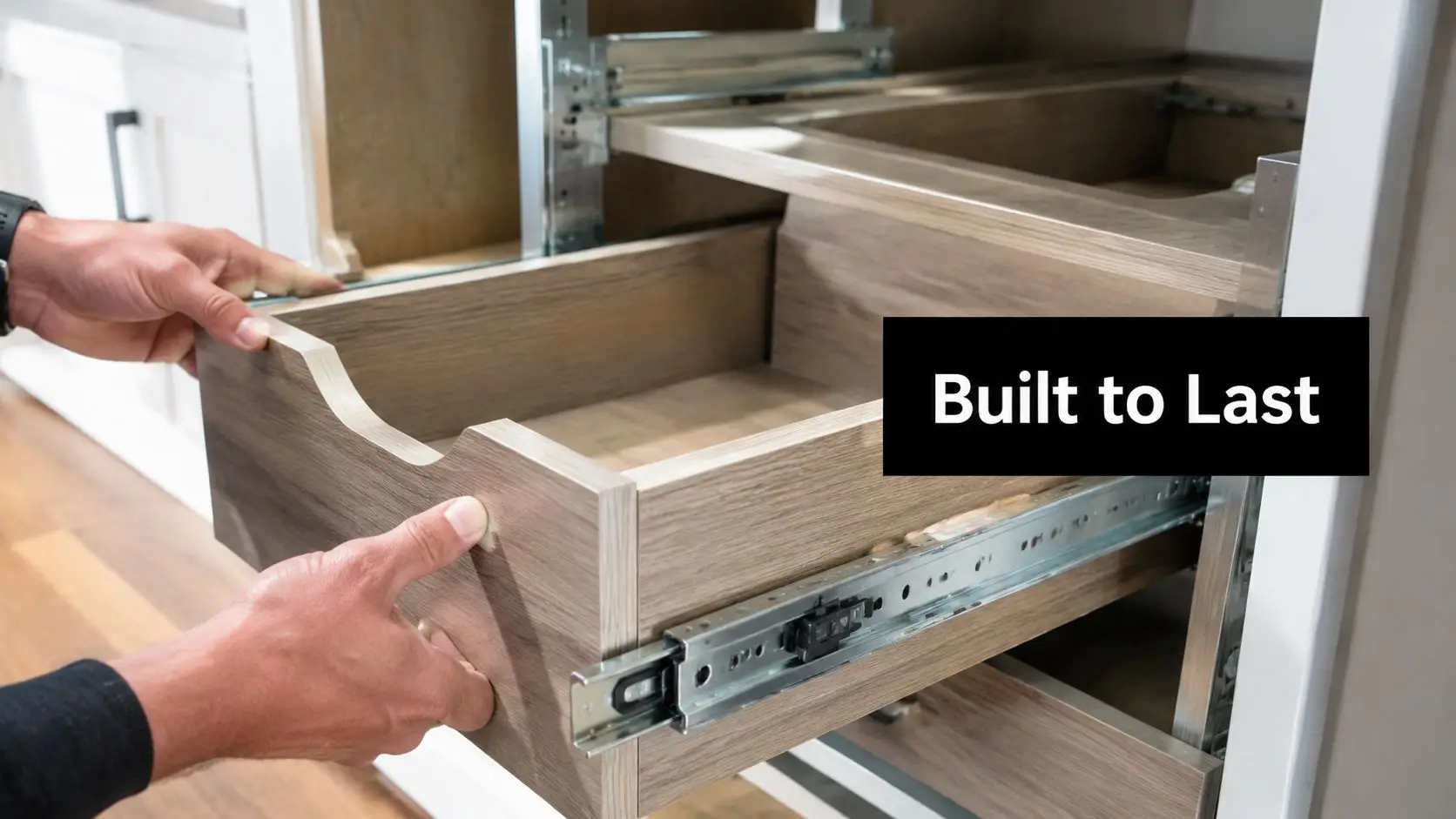
A blind corner pantry does more work than a standard cabinet. The door geometry puts stress where people grab, swing and load repeatedly, and that means cheap materials show their weaknesses quickly. If the cabinet swells, drops out of alignment, or develops sticky movement, the corner becomes irritating fast.
That's why build quality matters. In local cabinetry practice, these units are commonly made with 16 mm HMR board and 16 mm or 18 mm doors, often paired with premium soft-closing hinges because the concentrated door stress makes durability more important than it might be in a simpler cabinet, as described in this blind corner pantry construction detail.
What to pay for
You don't need every premium upgrade. You do need the right ones.
Focus on these first:
- Moisture-resistant board because kitchens deal with steam, spills and cleaning products
- Reliable soft-close hardware to reduce impact on doors and hinges
- Accurate installation so the door sits square and the mechanism runs smoothly
- Proper adjustment after install because corner hardware often needs fine tuning once loaded
A blind corner pantry is not a good place to save money on workmanship. If the cabinet sits out of square, even quality hardware can feel poor in use.
Cost expectations without guesswork
Costs vary widely depending on whether you choose a simple cabinet box, internal organisers, custom joinery, and the level of finish across the rest of the kitchen. Rather than pretend there's one universal figure, it's more honest to think in tiers:
- Budget-friendly usually means a basic blind corner cabinet with minimal internal hardware
- Mid-range often includes better access mechanisms and upgraded joinery finishes
- Premium typically means custom internal storage, higher-spec hardware, and tighter detailing across the full renovation
If you're budgeting across a larger project, it helps to compare the pantry decision against the wider kitchen spend. This overview of the cost of a new kitchen is a useful starting point.
Who should install it
For work that affects cabinetry, layout, services, and broader renovation sequencing, use appropriately registered builders and qualified trades. If the kitchen upgrade forms part of a larger reconfiguration, then registered builders unlimited and an experienced renovation team make a real difference.
The same is true in bathroom renovations. The finish you see at handover depends on what was set out accurately at the start.
Is a Blind Corner Pantry Right for You
The final decision comes down to how you want the kitchen to behave. Not just how you want it to look on handover day. A blind corner pantry can be a strong choice for storage-heavy households, but long-term success depends on access, maintenance, and who'll be using the kitchen over time.
That wider view matters. Beyond hardware, the core issue is renovation performance. Accessibility, maintenance, and long-term appeal often matter just as much as raw capacity, especially as Australia's ageing population makes easy daily function more relevant for homeowners and landlords, as discussed in this blind corner accessibility perspective.
When it's a good fit
A blind corner pantry usually makes sense if:
- You need hidden capacity for large appliances, platters, or occasional-use cookware
- Your layout benefits from a continuous cabinet run rather than a more angular corner treatment
- You're willing to invest in access hardware instead of relying on a plain deep shelf
- The pantry won't be asked to serve your fastest daily routines
When another solution may be better
It may be the wrong choice if:
- You want quick grab-and-go access to everyday pantry items
- You're planning for ageing in place and want easier reach lines
- The kitchen is very tight and open doors will interrupt circulation
- Simple drawers nearby can do the job better
Other options include voiding the corner, using an angled cabinet, or reorganising adjacent storage so the corner doesn't have to work so hard.
A corner solution should reduce frustration, not formalise it in joinery.
A short decision checklist
Ask yourself these questions before locking in the design:
What will live there
Bulky appliances and seasonal items suit a blind corner better than small everyday goods.Who uses the kitchen most
A young family, an older couple, and a rental household all use storage differently.How often will the corner be opened
Occasional use supports deeper storage. Constant use demands easier access.Would better drawers elsewhere outperform the corner unit
Sometimes the smartest corner is the one you stop trying to over-engineer.Does the pantry align with the whole renovation brief
The best kitchens, like the best modern bathrooms and designer bathrooms, support the life of the home over time, not just the styling mood of the moment.
If you're weighing up a blind corner pantry as part of a broader renovation, get the layout tested properly before you commit. SitePro Bathrooms can help with customized kitchen and bathroom renovations, detailed 3D design, practical new bathroom ideas, and end-to-end construction delivered by an experienced team of registered builders. If you want clarity before work begins, book a consultation and get a plan that fits the way you live.