
How to Remodel a Kitchen: Expert Guide
If you're staring at an ageing kitchen in Highett and wondering where to start, you're not alone. Most homeowners don't get stuck on tiles or tapware first. They get stuck on the bigger questions. How much should this cost, what needs approval, how long will the house be disrupted, and what mistakes turn a straightforward upgrade into an expensive mess?
That's the main effort in learning how to remodel a kitchen. It isn't choosing pretty finishes in isolation. It's getting the scope right, locking the design before demolition, understanding Victorian compliance, and building the room in the right order so the result works every day.
In this part of Melbourne, that local detail matters. Trades are often booked ahead, older homes can hide service issues, and changes made mid-build usually cost more than people expect. The best kitchen renovations don't start with demolition. They start with decisions.
Planning Your Perfect Kitchen Goals and Budget
The first question isn't what colour cabinets you want. It's why you're renovating.
A kitchen built for resale looks different from one built for a family of five. An investor usually wants durability, easy cleaning, strong storage and a layout that appeals broadly. A homeowner planning to stay put may care more about workflow, entertaining, appliance integration and the feel of the room at night. If you want a designer finish, that choice needs to be visible in the budget from day one.
Start with the job the kitchen needs to do
Most kitchen projects fall into one of three categories:
- Cosmetic update. Keep the layout, improve surfaces, and freshen the space without moving major services.
- Functional reconfiguration. Adjust storage, improve circulation, replace cabinetry and appliances, and make the room work better.
- Full strip-out. Rebuild the kitchen with service changes, structural considerations, and a new layout.
That distinction matters because scope drives cost more than style does. A simple-looking kitchen can become expensive fast if the sink moves, extra power is added, or walls need changing.
Practical rule: If the renovation changes plumbing or wiring, treat it as a coordinated building project, not a surface makeover.
National Australian trade guidance places kitchen renovations in broad cost bands. A basic refresh often sits around AUD $10,000 to $20,000, a mid-range renovation around AUD $20,000 to $45,000, and a high-end transformation commonly exceeds AUD $50,000, according to Australian kitchen renovation cost guidance.
What those budget bands usually mean
A basic refresh generally suits owners keeping the footprint similar. Think new cabinetry fronts or replacement cabinetry in the same general layout, updated benchtops, splashback changes, and selected appliance swaps.
A mid-range renovation is where many Highett homeowners land. This is usually enough for a proper layout improvement, better storage, stronger finishes, and a cleaner result overall.
A high-end kitchen usually means more joinery detail, premium surfaces, custom storage, integrated appliances, and often some level of service relocation or opening the space to adjoining living zones.
For a more detailed local breakdown, see this guide to the cost of a new kitchen.
Budget for what you don't see straight away
The expensive decisions are rarely the decorative ones. Budget pressure usually comes from:
- Service changes. Moving plumbing, waste, gas or electrical points.
- Joinery complexity. Corner solutions, appliance housing, overheads to bulkheads, and custom pantry storage.
- Site conditions. Uneven walls, damaged subfloors, hidden water issues, or dated wiring in older homes.
- Late changes. A new appliance size after cabinetry is ordered can ripple through the whole job.
That's why realistic budgeting starts with measured drawings and a locked scope, not showroom browsing.
Sample Kitchen Renovation Cost Breakdown in Victoria (2026)
| Expense Category | Percentage of Budget | Example Cost |
|---|---|---|
| Cabinetry and joinery | 35% | $14,000 on a $40,000 renovation |
| Benchtops | 15% | $6,000 on a $40,000 renovation |
| Appliances | 15% | $6,000 on a $40,000 renovation |
| Plumbing and electrical labour | 15% | $6,000 on a $40,000 renovation |
| Splashback, flooring, painting and finishes | 10% | $4,000 on a $40,000 renovation |
| Project management and contingencies | 10% | $4,000 on a $40,000 renovation |
That table is a sample allocation, not a fixed pricing rule. In practice, one project will spend more on joinery, another on appliances, another on service changes. The point is to build the budget around priorities instead of hoping everything fits.
Where homeowners usually get it right
The smoothest projects start with a short written brief. It doesn't need to be fancy. It just needs to answer a few things clearly:
- Who uses the kitchen every day
- What isn't working now
- What must stay
- What must change
- What the spending ceiling is
That brief becomes the filter for every later decision. If your goal is family function, spending heavily on decorative extras while leaving poor storage unresolved doesn't make sense. If resale is the goal, broad appeal and durable finishes usually beat highly specific design moves.
A good kitchen budget isn't just a number. It's a decision-making tool. If that's solid, the rest of the project gets far easier.
Designing Your Space and Navigating Victorian Permits
A kitchen design only works when it solves movement, storage and service locations at the same time. Plenty of layouts look good on paper and fail the moment someone opens the dishwasher door, tries to carry groceries in, or realises the pantry blocks circulation.
That's why detailed design needs to happen before anyone lifts a hammer.
Build the layout around work zones
Forget chasing trends first. Start with the way the room is used.
A practical kitchen in Victoria should account for prep space, cooking access, cleaning space, storage reach, appliance swing, and clear walking paths. In older Highett homes, kitchens often need more attention to storage and circulation than people expect. A room can have enough square metres and still feel awkward because the joinery isn't planned around actual use.
Key design checks include:
- Prep near the sink so food can move from washing to chopping without crossing the room.
- Cooktop clearance so handles, heat and movement don't clash with walkways.
- Pantry placement where groceries can be put away quickly.
- Bin storage close to prep, not across the kitchen.
- Lighting layers that cover task areas, not just the centre of the ceiling.
If you're refining shape and circulation, this overview of an L-shaped kitchen layout is a useful starting point.
Good design removes friction. You notice it in the first week of use, not just in the photos after handover.
Use drawings to prevent expensive assumptions
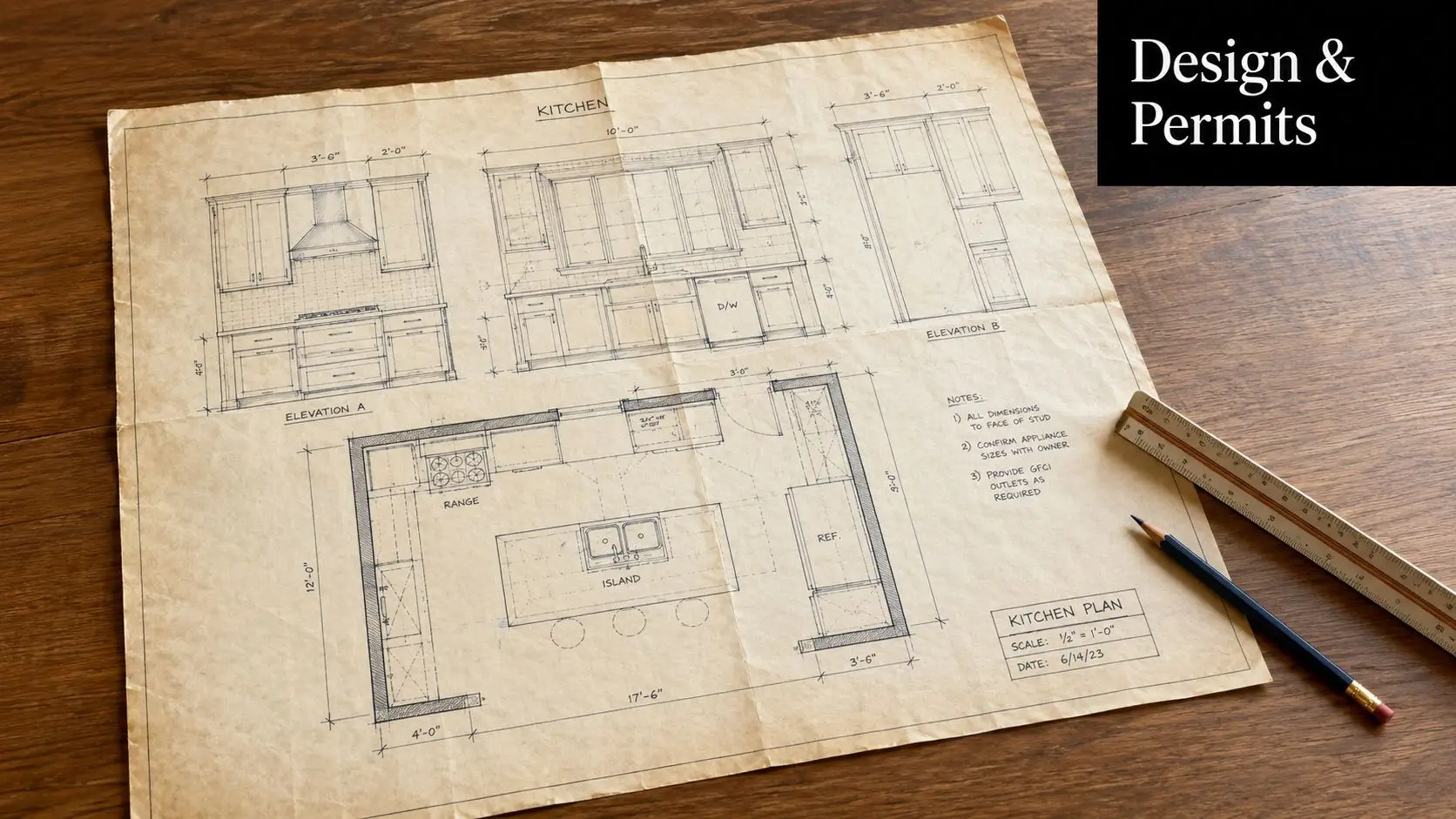
A proper design package should show more than cabinet faces. It should confirm dimensions, appliance locations, service points, clearances, and how the room ties into adjoining floors, walls and openings.
This is also where 3D design earns its keep. It lets you test the island size, check whether overheads feel too heavy, and see if the walkway beside the fridge will feel cramped. That's far cheaper than discovering the problem once cabinetry is on site.
In practical terms, a locked design should answer these questions before demolition:
- Where exactly do power points go?
- Are appliances integrated, freestanding, or semi-integrated?
- Does the flooring run under cabinetry or stop at the kitchen line?
- Will the splashback finish affect power point placement?
- Are there bulkheads, beams, or ceiling inconsistencies to resolve?
Permits and compliance in Victoria
This is the part generic renovation guides often skip, and it's where budgets can unravel.
In Victoria, kitchen work can require licensed trades and may need building approval depending on the scope, especially when structural changes, plumbing, or electrical modifications are involved, as noted in Victorian kitchen renovation guidance. That matters in Highett because many homes involve some mix of older services, altered floor plans, and renovation layering from previous owners.
The practical takeaway is simple. If your kitchen project involves any of the following, pause and confirm compliance requirements early:
- Structural work such as removing or altering walls
- Plumbing changes involving sink moves or new appliance connections
- Electrical changes such as added circuits, relocated power, or new lighting layouts
- Ventilation upgrades where the exhaust path changes
- Building fabric changes that affect surrounding works
A cheap quote that ignores compliance isn't cheap. It's incomplete.
What works in Highett homes
The best kitchen plans in this area usually respect the house rather than fighting it. In weatherboard homes, space planning often needs careful thought around wall alignment and hidden services. In brick homes and unit renovations, access, body corporate requirements and service limitations often affect what's practical.
That's why the design phase should produce two things. A kitchen that looks right, and a scope that can be built under Victorian requirements. If either one is missing, the job isn't ready.
Choosing Your Team Materials and Appliances
People often spend more time choosing splashbacks than choosing who will run the project. That's backwards. A strong team protects the build, the program, the compliance side, and the finish quality. Materials and appliances matter, but they only perform as well as the planning and installation behind them.
Choose the builder before you fall in love with finishes
For kitchen renovations that involve broader building scope, many owners want the protection of working with registered builders unlimited. In Victoria, that matters because project complexity can move quickly from cosmetic to structural. Once walls, services and approvals enter the picture, you want a builder who understands the whole chain, not just the cabinet line.
Ask direct questions when reviewing builders:
- What's included in the quote. Is demolition included, rubbish removal included, disconnect and reconnect included?
- Who coordinates licensed trades. You don't want finger-pointing between trades mid-job.
- How are variations handled. Changes happen, but they should be documented clearly.
- What information is needed before ordering joinery. This tells you how disciplined the process is.
- Who is responsible for sequencing and site supervision. Kitchens fail when no one owns the critical path.
A polished estimate isn't enough. Look for scope clarity. If one quote seems much lower, check whether it has left things out.
Durable beats fashionable in the long run
Australian housing data consistently shows kitchens are one of the most important rooms for buyer appeal, and renovation decisions should prioritise layout efficiency, ventilation, and durable finishes handled by licensed trades for maximum value, according to Australian kitchen buyer-appeal guidance.
That's why material selection should start with wear, maintenance and fit for purpose.

For a deeper look at finish options, browse these kitchen cabinets materials.
What works well and what tends to disappoint
A practical way to assess materials is to ask what daily life will do to them.
Benchtops
Laminate can work well in tighter budgets and rental properties when the goal is durability and easy replacement. Engineered stone style surfaces are often chosen for consistency and low upkeep. Natural stone gives strong visual character but needs an owner who accepts variation and maintenance.
Cabinet finishes
Two-pack painted finishes can look sharp, especially in cleaner modern kitchens, but they need careful handling to stay pristine. Laminates and melamine-based options often perform better where impact resistance matters. Timber-look finishes can soften a modern kitchen and work particularly well in homes that also feature warm, modern bathrooms.
Splashbacks
Large-format splashbacks reduce grout lines and can make cleaning easier. Tiled splashbacks can add texture and detail, but they need to be chosen with restraint if the rest of the room is already busy.
On site, the best material choice is usually the one that still looks good after years of heat, steam, cleaning, and family traffic.
Appliances should match the way you live
Appliance mistakes are common because buyers focus on brands and forget the plan. The better approach is to decide what the kitchen needs to support.
Consider:
- Cooking habits. A serious home cook needs stronger prep zones and ventilation planning than someone who mainly reheats and assembles.
- Household size. Fridge volume and dishwasher capacity should match actual use.
- Cleaning tolerance. Some finishes and appliance types show fingerprints and grime faster than others.
- Energy use and practicality. Efficient, straightforward appliances often make more sense than feature-heavy models that don't get used.
The lessons from bathroom renovations carry across neatly. Whether you're planning kitchens, new bathroom ideas, modern bathrooms, or more detailed designer bathrooms, the same principle holds. Buy once for function first, then layer in style. The room will age better.
The Construction Timeline From Demolition to Completion
Once the design is signed off and selections are locked, the project becomes a sequencing exercise. Good kitchen renovations don't move forward because demolition starts fast. They move forward because each trade arrives to a site that's ready for them.
A standard kitchen remodel is often 6 to 12 weeks once construction starts, but planning, approvals and ordering can add several more weeks before that, according to kitchen remodel timeline guidance. The same guidance also warns against starting demolition before all material and design choices are finalised.
What happens first and why it matters
Demolition feels like progress, but it's only safe progress if the pre-construction work is complete. Before demo begins, the joinery should be approved, appliance sizes confirmed, service locations finalised, and key materials ordered.
If those decisions are still floating, the build usually stalls in one of three places. Rough-in changes, delayed cabinetry, or benchtop hold-ups.
The usual site sequence
Most kitchen builds follow a logical chain. The exact details vary by house, but the order matters.
Site protection and demolition
Existing cabinets, splashbacks, appliances and affected finishes are removed. Waste is cleared and hidden conditions are assessed.Preparation and rough-in
Plumbers and electricians complete the service changes. If walls are being altered, this stage also deals with framing and related building work.Subfloor and surface readiness
Floors and walls need to be true enough for joinery and finishes. Shortcuts taken will later manifest as crooked lines and awkward gaps.Flooring where required
Depending on the design, flooring may go in before or after cabinetry. What matters is that the sequence matches the documented plan.Cabinet installation
Base cabinets, tall units, wall cabinets and panels are set in place and aligned.Template and benchtops
Once cabinets are fixed, benchtops are measured and then installed.Splashback, painting and fit-off
Final finishes go on, appliances are installed, plumbing fixtures are connected, electrical fittings are completed, and defects are checked.
Living through the renovation
Homeowners often underestimate the temporary disruption. Even a well-run project changes your daily routine. You may need a temporary food prep area, a separate kettle and microwave setup, and a plan for meals when water or power is interrupted.
In occupied homes around Highett, the smoother projects usually have a site access plan from the start. That includes delivery timing, rubbish removal, parking for trades, and a clear decision on whether the family is staying in the house the whole time.
Set up a temporary kitchenette before demolition day. It sounds simple, but it makes the first two weeks much easier.
Where delays usually begin
Most delays don't come from one dramatic failure. They come from small decisions left unresolved too long.
Common examples include:
- Appliances ordered after cabinet drawings are approved
- Tiles selected after power point positions are already set
- Late changes to island size
- Stone selections made after cabinetry is installed
- Unclear responsibility for trade coordination
If you want to know how to remodel a kitchen without turning the process into a rolling variation list, the answer is discipline before demo. Once the room is stripped out, every undecided item gets more expensive.
Inspiring Kitchen Transformations in Victoria
The most useful renovation examples aren't fantasy projects. They're ordinary Victorian homes with ordinary constraints. Tight footprints, dated layouts, awkward service locations, and clients trying to balance style with practical use.
Those are the projects that show what a kitchen renovation can really achieve.
A family kitchen opened up for daily life
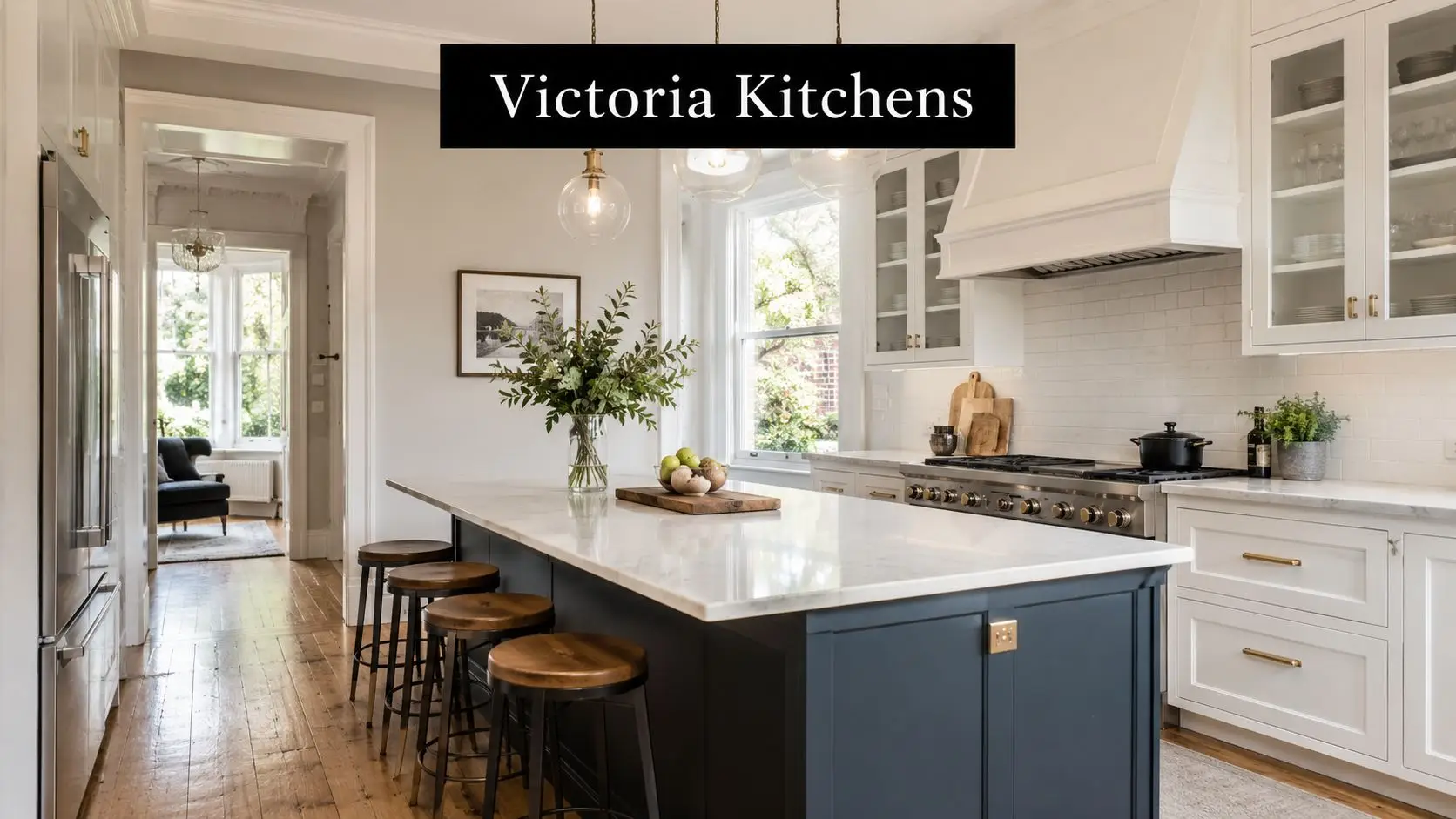
One common Highett scenario is the older family home where the kitchen feels cut off from the living area. The room itself may not be tiny, but the wall placement makes it feel separated and cramped.
In that kind of project, the problem usually isn't just dated finishes. It's poor flow. Parents cook facing a wall, kids crowd narrow walkways, and storage ends up scattered across adjoining rooms.
The solution is often less about adding luxury and more about reorganising function. A better island position, stronger pantry joinery, and a layout that opens sightlines into the living space can change the way the whole home works. Once the kitchen becomes part of the social zone, lighting, appliance placement and circulation all need to support that broader use.
The result is a room that handles weekday traffic better and feels more natural for entertaining. That's a stronger upgrade than surface-level styling alone.
A compact kitchen made to feel larger
At the other end of the market is the apartment or unit kitchen with very little margin for error. In smaller homes, one oversized appliance, one badly placed pantry, or one heavy run of overheads can make the room feel boxed in.
These projects reward restraint.
A successful compact kitchen usually relies on cleaner lines, careful storage planning, and finishes that reflect light without becoming sterile. Tall cabinetry can add serious utility, but only when balanced against visual weight. Integrated bins, considered drawer storage, and a splashback with minimal visual clutter often do more for the room than flashy details.
There's also a strong crossover here with bathroom design thinking. The same choices that lift compact ensuites often lift small kitchens too. Consistent tones, low-maintenance surfaces, neat junctions, and hardware that doesn't dominate the eye. That's why clients looking at kitchen work are often also thinking about bathroom renovations. The aim in both spaces is similar. Better function, a more refined feel, and fewer compromises in everyday use.
What these projects have in common
Different homes, different budgets, same core pattern.
- The old problem was functional first. Bad storage, poor movement, weak layout.
- The best fix came from planning, not decoration. Once the plan improved, the room looked better as a by-product.
- The final result felt calmer. Better kitchens aren't just prettier. They reduce daily friction.
That's also why “before and after” photos can be misleading without context. The dramatic change usually didn't come from one hero feature. It came from dozens of decisions made properly in sequence.
The kitchens people remember most aren't always the biggest. They're the ones that feel easy to use from the first morning.
Common Kitchen Remodel Questions Answered
The questions below come up on almost every project, especially with homeowners trying to balance family life, budget, and compliance.
How long should I spend planning before work starts
Kitchen remodeling timelines often exceed initial expectations. A 2020 Houzz & Home study found the average kitchen remodeling project involved 8.3 months of planning time and 4.5 months of actual construction time, which underlines how important the pre-construction phase is, according to BLANCO's summary of the Houzz & Home study.
That doesn't mean every Highett kitchen will take exactly that long. It does mean rushed planning usually creates slower building.
Can I live at home during the renovation
Usually, yes, but it depends on your tolerance for disruption and the project scope. If the kitchen is your main food prep area, set up a temporary station elsewhere before demolition starts. If the work involves broader structural change or multiple wet areas at once, staying elsewhere may be more practical.
Is it cheaper to keep the existing layout
Often, yes. Keeping the sink, cooktop and major appliances in similar locations can reduce service work. But a cheap layout that stays awkward can be poor value if the kitchen still doesn't function properly at the end.
What causes the biggest budget surprises
The most common problems are hidden services, late design changes, and scope that looked cosmetic at first but turns into compliance-heavy work once walls open up. That's why proper investigation and a locked design matter so much.
Should my kitchen match my bathrooms
They don't need to match exactly, but they should feel related. Repeated tones, similar hardware language, and a shared approach to materials help the home feel more resolved. If you're planning both a kitchen and bathroom renovations, it's smart to consider them together so one space doesn't date the other.
Are high-end finishes always worth it
Not always. In many homes, practical layout improvements, durable cabinetry and better ventilation outperform expensive decorative upgrades. Premium finishes can be worth it, but only after the essentials are right.
What's the best first step if I'm serious about renovating
Get the existing kitchen measured properly and write a brief that states your priorities clearly. Include what isn't working, what you want to improve, and where you won't compromise. That gives the design and quoting process something solid to respond to.
If you're planning how to remodel a kitchen in Highett or greater Victoria, the smartest move is to begin with measured advice, not guesses. SitePro Bathrooms helps homeowners plan and deliver kitchens and bathroom renovations with clear design, coordinated construction, and local renovation experience managing the job from concept to handover.