• siteprobathrooms

Bathroom Renovation Cost Calculator: A 2026 Highett Guide

A lot of Highett homeowners start in the same place. They know the bathroom has to change, but they don't yet know whether they're looking at a sensible update, a full strip-out, or a project that will grow the moment tiles come off the wall.

That uncertainty is what stops most projects before they start. You might have saved inspiration for modern bathrooms, compared tapware, and talked about better storage or a larger shower, but none of that feels real until you can attach a workable budget to it.

A bathroom renovation cost calculator helps with that first step. Used properly, it turns a vague wish list into a planning range you can work with. It won't replace a site inspection or a professional quote, but it does help you test ideas early, spot budget pressure points, and avoid going into meetings blind.

For Victorian homes, and especially bayside suburbs like Highett, local detail matters. Soil movement, waterproofing rules, digital estimating expectations, labour rates, and the age of the housing stock all affect the actual cost. Generic online figures often miss those issues completely.

Your First Step to a New Bathroom Starts Here

The biggest mistake people make is treating the budget as something to sort out later. In bathroom renovations, that usually creates more stress, not less. The smarter approach is to price the project before you commit to layouts, finishes, or demolition.

A bathroom renovation cost calculator gives you a controlled starting point. You enter the details you already know, such as room size, whether the layout stays the same, the type of fixtures you want, and the general finish level. From there, you get a ballpark figure that helps answer the practical questions first.

Start with the decisions that change cost fastest

Before you get carried away with new bathroom ideas, answer these four basics:

  • Room type: Is it a compact ensuite, a main family bathroom, or a larger master bathroom?
  • Layout changes: Are the shower, toilet, and vanity staying put, or moving?
  • Finish level: Are you aiming for a straightforward update, quality mid-range finish, or one of the more polished designer bathrooms you see in magazines?
  • Condition of the existing room: Is this likely to be a clean rebuild, or could there be hidden issues once demolition starts?

Those answers shape the budget more than colour palettes do.

Practical rule: If you don't know whether you're changing layout, you don't yet know your likely renovation bracket.

For homeowners in Victoria, budgeting also needs to line up with compliance. Waterproofing, ventilation, licensed trades, and proper project coordination aren't optional extras. They're part of the job. That's also why it matters to understand why using a registered builder matters for your bathroom renovation, especially when you're comparing online estimates with real-world project delivery.

Use the calculator as a planning tool, not a promise

The right mindset is simple. A calculator is there to help you:

  1. Set a realistic range
  2. Test different options before committing
  3. Prepare for the quote stage with better questions

That's where confidence starts. Not with a random average, but with a clearer idea of what your own bathroom might cost in your own suburb.

What Is a Bathroom Renovation Cost Calculator

A bathroom renovation cost calculator gives you an early budgeting range based on the scope you select. It helps you test whether your plan looks like a basic update, a full renovation, or something in between before you start requesting quotes.

A green pen resting on a technical drawing of a bathroom layout next to a plan.

For Highett homeowners, that can be useful early on. A calculator can show the likely cost difference between keeping plumbing where it is and moving it, or between choosing builder-grade fixtures and higher-spec fittings. That sort of comparison saves time because it tells you quickly which ideas fit your budget and which ones need reworking.

The catch is simple. Generic calculators often miss the things that change real project costs in Victoria.

They usually do a reasonable job on visible selections like tiles, tapware, vanities, and baths. They are much weaker on site conditions, access, compliance, and the small construction details that push a bathroom from straightforward to expensive. In this part of Melbourne, I would treat any online figure as a planning number only until someone has looked at the room properly.

What the calculator is actually measuring

A good calculator should convert your choices into a rough cost range across three areas:

  • the amount of demolition and rebuilding involved
  • the level of finishes and fixtures you want
  • the likely labour and compliance load tied to that scope

That last point matters more in Victoria than many online tools allow for. Bathroom work here needs to line up with current building standards, waterproofing requirements, ventilation expectations, and the use of appropriately licensed trades where required. If a calculator ignores those items, the estimate can look tidy on screen and still be short once the job is priced properly.

Why local context matters in Highett

Two bathrooms of the same size can land in very different budget ranges in Highett because the room itself is only part of the story. Older homes can hide uneven subfloors, dated pipework, wall damage, or previous renovation work that needs correcting. Ground conditions and slab details also matter if the job involves drainage changes or toilet relocations. A generic calculator rarely asks those questions.

I see the same problem with compliance allowances. Many calculators assume a clean, standard installation. Real projects in Victoria often need extra work to meet waterproofing standards, improve ventilation, correct falls, or deal with defects exposed during demolition. None of that means the calculator is useless. It means the calculator is only as reliable as the assumptions behind it.

A useful calculator gives you a budget starting point. A site inspection turns that starting point into a quote you can rely on.

What a good calculator should help you decide

Question Why it matters
How big is the job really? Replacing finishes is a different cost category from rebuilding the room and relocating services.
Which choices are adding cost fastest? Layout changes, custom joinery, premium fixtures, and rectification work can shift the budget quickly.
Am I ready to ask for quotes? Clear inputs lead to better conversations with builders and fewer surprises later.

Used properly, a calculator is a filter. It helps rule out unrealistic ideas, set a workable range, and prepare you for the quote stage. What it cannot do is inspect your bathroom, confirm hidden conditions, or price the Victorian-specific compliance work that may sit behind the finishes.

Decoding the Key Inputs for an Accurate Estimate

A calculator gets more useful when the inputs match the job you are planning in Highett. A clean looking online estimate can drift a long way from the final cost if you leave out layout changes, compliance work, or the condition of the existing room.

A person uses a tablet to input renovation preferences into a digital bathroom design calculator app.

Size and layout

Floor area matters, but the plan matters more.

Two bathrooms with the same square metre rate can end up in different price bands once the toilet moves, the shower is enlarged, or the vanity wall changes. A useful calculator should ask whether plumbing points stay where they are, whether walls are changing, and whether the room is being opened up for better movement. If it only asks for size, it is giving you a rough range, not a reliable budget.

That is especially true in older Highett homes where the existing setout often reflects how bathrooms were built decades ago, not how people want to use them now.

Scope of works

The biggest budgeting mistake I see is calling a full rebuild a simple update.

If you are replacing tiles, waterproofing, fixtures, lighting, ventilation, and damaged wall linings, that is a renovation. If you are altering drainage, rebuilding shower bases, or correcting poor falls, the scope has moved well beyond a cosmetic refresh. A calculator needs to separate those levels clearly so the estimate reflects the amount of demolition, preparation, and licensed trade work involved.

A practical way to enter scope is to choose the closest fit:

  • Cosmetic update: keep the layout, replace selected finishes and fixtures
  • Full renovation: strip out the room and rebuild it to current standard
  • Reconfiguration: relocate plumbing, adjust walls, or change the room plan
  • Custom fitout: add detailed joinery, premium surfaces, feature lighting, or niche detailing

For compact rooms, it also helps to compare your ideas against realistic cost ranges for a small bathroom remodel, because small spaces often cost more per square metre once custom planning and tight trade access are involved.

Fixtures and finishes

This input changes budgets fast.

A standard acrylic bath, builder-range toilet suite, and semi-frameless screen sit in a very different cost bracket from a freestanding bath, wall-hung pan, stone-top vanity, full-height tiling, and frameless glass. The calculator should let you choose finish levels in a way that reflects how bathrooms are priced. Entry level, mid-range, and premium is usually enough for planning.

Selections also affect labour. Larger format tiles, recessed shaving cabinets, wall-hung vanities, and tiled niches can all add time on site. The product cost is only part of the story.

Structural and local conditions

This is the area generic calculators handle poorly.

Bathrooms in Victoria can carry extra cost before the new fittings even arrive. Subfloor movement, older framing, out-of-level surfaces, and hidden water damage all affect what has to be repaired before waterproofing and tiling start. In bayside areas such as Highett, site conditions and past settlement can also influence floor preparation if the job involves drainage changes or correcting movement-related cracking.

Compliance matters too. Victorian bathroom work has to align with current requirements for waterproofing, ventilation, plumbing, and electrical safety. If demolition exposes defects, the room still has to be rebuilt properly. A calculator cannot inspect any of that. It can only assume average conditions.

Labour and licensed trades

Bathrooms are trade-dense projects. Plumbers, electricians, waterproofers, tilers, carpenters, and installers all need to work in the right order, and delays in one trade can push costs elsewhere.

That is why labour should never sit in the calculator as a generic allowance. In Victoria, a key issue is whether the work is being carried out and coordinated by properly registered and licensed professionals, with the right checks and documentation where required under VBA rules. Cheap allowances usually mean something has been left out.

The better your inputs, the better your estimate. But even a well-set-up calculator cannot see under tiles, test falls, confirm substrate condition, or price rectification after demolition. It gets you to a sensible budget range. A site inspection gets you to numbers you can build around.

Typical Bathroom Renovation Costs in Highett Victoria

A Highett bathroom can look like a straightforward update on paper and still price like a full rebuild once actual work starts. I see that often in older bayside homes. Owners budget for tiles, tapware, and a new vanity, then demolition exposes floor correction, wall straightening, drainage adjustments, or ventilation upgrades that a generic calculator never allowed for.

That is why local budget ranges matter more than broad national averages. In Highett, labour rates, access, product choices, and Victorian compliance requirements usually push bathroom costs above the numbers you see in generic online tools.

What these ranges look like in practice

Use these figures as early planning ranges for a complete renovation in Highett. They help set a sensible budget before you commit to selections or request a fixed quote.

Bathroom Type Typical Size Budget Range (Basic Finish) Mid-Range (Quality Finish) High-End / Luxury (Designer Finish)
Small ensuite Under 4 sqm $15,000 to $25,000 $15,000 to $25,000 $25,000+
Standard family bathroom 6 to 10 sqm $30,000 to $50,000 $30,000 to $50,000 $50,000 to $60,000+
Larger primary bathroom 6 to 10 sqm and above with premium inclusions $30,000+ $30,000 to $50,000 $60,000+

Those overlaps are not a mistake.

In Victoria, the fixed cost of doing the room properly is a large part of the budget. Demolition, waste removal, plumbing and electrical rough-in, waterproofing, screeding or floor prep, tiling, fit-off, and final installation all stack up before you get to premium upgrades. A basic finish can still cost more than expected if the room needs rectification work or the existing layout is inefficient.

Why one Highett bathroom costs more than another

The biggest cost swings usually come from a few practical decisions and local site conditions:

  • Keeping the layout or changing it: Leaving the shower, vanity, and toilet in place usually protects the budget. Moving wastes or water points often adds plumbing time, floor work, and patching.
  • Condition of the existing room: Older homes around Highett can hide moisture damage, uneven substrates, outdated services, or previous renovation shortcuts.
  • Floor and drainage work: If falls are poor or drainage needs correction, the cost rises quickly. In some homes, soil movement and past settlement also show up in cracked tiles or out-of-level floors, which means more preparation before waterproofing starts.
  • Product selection: Large-format tiles, custom joinery, recessed shaving cabinets, frameless glass, underfloor heating, and premium fixtures all lift the price.
  • Victorian compliance requirements: Work has to be carried out to current standards. That can affect waterproofing details, ventilation, plumbing, electrical work, and documentation under VBA-related requirements.

Small bathrooms catch people out for the same reason. The footprint is smaller, but the job still needs most of the same trades and the same sequence.

A compact ensuite is rarely cheap per square metre.

That is why a tiny room with full-height tiling, a custom vanity, and difficult access can end up costing more than expected, even when the layout stays put. If you are planning a tighter space, this guide to small bathroom remodel cost factors will help you budget more realistically.

How to use these numbers well

Use the table to set a range, then test your brief against the room you have. If your Highett bathroom is in an older home, has signs of movement, or needs drainage changes, budget toward the middle or upper end rather than the entry number.

The lower end only makes sense when the layout stays the same, the room is in sound condition, and the finishes are controlled. Once you add structural repairs, higher-spec materials, or custom detailing, the calculator range becomes a starting point rather than a likely final cost.

Sample Calculations Putting It All Together

A Highett homeowner can enter the same room size into a calculator as someone in another suburb and still end up thousands apart once the job reaches site. That usually comes down to scope, access, existing building condition, and local compliance details the calculator cannot see.

A table detailing the estimated and actual costs for a bathroom renovation project including materials, labour, and subcontractors.

Scenario one, compact ensuite with a restrained brief

Start with a small ensuite in a solid, straightforward home. The owners want a cleaner finish, better storage, and fixtures that feel current, but they are not chasing a full redesign.

The shower stays put. The vanity stays put. The toilet stays put.

That single decision usually keeps the estimate closer to reality because the plumber, waterproofer, tiler, and electrician can work within an existing layout instead of rebuilding the room around new service points. In practical terms, the calculator should be set up around a like-for-like renovation with upgraded finishes, not a reconfiguration.

A sensible allowance in this type of project usually includes:

  • demolition and strip-out
  • waterproofing and tiling
  • replacement vanity, tapware, toilet, and shower screen
  • lighting, mirrors, paint, and basic accessories
  • labour for standard installation without major service relocation

This is also the kind of job where timing is easier to predict. If you are budgeting around access to the bathroom during works, this guide on how long a bathroom remodel should take helps put the estimate in context.

Scenario two, family bathroom with layout changes

Now take a family bathroom in an older Highett home where the owners want the room to function better day to day. They want a larger shower, a better vanity position, and more open floor space, so fixtures need to move.

That changes the budget fast.

Moving plumbing points often means opening more of the floor and walls, adjusting waste locations, coordinating new set-outs, and checking falls still work properly. In Victoria, that can become more involved if the existing slab, subfloor, or drainage layout gives you little room to work with. On some sites, even a modest layout change leads to extra labour before new finishes have even been ordered.

I see this regularly in older properties. What looks like a simple shift on a plan can turn into drainage changes, floor correction, or additional making-good work once demolition starts.

What the calculator is helping you compare

The useful part of the calculator is not the headline number. It is the gap between one scope and another.

Decision Budget effect
Keep fixture locations Lower installation complexity and a more stable early estimate
Move one key fixture Higher plumbing labour and more coordination on site
Move multiple fixtures Larger jump in cost risk, especially in older bathrooms
Add custom or premium finishes Higher material spend and more installation time

Use it to price two versions of the same room. One version keeps the layout and tightens the finish schedule. The other includes the changes you would like if budget was less constrained.

That comparison usually gives homeowners a clearer answer than a single average ever will. It shows whether the extra spend is going into function, appearance, resale value, or hidden site work that a generic online tool cannot price properly in advance. In Highett and across Victoria, that last category matters more than many people expect.

From Estimate to Quote Where Calculators End

A Highett homeowner can enter room size, tile allowance, tapware level, and labour assumptions into a calculator and get a useful budget range in minutes. Then demolition starts, the floor falls away to one corner, the waterproofing underneath has failed, and the existing plumbing does not suit the new layout. That is the point where an estimate stops being enough.

Online calculators are good for early planning. They help you test scope before you commit to design meetings, product selections, and site visits. They do not inspect the room, and they do not price the hidden work that often drives the difference between a rough estimate and a contract figure.

In Victoria, that gap matters.

A proper quote takes account of site conditions, current product pricing, and compliance requirements that a generic calculator cannot verify from a screen. In older Highett homes, I would also expect the builder to check how the existing floor, wall framing, drainage falls, and ventilation setup will affect the build. If the property has movement, moisture damage, or previous work that would not pass current standards, the budget can change for good reason.

What a quote adds that a calculator cannot

A site-based quote should do three practical jobs.

  1. Measure and inspect the actual room
    This includes checking levels, wall condition, access, service locations, and the likely amount of rectification work before new finishes go in.

  2. Test the design against Victorian requirements
    Waterproofing, ventilation, drainage, electrical work, and plumbing all need to suit current expectations. If permits, licensed trades, or VBA-related compliance steps apply, they need to be allowed for before the job starts, not discovered halfway through.

  3. Set out inclusions, exclusions, and variation risk clearly
    A good quote shows exactly what is priced and where hidden conditions may still affect cost. That is how homeowners avoid false confidence from a low starting number.

Material pricing can shift between the day you use a calculator and the day you approve fixtures and tiles. Lead times can shift too. A live quote reflects what suppliers are charging at the time of pricing, which is far more useful than an average pulled from a broad national range.

Why local quoting matters in Highett

Local housing stock creates its own cost pattern. Some bathrooms are straightforward cosmetic upgrades. Others involve concrete slab work, reactive clay movement, dated pipework, or awkward drainage positions that limit what can be moved without extra labour.

Those are not edge cases in Victoria. They are common budgeting issues.

A local specialist should price with those risks in mind and explain the trade-off clearly. Keeping the existing layout may protect budget. Moving the shower and toilet might improve function, but it can trigger extra plumbing, floor preparation, and compliance checks. That is the kind of decision a calculator helps compare, but only a quote can price with enough confidence to sign off on.

Timing matters as well. Product selection, trade sequencing, and inspection requirements all affect total cost, which is why it helps to review how long a bathroom remodel should take before you lock in your budget and start date.

Use the calculator to narrow the brief and set a realistic range. Then get an on-site quote from a bathroom specialist who understands Highett homes, Victorian compliance, and the hidden work that online tools cannot see.

  • siteprobathrooms

Unlock Savings: How to Renovate a Bathroom on a Budget

If you're standing in a bathroom with tired tiles, weak lighting, swollen cabinetry and a layout that feels older than the house listing photos, you're not alone. Most Victorian homeowners start in the same place. They want a cleaner, sharper, more functional room, but the quotes for full bathroom renovations can feel miles away from the budget they have.

The good news is that learning how to renovate a bathroom on a budget isn't about cutting every corner. It's about choosing the right corners to leave alone. The biggest savings usually come from smart planning, selective upgrades, and knowing when a cheap decision will cost more later.

A budget bathroom can still look polished. It can still feel like one of those modern bathrooms you save for inspiration. It just needs discipline from day one.

Your Budget Renovation Blueprint

That old bathroom usually tells you where the money will disappear. It might be the awkward shower base, the vanity with no storage, or the plumbing layout that tempts you to move everything around. Before buying a single fitting, define what success looks like for your space.

For some households, success means a hard-wearing family bathroom that cleans easily. For others, it means one of those designer bathrooms with better lighting, calmer colours and smarter storage, but without the full designer price tag. If you don't pin this down early, you'll keep changing direction mid-project. That's how budgets drift.

A dated, vintage bathroom featuring floral wallpaper, a pedestal sink, and a green toilet with retro tiles.

Start with the numbers that matter

In Australia, the average cost of a full bathroom renovation ranges from AUD 20,000 to AUD 35,000, while budget-conscious renovations can be achieved for AUD 8,000 to AUD 20,000 if you focus on high-impact choices and keep the plumbing layout in place. Retaining that layout can save up to AUD 5,000 to AUD 8,000 in relocation costs, according to this Australian budget renovation cost guide.

That one decision changes everything. If the toilet, shower and vanity stay broadly where they are, your spend goes into visible improvements instead of hidden pipework.

Run a renovation audit before you design

A proper budget plan starts with a blunt audit. Walk through the room and sort each element into one of three categories:

  • Must replace. Failed waterproofing signs, damaged vanity carcasses, cracked pans, unstable fixtures, severe mould issues.
  • Can refresh. Cabinet fronts, mirrors, handles, wall colour, grout appearance, lighting style.
  • Leave alone. Sound plumbing positions, decent room proportions, serviceable windows, functional towel rails in secondary spaces.

Practical rule: If an item is sound, compliant, and not ruining the look of the room, keep it.

This is the point where many homeowners stop thinking in terms of a full rip-out and start seeing a staged, workable plan.

Set guardrails before ideas get expensive

Budget projects need fixed guardrails, not wish lists. Decide these items early:

  1. Your maximum spend
  2. Whether you're keeping the existing layout
  3. Which finishes need to look premium
  4. Which jobs require trades
  5. Whether the work will happen all at once or in stages

If you're still pricing up possibilities, this guide to small bathroom remodel cost helps frame what different levels of work usually involve.

New bathroom ideas are useful only when they fit the room, the building, and the money. The homeowners who stay on budget don't chase every idea. They choose a direction, protect the layout, and spend where the eye lands first.

Smart Savings on Materials and Fixtures

Budget bathrooms look expensive when the spending is deliberate. They don't look expensive when every item is the cheapest thing available. The difference is usually in where the money lands.

In Victoria, budget bathroom renovations can yield a 70-85% return on investment, and a common framework is the 40-30-20-10 rule: 40% for fixtures and vanity, 30% for surfaces, 20% for labour, and 10% for contingency, as outlined in this Victorian budget renovation guide.

An aesthetic flatlay of various interior design material samples, textures, and faucets for home renovation planning.

Where to spend for maximum visual return

Most bathrooms have two or three focal points. Usually it's the vanity, the shower area, and the wall or floor finish. Put your cleaner-looking selections there.

A few practical examples:

  • Vanity front and benchtop look matter more than an elaborate cabinet interior in a compact room.
  • Tapware finish consistency matters more than chasing unusual shapes.
  • Lighting and mirror scale can lift the whole room faster than another decorative feature.

If you want the room to read as modern, keep the visual language simple. Straight lines, quiet finishes, and fewer materials usually beat a long list of “features”.

Where to save without the room looking cheap

Budget jobs are won in this phase.

  • Keep the cabinet carcass if it's solid. Refinish doors or replace fronts rather than rebuilding the whole vanity.
  • Choose simple tile profiles. Fancy laying patterns and fiddly edges often add labour pressure.
  • Use a restrained palette. Too many feature moments make a small bathroom feel cluttered.
  • Standard sizes help. Custom dimensions can look excellent, but they rarely support a tight budget.

Expensive-looking bathrooms are often simpler than people expect. Fewer finish changes usually mean cleaner lines and fewer labour headaches.

Surfaces are one area where homeowners often overspend trying to recreate showroom drama. In a real bathroom, durable and easy-to-maintain usually beats visually busy.

A practical way to apply the 40-30-20-10 split

Use the framework as a discipline tool, not a rigid formula. If your vanity and fixtures are the hero elements, keep the rest calm and efficient.

Spend area What it usually covers Budget mindset
Fixtures and vanity Vanity, toilet, tapware, shower fittings, mirror Make this look deliberate
Surfaces Wall finish, flooring, tile, paint Keep it cohesive, not flashy
Labour Install, fit-off, prep, compliance tasks Don't squeeze this too hard
Contingency Unknowns behind walls and under floors Protect the project

One more rule matters here. Buy for the whole room, not one item at a time. A vanity that looked perfect in isolation can force dearer tile choices, different plumbing connections, or awkward spacing around the toilet.

If you're weighing finishes, this article on how to choose bathroom tiles is a useful starting point for balancing look, maintenance and budget.

The best budget bathrooms don't try to look luxurious in every detail. They aim for one clear result: a room that feels organised, current and easy to live with.

Deciding Between DIY and Professional Trades

A Melbourne bathroom reno often goes off budget the same way. The owner takes on one licensed job to save a few thousand dollars, the waterproofing or plumbing gets delayed, and the room sits half-finished while trades reshuffle their schedules. The original saving disappears in rework, call-out fees, and extra time without a working bathroom.

DIY still has a place. It just needs to stay in the safe, low-risk parts of the job.

Two people holding home renovation tools up against a sky background with a text overlay.

Good DIY jobs

Owners can save real money on preparation and finishing work, especially in straightforward cosmetic updates.

These tasks are usually suitable if you're organised, have the right tools, and know your limits:

  • Strip-out support work. Removing mirrors, accessories, shelves, and other non-service items after the area is made safe.
  • Painting. Walls, ceilings, trims, and some cabinetry if the substrate is sound and the coating system suits a wet area.
  • Flat-pack assembly. Putting together vanities or storage units before installation.
  • Accessory installation. Hooks, towel rails, freestanding storage, and styling items where no concealed plumbing or wiring is involved.
  • Site prep and clean-up. Protecting floors, managing rubbish, and keeping access clear for trades.

The best DIY tasks are easy to inspect, easy to redo, and unlikely to cause hidden damage.

Jobs that should stay with trades

In Victoria, bathrooms are not the room to guess your way through. Waterproofing, plumbing, electrical, and many fit-off tasks need licensed people, and for good reason. If these parts fail, the damage usually sits behind tiles, under floors, or inside walls until the repair bill gets ugly.

Body corporate rules can add another layer. In apartments and some townhouses, works that affect waterproofing, services, penetrations, or waste lines may need approval before the job starts. Owners who skip that step can end up paying to open finished work for inspection or reverse unauthorised changes.

Use this test before deciding a task is DIY-friendly:

Task DIY suitable Trade required
Remove old accessories Yes No
Paint walls and ceiling Yes No
Move plumbing points No Yes
Electrical changes No Yes
Waterproofing No Yes
Install and certify key wet-area work No Yes

If a mistake can cause leaks, electrical risk, failed compliance checks, or damage to another lot, hand it to a trade.

Where homeowners get caught out

The expensive part is rarely the first mistake. It's the chain reaction after it.

A tap set out a few millimetres wrong can force tile cuts to shift. A vanity installed before final service checks can come back off the wall. An unlicensed waterproofing shortcut can hold up the whole fit-off because no reliable trade wants to inherit the risk.

I see the same trade-off on budget projects all the time. Save on labour where the work is visible, simple, and separate from compliance. Pay for licensed work where sequencing, certification, and long-term performance matter.

When a builder or project manager makes sense

Some bathrooms need more than booking a plumber, tiler, and electrician one by one. If the renovation includes layout changes, apartment approvals, older Melbourne housing stock, or tight access, coordination becomes part of the budget equation.

A registered builder can be the right choice when structural work or broader building scope is involved. A renovation project manager also adds value on budget-conscious jobs by handling trade sequencing, product lead times, and site decisions before they turn into variation costs. Add 3D design early and you can solve spacing problems on screen instead of on site, which is much cheaper.

That approach is not about making the project bigger. It's about keeping a modest bathroom renovation controlled, compliant, and finished properly the first time.

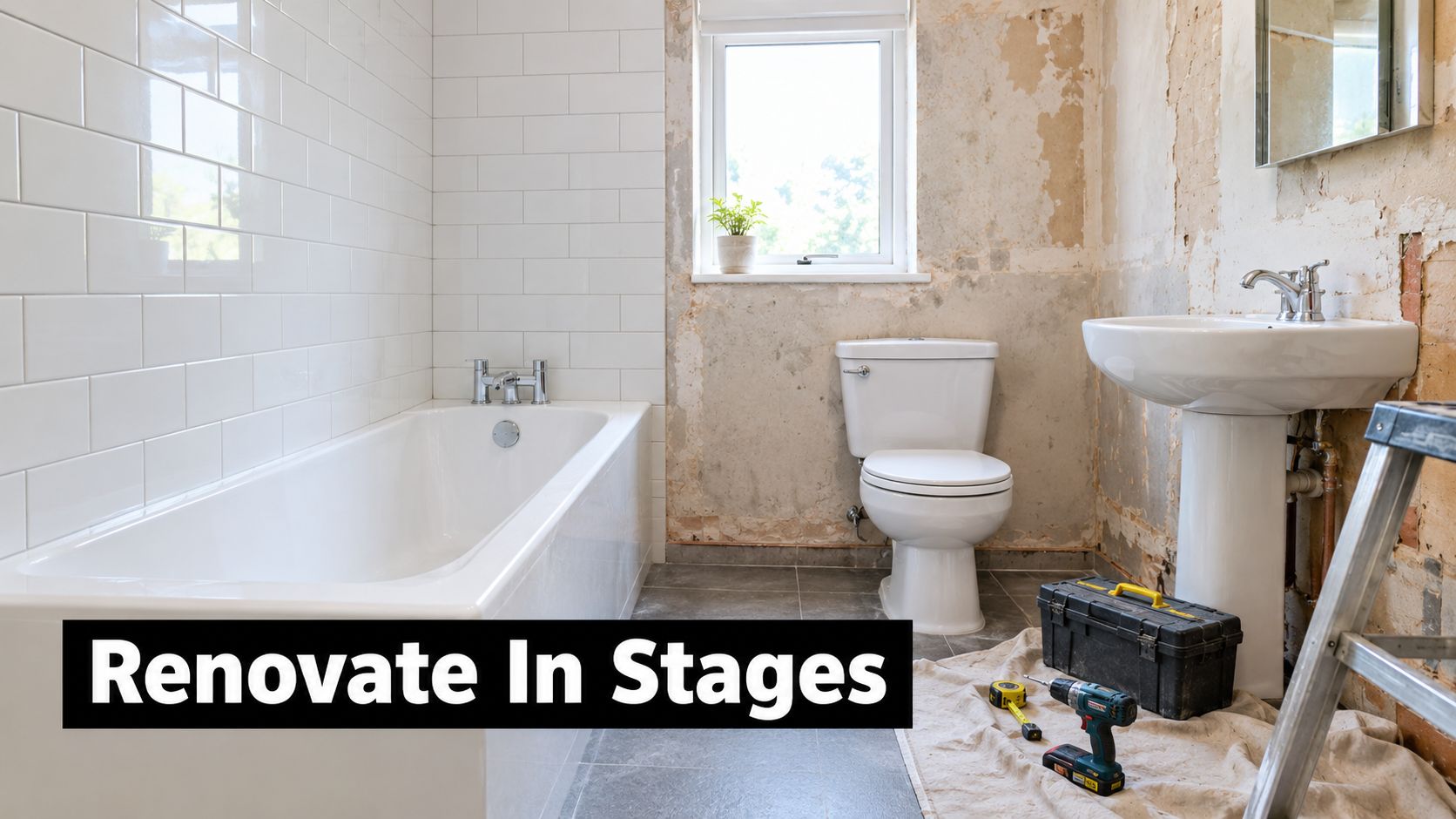
High-Impact Quick Wins and Phased Renovations

Not every bathroom needs a full demolition to improve fast. Some rooms are structurally fine but visually dated. Others need bigger work, just not all in one hit. That's where quick wins and phased renovations make sense.

Quick wins that change the room fast

Cosmetic changes work best when they target what your eye notices immediately. In most bathrooms, that means dated finishes, poor lighting and tired hardware.

Good quick wins include:

  • Updating tapware and shower fittings when the existing setup allows like-for-like replacement
  • Replacing mirrors with a better-proportioned option
  • Changing cabinet handles and accessories so the room reads as one scheme
  • Painting walls or cabinetry where the substrate is sound
  • Refreshing grout appearance or replacing tired silicone where appropriate
  • Improving lighting to make the room feel cleaner and brighter

These aren't glamorous decisions, but they do a lot of visual lifting. A bathroom feels newer when the room looks cleaner, lighter and more intentional.

How to phase a bathroom renovation properly

A staged approach only works if each stage leaves the room usable and doesn't undo the previous one. Random upgrades cost more because one new item often exposes three old ones.

A practical sequence is:

  1. Stabilise the room first
    Fix leaks, fan issues, damaged seals, storage problems and anything affecting daily use.

  2. Upgrade visible surfaces next
    Paint, mirror, lighting, accessories and vanity refinishing can give the biggest immediate lift.

  3. Tackle fixtures and major wet-area work later
    Keep this stage for when you've built enough budget to do it properly.

A phased renovation works when each phase solves a real problem. It fails when each phase is just a temporary patch.

This is also the right approach if you're collecting ideas for modern bathrooms but don't yet have the funds for a full reset. Do the work that improves function and visual calm first. Save the major plumbing and shower-area changes for the stage when you can complete them without compromise.

When to Engage a Specialist for Your Renovation

A budget bathroom renovation often stops being a budget renovation the moment the owner has to reschedule three trades, answer a body corporate manager, and reorder a vanity that does not fit the as-built room. I see that pattern a lot in Melbourne apartments. The job looks simple until approvals, access rules, and wet-area compliance start affecting every decision.

A professional interior designer and client reviewing a floor plan layout while sitting on a couch.

Apartment bathrooms change the budget equation

In Victoria, apartment and townhouse bathrooms usually come with extra layers of control. Body corporate or owners corporation approval may be required before demolition starts, especially if the work affects waterproofing, services, acoustic performance, waste pipes, or common property. Some buildings also restrict working hours, lift use, rubbish removal, parking, and where materials can be stored.

Those rules cost time if they are handled late. They also affect money. A cheap quote can unravel fast once the contractor has to work around booking windows, protection requirements for common areas, or extra documentation for management approval.

That is usually the point where a specialist earns their fee.

What a specialist actually changes

True value lies beyond simple trade coordination. It involves minimizing costly errors before they occur.

A specialist team can help by:

  • confirming site constraints early, including access, services, wall positions and fixture clearances
  • locking selections before demolition so plumbing and electrical rough-ins suit the final layout
  • preparing drawings and scope clearly for owners corporation review where needed
  • sequencing trades properly so waterproofing, tiling, glazing and fit-off do not clash
  • assigning responsibility for compliance, defects and variations

That last point matters in Victoria. If several trades are booked separately and one step goes wrong, each contractor can blame the previous one. Homeowners end up stuck in the middle. Working with a team that understands why using a registered builder matters for your bathroom renovation gives you a clearer line of responsibility.

Why 3D planning is worth it on a tight budget

3D design is not just for high-end bathrooms. On a tighter budget, it can save more because there is less room for corrections once materials are ordered.

It helps test the details that usually cause rework. Vanity depth. Door swings. Mirror centring. Niche placement. Towel rail positions. Whether the room feels balanced once tile sizes and grout lines are set out.

I would rather adjust a layout on screen than after waterproofing is done.

One local example is SitePro Bathrooms, which handles bathroom planning, 3D design and construction coordination. That setup suits homeowners who want fewer handover points and fewer chances for miscommunication.

If your bathroom is in an apartment, if approvals are likely, or if you cannot manage trades and compliance around work and family life, bringing in a specialist is often the lower-risk budget decision.

Common Pitfalls and Your Sample Timeline

Most overspends happen before the room starts looking better. They come from hidden issues, poor sequencing and decisions that should've been settled earlier.

Two of the biggest traps are beneath the finishes. Failing to inspect the subfloor after demolition can reveal rot that inflates budgets by an average of 15%. Ignoring waterproofing requirements is another major problem, with 28% of budget renovations failing council inspection on that point and causing 4 to 6 week delays.

The mistakes that hurt most

Some problems are obvious in hindsight, but not during the rush of demolition and ordering.

  • Skipping subfloor checks. Once fixtures and tiles are out, inspect properly. If you don't, hidden deterioration can force disruptive changes later.
  • Treating waterproofing like a minor step. It isn't a paint job. It affects compliance, longevity and whether the bathroom can be handed over without drama.
  • Buying finishes before confirming site conditions. A vanity, shower screen or tile selection can look perfect online and still be wrong for the actual room.
  • Starting without a sequence. Bathroom work is unforgiving when trades overlap badly or arrive before the room is ready.

Waterproofing and substrate condition aren't “back-end details”. They're the project.

A realistic sample timeline

A budget renovation doesn't need to be chaotic. It does need a clean order of operations. Here's a simple planning guide you can use as a reference point.

Budget Tier Typical Scope of Works Estimated Timeline
Cosmetic refresh Paint, mirror, accessories, hardware, minor fixture updates, surface refresh where suitable Short timeline, often planned as a light refresh
Mid-range budget update Vanity replacement, fixture upgrades, partial surface work, licensed trade involvement, layout retained Moderate timeline with allowance for ordering and trade coordination
Full budget-conscious renovation Demolition, waterproofing, new fixtures and finishes, full fit-off while keeping core layout Longer timeline, especially if approvals or hidden repairs arise

Your pre-start checklist

Before work begins, make sure you can answer these clearly:

  1. What are you keeping no matter what
  2. What will be replaced if demolition exposes problems
  3. Who is handling waterproofing and service work
  4. Whether approvals are needed
  5. What your contingency is reserved for

A budget renovation succeeds when the unseen parts are handled as carefully as the visible ones. That's what gives you the finished room people notice, and the durability you notice years later.


If you're planning bathroom renovations in Highett or elsewhere in Victoria, start with the layout, the compliance requirements, and the items that deliver the biggest visual return. That's how you get fresh new bathroom ideas into a room that looks current, functions properly and stays inside budget.

  • siteprobathrooms

Adding a Bathroom: A Victoria Homeowner’s Guide (2026)

If your home has reached that stage where mornings feel like a queue, guests always need to “just wait a minute”, or the kids have somehow taken over the only shower, adding a bathroom starts to feel less like a luxury and more like the obvious next step. In a lot of Melbourne homes, that pressure point arrives well before the family is ready to move.

That's especially true in older houses across bayside suburbs, where the floor plan often made sense decades ago but doesn't suit how people live now. A second bathroom can mean a private ensuite, a proper family bathroom renovation strategy, or a basic toilet and shower where they're needed most. It can also be the difference between making your current house work for another ten years and deciding you've outgrown it.

The catch is that adding a bathroom isn't just about picking tiles and tapware. In Victoria, the job sits at the intersection of layout, drainage, waterproofing, permits, structural work, and compliance. That's where many first-time renovators get tripped up. The nicest new bathroom ideas still fail if the location is wrong, the plumbing run is awkward, or the approvals haven't been handled properly.

Is Adding a Bathroom the Right Move for Your Home

A typical scenario goes like this. A family buys a solid home in Highett because the block is good, the schools are close, and the location works. A few years later, the one original bathroom starts causing friction. One person needs the shower, another needs the basin, and guests are walking past bedrooms to get to the toilet.

That's usually the moment people start looking at adding a bathroom instead of moving house.

A modern bathroom vanity with natural wood cabinets, brass hardware, and a dark marble bowl sink.

When the project makes sense

The best bathroom additions solve a daily problem first. Value matters, but function matters more. If the house has one bathroom serving a growing family, no guest facility, or no ensuite for the main bedroom, the project often pays off in day-to-day comfort long before resale enters the conversation.

There's also a property angle. Bathroom additions in Victoria have been linked with resale uplift, particularly when the new room is practical, well-located, and built to suit the home rather than forced into it. That's one reason so many owners now look at modern bathrooms and smarter layouts as part of a larger upgrade plan rather than a cosmetic renovation alone.

A good bathroom addition doesn't feel “added on”. It feels like the house should always have had it.

What works and what doesn't

Some additions are straightforward wins. Turning underused floor area into a compact ensuite, reworking a laundry, or converting part of a garage can transform the way a house functions. These projects tend to work because they use space the home already has.

What doesn't work is chasing a bathroom at any cost. If the room ends up dark, cramped, or dependent on difficult plumbing runs, the final result can feel compromised. The same applies when homeowners start with finishes instead of planning. Designer bathrooms only work when the bones are right first.

A better approach is to test three things early:

  • Daily use: Who needs the room, and when?
  • Placement: Can it sit near existing services or in a structurally sensible spot?
  • Long-term fit: Will it still suit the home in five or ten years?

Lifestyle first, style second

Many strong projects begin to take shape, driven by varied needs. A family might want a hard-wearing bathroom near the kids' bedrooms. A couple might want a calm ensuite with cleaner lines and more storage. An investor might focus on adding an extra shower and toilet to make the property more attractive to future buyers or tenants.

All three are valid. The right answer depends on the house, not on trends.

Finding the Perfect Spot Feasibility and Layout Planning

The location drives almost everything. Cost, complexity, approvals, plumbing, natural light, and how the bathroom feels once it's finished all start with one decision. Where will it go?

Before you think about finishes, walk through the house and look for wasted or underperforming space. In many homes, the answer isn't an extension. It's a better use of existing floor area.

A conceptual floor plan overlaying a bathroom layout onto a hallway and doorway interior design perspective.

The most common locations

A few spots come up again and again because they're practical.

  • Laundry conversion: If the laundry is oversized or poorly laid out, it can often absorb a shower room or combined bathroom.
  • Garage conversion: Useful when internal space is tight, but structural and approval issues need close attention.
  • Upstairs reconfiguration: A common move in older homes where a robe, retreat, or part of a hall can become an ensuite.
  • Ground-floor extension: Best when the existing plan offers no sensible internal option, though this usually carries more build complexity.
  • Large walk-in storage area: Sometimes the simplest answer, especially near existing plumbing.

Each option has trade-offs. A converted internal space often saves money and shortens the build path. An extension gives more freedom but adds more structural, envelope, and drainage work.

What to check first

The first walkthrough should be practical, not aspirational. Ask:

  1. How close is the new room to existing water and waste lines? Shorter runs are usually simpler.
  2. Does the floor structure support the change? Upstairs additions often need more scrutiny.
  3. Can the room ventilate properly? Bathrooms without natural airflow need careful mechanical ventilation planning.
  4. Will the new layout damage another room? A second bathroom shouldn't ruin circulation or storage elsewhere.
  5. Is there enough door clearance and usable floor space? A plan can fit on paper and still feel awkward in real life.

If you're considering an ensuite, looking at examples of ensuite design layouts and planning ideas can help you understand how circulation, vanity position, and shower placement affect the final feel of the room.

Practical rule: The cheapest square metre in a bathroom addition is often the one that already exists inside the house.

Layout matters more than room size

A bathroom doesn't need to be huge to work well. What matters is sequence. If the first thing you hit is the toilet, the room feels clumsy. If the vanity steals the walkway, the room feels tight. If the shower door opens into the traffic line, the room feels badly planned even when the finishes are beautiful.

That's why early visualisation matters. Good 3D planning helps homeowners test whether a nib wall improves privacy, whether a cavity slider frees up circulation, or whether swapping a hinged shower screen for a fixed panel gives the room more breathing space.

Here's what usually improves the layout fast:

  • Place the vanity where it's easy to access
  • Keep the toilet out of the direct sightline where possible
  • Use shower screens and door swings to preserve movement
  • Build in storage from the start
  • Future-proof with walk-in access if the household may need it later

Natural light and privacy

The nicest bathrooms balance light and privacy. A frosted window, skylight, or borrowed light from an adjacent zone can lift a room dramatically. But privacy should be handled early, especially in side setbacks, garages, or upper-level additions overlooking neighbours.

A bright room feels larger. A private room gets used comfortably. You need both.

Budgeting Your Victorian Bathroom Addition A Realistic Cost Breakdown

A bathroom addition can look straightforward on paper, then shift fast once the hidden work is priced properly. In Victoria, the budget is usually driven by drainage, waterproofing, structure, ventilation, and access before anyone starts talking about tile patterns or tapware finishes.

For a full bathroom addition in Victoria, I'd usually tell homeowners to allow about AU$25,000 to AU$60,000 as a practical working range based on SitePro's project experience across Melbourne. A compact bathroom carved from existing internal space can sit at the lower end. An upstairs addition, garage conversion, or new extension can move well beyond that range once structural changes and longer service runs are involved.

Where the money usually goes

The spending pattern is fairly consistent, even though every house throws up its own issues.

Expense Category Estimated Cost (AU$) Percentage of Total Budget
Fixtures and fittings AU$10,000 to AU$20,000 45%
Plumbing and electrical AU$8,000 to AU$12,000 30%
Structural work AU$5,000 to AU$15,000 25%

Those percentages are best treated as a guide, not a fixed formula. In an older Melbourne home, plumbing and structural work often take a bigger share because the existing house was never set up for an extra wet area. In a cleaner internal conversion with easy access to waste lines, more of the budget can go into finishes and joinery.

The biggest budgeting mistake is assuming visible items control the final cost. They don't. A cheaper basin mixer will not offset a new drainage connection under a slab, floor levelling, or reinforcement for an upper-floor bathroom.

What usually pushes the budget up

Some costs are easy to see early. Others only show themselves after site inspection and opening works.

  • Longer plumbing and drainage runs increase labour, materials, and coordination
  • Concrete slab work can add excavation, cutting, and reinstatement costs
  • Garage and upstairs conversions often need structural engineering and floor reinforcement
  • Older homes can uncover out-of-level floors, dated pipework, and framing adjustments
  • Tight side access slows delivery, waste removal, and trades
  • Higher-end selections such as custom vanities, full-height feature tiling, and niche fittings add up quickly

A separate toilet can also affect the number, especially if you are adding or relocating it as part of the new layout. If that forms part of the wider scope, it helps to understand the cost differences in a toilet renovation or relocation project before locking in the final design.

The trade-off that matters most

The clearest cost split is usually conversion versus extension.

Using existing internal space is often the more controlled option because the roof, external walls, and footprint are already there. The trade-off is that you may be working around awkward dimensions or existing doors and windows.

Building outward gives you more freedom with layout and can produce a better end result for family use. It also brings extra costs such as footings, framing, cladding, roofing, insulation, and external weatherproofing. In Victoria, it can also make the approval pathway more involved, which affects both time and consultant costs.

A budgeting approach that works in practice

Start with a realistic range, then rank your priorities. For most households, that means deciding what matters most out of function, storage, durability, and finish level.

A good budget usually includes:

  • the base build cost
  • fixture and fitting selections
  • a contingency for hidden conditions
  • consultant and permit-related costs where required

Keep some room in reserve. In existing homes, surprises are common. Rotten subfloors, pipe relocations, and framing changes are not rare events. They are part of bathroom building, especially in older Victorian housing stock.

The projects that stay under control are usually the ones where the owners are clear on what they are paying for. Better layout, proper storage, easy-clean surfaces, and reliable waterproofing usually give more long-term value than chasing expensive finishes in the wrong room shape.

Navigating Council Permits and Victorian Building Codes

A lot of bathroom additions in Victoria go off track before any tiles are laid. The plans look straightforward, the room seems small, and the owner assumes approvals will be simple. Then the drainage set-out does not suit the existing pipe run, the window is too small for ventilation requirements, or structural changes have already started before a permit is in place.

That is where experience matters. In Victoria, adding a bathroom is regulated building work once you involve structural changes, new plumbing, drainage alterations, or work that triggers a building permit. If those parts are handled poorly, the room may look finished but still create problems at inspection, handover, or resale.

A clipboard with a construction permit application form sits on a wooden desk with papers.

The approvals side

For many bathroom additions, a building permit is required. The plumbing and drainage also need to comply with the applicable standards, including AS/NZS 3500.3. Whether council is directly involved depends on the scope, the siting, and whether planning controls affect the property. That point catches plenty of homeowners in Melbourne, especially on older blocks, heritage-affected sites, or projects that push into an extension.

In practice, projects run by licensed trades and properly documented from the start pass inspections far more reliably than jobs pieced together on the fly. The common failures are predictable. Incorrect pipe fall, poor ventilation to internal rooms, incomplete waterproofing details, and site conditions that were never checked properly before work began.

What homeowners should expect

A compliant bathroom addition usually involves more than one approval path and more than one party checking the work.

  1. Site assessment and measured drawings
    Existing floor levels, wall locations, drainage points, and structural conditions need to be confirmed on site.

  2. Permit documentation
    If a building permit is required, the drawings and supporting details have to reflect what will be built.

  3. Licensed trade work
    Plumbing, electrical, and any structural changes must be carried out by the right registered or licensed professionals.

  4. Mandatory inspections and certificates
    The job needs to be inspected at the right stages, not just at the end when everything is covered up.

For smaller linked projects, such as folding a separate WC into a new bathroom, the layout choices can affect both plumbing and approval requirements. This guide to renovating a toilet within a bathroom reconfiguration is useful if you are trying to connect old and new wet areas without creating compliance issues.

Why builder oversight matters

On a bathroom addition, someone needs to take responsibility for the whole job. Not just the tiling. Not just the plumbing. The whole chain, from drawings and permits through to waterproofing, ventilation, drainage, and final sign-off.

That is why builder oversight matters on regulated work.

I see the same mistake with first-time renovators. They speak with individual trades, get a rough idea of costs, and assume the pieces will come together on site. They usually do not. One trade works from an old plan, another makes a site decision without checking the permit drawings, and the owner gets left sorting out delays and variation costs.

Common trouble spots in Victoria

Some issues come up again and again on Melbourne bathroom additions:

  • Drainage runs that looked fine on paper but do not work with the actual floor height
  • Internal bathrooms without adequate mechanical ventilation
  • Structural alterations started before permit approval
  • Assumptions that a small room means permit-free work
  • Waterproofing details that do not suit the substrate or room design
  • Older homes hiding rotten framing, uneven floors, or outdated services

Older Victorian housing stock adds another layer. Weatherboard homes, post-war brick veneers, and terrace-style renovations often carry hidden conditions that affect compliance as much as cost. A bathroom addition in a new home and one in a 1930s house are rarely the same exercise.

The jobs that stay under control are the ones where compliance is treated as part of the build from day one. Not as paperwork to sort out after the room is already closed up.

The Construction Sequence From Frame to Taps

A bathroom addition can look like it is racing ahead one week, then lose time fast because one step was done too early or checked too late. On Melbourne jobs, the build itself is usually straightforward. Keeping the sequence tight is what protects the budget, the finish, and the compliance side of the work.

An unfinished room under construction showing exposed wooden wall studs and newly installed copper and PVC plumbing pipes.

The first physical stage is usually demolition or strip-out, if the new bathroom is going into an existing room, part of a laundry, a garage conversion, or an upstairs rework. Once the room is opened up, the condition of the house becomes clear. I often find floor levels out by more than expected, old pipework in the wrong spot, or framing that needs repair before any new work starts.

From there, the structure and services get set in place.

  • Framing: new walls, door openings, shower hobs, wall niches, and any structural changes are built to the approved layout
  • Plumbing rough-in: water, waste, and drainage points are set before the room is lined
  • Electrical rough-in: lighting, switches, power, heated rails, and exhaust wiring are positioned before surfaces are closed

This stage gives the builder one of the last chances to catch layout issues cheaply. A shifted waste point or a niche that clashes with pipework is manageable here. It is expensive once waterproofing, tile, and fit-off have started.

The waterproofing checkpoint

Waterproofing is the part of the job that deserves the least guesswork. Industry data consistently shows that a large share of bathroom rectification work comes back to moisture ingress. In practice, that means small mistakes at junctions, penetrations, and floor-to-wall transitions can lead to major repair work later.

In Victoria, wet area waterproofing needs to suit the substrate, the room layout, and the intended use of the space. The membrane system matters, but so does the preparation underneath it. If the floor is uneven, the falls are wrong, or the sheeting is not installed properly, the membrane is already starting from a weak position.

Rushing this stage is one of the costliest mistakes on a bathroom addition.

The finishing sequence

Once rough-ins are checked and waterproofing has cured, the room starts to look like a bathroom. The order still matters.

  1. Wall linings and floor preparation
  2. Tiling and grout
  3. Cabinetry, toilet, shower fittings, tapware, and screens
  4. Electrical fit-off
  5. Painting, sealing, testing, and final adjustments

This is also the point where poor planning becomes obvious. A vanity can crowd a doorway. A shower screen can leave too little clearance. A towel rail can end up fighting for the same wall space as a switch plate. Good documentation reduces that, but site checking still matters because older Melbourne homes rarely give perfectly square rooms or level floors.

If you want a realistic sense of timing between rough-in, waterproofing, tiling, and fit-off, this guide on how long a bathroom remodel should take helps set expectations.

Small build choices that make a big difference

A lot of value gets decided before the taps go on. If the room might need easier access later, frame for it now. A wider doorway, a hobless shower, or noggings for future grab rails cost far less during construction than after the bathroom is finished.

Other choices that usually pay off are straightforward:

  • Recessed niches to keep storage off the floor area
  • Wall-hung vanities where every millimetre counts
  • Cleaner shower detailing to reduce maintenance
  • Stronger mechanical ventilation in internal or low-airflow bathrooms
  • Simple alignment of fittings and fixtures so the room feels deliberate and balanced

A good bathroom addition is built in layers. Each layer has to be right before the next one starts. That is how you get from bare frame to finished taps without paying twice for the same work.

Choosing Your Builder and Finalising Your Design

The builder you choose will shape the outcome as much as the budget or the plan. A bathroom addition asks for more than decent workmanship. It needs coordination. The room has to be designed properly, documented clearly, built in the right order, and handed over without unresolved compliance issues.

That's why homeowners should spend more time vetting the builder than choosing feature tiles.

What to ask before signing

The basics matter. Ask whether the builder is appropriately registered, fully insured, and experienced with structural bathroom additions rather than cosmetic bathroom renovations alone. Then go further.

Ask how they handle:

  • Documentation and approvals
  • Trade sequencing
  • Waterproofing responsibility
  • Variations and cost changes
  • Communication during the build
  • Defect management after completion

You're looking for clarity, not charm. A strong builder can explain the build pathway in plain language.

Why design should be locked in early

Many expensive problems don't come from bad construction. They come from unfinished decisions. A homeowner changes the vanity width once plumbing is roughed in. The shower screen conflicts with a light switch. The wall niche lands in the same space as pipework. Suddenly the build is absorbing changes that should have been solved before work started.

That's where detailed visual planning helps. Internal project data from more than 50 Victorian bathroom projects shows that 3D modelling can cut mid-project changes by up to 25%, making budgets and timelines more reliable. That's the strongest argument for resolving layout, fixture positions, and joinery before demolition begins.

The difference between a quote and a build plan

A cheap quote can hide a vague scope. A better quote usually reflects better thinking. It shows what is included, what assumptions have been made, and where allowances sit. That clarity matters most on bathroom additions because small omissions become expensive once walls are opened.

If you want a project that feels organised from the start, work with a team that handles the process end to end. SitePro Bathrooms does exactly that, from concept and 3D planning through construction and handover. If you're ready to price your project properly, you can request a tailored bathroom renovation quote from SitePro Bathrooms.

Frequently Asked Questions About Bathroom Additions

Is adding a bathroom worth it in Victoria

Usually, yes, if it fixes a real problem in the way the home works.

A second bathroom often makes the biggest difference in older Melbourne homes with one original bathroom and a growing family, regular guests, or a main bedroom that would benefit from an ensuite. In resale terms, buyers respond well to practical improvements they can use straight away. The best return usually comes from adding the right bathroom in the right spot, not from overspending on finishes that do not suit the area or the house.

Is it better to convert space or build an extension

If you have usable internal space, a conversion is often the simpler and cheaper option. Converting part of a laundry, rear hallway, oversized bedroom, or underused study can reduce structural work and keep approval pathways more straightforward.

An extension can still make sense, especially if the existing floorplan is already tight. But once you push outside the current building envelope, costs usually rise fast. Footings, external walls, roofing, stormwater, setbacks, and site access all start to matter more, and in Victoria that can also mean a more involved permit process.

Can I add a bathroom in an apartment

Sometimes, but apartment bathrooms are rarely simple.

The main limits are strata approval, waterproofing requirements, acoustic treatment, and where existing waste pipes and water services run. If the proposed bathroom sits a long way from the stack, the design may need reworking or the project may stop making financial sense. In older blocks around Melbourne, that question comes up a lot.

How do I know if the layout is workable

A workable layout needs more than fittings that physically fit on paper. It needs enough clearance to use the room comfortably, practical door swings, proper ventilation, compliant waterproofing details, and plumbing runs that can be built without creating bigger problems elsewhere.

If the toilet is jammed behind a door, the vanity has no useful storage, or the shower only works with custom compromises everywhere, the plan needs more work.

What's the biggest mistake homeowners make

Committing to the idea before testing the site.

The expensive mistakes usually start with assumptions. Homeowners see an unused corner and assume it can take a bathroom. Then the floor wastes do not fall the right way, the wall carries load, the ceiling space is too tight for exhaust ducting, or a permit issue appears late. In Victoria, those details matter early. A quick feasibility check saves far more than it costs.

If you're planning on adding a bathroom in Highett or anywhere across greater Melbourne, the smartest first step is a proper site-based assessment. SitePro Bathrooms can help with design, layout planning, 3D visualisation, construction, and a clear quote that matches the actual conditions of your home.

  • siteprobathrooms

Modern Bathroom Renovations: 2026 Highett Design Guide

If you're in Highett staring at a bathroom with tired tiles, poor storage, fogged mirrors, and a shower that never quite feels right, you're in the same position as many Victorian homeowners. The room still works, technically. But it doesn't work well. It's slow in the morning, awkward at night, and every dated finish makes the whole space feel older than the rest of the house.

That's usually when modern bathroom renovations move from “nice idea” to practical priority. You want a room that's easier to clean, better organised, properly ventilated, and built for the way your household lives. You also want something that won't feel dated again in a few years.

In Highett and the surrounding bayside suburbs, that decision often comes with extra layers. Older homes can hide plumbing limitations, uneven walls, and layouts that were never designed for contemporary fixtures. Even newer homes can suffer from poor waterproofing, weak ventilation, and builder-grade finishes that haven't aged well. Good planning matters because bathroom renovations aren't just about selecting attractive tapware and tiles. They involve structure, drainage, compliance, and trade coordination.

There's also a strong financial case for doing the job properly. The global bathroom remodeling market reached USD 412.80 billion in 2025 and is projected to reach USD 428.07 billion in 2026, with the residential segment making up about 85.8% of the market, which shows how firmly bathrooms now sit in the category of core home investment rather than optional luxury, according to Future Market Insights' bathroom remodeling market outlook.

Your Journey to a Modern Bathroom Starts Here

A first bathroom project usually starts with mixed signals. You've saved inspiration photos. You know you want cleaner lines, better lighting, and more storage. At the same time, you're wondering what you're permitted to change, what the job is likely to cost, and how to avoid spending heavily on a room that looks good online but performs poorly in real life.

That uncertainty is normal. A modern bathroom should feel simple when finished, but it takes careful decisions to get there. The layout has to suit the room. The materials have to handle moisture. The plumbing has to support the fixtures you choose. The workmanship has to hold up after years of steam, water, and daily use.

For most Highett homeowners, the smartest starting point is to narrow the project into three practical questions:

  1. What isn't working now
    Is the issue storage, shower size, lighting, cleaning effort, poor ventilation, or a combination of all of them?

  2. What level of change do you want
    Some projects keep the existing footprint and upgrade finishes. Others move walls, rotate the vanity, or replace a bath with a walk-in shower.

  3. What can't be compromised
    This usually includes waterproofing, drainage falls, ventilation, compliant electrical work, and using the right trades.

Practical rule: If a renovation decision improves the look but weakens drainage, access, cleaning, or compliance, it's the wrong decision.

Modern bathrooms work best when the design follows the room's daily demands. A family bathroom needs different priorities from an ensuite. An investment property needs different selections from a forever home. A compact older bathroom in Highett often benefits more from smarter layout planning than from expensive finishes alone.

The strongest results come from balancing new bathroom ideas with buildability. That's what turns inspiration into a bathroom you'll still be happy with after the novelty wears off.

Defining the Modern Bathroom Aesthetic

Modern doesn't mean cold, empty, or overly glossy. In practice, the best modern bathroom renovations use restraint. Fewer visual interruptions, cleaner detailing, and materials that do their job without asking for constant attention. That's why many well-designed designer bathrooms feel calm rather than busy.

The look usually comes from a handful of consistent choices. Flat or lightly profiled cabinetry. Minimal grout lines. Frameless or low-visual-weight shower screens. Hardware in a single finish. Open wall space around mirrors and vanities. Good lighting that flatters the room instead of fighting it.

A gallery showcasing six unique, modern bathroom fixtures including sinks, a faucet, a mirror, and shower tiles.

What modern design gets right

A well-composed modern bathroom usually relies on contrast in small doses rather than decoration in bulk. You might see warm timber against white porcelain, brushed metal against soft stone tones, or a floating vanity balanced by a full-height tiled wall. The room feels deliberate because every element has a reason to be there.

That matters in Highett homes, where bathrooms often aren't large. Cluttered detailing shrinks a room quickly. Clean lines and visual continuity make a compact space read larger and feel more organised.

These are the design moves that generally work:

  • Large uninterrupted surfaces: They make walls and floors feel less chopped up.
  • Natural texture: Timber tones, stone-look surfaces, and matte finishes stop the room from feeling clinical.
  • Integrated storage: Recessed niches, mirrored cabinets, and vanity drawers reduce bench clutter.
  • Simple fixture language: Rounded all over, or angular all over, usually looks better than mixing too many shapes.

The tile decision that changes the whole room

One of the clearest markers of modern bathrooms is the move toward large-format tiling. Modern bathroom renovations commonly use tiles from 24×24 inches to 48×96 inch porcelain slabs, and the reduced grout joints help create the expansive look people want while also lowering cleaning effort because grout is the most maintenance-demanding part of a tiled bathroom, as explained in this guide to modern bathroom design and tile scale.

That design choice has a trade-off. Large-format tiles look refined, but they also expose installation errors. Lippage, poor set-out, misaligned cuts, and uneven joints are much easier to see when the room is otherwise minimal.

Fewer lines on the wall means every line has to be right.

There's another important distinction. Large-format tile may suit walls and some general floor areas, but shower floors are different. They need proper drainage control and slip resistance, which is why smaller mosaics are often the right technical answer even when the rest of the room uses larger pieces. In a modern bathroom, that contrast isn't a compromise. It's good design backed by function.

What usually dates a “modern” bathroom too quickly

Some bathrooms miss the mark because they chase trend over durability. Common problems include oversized statement basins that leave no bench space, awkwardly dark finishes that show every watermark, and decorative feature tiles that dominate a small room.

A modern bathroom should still be easy to live with on a rushed weekday. If the room looks sharp but gives you nowhere to put a toothbrush, towel, or cleaning product, the design hasn't been resolved.

Planning Your Renovation and Budgeting for Highett Homes

Budgeting gets easier once you stop thinking of a bathroom as one price and start seeing it as a set of moving parts. The final spend depends on layout changes, waterproofing requirements, fixture level, tile selection, custom joinery, and how much remedial work the room needs once demolition starts. Older Highett homes can surprise you here. Out-of-square walls, ageing pipework, and previous patch repairs often affect scope.

The first useful distinction is between a cosmetic update and a full renovation. If you keep the plumbing where it is, retain a workable layout, and focus on new finishes, the budget pressure usually stays lower. Once you move waste points, alter walls, enlarge showers, or replace everything down to the substrate, costs rise quickly.

Cost ranges homeowners can use for early planning

The table below gives practical planning ranges in AUD for Highett and broader Victorian projects. These are working estimates only, not fixed quotes. Site access, product selection, and hidden condition issues can change the figure materially.

Renovation Type Estimated Cost Range (AUD)
Cosmetic bathroom refresh $12,000 to $18,000
Standard full bathroom renovation $18,000 to $30,000
Mid-range modern bathroom renovation $30,000 to $45,000
Premium designer bathroom with layout changes $45,000 to $70,000+
Compact ensuite renovation $16,000 to $28,000
Accessible or future-proofed bathroom with specialist detailing $30,000 to $55,000+

Those ranges are most useful when paired with a scope list. Instead of asking “What does a bathroom cost?”, ask what your budget needs to cover.

What pushes the price up

In local projects, these are the biggest budget drivers:

  • Layout changes: Moving the shower, toilet, or vanity usually affects plumbing, floor waste positions, and wall repairs.
  • Tile selection and coverage: Full-height tiling, large-format materials, and difficult set-outs take more labour and skill.
  • Joinery level: Off-the-shelf vanities cost less than fully custom cabinetry built around an awkward room.
  • Hidden repairs: Damaged sheeting, poor previous waterproofing, and structural rectification add cost without adding visible glamour.
  • Fixture complexity: Wall-hung fittings, in-wall cisterns, recessed storage, and integrated lighting all increase labour coordination.

A bathroom renovation can still be financially sensible. A well-executed remodel delivers about 70 to 80% return on investment, and the median cost for primary bathroom renovations reached USD 13,500 in 2022, up 50% year over year, according to Market Research Future's bath remodeling market report. Those figures aren't a substitute for a project-specific estimate in Victoria, but they do reinforce a broader truth. Bathrooms are one of the rooms where careful spending can improve both daily use and resale appeal.

Budgeting without fooling yourself

A practical budget should separate what you want from what the room requires. Put your money into the hard-to-change items first: waterproofing, drainage, tiling quality, ventilation, and reliable fixtures. Decorative upgrades can sit after that.

Set your “must-have” list before you choose finishes. Otherwise the budget gets consumed by visible items and the hidden essentials get squeezed.

If you're planning your first project, allow enough flexibility to handle discoveries during demolition. Bathroom renovations almost always become harder and more expensive when owners commit every dollar to the pretty part of the room.

Selecting Materials and Fixtures for Durability and Style

A bathroom can look finished on handover day and still be a poor long-term fit. That usually comes down to selections. Materials need to survive moisture, cleaning products, temperature shifts, and daily wear. Stylish choices matter, but the better question is whether a finish still works after years of steam, splashes, and hard use.

The easiest way to choose well is to compare products by maintenance burden, repairability, and how forgiving they are in a wet area. Some finishes look sharp under showroom lighting and become irritating almost immediately in real homes.

A design collage displaying various interior materials and fixtures like metal hardware, wood cabinetry, marble tiles, and ceramics.

Vanities, benchtops, and surface choices

For vanity cabinetry, laminate and polyurethane finishes are common because they're practical and easier to maintain than many raw or lightly sealed timber options. Timber can work beautifully, but it needs the right detailing and realistic expectations around movement and upkeep. In a family bathroom, consistency often beats novelty.

Benchtops should suit both water exposure and the visual tone of the room. Porcelain and engineered surfaces are popular because they can offer a crisp, modern look with relatively straightforward cleaning. Matte finishes tend to hide water spotting better than high gloss. That's a small detail, but it affects how the room feels on an ordinary Tuesday morning.

Tile choices need the same mindset. The wall tile that looks elegant in a sample board may not be the best choice if every splash mark shows up instantly. If you're weighing style against maintenance, start with how much effort you're willing to put in week after week.

For a more detailed look at tile decision-making, this guide on how to choose bathroom tiles is worth reading before you lock in finishes.

Fixtures should suit the plumbing, not just the mood board

Many initial projects struggle at this stage. Homeowners purchase advanced shower systems, touchless tapware, or a smart toilet because the product fits their design brief, then discover the existing plumbing doesn't support it properly.

Before installing modern fixtures, especially smart toilets, touchless faucets, and advanced shower systems, an in-depth plumbing assessment is essential because existing water pressure and flow rates need to be verified for compatibility with those fixtures, as outlined in this bathroom remodel plumbing checklist.

That affects more than performance. It can change the entire project scope. If the plumbing supports your planned fixtures, great. If it doesn't, you may need different products, upgraded services, or layout changes. Better to know that early than after ordering expensive items.

Selections that usually age well

Some combinations remain durable and easy to live with:

  • Wall-hung vanity with drawers: Easier floor cleaning and better storage access than deep cupboards.
  • Porcelain wall and floor surfaces: Hard-wearing and available in restrained finishes that suit modern bathrooms.
  • Simple mixer and shower forms: Cleaner visually and often easier to service than overly complicated feature pieces.
  • Mirrored storage: Adds utility without making a small room feel crowded.

One practical option for homeowners who want selections tied to a full renovation process is using a specialist service such as SitePro Bathrooms, which handles bathroom design, 3D drawings, on-site assessment, and construction coordination as part of an end-to-end scope. That setup can help keep material choices aligned with buildability, rather than treated as a separate showroom exercise.

Waterproofing Ventilation and Legal Compliance

The most expensive bathroom failures in Victoria are often hidden behind the finished surfaces. The room might look polished, but if the waterproofing is poor, the substrate is compromised, or the ventilation is inadequate, the renovation hasn't been done properly. Modern bathroom renovations demand more than a good eye. They require disciplined execution where the homeowner won't see it.

This is the point many first-time renovators underestimate. Tiles aren't the waterproof layer. Grout isn't the waterproof layer. Silicone alone doesn't solve movement or moisture management. The performance of the room depends on the systems beneath the finish.

Waterproofing is not the place to cut corners

In practical terms, compliant waterproofing protects adjoining rooms, framing, flooring, and the long-term integrity of the bathroom itself. When waterproofing fails, the signs often arrive late. Swollen skirting, mould smell, loose tiles, stained ceilings below, or soft wall linings. By then, the repair usually means opening the room back up.

For Highett homeowners, the right question isn't whether waterproofing is included. It's how it's being prepared, applied, cured, detailed around penetrations, and documented. Shower niches, hob transitions, wall-floor junctions, and waste areas are all common failure points if the work is rushed or badly sequenced.

A bathroom can survive a design mistake. It won't survive a waterproofing failure for long.

Ventilation decides how the room ages

Good ventilation protects finishes and keeps the room healthier to use. Without it, steam hangs in the space longer, mirror cabinets stay damp, paint degrades faster, and mould becomes much harder to control. In smaller bathrooms and ensuites, this issue shows up quickly.

Mechanical extraction should be planned as part of the renovation, not treated as an afterthought. That includes fan placement, duct routing, and the overall lighting plan. If you're reviewing fitting choices, this article on downlights in bathrooms helps explain how lighting decisions interact with wet-area practicality.

Why a registered builder matters in Victoria

Legal compliance matters just as much as workmanship. Depending on the project scope and value, Victorian renovation work can require the right registration, permits, and appropriately licensed trades. That's one reason many homeowners look specifically for registered builders unlimited or similarly qualified professionals with the authority to manage larger and more complex residential works. The exact registration pathway should match the nature of the project, but the underlying principle is simple. If the work requires compliant building oversight, the person taking responsibility needs to be properly registered to do it.

That protects the homeowner in several ways:

  • Insurance pathway: Properly documented and compliant work is easier to support if something goes wrong.
  • Trade coordination: Plumbing, electrical, waterproofing, and structural tasks need correct sequencing.
  • Accountability: There's a responsible party attached to the scope, not a loose collection of subcontractors.
  • Resale confidence: Future buyers and their advisers often scrutinise bathroom work closely.

Bathrooms aren't minor rooms anymore. The scale of investment homeowners are making reflects that. The global market figures cited earlier support the same conclusion: bathrooms have become essential residential assets, not side projects. As spending and expectations rise, professional compliance becomes more important, not less.

If a contractor talks mainly about finishes and barely mentions waterproofing, ventilation, registration, or inspections, that's a warning sign. A modern bathroom should be attractive. It should also be legal, durable, and built to stay that way.

Maximising Space and Accessibility in Your Layout

A bathroom doesn't need to be large to feel generous. It needs the right layout. In many Highett homes, the challenge isn't total floor area. It's that the room was planned for a different era. Swinging doors collide with vanities, bulky shower screens cut up the sightline, and storage is either too shallow or in the wrong place.

Good layout work solves daily friction first. You should be able to move through the room naturally, open drawers fully, dry off without banging an elbow, and clean around fittings without gymnastics. That's what makes a bathroom feel modern, even before the finishes go in.

A marketing graphic showcasing modular furniture components that create flexible, space-saving layouts for modern home interior designs.

Small-space moves that work in older Victorian homes

A few layout decisions consistently improve compact bathrooms:

  • Wall-hung vanity: Exposes more floor area and makes the room easier to clean.
  • Frameless shower screen: Keeps the visual line open instead of breaking the room into pieces.
  • Large mirror: Reflects light and gives a narrower space more presence.
  • Recessed storage: Niches and in-wall cabinets reduce the need for protruding shelves.
  • Sliding or well-planned door swing: Prevents awkward conflicts with basins, towel rails, or toilets.

These choices work because they reduce visual and physical obstruction. The room feels calmer when fewer elements interrupt your eye line.

Accessibility is smart planning, not a specialist add-on

Many homeowners only think about accessibility when an immediate need appears. It's better to plan for it while the room is already being rebuilt. That doesn't mean making the bathroom look clinical. It means choosing a layout that remains comfortable and safe over time.

Useful future-proofing features include step-free shower entry, strong wall provisions for future grab rails, wider circulation areas, practical vanity heights, and tapware that's easy to use with limited grip strength. A handheld shower on a rail is another simple inclusion that improves flexibility for children, older adults, and anyone with temporary mobility issues.

The best accessible detail is the one you barely notice because it fits the room naturally.

A curbless shower, for example, can look cleaner and more contemporary than a traditional hobbed shower while also making access easier. That's a rare case where style and function point in exactly the same direction.

Think beyond the current household

Families change. Parents age. Injuries happen. Guests stay over. Good bathroom planning accounts for more than today's routine. If your renovation can improve safety and convenience now without compromising style, it's usually worth doing.

This matters even more in homes where the bathroom will serve multiple generations. A layout that only suits one stage of life often forces another renovation sooner than expected. Smart modern bathrooms don't just photograph well. They adapt well.

The Renovation Journey From 3D Design to Completion

A bathroom renovation feels manageable when each stage is resolved before the next one starts. It feels chaotic when decisions are made on the run. The difference usually comes down to planning, documentation, and who is coordinating the trades. Homeowners often assume the hard part is choosing the tiles. In reality, the hard part is keeping design, buildability, and sequencing aligned from day one.

That's where a proper process earns its keep. A bathroom should be designed as a buildable room, not as a collection of disconnected selections.

It starts on paper before it starts on site

The early stage should answer the big questions clearly. What stays. What moves. What the room needs to do better. Which fixtures fit. How storage is handled. How the lighting works. What the finished sightlines will be from the doorway.

A 3D design is useful because it turns vague ideas into something testable. You can assess proportions, recess locations, vanity scale, tile balance, and circulation before demolition begins. That's especially helpful in smaller Highett bathrooms, where a few centimetres in the wrong place can make the room feel cramped.

Selections also need to be finalised in enough detail that the trades can work without guesswork. If the wall mixer height, niche position, tile set-out, mirror dimensions, and electrical rough-in points are still fluid halfway through, delays and compromises tend to follow.

Construction only runs smoothly when trades are coordinated

Once demolition begins, the room moves through a sequence that has to be respected. Strip-out. Substrate preparation. Plumbing and electrical rough-in. Waterproofing. Tiling. Fit-off. Joinery. Final fixtures. That order sounds simple, but there are dozens of smaller decisions within it that affect quality.

The homeowner shouldn't be left managing those moving parts alone. Plumbers, electricians, tilers, waterproofers, and carpenters all rely on timing and accurate information. If one stage slips or gets installed incorrectly, the impact usually lands on the next trade.

A managed project should also reduce disruption to the household. That means realistic timelines, clear communication about access, sensible material delivery planning, and making sure variations are identified early rather than buried until the end.

If you're trying to judge whether a proposed timeline sounds realistic, this article on how long a bathroom remodel should take gives a useful planning reference.

What a well-run renovation looks like

When the process is working, you'll notice a few things:

  • Decisions are documented: There's less back-and-forth on site because positions and selections were resolved early.
  • Questions are specific: Trades ask about exact details, not broad guesses.
  • The room improves in logical stages: You can see the structure of the project, not just scattered activity.
  • Quality checks happen before the next layer covers the previous one: Problems are easier to fix when caught early.

Authentic confidence provides the true advantage. You understand the process, the underlying reasons, and the specific individuals accountable for every phase of the work. That clarity transforms a complex project into a controlled one.

A successful modern bathroom renovation isn't the result of one smart tile choice or one expensive fitting. It comes from a chain of good decisions, made in the right order, and executed by the right people. That's how a dated bathroom in Highett becomes a room that looks sharp, functions properly, and still feels right long after handover.


If you're weighing layouts, finishes, or the practical side of bathroom renovations in Highett, start with the room's real constraints first. Once the plumbing, waterproofing, ventilation, compliance, and layout are solved, the design choices become much clearer. That's when modern bathrooms stop being overwhelming and start becoming buildable.

  • siteprobathrooms

Expert Guide To Bathroom Displays Melbourne

You're probably in the same place most bathroom renovation clients start. You've saved photos of modern bathrooms, shortlisted a few designer bathrooms you like, and maybe visited a showroom or two, only to leave with more ideas than answers.

That's normal. Bathroom displays melbourne can be inspiring, but inspiration on its own doesn't build a bathroom. A display only becomes useful when you treat it as a working reference for selections, layout decisions, measurements, and buildability. That's where many projects either sharpen into a clear plan or drift into expensive guesswork.

The smartest showroom visits aren't casual browsing trips. They're data-gathering sessions for your bathroom renovations. Every vanity depth, tile finish, drawer layout, screen profile, and tapware finish you inspect should help answer a practical question about your own room. Will it fit. Will it function. Will it last. Will it still work in five years.

Turning Inspiration into Action for Your Bathroom Renovation

A good showroom visit starts before you look at colours or tapware. It starts with a shift in mindset. Don't walk in asking, “What do I like?” Walk in asking, “What can work in my bathroom?”

That approach matters because renovating isn't a fringe decision anymore. The Australia Bathroom Fittings Market is projected to grow from USD 429.82 million in 2023 to USD 790.20 million by 2032, at a CAGR of 7.00%. That tells you something useful. Homeowners are continuing to put serious value into bathroom upgrades, and they're treating them as meaningful property improvements rather than cosmetic spending.

A creative professional sketching interior designs for a bathroom project while viewing digital bathroom renders.

Why showroom visits often go wrong

Visitors often enter a display with the right intention and the wrong process. They react to styling instead of analysing the setup. They remember the feature wall but forget to check whether the vanity projection would crowd their doorway at home. They focus on a freestanding bath without asking whether the room can carry that layout comfortably.

A showroom is staged to sell a feeling. Your job is to extract useful information from that feeling.

Three things matter more than the wow factor:

  • Layout clues that show how much room fixtures really need
  • Material decisions that affect maintenance, durability, and cleaning
  • Specification details that can feed into design drawings and quoting

Practical rule: If you can't take a display idea home as a measurable selection or a clear layout reference, it's only inspiration.

What a productive visit looks like

The best clients I see don't try to finalise everything in one afternoon. They use bathroom displays melbourne to narrow choices. They identify what style direction suits the home, what fixtures feel right in person, and what details need checking in a proper design stage.

That's the point where new bathroom ideas become usable. A floating vanity stops being a trend image and becomes a question of width, drawer access, cleaning space underneath, storage volume, and visual weight in the room. A niche stops being a Pinterest detail and becomes a waterproofing and tile setout decision.

If you approach showrooms this way, you'll leave with something more valuable than a stack of brochures. You'll leave with evidence. And evidence is what turns renovation ideas into a buildable plan.

How to Prepare Before You Visit Any Melbourne Showroom

Walking into a showroom without preparation usually leads to poor decisions. Everything looks good under display lighting. That doesn't mean it suits your bathroom, your budget, or the way your household uses the space.

Preparation at home saves time and sharpens your eye once you're standing in front of real products.

A professional desk setup featuring architectural blueprints, a measuring tape, iced coffee, and a bathroom design brochure.

Bring the right information with you

You don't need architectural drawings to get value from a showroom. You do need a basic record of your existing room.

Take these with you:

  • Room measurements including wall lengths, ceiling height, window position, and door swing
  • Fixture locations such as toilet position, waste points, and current shower or bath location
  • A short style folder with images you've saved for modern bathrooms, classic bathrooms, or more bespoke designer bathrooms
  • A budget range for the full job, not just products
  • A practical wish list covering storage, cleaning, lighting, ventilation, and who uses the bathroom daily

The room sketch can be rough. What matters is accuracy. A badly measured room sends you toward the wrong products very quickly.

Know your style, but don't overcommit

Mood boards help, but they can also trap people into copying a look that doesn't suit their actual home. A compact family bathroom won't always support the same selections that work in a large display suite.

Use your reference images to define direction, not dictate every choice. You might like warm timber, brushed finishes, wall-hung joinery, and large-format tiles. That's enough to guide a productive showroom visit.

If you're weighing tile options, this guide on how to choose bathroom tiles is worth reading before you go. It helps separate visual preference from practical performance.

Think beyond today's needs

One thing many homeowners miss is future use. That matters even more if you plan to stay in the property long term, live in a multigenerational home, or manage a property that needs broader usability.

A 2023 Master Builders Australia survey found that 68% of Victorian homeowners over 50 prioritise accessibility in renovations. The gap is that many local displays still don't show these features in a way that feels modern and well designed.

That means you often need to look for accessible planning cues yourself, including:

  • Shower access with low-threshold or walk-in layouts
  • Wall reinforcement potential for future grab rails
  • Tapware operation that's easier to use than tight pin handles
  • Clear movement space around the vanity and toilet
  • Lighting and contrast that improve usability, not just appearance

A bathroom can be contemporary and still be easier to use. Good planning does both.

Set your showroom agenda

Before you leave home, write down the five decisions you most need help with. Not twenty. Five.

For example:

  1. Vanity type and width
  2. Shower screen style
  3. Tile finish for floor grip and wall maintenance
  4. Bath or no bath
  5. Storage layout

That list keeps you focused. It stops you getting distracted by display features that look impressive but have nothing to do with the problems your renovation must solve.

What to Inspect in Designer Bathroom Displays

A polished display can hide weak choices. Good styling often covers poor storage, awkward proportions, or products that feel less solid the moment you touch them.

When you inspect bathroom displays melbourne properly, you stop looking like a shopper and start thinking like someone who has to live with the result every day.

A close-up view of a person opening a modern wooden drawer featuring a sleek gold handle.

Start with the vanity

The vanity deserves more attention than it often gets. It's one of the hardest-working pieces in the room, and it shapes how the whole bathroom feels.

Bathroom vanities have evolved into 'hero' furniture pieces, with floating designs in sustainable timbers like oak and walnut becoming especially popular in Melbourne. Modern vanities now incorporate smart storage like integrated power outlets and custom dividers.

That trend makes sense, but it only works when the vanity performs as well as it presents.

Inspect these details closely:

  • Drawer function. Open every drawer fully. Check glide quality, extension, soft-close action, and whether internal storage is useful.
  • Material finish. Look at corners, edges, and undersides. These reveal quality more effectively than front faces do.
  • Storage logic. A vanity can look sleek and still waste space. Dividers, charging points, and practical drawer depth matter.
  • Cleaning practicality. Wall-hung units look lighter, but make sure the profile and finish won't become a dust trap.

If you're comparing heights and user comfort, this article on standard benchtop height helps frame what feels right in everyday use.

Test every touchpoint

You can learn a lot from thirty seconds of physical interaction. Don't just stand back and admire the room. Use it.

Touch the tapware. Pull the handles. Step into the shower area. Check whether the mirror placement feels natural. Look at the tile surface from different angles, especially under strong lighting.

A few practical checks matter more than display styling:

Element What to inspect
Vanity drawers Smooth action, usable internal layout, quality of runners
Tapware Solid feel, finish consistency, ease of grip
Tiles Surface texture, slip feel underfoot, grout line effect
Shower screen Hardware sturdiness, ease of cleaning, visual bulk
Basin and benchtop Splashing behaviour, edge detailing, cleaning access

Look past the styling tricks

Displays are often arranged to exaggerate space. Mirrors are oversized. Lighting is flattering. Towels and accessories soften hard lines. None of that is wrong, but it can blur your judgement.

Strip the display back mentally and ask:

  • If the styling were removed, would the proportions still look right?
  • Does the layout leave enough practical elbow room?
  • Is the feature product strong enough to justify its visual dominance?
  • Would this still feel balanced in a normal household bathroom?

The best display isn't the one that photographs well. It's the one that still makes sense after you remove the styling layer.

Judge the installation, not just the products

Even a quality product can look poor if it's installed badly. Showroom fit-off should be cleaner than residential work because the display doesn't have the same live-site constraints. If you notice rough silicone lines, awkward junctions, misaligned tile cuts, or inconsistent gaps in a display, pay attention.

That's useful information. It shows where a concept may be less refined in practice than it appears in marketing photos.

This is especially important with designer bathrooms, where tight detailing is part of the appeal. Fine lines, floating forms, recessed storage, and large-format materials all rely on precise execution. If the workmanship isn't there, the look falls apart quickly.

Key Questions to Ask Showroom Suppliers

A showroom visit gets more useful when you stop asking “How much is this?” and start asking “What do I need to know before this goes into a real renovation?”

Good questions expose hidden costs, lead times, installation requirements, maintenance issues, and whether a product suits your layout at all. They also help you compare suppliers on substance rather than sales language.

Essential Showroom Questions Checklist

Category Question to Ask
Product specs What are the exact dimensions, including projection from wall and required clearances?
Materials What is this made from, and which parts are most vulnerable to moisture or wear?
Finish How should this finish be cleaned, and what tends to mark or stain it?
Joinery Are the drawers soft-close, full-extension, and serviceable if hardware fails later?
Tapware What pressure or plumbing conditions does this need to work properly?
Shower screens What installation conditions are required for this screen to fit correctly?
Tiles Is this tile better suited to floors or walls, and how does the surface feel when wet?
Lighting What effect does this lighting produce in a smaller or darker bathroom?
Warranty What does the warranty actually cover, and what falls outside it?
Availability Is this stocked locally, made to order, or subject to long lead times?
Maintenance Which parts usually need adjustment, resealing, or replacement over time?
Compliance Are there any installation or compliance requirements a registered builder needs to allow for?

What separates a useful answer from a sales answer

A useful answer is specific. It gives dimensions, conditions, limitations, and practical consequences.

A sales answer tends to stay broad. It sounds reassuring but doesn't tell you what your builder or designer needs to know.

Listen for details about:

  • Installation conditions such as wall type, fixing requirements, and tolerance for uneven surfaces
  • Ongoing maintenance including finish care, parts access, and common wear points
  • Suitability for compact rooms, family bathrooms, or low-maintenance investor projects

Ask about coordination, not just supply

Bathroom renovations succeed when product selection and site execution are coordinated. That's why you should ask how information is provided for quoting and construction. Dimension sheets, finish schedules, and installation details matter far more than a glossy brochure.

It's also reasonable to ask whether they regularly work with qualified renovation teams and whether specifications are clear enough for registered builders unlimited style compliance expectations on larger or more complex work. You're not just buying a product. You're assessing whether the supply process supports a clean build.

“If a supplier can't explain how a product gets from display floor to compliant installation, keep asking questions.”

From Showroom Inspiration to a 3D Reality

After a few showroom visits, most homeowners have a phone full of photos and a head full of competing ideas. That's the moment where projects either become structured or start to drift.

What you need next isn't more browsing. You need translation. Every selection and layout reference from the showroom has to be tested against your room, your priorities, and the constraints of real construction.

A modern tablet displaying a luxurious bathroom design, placed on a wooden desk with printed brochures.

Why 3D design changes the quality of decisions

A proper 3D process earns its place. It takes the things you liked in a display and checks whether they work in your actual bathroom.

That includes the obvious decisions, such as whether a wall-hung vanity feels too dominant in a compact room, but it also catches less obvious conflicts. Door swing. Screen placement. Reach space. Storage access. Visual crowding. Junctions between fixtures and tile setout.

According to Victorian builder surveys, renovation projects planned with detailed 3D displays achieve 92% on-time completion and 15% higher client satisfaction, compared to 65% for those using basic 2D plans. Common pitfalls like door swing obstructions account for 28% of all rework.

That lines up with what works in practice. Once clients can see the room properly, decisions sharpen. They stop choosing in isolation and start choosing in context.

What gets resolved before construction starts

A useful 3D design process doesn't just produce a pretty render. It resolves build questions early.

That usually includes:

  • Layout testing so fixture positions work together, not just individually
  • Selection validation to confirm chosen products suit the available space
  • Proportion checks so feature items don't overpower the room
  • Practical access review around drawers, screens, doors, and circulation
  • Presentation clarity so everyone is working from the same plan

If you're planning a smaller adjoining bathroom, this guide on designing an ensuite is a helpful example of how compact spaces benefit from tighter planning discipline.

What clients often realise at this stage

The most common shift happens when someone sees their preferred display ideas modelled in their own room. A product that looked perfect in a large showroom might feel oversized at home. A darker finish might need more balance. A bath might consume too much functional space. Or the room might handle a stronger design move than they first expected.

That's a healthy outcome. It's far better to change your mind in a render than during demolition.

Good 3D planning doesn't lock clients in. It gives them enough clarity to make better changes before the build starts.

For modern bathrooms in particular, this stage matters because the cleaner the design language, the less room there is for unresolved layout problems. Minimal spaces only look effortless when the planning behind them is thorough.

Making Your Final Selections and Maximising Value

Final selections shouldn't be a rush to the cheapest acceptable option. They should be the point where style, durability, and property value line up.

That's especially true for investors, but owner-occupiers benefit from the same thinking. Low upfront spend can be expensive if products age badly, mark easily, or need replacement earlier than expected. Value sits in the full picture. Function, lifespan, maintenance, fit, and the contribution the bathroom makes to the home.

Think in terms of matched decisions

Selections work best when they support each other. A premium vanity paired with weak tapware, poor lighting, or impractical storage usually won't deliver the result clients expect. The room feels inconsistent because it is inconsistent.

The opposite also happens. Mid-range selections can perform very well when the layout is resolved, finishes are balanced, and specifications are matched properly.

For investor-focused work, there's useful benchmark guidance here. For Melbourne investors, a benchmark bathroom renovation cost of around $12,000 can target a 10-15% property revaluation. Using modular displays with vanities from 600-1200mm can help project a 20% equity gain while avoiding the 25% cost overruns common with specification mismatches.

Where value usually gets lost

In my experience, value usually slips away in three places:

  • Overbuying features that don't suit the room or tenant profile
  • Underspecifying daily-use items such as storage, hardware, and easy-clean surfaces
  • Mismatched product choices that create extra site adjustments later

If a selection creates friction during installation, cleaning, or daily use, it's rarely good value even if the purchase price looked attractive.

For homeowners, the right final package is the one you won't regret after the novelty fades. For investors, it's the one that presents well, functions reliably, and supports the property as an asset rather than a maintenance problem.

Frequently Asked Questions About Visiting Bathroom Displays

Should I visit showrooms before getting a renovation quote

Yes, but don't treat the visit as the final decision stage. Use it to narrow style direction, inspect product quality, and identify a few realistic options. Quoting becomes far more accurate when your preferences are grounded in actual products rather than screenshots.

How many showrooms should I visit

Usually enough to compare, not enough to confuse yourself. Once you start seeing the same ideas repeated, stop collecting more inspiration and start refining your selections.

Is it a problem if I like parts of different displays

Not at all. Most strong bathrooms are built from a mix of references. What matters is how those ideas work together in one room, with one clear layout and one consistent level of finish.

What if the display bathroom is much larger than mine

That's common. Focus on proportions, storage ideas, materials, and fixture details rather than copying the full layout. Large displays often make products feel more flexible than they'll be in a compact room.

Should I bring photos and measurements

Yes. They make every showroom conversation more useful. Staff can respond more accurately, and your later design process will be clearer.

Are showroom displays a reliable guide to build quality

They're a starting point, not proof of how your project will turn out. Look closely at installation quality, ask practical questions, and make sure your final selections are tested through a proper design and quoting process.


If you're ready to turn bathroom displays melbourne into a buildable renovation plan, SitePro Bathrooms can help with concept development, detailed 3D design, construction, and finishing for bathroom renovations across Highett and greater Victoria.

  • siteprobathrooms

Small Bathroom Remodel Cost in Highett: 2026 Price Guide

A small bathroom remodel cost in Victoria typically sits between AUD $25,000 and $45,000 in 2026. In Highett, that range is usually shaped less by room size alone and more by plumbing changes, waterproofing requirements, and the level of finish you choose.

If you're standing in a cramped ensuite or dated family bathroom wondering why quotes vary so much, you're not alone. Most homeowners start by searching online, then quickly realise the numbers are all over the place and often written for the US market, not Melbourne.

That's where confusion starts. A tiny room doesn't automatically mean a tiny budget. Bathrooms pack a lot of technical work into a small footprint, and in Victoria the cost is heavily tied to licensed trades, compliant waterproofing, and how much of the existing layout can stay put.

Thinking About a Small Bathroom Renovation

A small bathroom usually becomes a problem long before it becomes a project. The vanity is too bulky, the shower feels tight, storage is poor, and the whole room can look tired even when it's clean. In older Highett homes, the bigger frustration is often function, not style. The bathroom doesn't work for how the household lives now.

A person gesturing with their hands in a small bathroom with blue cabinets and yellow striped wallpaper.

A proper renovation fixes more than surface finishes. It can improve movement through the room, make cleaning easier, add storage, and turn an awkward layout into something calm and practical. That applies whether you're planning simple bathroom renovations, collecting new bathroom ideas, or aiming for a more refined result with modern bathrooms or designer bathrooms.

What catches homeowners out

The biggest mistake is treating a bathroom like a paint-and-fittings update. In practice, even a small room can involve demolition, substrate repairs, waterproofing, tiling, plumbing, electrical work, ventilation, glazing, joinery, and final fit-off.

Practical rule: If water is involved, compliance matters more than cosmetics.

That's why online price guides often feel misleading. Many of them quote overseas numbers or leave out the work hidden behind the tiles. The room might be compact, but the trade coordination isn't.

What usually works best

For most homes, the smartest path is to decide early what matters most:

  • Keep the layout: This usually protects the budget better than moving the toilet or shower.
  • Spend where you touch the room daily: Vanity design, storage, lighting, and shower function change the experience more than novelty finishes.
  • Choose durable finishes: In small bathrooms, every surface is close-up. Cheap selections tend to show wear faster.
  • Build for the house: A rental, family home, and long-term forever home should not be specified the same way.

Homeowners who get the best outcome usually start with a clear brief, realistic allowances, and a builder who explains the trade-offs plainly.

Typical Small Bathroom Renovation Costs in Victoria

A Highett homeowner with a compact 1980s bathroom and a clear brief will usually spend very differently from someone renovating an older Melbourne home with out-of-level floors, dated plumbing, or hidden water damage. In Victoria, a realistic allowance for a proper small bathroom renovation often lands around AUD $25,000 to $45,000, depending on layout changes, finish level, site conditions, and the amount of compliance work required.

That range reflects Melbourne labour rates, licensed trade costs, waste removal, waterproofing, and the finishing items homeowners expect in a completed bathroom. It also reflects the fact that small rooms are not cheap rooms. They still need plumbers, electricians, waterproofers, tilers, and final fit-off, even when the floor area is modest.

Budget-conscious end of the range

At the lower end, the projects that stay under control usually keep the plumbing layout close to existing positions. That means the toilet, shower, and vanity remain where they are, or move only slightly to suit new fixtures.

Typical inclusions at this level are:

  • Existing layout mostly retained: Less plumbing and drainage alteration keeps labour down.
  • Off-the-shelf fixtures and fittings: Standard vanities, tapware, and screens are usually better value than custom pieces.
  • Simple tile format and layout: Large format wall tiles or straight-set patterns are faster to install than intricate designs.
  • Limited rectification work: Budgets hold up better when framing, flooring, and sheeting are still serviceable.

This price point suits owners who want a clean, durable result and better function without paying for custom detailing that adds labour but not much day-to-day benefit.

Mid-range and most common

The middle of the range is where many Highett and Bayside bathroom projects sit. The room is still small, but the expectations are higher. Homeowners often want better storage, stronger lighting, a more practical shower, and finishes that feel right for the age and value of the home.

Typical upgrades here include a wall-hung vanity, a recessed shower niche, a frameless or semi-frameless screen, better ventilation, and more considered tile selection. None of those items sounds dramatic on its own. Together, they can shift the price quickly because each one affects labour, coordination, or both.

If your bathroom project also includes a separate WC, this guide on renovating a toilet is worth reviewing early so the scope is clear before quoting starts.

Higher-end small bathrooms

At the top end, the room size stops being the main pricing factor. Detail takes over.

Custom joinery, feature lighting, full-height tiling, premium tapware, complex tile patterns, concealed fixtures, and layout rework all add time. In older Melbourne homes, higher-end jobs also tend to uncover more preparation work behind the walls and under the floor, which pushes the budget further.

A well-designed high-end bathroom can be money well spent. A poorly planned one can burn through budget on details that look impressive in photos but make very little difference in daily use. The best results usually come from being selective. Spend on storage, lighting, waterproofing quality, and fixtures you use every day. Be careful with upgrades that mainly add installation complexity.

A Detailed Line-Item Cost Breakdown

When homeowners ask what they're paying for, the best answer is to pull the project apart. A bathroom quote isn't one big number created out of thin air. It's a stack of trade packages, materials, compliance tasks, and finishing work that all need to line up in the right order.

For a mid-range small bathroom remodel, the table below shows a practical allowance structure. The percentages are estimated ranges, not fixed rates, because one item often grows when another is simplified.

Estimated Cost Breakdown for a Mid-Range Small Bathroom Remodel

Expense Item Estimated Cost (AUD) Percentage of Budget Notes
Demolition and waste removal Qualitative only Estimated portion of budget Removal of old tiles, fixtures, sheeting, shower screen, and waste disposal
Carpentry and substrate preparation Qualitative only Estimated portion of budget Floor levelling, wall straightening, framing corrections, backing for fixtures
Plumbing labour and fit-off Qualitative only Estimated portion of budget Licensed plumbing work, fixture rough-in, drainage and final connections
Electrical labour and fit-off Qualitative only Estimated portion of budget Lighting, switches, power points, fan connection and compliance work
Waterproofing Qualitative only Estimated portion of budget Wet area preparation and compliant membrane application
Tiling and tile installation Qualitative only Estimated portion of budget Floor and wall tiling, trims, adhesive, grout, set-out labour
Vanity and joinery Qualitative only Estimated portion of budget Stock or custom vanity, shaving cabinet, storage components
Fixtures and fittings Qualitative only Estimated portion of budget Toilet, basin, tapware, shower fittings, accessories, screen
Painting and silicone finishing Qualitative only Estimated portion of budget Ceiling, door trims, final sealing and presentation work
Project management and coordination Qualitative only Estimated portion of budget Scheduling, site supervision, trade sequencing, procurement handling
Permits or approvals if required Qualitative only Estimated portion of budget Depends on project scope and building conditions
Contingency for hidden conditions Qualitative only Estimated portion of budget Helps absorb issues found after strip-out

Why demolition isn't just “rip out and go”

Demolition is fast compared with the rest of the job, but it sets the tone for everything that follows. Careless strip-out can damage substrate, crack adjoining finishes, or hide problems until later. A tidy demolition phase also matters in occupied homes where dust, access, and waste removal affect the rest of the property.

In older bathrooms, strip-out often reveals uneven walls, moisture damage, or previous work that needs correction before new finishes can go on. That's not overservicing. It's the difference between a bathroom that lasts and one that starts failing early.

The expensive parts are often the invisible ones

Plumbing and electrical work carry a lot of value because they involve licensed trades and strict sequencing. Homeowners naturally notice the tapware and tiles, but the rough-in behind the walls is what makes the room safe and functional.

Waterproofing sits in the same category. It's one of the least visible parts of the project once completed, but one of the most important. If someone tries to save money there, they usually create a bigger bill later.

  • Plumbing costs climb quickly when fixtures move, access is tight, or the original layout doesn't suit the new design.
  • Electrical costs rise when the room needs better lighting, improved ventilation, or additional outlets.
  • Tiling labour changes a lot depending on tile size, pattern, substrate condition, and how many corners, niches, and trims are involved.

Cheap-looking bathrooms are often the result of rushed preparation, not just cheap products.

Where budget decisions actually make a difference

Some items are easier to control than others. Vanity selection, mirror style, tile format, and shower screen choices can usually move up or down without affecting the technical backbone of the renovation.

By contrast, these areas are poor places to cut back:

  1. Waterproofing and wet area preparation
    If this fails, the repair is invasive and expensive.

  2. Licensed trade work
    Plumbing and electrical compliance protect both the home and the owner.

  3. Substrate correction
    Tiles only look as good as the surface beneath them.

  4. Ventilation
    A bathroom that can't clear moisture won't age well.

If you want a sharper early estimate before requesting a formal quote, one practical option is the SitePro Bathrooms calculator tool, which lets homeowners test room size, fixtures, materials, and upgrades to build a planning-level cost picture.

Key Factors That Change Your Renovation Price

Two bathrooms can look similar in photos and still have very different costs. The difference usually comes down to complexity, not just style. The cheapest-looking decision on paper can become the expensive one once trade work starts.

Layout changes versus in-place replacement

Moving fixtures is one of the fastest ways to lift the small bathroom remodel cost. Replacing old with new in roughly the same location is usually cleaner, faster, and easier to coordinate. Once a toilet, shower waste, or vanity plumbing shifts, the job becomes more involved.

That doesn't mean layout changes are a bad idea. Sometimes they're the whole reason the renovation is worth doing. But they should solve a genuine problem, such as an unusable shower entry or a vanity that blocks circulation.

Finish selection and installation labour

Material cost matters, but labour often matters more. A simple tile installed on a straightforward set-out can be efficient. A premium tile with difficult cuts, feature layouts, or strict pattern matching can add a lot of installation time.

The same applies to joinery and screens. A clean modular vanity may give you nearly all the function you need without the cost of full custom cabinetry. On the other hand, if the room has awkward dimensions, custom joinery can be money well spent because it solves dead space.

  • Large-format tiles can reduce grout lines and create a cleaner look, but they demand flatter surfaces.
  • Feature niches and trims sharpen the finish, though they require more precise planning.
  • Custom vanities improve storage in tricky rooms, but fabrication and installation are slower.

Condition of the existing bathroom

Many older bathrooms in Melbourne look serviceable until demolition starts. Then the underlying issues emerge. Water damage, poor past renovations, out-of-plumb walls, or deteriorated sheeting all affect labour and materials.

This is why experienced builders are careful with early pricing. A quote can be honest and still need room for hidden conditions. No one can see through finished tile before strip-out.

A bathroom isn't priced only on what you want to build. It's also priced on what has to be corrected first.

Compliance and risk

The technical side of bathrooms isn't optional. Waterproofing, ventilation, plumbing, and electrical work all need to be treated as core scope. Trying to dodge them rarely saves money in the long run.

In Victoria, that matters even more on small projects because the room is compact and moisture concentrates fast. A weak fan, poor sealing detail, or rushed membrane job can affect the whole space.

Design ambition versus daily use

Some of the best modern bathrooms are surprisingly restrained. They don't rely on expensive gimmicks. They use proportion, storage, lighting, and durable finishes well.

When reviewing new bathroom ideas, ask a hard question. Does this detail improve how the room works every morning, or does it just look good in a photo? That one filter protects a lot of budgets.

A practical brief often includes:

  • Better movement through the room
  • Storage that reduces bench clutter
  • Shower design that's easy to clean
  • Finishes that suit the house, not just current trends

If you keep those priorities in front of the design, the final number is more likely to feel justified.

Sample Budgets Inspiring New Bathroom Ideas

Budgets make more sense when you can picture the finished room. The three examples below aren't case studies or fixed-price promises. They're realistic ways homeowners in Highett often frame a project.

A display of four unique bathroom vanity designs with various tiles arranged on stone pedestals and pebbles.

The efficient ensuite upgrade

This is the project for a tired ensuite that works poorly but doesn't need major relocation of fixtures. The layout stays familiar, but the room is rebuilt with better storage, cleaner lines, and finishes that are easier to maintain.

The spend focuses on a compact vanity, a more practical shower screen, updated tiles, and a calmer palette. This is often the best-value route for owners who want modern bathrooms without paying for unnecessary structural changes.

The modern family bathroom

This version suits a main bathroom that gets daily use and needs to work harder. The brief is usually less about luxury and more about better organisation, stronger lighting, and a layout that makes the room feel bigger than it is.

A wall-hung vanity, walk-in shower feel, recessed storage, and carefully chosen tile sizes can completely change the room. For homeowners collecting small bathroom ideas in Australia, this is often where practical design and visual polish meet.

The most convincing upgrades are usually the ones that make the room feel easier to use, not just newer.

The compact designer retreat

This is the small bathroom with a bigger design ambition. It may include custom joinery, more refined tile detailing, concealed storage, upgraded tapware, and a layout tweak that improves circulation or sightlines.

Designer bathrooms at this scale work best when every upgrade earns its place. In a small room, overdesign is easy. The strongest outcomes feel intentional, not crowded.

Common inclusions at this level might be:

  • Custom vanity design to use every millimetre well
  • Sharper tile detailing around niches, trims, and shower edges
  • Improved lighting layers for task use and atmosphere
  • Cleaner visual lines through recessed or concealed elements

The right brief here isn't “add everything.” It's “make the room feel resolved.”

The Return on Investment of a Quality Bathroom Renovation

A small bathroom renovation often starts with a daily frustration. The vanity has no usable storage, the exhaust fan leaves the room damp, and the shower layout makes a tight space feel tighter. Fix those problems well, and the gain is immediate. The room works better every day, and the home presents better when it is time to sell.

A modern, stylish bathroom featuring a wooden vanity, a walk-in shower, and patterned green floor tiles.

In Highett and across Melbourne, the return is usually strongest when the bathroom solves practical issues buyers notice straight away. Good ventilation, sensible lighting, durable finishes, and a layout that feels easy to use all help. Cheap cosmetic work can photograph well, but it rarely holds up in person.

Why build quality affects value

Buyers may not ask about waterproofing certificates or fall lines to the waste, but poor workmanship still shows. Cracked grout, swollen cabinetry, loose tapware, and bad tile set-out all raise questions about the rest of the house.

Quality matters because bathrooms are dense with trade work. Plumbing, electrical, waterproofing, tiling, glazing, and joinery all meet in a very small footprint. In Victoria, that detail has to be handled properly, and the room needs to perform in real conditions, not just look good on handover day.

A renovation that supports value usually has three things behind it. Clear planning, compliant construction, and finishes chosen for service life rather than showroom appeal.

What usually adds the most value

  • A layout that makes the room easier to use
  • Storage that reduces bench clutter
  • Ventilation and lighting that improve comfort
  • Materials that wear well in a wet area
  • Workmanship that feels straight, solid, and well resolved

The best return often comes from restraint. In a small bathroom, one smart layout fix or a better vanity can do more for value than a long list of upgrades that push the budget without improving function.

For homeowners weighing cost against payoff, it also helps to understand the full project timeline before committing. This guide on how long a bathroom remodel should take is useful because delays, access issues, and rework can affect both cost and outcome.

A quality bathroom renovation does not guarantee a specific resale figure, and I would be cautious of anyone who suggests otherwise. What it does do is strengthen buyer confidence, reduce visible defects, and make the home easier to live in now. In practice, that is where the return sits.

Begin Your Transformation & FAQs

The best bathroom projects start with clear decisions, not guesswork. If you know your priorities, keep the brief realistic, and work through the technical requirements early, the cost becomes much easier to manage. That's true whether you're planning a clean functional update or something closer to a designer finish.

For homeowners in Highett, the most useful next step is usually a measured consultation, a defined scope, and a design that tests the layout before construction starts. If you're comparing options, this guide on how long a bathroom remodel should take helps frame the planning side properly.

Common questions homeowners ask

Do small bathrooms cost less just because they're smaller?
Not always. Bathrooms contain dense trade work, and the technical components don't shrink as much as people expect. A compact room can still require full demolition, waterproofing, plumbing, electrical, and tiling.

Is it cheaper to keep the existing layout?
Usually, yes. Retaining the general fixture positions often helps control labour and complexity. When a layout change solves a real usability issue, though, it can still be worth the added spend.

Do I need a registered builder?
For most homeowners, using properly qualified, insured professionals is the safer path. Bathrooms involve wet area detailing, licensed trades, coordination, and compliance. This isn't a room where shortcuts age well.

What should I prioritise if the budget is tight?
Keep the layout efficient, protect the technical work, and spend on the items that improve daily use. Good storage, a functional shower, and durable finishes usually matter more than novelty upgrades.


If your current bathroom feels too small, too dated, or too hard to use, the smartest move is to price the project based on real Victorian conditions, not generic overseas guides. A clear scope and honest advice at the start will save far more than hopeful assumptions later.

  • siteprobathrooms

Bathroom Decor Australia: 2026 Trends & Ideas

You’re probably doing what most Melbourne homeowners do at the start of a bathroom renovation. Saving polished photos, comparing tile samples, wondering whether the brushed nickel tapware costs too much, and trying to work out if the room you have can ever look like the designer bathrooms you keep seeing online.

That mix of excitement and hesitation is normal. Bathrooms ask for more decisions per square metre than almost any other room in the house. Layout, waterproofing, lighting, ventilation, storage, cleaning, finish durability, and budget all collide in one compact space. If you get the decor right but the planning wrong, the room won’t feel good to use. If you make it technically sound but visually flat, you’ll feel that disappointment every morning.

Good bathroom decor australia choices sit in the middle of those extremes. They look refined, but they also suit the way Australian homes are lived in. They handle steam, hard water, family traffic, damp towels, cleaning products, and shifting design tastes. They also need to respect compliance, especially in Victoria, where wet area requirements are not something you can treat as a background detail.

Your Guide to Bathroom Decor in Australia

Bathroom decor in Australia has moved well beyond choosing a nice vanity and matching mirror. Clients now expect more from the room. They want comfort, practical storage, easy maintenance, and a finish that feels current without becoming dated too quickly. They also want the renovation to add value, not just visual appeal.

That shift isn’t just anecdotal. The Australia bathroom accessories market was valued at USD 540.02 million in 2025 and is projected to expand to USD 1,373.00 million by 2034, growing at a CAGR of 10.92%, according to Australia bathroom accessories market projections. The same source notes that growth is being driven by demand for eco-friendly materials and smart home integrations as Australians prioritise sustainability and convenience.

That tells you something useful as a renovator. People aren’t spending more attention on bathrooms by accident. They’re treating them as serious living spaces.

What homeowners usually get stuck on

The overwhelm usually comes from four pressure points:

  • Style confusion because modern bathrooms can mean warm minimalism, hotel-style luxury, coastal calm, textured natural finishes, or darker moodier palettes.
  • Budget tension because some upgrades matter more than others, and expensive choices aren’t always the smartest ones.
  • Layout limitations because many Victorian homes have compact footprints, awkward windows, or plumbing positions that make dream layouts unrealistic.
  • Compliance blind spots because decor decisions often get made before waterproofing, ventilation, and access requirements are properly resolved.

Practical rule: A bathroom should be designed from the floor plan out, not from the tapware in.

What works in real homes

The strongest renovations don’t chase every trend. They translate the best new bathroom ideas into choices that suit the home, the household, and the room size. In a compact ensuite, that might mean a floating vanity, recessed storage, and one standout surface rather than five competing finishes. In a family bathroom, it might mean prioritising tougher materials, better drawer storage, and lighting that works at 6 am as well as 9 pm.

A well-planned bathroom renovation also separates designer bathrooms from merely expensive bathrooms. A designer result feels balanced. The proportions are right. The lighting is flattering. The joinery solves storage properly. The tile selections support the room instead of fighting for attention.

That’s the standard worth aiming for. Not showroom fantasy. A bathroom that looks sharp, functions cleanly, and still makes sense years after handover.

Embracing 2026 Modern Bathroom Trends

The most useful 2026 trends aren’t the loudest ones. They’re the ones that improve how the room feels day to day. In practice, the best modern bathrooms are moving toward calmer finishes, more tactile materials, better hidden storage, and technology that solves an actual problem rather than adding gimmicks.

A luxurious modern bathroom featuring marble walls, a rainfall shower, and a scenic ocean view through window.

The micro-spa look needs restraint

A lot of homeowners ask for a spa feel. That’s understandable, but it often gets interpreted too narrowly. A spa-style bathroom isn’t created by adding every luxury feature possible. It comes from controlling visual noise.

The better version usually includes:

  • A simplified palette with two main materials and one accent finish
  • A generous shower experience with enough elbow room and good water containment
  • Soft lighting that doesn’t flatten faces or create harsh glare on mirrors
  • Storage that disappears so benches stay clear

What doesn’t work is layering texture over texture in a small room. Ribbed joinery, busy stone, statement floor tile, fluted glass, oversized pendants, and dark grout can quickly make an ensuite feel crowded instead of restful.

Nature-led finishes suit Australian light

Australian homes often get strong natural light, and bathroom decor should respond to that. Warm whites, soft stone tones, muted greens, clay shades, and natural timber notes generally read better in daylight than icy grey schemes. They also age more gracefully.

This doesn’t mean every bathroom should be beige. It means the palette should work with the light quality in the room. A south-facing bathroom can carry more warmth. A bright west-facing room may need softer contrast so it doesn’t feel harsh in the afternoon.

Natural materials look best when you balance them with clean lines. If every surface tries to feel organic, the room can start to look unresolved.

Smart features should solve friction

Technology has a place in modern bathrooms, but only when it reduces daily annoyance. Useful additions include demisting mirrors, well-integrated lighting controls, and ventilation that responds to moisture levels. Those upgrades make the room easier to use and easier to maintain.

Less useful are tech inclusions that complicate servicing, date quickly, or add visual clutter. If a feature needs constant explaining, it’s probably not improving the room.

Texture is back, but scale matters

One of the strongest shifts in new bathroom ideas is the move away from completely flat, sterile surfaces. Textured tiles, curved mirrors, softened vanity profiles, and more tactile finishes are all coming through. They can make a bathroom feel considered and less clinical.

The key is scale. In smaller bathrooms, use texture in one zone only. A ribbed vanity front or textured feature tile can work beautifully, but pairing both with patterned flooring and veined wall tile usually tips the room into visual chaos.

For many bathroom renovations, the most successful trend move is selective adoption. Borrow the warmth, the calm, and the functionality from current design. Leave the excess behind.

Choosing Climate-Smart and Durable Materials

Material selection decides whether a bathroom still looks good after real use. Steam, temperature changes, cleaning chemicals, wet feet, water splash, and poor ventilation will expose weak choices very quickly. The best-looking room on handover can become the most disappointing room in the house if the finishes weren’t chosen for Australian conditions.

The first foundational element is the wet area build-up behind the visible surfaces. Under the NCC 2022 standards, mandatory in Victoria, bathroom wet area walls must be waterproofed to a minimum height of 1,800mm, which matters for preventing moisture damage and mould growth in Australian homes, as outlined in Victorian bathroom standards and waterproofing requirements. Decor sits on top of that foundation. It doesn’t replace it.

Start with the surfaces that take the hit

Tiles, benchtops, vanity finishes, and shower wall materials all need to cope with moisture and cleaning. Homeowners often focus on appearance first, but the better sequence is this: performance, maintenance, then appearance.

If you’re comparing tile options in detail, a practical breakdown in this guide on how to choose bathroom tiles is a useful place to narrow the field.

Comparison of Bathroom Surface Materials for Australian Climates

Material Pros Cons Best For
Porcelain tile Dense, low maintenance, handles moisture well, available in many finishes Can feel hard and cold underfoot, cheaper prints can look artificial Floors, shower walls, family bathrooms
Ceramic tile Cost-effective, broad style range, easier to cut for wall applications Usually less robust than porcelain in heavy-use areas Bathroom walls, lower-impact areas
Engineered stone look surfaces Consistent appearance, cleaner visual lines, suits modern bathrooms Some finishes show water marks more easily, edge profiles matter Vanity tops, splashbacks, streamlined schemes
Natural stone Rich character, high-end appearance, unique variation Requires more maintenance, can etch or stain depending on type Feature walls, premium designer bathrooms
Timber veneer or timber-look joinery Adds warmth, softens hard finishes, works across many styles Real timber needs careful detailing in wet zones Vanities, shaving cabinets, storage
Acrylic or solid surface style wall panels Fewer grout lines, easier cleaning, sleek contemporary finish Not every home suits the look, detailing must be neat Low-maintenance shower zones

Where people often choose badly

The most common mistake isn’t picking an ugly material. It’s picking the right material in the wrong location.

  • Glossy floor tiles look crisp in a showroom, but they can become slippery and unforgiving in everyday use.
  • Highly porous natural finishes can create a maintenance burden that doesn’t suit busy households.
  • Delicate cabinetry finishes near wet zones can swell, peel, or wear prematurely if the detailing is poor.
  • Too many grout joints create more cleaning work and can make a small room feel busy.

The practical trade-off

Luxury and durability aren’t opposites, but they do require balance. A premium stone-look porcelain often gives you the visual calm of a slab material with easier day-to-day maintenance. Real timber can be beautiful, but many homes are better served by timber-look joinery in the highest splash areas. Large-format tiles reduce grout lines, but they need skilled set-out so cuts don’t look awkward around niches, drains, and corners.

The best material schedule usually mixes priorities. Spend visual impact where the eye lands first. Spend durability where the room works hardest. That’s how modern bathrooms keep their finish without becoming high-maintenance.

Mastering Colour Palettes and Lighting

Most bathroom decor mistakes aren’t about boldness. They’re about mismatch. The colour palette says calm, but the lighting is clinical. The tile is soft and warm, but the mirror light throws grey shadows onto skin. The vanity is elegant, but the room feels flat because every finish sits at the same visual volume.

A bathroom needs colour and light to work as one system.

A luxurious bathroom featuring natural marble walls, wooden cabinetry, indoor plants, and a large arched window.

Build the palette from the largest surface

Start with the largest surface area. Typically, this is the wall tile or floor tile. Once this is established, choose the vanity finish, then tapware, then mirrors and accessories. Doing it in the opposite order often leads to scattered decisions.

A simple framework works well:

  1. Choose the base tone
    Warm neutral, cool neutral, earthy mid-tone, or darker dramatic palette.

  2. Add one grounding element
    Timber-look joinery, deeper floor tile, or a stronger stone pattern.

  3. Use metal finishes as punctuation
    Not as the main story.

The rooms that feel expensive often have less contrast than people expect. They use tonal variation rather than constant opposition.

What colours tend to last

In Australian homes, timeless doesn’t have to mean plain. These palette directions generally hold up well:

  • Warm stone and off-white for calm, adaptable spaces
  • Soft green-grey and timber for homes that need warmth without heaviness
  • Charcoal accents with lighter walls for a sharper contemporary look
  • Muted clay and sand tones where you want softness and depth

Very trendy colours can work, but they should usually be easy to replace. Paint, accessories, and decorative lighting are safer places for experimentation than full-height feature tile in a strong niche tone.

Layered lighting changes everything

Most bathrooms need three lighting layers. If they only have one, the room rarely performs well.

  • Ambient lighting gives the room overall brightness. Ceiling lighting usually handles this.
  • Task lighting supports shaving, skincare, makeup, and grooming. Mirror-side lighting or well-placed integrated mirror lighting does the heavy lifting.
  • Accent lighting creates mood and depth. Under-vanity lighting, niche lighting, or a decorative wall light can do this subtly.

If you’re planning ceiling placement, this guide on downlight placement in a bathroom helps avoid the common issue of putting light exactly where it casts shadows onto the face.

Good bathroom lighting should make the room feel brighter, but your reflection softer.

What usually goes wrong

One central downlight over the vanity is a classic mistake. It throws shadows under the eyes and chin and makes daily use less comfortable. Another problem is over-lighting glossy finishes, which can create glare and make the room feel colder than intended.

A strong bathroom lighting plan respects function first, but it doesn’t stop there. It also shapes mood. That’s what turns a practical room into one that feels finished.

Smart Space Planning for Every Bathroom Size

A bathroom can be beautiful and still feel awkward. That usually comes down to planning, not styling. If circulation is tight, doors clash, drawers can’t open fully, or the shower feels boxed in, no amount of expensive decor will rescue the experience.

Function-first planning matters even more in Victorian homes, where existing footprints often aren’t generous. Many ensuites and secondary bathrooms need very careful set-out to avoid wasted space.

A modern, stylish bathroom in Australia featuring a unique green storage unit, wood flooring, and a glass-enclosed shower.

Ergonomics are part of good design

Australian standards recommend basin tops sit between 860–880mm from the floor and shower heads at 1,900–2,100mm, which supports a more functional and comfortable room, according to Australian bathroom dimension guidelines. Those details sound technical, but they directly affect whether a bathroom feels natural to use.

The same applies to door clearance, shower proportions, and tap placement. A room can be legally built and still feel wrong if the ergonomics haven’t been thought through carefully.

Compact bathrooms need visual discipline

In a small ensuite, the layout has to do more than fit. It has to feel composed.

A few moves tend to work well:

  • Floating vanities keep more floor visible
  • Wall-hung storage reduces visual bulk
  • Large mirrors stretch sightlines
  • Clear shower screens maintain openness
  • Recessed niches reduce the need for add-on storage

For more layout-specific inspiration, these small bathroom ideas for Australian homes show the kinds of adjustments that can make tight rooms perform better.

Larger bathrooms still need structure

A bigger room isn’t automatically easier. In fact, large bathrooms can feel disjointed when fixtures are spread too far apart or when every wall gets a different treatment. Family bathrooms need zones. Wet zone, vanity zone, storage zone, circulation path.

That zoning creates order. It also helps with lighting, material transitions, and cleaning.

If you have extra space, use it to improve comfort, not to increase walking distance between fixtures.

Why 3D planning saves money

Many layout problems don’t show up clearly on a flat plan. You only notice them once you picture a person opening a vanity drawer, stepping out of the shower, or trying to hang a towel beside a swinging door. That’s why 3D visualisation is so useful before construction starts.

It helps test:

  • Sightlines from the doorway
  • Balance between vanity, mirror, and lighting
  • Storage usability
  • Shower screen size and swing
  • How finishes read together in the actual room shape

Modern bathrooms achieve practicality rather than remaining merely aspirational. The room gets resolved before trades start cutting, setting, and installing. That protects both budget and outcome.

Budgeting Your Renovation and Sourcing Smartly

A bathroom budget usually comes undone after the selections start. The vanity gets upgraded, the tile area expands, the tapware finish changes, and suddenly the money that should have gone into prep and installation has been spent on visible items. I see this often in Melbourne renovations, especially when homeowners are trying to recreate a high-end look in a standard suburban bathroom or compact apartment ensuite.

The fix is straightforward. Rank every cost by how hard it is to change later, how much daily use it gets, and whether it affects compliance.

Spend where failure costs the most

Put the budget into the parts behind the finished surface first. If waterproofing, falls to waste, substrate preparation, or ventilation are handled poorly, the room may look good at handover and still become expensive to fix. In Victoria, bathrooms also need trades and installation methods that meet the relevant Australian requirements, so budget pressure should never push those items down the list.

The categories that usually deserve protection are:

  • Waterproofing and substrate preparation
  • Qualified labour from registered or licensed builders and trades
  • Tapware and fittings used every day
  • Vanity storage that improves function
  • Ventilation and lighting that support comfort and maintenance

Good budgeting protects performance before appearance. That is how a bathroom keeps working long after the styling trend has passed.

Cut costs where replacement is easy

Savings are still possible, but they need to be deliberate.

Good places to save often include:

  • Using a feature tile in one area instead of tiling every wall
  • Choosing porcelain that gives the look of stone or terrazzo with less upkeep
  • Keeping plumbing close to existing locations where practical
  • Reducing customisation on decorative details while keeping storage well resolved

This is the practical middle ground between Pinterest ambition and a real renovation budget. The room can still feel refined, but the money goes into items that improve use in an Australian home, not just the photo.

Storage usually earns its keep

Analysts tracking the Australian bathroom furniture market found strong demand for bathroom cabinets and growing interest in vanities. That lines up with what happens on site. Storage has a direct effect on whether the room feels organised, easy to clean, and calm to use during a busy morning.

A well-planned vanity earns its floor space. It gives everyday items a home, reduces bench clutter, and helps the whole room read as considered rather than crowded.

Cheap joinery often shows its age early. Drawers start to rack, finishes wear at the edges, and the inside never quite works for real household storage.

Source with lead times, warranties, and replacements in mind

Sourcing smartly is not only about ticket price. Check lead times before you commit to imported tiles, custom glass, specialty basins, or uncommon tapware finishes. One delayed item can hold up multiple trades and push labour costs up.

Local supply can make life easier, especially if an item arrives damaged or a replacement part is needed months later. It also helps when you are matching accessories and finishes across separate orders.

The best budget is rarely the cheapest one. It is the one that puts money into the parts that protect the build, trims costs where the compromise is low, and leaves you with a bathroom that suits the way Australians live.

Bringing Your Designer Bathroom Vision to Life

A strong bathroom renovation doesn’t come from a moodboard alone. It comes from a sequence of good decisions. Trend choices that suit the home. Materials that handle moisture and wear. Lighting that flatters and functions. Layouts that feel right in use, not just on paper. Budget choices that protect the important parts first.

That’s how bathroom decor australia moves from inspiration to a finished room that works.

A luxurious modern bathroom featuring vibrant green marble vanity, a gold frame mirror, and checkered sphere pendant light.

Some homeowners enjoy being fully involved in every selection. Others want a clear expert process that removes the guesswork. Both approaches benefit from the same essentials: careful planning, realistic detailing, strong communication, and trades who understand that a bathroom is one of the most unforgiving rooms in the house for poor workmanship.

The best results usually share a few traits:

  • The layout was solved early, before finishes distracted from functional issues.
  • The visual language stayed consistent, instead of chasing too many new bathroom ideas at once.
  • The build team respected compliance and sequencing, rather than treating them as admin.
  • The final room reflected the household, not just a passing online trend.

A bathroom should feel better six months after completion than it did on handover day. That’s the test.

If you want a smoother path from concept to completion, SitePro Bathrooms offers end-to-end bathroom renovations in Highett and across greater Victoria, including 3D design, coordinated construction, and finishes that balance practicality with a designer outcome. You can explore the project gallery and renovation guidance on the SitePro Bathrooms website or get in touch for a personalised consultation on your next bathroom upgrade.


If you’re ready to create a bathroom that feels refined, functional, and properly built for Victorian conditions, talk to the team at SitePro Bathrooms.

  • siteprobathrooms

How To Choose Bathroom Tiles: Your 2026 Expert Guide

You’ve probably got a dozen tile tabs open right now. One looks perfect in the showroom, another seems cheaper online, and a third keeps showing up in modern bathrooms on social media. The problem is that bathroom tile isn’t just a style choice. In a Victorian home, it’s also a building decision.

A good tile choice has to do three jobs at once. It has to suit the way the room is used, handle moisture properly, and still look right once it’s installed under your actual lighting, next to your vanity, tapware, and shower screen. That’s where many bathroom renovations go off track. People choose a tile they like before they’ve worked out what the room needs.

If you want to know how to choose bathroom tiles properly, start with function and finish with style. That order matters.

Planning Your Foundation Before You Browse

Most homeowners start with colour. Builders start with use.

A family bathroom in Highett has different demands from a guest powder room or a quiet ensuite. The first gets daily traffic, wet feet, dropped products, stronger cleaning chemicals, and more wear around the shower and vanity. The second may barely see use. If you treat those rooms the same, you often end up overspending in one or under-specifying the other.

Start with how the bathroom is actually used

Before you visit a showroom, answer four practical questions:

  1. Who uses the room every day
    Kids, older adults, tenants, guests, or just two adults all create different wear patterns and safety needs.

  2. Where are the wet zones
    The shower floor, shower walls, bath surround, and floor outside the shower don’t all need the same tile.

  3. How much natural light is there
    A soft grey tile in a bright north-facing bathroom can look very different in a darker south-facing room.

  4. What are you renovating around
    Existing windows, nib walls, floor falls, recessed niches, and door clearances all affect tile size and layout.

That last point gets missed a lot. A tile may look balanced on a sample board and awkward in a compact bathroom once cuts start appearing around the vanity, waste, and corners.

Practical rule: choose the room type first, then the floor tile, then the wall tile, then any feature tile. That sequence keeps the project grounded.

Break the bathroom into zones

A bathroom isn’t one tiled box. It’s a set of zones with different demands.

  • Shower floor
    This is the highest-risk area for slipping and one of the most demanding for drainage. Grip matters more than visual simplicity.

  • Main floor
    This needs durability, cleaning practicality, and a finish that still looks good when wet.

  • Walls in splash areas
    These need a surface that handles regular moisture and is easy to wipe down.

  • Vanity or feature wall
    Here, you can take more design freedom because the performance demands are lower.

If you’re working with a builder, this early planning stage is also when compliance and scope should be locked in. That’s one reason using a registered builder for your bathroom renovation matters. Bathrooms don’t forgive loose planning.

Test the tile in your real light

Showroom lighting flatters almost everything. Your bathroom won’t.

Take samples home and check them at three times of day. Morning light, late afternoon light, and artificial lighting can all change how a tile reads. Warm whites can turn creamy. Cool greys can become blue. Gloss tiles can bounce light well on one wall and show every splash mark on another.

A simple pre-selection checklist helps:

  • Check scale
    Hold the sample against the room dimensions, not just in your hand.
  • Check reflection
    Look at the tile under downlights and window light.
  • Check maintenance
    Rub water on the surface and see what marks show.
  • Check neighbouring finishes
    Put the sample next to cabinetry, benchtops, and paint.

That groundwork makes the rest of the decision much easier.

Material Matters for Victorian Homes

A bathroom in Melbourne can look dry at 10 am and still carry moisture in the air well into the afternoon. In older Victorian homes, that gets amplified by cooler rooms, limited ventilation, and wall and floor substrates that are rarely as flat or stable as they first appear. Tile choice has to suit those conditions, not just the showroom sample.

A selection of various durable tile samples including stone, ceramic, and marble textures for home renovation.

Porcelain, ceramic and stone compared

The material sets the baseline for how the bathroom will wear, how much maintenance it will need, and how forgiving it will be in a wet Victorian climate.

Material Where it works well Where it can fall short
Porcelain Floors, showers, family bathrooms, high-use ensuites Usually costs more than basic ceramic and can be harder to cut and drill
Ceramic Walls, lower-wear areas, some lighter-use bathrooms Less durable on hard-working floors and in consistently wet areas
Natural stone Feature walls, high-end bathrooms, spa-style finishes Needs sealing, more maintenance, and tighter installation control

For most Victorian homes, porcelain is the safest all-round choice. It is denser, absorbs less water, and stands up better to regular wetting, cleaning, and temperature swings between colder mornings and heated interiors. That matters in suburbs closer to the bay, but I also see it matter in inland Melbourne bathrooms where condensation lingers because the room never really dries out.

Ceramic still has a place. It is often good value on walls, easier on the budget, and available in a huge range of finishes. The limitation is wear. On floors that cop daily traffic, dropped products, and repeated cleaning, ceramic can show its age sooner than a good porcelain tile.

Natural stone gives a bathroom a different character, but it asks more from the owner and the installer. Stone needs the right sealer, the right adhesive system, and realistic expectations about upkeep. If a client wants stone in a period renovation or a higher-end ensuite, I make sure they understand the maintenance before we order. That is the same approach I recommend when designing an ensuite for a tighter footprint, because premium finishes have to perform, not just photograph well.

PEI and slip resistance are practical selection checks

A good-looking tile can still be the wrong tile.

PEI rating helps you judge how the surface will handle wear. For bathroom walls, the demand is low. For an ensuite floor, the load is still fairly modest, but it is constant. For a family bathroom, traffic, grit on feet, and stronger cleaning products all add up. If the tile is too lightly rated for the job, the finish dulls or scratches long before the waterproofing system is due for inspection.

Slip resistance matters even more in real use. In Australia, bathroom floor tiles should be checked against AS 4586, not chosen on appearance alone. A polished tile can look sharp on a display board and become a liability once soap film, overspray, and steam hit the surface. For shower floors in particular, a suitable slip rating and a surface that still feels secure when wet are worth paying for.

What works in Victorian bathrooms

These are the combinations I recommend most often across Melbourne renovations:

  • For shower floors
    Use smaller format tiles or a textured surface so the floor follows the fall properly and gives better grip underfoot.

  • For main bathroom floors
    Choose porcelain with confirmed slip performance and a wear rating that suits family use, not just guest use.

  • For walls
    Ceramic often works well because the wear is lower and the cleaning is straightforward, provided the tile is installed over the right substrate in wet areas.

  • For feature areas
    Stone or specialty finishes can work, but only if sealing, cleaning, and long-term upkeep are acceptable to the owner.

  • For any tile you are seriously considering
    Ask for the technical data sheet. Check water absorption, slip classification, and whether the tile is rated for the location you plan to use it in.

The tile itself is only part of the decision. In Victoria, the material has to work with the waterproofing system, the substrate, the room ventilation, and how the household uses the bathroom. That is why a tile that suits a powder room wall may be a poor choice for a shower floor in a busy family home.

Sizing Up Your Style With Finishes and Shapes

Once the technical side is sorted, the design decisions become much clearer. New bathroom ideas begin to take shape. The tile still has to perform, but now it can also set the mood of the room.

An artistic arrangement of various colored, shaped, and textured ceramic and stone sample tiles.

Large format versus small format

Large-format tiles often suit modern bathrooms because they create a calmer visual field. Fewer grout lines usually means the room feels less busy, and in a smaller bathroom that can make the space read larger.

Small tiles do a different job. They add texture, movement, and often better practicality underfoot in the shower. Mosaics are especially useful where the floor needs to follow fall lines cleanly toward the waste.

A simple comparison helps:

  • Large-format tiles
    Best for a sleek appearance, easier visual continuity, and cleaner wall expanses.

  • Medium-format tiles
    Good when you want balance and easier handling around standard bathroom dimensions.

  • Mosaics and smaller tiles
    Strong for shower floors, niches, curved details, and feature moments.

Gloss, matte and textured finishes

Finish changes how a tile looks and how it behaves.

Gloss tiles reflect more light, so they can brighten an ensuite or make a narrow bathroom feel more open. They’re often useful on walls, especially where you want a crisp, polished feel. The downside is that they tend to show splash marks, smudges, and uneven wall light more readily.

Matte and textured finishes feel quieter and more architectural. They usually suit floors better because they look more grounded and are less visually slippery. In designer bathrooms, a matte tile can also make stone-look finishes read more naturally.

Builder’s note: if you love a glossy tile, keep it on the wall. Let the floor do the hard work.

Shape changes the personality of the room

The same colour palette can feel classic, sharp, soft, or bold depending on shape and layout.

Shape Effect in the room Best use
Subway Familiar and adaptable Walls, niches, splashback-style areas
Square Calm and balanced Floors or walls in minimalist bathrooms
Hexagon More graphic and contemporary Feature areas, powder rooms, small impact zones
Kitkat or finger mosaics Vertical texture and movement Curved walls, niches, vanity features

If you’re aiming for designer bathrooms rather than trend-driven bathrooms, restraint usually wins. One hero tile, one supporting field tile, and a consistent colour story tend to age better than mixing too many shapes and finishes in one room.

Beyond the Tile Grout Layout and Substrate

A bathroom can have beautiful tile and still fail if the supporting work is poor. The finished look depends on what’s underneath, what sits between the tiles, and how the whole layout is set out before the first piece is fixed.

A professional tiler in a blue uniform and green beanie installing ceramic bathroom floor tiles.

Grout affects both look and maintenance

People often treat grout as an afterthought. It isn’t.

A grout colour that matches the tile creates a more unified finish. A contrasting grout makes the pattern stand out and can sharpen the geometry of subway, stack bond, or herringbone layouts. Neither is right or wrong. It depends on whether you want the tile shape to disappear or become part of the design.

Grout width also matters. Narrow joints can look refined on rectified porcelain, while slightly wider joints may better suit handmade-look finishes that have natural variation.

  • Matching grout
    Better when you want a calm, continuous surface.

  • Contrasting grout
    Better when shape and pattern are part of the design intent.

  • High-moisture areas
    Need a grout selection that stands up to regular cleaning and damp conditions.

Layout decides whether the room feels polished

Layout is where trade skill becomes visible.

A centred layout around the vanity or rear wall often feels deliberate and balanced. Poor planning leaves you with awkward slivers at edges, messy cuts at the doorway, or feature walls that aren’t visually centred to the fittings. This is one of the reasons tile should never be selected in isolation from the room measurements.

If you’re considering bigger tile formats, installing large-format porcelain tiles requires tighter planning around substrate flatness, lipping control, and set-out. The larger the tile, the less forgiving the room becomes.

Set-out should respond to the room, not force the room to obey the tile packet.

The substrate and waterproofing do the hidden heavy lifting

No tile system is better than the surface beneath it.

The substrate has to be sound, level, and suitable for a wet area build-up. Floor falls need to be correct before tiling begins. Waterproofing needs to be completed properly, with junctions, penetrations, and transitions treated as critical details rather than quick prep.

Experienced bathroom renovations separate from cosmetic updates. A bathroom might look excellent on completion and still hide movement, moisture problems, or weak prep that leads to failure later. In practice, the best-looking result usually starts with the least glamorous work.

Designer Bathroom Inspiration in Action

Good tile selection becomes easier when you can see how the decisions work together. The room type drives the palette, the finish, and the layout. That’s true whether you’re aiming for practical family use or a more refined designer bathroom feel.

A luxurious bathroom featuring bold green marble countertops, blue and beige tile flooring, and dark wall accents.

A family bathroom that can take daily use

A busy shared bathroom usually works best with a restrained base. Think matte porcelain on the floor in a mid tone that hides marks well, then simpler wall tiles that keep the room bright without asking for too much maintenance.

The feature can sit behind the vanity rather than in the shower. That keeps the high-design moment in the driest visual zone and leaves the most demanding areas easy to clean and easy to live with.

A compact ensuite that feels bigger than it is

An ensuite often benefits from lighter wall tiles and a simpler tile count. Gloss on the walls can help bounce light around, while a smaller, more tactile tile underfoot in the shower gives grip and solves the drainage geometry neatly.

In tight rooms, keeping the floor tile consistent through the open floor and into the shower usually helps the space feel less chopped up.

A seamless main bathroom with a luxury finish

For higher-end modern bathrooms, one stone-look porcelain used across floor and selected walls can create a quiet, spa-style result. The success here usually comes from discipline. Minimal transitions, carefully selected grout, and clean set-outs do more than adding extra colours or feature strips.

Luxury in a bathroom rarely comes from using more materials. It usually comes from using fewer materials more carefully.

Your Final Checklist for a Perfect Choice

A tile sample can look right in the showroom and still be wrong for a Victorian bathroom once steam, winter temperatures, cleaning, and daily foot traffic come into play. The final check is where costly mistakes get caught before the order is placed.

Price per square metre rarely tells the full story. The actual cost sits in the whole assembly: surface preparation, waterproofing, falls, trims, waste from cuts, grout selection, and the extra labour some tiles demand. I have seen inexpensive tiles turn into expensive jobs because they arrived with edge variation, chipped during cutting, or forced awkward set-outs around wastes and niches.

Before you order, run through these points:

  • Use check
    Match the tile to the room’s actual job. A hard-wearing family bathroom needs a different floor tile from a low-use powder room or ensuite.

  • Wet-zone check
    Confirm the shower floor, main floor, and walls are suited to their location. In Melbourne homes, that usually means paying close attention to grip underfoot and ease of cleaning on larger wall areas.

  • Performance check
    Read the technical data sheet. Check water absorption, slip rating where relevant, tile variation, and whether the product suits internal wet areas under Australian requirements.

  • Lighting check
    View the sample in your own bathroom, in daylight and at night. South-facing rooms, poor natural light, and warm artificial lighting can all change how colour and texture read.

  • Layout check
    Make sure the tile size works with the room dimensions, floor wastes, niches, windows, and tap set-outs. Good tile choices still fail visually if the layout creates thin cuts in obvious places.

  • Installation check
    Confirm the substrate is suitable, the waterproofing system is specified correctly, and the installer has allowed for movement joints, falls, and the right adhesive for the tile type.

Professional specification usually pays for itself because it removes guesswork from the parts homeowners do not always see. The tile has to work with the substrate, the waterproofing, the room dimensions, and the way the bathroom will be used through Melbourne’s colder months and humid summer periods. That is what gives you a bathroom that still looks right and performs properly years after handover.

If you’re ready to turn your shortlist into a finished bathroom, SitePro Bathrooms can help with practical selection, 3D planning, and build execution that balances new bathroom ideas with real-world performance in Victorian homes.

If you want expert help choosing tiles for modern bathrooms, family bathrooms, ensuites, or more refined designer bathrooms, contact SitePro Bathrooms to discuss your renovation.

  • siteprobathrooms

L-Shaped Kitchen Layout: The Ultimate Victorian Guide

You probably know the feeling already. One person is at the cooktop, someone else opens the fridge behind them, a third drops school bags on the only clear bench, and the sink somehow ends up being both the prep zone and the clean-up zone. The kitchen isn’t small enough to excuse the chaos, but it still doesn’t work.

That’s usually the moment homeowners start looking at the l-shaped kitchen layout properly. Not because it’s fashionable, but because it solves a practical problem. It opens the room up, creates clearer movement paths, and gives you two connected runs of bench space without boxing the kitchen in.

In Victorian homes, that matters. Many layouts need to support family life, entertaining, working from home, and long-term liveability all at once. The best renovation outcomes come from treating the kitchen the same way we approach bathroom renovations. Start with movement, storage, lighting, safety, and how the room gets used every day. The finish selections come after that.

Why Your Current Kitchen Isn't Working

A lot of kitchens fail in predictable ways.

The fridge sits in the wrong place, so anyone grabbing milk cuts straight through the cooking zone. The sink and cooktop are too close, so prep becomes cramped. The corner cupboards turn into dead storage. You end up with plenty of cabinetry on paper and nowhere useful to put the things you reach for every day.

The daily friction points

Most homeowners don’t complain about the room in technical terms. They say things like:

  • There’s nowhere to land groceries
  • Two people can’t cook at once
  • The benches are always cluttered
  • The kitchen feels shut off from the rest of the house
  • The space looks dated even after minor updates

Those complaints usually point to layout problems first, not just finish problems.

A kitchen can have nice joinery and still be frustrating to use. We see the same thing in bathrooms. A room can look modern, but if the vanity blocks movement or the shower entry is awkward, the renovation hasn’t done its job. Good planning fixes the room at the circulation level, not just the styling level.

A kitchen that slows down the household will still feel wrong, even with expensive finishes.

Why the L shape solves so many of these issues

The strength of an l-shape is simple. It uses two adjoining walls to create connected work zones while keeping the centre of the room open. That open zone can stay clear, take a small dining setting, or support an island or peninsula if the room allows it.

For Highett homeowners, this is often the most balanced answer. It suits older homes being reworked for open-plan living, compact townhouses where every square metre matters, and family homes that need better day-to-day flow without pushing into overbuilt territory.

It’s also one of the easiest layouts to coordinate with a full home update. If you’re planning a kitchen and bathroom project together, consistency in joinery lines, material tones, lighting, and accessibility decisions can make the whole renovation feel intentional instead of pieced together.

The L-Shaped Kitchen Explained

An l-shaped kitchen layout places cabinets, benchtops, and appliances along two adjoining walls, forming a right angle. That sounds basic, but it creates a layout that’s efficient without feeling crowded.

A modern kitchen with an L-shaped green marble countertop, wooden cabinetry, and stylish bar stools.

Why it has lasted

This layout isn’t a trend. It has been part of Australian residential design for decades. The Commonwealth Housing Commission’s 1944 report recommended the l-shaped kitchen for efficiency, and by 1950 over 60% of new suburban homes in Victoria used it as standard, reflecting a shift away from older galley styles for growing families, as noted in this post-war design history of l-shaped kitchens.

That long history matters because it shows the layout solves a real planning problem. It’s adaptable. It works in modest footprints. It supports family use better than many tighter, single-run arrangements.

How it works in real homes

Think of the layout as a working corner with breathing room. One leg usually handles a heavier utility role, such as fridge and pantry storage. The other leg usually carries a mix of prep and cooking functions. The open side keeps the room visually lighter and easier to move through.

In practical terms, an l-shape tends to work well when you want to:

  • Open the kitchen to living areas without fully losing definition
  • Keep traffic out of the cooking zone as much as possible
  • Preserve bench space on two sides
  • Create flexibility for future changes such as a peninsula, island, or improved accessibility

Where it works best

This layout is especially strong in homes that need to do several things at once. Family kitchens, investor updates, and homes being renovated for ageing in place all benefit from a plan that is easy to read and easy to move through.

It also gives you cleaner zoning than many people expect. The kitchen still feels connected to the living room or dining area, but the right-angle shape naturally creates a working corner. That’s useful in the same way a good bathroom layout separates wet and dry areas without making the room feel chopped up.

The best l-shaped kitchens don’t just look open. They direct movement so the room feels calmer during busy parts of the day.

Planning Your Dimensions and Work Triangle

An l-shape only performs well when the distances are right. If the room is too tight, it becomes awkward. If the main appliances are too far apart, the kitchen feels tiring to use.

A top-down view showing an L-shaped kitchen layout with a designated work triangle connecting the major appliances.

The work triangle that actually works

For family kitchens, the work triangle perimeter should sit between 4 and 8 metres, and ergonomic standards show that this can reduce cooking time by up to 20% in multi-user scenarios, with aisle clearances of at least 1.07 metres helping prevent bottlenecks, according to these l-shape kitchen dimensions and workflow guidelines.

That triangle links the three key points:

  1. Fridge
  2. Sink
  3. Cooktop or stove

The point isn’t to force a perfect triangle drawing on a floor plan. The point is to stop the room from making basic tasks harder than they need to be.

Practical spacing rules

In a workable l-shaped kitchen layout, these principles matter most:

  • Keep the triangle compact, not cramped. Too short and users collide. Too long and every meal involves extra walking.
  • Protect the aisle width. That 1.07 metre minimum is a real usability line, not a nice-to-have.
  • Give each appliance breathing room. Fridges need door swing space. Sinks need landing space. Cooktops need safe separation from adjacent zones.

Homeowners often focus on cabinet sizes before they understand the body movement in the room. That’s backwards. In both kitchens and bathrooms, circulation comes first. Joinery is fitted around that, not the other way around.

For bench ergonomics, it also helps to understand how height affects comfort during prep and clean-up. A practical starting point is this guide to standard benchtop height for Australian renovations, especially if more than one household member uses the kitchen heavily.

Common planning mistakes

A room can meet the minimums and still feel wrong. These are the issues that cause most problems:

  • The fridge is buried in the corner so the door blocks movement.
  • The sink and cooktop are pushed together to save space, which makes prep and cleaning overlap.
  • The aisle is technically passable but not comfortable, especially once handles, stools, or appliance doors are in use.
  • The layout ignores through-traffic, so family members cut across the work zone on the way to another room.

Practical rule: If someone can unload shopping, rinse vegetables, and reach the cooktop without crossing another person’s path, the plan is usually on the right track.

Measuring the room properly

When reviewing your own space, don’t just measure wall lengths. Check:

  • Window positions, because they affect sink placement and upper cabinetry
  • Door swings and openings, especially in compact homes
  • Bulkheads and service points, which can limit relocation options
  • Natural walking paths, not just the paths shown on paper

A good plan looks efficient on the drawing and feels easy once people start using it. That’s the standard to aim for.

Optimising Cabinetry and Appliance Placement

The l-shape gives you a strong framework, but the success of the room comes from what happens inside that framework. Appliance placement, corner hardware, drawer selection, and cabinet sequencing all affect whether the kitchen feels effortless or annoying.

Put appliances where people use them

A practical arrangement usually works like this:

  • Fridge near the end of the longer run so someone can access it without stepping through the main cooking zone
  • Sink on a useful prep stretch, often where lighting is strongest
  • Cooktop on the shorter leg or a dedicated run so heat stays away from the highest traffic point

That sequence separates food retrieval, preparation, and cooking in a way that reduces interference. It also makes the kitchen easier for more than one person to use at once.

The same thinking applies in bathroom renovations. Towel storage belongs near the shower. Vanity drawers should suit the morning routine. Good layouts place functions where they naturally belong.

The corner is where good plans separate from average ones

The main weakness of an l-shaped kitchen layout is the inside corner. If you leave it as a basic cupboard with a fixed shelf, it becomes wasted volume very quickly.

Australian standards require a minimum 60cm separation between sink and hob, and in the corner junction, magic corner or LeMans units can extend usable storage by 40% over fixed shelves, according to this guide to l-shaped kitchen corner optimisation.

That’s why corner planning shouldn’t be left to the cabinet order stage. It needs to be part of the layout decision from the start.

Kitchen Corner Storage Solutions

Solution Accessibility Storage Capacity Typical Cost
Fixed shelf corner cabinet Low. Items at the back are hard to reach Moderate, but inefficient in daily use Lower
Lazy-style rotating system Better than fixed shelving for general items Moderate Moderate
Magic corner pull-out High. Good for heavier or awkward items High Higher
LeMans pull-out High. Smooth access and strong usability High Higher
Corner drawers Very good when the joinery allows for them High Higher

The cheapest corner option often becomes the most frustrating one. That doesn’t mean every project needs premium hardware everywhere. It does mean the corner deserves budget priority if the kitchen is compact or heavily used.

For homeowners weighing finishes and carcass choices at the same time, this guide to kitchen cabinet materials for renovation projects is a useful companion to the storage conversation.

What works and what doesn’t

What works:

  • Drawers for everyday cookware
  • Pull-outs for corners and narrow gaps
  • A clear landing space beside the sink
  • Appliance locations that don’t force people to cross paths

What doesn’t work:

  • Deep cupboards for frequently used items
  • A corner with no retrieval system
  • The cooktop jammed too close to the sink
  • Tall units placed where they visually close the room off

If the layout is right but the cabinetry is wrong, the kitchen still underperforms. Joinery isn’t just storage. It’s how the layout becomes usable.

Adding an Island or Peninsula

Most homeowners like the idea of adding a central feature to an l-shaped kitchen layout. The question isn’t whether an island or peninsula looks good. The question is whether the room can carry it without losing the openness that made the l-shape appealing in the first place.

A modern kitchen island with a green marble countertop and a wooden breakfast bar in an open space.

When an island makes sense

In Melbourne suburb renovations, l-shaped kitchens make up 62% of kitchen layouts, and data shows they can boost resale values by up to 15% compared to galley layouts, but an island is only feasible in kitchens over 12sqm if proper clearances are to be maintained, according to this review of l-shaped kitchen pros, cons, and resale impact.

That last point matters most. An island shouldn’t be forced in because the room seems almost large enough. “Almost” is where projects go wrong.

Island versus peninsula

Here’s the practical difference.

Option Best for Main advantage Main drawback
Island Larger open-plan kitchens Better circulation around all sides Needs more floor area
Peninsula Smaller or medium spaces Adds bench space and casual seating with less floor demand Can make the kitchen feel more enclosed

A peninsula often suits Victorian homes better than people expect. It can define the kitchen from the living area, add storage, and create a breakfast bar without requiring the same open clearance as an island.

The decision test

Choose an island if:

  • The kitchen is over 12sqm
  • You want walk-around access
  • You need extra prep space without attaching another run to the wall line

Choose a peninsula if:

  • The room is tighter
  • You want to zone the open-plan area
  • You need seating or extra bench space but can’t sacrifice circulation

A central feature should improve movement, not interrupt it.

A lot of homeowners also overestimate how much seating they need. In practice, a short breakfast ledge or compact peninsula often gets used more consistently than a large island with too many stools. The right choice depends less on trends and more on how your household uses the room.

Designing for Family Life and Accessibility

A kitchen layout can be technically correct and still fail the household. Family use, ageing in place, storage reach, lighting, and finish choices all affect whether the room stays useful over time.

Family use changes the brief

In a busy home, the kitchen usually serves several roles at once. It’s a cooking space, a drop zone, a homework spot, and a social room. That means the layout needs more than a neat appliance triangle. It needs durable surfaces, sensible lighting, and storage that doesn’t make daily tasks harder.

A few practical choices improve family use straight away:

  • Task lighting over benches so prep work is clear and safe
  • Drawers instead of low shelves for easier access
  • A dedicated landing zone for bags, lunchboxes, or groceries
  • Finishes that clean easily and don’t show every mark immediately

These are the same decisions that separate ordinary bathroom updates from successful modern bathrooms. A designer bathroom isn’t just attractive. It works cleanly for the people using it morning and night. Kitchens need the same mindset.

Accessibility needs to be planned early

One of the biggest gaps in generic kitchen advice is accessibility. In Victoria, that matters more every year. A strong l-shaped kitchen layout can still create tight turning points or awkward reaches if it isn’t planned carefully.

A key gap in current advice is adapting l-shaped kitchens for accessibility. With Victoria’s ageing population, demand is rising, yet few guides cover National Construction Code requirements such as 1200mm circulation spaces or AS 1428.1 reach ranges, which are essential for a safe, liveable home, as outlined in this accessibility-focused discussion of l-shaped kitchen planning.

That means homeowners should consider:

  • Wider circulation paths
  • Easier-to-grip handles
  • Drawers and pull-outs instead of deep cupboards
  • Appliance heights that reduce bending
  • Bench segments that allow seated use where needed

Why qualified builders matter

Accessibility and compliance aren’t styling extras. They affect approvals, safety, and long-term usability. That’s why it’s worth engaging registered builders unlimited where the project scope requires it, especially when structural changes, service relocations, or broader kitchen and bathroom renovations are involved.

Good renovation planning also keeps your design language consistent across spaces. If you’re exploring new bathroom ideas, designer bathrooms, and a kitchen at the same time, materials, joinery profiles, lighting temperatures, hardware, and circulation principles should all speak the same language.

The most future-proof kitchens aren’t over-designed. They’re easier to move through, easier to reach into, and easier to live with.

Examples Costs and Getting Started with Your Renovation

Costs depend on scope, finishes, structural changes, service relocations, and appliance choices. It’s better to think in project types than generic one-price-fits-all figures.

An L-shaped kitchen featuring wooden cabinets, a green marble countertop, and fresh produce sitting on the counter.

Example renovation scenarios

Compact Highett unit
An older unit often suits a clean l-shape with improved corner storage, better lighting, integrated laundry coordination, and a simple material palette. The focus is usually on gaining bench space and making the room feel larger without changing the footprint.

Family home with open-plan living
This type of project often involves removing visual barriers, improving the appliance sequence, and adding a peninsula or island if the room supports it. Storage becomes more detailed because the kitchen has to handle school routines, entertaining, and bulk grocery use.

Accessibility-focused update
In this version, the l-shape remains, but the detailing changes. Drawer systems replace hard-to-reach cupboards, circulation is opened up, and appliance and bench heights are reviewed carefully. Often, these projects are paired with modern bathrooms designed for long-term liveability.

What affects cost and timing

The biggest cost drivers usually include:

  • Structural work such as wall changes or bulkhead alterations
  • Plumbing and electrical relocation
  • Cabinetry complexity, especially corner hardware and custom storage
  • Stone selection and edge detailing
  • Appliance upgrades
  • Whether the kitchen is part of a larger renovation, such as bathrooms, laundry, or full interior updates

Timelines also shift depending on whether materials are standard or custom, whether approvals are needed, and whether the home is occupied during the works. The most accurate starting point is a measured design and scope, not a rough verbal allowance.

If you’re trying to set expectations before starting, this breakdown of the cost of a new kitchen in Australia is a practical place to begin.

How to start well

The best first step isn’t choosing colours. It’s defining the problems the new kitchen must solve.

Write down:

  1. What frustrates you most in the current room
  2. How many people use the kitchen at once
  3. What must be stored near the main work area
  4. Whether long-term accessibility matters
  5. Whether the kitchen needs to align with bathroom renovations or a broader home update

That list gives the project direction.


If you’re planning a kitchen update in Highett or greater Victoria, SitePro Bathrooms can help with the full process, from concept planning and 3D design through to construction and finishing. That includes kitchens, bathroom renovations, modern bathrooms, and complete renovation packages designed to work as one coordinated project. If you want a practical l-shaped kitchen layout that looks sharp, functions properly, and fits the way your household lives, book a consultation and start with a measured plan.

  • siteprobathrooms

Your Guide to Kitchen Cabinets Materials in 2026

You’re probably standing in your kitchen right now noticing the same things most homeowners notice before a renovation starts. The storage doesn’t work. The doors feel tired. The layout might still be serviceable, but the finishes date the whole room. Then the material choices begin, and that’s where a lot of projects go off track.

Cabinet colour is easy to picture. Cabinet material is harder. Yet it’s the material decision that usually determines how well the kitchen holds up, how much maintenance it needs, and whether the renovation still feels like money well spent years later. The same logic applies when people start thinking about bathroom renovations, new bathroom ideas, modern bathrooms, or designer bathrooms. Surface style matters, but substrate and construction matter more.

Starting Your Kitchen Renovation Journey

The initial consideration often focuses on aesthetics. Images are saved of shaker doors, warm timber finishes, flat-panel white kitchens, or darker joinery with stone tops. Then, upon getting quotes, it becomes clear that two cabinets looking similar on day one can behave very differently after a few winters, a few summers, and a few years of steam, spills, and daily use.

A young man holding a tablet with a kitchen redesign plan inside an old-fashioned kitchen.

That’s why kitchen cabinets materials should be one of the first decisions, not one of the last. In Australia, wood materials hold approximately 60% market share in 2025, reflecting strong buyer preference for durability and appearance in variable climates like Victoria’s, according to Australian kitchen cabinet market data.

What homeowners usually get wrong

The common mistake is treating cabinetry as one material choice. It isn’t. The cabinet box, the doors, the drawer fronts, the shelves, and the frame can all be made from different materials. A smart renovation often mixes them on purpose.

For example, a homeowner might want the warmth of timber but not the movement and upkeep that comes with full solid timber construction. In that case, a practical build could use a stable cabinet box and reserve the premium finish for the visible door fronts. That approach protects budget without cheapening the job.

Practical rule: Pick materials based on where they sit and what they have to survive, not on what sounds premium in a showroom.

A good early step is to look at complete kitchen renovation services in Highett and assess your project as a full system. The cabinet material has to suit the room, the layout, and the way your household lives. A young family, a downsizer, and an investor won’t all make the same choice, and they shouldn’t.

Understanding the Anatomy of a Cabinet

A cabinet only looks simple from the outside. In practice, it’s a group of parts doing different jobs. If you understand those parts, the material decisions become much clearer.

The cabinet box

The cabinet box, also called the carcass, is the structural shell. It carries the load, supports the shelves, anchors the hinges and runners, and takes the pressure of everyday use. You don’t usually notice it once the kitchen is installed, but it does most of the work.

Structural performance matters more than showroom appeal. If the box swells, racks, or loses screw-holding strength, the whole kitchen starts to feel tired long before the doors look old.

Doors and drawer fronts

These are the visible faces of the kitchen. They determine most of the visual style and much of the cleaning routine. A painted profile door, a timber veneer panel, and a laminate flat panel can all suit the same layout, but they won’t behave the same way over time.

This is also where people often overspend on appearance while underspending on the box behind it. That usually works in reverse of what’s best for long-term value.

Frames, shelves, and hardware fixing points

Some cabinetry includes a front frame. In framed construction, that frame adds rigidity and helps with alignment and hardware retention. The standard of that joinery matters. High-quality cabinetry standards specify 3/4" solid hardwood front frames using mortise and tenon joinery, a method that spreads stress and helps prevent fastener pull-out, according to cabinet construction standards guidance.

A simple way to think about cabinet anatomy is this:

  • Box: Carries weight and handles moisture exposure.
  • Door fronts: Deliver the look and take the hand contact.
  • Shelves: Need stiffness so they don’t sag under plates, appliances, or pantry items.
  • Frame and fixing zones: Need to hold screws, hinges, and runners reliably.

If the box is weak, expensive doors won’t save the kitchen.

Why this matters for budgeting

Smart budgeting means putting money where failure would be expensive. A door can often be replaced later. A failing cabinet box usually means deeper rectification work.

That’s why many well-planned renovations prioritise structural materials in the unseen areas first, then match the external finish to the design brief. The same thinking applies in bathrooms. In modern bathrooms and designer bathrooms, what sits behind the finish often determines whether the room still performs properly years later.

A Detailed Comparison of Common Cabinet Materials

Not all kitchen cabinets materials suit the same job. Some are best for structure. Some are chosen for paint finish. Some are strictly budget options. If you compare them side by side, the trade-offs become easier to judge.

Plywood

Plywood has become the default recommendation for many cabinet boxes for a reason. In Australia, plywood is the preferred material for cabinet boxes in 65% of custom kitchen projects by 2025, valued for stability and moisture resistance in climates like Victoria’s, according to Australian custom cabinetry statistics.

Its strength comes from layered construction with alternating grain direction. That makes it more resistant to warping and movement than many single-material sheet products. In practical terms, it’s a strong choice for cabinet boxes, pantry internals, and shelving where moisture and load both matter.

It isn’t the cheapest option, but it tends to be one of the most balanced.

Solid wood

Solid wood still has a place, especially for doors, feature panels, and homes where natural grain is part of the design language. It looks better with age than many synthetics if it’s well chosen and properly finished.

The downside is movement. Timber reacts to the environment. In a stable internal space that’s manageable. In rooms with fluctuating moisture, it needs more care in species selection, detailing, sealing, and placement. Used well, it’s beautiful. Used carelessly, it can become a maintenance issue.

MDF

MDF is popular because it gives a smooth, consistent surface for painted finishes. If you want crisp modern profiles, detailed routed doors, or a very even painted look, MDF can do that well.

Its weakness is water. Once moisture gets through a damaged edge, failed paint line, or compromised joint, the board can swell and degrade. That doesn’t mean MDF is always a bad choice. It means it needs the right application, proper sealing, and realistic expectations.

Particleboard

Particleboard usually sits at the lower end of the market. It can be acceptable in dry, low-demand settings when budgets are tight, but it has less tolerance for moisture and repeated wear. Once it takes on water, it tends to deteriorate quickly.

For an investment property with a very tight budget, it may still appear in the discussion. For a long-term family kitchen, it’s rarely the first recommendation where durability is the goal.

Laminates and thermoformed finishes

Laminate-style finishes work because they’re practical. They offer a broad design range, wipe clean easily, and can suit very contemporary spaces. For flat-panel kitchens, they often give a clean and controlled result without the upkeep of painted timber.

The trade-off is repairability. Once a synthetic face is significantly chipped, lifted, or heat-damaged, repair options are usually more limited than with natural materials.

Veneers, acrylics, metal, and glass accents

These are usually finish decisions rather than full-construction decisions. Veneers can bring timber character with more control than solid wood. Acrylic-style faces can suit sharp, modern schemes. Glass and metal are often best used selectively, not across every elevation.

The key is restraint. Accent materials can lift a kitchen, but too many different finishes can make it feel busy and date it faster.

Kitchen Cabinet Material Comparison

Material Cost Range (per linear metre) Durability Pros Cons
Plywood AUD 150-500 High Strong, stable, better moisture resistance, good for cabinet boxes Dearer than entry-level board options
Solid wood AUD 200-700 High when detailed well Natural character, can be refinished, premium appearance Higher cost, can move with humidity
MDF Qualitative only Moderate Smooth for painted finishes, clean modern look Vulnerable if water penetrates
Particleboard Qualitative only Lower Budget-friendly, widely available Poor moisture tolerance, shorter service life
Laminate-faced board Qualitative only Moderate Easy cleaning, broad finish range, practical for modern kitchens Harder to repair once damaged
HDP composites Qualitative only High in humid conditions Low maintenance, strong moisture performance in coastal settings Not always the first material homeowners consider

Don’t choose a single “best” material for the whole kitchen. Choose the best material for each cabinet part.

Engineered vs Natural Materials What You Need to Know

The material debate usually comes down to this. Do you want the character and repairability of natural products, or the consistency and lower-maintenance performance of engineered ones?

Where natural materials win

Natural materials, especially timber-based options, have a tactile quality that engineered boards often imitate but rarely match. Grain variation, depth, and the way the surface matures can give a kitchen warmth that feels less manufactured.

They also tend to be more forgiving when damaged. A scuffed solid timber door may be repaired or refinished. A veneered or painted natural product can often be refreshed if the underlying construction is sound. That matters if you plan to stay in the home for a long time and want the kitchen to age well rather than just survive.

Natural products also make sense in homes where the cabinetry is part of a broader architectural story. In period homes or warmer contemporary interiors, they can anchor the room.

Where engineered materials win

Engineered materials are usually about control. They offer more consistency from panel to panel, a broader range of repeatable finishes, and fewer visual surprises. That’s useful if you want a sharp painted scheme, a uniform texture, or a very clean contemporary line.

Plywood sits in an interesting middle ground. It’s engineered, but timber-based, and structurally very capable. Its cross-laminated construction resists warping and bending under load and is well suited to cabinet boxes in high-moisture zones, as outlined in guidance on long-lasting kitchen cabinet materials.

MDF and similar products also have a place, especially for painted doors where movement in solid timber can telegraph through the finish. But when those surfaces are severely damaged, repair often becomes replacement rather than restoration.

The practical trade-off

For most Victorian homes, the most balanced result isn’t fully natural or fully engineered. It’s mixed.

  • Use structural materials where water and load matter most. Cabinet boxes, sink units, and wide shelves need stability first.
  • Use decorative materials where appearance drives the brief. Doors and feature panels can carry the visual style.
  • Match the maintenance level to the household. A busy family kitchen and a lightly used entertainer’s kitchen won’t wear the same way.

The best joinery isn’t the most expensive on paper. It’s the one that still opens, closes, and looks right after years of normal use.

Choosing the Right Material for Your Highett Home

Highett homes have a specific challenge that generic renovation advice often ignores. Moisture matters here more than many homeowners expect.

A close-up of wooden cabinet surfaces covered in water droplets with a blurred ocean background.

In coastal parts of Victoria such as Highett, average relative humidity sits around 65-75% year-round, and that can accelerate warping in solid timber cabinets by up to 30%. The same data notes that high-density polymer composites outperform traditional laminates in these conditions, making them a strong low-maintenance option in salt-laden coastal humidity, according to Victorian humidity and cabinet material guidance.

What tends to work better locally

In this part of Victoria, material selection should start with moisture exposure, not colour. That doesn’t mean every kitchen needs synthetic finishes, but it does mean you should be cautious about using movement-prone materials in the wrong places.

A practical Highett specification often leans toward:

  • Plywood cabinet boxes for structural stability in working zones
  • Carefully sealed painted fronts where the design calls for a refined finish
  • HDP composites in areas where low maintenance and moisture resistance are high priorities
  • Timber used selectively on feature elements rather than across every component

The bathroom connection matters too

This climate logic doesn’t stop at the kitchen. It carries directly into bathroom renovations, especially if you’re planning modern bathrooms or exploring new bathroom ideas that include timber-look joinery. Bathrooms punish poor material choices faster than kitchens do.

If a material struggles in a humid kitchen, it usually struggles more in a bathroom vanity, linen unit, or shaving cabinet. That’s why local renovation planning should treat kitchens and bathrooms as part of the same performance conversation, not separate style exercises.

Think beyond resale buzzwords

Homeowners often ask which material “adds value”. The better question is which material avoids looking tired too soon. In most cases, buyers and tenants respond to cabinetry that feels solid, stays aligned, and doesn’t show early moisture damage. Durability reads as quality, even when the buyer doesn’t know the substrate.

How 3D Design Helps You Visualise Your Materials

Material decisions are hard to judge from a small sample. A door swatch might look perfect in your hand and wrong across an entire wall. Grain, sheen, colour temperature, and shadow lines all change once the kitchen is built around them.

A 3D rendering showing a wooden kitchen cabinet with a green surface being presented by two hands.

That’s why 3D visualisation is more than a presentation tool. It’s a risk-reduction tool. It lets you test whether a timber tone makes the room feel warm or heavy, whether a matte finish softens the space, or whether a darker cabinet face closes the room in too much.

What 3D design solves

A useful rendering helps with decisions that are difficult to make from drawings alone:

  • Material balance: Whether the joinery, benchtop, splashback, and flooring sit well together
  • Scale: Whether a feature finish should cover one run of cabinets or the whole kitchen
  • Light response: How darker or reflective surfaces may read in your actual room
  • Consistency across rooms: Whether kitchen and bathroom joinery feel connected without looking copied

This matters just as much for designer bathrooms as it does for kitchens. A vanity finish that feels elegant in isolation can clash badly with tile tone, lighting, or wall colour once the room is complete.

A strong interior design and 3D visualisation process gives homeowners a chance to make material decisions before ordering, not after installation starts. That’s one of the simplest ways to avoid expensive regret.

Good design drawings don’t just show where cabinets go. They show whether the material choice still makes sense at full scale.

Finalising Your Choice Budget Longevity and Style

By this point, the right decision usually isn’t about finding the fanciest finish. It’s about matching the material to the life the kitchen will have.

Start with your absolute requirements.

A simple decision filter

  1. How hard will the kitchen be used?
    A busy family kitchen needs forgiving materials and strong cabinet boxes. A low-use apartment kitchen may allow more emphasis on appearance.

  2. How long do you plan to keep the kitchen?
    If this is your long-term home, repairability and structural quality deserve more weight. If it’s a shorter-hold improvement, balance durability with budget.

  3. How much maintenance will you realistically do?
    Don’t choose a material that requires care you know won’t happen.

  4. Does the material suit the location?
    In Victoria, climate and moisture exposure are not side issues. They’re core performance issues.

Don’t skip fire safety

Material choice also affects compliance and risk. In Victoria, 28% of kitchen fires originate near cabinets, so the material near appliance zones matters, according to Victorian kitchen fire safety guidance. Standard melamine-faced MDF may not suit bushfire-prone requirements in some settings, while intumescent-coated acrylics offer stronger protection.

That won’t drive every kitchen brief, but it should be part of the discussion, especially in homes where bushfire compliance or multi-unit fire spread is a concern.

The last check before you commit

Use this final shortlist:

  • Best structure first: prioritise cabinet box quality
  • Finish second: pick the visible material that suits your style and maintenance tolerance
  • Climate check: confirm it suits Highett and wider Victorian conditions
  • Installation standard: good materials fail when poor installation lets moisture in or hardware loosen
  • Whole-project budget: review the cost of a new kitchen in practical terms before locking premium upgrades

Registered builders unlimited in scope and experience matter here because installation quality determines whether the material performs as intended. The best board, timber, or finish won’t rescue poor detailing around sinks, appliances, corners, and service penetrations.


If you’re weighing kitchen cabinets materials for a Highett project and want clarity before you build, SitePro Bathrooms can help with practical planning, 3D design, kitchen upgrades, and bathroom renovations that suit Victorian conditions. For personalized advice on kitchens, modern bathrooms, designer bathrooms, and material selections that balance durability with style, get in touch through SitePro Bathrooms.