
Mid Century Modern Bathroom Vanity: Your 2026 Guide
You're probably in the same spot many Victorian homeowners reach after scrolling through endless inspiration photos. You want a bathroom that feels warmer than stark contemporary design, cleaner than traditional joinery, and more considered than whatever happens to be on sale this week. You also need it to work. The vanity has to handle daily use, fit the room, and survive steam, splashes, and family habits that aren't always gentle.
That's why the mid century modern bathroom vanity keeps coming up in good bathroom renovations. It gives you strong design direction without locking you into something fussy. Done well, it sits comfortably in modern bathrooms, but it doesn't feel cold. It adds timber, shape, and personality, yet still supports a practical layout.
For many clients, the challenge isn't liking the look. It's choosing one that suits the room, the plumbing, the storage needs, and the finish level expected in designer bathrooms. That's where the decisions matter. A beautiful vanity with poor drawer access, awkward basin placement, or the wrong mounting method quickly becomes an expensive frustration.
Embracing Timeless Style in Your Bathroom
A vanity style isn't typically the initial focus. Instead, the process often begins with addressing a problem. The old bathroom feels dated, storage is clumsy, the room is hard to clean, and the overall look doesn't match the rest of the house. Then the search begins for new bathroom ideas that are stylish without becoming trendy for the wrong reasons.
A mid century modern bathroom vanity solves that tension well. It brings clean lines, warm materials, and visual lightness into a room that usually needs all three. Instead of relying on ornament, it uses proportion, timber grain, simple fronts, and carefully chosen hardware to do the work.
Why this style works in real renovations
The appeal isn't just visual. In practice, this style helps homeowners make better decisions because it gives the renovation a clear filter. If an item is bulky, over-detailed, glossy in the wrong way, or decorative without purpose, it usually doesn't belong.
That clarity helps with:
- Layout choices that keep the room open instead of overfurnished
- Material selection that feels warm and architectural rather than generic
- Fixture decisions that support a cohesive finish
- Long-term appeal so the bathroom doesn't date too quickly
A good vanity shouldn't just fill a wall. It should organise the whole room around it.
What to get right first
Before choosing colours or mirrors, settle three practical points:
-
How the vanity will be mounted
Wall-hung and freestanding units create very different plumbing, cleaning, and visual outcomes. -
How much storage you need
Daily-use family bathrooms need a different internal layout from guest ensuites. -
How the vanity connects to the rest of the bathroom
The basin, tiles, tapware, lighting, and floor finish should support the vanity, not compete with it.
Stylish bathroom renovations either become calm and resolved, or crowded and compromised.
What Makes a Vanity Mid Century Modern
A mid century vanity is best understood as well-made furniture that happens to live in a bathroom. It isn't trying to look ornate, industrial, coastal, or ultra-minimal. It balances restraint with warmth. That's the key.
The design DNA
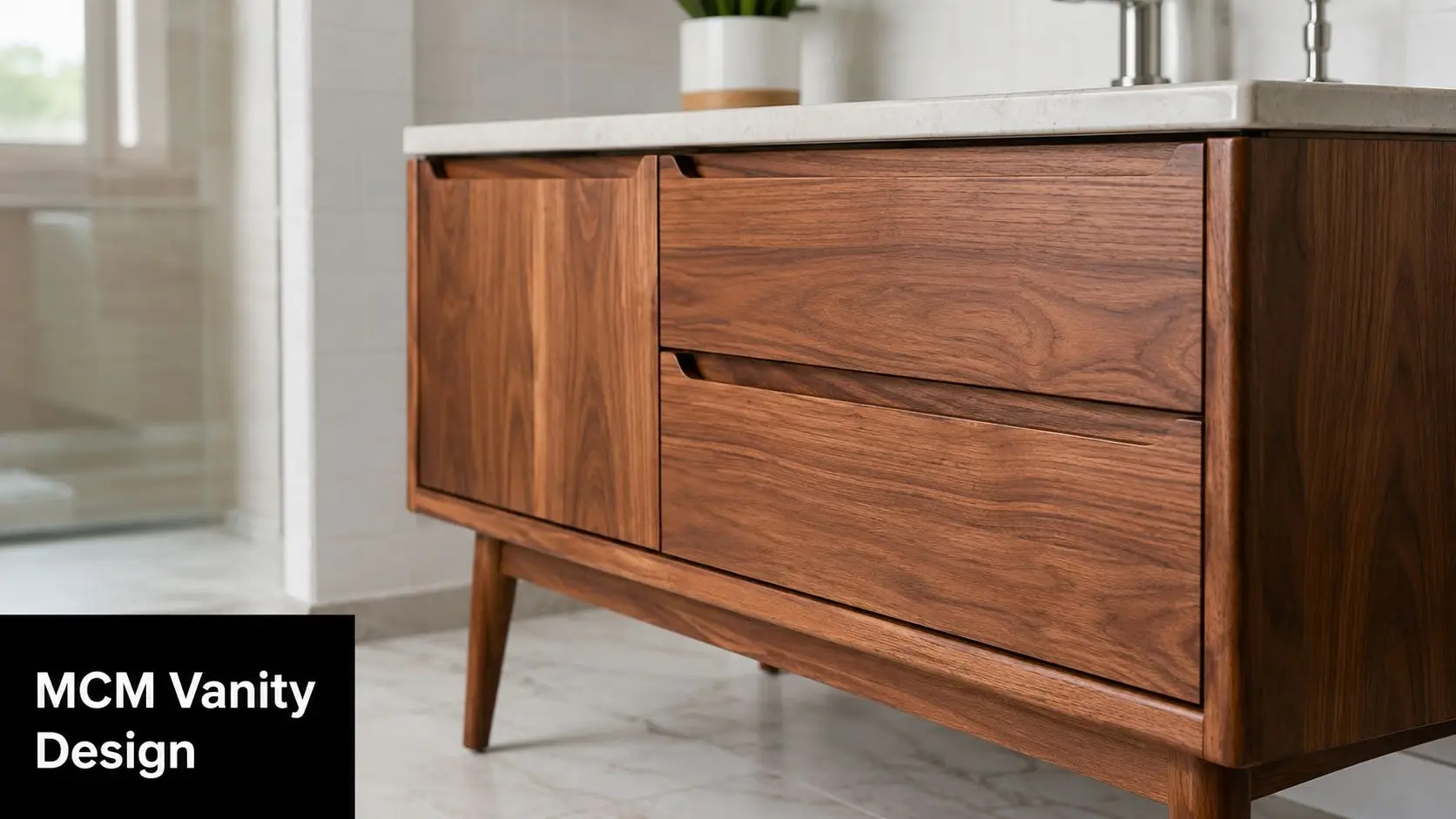
The style came from a period that valued functional design and honest materials. According to Phoenix Tapware's review of mid-century bathroom trends in Australia, mid-century modern bathroom vanity design emerged around the 1930s and reached peak popularity through the 1960s, using clean lines and practical materials such as wood, metal, and brass. The same source notes a strong Australian resurgence around organic forms, timeless functionality, and clean silhouettes, and points to custom solid wood and veneer vanities priced between $1,500 and $3,000 in Australia.
That history still shows up in the best current designs. You'll see:
- Flat or simple drawer fronts instead of profiled cabinet doors
- Warm timber tones that show grain rather than hiding it
- Slim proportions with a lighter visual footprint
- Minimal hardware or integrated pulls
- Legs or floating forms that avoid a heavy box on the floor
What works and what doesn't
Some vanities get labelled mid-century when they're really just generic modern joinery with timber-look laminate. That usually misses the point.
A vanity feels authentically mid-century when it has:
- Clear geometry with softened edges where needed
- A furniture-like stance rather than a kitchen-cabinet look
- Balanced detailing with nothing oversized or flashy
It stops feeling mid-century when it includes:
- Thick waterfall ends that dominate the room
- Busy shaker fronts or coastal panelling
- Overly industrial hardware
- Too many finishes in one unit
Practical rule: If the vanity is the loudest object in the room, it's usually not the right mid-century expression.
Why Victorian homeowners keep choosing it
In Victoria, this style fits a broad mix of homes. It can soften a compact apartment ensuite, bring order to a post-war renovation, or add warmth to a new extension. It also works well when clients want designer bathrooms that feel curated rather than showroom-generic.
The smartest results don't chase nostalgia. They take the principles of the style and adapt them to current use. Soft-close drawers, durable tops, better lighting, and better plumbing access can all sit behind a mid-century look without compromising it.
Materials and Finishes for an Authentic Look
Material selection is where many mid-century bathrooms either become convincing or drift into imitation. The style depends on the right surfaces. If the timber tone is wrong, the top is too busy, or the finish feels plastic, the whole vanity loses credibility.
There's another problem in the Australian market. The simple version is often the hardest to find. A homeowner discussing the search for a vanity in Australia described most available options as “busy, modern or beachy style vanities” while trying to find something “simple and clean” in a mid-century direction, which captures a real gap in the market for this look in practice, especially when custom vanities are already a popular element in Victoria renovations according to the same discussion thread on an Australian renovation conversation about mid-century bathroom vanity options.
Solid timber or veneer
Both can work. The right choice depends on budget, detailing, and how the bathroom is used.
| Material | Best use | Trade-off |
| | | |
| Solid timber | Feature vanities where grain, edges, and craftsmanship matter most | Costs more and needs careful sealing and ventilation management |
| Quality veneer | Cleaner budget control with a convincing timber face | Edge treatment matters. Cheap veneer quickly looks flat or artificial |
Solid timber gives you depth and authenticity. Veneer gives you control and can be very effective when the substrate, edge finishing, and coating are done properly. What doesn't work well is a fake timber pattern with repetitive grain that reads instantly as mass-produced.
Benchtops that support the style
The vanity top should calm the composition, not dominate it. Good choices usually include:
- Muted stone-look surfaces with minimal movement
- Simple solid-surface tops with crisp lines
- Concrete-style finishes if the overall palette stays restrained
If you're considering an all-in-one basin arrangement, integrated bathroom sink options can suit the clean geometry of a mid-century scheme, especially when you want fewer visual breaks across the vanity top.
Finishes that age well
For timber finishes, satin usually beats high gloss. It reads more like furniture and shows fewer water marks. For handles and tapware, choose one metal finish and repeat it consistently.
A few practical calls help:
- Walnut-style tones create warmth without making the room too yellow
- Lighter oak directions can work, but only if the rest of the bathroom avoids a beach-house look
- Matte or low-sheen coatings generally look more resolved than polished surfaces
The best mid-century vanities feel edited. Every visible finish should have a reason to be there.
Practical Sizing and Smart Storage Solutions
The vanity can be beautiful and still fail the room if it's the wrong type or size. Function must be the priority. In bathroom renovations, the vanity is often doing too many jobs at once. It has to store products, hide plumbing, support the basin, create bench space, and still leave enough room for movement.
For most mid-century schemes, I favour a lighter footprint. That often means a wall-hung vanity, especially in compact bathrooms.
Why wall-hung often wins
A bulky floor-standing unit can make a small bathroom feel shorter, heavier, and harder to clean. A wall-hung vanity opens the floor line and gives the room more breathing space. In lower-use bathrooms, that benefit can be even more valuable than extra cabinet volume.
A niche recommendation highlighted in a mid-century bathroom advice video discussing wall-mounted options suggests removing a replacement vanity in favour of a wall-mounted option in bathrooms “not getting a lot of daily use”. That advice matters because many homeowners don't get clear guidance on where a wall-hung mid-century sink or vanity is the better functional decision.
When a floating vanity is the right call
Choose wall-hung when:
- The ensuite is compact and every visible floor area helps
- Cleaning matters and you want easier access underneath
- The style needs visual lightness to keep the joinery from looking blocky
- The bathroom isn't trying to carry oversized storage
Check the finished height carefully. If you're weighing basin type, benchtop thickness, and user comfort, a guide to standard benchtop height is useful early in planning because the wrong height is hard to forgive once installed.
In small bathrooms, visual space is functional space. If the vanity looks lighter, the room usually works better.
Storage without losing the aesthetic
The common mistake is forcing too much storage into a mid-century vanity and ending up with a heavy cabinet that contradicts the style. The better approach is to make the storage smarter.
Use a mix of:
- Deep drawers for daily items rather than low cupboards where things get lost
- Inner organisers for grooming tools and small containers
- A reduced-width vanity paired with mirrored shaving cabinets or wall niches
- One open visual zone if the room needs a furniture feel, but not so much open shelving that clutter becomes unavoidable
Freestanding still has a place
A freestanding vanity can work in a larger bathroom or where wall structure makes mounting more complex. It also suits some furniture-inspired designs with tapered legs. But the proportions need discipline. If the unit is too deep, too tall, or too ornate at the base, it will overpower the room.
For compact ensuites in Victoria, the decision is usually straightforward. If you want the room to feel cleaner, bigger, and more aligned with the mid-century look, wall-hung is often the stronger move.
Styling Your Mid Century Modern Bathroom
A mid-century vanity won't carry the room by itself. The surrounding selections decide whether the bathroom feels coherent or confused. Often, modern bathrooms falter here. The vanity says one thing, the tiles say another, and the tapware introduces a third idea entirely.
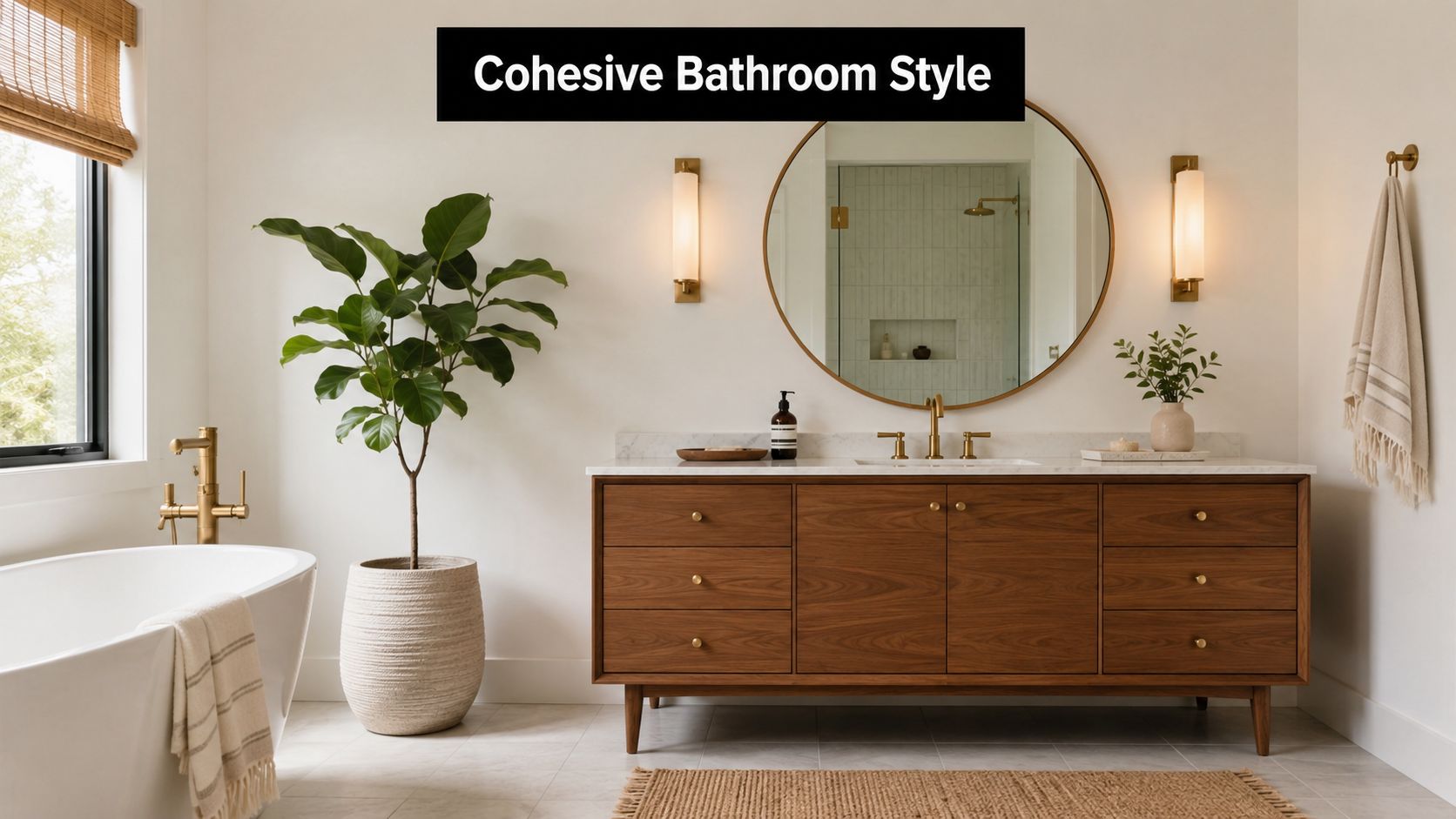
The styling should feel deliberate. One strong vanity, one or two supporting shapes, one timber tone, one metal finish, and a restrained colour story usually gets the best result.
Colour, shape, and light
A practical guide to this style in Australia notes that soft pastel tones such as blush pink and minty green, bold graphic or hexagonal-shaped tiles, natural light, greenery, and angular metal fixtures are all part of the mid-century modern bathroom language. The same article also notes retail activity with discounts of up to 70% on mid-century modern bathroom collections as of July 1, 2026, which reflects strong consumer demand in Australia according to this overview of mid-century bathroom vanity ideas in Australia.
That doesn't mean you should use every feature at once. Good styling is selective.
A practical coordination checklist
-
Mirror choice
Round mirrors and softly radiused rectangles work well because they break up the straight lines of the vanity. -
Tapware direction
Angular fixtures suit the style better than heavily curved or ornate sets. -
Tile strategy
If you use geometric tiles, keep the vanity face simple. Let one element be expressive and the other calm. -
Lighting
Choose fittings that feel architectural, not decorative. You want shape and glow, not embellishment. -
Greenery and daylight
If there's natural light, use it. A plant, a softer tile colour, and a timber vanity often do more than another layer of artificial styling.
What to combine and what to avoid
A strong mid-century palette often looks like this:
| Element | Better choice | Usually weaker choice |
| | | |
| Vanity finish | Warm walnut or calm timber grain | Grey-washed timber |
| Wall colour | Soft pastel or warm neutral | Bright white with no warmth |
| Tile pattern | Hexagon or bold graphic in moderation | Multiple feature tiles competing |
| Metal finish | One consistent angular metal finish | Mixed metals with no hierarchy |
For a fuller room concept, a mid-century modern bathtub pairing can help anchor the vanity within a complete scheme rather than treating it as a standalone feature.
The best designer bathrooms don't rely on more products. They rely on fewer, better-matched decisions.
Bringing Your Vision to Life with SitePro Bathrooms
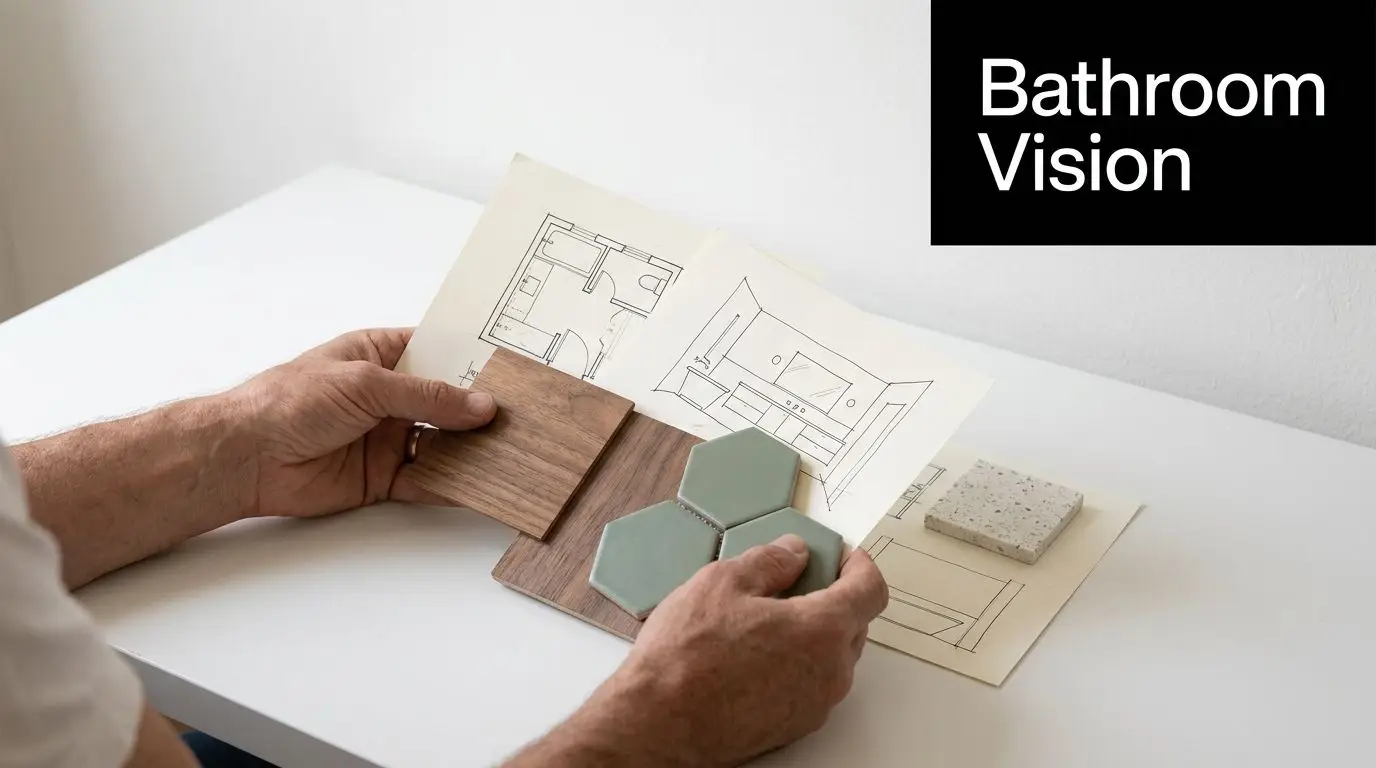
Most clients don't arrive with a fully resolved design. They arrive with a folder of saved photos, a rough budget in mind, and a list of frustrations about the current bathroom. The process only becomes clear when someone translates those ideas into a layout, materials schedule, and buildable plan.
That's where a structured renovation pathway matters. A client might begin by saying they want warmer timber, better storage, and a bathroom that feels less generic. From there, the discussion turns practical. Can the plumbing shift to suit a wall-hung unit? Is the room better with drawers than doors? Does the floor need to be retiled throughout to make the vanity sit correctly in the space?
Seeing the bathroom before work starts
The biggest confidence shift usually happens during design visualisation. When the vanity, tiles, mirror, and lighting are shown together in a 3D layout, uncertainty drops quickly. Clients can assess scale, proportion, circulation space, and colour relationships before construction begins.

That step matters because a mid-century bathroom is easy to get almost right. Almost right usually means the vanity is too deep, the timber tone is off, or the wall-hung setout clashes with tile joints. It's far better to resolve those issues on screen than on site.
From concept to handover
An end-to-end process keeps the bathroom organised from demolition through to installation and finishing. That includes:
- Consultation and planning around layout, use, and style direction
- Detailed design so materials and fixtures are selected with intention
- Build coordination across plumbing, waterproofing, tiling, joinery, and fit-off
- Final refinement so the vanity sits as part of a complete room, not an isolated product
For Victorian homeowners who want bathroom renovations handled properly, it also helps to work with a team that is registered builders unlimited and can coordinate the renovation from first measure to final clean.
If you're collecting new bathroom ideas and want them turned into a buildable plan, SitePro Bathrooms can guide you from concept through 3D design to a finished bathroom that feels resolved, practical, and built to last. You can explore their process and request a customized quote directly through the website.
Frequently Asked Questions About MCM Vanities
Can a mid-century vanity work in a small bathroom
Yes, if the proportions are controlled. The style often suits small spaces because it avoids visual heaviness. Wall-hung versions are especially effective in compact ensuites because they expose more floor area and make cleaning easier. The key is not overloading the vanity with unnecessary depth or oversized basins.
Is timber a risky choice in a bathroom
Timber is fine when the vanity is properly made, properly sealed, and paired with decent ventilation. The risk usually comes from poor finishing, water sitting around the basin, or steam-heavy rooms with inadequate extraction. In family bathrooms, I'd specify a finish that's easy to wipe down and I'd keep detailing simple around sink cut-outs and joins.
Should I buy off the shelf or go custom
That depends on how exact your vision is. Off-the-shelf can work if the size, timber tone, storage layout, and mounting type all align. The issue is that many homeowners looking for a mid-century vanity want something simple and clean, and that combination can be surprisingly hard to find. Custom is the better route when the room has awkward dimensions, the plumbing needs to be concealed carefully, or the style direction has to be precise.
What plumbing issues matter with a wall-hung vanity
Wall-hung units need more planning than people expect. The wall has to suit the mounting method, the waste position has to work with drawer design, and the setout needs to be coordinated before waterproofing and tiling are finalised. If the plumbing is left too low or too proud of the wall, it can compromise storage or force awkward modifications inside the cabinet.
Ask about plumbing setout before the vanity is ordered, not after it arrives. That one decision affects mounting height, drawer function, and the finished look.
What makes a mid-century bathroom feel authentic instead of themed
Restraint. Choose one strong timber vanity, one clear tile idea, one mirror shape, and one metal finish. Let the style come through proportion and material rather than retro accessories. That approach gives you a bathroom that feels current, not staged.