
Rental Property Maintenance Request Form: 2026 Guide
You're probably dealing with this already. A tenant sends a text at 9:40 pm saying, “Bathroom leak again.” No photo. No detail. No note about when it started. By the next morning, your property manager has one version of the story, the plumber gets another, and you're left approving a call-out without knowing whether this is a minor seal issue or the latest symptom of a failing wet area.
That's where a proper rental property maintenance request form earns its keep. It gives you a clean record, helps you triage faster, and turns scattered repair noise into useful asset data. Over time, those requests tell you something important: whether you should keep patching, or whether the property is asking for a smarter capital works decision such as bathroom renovations, especially when recurring moisture issues start dragging down presentation, tenant satisfaction, and long-term value.
Why Your Ad-Hoc Maintenance Process Is Costing You Money
A vague maintenance process looks harmless until you price the friction.
One tenant emails. Another texts. A third leaves voicemail. Someone sends a photo to the wrong number. The issue itself might be small, but the process around it creates delay, duplicate handling, and poor decisions. In practice, that means trades arrive without enough information, tenants feel ignored, and owners approve reactive fixes that should have been screened properly at the start.

I've seen this pattern most often around bathrooms. A tenant reports “shower leak” three times in six months, but because each report comes through a different channel, nobody connects them. The first visit replaces silicone. The second visit tightens a fitting. The third visit reveals water movement behind finishes. At that point, you're no longer managing maintenance well. You're subsidising confusion.
What a structured intake changes
A formal form does two jobs at once. It captures the detail needed for the immediate repair, and it creates a record you can review later for patterns.
That's why the best systems don't just ask what's broken. They ask for priority, photos, and enough context to decide whether the issue is urgent, routine, or part of a bigger deterioration cycle.
Practical rule: If the first report doesn't help you decide who should attend, what they should bring, and whether the issue is isolated or recurring, the intake process is weak.
According to benchmark data on maintenance form methodology, defining Service Level Agreements, separating emergencies from non-emergencies, and requiring photos increased first-time resolution rates from 62% to 87% in Victorian property management firms, while also improving response times by 35%.
Those results make sense on site. Clearer intake means fewer speculative call-outs, better scheduling, and less wasted labour.
The hidden cost of informal systems
Most owners think the main risk is slower repairs. That's only part of it.
An ad-hoc process also leads to:
- Poor diagnosis: Trades attend blind and spend paid time gathering basics the tenant could have submitted upfront.
- Weak documentation: If a dispute arises, the timeline is patchy.
- Bad capital planning: You can't see recurring failure points across plumbing, waterproofing, ventilation, or finishes.
- Tenant frustration: People don't mind process if the process is clear. They do mind repeating themselves.
A maintenance form isn't admin for admin's sake. It's the first control point in protecting the property. It helps you keep routine issues routine, and it helps you spot the moment a tired bathroom stops being a repair problem and starts becoming a renovation decision.
Crafting a Form That Captures Everything You Need
The best form is short enough that tenants will complete it, but detailed enough that your team can act without chasing missing information.
That balance matters. If the form is too thin, you get low-quality requests. If it's too long, tenants avoid it and go back to texting.
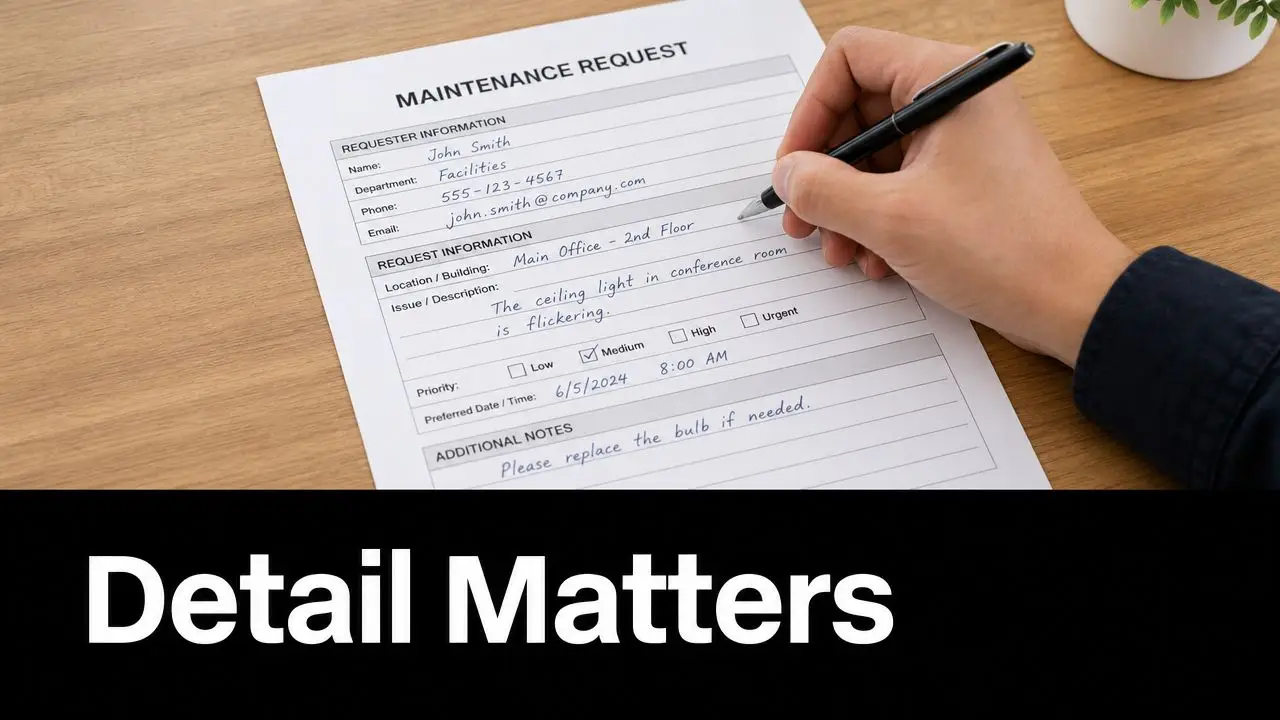
The field structure already used in the AU Elders Real Estate Tenant Maintenance Request form is a strong baseline. It requires the tenant's full name, contact information, property address, detailed issue description, submission date, photo attachments, and notes on when the problem was first noticed, which helps streamline the process for property managers, as outlined in the AU Elders Real Estate tenant maintenance request form reference.
The fields that actually matter
Every effective rental property maintenance request form should capture these basics:
- Tenant identity: Full name and current contact details let your manager or trade confirm access fast.
- Property address: Sounds obvious, but portfolios with similar unit numbers catch people out more often than they should.
- Date submitted: This anchors the timeline and keeps response handling defensible.
- Date first noticed: This is one of the most useful fields on the form. It helps distinguish sudden failure from ongoing deterioration.
- Clear description of the issue: “Tap leaking under vanity after shower use” is useful. “Bathroom problem” is not.
- Photo or video upload: Visual evidence often tells you whether the job needs a plumber, waterproofing investigation, or a builder.
- Access instructions: Gate codes, pet notes, preferred times, and whether the occupant will be home all reduce friction.
- Priority selection: Critical, high, medium, or low gives the triage team somewhere to start.
Why the date first noticed matters more than owners think
This field does more than help with scheduling. It helps with pattern recognition.
If a tenant notes they first saw bubbling paint near the shower base three weeks ago, and your records show two earlier moisture complaints in the same bathroom, you're no longer looking at a simple cosmetic defect. You may be looking at failed waterproofing, exhausted fixtures, poor ventilation, or a layout problem that keeps forcing water where it shouldn't go.
That's the point where maintenance data starts informing investment strategy. Repeated small bathroom jobs often lead investors to review a bathroom renovation checklist rather than keep funding isolated repairs that don't solve the underlying issue.
Good forms don't just organise repair work. They expose repeat failure points that tell you where the asset is ageing badly.
Add prompts that improve the quality of the request
A blank text box won't consistently give you usable information. Guided prompts will.
Use prompts such as:
What happened
Ask the tenant to describe what they saw, heard, smelt, or lost use of.When it happens
Some problems only appear during rain, after showering, or when an appliance runs.What area is affected
Room, fixture, wall, ceiling, floor, or external zone.Has this happened before
Repeat issues are the bridge between maintenance and capital planning.Is there any immediate risk
Water spread, electrical concern, security risk, or inability to use an essential part of the home.
For bathrooms in particular, this structure helps you judge whether you're dealing with a minor service item or the early signs of a larger upgrade opportunity. That's often where new bathroom ideas, modern bathrooms, and designer bathrooms stop being aesthetic wish lists and start becoming practical asset solutions.
From Submission to Resolution A Landlord's Action Plan
A form only works if the response workflow behind it is disciplined.
Once the request comes in, you need a repeatable sequence: acknowledge, classify, assign, inspect if needed, complete, and close with notes. Without that sequence, even a strong form turns into a filing exercise.
Written notice is not optional
In Victoria, the Residential Tenancies Act 1997 requires tenants to provide written notice of a required repair and give the landlord a reasonable time to fix it before pursuing remedies. A 2025 Victorian Ombudsman report also found that 34% of tenant complaints about unresolved repairs were due to failure to formally document the initial request in writing, as noted in this Victorian written notice and complaint data reference.
That matters because many disputes don't start with refusal. They start with poor records.
Use a priority framework that your team can apply consistently
You don't need a complicated system. You need one that everyone understands and uses the same way.
| Priority Level | Examples | Target Acknowledgement | Target Resolution |
|---|---|---|---|
| Critical | Gas smell, active major leak, unsafe electrical issue, no secure access | Immediate | As soon as possible with emergency attendance |
| High | Loss of essential fixture use, leaking shower affecting adjacent areas, hot water issue requiring prompt attention | Same day | Prompt scheduling after assessment |
| Medium | Dripping tap, exhaust fan not working, sticking door, isolated appliance fault | Next business day | Scheduled in normal maintenance run |
| Low | Minor cosmetic damage, loose fitting with no current risk, touch-up items | Next business day or routine cycle | Group with other non-urgent works |
The acknowledgement target is internal discipline. It tells the tenant you've received the request, reviewed the risk, and moved it into the system. The resolution target is operational. It helps your manager and trades plan without treating every issue like an emergency.
What happens after triage
A good post-submission process usually looks like this:
- Acknowledge receipt: Confirm the issue has been logged and note the priority.
- Check the evidence: Review photos, dates, and prior history for that room or fixture.
- Assign the right trade: Don't send a general handyman to a problem that may involve concealed water damage.
- Confirm access: This avoids missed appointments and repeat call-out costs.
- Document the outcome: Record what was repaired, what was observed, and whether follow-up is needed.
- Review recurrence: If the same bathroom has generated multiple plumbing or moisture requests, flag it for a broader asset review.
A leak that returns after two repair attempts usually isn't a maintenance scheduling problem. It's a diagnosis problem.
Turn the workflow into a defensible record
Landlords often focus on speed. Documentation matters just as much.
The file should show when the request came in, how it was classified, who reviewed it, what action was taken, and whether the repair solved the issue. If the matter escalates, that record protects the owner. If the issue recurs, that record helps you decide whether to keep repairing or budget for replacement works.
Experienced investors separate maintenance handling from asset management. Maintenance closes today's problem. Asset management asks whether the pattern suggests a component reaching the end of its useful life.
Bathrooms are the classic example. Repeated reports about leaks, cracked grout, failed sealants, mould recurrence, poor extraction, and vanity swelling often point to one conclusion. The room may need more than another service call.
Avoiding Costly Mistakes in Your Maintenance Process
The most expensive maintenance mistake isn't slow repair. It's unclear responsibility.
When leases and maintenance procedures don't clearly separate what a tenant handles from what the landlord or contractor handles, tenants fill the gap themselves. They patch, flush, reseal, unscrew, repaint, and improvise. That rarely ends well.

According to data on maintenance request pitfalls and digital workflows, tenants self-repairing because leases fail to assign responsibilities leads to 28% higher vendor costs and 52% longer resolution times. The same source reports that digital workflows that track requests reduce maintenance costs by 15–22% and shorten average repair duration from 4.3 days to 2.1 days in Highett and greater Victoria portfolios.
The assumptions that usually backfire
Owners often assume tenants know what counts as minor upkeep. Some do. Many don't.
They also assume a general repair note in the lease is enough. It usually isn't. If the form and lease don't clearly state what the tenant should report, what they must not attempt, and how urgent issues are escalated, avoidable damage creeps in.
Common failure points include:
- DIY fixes to wet areas: Temporary sealing over a failed junction can hide ongoing moisture.
- Delayed reporting: Tenants wait because they're unsure whether the issue is their responsibility.
- Wrong trade allocation: Incomplete descriptions send the cheapest person first, not the right person first.
- No closure check: The work is marked complete even though the root cause wasn't resolved.
Draw a hard line between repair and intervention
This is especially important in bathrooms, laundries, and kitchens.
If the maintenance history shows recurring water ingress, substrate swelling, or fixture instability, a patch repair may be false economy. At some point, you need a proper scope review. In practical terms, that can mean getting pricing from the right level of practitioner, including where the problem has moved beyond isolated repair and requires someone with registered builders unlimited capability for broader structural or regulated works.
Site note: If the issue involves repeated water damage, don't judge it by the cost of the last repair. Judge it by the cost of continued misdiagnosis.
If a tenant remains in the property during larger works, planning gets more complex. That's where investors often need to think through logistics such as access, sequencing, dust control, and temporary amenity arrangements. A practical starting point is this guide on living in house during renovation, especially when a maintenance pattern is tipping toward a bigger bathroom upgrade.
What works better
The safer process is simple:
- State responsibilities clearly: Basic consumables and accidental tenant damage should be identified separately from landlord maintenance obligations.
- Ban unauthorised repair attempts: Put it in the lease and on the form.
- Require photo evidence: It reduces guesswork before anyone attends site.
- Track repeat jobs by room: One bathroom generating repeated call-outs needs a strategic review.
That review is where repair data becomes valuable. A tired rental bathroom may still function, but if the room is repeatedly causing moisture, plumbing, and finish issues, the better financial move can be a full refurbishment that improves reliability and presentation in one hit.
Streamlining Repairs with Property Managers and Trades
A detailed form saves money long before a tool comes out of the van.
Property managers need enough information to triage confidently. Trades need enough information to arrive prepared. If either party starts with guesswork, the owner pays for the missing detail through delay, extra visits, or unnecessary investigation time.
Give every handoff the information it needs
A good request should travel cleanly from tenant to manager to trade without being rewritten three times.
That means including:
- Issue summary: One clear sentence that explains the practical problem.
- Visual evidence: Photos of leak paths, cracked tiles, swollen skirtings, or failed fittings.
- Access details: Whether someone will be home, where keys are held, and any constraints.
- Timing context: When it started and whether it is getting worse.
- Relevant history: Prior repairs in the same room or to the same fixture.
This level of detail matters most when the first request hints at something deeper. A leaking shower screen, for example, may sound straightforward. But if the photos also show grout breakdown, vanity edge swelling, and stained architraves, the first report has already done more than request a repair. It has flagged a possible renewal project.
Better intake creates better scope
The maintenance form becomes a bridge to larger works.
A specialist reviewing the request can often tell whether the issue looks isolated or whether the room needs a broader rethink around waterproofing, layout, storage, or finishes. That's useful for investors considering whether a rental should stay in patch mode or move toward a higher-performing upgrade.
If you're at the stage of handing recurring bathroom issues over for a more complete review, choosing the right bathroom remodel contractor becomes part of the maintenance strategy, not a separate conversation.
Clean intake data gives a renovation specialist a better starting brief, which usually means a more accurate early assessment.
For owners, that's the gain. You stop treating repairs and upgrades as unrelated categories. The same information that helps a plumber diagnose a fault can also help a bathroom specialist assess whether the room is due for renewal, repositioning, or a full presentation lift suited to the rental market.
Turning Maintenance from a Chore into an Asset Strategy
Most landlords treat maintenance forms as admin. That's too narrow.
A strong rental property maintenance request form does more than log faults. It creates a dated record of where the property is wearing out, which rooms are generating repeated spend, and where reactive maintenance is starting to lose the argument against planned renewal.
In South Australia, landlords must carry out repairs within a reasonable time after receiving a formal written request, and tenants can apply to the tribunal for remedies if that doesn't happen, as set out in the South Australian repairs and maintenance requirements. That legal position reinforces something experienced investors already know. A formal process isn't optional paperwork. It has real operational and compliance weight.
What the request log is really telling you
When you review requests over time, patterns become obvious:
- One bathroom keeps leaking
- The same vanity area keeps swelling
- Ventilation complaints repeat through winter
- Tiles, sealants, and fittings are all failing in the same room
That's not random wear. That's asset intelligence.
A landlord who reads those signals early can budget properly, reduce repeat disruption, and improve the property in a more deliberate way. Sometimes the right call is still a repair. Sometimes the better move is a planned renovation that lifts function, durability, and rental appeal in one project.
For bathroom-heavy maintenance histories, that can mean stepping back and deciding whether ongoing call-outs are masking the need for a full refresh. Well-executed bathroom renovations can improve reliability and marketability at the same time, especially when the current room no longer meets modern tenant expectations for storage, ventilation, finish quality, and easy cleaning.
If you're ready to turn recurring bathroom maintenance into a smarter upgrade plan, SitePro Bathrooms can help assess whether repeated repair issues point to a better long-term renovation solution.