
If you're standing in your kitchen wondering why a simple dinner feels harder than it should, the layout is often the main problem. The fridge door blocks the walkway. Prep space disappears the moment groceries land on the bench. Someone opens a drawer and nobody else can move. In many Victorian homes, especially older ones, that frustration gets worse because the room wasn't built for how families live now.
A good renovation fixes more than tired finishes. It changes how the room works. Among the most dependable solutions, U shaped kitchen designs keep storage, prep space and cooking zones close together without forcing the room to feel chaotic. When they're planned well, they suit compact houses, family homes and many renovation projects where every wall has to work harder.
For homeowners weighing a kitchen update alongside bathroom renovations, the planning process often overlaps more than expected. Budget choices, trade sequencing, finishes and builder coordination all affect the final result. That matters whether you're collecting new bathroom ideas, aiming for modern bathrooms, considering designer bathrooms, or trying to decide if one staged renovation makes more sense than two separate ones.
Is Your Current Kitchen Working Against You
A lot of kitchen problems look cosmetic at first. Homeowners talk about dated doors, worn laminate or a splashback they can't stand anymore. But once you ask how they use the room, the underlying issues show up quickly.
Breakfast becomes a traffic jam. One person is at the sink, another is reaching the fridge, and somebody else is trying to pack lunches with nowhere to stand. Pots end up stacked in awkward cupboards because there isn't a proper zone for them. Small appliances live on the benchtop because the storage doesn't match real life.
In Victorian homes, I often see layouts shaped by older room divisions rather than modern routines. The kitchen may have enough floor area on paper, yet still feel cramped because the working parts are in the wrong places. A single long run of cabinetry can leave you walking back and forth all day. An L-shape can be fine, but in some rooms it does not provide enough bench space or storage.
A kitchen can be generous in size and still work badly if the prep, washing and cooking zones fight each other.
That's where a U-shape earns its reputation. Instead of stretching the kitchen out, it wraps the work area around the cook. That usually means better access to tools, more continuous bench space, and clearer separation between cooking and through-traffic.
What homeowners usually notice first
- Less bumping into each other: The room starts to support routines instead of interrupting them.
- More useful bench space: You get longer working surfaces rather than scattered short sections.
- Better storage logic: Everyday items can sit closer to where they're used.
The appeal isn't just efficiency. A well-planned U-shape can also make the kitchen feel calmer. When things have a proper home and the workflow makes sense, the room becomes easier to clean, easier to cook in, and easier to live with.
The U-Shaped Kitchen Explained
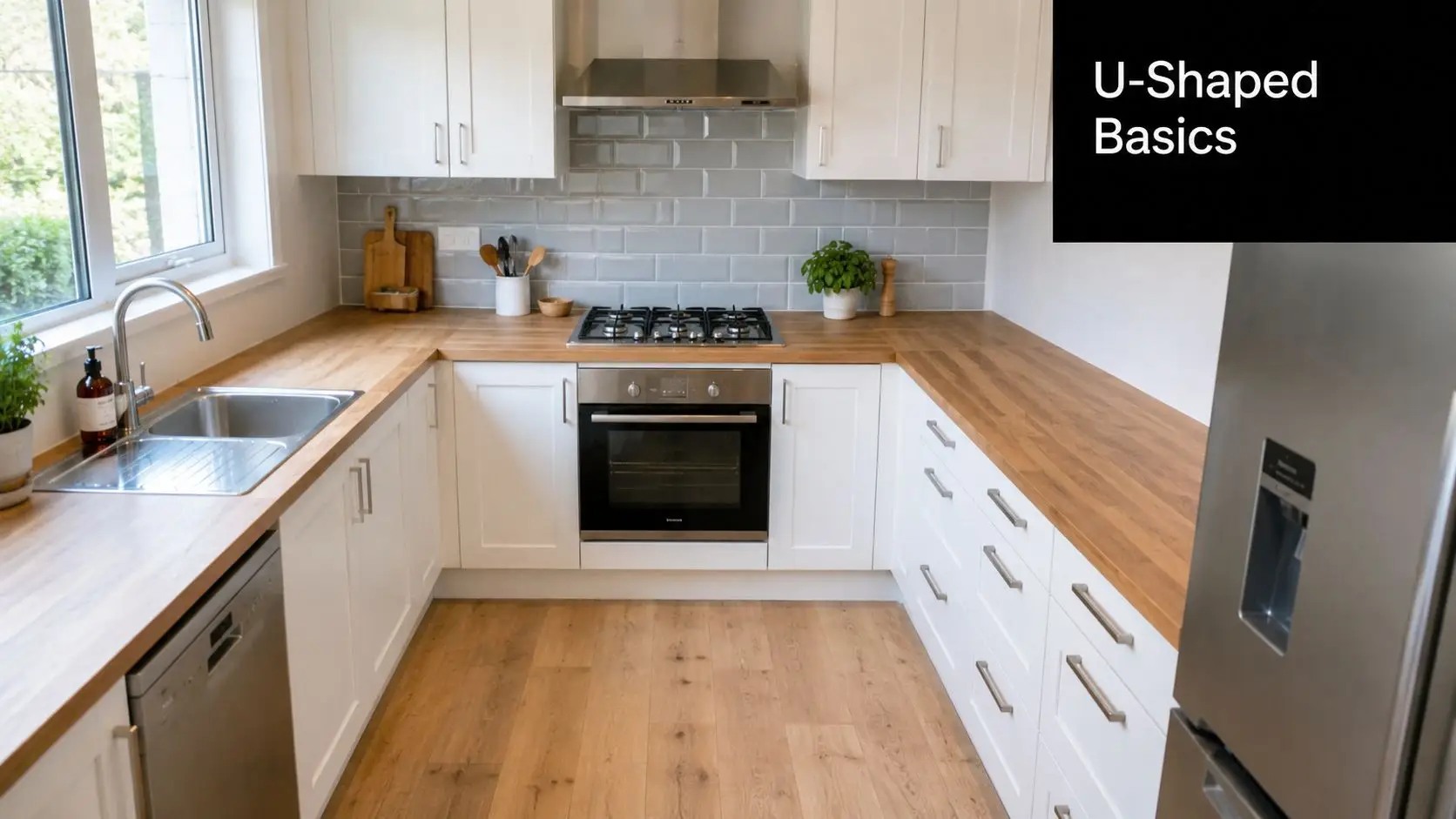
A U-shaped kitchen places cabinetry and benchtops on three adjoining walls, creating a horseshoe-style work area around the cook. In practical terms, that means the room uses more perimeter wall space than many other layouts, which is why it often delivers stronger storage and longer uninterrupted benches.
According to Australian guidance on U-shaped kitchen versatility and workflow, U-shaped kitchens are the most versatile layout for both large and small Australian homes, offering continuous countertops and surrounding the chef with benchtops on three adjoining walls, which maximizes workflow efficiency by placing the cooktop, refrigerator, and sink on adjacent walls or counter surfaces.
Why the layout works so well
The main strength is proximity. In a strong U-shape, the sink, cooktop and fridge sit close enough to support a natural workflow without crowding each other. You wash, prep and cook with fewer extra steps.
That doesn't mean every U-shaped kitchen is automatically ergonomic. The layout only works when each leg of the U has a clear job. One side might suit food storage, another cleanup, and the third the main cooking run. When homeowners ignore that zoning and just fit cabinets wherever they can, the room loses the very benefit that makes the shape useful.
What works
- Continuous benchtops: Better for meal prep, small appliances and serving.
- Good containment: The main cook can work without people constantly crossing through the zone.
- Strong storage capacity: Three walls usually allow more drawers, overheads and tall units.
What doesn't
- Poorly handled corners: Two corners can become awkward dead space.
- Overly enclosed rooms: In a tight space, full-height cabinetry on every side can feel heavy.
- Bad appliance swing planning: A fridge or oven in the wrong position can block movement fast.
Practical rule: A U-shape should feel compact, not trapped. If cabinet doors, people and appliances all compete for the same central space, the layout needs reworking.
For many Victorian homes, this balance matters. Older houses can have beautiful proportions but awkward openings, chimneys, windows or service locations. That's why U shaped kitchen designs need more than a nice floor plan. They need a layout that responds to the room you have.
Planning Your Perfect U-Shaped Layout
A U-shape works best when the middle space is set first. In older Victorian homes, that matters even more because walls are rarely perfectly straight, windows can sit lower than expected, and old service points often limit where appliances can go.
Start with the aisle, not the cabinetry
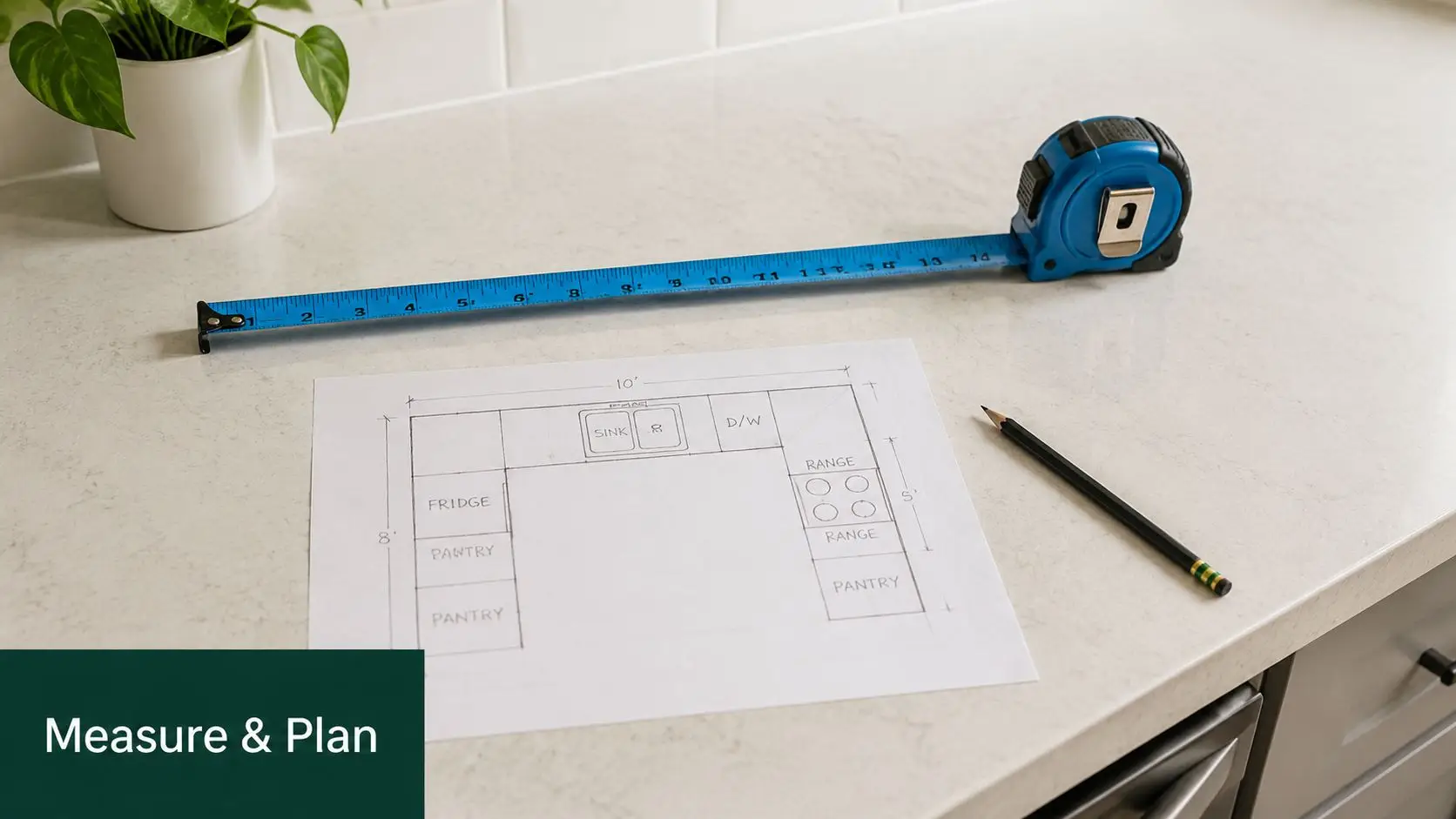
Set the aisle width before you choose cabinet runs. If the gap is too narrow, doors and drawers clash and two people end up waiting on each other. If it is too wide, the room loses the compact efficiency that makes a U-shape worth doing in the first place.
As a practical rule, the central aisle should allow comfortable movement, appliance door swing, and enough standing room at the sink or cooktop without someone getting pinned behind an open dishwasher. I measure that space on site before I talk about finishes, because correcting it later usually means redrawing the whole kitchen.
Budget comes into it early as well. Wider aisles, relocated plumbing, new power circuits and custom filler panels all affect price, which is why it helps to review a realistic guide on what a new kitchen can cost before locking in the plan.
Assign each leg of the U a clear job
Good layouts come from use, not symmetry. One leg usually handles storage and refrigeration, one suits washing and prep, and one becomes the cooking run. That division stops the room from feeling busy even when the footprint is modest.
The sink needs practical bench space beside it. The dishwasher belongs next to the sink, not across the aisle. The fridge should open without blocking the entry or forcing someone to step back into the middle of the room every time they grab milk.
Cooktops need room on at least one side for hot trays, utensils and ingredients. In many Victorian kitchens, chimney breasts, narrow wall sections or existing windows make the obvious cooktop position the wrong one. A layout can look balanced on paper and still perform poorly once real door swings and body movement are tested.
Plan corners early, or pay for them later
Corners decide whether a U-shaped kitchen feels well resolved or awkward. I see two common mistakes. Homeowners either leave both corners as deep cupboards they can barely reach, or they spend heavily on internal mechanisms that do not suit what they store.
A better approach is to choose the role of each corner during the planning stage. One may justify a storage fitting if it will hold pantry items used every week. The other may work better as a dead corner that allows a cleaner run of drawers, wider benches and fewer moving parts.
That trade-off often saves money and improves daily use. More hardware is not always a better kitchen.
Check the room like a renovator, not just a designer
Before speaking with a builder or cabinetmaker, sketch the room with the practical constraints marked in.
- Entry points and walking paths: Show how people enter, turn and move through the space.
- Door and appliance swings: Include the fridge, oven, dishwasher, pantry and any nearby laundry or bathroom doors.
- Service locations: Mark plumbing waste, water points, gas, power and ventilation paths.
- Tall elements: Note where pantry towers, fridge surrounds or overheads might make the room feel closed in.
- Adjacent renovation work: If the kitchen upgrade sits near a bathroom or laundry, check whether plumbing changes can be staged together to reduce labour and patching costs.
That last point is often missed in Victorian homes. From a renovation perspective, kitchen and bathroom planning should talk to each other. If both rooms sit on the same side of the house, combining plumbing, waterproofing prep, tiling transitions or subfloor repairs can make the overall project easier to price and simpler to sequence.
The best U shaped kitchen designs are shaped by the house you have, the budget you are working with, and the way the rest of the renovation needs to unfold.
Common Pitfalls and Smart Solutions
The most common U-shape mistakes aren't dramatic. They're small planning decisions that create daily annoyance. A corner you can't reach. An overhead cabinet that blocks light. A room that feels boxed in because every surface is dark and heavy.
The good news is that these issues are usually fixable before construction starts.
The corner problem most homeowners underestimate
Corners look useful on a plan because they add storage area. In practice, they can become the least functional part of the kitchen. Deep shelves hide items, access is awkward, and doors can clash with adjacent cabinetry if the spacing isn't right.
Modern storage can help, but not every option suits every household. If you're weighing alternatives, this page on a blind corner pantry solution gives a useful reference point.
Corner Cabinet Storage Solutions Compared
| Solution | Best For | Pros | Cons |
|---|---|---|---|
| Lazy Susan | General pantry items and containers | Improves access to hard-to-reach corner space, simple to understand in daily use | Shape can limit what fits neatly, not ideal for every item |
| Blind corner cabinet with internal baskets | Households that want to recover storage from a deep corner | Pulls stored items closer to the user, makes hidden space more practical | Internal mechanisms add complexity and need careful planning |
| Large bank of drawers with one corner effectively sacrificed | Homeowners who value easy-access storage over using every last corner | Drawers are more usable for cookware, utensils and dry goods, simpler day to day | You give up some theoretical corner capacity |
As noted earlier, Australian kitchen designers often recommend Lazy Susan units, blind corner cabinets with internal baskets, or in some cases giving one corner over to a more useful drawer arrangement rather than chasing unusable storage.
Lighting can ruin a good layout
A U-shape creates excellent work zones, but overhead cabinetry can cast shadows exactly where you prep food. That's common in Victorian homes where natural light enters from one side only.
What usually works best is layered lighting:
- Task lighting under overheads: This helps the benchtop where chopping and prep happen.
- Ambient room lighting: It prevents the middle of the kitchen feeling gloomy.
- Feature lighting used sparingly: Decorative fittings should support the room, not fight with practical light.
How to stop a U-shape feeling closed in
If the room is compact, visual weight matters almost as much as floor area. A full U with dark cabinetry on every wall can feel tighter than it is.
In smaller kitchens, visual openness often comes from restraint. Fewer bulky upper units can improve the room more than another cabinet ever will.
Useful ways to lighten the feel include:
- Lighter finishes: Pale cabinetry and reflective splashbacks help the room bounce light around.
- Mixed storage types: Open shelving or reduced overheads can soften one wall.
- A partial end treatment: In some layouts, a peninsula-style edge can feel less boxed in than a hard wall of cabinetry.
The best solution depends on the room. What matters is being honest about trade-offs. More storage isn't always the same as a better kitchen.
Styling Ideas for Every Victorian Home
A U-shaped kitchen should suit the house it sits in. In Victoria, that usually means making clear choices early. A 1970s brick veneer, a weatherboard cottage and a Victorian-era terrace all want a different level of detail, and the budget needs to match that decision from the start.
Style also affects where the money goes. A restrained scheme usually leaves more room for better storage hardware, stronger appliance choices and cleaner service work. A more detailed kitchen can look right for the home, but profiled doors, feature finishes and custom joinery add labour and cost quickly.
Minimal and clean for updated family homes
In renovated townhouses and newer family homes, a simpler U-shape often performs best. Flat-front cabinetry, a quiet splashback and a limited material palette keep the room easier to live with day to day. It also tends to age better than a kitchen built around a short-lived finish trend.
The practical gain is cost control. Keep the decorative elements tight and spend on the parts you touch every day, such as drawers instead of deep cupboards, hard-wearing benchtops and lighting that actually covers the prep zones. If you want a clearer sense of how finishes and layout work together, these modern kitchen design ideas show the sort of disciplined approach that usually delivers better long-term results.
Classic detail for period and weatherboard homes
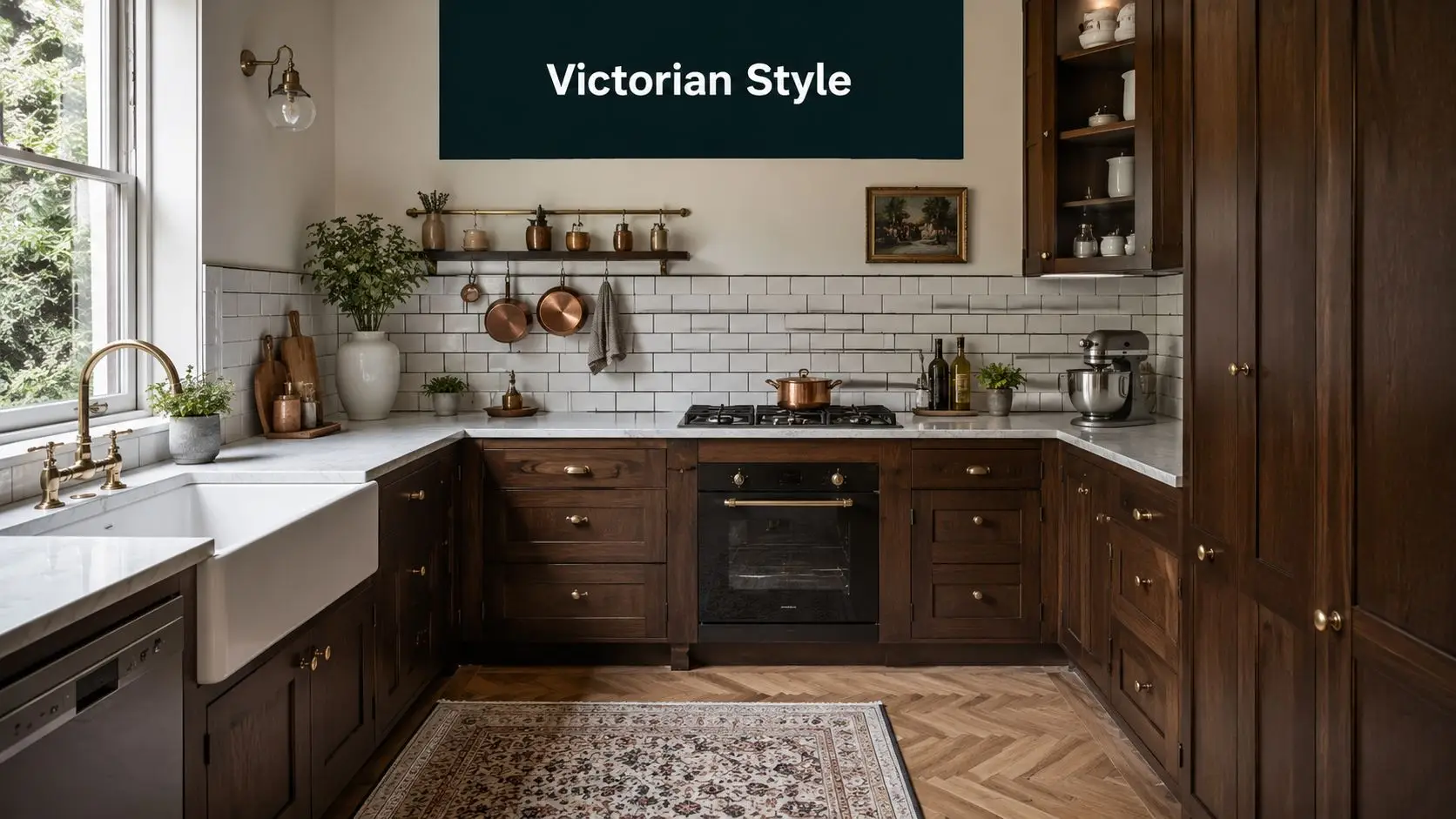
Older Victorian homes often need a softer hand. Shaker-style cabinetry, warmer whites, muted greens, timber accents and tiled splashbacks can help a new U-shape feel consistent with the rest of the house.
There is a trade-off, and it is not just visual. Detailed door profiles catch more grime, open shelving needs regular upkeep, and natural timber near wet or high-use areas needs careful product selection. Used in the right places, those features add character. Used across every surface, they can make the kitchen harder to clean and more expensive to maintain.
I usually advise homeowners to choose one or two character elements and keep the rest calm. That gives the room personality without turning everyday maintenance into a chore.
Richer finishes for a premium result
In larger homes or full-scale renovations, a premium U-shaped kitchen often reads more like fitted joinery than a standard cabinet package. Integrated appliances, taller cabinetry, better internal storage and carefully matched finishes create a more resolved result.
The common mistake is over-specifying the room. Dark joinery, statement stone, brass accents and feature lighting can all work, but they need restraint. The best premium kitchens feel edited and balanced, not crowded.
This matters even more if the kitchen sits alongside a bathroom renovation. We see this often in Victorian homes where owners want both rooms to feel related without looking copied. Repeating one finish, one timber tone or one tapware colour across kitchen and bathroom planning can tie the house together and prevent the budget from blowing out on too many separate selections.
A kitchen that suits the home usually looks better for longer. It also makes renovation decisions easier, because the style, scope and budget are working in the same direction.
Beyond the Kitchen Renovating Your Whole Home
A kitchen upgrade often changes how the rest of the house feels. In many Victorian homes, once the kitchen starts working better, the bathroom's shortcomings become harder to ignore. Poor storage, dated finishes, awkward circulation and old plumbing all stand out more clearly.
That is why whole-home planning matters, even if the work happens in stages.
Kitchen and bathroom renovations rely on many of the same early decisions. Plumbing locations, electrical load, ventilation, waterproofing details, tile set-out, joinery sizes and access for trades all affect cost and buildability. If both rooms are on the agenda, even a year or two apart, it makes sense to map them together before committing to one room in isolation.
Budget is usually the deciding factor. In practice, many Victorian homeowners choose one of two paths. They either complete both rooms under one build so trades, approvals and material selections are coordinated, or they stage the work but keep a single plan for finishes, services and spending. The second option can work well, but only if the first renovation does not create rework later.
Shared planning decisions that affect both rooms
The overlap is less about style and more about construction logic.
- Services first: Moving waste points, water lines or major electrical items in either room can push costs up quickly, especially in older Victorian homes with tight subfloors, brick walls or limited ceiling access.
- Storage has to suit daily use: Tall pantry storage and bathroom tallboys solve different problems, but the same rule applies. Storage should reduce clutter without making everyday items harder to reach.
- Durability beats showroom appeal: Finishes need to cope with steam, splashes, cleaning products and constant use. A material that looks good in a display can become high-maintenance fast in a busy family home.
- Trade coordination affects the result: Tilers, cabinetmakers, plumbers, electricians and waterproofers all depend on accurate set-out. If one detail is missed early, both time and money go with it.
SitePro's kitchen and bathroom experience helps homeowners avoid split decision-making. Selections can be made with both rooms in mind, which usually leads to fewer variations and a more consistent result across the house.
Keep the house consistent without copying rooms
The goal is not to make the kitchen and bathroom match. The goal is to make them belong to the same home.
In Victorian properties, that usually means respecting the age of the house while improving how it works now. A shaker-style profile in the kitchen might pair well with a simpler vanity front. A warm white wall colour, one timber tone, or one tapware finish can carry through both spaces without making them feel repetitive. That approach also keeps selections tighter, which helps control costs.
If you're planning both spaces, builder coordination matters as much as design. One team managing scope, sequencing, compliance and trades can reduce delays and help prevent the common problem of one renovated room making the next room more expensive to fix later.
Turn Your Vision into a 3D Reality with SitePro
A well-planned U-shape changes more than the room. It improves how the house functions every morning, every weeknight, and every time family or guests gather around the kitchen. The layout works because it rewards careful decisions early. Measurements, corner planning, appliance locations, lighting and finish choices all need to line up before construction starts.
That early clarity is where many renovations either settle into a smooth build or drift into expensive uncertainty. Homeowners don't just need drawings. They need to understand what the finished room will feel like, how doors will open, where the prep space will sit, and whether the design suits the way they live.
Why 3D design matters before work begins
A 3D design process helps remove guesswork. Instead of approving a layout from a flat plan and hoping it translates well on site, you can assess the room more realistically before trades begin. That gives you a better chance to refine storage, finishes and proportions while changes are still manageable.
For homeowners in Highett and across greater Victoria, that's especially useful in renovations where the existing home has quirks. Ceiling lines, wall thicknesses, openings and service positions can all affect the final feel of a kitchen. Seeing those decisions in a more lifelike format makes the process clearer and less stressful.
An end-to-end renovation partner
SitePro Bathrooms handles kitchens and bathrooms as coordinated renovation projects, from concept development and detailed 3D design through to construction and finishing. That matters when you want one team to manage the whole process rather than juggling separate trades and trying to keep timelines aligned on your own.
If you're ready to turn ideas into a workable plan, start with a conversation through SitePro Bathrooms. A thoughtful design review can show whether a U-shape suits your home, what trade-offs make sense for your budget, and how to create a kitchen that looks right and works properly for years to come.