• siteprobathrooms

Cost of Kitchen Cabinets: A 2026 Price Guide for VIC

Kitchen cabinets usually take up about 29% of a kitchen renovation budget, and a full set in Australia can start at $2,800 for budget flat-pack options and go to $15,000+ for high-end 2-pac or timber cabinetry. If you're pricing a renovation in Victoria right now, that range is wide enough to feel confusing, especially once installation, hardware, and layout decisions start affecting the final number.

Most homeowners reach this point with the same question. They've looked at a few cabinet prices online, maybe saved some inspiration for clean-lined kitchens, shaker fronts, or full-height pantries, and now they're trying to work out what the actual installed figure will be in a Victorian home. That's where the numbers often stop being useful.

The core issue isn't just the sticker price of cabinets. It's the gap between a product cost and an installed cost that functions in your house, sits level on old floors, fits awkward walls, carries stone safely, and still looks right years later. In Melbourne homes, especially older ones, those details matter.

Planning Your Kitchen Renovation Budget

A kitchen budget usually starts with optimism and ends with trade-offs. You might begin with a rough figure in mind, then realise the cabinetry decision affects almost everything else, from benchtop support to appliance placement to how much room you keep for splashbacks, flooring, and electrical work.

Cabinetry is often the biggest single moving part because it's both visual and structural. It has to look right, but it also has to carry weight, open properly, survive steam, spills, and daily use, and suit the way your household functions. If you're still shaping your overall numbers, it's worth reviewing a broader cost of a new kitchen guide for Victorian homes before locking in cabinet choices.

Start with the realistic cabinet range

At the low end, a basic flat-pack setup can suit a rental, a compact unit, or a tight cosmetic refresh. At the upper end, fully custom joinery suits homes where layout efficiency, finish quality, and a more resolved design matter.

That wide spread exists for good reason:

  • Budget flat-pack works when sizes are standard, the layout is simple, and you're willing to compromise on fit and finish.
  • Mid-range cabinetry usually gives better materials, more consistent finishes, and stronger day-to-day usability.
  • High-end custom joinery makes sense when the kitchen has awkward dimensions, premium finishes, or you want every millimetre used properly.

Practical rule: If your kitchen has uneven walls, unusual ceiling heights, tight circulation zones, or you want an island and full-height storage to work cleanly together, the cheapest cabinet option often stops being the cheapest once installation starts.

Victorian homeowners also tend to think about the house as a whole. A kitchen upgrade often sits alongside bathroom renovations, or at least alongside planning for them later, so the better approach is to budget for consistency rather than treat every room as a separate problem. That's especially true if you're aiming for a finish language that carries across modern bathrooms, designer bathrooms, and the kitchen without looking pieced together.

The Anatomy of Cabinet Costs

Most quotes look simple until you break them apart. The cost of kitchen cabinets is really a bundle of four things: carcass materials, hardware, labour, and finish. Once you understand those parts, quotes become much easier to read.

According to Australian kitchen cabinetry cost benchmarks, cabinetry makes up about 29% of the total kitchen renovation cost, with a typical average spend of $7,250. The same pricing guide puts budget flat-pack options from $2,800, mid-range melamine at $4,500, and high-end 2-pac or timber finishes starting from $15,000, with cabinet maker labour commonly ranging from $50 to $75 per hour for standard work and $100+ per hour for more complex joinery.
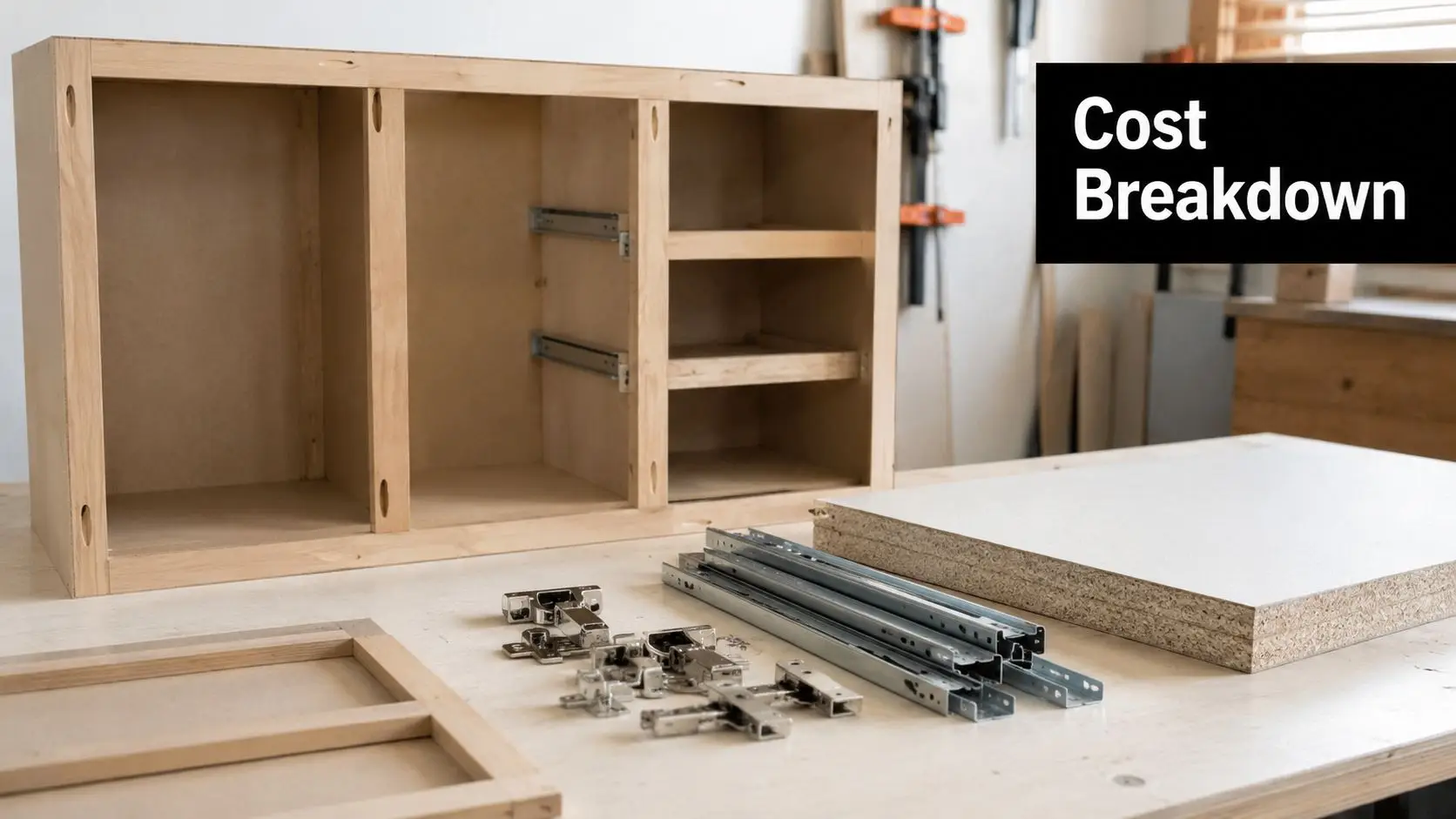
A custom wooden kitchen cabinet frame with hardware and components sitting on a workbench during assembly.

Materials affect more than appearance

Base cabinets usually need more from the material than overheads do. They carry benchtops, absorb daily knocks, and deal with the hardest wear. That's why lower cabinets often end up being the costlier part of the run in practical terms, even before you add drawers or pull-out systems.

A cheaper board can still be serviceable in the right project. But in a family kitchen, the internal build quality matters more than people expect. Shelves sagging, hinges pulling loose, and swollen edges around the sink area aren't styling issues. They're material and construction issues.

If you're weighing finish against substrate, a good starting point is this guide to kitchen cabinet materials in 2026, which helps separate cosmetic upgrades from structural value.

Hardware is small on paper, big in use

Handles, drawer runners, hinges, soft-close systems, corner mechanisms, and integrated bins don't always dominate the quote line by line, but they change how the kitchen feels every day.

Here's what usually happens in real projects:

  • Standard hinges and runners keep the budget controlled, but the kitchen can feel more basic in use.
  • Soft-close hardware improves noise, wear, and day-to-day comfort.
  • Internal storage upgrades help in compact kitchens, though they can push costs up quickly if added everywhere.

Labour and finish are where quotes split apart

Two cabinet quotes can look similar until you compare how much skilled labour is built into them. Straight runs with standard sizes are faster to manufacture and install. Detailed profiles, tight tolerances, filler panels, appliance integration, and site scribing take more time.

Finish selection drives a lot of that labour. Melamine is usually more budget-friendly because it's efficient to produce and install. A painted 2-pac finish costs more because the process is more exacting and the standard for visible surfaces is higher.

A kitchen quote makes more sense once you stop asking, “How much are the cabinets?” and start asking, “How much build quality, finish quality, and fitting accuracy are included in that number?”

How Cabinet Prices Are Calculated

Cabinet pricing in Melbourne usually appears in one of two ways. You'll either see a per linear metre rate, or you'll see the job broken down by individual units and components. If you don't know which method a quote is using, comparisons get messy fast.

The most useful benchmark for local planning comes from Melbourne 2026 kitchen cabinet cost benchmarks, which place budget cabinetry at $1,000 to $1,500 per linear metre, mid-range at $1,500 to $2,500, and premium custom at $2,500 to $3,500+. That same source notes a mid-range new kitchen with custom cabinetry typically totals $20,000 to $45,000, with trades and installation making up 15% to 30% of the total.

Per linear metre pricing

Linear metre pricing gives you a fast planning tool. It's commonly used early in budgeting because it gives a broad estimate before every cabinet detail has been finalised.

In practical terms, the metre total is worked out by measuring the runs of:

  • Under-bench cabinetry
  • Overhead cabinetry
  • Full-height pantry or utility units
  • Island cabinetry where applicable

That method is useful, but it can also hide detail. A metre of simple cupboards isn't the same as a metre filled with deep drawers, integrated bins, appliance housing, and premium fronts.

Per unit pricing

Per unit pricing is usually clearer once drawings are developed. It shows how much each cabinet type contributes to the quote, which matters because not all units cost the same to build.

Base cabinets usually attract more cost than simpler overheads because they do more work structurally and often include drawers, pull-outs, and heavier hardware. If you're planning cabinet runs and trying to make sense of standard widths before requesting a quote, this kitchen cabinet sizes guide helps frame what's standard and where custom sizing starts to matter.

A simple Melbourne benchmark table

Cabinet Tier Estimated Cost per Linear Metre Common Materials & Finishes
Budget $1,000 to $1,500 Basic flat-pack style cabinetry, simple finishes
Mid-range $1,500 to $2,500 Melamine fronts, improved hardware, more tailored layout
Premium custom $2,500 to $3,500+ Custom joinery, higher-end finishes, more detailed integration

What to check in a quote: Ask whether the metre rate includes overheads, panels, fillers, kickboards, handles, soft-close hardware, delivery, and installation. If it doesn't, the “cheap” rate can shift quickly.

Choosing Between Stock Semi-Custom and Custom

The cabinet choice buyers often prioritize is style. The underlying decision, however, pertains to fit, flexibility, and installation risk.

Stock cabinets suit straightforward spaces. Semi-custom works well when you want some flexibility without going fully bespoke. Custom joinery is the right move when the room needs precision, especially in Victorian homes where walls, floors, and corners rarely behave like showroom dimensions.

Stock cabinets

Stock cabinetry is the fastest path to a kitchen that looks new. It's typically based on fixed sizes, standard colours, and limited configuration options.

That can work well in:

  • Investment properties where durability matters more than bespoke fit
  • Simple apartment layouts with conventional dimensions
  • Budget-led updates where the existing plan is mostly staying put

The weakness is wasted space. Fillers get larger, awkward gaps appear, and appliance integration can feel patched together if the room isn't forgiving.

Semi-custom cabinetry

Semi-custom tends to sit in the practical middle. You get more flexibility in dimensions, finishes, and internal configuration, but without the full price of bespoke joinery across every element.

This option often suits family homes where the layout is mostly settled, but storage needs are specific. You might want deeper drawers in one zone, a more resolved pantry, or fronts that tie in with other spaces in the home. That's often enough to lift the kitchen without stepping into full custom pricing.

Custom joinery

Custom work makes the most sense when precision creates real value. That includes older homes, compact kitchens, unusual ceiling heights, feature islands, integrated appliances, or projects where the kitchen finish needs to sit comfortably beside high-quality bathroom renovations and other upgraded spaces.

For homeowners wanting one coordinated renovation partner, SitePro Bathrooms handles kitchen and bathroom projects from design through construction, which is useful when the brief spans cabinetry, layout, finishes, and new bathroom ideas across more than one room.

The DIY flat-pack trap in Victoria

The hidden issue in many cabinet guides is installation. Product pricing gets all the attention, but installed pricing is where the decision becomes real.

According to Victoria-focused cabinet cost guidance, flat-pack cabinets are priced from $2,800 to $8,000, and professional installation adds $2,000 to $5,000. That same source notes this often narrows the difference with professionally installed custom joinery, particularly against an average 2026 Melbourne kitchen renovation cost of $42,630.

That's the part many homeowners miss. DIY can save money if the room is square, the walls are true, the assembly is accurate, and nothing goes wrong. But Melbourne homes often aren't that cooperative. Floors fall out of level. Walls bow. Services are slightly off. Panels need scribing. Tall units need careful packing and fixing. Stone tolerances matter.

If a cabinet system is cheap to buy but expensive to correct, it wasn't cheap.

There's also a quality issue that isn't visible on day one. Poorly aligned doors, weak fixing into walls, or incorrect support under benchtops often show up later. In homes where owners want a refined finish, or where they're already using registered builders unlimited to manage broader works, professional joinery and installation usually give a cleaner result and fewer downstream problems.

What Really Drives Your Cabinet Cost Up

Two kitchens can have the same footprint and land in very different price brackets. The jump usually comes from design decisions, not just kitchen size.

The biggest cost drivers are profile complexity, finish type, hardware level, and how much custom fitting the room requires. None of those are automatically bad choices. They just need to earn their place in the budget.
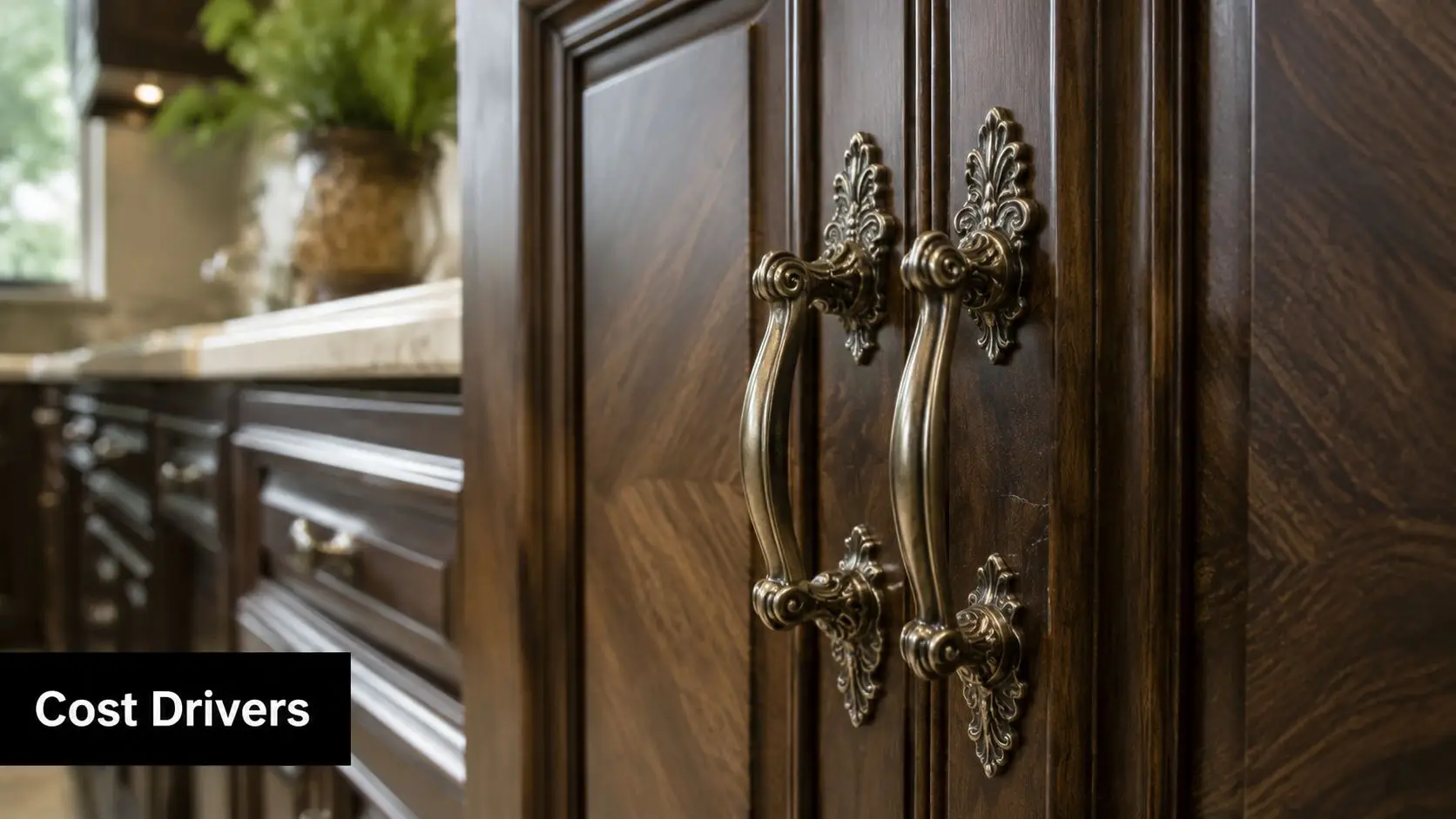
Close-up view of ornate vintage-style brass cabinet handles installed on dark wood kitchen cabinet doors.

Door style and finish

A flat-profile door is usually more economical to make and finish. It suits cleaner, more contemporary kitchens and can work very well in homes aiming for a restrained look.

A more detailed front, such as a shaker-style or routed profile, takes more work. The manufacturing is more involved, and the finishing standard becomes more noticeable because every line and edge is visible.

Finish choice matters just as much:

  • Melamine is practical and cost-conscious.
  • Two-pack painted finishes give a more refined result, especially in lighter colours or detailed profiles.
  • Timber and timber-look choices can add warmth, but they need to be chosen carefully so they don't dominate the space.

Hardware and internal fit-out

Handles seem minor until they're multiplied across the whole kitchen. The same goes for soft-close hinges, premium runners, hidden bins, drawer inserts, and lift-up systems.

Some upgrades are worth paying for because they improve how the kitchen functions every single day. Others are better used sparingly.

A sensible approach: Spend on drawers, hinges, and runners in the most-used zones first. Save the decorative upgrades for the places people actually see.

Room conditions and customisation

Older Victorian homes often need more site adjustment than new builds. That affects labour. A quote rises when installers need to pack cabinets off uneven floors, scribe panels to wandering walls, or resolve out-of-square corners so the finished kitchen still reads as straight and intentional.

People often overspend on visible luxuries while underspending on fit. In practice, a kitchen with simpler fronts and excellent installation often looks better than a heavily upgraded kitchen that doesn't sit cleanly in the room.

That principle carries across the home too. If you're designing a cohesive renovation language between the kitchen, modern bathrooms, and designer bathrooms, consistency in materials and joinery detailing usually gives better value than chasing expensive statement features in every room.

Sample Kitchen Cabinet Budgets in 2026

People don't want theory. They want to know what different budget levels look like in a real home.

Australian spending patterns show where the middle of the market sits. According to 2024 Australian kitchen renovation spending data, 38% of homeowners who renovated their kitchens spent between $20,000 and $40,000, and 23% spent upwards of $40,000. Those figures line up with what many Victorian homeowners experience once cabinetry, finishes, and trade coordination are all included.
Screenshot from https://siteprobathrooms.com.au

Smaller kitchen with a tighter budget

This type of project is common in units, smaller homes, or investor updates. The priorities are usually serviceable storage, a clean finish, and avoiding expensive layout changes.

A realistic approach here is:

  • Use flat-pack or simple semi-custom cabinetry
  • Keep cabinet sizes standard where possible
  • Limit specialty storage
  • Choose durable but straightforward finishes

This level can work well when expectations are clear. It usually isn't the place for heavy customisation, highly detailed profiles, or trying to make a budget product perform like bespoke joinery.

Mid-size family kitchen

This is the range where many owner-occupiers land. The kitchen has to function hard, look considered, and justify the spend over time.

The cabinet budget usually goes into better internals and better planning, not just prettier fronts. You might combine standard carcasses with improved door finishes, add more drawers where they matter, and invest in a pantry layout that reduces clutter.

This is also the budget band where continuity across the home starts to matter. Homeowners often borrow from kitchen selections when exploring new bathroom ideas, using related colours, joinery tones, or hardware styles to create a more coherent renovation.

Larger or premium renovation

This category suits projects where the kitchen is central to the home and the owner wants a more resolved result. Full-height joinery, integrated appliances, statement islands, customized storage, and higher-end finishes are more common here.

The extra spend usually goes into three areas:

  1. Precision fit in more demanding layouts
  2. Higher finish quality on visible surfaces
  3. A better overall experience of use, especially in drawers, pantry access, and appliance integration

What doesn't work in premium projects is mixing expensive visual finishes with weak planning. A large budget can still be wasted if the kitchen flow is poor, the storage is generic, or the installation quality isn't there.

Getting an Accurate Quote and Saving Smartly

A cabinet quote should be detailed enough that you can see what you're paying for. If it isn't itemised, it's hard to know whether one quote is better value or just missing important pieces.

Ask for clarity on:

  • Cabinet construction including carcass material and door finish
  • Hardware specification including hinges, runners, and soft-close inclusions
  • Installation scope including fillers, end panels, kickboards, and site adjustments
  • Exclusions so you know what still sits outside the price

The smartest way to save isn't stripping the kitchen back to the cheapest version. It's choosing where precision matters and where standardisation is perfectly fine. Standard cabinet sizes, simpler door profiles, and disciplined hardware selections usually save more than cutting corners on installation.

A good kitchen doesn't just photograph well on handover day. It fits the house, works properly, and holds up under daily use. That's the difference between a low cabinet price and a sound installed result.


If you're planning a kitchen in Highett or elsewhere in Victoria, the next step is to get a quote that separates cabinet supply from installation, finish choices, and site-specific labour so you can compare options properly.
  • siteprobathrooms

Affordable Kitchen Renovations Melbourne: 2026 Guide

A lot of Melbourne homeowners start in the same place. The kitchen still works, but only just. Doors are tired, storage is awkward, the benchtop has seen better days, and every quote online seems to swing between “cheap and cheerful” and “full custom luxury” with no clear middle ground.

That's where most budgets go off track. Not because people want too much, but because they don't get straight advice early enough about what drives cost in Victoria, what can stay, and what's worth upgrading. Affordable kitchen renovations melbourne projects aren't about chasing the lowest quote. They're about protecting the layout where possible, choosing finishes that give visual impact, and keeping compliance-heavy work under control.

Your Guide to Affordable Kitchen Renovations in Melbourne

A typical renovation conversation starts with a simple goal. Make the kitchen feel cleaner, lighter, easier to use, and better suited to daily life. The problem is that “new kitchen” can mean anything from painted doors and new handles to a full rebuild with new services, custom joinery, and structural alterations.

That difference matters more than is often appreciated. In Melbourne, a kitchen can look dramatically better without becoming a full strip-out. If the cabinet carcasses are still sound, the layout functions reasonably well, and the appliances are serviceable, a refresh can deliver far better value than ripping everything out on day one.

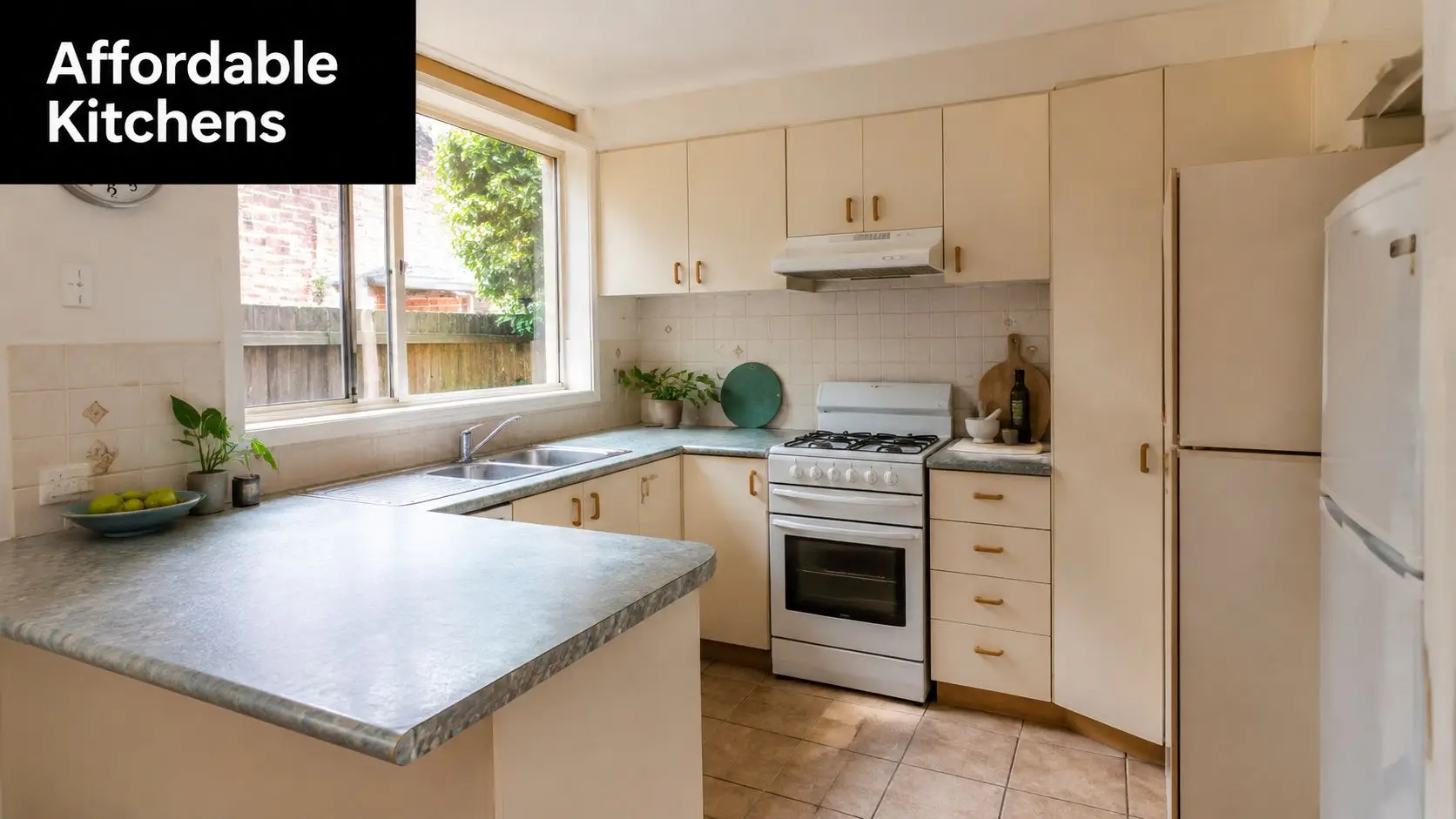
An L-shaped kitchen featuring off-white cabinetry, blue-grey laminate countertops, and a white freestanding oven appliance.

What most homeowners are really deciding

They're not choosing between “good” and “cheap”. They're choosing between scope levels.

Some projects need a proper remodel because the kitchen is failing functionally. Others only need a disciplined upgrade plan. The trouble starts when people price one option but expect the result of the other.

Practical rule: If you want an affordable result, decide first whether you're refreshing, replacing, or reconfiguring. Materials come second.

The same thinking applies across the house. Bathroom renovations follow similar budget logic. Modern bathrooms and designer bathrooms don't always come from expensive layouts or custom everything. New bathroom ideas often work best when the planning is tight and the finish selections are disciplined.

What works in the real world

Affordable projects usually share a few traits:

  • Existing footprint stays put: Sink, cooker and major services remain in their current positions.
  • Cabinet boxes are reused where possible: New doors, panels, hardware and paint can change the entire feel.
  • Visible finishes get priority: Benchtops, splashbacks, lighting and tapware shape the look more than hidden demolition does.
  • Builder input happens early: A proper site assessment catches service issues and compliance risks before selections are locked in.

That's the difference between a kitchen that looks fresh for sensible money and a job that burns budget in the walls and floor before the joinery even arrives.

What Affordable Really Means for Melbourne Kitchens in 2026

“Affordable” needs a proper definition, otherwise it's just sales language. Melbourne cost guides for 2026 put a cosmetic refresh at about A$8,400 to A$21,000, a budget renovation with flat-pack cabinetry at A$12,600 to A$26,250, and a mid-range kitchen at A$26,250 to A$47,250. The same Melbourne guide notes that most budget-to-mid-range projects fall between A$12,600 and A$47,250. You can review those ranges in this Melbourne kitchen renovation cost guide.

Those figures matter because they tie budget directly to scope. A homeowner chasing a full redesign on a cosmetic-refresh budget usually ends up disappointed. A homeowner who matches expectations to the right tier usually gets a better finish and fewer surprises.

Melbourne kitchen renovation budget tiers

Renovation Tier Typical Cost Range (AUD) Common Scope of Works
Cosmetic Refresh A$8,400 to A$21,000 Painting or refacing doors, new handles, updated lighting, simple splashback changes, laminate surface updates, limited appliance changes
Budget Overhaul A$12,600 to A$26,250 Flat-pack cabinetry, laminate benchtops, new sink and tapware, moderate finish upgrades, retained general layout
Mid-Range Renovation A$26,250 to A$47,250 Broader cabinet replacement, upgraded benchtops, more complete finish package, stronger appliance integration, higher fit-out quality

What each tier usually feels like

A cosmetic refresh suits kitchens that are dated but structurally serviceable. The carcasses stay. The layout stays. Money goes into what people see and touch every day. This is the bracket where careful colour selection, better lighting and sharper detailing do the heavy lifting.

A budget overhaul is where flat-pack cabinetry starts to make sense. You're replacing more, but still controlling cost by avoiding unnecessary design complexity and keeping the services where they are. For many households, this is the practical middle ground.

A mid-range renovation gives you more freedom on finish level and cabinetry quality, but it still isn't unlimited. It's where many homeowners start adding details that look great on paper but only make sense if the rest of the room justifies them.

A useful way to split the budget

One Melbourne-focused cost breakdown suggests a practical allocation where cabinetry and joinery take about 35% of the budget, appliances 20%, labour 20%, benchtops 15%, and lighting and finishes 10%. That breakdown appears in this kitchen reno cost planning guide.

This split is helpful because it shows where control really sits. Joinery and labour are the pressure points. If you reduce custom work and avoid unnecessary trade hours, you create room for finishes that improve the look and feel of the space.

For a closer look at how these price brackets translate into real project planning, see this guide on the cost of a new kitchen.

Planning Your Scope by Keeping Layout and Services Intact

The biggest budget decision usually happens before colours, handles or splashback tiles are chosen. It's the layout.

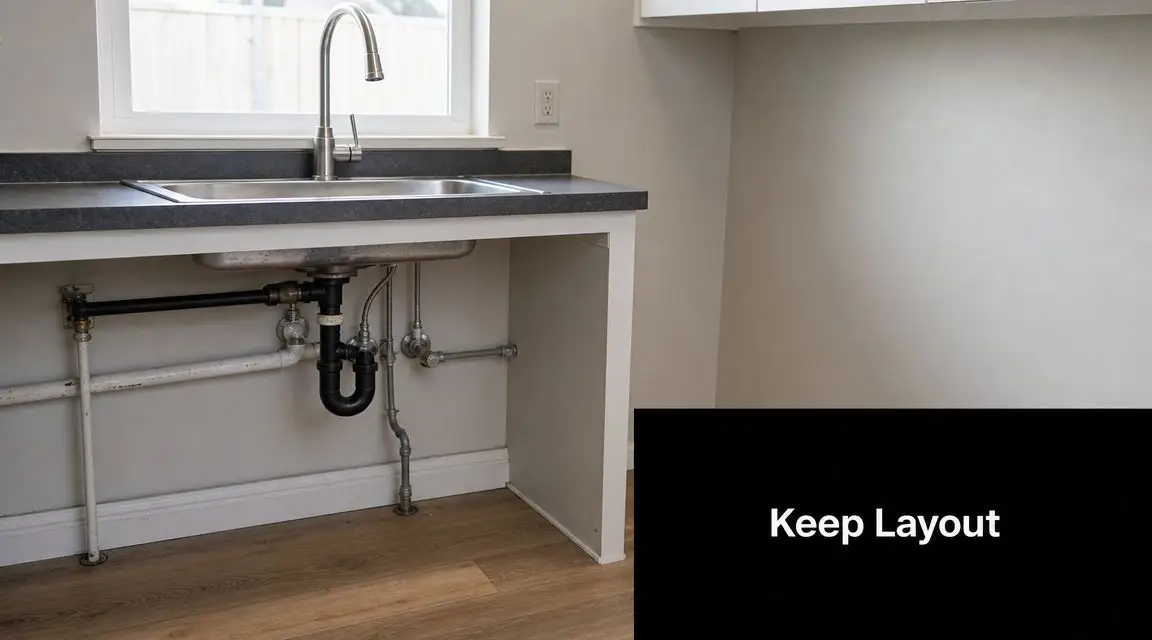
Once you start moving the sink, cooktop, gas point, oven location or power runs, the project changes category. What looked like an affordable update can quickly become a true remodel, and that shift often happens subtly. The client sees one relocated feature. The trades see new plumbing paths, electrical changes, patching, access problems, and compliance steps that weren't needed before.

A modern kitchen sink installation showing exposed plumbing pipes underneath a countertop in front of a window.

Why keeping services in place protects your budget

Australian renovation guidance is clear on this point. Cost blowouts are often driven by compliance and hidden trade work rather than cabinetry choice alone, and homeowners need a framework for deciding between a cheap refresh and a true remodel, especially when relocating plumbing, gas or electrical work can quickly wipe out value. That point is outlined in this Melbourne kitchen renovations guidance.

That lines up with what happens on site. Moving services can trigger work that isn't obvious in the showroom:

  • Plumbing changes: New pipe runs, altered waste positions, and extra opening-up works.
  • Electrical changes: Rewiring, new circuits, switch relocation, and updated connections.
  • Gas adjustments: Repositioning and testing by the relevant trade.
  • Repair works: Wall, floor and cabinet rectification after rough-in changes.
  • Compliance follow-through: Documentation and trade sign-off where required.

A better decision test

Ask a harder question than “Can this be moved?” Ask “Is moving this worth what it takes away from the finish budget?”

That question changes behaviour fast. If relocating the sink gives only a minor layout improvement but forces more trade work, most budget-conscious homeowners are better off refining the existing plan instead.

Keep the footprint unless the current layout is fundamentally broken. A smarter version of the same kitchen usually beats an expensive redesign with downgraded finishes.

When changing the layout can still be justified

Sometimes the old kitchen doesn't work. The fridge blocks circulation. The prep zone is useless. Storage is poor enough that the room fails every day. In those cases, reconfiguration may be the right move. But it should be a deliberate call made with a registered builder after the service implications are understood.

That's where professional assessment matters. A builder doesn't just price cabinets. They look at walls, service access, sequencing, compliance triggers, demolition realities, and what happens if the floor or substrate isn't as expected once the old kitchen is removed.

Where to Save and Where to Splurge in Your Kitchen

If the budget is tight, don't try to make every element premium. That approach usually produces a kitchen full of compromises. Make a few decisions well instead.

The strongest affordable kitchen renovations melbourne outcomes usually come from saving on hidden complexity and spending on visual surfaces and touchpoints. That's why refresh-style projects can work so well. Local guidance recommends repainting or refacing existing cabinets and pairing that with laminate benchtops and subway-tile splashbacks, because this avoids the most labour-intensive parts of a full strip-out. That advice is outlined in this budget-friendly kitchen renovation guide for Melbourne.

Save on the carcasses, not the look

If the cabinet boxes are square, stable and dry, replacing them all isn't always the best use of money. New doors, end panels, fillers and hardware can transform the room without paying for full demolition and custom joinery manufacture.

Many people frequently find better value than expected. The room reads as “new” because the visible surfaces are new.

  • Good saving move: Repaint or reface existing cabinets.
  • Poor saving move: Keep damaged carcasses that are already failing.
  • Worth spending on: Door fronts, handles and soft-close hardware if the base structure is sound.

Choose benchtops with discipline

A benchtop has a huge visual role, but it's still one line item in a larger budget. If choosing a premium surface forces cuts elsewhere, the room can end up unbalanced. A well-selected laminate can look clean, practical and consistent, especially in a budget or refresh project.

Where homeowners usually overspend is choosing a benchtop level that clashes with the rest of the kitchen quality. A practical kitchen with modest cabinetry often looks better with a smart laminate than with one expensive feature trying to carry the whole room.

For a deeper look at practical surface choices, this guide to kitchen benchtop materials is worth reviewing.

Splashbacks, lighting and hardware do more than people think

Subway tiles keep appearing in affordable projects for a reason. They're familiar, clean, and easier to work into many styles than heavily patterned or highly complex alternatives. They can suit traditional homes, compact units and more modern kitchens without forcing the rest of the palette.

On-site advice: If you need the kitchen to look sharper without blowing the budget, improve the splashback, handles and lighting before chasing expensive structural changes.

A few upgrades often punch above their cost:

  • Lighting: Better task lighting improves function and makes finishes look cleaner.
  • Tapware: One crisp tap can enhance a modest sink run.
  • Handles: This is one of the cheapest ways to shift the style of the room.
  • Appliance retention: If existing appliances still suit the design and work properly, keeping them can free budget for areas everyone notices.

The key is balance. Spend where the eye lands first. Save where labour or hidden complexity adds little day-to-day value.

Applying Budget Principles to Bathroom Renovations

The same budget logic that works in kitchens applies almost line for line to bathroom renovations. Keep the wet areas where they are if you can. Don't rip out serviceable components just because they aren't brand new. Spend on the parts that shape the finished look.

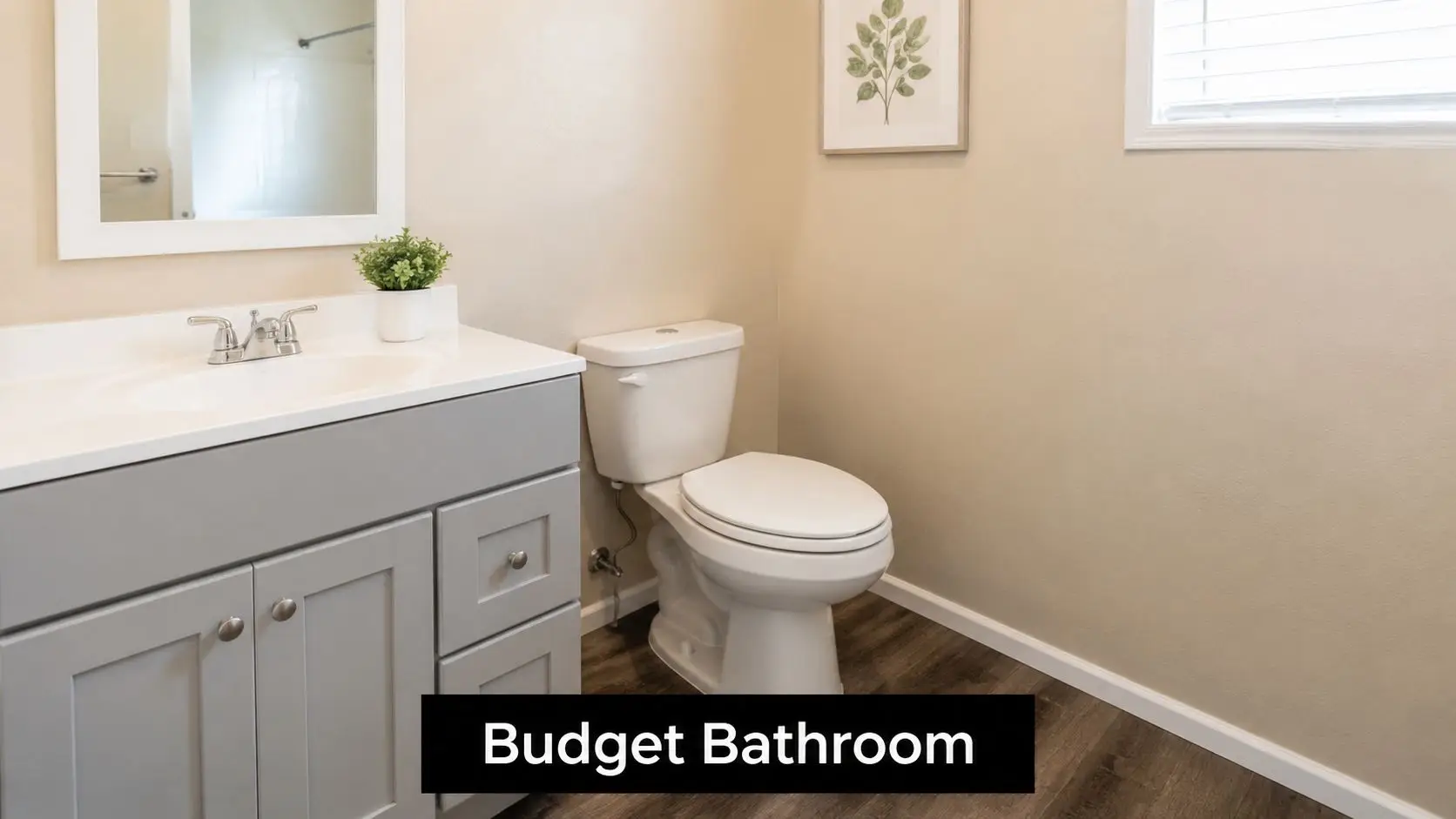
That's why new bathroom ideas need to start with plumbing positions, not tile samples. In bathrooms, moving the toilet, shower waste or vanity location can change the whole job. If the room already functions, a controlled upgrade often gives better value than a full redesign.

A modern, bright, small bathroom featuring a grey vanity cabinet, a white toilet, and minimalist wall decor.

How modern bathrooms stay on budget

Modern bathrooms don't need oversized layouts or custom everything. They need restraint. Clean tile selections, a standard-sized vanity that fits properly, and lighting that flatters the room will usually outperform a pile of expensive add-ons.

Designer bathrooms on a budget tend to rely on proportion and finish discipline rather than novelty. A simple mirror, a tidy vanity, consistent fixtures and a calm palette can produce a far more refined result than trying to force luxury into every corner.

Kitchen lessons that carry straight across

The crossover is simple:

  • Keep services in place: In bathrooms, this matters just as much as in kitchens.
  • Prioritise visible upgrades: Vanity, tapware, tiles, screen and lighting shape the result.
  • Use standard sizes where possible: Custom pieces have their place, but they're rarely the first answer on a budget.
  • Let layout earn its cost: Reconfigure only when the existing room clearly fails.

A well-planned bathroom and a well-planned kitchen often come from the same mindset. Protect the spend from hidden trade escalation, then apply the budget where the homeowner will feel the improvement every day.

How to Hire and Work With Registered Builders in Melbourne

Plenty of renovation problems start long before demolition. They start with vague quoting, poor scope definition, and hiring someone who prices the visible work but not the compliance and coordination behind it.

For kitchens and bathroom renovations, working with registered builders matters because the job isn't just about fitting products. It's about sequencing trades, understanding what triggers extra work, managing defects risk, and keeping the project organised from measure-up to handover.

A white hard hat and rolled architectural blueprints sit on a wooden table for construction projects.

What a proper quote should show

A one-line total isn't enough. If a quote doesn't show what's included, the owner can't tell whether they're comparing scope or just comparing missing items.

Look for detail around:

  • Demolition and removal: What's being removed, protected and disposed of.
  • Trades and services: Plumbing, electrical, gas, installation and finishing responsibilities.
  • Joinery and materials: What level of cabinetry, benchtops and hardware is included.
  • Exclusions: What the builder has not allowed for.
  • Variations process: How changes will be handled if site conditions shift.

What good builder communication looks like

Good builders don't just say yes to every idea. They push back when something doesn't suit the budget, the site or the compliance path. That's useful. It keeps the job honest.

A strong process usually includes clear site assessment, measured plans, finish discussions tied to budget reality, and visual planning before construction starts. For many homeowners, 3D design is a practical tool because it reduces expensive second-guessing once selections are being locked in.

A registered builder should make the scope clearer, not foggier. If every answer creates more uncertainty, the process is already heading the wrong way.

If you're weighing up builder credentials and why they matter in Victoria, this guide on why using a registered builder matters for your bathroom renovation is a useful place to start.

Registered builders unlimited and what that should mean to homeowners

Homeowners sometimes hear phrases like “registered builders unlimited” and assume it's just branding. It should mean something more practical. You want a builder who can assess the whole renovation properly, understand the trade and compliance implications, and manage the project end to end rather than treating it as a collection of disconnected tasks.

That's what lowers risk. Not flashy language. Clear scope, proper supervision, and decisions made before the walls are opened.

Start Your Melbourne Renovation with a Clear Plan

A good renovation budget doesn't start with a number pulled from the air. It starts with decisions. Are you refreshing or remodelling? Are the existing services staying put? Which finishes matter most to how the room will look and work every day?

That's how affordable kitchen renovations melbourne projects stay affordable without looking cheap. The outcome comes from controlled scope, sensible material choices, and a builder who understands where hidden cost lives in a Victorian renovation.

The clearest path to value

If you strip the process back, most successful kitchen and bathroom renovations rely on the same moves:

  • Lock the scope early: Keep layout changes to cases where they're essential.
  • Protect the trade budget: Hidden service work can consume funds fast.
  • Spend where it shows: Doors, benchtops, splashbacks, lighting, vanities and hardware shape perception.
  • Choose qualified oversight: Registered professionals help prevent expensive surprises.

These principles work whether you're updating a compact apartment kitchen, planning family bathroom renovations, or exploring new bathroom ideas for a more modern finish. They also help avoid overcapitalising. A tidy, functional result with durable selections usually ages better than a renovation built around one expensive statement feature.

A practical next step

Before requesting prices, write down three things. What must stay. What must change. What would be nice if the budget allows. That short list will improve every conversation you have with a builder.

Then get advice based on your actual layout, not a generic online allowance. If you want specific guidance for kitchens, modern bathrooms, or designer bathrooms in Highett and across greater Melbourne, contact SitePro Bathrooms for a no-obligation consultation and a project-specific quote. They handle end-to-end renovation planning, design and construction, so you can move forward with a clearer scope and a result that suits both your home and your budget.