
Bathroom Benchtop Materials Compared for Modern Homes
You're probably standing in front of a vanity display, touching one sample after another, and noticing that they all look good for the first five seconds. Then the important questions start. Will this stain from makeup? Will it cope with wet toothbrush cups, hair products, and steamy mornings? Will it still look right in two years, not just on installation day?
That's where many bathroom renovations go sideways. A benchtop gets chosen like a showroom ornament when it really needs to behave more like a hardworking bathroom fitting. In a kitchen, people usually expect heat, spills, and mess. In a bathroom, they often underestimate the daily mix of splashback, humidity, soap residue, toothpaste, cosmetics, and cleaning sprays.
The other thing that's changed is the Australian market itself. A lot of older advice still treats engineered stone as the obvious default. For homeowners planning new bathroom ideas, that's no longer a safe shortcut. Material choice now has to balance look, upkeep, moisture performance, and compliance.
Introduction to Bathroom Benchtop Materials That Last
A common regret sounds like this: “We picked the one that looked most like a luxury hotel vanity, but nobody told us how much care it needed.” That usually happens when a benchtop is judged by colour and pattern first, and by bathroom reality second.
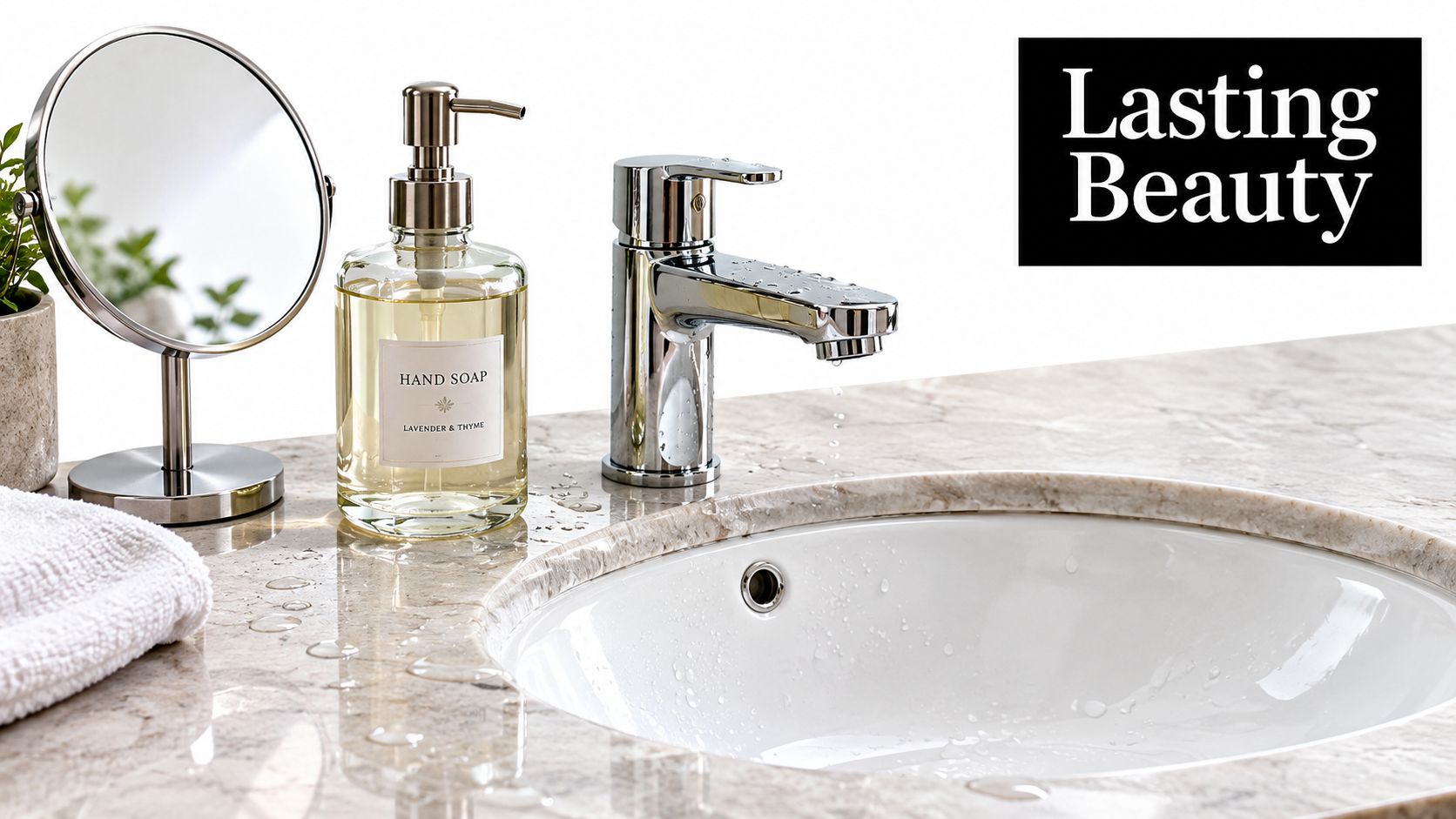
In a bathroom, the benchtop sits in a strange middle ground. It's partly decorative, like a piece of furniture, and partly a wet-area work surface. It has to handle puddles around the basin, drips down the front edge, pump bottles left in one spot, and cleaning products that get sprayed a bit too generously. A beautiful slab can still be the wrong choice if it needs more attention than your household can realistically give it.
The decision most homeowners are really making
When people compare bathroom benchtop materials, they often think they're choosing between “modern” and “classic” looks. In practice, they're choosing between different levels of forgiveness. Some surfaces hide daily life well. Others show every watermark, residue mark, or chemical dulling.
That matters whether you're planning compact powder rooms or full designer bathrooms. It also matters if you're trying to keep the renovation calm and straightforward instead of turning your vanity top into one more maintenance task.
Practical rule: Pick the surface that suits how you actually live, not how you imagine you'll maintain it on your most organised week.
Why this choice feels more loaded now
Australia's material selection has shifted. Safe Work Australia states that engineered stone had an estimated 55% market share by volume in the Australian benchtop market, compared with 29% for laminate, 5% for porcelain, and 4% for granite, within a market estimated at about A$600 million in 2022 covering roughly 4.5 million square metres. It was also used widely beyond kitchens, including bathrooms and wall and floor applications, according to the Safe Work Australia decision RIS on engineered stone.
That old default has changed. The better question now isn't “What's most popular?” It's “What survives bathroom life, suits my style, and complies with current Australian conditions?”
What Makes a Bathroom Benchtop Different
A bathroom benchtop doesn't fail all at once. Water sits around the tap. A cleaner gets left on the surface. The edge near the basin takes repeated splashes. Then the top starts looking tired long before the rest of the room.
Moisture is constant, not occasional
Think of a kitchen spill as an event. Think of bathroom moisture as weather. It keeps returning. Steam settles, splash zones stay damp, and water often reaches the underside edge around the basin cut-out or front lip.
That's why the top surface alone isn't the whole story. The substrate, edging, joins, and penetrations all matter. In moisture-exposed Victorian public building specifications, benchtops are required to be built on a solid moisture-resistant substrate of at least 25 mm thickness and finished with materials suited to the installation. The default finish listed is 1.0 mm coloured laminate with rigid PVC edging, as outlined in the Victorian technical specifications handbook.
Bathrooms also bring chemistry into the picture
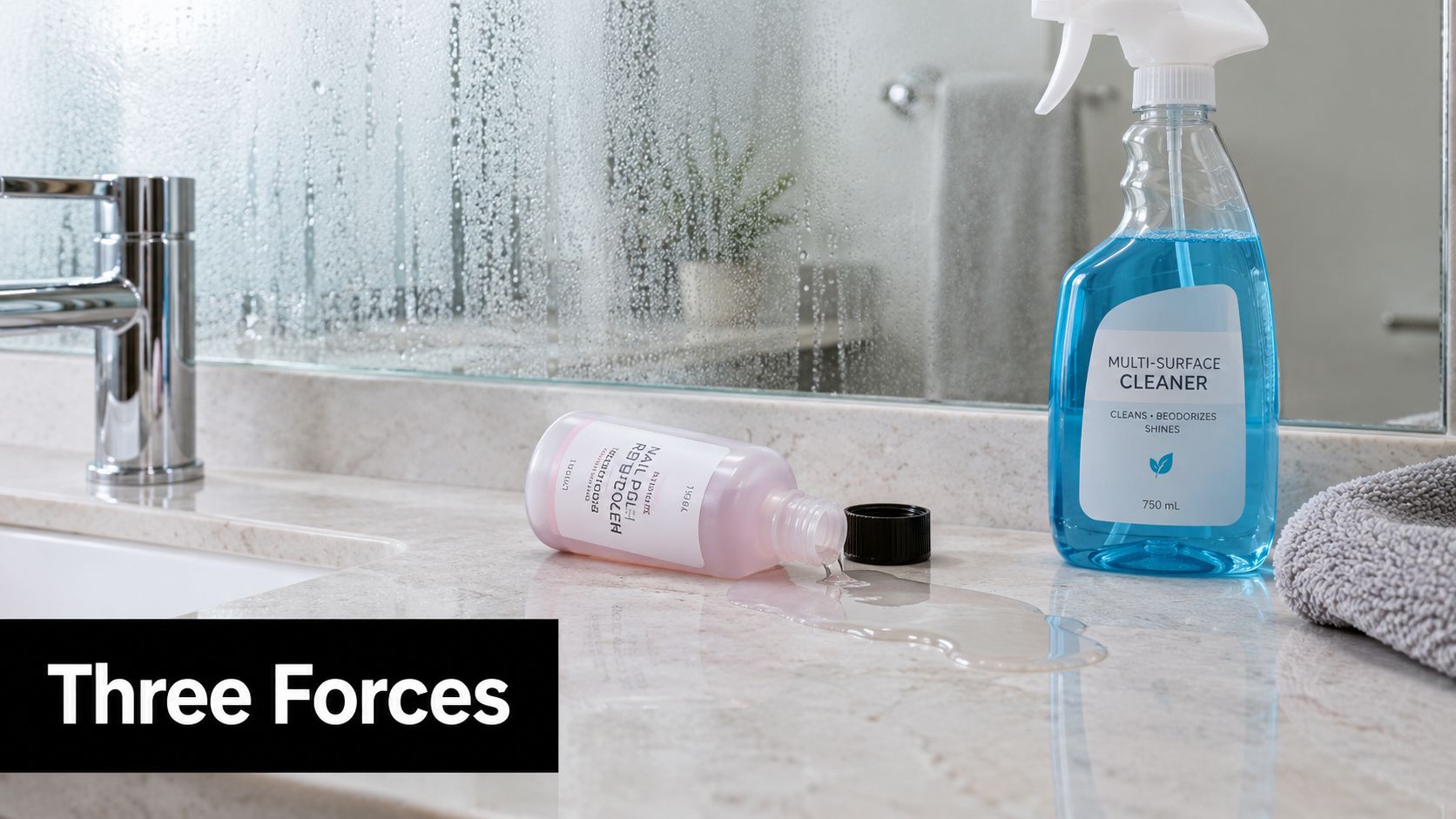
Many people hear “water resistant” and think that's enough. It isn't. Bathrooms also expose benchtops to toothpaste, skincare acids, acetone-based products, hair dye, bleach-based cleaners, and limescale removers. A surface can resist water and still dislike certain chemicals.
The same Victorian specifications point to performance expectations for laminate and compact laminate, including an ASTM D5116 moisture-emission criterion of ≤0.1 mg/m²/hr, and they allow chemical-resistant laminate or solid acrylic polymer where chemical exposure is higher, as noted in the Victorian technical specifications handbook. In plain terms, that means appearance isn't enough. You need a surface that suits both moisture and what you clean it with.
Three checks that simplify the showroom decision
When you're looking at samples, ask these three things:
- How does it handle standing water: Not just a wiped-up splash, but water sitting around a tap base or soap dispenser.
- What happens with everyday products: Makeup, skincare, cleaning spray, and hair products are part of the test.
- What supports it underneath: A good-looking top on the wrong base is like good paint on damp plaster.
For homeowners interested in lower-impact selections as well as durability, it also helps to review broader renovation choices through a sustainability lens. This guide on eco-friendly renovation materials and methods is a useful companion to benchtop planning.
A bathroom benchtop isn't just a slab choice. It's a moisture system, a cleaning surface, and a finishing detail all in one.
Comparing Popular Bathroom Benchtop Materials
Samples start to make sense here. Instead of asking which material is "best," ask which one gives you the balance you want between look, touch, upkeep, and moisture tolerance.
Engineered stone in Australia now sits in a different category
Older buying guides still treat engineered stone as standard. In Australia, that advice is out of date. Safe Work Australia states that ministers unanimously agreed on 13 December 2023 to prohibit the manufacture, supply, processing, and installation of engineered stone benchtops, panels, and slabs from 1 July 2024, and from 1 January 2025 the importation of engineered stone benchtops, slabs, and panels was also banned, according to the Safe Work Australia engineered stone ban guidance.
That's why current bathroom benchtop materials discussions need to focus on compliant substitutes, not on quartz-style engineered stone as the assumed answer.
Key takeaway: In Australia, the practical question has shifted from whether engineered stone is stylish to which compliant alternative suits your bathroom habits.
A recent Australian editorial gap has opened because many articles still speak about quartz or engineered stone as if nothing has changed. More current local guidance now pushes renovators towards alternatives such as porcelain, natural stone, laminate, or solid surface, with suppliers also marketing zero-crystalline-silica and silica-free ranges for bathrooms, as discussed in this Australian bathroom benchtop materials article.
Bathroom benchtop materials at a glance
| Material | Water Resistance | Maintenance Level | Best Style Fit |
|---|---|---|---|
| Porcelain | Strong when properly fabricated and installed | Low | Modern bathrooms, minimal, luxe stone-look spaces |
| Natural stone | Varies by stone and sealing | Medium to high | Designer bathrooms, classic, hotel-style rooms |
| Solid surface | Strong for daily splash use | Low to medium | Clean-lined vanities, integrated sink designs |
| Laminate | Good when detailing is done well | Low | Budget-conscious updates, family bathrooms |
| Concrete | Moderate, depends heavily on sealing | Medium to high | Architectural, industrial, custom modern looks |
| Timber | Lower in wet zones unless carefully sealed and maintained | High | Warm spa-like rooms, furniture-style vanities |
| Stainless steel | Excellent with water | Low | Utility spaces, ultra-modern or commercial-inspired bathrooms |
If you'd like a broader surface comparison that also crosses over with kitchen planning, this overview of benchtop surface categories and trade-offs helps put bathroom selections in context.
How each material behaves in real life
Porcelain
Porcelain is the neat freak of the group. It suits homeowners who want a refined look without much drama afterwards. It can mimic stone, concrete, or softer matte finishes, so it works well in modern bathrooms where you want the benchtop to look crisp rather than fussy.
Its weak point isn't daily water exposure so much as detailing. Edge fabrication and installation quality matter because a beautifully specified porcelain top can still disappoint if corners, joins, or support aren't handled carefully.
Natural stone
Natural stone offers depth that printed or manufactured looks often can't fully copy. Marble feels luminous. Granite feels grounded. Other stones sit somewhere in between. In a calm ensuite or powder room, stone can make the vanity feel like a furniture piece rather than a standard cabinet top.
The trade-off is that natural materials ask for attention. Some need sealing. Some mark more easily from acidic or pigmented products. This is a good option for people who love authenticity and don't mind adapting their cleaning habits to suit it.
Solid surface
Solid surface is the practical minimalist. It tends to work best when you want soft visual lines, easy cleaning, and an integrated basin look. Because the joins can be less visually intrusive, the whole vanity can read as one continuous form.
This suits compact bathrooms especially well. Fewer visual interruptions can make a smaller room feel tidier and more spacious.
Laminate
Modern laminate deserves more respect than it usually gets. It won't pretend to be a premium stone slab up close, but it can be a smart and very sensible choice for bathrooms where reliability, cost control, and straightforward maintenance matter most.
It's especially useful in busy family settings. If the edges are protected properly and the substrate is appropriate, laminate can perform well while freeing more of the renovation budget for waterproofing, tapware, or storage.
Concrete
Concrete has presence. It feels custom and architectural, and it can look excellent in pared-back rooms with timber joinery or brushed metal fixtures. But it isn't a fit-and-forget option. It relies on sealing and realistic expectations.
People often choose concrete for mood rather than convenience. That's fine, as long as you know the mood comes with maintenance.
Timber
Timber brings warmth that hard surfaces can't. In a bathroom full of tile, glass, and metal, that warmth can be exactly what softens the room. It pairs particularly well with new bathroom ideas built around spa-like textures and a furniture feel.
Its challenge is predictability. Timber can work, but only if sealing, ventilation, and user habits all line up. Around basins and wet hands, it's less forgiving than most alternatives.
Stainless steel
This isn't common in homes, but it's worth mentioning because it performs very well with water and cleaning. It gives a sharp, deliberate look. Some people love the clean, almost clinical neatness. Others find it too hard-edged for residential spaces.
Durability Maintenance and Everyday Care
The right material still needs the right habits. Most benchtops don't get ruined by one dramatic incident. They get worn down by repeated shortcuts. Wet items left in place, harsh spray cleaners, and grime allowed to sit around fixtures are the usual culprits.
Match the cleaner to the surface
A simple mistake is using the same bathroom spray on every finish in the room. Tiles, tapware, mirrors, and benchtops may all need different care. That's especially true when the vanity top is a natural material or a decorative laminate rather than a purely utilitarian surface.
For everyday care, a soft cloth and mild cleaner usually beat aggressive products. Strong chemicals can dull sealers, mark sensitive finishes, or attack joins over time. If your household prefers heavy-duty cleaning, choose a benchtop that tolerates that reality rather than hoping everyone will suddenly become gentle.
Wipe first. Spray second only when needed. The less chemical residue you leave behind, the better most benchtops age.
What maintenance really feels like by material
Some materials ask for almost nothing beyond routine cleaning. Others expect periodic sealing or a bit more caution around cosmetics and cleaners. That difference matters more than most sample boards admit.
- Low-fuss choices: Porcelain, well-selected solid surface, and many laminate setups usually suit households that want simple wipe-down care.
- Needs more attention: Natural stone and concrete generally suit people willing to monitor cleaners, water sitting time, and surface condition.
- High-awareness living: Timber can look beautiful, but it asks you to notice moisture early and react quickly.
Daily habits that prevent most problems
You don't need a strict ritual. You need a few sensible patterns.
- Dry around the basin: Water that sits around the tap base or basin rim causes more trouble than occasional splashes.
- Move bottles occasionally: Soap and skincare containers can trap moisture and leave ring marks or grime lines.
- Use a tray when styling: A small vanity tray keeps oils, perfumes, and cosmetics from turning the benchtop into a testing ground.
- Check corners and edges: The front edge and cut-out area often age faster than the middle of the slab.
If your household is busy, choose a surface that still looks respectable when care is imperfect. That's often a wiser durability decision than choosing a delicate material and promising yourself you'll treat it like a museum piece.
Cost Styling and Best Uses by Bathroom Type
A benchtop doesn't live in isolation. It sits inside a room with a budget, a layout, and a style direction. That's why the right material for an ensuite may be the wrong one for a kids' bathroom.
Australian bathroom renovations are commonly benchmarked in the low-to-mid five figures. One 2026 market summary cites a national bathroom renovation range of A$10,221 to A$20,443 with a midpoint of A$15,332, and reports Melbourne at A$10,500 to A$21,000, according to this Australian bathroom renovation cost summary. Treat those figures as planning context rather than a fixed quote, but they help explain why benchtop choices should support the whole room budget, not consume it.
Match the benchtop to the bathroom's job
A family bathroom usually benefits from surfaces that are forgiving, easy to wipe, and not precious about daily mess. That often points towards laminate, solid surface, or porcelain depending on the visual target.
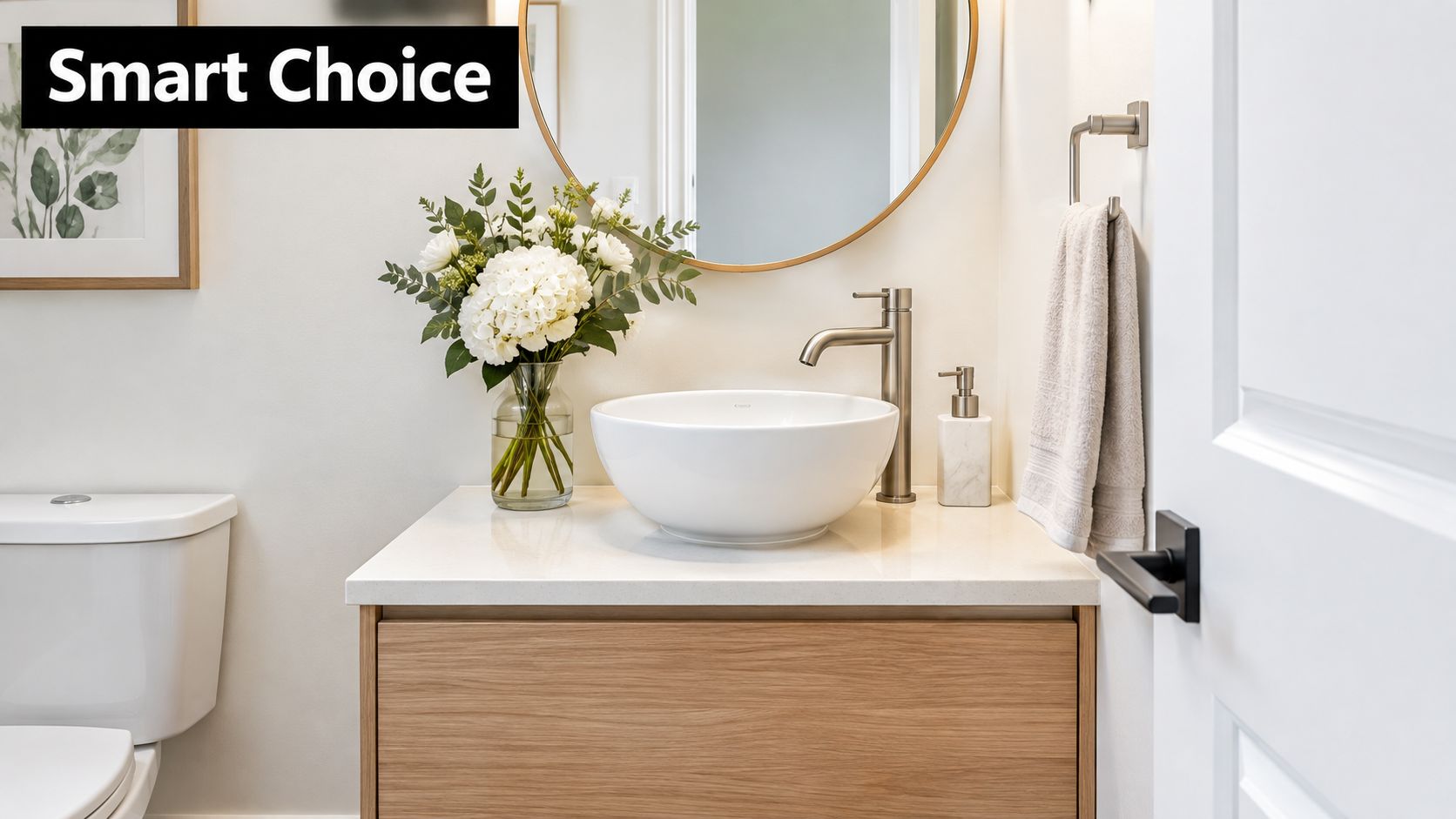
A powder room can carry a more expressive choice because it sees less intense use. That's where natural stone, concrete, or a bold colour move can make sense. In a primary ensuite, the balance often shifts again. People usually want a calmer, more refined feel, but still with manageable upkeep.
Style direction matters as much as material
A 2026 Australian trends article identifies Contemporary Classics, Modern Australian, Wellness Sanctuary, White On White, and Colour Drenching as major bathroom directions, according to this Australian bathroom trends overview. Those labels are useful because they help you stop saying “I want modern” and start saying what kind of modern.
A separate 2023 Australian trend article also names Art Deco, Day Spa, Hamptons, Hotel Experience, and Modern Australian, noting that Modern Australian is curated by local designers and architects, as outlined in this Australian bathroom design trends article.
Easy pairings that work
- Modern Australian: Pair warm timber cabinetry with porcelain or a soft-toned solid surface. This keeps the room grounded and relaxed.
- Wellness Sanctuary: Favour calm textures and lower visual noise. Light stone looks, pale solids, and rounded edges help.
- White On White: Use texture and finish to avoid flatness. A matte top often adds more depth than a bright glossy one.
- Colour Drenching: Let the benchtop either match closely for a uniform look or contrast very deliberately. Halfway choices can feel accidental.
- Art Deco or Hotel Experience: Natural stone or a convincing porcelain stone-look can support stronger metal finishes and more sculptural forms.
A benchtop should either quietly support the room or intentionally star in it. Problems usually start when it tries to do both.
For modern bathrooms, one of the smartest budgeting moves is to spend where your hand and eye go every day, then save where performance won't suffer. A practical top with excellent joinery and lighting often feels more expensive than a premium slab surrounded by compromised details.
Installation Edge Profiles and Sustainability Considerations
The sample gets the attention. The installation decides whether it lasts.
Details that change the outcome
Ask what the benchtop is sitting on, how the basin cut-out is reinforced, and how edges are finished. Those aren't fussy trade questions. They're the difference between a top that stays neat and one that starts showing wear early.
If you're unsure how vanity dimensions affect comfort and splash behaviour, this guide to standard benchtop height planning helps frame the installation side of the decision.
Edge profiles are more than a style choice
A square edge feels clean and contemporary, but it can show knocks more readily depending on material. A softened edge is often more forgiving in family bathrooms. Mitred details can create a thicker, more substantial look, but they need precise fabrication and good support.
Bullnose and rounded profiles soften the room visually and are kinder on hips in tighter layouts. They can also make day-to-day cleaning feel easier because there's less of a sharp corner catching residue.
A short pre-purchase checklist
Before you approve a benchtop, confirm these points:
- Substrate suitability: Ask what base material is being used and whether it suits a moisture-exposed bathroom setting.
- Edge treatment: Confirm whether the selected material is prone to visible chipping and how the chosen profile addresses that.
- Cleaning compatibility: Make sure your preferred cleaning routine won't fight with the surface requirements.
- Warranty terms: Read what's covered for staining, surface marks, joins, and installation defects.
- Material claims: If a product is described as silica-free, recycled, or low-maintenance, ask for the product information in writing.
- Installer credentials: For bathroom renovations, use appropriately qualified trades and, where required for the project scope, work with registered builders unlimited so waterproofing, cabinetry, plumbing coordination, and finish installation are treated as one compliant system.
Sustainability also deserves a practical reading. Recycled content is useful. Silica-free composition matters. Durability matters too, because a surface that needs replacing early rarely counts as a better environmental outcome.
Your Next Steps to a Beautiful Compliant Benchtop
By the time you've narrowed the samples down, the decision usually becomes much simpler. You're not choosing from every possible finish. You're choosing the one that best matches your bathroom habits, your visual direction, and your renovation budget.
Use these five questions as your final filter:
- How wet is this bathroom really: Not the brochure version. The version with rushed mornings and wet hands.
- How much maintenance will we do: Honest answers lead to better surfaces.
- What style am I building towards: Modern bathrooms can look completely different from one another. Name the mood, not just the era.
- Where should the budget work hardest: Sometimes a simpler top allows better cabinetry, lighting, or layout.
- Is the material compliant and suitable for current Australian conditions: That question matters far more now than it did a few years ago.
If you want help turning sample-board decisions into a complete buildable plan, SitePro Bathrooms provides concept development, detailed 3D design, construction, and finishing for bathroom renovations in Highett and greater Victoria. That kind of end-to-end process is useful when the benchtop choice needs to line up with cabinetry, waterproofing, lighting, and overall room proportions rather than being selected in isolation.
The best bathroom benchtop materials aren't the ones with the biggest showroom impact. They're the ones that still look right after steam, splashes, skincare, and ordinary family life have had their say.
If you're comparing options now, gather a few samples, test them against your cleaning habits, and brief your builder with the practical points above. That's how good new bathroom ideas turn into finished bathrooms that still feel good to use every day.