

Would you stand behind a fluted glass shower screen confident that nobody in the hallway could identify you? Most buyers assume yes. The ribbed surface sells itself on atmosphere: soft focus, vertical lines, light bending across a bathroom in a way that photographs beautifully. Privacy, cleaning effort and legal compliance all get folded into a single word, texture, and that's exactly where renovation budgets go sideways.
A fluted glass shower screen is a performance decision. The pattern changes what people can see, changes how residue behaves on the surface, and changes how the panel must be specified, because the size of the pane decides the thickness of the glass, and the thickness is a legal requirement rather than an upsell. Treat the look as the last decision, not the first.
What follows works through the three questions in order. What the glass does to a sightline. What Victorian rules demand of the panel. What it costs to buy, clean and live with.
Fluted Glass Compared With Clear and Frosted Options
Start with the physical difference. Fluted glass, also sold as reeded glass, is patterned safety glass with a run of parallel ribs pressed into one face while the sheet is still molten. The other face stays smooth. That's why a real panel bends light as you move past it and why a printed film imitation reads as a flat grey blur under bathroom downlights.
| Glass type | Privacy | Light transmission | Cleaning effort |
|---|---|---|---|
| Clear toughened glass | Low | High | Low to moderate |
| Frosted or acid-etched glass | High | Moderate | Moderate |
| Fluted (reeded) glass | Moderate to high | Good, diffused | Higher, residue sits in grooves |
Clear glass gives you the brightest bathroom and the least concealment. A clear panel between a shower and a bedroom door leaves nothing to the imagination once the room lights are on. Frosted or acid-etched glass sits at the other end: the surface scatters light in every direction, shape disappears almost entirely, and the flat face wipes down in one pass.
Fluted glass lands in the middle, and the middle is where the confusion lives. The Australian Glass and Glazing Association's technical fact sheets note that a profiled surface creates repeated grooves rather than one flat wipeable surface, and that moisture resistance, ventilation and cleaning are genuine design considerations for glazing in wet environments, per the AGWA technical resources library. That's the trade: brightness and texture in exchange for a cleaning routine that has to be followed.
Where each glass type suits a real bathroom
- Fluted glass suits family bathrooms and ensuites that need daylight borrowed from a window or a hallway without offering a clear view into the shower. It also earns its place in modern bathrooms and designer bathrooms where the texture is doing visual work alongside tile and tapware.
- Clear glass suits a guest ensuite or a bathroom with its own window, where daylight is scarce and there's no sightline to protect. Don't spend on texture you'll never see the benefit of.
- Frosted glass suits a rental or a high-traffic shared bathroom where concealment matters most and nobody wants a maintenance routine attached to the screen.
One practical note before you decide. If privacy is the driver and you want a flat surface, our guide to frosted glass shower screens covers how the different obscuring methods behave in a wet area. Fluted is the right answer only when you want the light and the texture as well.
How Much Privacy Fluted Glass Really Gives
How much of a person does fluted glass hide? From two or three metres, a family bathroom usually shows a silhouette, a colour and movement. Press your face near the panel and the same glass gives away considerably more.
Fluting works like a blurred photograph. The ribs break up detail and smear edges, so a standing figure still reads as a shape rather than disappearing. Domain's look at bathroom trends makes the point that fluting obscures detail rather than creating complete visual privacy, and that a person can remain recognisable in a brightly lit shower when the adjoining room is darker. Pattern names do not settle that question. The variables do.
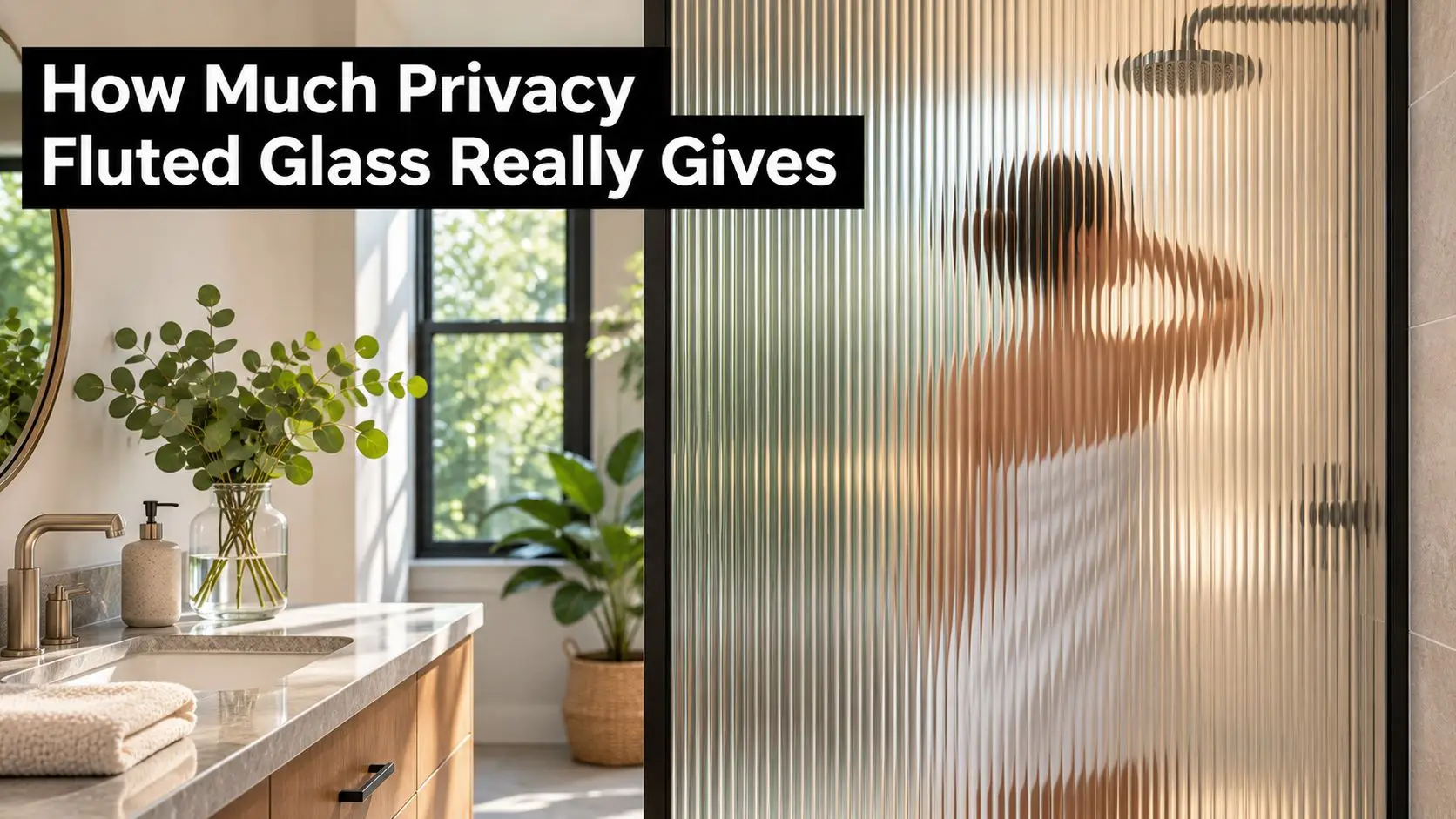
The variables that change what you see
Flute orientation. Vertical ribs blur a standing silhouette differently from horizontal ones. Vertical is the standard for showers because it sheds water. If the worry is someone seeing you side-on from a doorway, test the alternative before you commit.
Viewing distance. At half a metre, detail survives. At three metres across a bathroom, it is gone. Where is the furthest point someone can stand and still see the screen?
Lighting contrast. A lit shower and a dark hallway turn the person inside into a bright shape. Reverse it, hallway light on and bathroom dark, and the panel conceals far more. Many people only check the screen in one lighting setup, then get a surprise at the other end of the day.
Face orientation. Ribs on the wet side collect soap film in every valley. Ribs on the dry side wipe clean. The same panel handles completely differently depending on which way it is installed, and film in the valleys softens the view further once the shower is in daily use.
Etched versus clear-backed. An acid-etched backing layer lifts the obscuring effect well above plain clear fluted glass.
A worked example, then a test
Say a family bathroom has its shower at the end of the room and a hallway window directly opposite the screen. With the hall light off during the day, the fluted panel reduces the shower to a soft shape and nobody thinks about it. At 7am in winter, with the hall light on and the bathroom dim, a figure in the shower is clearly readable from the doorway.
Test rule: a sample held at the doorway in morning daylight tells you more than any product photograph, and the same sample under the bathroom's night lighting tells you the rest.
Order a sample, hold it in place at the finished height, and check it from the doorway and from the hallway, in daylight and again at night with the lights on as you would normally use them. Then plan privacy zones: keep towels, robes and the vanity outside the direct sightline, and consider a fluted return panel or a short solid section at the end where the view is most open. If hiding people completely is the requirement, pair the layout with an obscured or solid screen instead of relying on texture.
Victorian Safety Rules for Fluted Glass Panels
Here's the part that surprises people. The pattern changes nothing about how the panel is regulated. A fluted panel in a shower is safety glazing first and a decorative finish second, and the same human-impact provisions apply to it as to a plain clear screen.
| Requirement | Rule | Source |
|---|---|---|
| Lowest sightline below 2.0 m | Human-impact glazing required | NCC |
| Framed panel | Grade A or Grade B safety glazing | NCC |
| Exposed edge | Toughened safety glass, minimum 6 mm | NCC |
| 6 mm safety-glass pane | Maximum 3.0 m² | NCC table |
The trigger is height. The National Construction Code glazing provisions require glazing in bathrooms, ensuites, spa rooms and similar wet areas to meet human-impact requirements when its lowest sightline sits less than 2.0 metres above the finished floor, bath bottom or shower base. Framed panels must use Grade A or Grade B safety glazing. Panels or doors with an exposed edge must use toughened safety glass at a minimum nominal thickness of 6 mm.
That last clause catches most contemporary designs. Fluted screens are frequently partly framed or frameless, which leaves one or more edges exposed. The surface looks soft. The specification isn't.
Panel size drives thickness
The area limit is where layout becomes a glass decision. The NCC table caps a 6 mm safety-glass shower-screen pane at 3.0 m², and AGWA's guidance on glazing and AS 1288 sets out why these limits work as practical design controls rather than paperwork.
Work an example. A single fluted panel 1.2 m wide by 2.0 m high is 2.4 m², comfortably inside the cap for 6 mm glass. Take that same panel to 1.6 m wide at the same height and you're at 3.2 m², over the limit. At that point the choices are thicker glass, a different configuration, or subdividing the run into two panels with a channel between them.
Area also drives force. A larger sheet flexes more under load, and that load transfers to hinges, channels and wall fixings. A frameless panel fixed into a brick wall is a straightforward job. The same panel fixed into new stud framing needs the glazier to know what's behind the tile before anything is ordered.
What to put on the drawings
The ribbed pattern is a design choice. The compliance decisions are the classification, the thickness, the pane area, the edge exposure and the fixing method, and all of them belong on the quotation and the drawings.
What to ask for in writing: nominal thickness, safety-glass grade, maximum pane area, edge exposure, hardware rating and substrate fixing method.
One more variable applies to older homes. Standards Australia lists AS 1288:2021 as the current edition governing glass selection and installation, including human impact and special applications. An existing screen in a period Victorian bathroom may have been installed under an earlier rule set entirely, so replacing just the glass without reviewing the framing and fixing detail can leave you with a screen that satisfies nobody.
Cleaning Fluted Glass Without Hidden Buildup
How do the grooves stay clean when a flat blade never reaches the bottom of them?
A fluted panel behaves like a washboard set beside a dinner plate. On flat glass, one squeegee stroke meets the whole face. On fluted glass the blade rides the peaks, and hard-water minerals plus soap scum stay in the valleys. The ribs soften watermarks and fingerprints at eye level, so a screen can look acceptable while deposits sit in the pattern. Cosmetic concealment does not reduce buildup.
The AGWA guidance on shower screen care and maintenance sets out the routine that suits this kind of surface.
A routine that works on a ribbed panel
- Squeegee after every use. Glass, hardware and frame, not just the panel. The blade clears the flats. A dry microfibre cloth wiped across the ribs (across, never along) clears the valleys. Along the ribs, the cloth just pushes film from one groove into the next.
- Wash weekly with warm water and a pH-neutral soapy solution. A mild soap matters more than a stronger mix, and best soap for washing windows covers which mixes stay gentle on seals, coatings and metal finishes.
- Skip the abrasives and harsh acids. Scouring pads dull the ribs. Aggressive cleaners attack surface treatments, silicone and adjacent tapware.
- Check screws, channels and seals every few months. Loose fixings cause misalignment and water escape, and in the worst case they contribute to glass breakage.
| Setup | Spray exposure | Suggested routine |
|---|---|---|
| Family bathroom, daily use, hard water | Direct spray on one face | Squeegee after every shower, deep clean weekly |
| Ensuite, daily use, softer water | Spray reaches the edge only | Squeegee most days, clean fortnightly |
| Guest bathroom, a few uses a week | Low spray exposure | Clean fortnightly, check hardware every three months |
Where the wet face and the spray line matter
Orientation does a lot of the work before any cloth comes out. Ribs facing the dry side leave the wet face smooth, so it wipes in one pass. Keep the screen out of the direct spray line where the layout allows it, and make sure the bottom edge drains rather than sitting in a trapped film of water. A screen that dries quickly grows far less residue than one that stays wet between showers.
The practical test is whether the routine will happen. If a squeegee after every shower is unlikely, a smoother profile or a flat frosted panel is the easier surface to live with. Skip a day on fluted glass and the film sets in the grooves. The next wipe then has to lift mineral and soap that a flat sheet would have shed while it was still wet.
What Fluted Shower Screens Cost in Australia
What makes one fluted shower screen cost more than another? Start with the difference between a standard-size listing and a screen measured for a specific opening. Standard-size listings typically quote the product unit, while a custom screen's price depends on its glass, hardware and installation.
A listed price covers the unit; a quote covers the bathroom.
| Product | Configuration | Typical price information |
|---|---|---|
| Standard-size fluted screen | Fixed widths or standard configurations | Listing price usually covers the unit |
| Custom-sized fluted screen | Measured for the opening | Written quote required |
Why a listed price and a quote are different numbers
Five factors shape the total. Glass thickness depends partly on the panel's size and exposure. Panel size and subdivision affect the amount of glass, channel and installation work required. Hardware varies with the design, including whether the screen is framed or frameless. Curved corner profiles require shaped panels rather than a straight run.
The fifth factor is installation. Wall fixing, removal and disposal of an old screen, and work around the screen can add labour beyond the product listing. A standard-size curved corner unit and a custom single panel are different specifications, even if they look similar in a photo.
If the screen is part of a larger renovation, such as removing a bath, this guide to tub to walk-in shower conversion costs explains how the screen fits into the wider project budget.
Ask for an itemised quote showing glass, hardware, supply, installation and removal separately. The guide to frameless shower screen costs explains the main cost components of a frameless build. Check that the quoted configuration and measurements match the screen you are comparing, since listings can change with stock and sales.
Installers, Builder Registration and Pre-Order Checks
Who will install the screen, and what work does the project include? The answers affect builder registration, fixture choices and what proof to keep before the bathroom renovation begins.

When the $10,000 registration threshold applies
In Victoria, domestic building work costing more than $10,000, including labour and materials, requires a builder registered with the Building and Plumbing Commission. A major domestic building contract is also required above that value, according to the Consumer Affairs Victoria registration checklist. Confirm that registration is in place before work starts.
The registration class must suit the work. The Building and Plumbing Commission describes Domestic Builder (Unlimited) as covering all components of domestic building work on class 1, 2 and 4 buildings and associated class 10 buildings. A separate class is limited to bathroom, kitchen and laundry renovations.
For example, a project might combine a fluted screen with new floor tiles, a relocated vanity and wall reframing. The scope of work helps determine which registration class applies. Read more about why using a registered builder matters for your bathroom renovation.
Water efficiency belongs in the same plan
A shower screen can prompt a wider look at the bathroom's water use. Lower Murray Water says a 10-minute shower can use up to 200 litres. It recommends a dual-flush toilet with a four-star water-efficiency rating, using 4.5 litres for a full flush and 3 litres for a half flush, in its household water-saving guide. Choosing fixtures alongside the screen lets you consider water use as part of the overall renovation.
Three checks before you place the order
- Confirm builder registration. For domestic building work above the threshold, ask to see proof of registration and check that the class suits the project.
- Check water-efficiency details. Compare the proposed shower and toilet fixtures with the household's needs and the water-use guidance.
- Request waterproofing proof. Ask for confirmation that bathroom waterproofing is certified and applied to floors and walls in compliance with Australian Standards.
Keep the written scope and waterproofing confirmation with the project records. SitePro Bathrooms offers a free consultation, which you can request using the online form or by calling 1300 661 955.