

You're standing in a half-finished bathroom, the tile is in, the plumber's finished, and the shower screen is the last big decision hanging over the room. In a compact Victorian ensuite or family bathroom, that choice usually comes down to one thing, how much privacy you need without turning the room into a dim box. That's exactly where frosted glass shower screens earn their place in bathroom renovations, because they solve a real conflict instead of just adding another finish to the shopping list.
Why Frosted Glass Shower Screens Matter in Modern Bathrooms
A typical Highett bathroom puts you right at the point of tension. There's a window letting in useful morning light, the shower sits close to the vanity, and the household still needs enough privacy for the room to feel comfortable when two people are trying to get ready at once. In that setting, frosted glass shower screens work because they soften sightlines without blocking daylight completely, which is why they've become such a practical default in modern bathrooms and designer bathrooms across Melbourne.
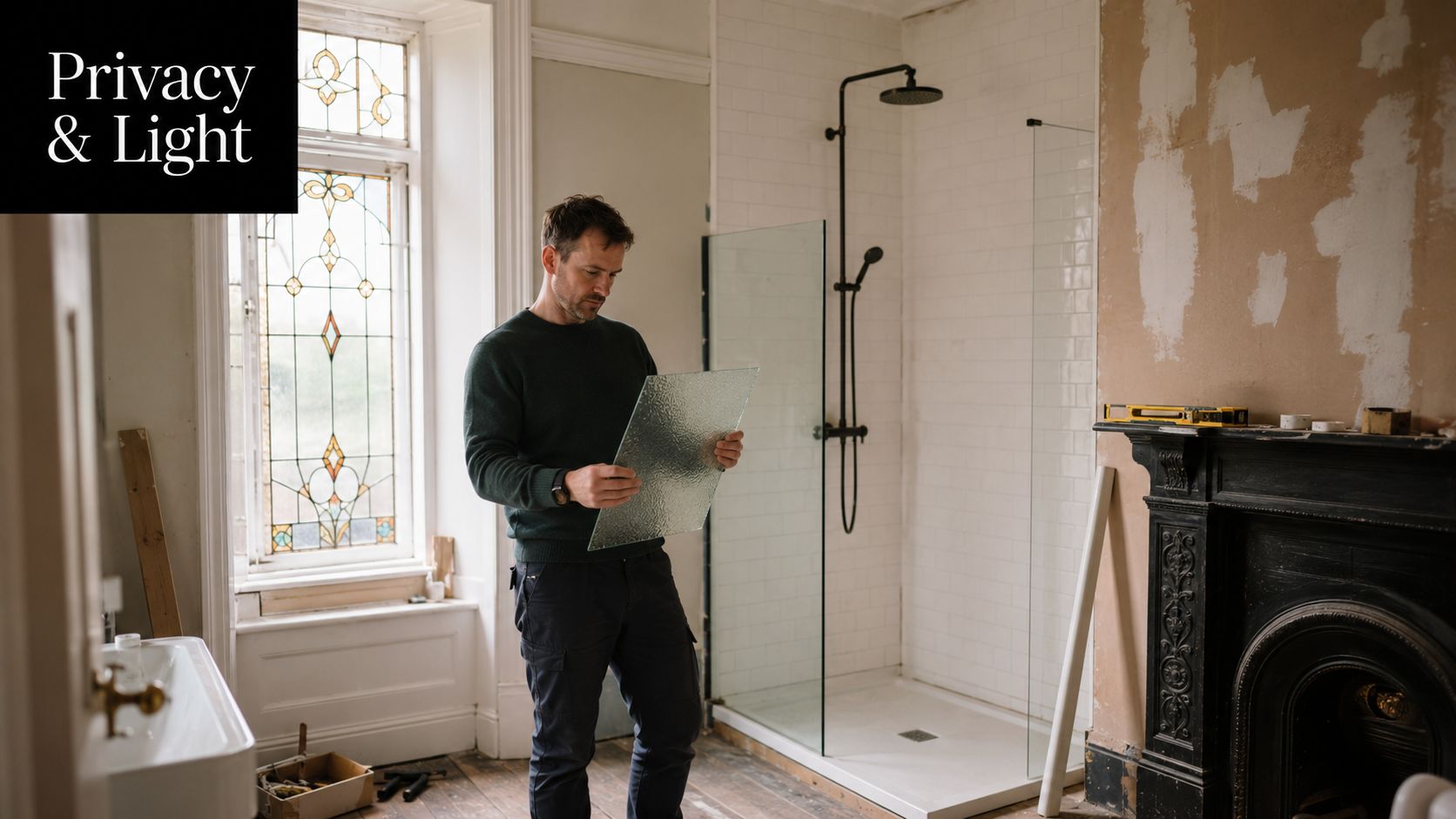
The bigger shift is that frosting isn't being treated as a gimmick or a compromise anymore. Australian trend reporting for 2026 points to more homeowners choosing textured, tinted, or frosted bathroom panels, along with bespoke sizing and custom etching, which tells you privacy-led glazing has moved into the design conversation rather than sitting on the edge of it history of glass shower screens. That shift makes sense in homes that are moving towards walk-in and curbless layouts, because those layouts open the room up visually while still needing a way to preserve personal privacy.
A frosted screen is usually doing two jobs at once. It's protecting the user's comfort, and it's helping the room keep its sense of light.
For a renovation brief, that means the screen shouldn't be an afterthought. It needs to be considered with the vanity position, window line, shower entry, and how the room reads from the door. In a small bathroom, the wrong screen can make the room feel busy and closed in. The right frosted panel can make the same room feel calm, ordered, and ready to use every morning.
What Frosted Glass Actually Is and How It Is Made
Frosted glass isn't a special structural category, it's a surface treatment. That matters because the privacy effect comes from how the surface scatters light, not from any change to the glass's role in the shower enclosure. In practice, the finish is usually created in one of three ways, acid etching, sandblasting, or film application, and each one leaves a slightly different result on the bathroom floor.
How the finish changes the look
Acid etching gives a smoother, more even frost and is often the finish people mean when they picture a clean, soft, semi-opaque panel. Sandblasting can create a stronger textured effect, which may suit a more architectural look but can also feel heavier in a small room. Film application is the most flexible in theory, because it can be used to trial a look without committing to a permanently treated panel, although it's not the finish I'd default to for a high-use family shower if longevity is the priority.
In showroom terms, it helps to separate frosted glass from the other common options. Clear glass gives the most openness. Tinted glass changes the visual tone more than the level of privacy. Low-iron glass is about colour clarity and reduced green cast, not frosting. Fluted or reeded glass still distorts sightlines, but it does that through profile and texture rather than a frosted surface.
The simplest rule is this. If you want to obscure direct view while still borrowing light from the bathroom or window, you're looking at a frosted finish. If you want the enclosure to disappear visually, clear or low-iron glass is closer to that outcome. If you want a more decorative texture with stronger visual movement, fluted glass sits in a different lane again.
Read the spec sheet for the finish, not just the marketing label. “Frosted” can describe several different treatments, and they don't all behave the same way in day-to-day use.
Popular Frosted Styles and How They Change a Bathroom
Different frosted styles suit different room sizes, and the wrong choice shows up fast in a narrow ensuite. A full-frost panel gives the strongest privacy and the most uniform look, which is why it often works best in shared bathrooms where the shower sits close to a doorway or vanity. It can be the right answer in a compact room, but it also has the highest chance of visually compressing the space if the room already lacks natural light.
Partial frost bands take a more measured approach. A lower band can shield the body while leaving the upper portion clearer, which keeps the room feeling more open. That can work well in bathrooms where the shower is visible from the door and privacy matters, but the homeowner still wants to see tile, ceiling height, or a window beyond the screen.
Matching style to room type
Gradient frost is more of a design-led move. It softens the lower or central area and eases out toward clarity, which can look excellent in designer bathrooms where the screen is part of the visual composition rather than just a barrier. Decorative etching suits a renovation where the client wants a custom feel, though it's usually better when the rest of the room is restrained. If the vanity, tile, and tapware are already expressive, too much pattern can start to feel busy.
Fluted or reeded patterns sit between practical privacy and decorative impact. They can be a smart choice for accessible curbless layouts, because they deliver visual interest without requiring a heavy framed look. In family bathrooms, they also tend to hide daily wear well.
The decision is not “which frosted style looks best on a sample board”. It's which one fits the room's job. Small ensuites need lightness. Family bathrooms need comfort and resilience. Designer bathrooms can carry a more expressive finish if the rest of the room stays disciplined. A good new bathroom ideas mood board should reflect that, instead of choosing the same style for every space.
Privacy and Light Trade-Off in Small Bathrooms
The common mistake is treating frosted glass as the automatic answer. In a compact Victorian bathroom, the core question is how much daylight and visual depth the room keeps after the frosting goes in. Privacy is easy to achieve. The harder part is keeping the room feeling open enough that people still want to use it.
Orientation matters. A north-facing bathroom with good daylight can usually absorb a frosted panel better than a south-facing room that already depends on borrowed light. Window position matters too. If the window sits high and away from the shower, frosting the screen may barely change the room's feel. If the shower screen sits directly between the window and the entry, the drop in apparent brightness can be much more noticeable.
Height and adjacency do the rest. A taller screen, or a screen placed close to bulky cabinetry, can make a small room feel more enclosed even when the glass is doing its job. That is why hybrid solutions often work well. A frosted lower section with a clearer upper section can keep privacy where the body needs it most while still letting light travel across the top of the room.
For compact layouts, planning beats guesswork. If you are working through a small ensuite layout, this small bathroom planning guide is useful background, but the live decision still comes down to how your room behaves at different times of day.
If a bathroom already feels tight, full frost can solve privacy and still leave you with a room that reads smaller than it really is.
The best test is simple. Stand in the doorway and ask whether the screen is helping the room look calmer, or whether it is creating a dark block in the middle of the layout. In some bathrooms, frosted glass is the right answer straight away. In others, a partial frost or a different glazing strategy keeps the open feel much better.
That trade-off also affects budget and upkeep in Victorian homes. More frosting can mean more time spent living with a panel that shows limescale and soap marks differently from clear glass, especially in hard-water areas where cleaning habits matter. It also shapes installed pricing, because the screen type, size, fixing detail, and finish all affect the labour and supply side of the job, and a good quote should reflect those realities rather than just the look on a mood board.
If you are choosing for a renovation, the right call is usually the one that suits the room first and the style second. A frosted screen should support the layout, not dominate it.
Glass Specs, Safety, and NCC Compliance Essentials
A shower screen quote should never start and end with the finish. The first things I look for are glass thickness, toughening, fixing details, and whether the proposed screen matches wet-area compliance requirements under the National Construction Code. The NCC is the Australian minimum standard for building work, and bathroom glazing has to satisfy safe-glazing and wet-area rules, which means decorative glass alone isn't enough for a compliant installation bathroom mountain shower screen installation.
In Australian fabrication, 6 mm toughened glass is a common baseline for frosted walk-in screens because it balances stiffness, impact resistance, and installability in framed or semi-frameless systems shower screens catalogue PDF. The frosting changes privacy and light diffusion, but it doesn't replace the engineering role of the glass. That job still belongs to the toughened substrate and the hardware holding it in place.
Frosted Shower Screen Specs at a Glance
| Spec | Typical Value | Why It Matters |
|---|---|---|
| Glass type | Toughened safety glass | Required for safe shower use and compliance |
| Glass thickness | 6 mm common baseline | Helps balance strength and practical installation |
| Finish | Acid etched, sandblasted, or film applied | Determines privacy, texture, and cleaning behaviour |
| System type | Framed or semi-frameless | Affects rigidity, appearance, and price |
| Fixings | Quality hinges, clips, and seals | Supports safe installation and long-term performance |
A compliant renovation should also show who is responsible for the installation details, not just the glass order. That's where a registered builder unlimited matters, because coordination between waterproofing, glass fixing, and final fit-off is what keeps the job clean and compliant. The waterproofing layer has to be right before the screen goes in, so the screen isn't trying to compensate for poor wet-area work. waterproofing standards in Australia sits alongside glazing compliance, not after it.
The practical takeaway is straightforward. Any quote worth considering should name the glass type, thickness, system style, and hardware spec. If it doesn't, you're comparing finish samples without knowing whether the installation underneath is up to standard.
What Frosted Screens Actually Cost in Victoria
Pricing for frosted screens sits above clear glass because the finish requires extra processing such as acid etching, sandblasting, or film application. Industry guidance puts frosted glass at about 20–30% more than clear glass of the same dimensions and thickness frosted glass shower doors. That premium is real, but it's usually easier to justify once you factor in that the screen affects both privacy and how finished the whole room feels.
There's also a broader pricing signal from glazing suppliers. One source notes that frosted glass adds about $30 per square foot compared with clear glass, reflecting the extra finishing process rather than a different core function frosted glass shower screen product page. For Victorian homeowners, the useful part of that information isn't the exact converted figure. It's the direction of travel. Frosted is a premium finish, not a baseline one.
What pushes the quote up
Custom sizing is the first driver. A standard rectangular panel is always easier to price than a screen that needs to work around a nib wall, a roof slope, or a tight mixer position. Hardware finish also changes the final number because hinges, clamps, and handles are visible design decisions, not invisible extras. Frameless systems usually sit at the sharper end of the pricing spectrum, while framed and semi-frameless options tend to be easier to keep under control without losing the frosted effect.
In a real renovation budget, that means frosted screens should be priced alongside tile selection, tapware, and waterproofing rather than treated as the last small item. They aren't small. They affect the room's privacy, brightness, and perceived quality in one move. An end-to-end quote is useful because it bundles measurement, fabrication, and installation into one figure, which makes it easier to see where the money is going.
If you're planning modern bathrooms with multiple premium finishes, frosted glass works best when the rest of the spec is disciplined. A simple room with one high-quality frosted screen often feels more resolved than a busy room where every surface is trying to make a statement.
Maintenance and Longevity in Hard-Water Victorian Homes
Frosted glass hides fingerprints and water spots better than clear glass, but it isn't maintenance-free. Texture can trap grime more readily than a smooth clear panel, so the cleaning routine matters more than some might expect. In Victorian homes where water quality and daily use vary from household to household, the key is consistency, not aggressive scrubbing.
A practical routine is simple enough to hand to everyone in the house. Keep the screen wiped down after use, give it a regular wash with a gentle bathroom cleaner, and inspect the edges and hardware for limescale or seal wear on a monthly rhythm. Existing care guidance commonly points to weekly cleaning, a deeper clean every four weeks, and monthly checks of edges and hardware for limescale and seal failure. That's sensible advice, because the finish itself lasts better when deposits aren't left to build up.
What to avoid on etched finishes
Abrasive pads are the quickest way to dull a frosted surface. So are harsh cleaners that leave the finish patchy or strip away any protective coating around it. If you're unsure, keep the product choice conservative and test it in one corner before committing to the full panel. The finish should be cleaned, not polished into clarity.
The longevity question often comes down to the whole system, not the glass alone. Seals age. Hardware loosens. Caulking needs attention. That's true for frosted, fluted, and clear screens alike, which is why I treat the upkeep conversation as part of the renovation decision rather than something to worry about later. Over a renovation lifecycle, frosted glass is often easier to live with visually, but it still rewards the same disciplined cleaning habits as any other shower screen.
A screen that hides spots well can tempt people into ignoring maintenance. That usually shortens the life of the seals before it does anything to the glass.
Choosing the Right Frosted Screen for Your Renovation
The best choice starts with the room, not the sample board. In a compact ensuite, full frost may be the cleanest answer if privacy matters more than visual openness. In a family bathroom, a partial frost or a more textured finish can keep the room feeling lighter while still softening direct views. In designer bathrooms, a custom etched or gradient treatment can make the screen feel like part of the architecture instead of just a barrier.
A useful rule is to match the screen to the way the room is used. If the shower sits near the door, think harder about how much of the screen needs to be opaque. If the room borrows daylight from one opening only, avoid over-frosting the whole enclosure. If the layout is accessible or curbless, make sure the finish, hardware, and panel geometry support easy movement as well as privacy.
The clearest decisions happen before installation, not after delivery. That's where concept drawings and 3D design visualisation help, because they let you compare how a frosted panel affects the room's sightlines before the build is locked in. For homeowners weighing options, frameless shower screen inspiration can be a useful reference point when deciding whether the room wants a lighter visual finish or a more enclosed one.
What to bring to a consultation
- Measurements of the shower area: Exact dimensions stop avoidable fabrication surprises.
- A note on privacy needs: Shared use, guest use, or master ensuite use changes the right finish.
- Photos of the room in daylight: These show whether the bathroom already struggles for brightness.
- Your preferred finish direction: Full frost, partial frost, gradient, or decorative etching.
- A clear renovation brief: Tie the screen choice to the rest of the room, not just the shower.
If you're in Highett or anywhere across greater Victoria, bring those details to a consultation before you lock the glass in. The right screen lifts daily comfort, but it also helps the room feel more deliberate and better finished, which is what thoughtful bathroom renovations should do. Contact SitePro Bathrooms for a conversation about your bathroom, your layout, and the screen style that will work in your home.