
10 Modern Kitchen Design Ideas for Victorian Homes
Your kitchen is the heart of your home, but it only works well when the layout, storage and finishes suit the way you live now. In Highett and across greater Victoria, a lot of homes still have kitchens built for another era. Tight walkways, poor lighting, bulky overhead cupboards and awkward corners make daily use harder than it needs to be.
Good modern kitchen design ideas aren't about copying an online showroom. They need to fit Victorian homes, local block sizes, family routines and the realities of construction. A terrace, a post-war brick veneer and a newer townhouse all need different answers, even if the look you want is similar.
From what we see on local renovation projects, the best kitchens balance three things. They look calm, they work hard, and they stay practical once real life moves in. That means thinking beyond colours and splashbacks. Ventilation, storage depth, appliance placement, lighting layers and traffic flow matter just as much.
Below are 10 modern kitchen design ideas that work well in Victorian homes, especially when you want a space that feels current without becoming difficult to maintain. These are the approaches that consistently hold up on site, not just in glossy photos.
1. Open-Plan Kitchen Design
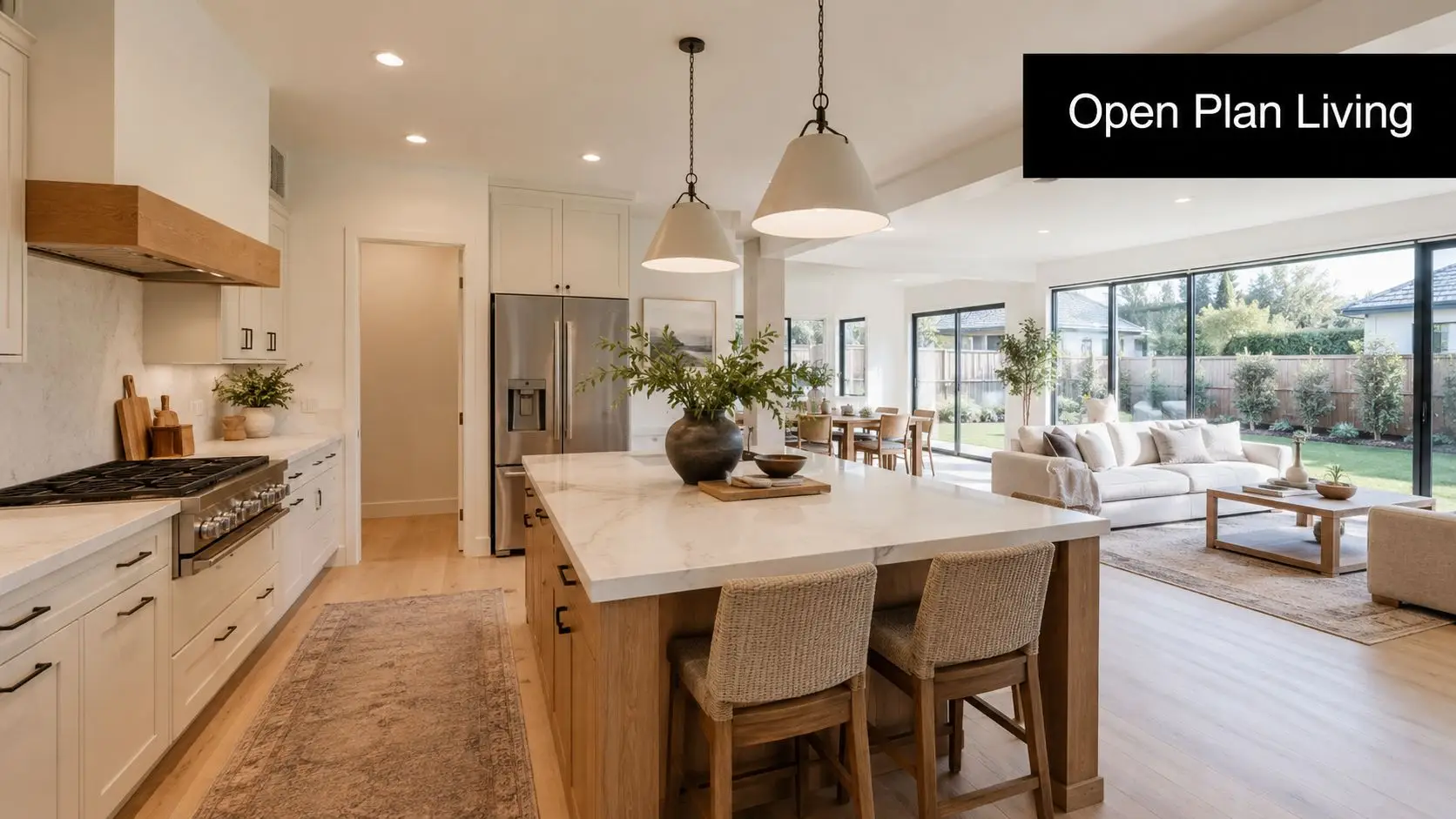
Open-plan kitchens remain one of the most requested moves in Highett renovations because they solve more than one problem at once. They can bring light deeper into the house, improve sightlines to the backyard, and make family life easier when cooking, dining and living all happen in the same zone.
That said, removing a wall doesn't automatically create a better kitchen. In older Victorian homes and brick veneers, the mistake is opening everything up without planning where mess, noise and smells will go. If the kitchen is always on show, clutter control becomes part of the design brief.
What works in Victorian homes
In Melbourne terraces and family homes around Highett, the strongest open-plan kitchens usually have one clear anchor. That might be an island, a peninsula, or a change in ceiling detail. You need something to define the kitchen without putting the wall back.
If your room is narrower, an L-shaped kitchen layout often gives a better result than forcing in an oversized island. It keeps circulation cleaner and leaves more usable floor area for dining.
Practical rule: Open-plan only works when the kitchen still has boundaries. Use joinery, lighting and flooring alignment to define the zone.
A few details make a big difference:
- Keep flooring consistent: Running the same floor finish through kitchen, dining and living areas helps the whole space feel deliberate.
- Choose ventilation early: A stronger rangehood matters more in open-plan spaces because cooking odours travel further.
- Build in hidden storage: The more visible the kitchen is, the less forgiving it is of bench clutter.
Done well, open-plan feels generous and social. Done badly, it turns the whole house into a workspace you can't escape.
2. Minimalist Kitchen with Hidden Storage
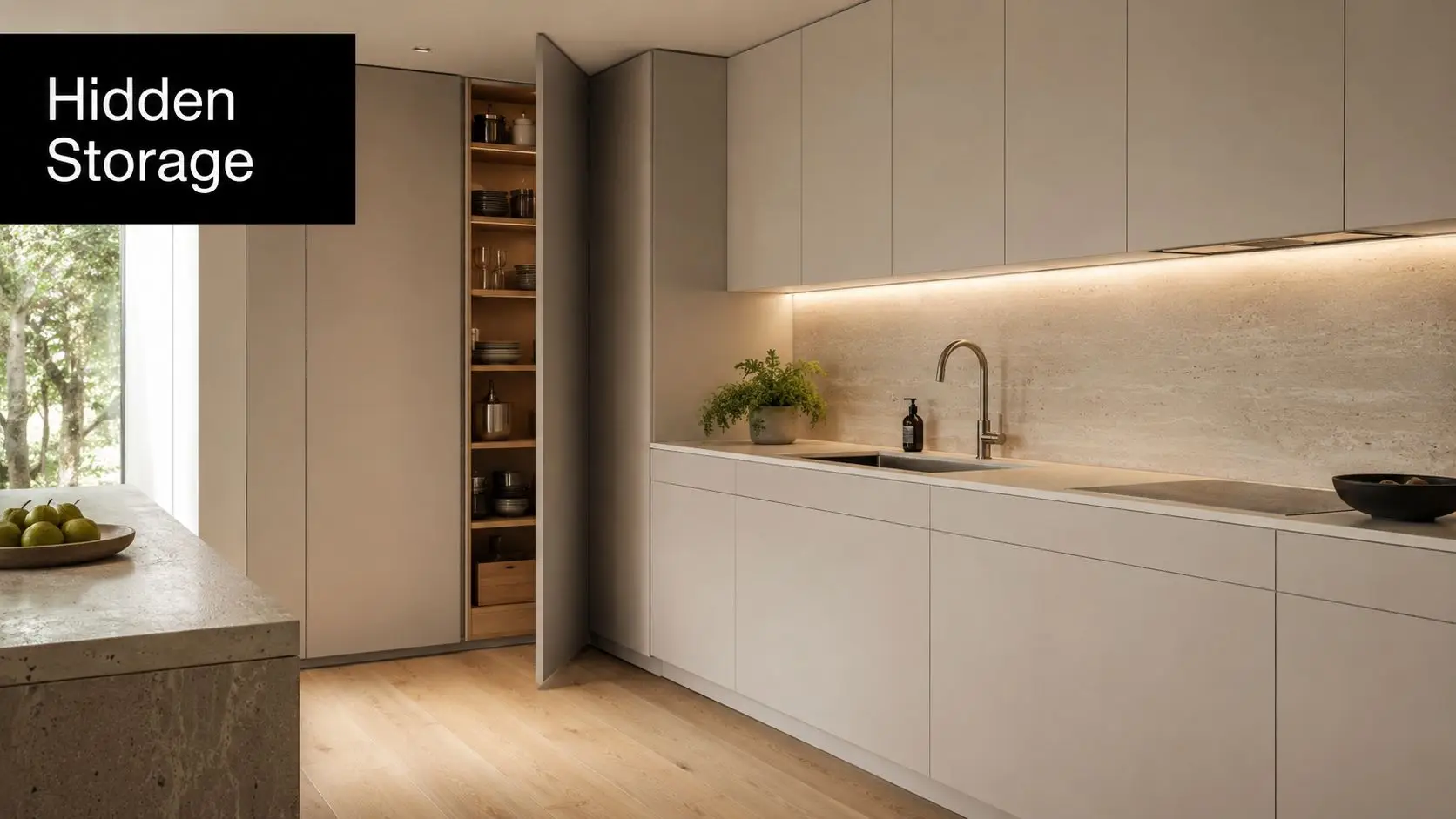
Minimalist kitchens aren't about having less stuff. They're about hiding the everyday items that make a kitchen look busy. For compact homes, apartments and townhouses, that's often the difference between a kitchen that feels spacious and one that feels crowded.
This is an area where mainstream inspiration often falls short. Hidden modern kitchens for small homes are still underexplained, even though demand is clearly there. The verified brief notes that a 2025 Master Builders Australia survey found 72% of renovators in Melbourne want “invisible kitchens” to maximise visual space, yet only 15% of published articles cover this niche.
Concealment that still works day to day
The best minimalist kitchens use full-height joinery, appliance garages, integrated fridges and pantries that disappear into the cabinetry line. In smaller Victorian homes, this approach makes the room feel calmer because your eye reads fewer interruptions.
Blind corners are where many minimalist kitchens fail. If you hide too much behind awkward doors, the kitchen looks neat but works poorly. A proper blind corner pantry solution can recover storage that would otherwise become dead space.
What tends to work best:
- Tall cabinetry on one wall: It creates a clean visual block and keeps bulk away from windows.
- Pocket or retractable appliance storage: Ideal for kettles, toasters and coffee machines that are used daily but don't need to stay visible.
- Simple door profiles: Flat or lightly detailed fronts read cleaner than heavily profiled doors in compact spaces.
What usually doesn't work is copying a showroom look with no allowance for bins, chargers, lunchboxes and small appliances. Minimalism only holds up when the inside of the cabinetry is as well planned as the outside.
A hidden kitchen still needs to be easy to open, clean and service. If every cupboard becomes a puzzle, the design has gone too far.
3. Kitchen Islands and Peninsulas
People often ask for an island first, before we've even confirmed whether the room should have one. Sometimes it's the right move. Sometimes a peninsula does the job better and wastes less space.
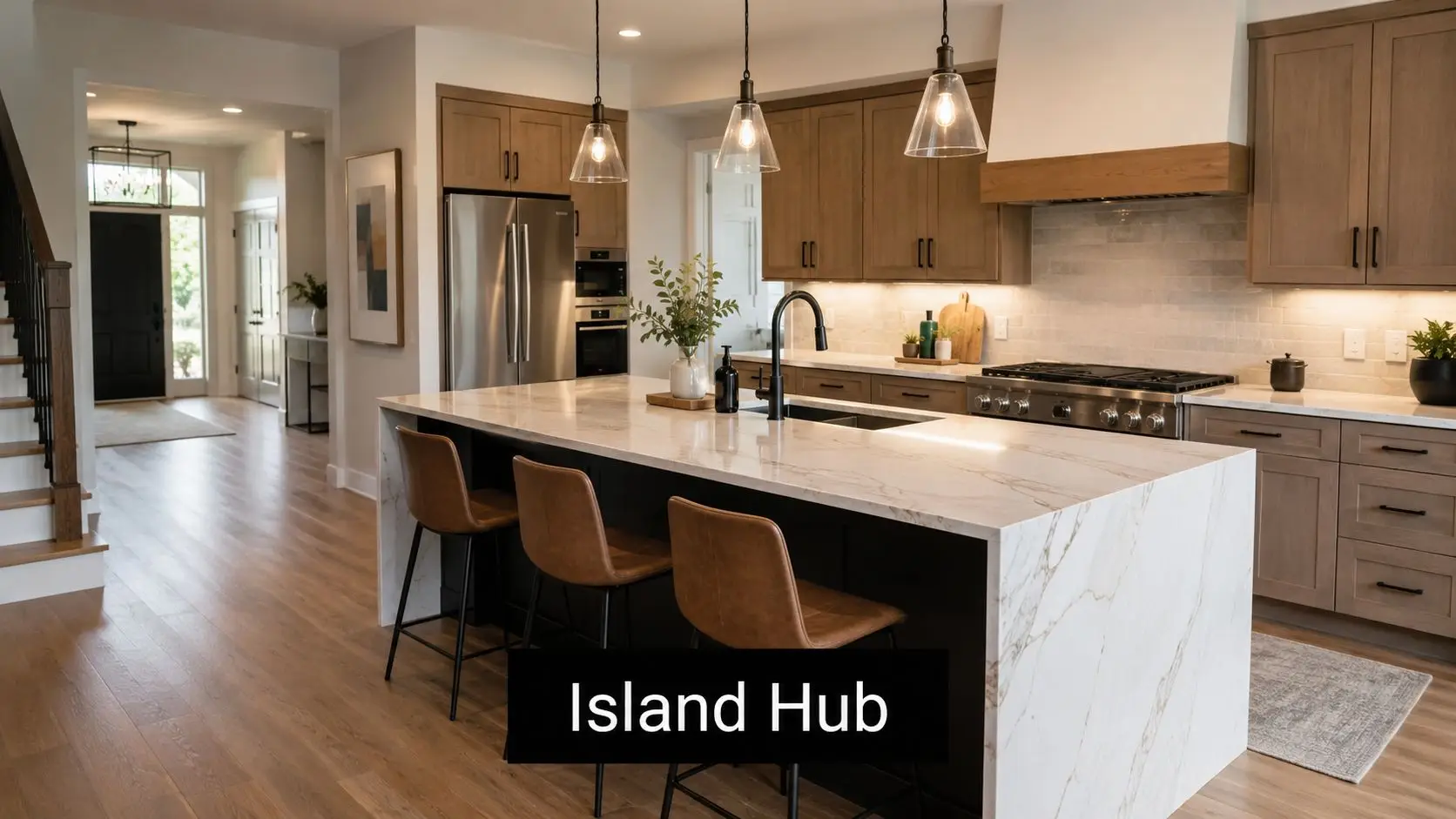
In Highett family homes, an island earns its place when it improves workflow and becomes a genuine gathering point. If it's just there because it looks modern, it can block circulation and create pinch points around the fridge, dishwasher or oven.
Island or peninsula
An island suits wider rooms where you can move comfortably around all sides. It works well in larger extensions, open-plan reconfigurations and homes where the island doubles as prep space, casual dining and storage.
A peninsula is often the smarter choice in narrower homes. It gives you seating and separation without demanding the same clearance on every side. That can be a much better fit in older houses where every millimetre matters.
Use this as a reality check:
- Choose an island when: you need a social hub, extra storage and uninterrupted circulation around it.
- Choose a peninsula when: the room is tighter, one side can connect to existing cabinetry, or you want to zone the space economically.
- Avoid either when: the result leaves appliance doors clashing or walkways feeling cramped.
Waterfall stone edges, power points and under-bench storage all add value when they're tied to how you use the kitchen. A breakfast overhang sounds great until stools block the main path to the backyard.
The strongest island designs feel effortless because the planning is tight. The weak ones look impressive on day one and become annoying by week two.
4. Smart Kitchen Technology Integration
Smart features can improve a kitchen, but it's a common issue that homeowners frequently misspend money on them. The priority shouldn't be novelty. It should be convenience, reliability and ease of maintenance.
In practical terms, smart kitchen design usually means better lighting control, charging points in the right places, quality appliances with useful functions, and electrical planning that supports how the room is used. It doesn't have to mean turning every task into an app.
Choose the tech you'll still use in two years
The most successful smart kitchens keep the technology quiet. Under-cabinet lighting on sensors, a boiling or filtered water unit, integrated charging drawers and programmable ovens are all easier to live with than flashy features that become dated fast.
For busy households, I'd prioritise these first:
- Lighting control: Separate switches for task, ambient and feature lighting.
- Charging zones: Inside drawers or appliance cupboards to keep benches clear.
- Appliance selection: Pick brands with dependable local service and clear manual override options.
The problem with overloading a kitchen with smart products is simple. Software changes. Devices get replaced. If the joinery and services are too tightly built around one system, future updates become expensive.
A kitchen should still work perfectly when the Wi-Fi drops out. That sounds obvious, but plenty of high-spec designs forget it.
5. Natural Materials and Organic Textures
Warmth has come back strongly into kitchen design, and timber is leading that shift. According to the 2026 Houzz Kitchen Trends Study summary, surveyed homeowners renovating kitchens chose wood-toned cabinetry at 29%, ahead of white at 28%. The same summary notes medium wood tones at 15% and light wood tones at 11%, with species such as white oak, maple, ash and walnut driving the look.
That trend makes sense in Victorian homes. Older houses already have texture, variation and character. Timber, stone and tactile finishes sit more comfortably in those settings than a flat, clinical all-white scheme.
Warm materials that age well
White oak veneer, natural stone-look surfaces, brushed metal accents and handmade tiles work particularly well when you want a kitchen to feel modern without looking sterile. In Highett, I've seen timber islands soften open-plan rooms that would otherwise feel too hard and reflective.
Good use of natural materials depends on restraint. You don't need timber everywhere. Often one strong material, used consistently, gives a better result than mixing too many feature finishes.
- Use timber where hands and eyes land often: island panels, tall pantry fronts or open niche details.
- Balance movement with plain surfaces: heavily veined stone needs calmer cabinetry around it.
- Expect variation: natural grain, tone shifts and texture are part of the point, not a defect.
The warmest kitchens usually mix clean lines with materials that don't feel factory-perfect.
What doesn't age as well is chasing a rustic look without enough discipline. If every finish is textured, the room loses clarity. Modern kitchens still need clean composition, even when the materials are natural.
6. Two-Tone and Contrasting Kitchen Cabinetry
Two-tone cabinetry is one of the easiest ways to add depth to a kitchen without making it feel busy. It can help define zones, break up long walls of joinery and stop a full kitchen of one colour from feeling heavy.
This works especially well in Victorian homes where you're blending old and new. A timber island paired with painted perimeter cabinetry, or darker lowers with lighter uppers, can connect modern joinery to the character of the rest of the house.
Contrast with control
The key is to keep the contrast intentional. You want clear hierarchy, not a patchwork. Usually that means one dominant finish, one secondary finish, and simple hardware tying the whole lot together.
A useful starting point is to compare likely kitchen cabinet materials before locking in colour. The same shade can look completely different on laminate, polyurethane, veneer or textured board.
Here's where two-tone designs usually succeed:
- Dark lower, light upper: grounds the room and keeps eye level open.
- Timber island, painted perimeter: gives the island more presence without overwhelming the space.
- Full-height pantry in one tone: helps large storage walls read as one neat block.
And here's where they usually go wrong:
- Too many colours: once a third major finish enters, the kitchen can start to feel unresolved.
- Ignoring natural light: a deep colour that looks rich in a showroom can feel flat in a dim room.
- No connection to the rest of the home: cabinetry should relate to flooring, wall colour and nearby furniture.
If you're uncertain, 3D visualisation is worth doing before ordering joinery. It's far cheaper to adjust colours on a screen than after fabrication.
7. Integrated Appliance Concealment
If minimalist storage hides the small stuff, integrated appliance concealment deals with the big visual interruptions. Fridges, dishwashers and even rangehoods can disappear into the joinery line, which gives the kitchen a more architectural feel.
This approach is particularly effective in open-plan homes because the kitchen reads more like furniture and less like a work zone. In compact homes, that visual quiet can make the room feel larger than it is.
Where concealed appliances make sense
Panel-ready fridges and dishwashers are the most common starting point. In larger projects, concealed pantry runs, integrated microwave towers and hidden utility cupboards can take the idea further.
The trade-off is that integrated appliances require tighter planning than standard installations. Service access, ventilation, hinge clearance and future replacement all need to be considered before the cabinetry is built.
A few practical points matter here:
- Match panel thickness carefully: poor alignment is obvious straight away.
- Allow for servicing: don't trap appliances behind joinery that can't be removed without damage.
- Plan replacements in advance: some custom panel setups become difficult when an appliance model changes later.
This look suits premium, pared-back kitchens. But if the budget is tighter, it's often better to integrate a few key items well than try to hide everything and compromise elsewhere.
The hidden result should still be reliable. A panelled fridge that never quite closes properly isn't a luxury detail. It's a daily annoyance.
8. Statement Lighting and Fixtures
Lighting does more than finish a kitchen. It changes how the space performs. Bench tasks, family dinners, early morning routines and evening entertaining all need different kinds of light.
That's why layered lighting matters so much in modern kitchen design ideas. The NKBA 2026 Kitchen Trends Report says homeowner priorities centre on natural lighting (95%), quality lighting (93%) and task lighting for work zones (92%), while common specified features include under-cabinet lighting (82%), interior cabinet lighting (72%) and pendant lighting (63%).
Layer the light, then choose the feature
In practice, pendants should be the last lighting decision, not the first. First solve visibility at the benches, cooktop and sink. Then add feature lighting that suits the scale of the island or dining zone.
A reliable lighting mix usually includes:
- Task lighting: under-cabinet LED strips or targeted downlights over prep areas.
- Ambient lighting: general ceiling lighting that fills the room evenly.
- Feature lighting: pendants or decorative fixtures that give the room personality.
Lighting should let the kitchen work hard at 7 am and feel softer at 7 pm.
A common mistake is relying on downlights alone. They create shadows where you need light most, especially when you're standing at the bench. Another is choosing pendants that are too small for the island, or too low for comfortable sightlines.
Good lighting feels invisible when it's doing its job. You notice the room, not the effort behind it.
9. Sustainable and Eco-Friendly Kitchen Design
Sustainable kitchens aren't just about product labels. In real renovation work, sustainability usually comes from durability, efficient planning and avoiding short-lived choices that need replacing too soon.
That might mean keeping part of an existing layout if the structure still works, reusing sound materials where possible, choosing low-maintenance finishes and improving daylight so you rely less on artificial light through the day. In Victorian homes, retention often matters as much as replacement.
Build for long life, not short trends
The most sustainable kitchen is often one that won't need another major overhaul because the basics were done properly. Strong carcasses, quality hardware, sensible storage and timeless materials beat fashionable details that date quickly.
When clients want a more environmentally aware kitchen, these moves usually make the most practical sense:
- Maximise natural light: skylights, glazed doors and better room openings reduce reliance on daytime lighting.
- Choose durable surfaces: hard-wearing benchtops and cabinetry last longer under daily use.
- Include waste sorting: built-in recycling and compost zones make good habits easier to maintain.
- Use low-VOC finishes where possible: especially in tightly sealed homes.
There's no point specifying eco-friendly materials if the design itself is frustrating to use. When a kitchen works well, people keep it longer. That's one of the most effective sustainability outcomes you can get.
10. Curved and Organic Kitchen Shapes
Curves are showing up more often in premium kitchen design, but they need to be used carefully. In the right home, a curved island end, rounded shelf return or softened joinery edge can take the hardness out of a very linear room.
This is especially useful in open-plan spaces where straight runs of cabinetry, stone and glazing can feel severe. A curved element can make movement through the space feel more natural and soften the transition to living areas.
Use curves where they improve movement
Curves work best when they solve something practical as well as aesthetic. A rounded island corner can reduce bump points in a busy family kitchen. A curved end panel can open up a walkway near a doorway. A soft radius on joinery can make a compact room feel less boxed in.
They're less successful when they're added as decoration without considering fabrication and storage. Curved cabinetry is more specialised, often more expensive, and not every joiner handles it equally well.
A sensible approach is:
- Keep the main layout simple: let one curved feature carry the idea.
- Use curves where people walk past often: island corners and passage edges are good candidates.
- Balance with straight cabinetry: too many curved forms can make the room feel vague rather than refined.
Curves can add polish and individuality, especially in custom renovations. But they need discipline. One well-placed curve does more than a room full of them.
Modern Kitchen Design Ideas: 10-Point Comparison
| Design | Implementation complexity | Resource requirements | Expected outcomes | Ideal use cases | Key advantages |
|---|---|---|---|---|---|
| Open-Plan Kitchen Design | Moderate–High (structural removals, zoning) | Structural work, high-performance ventilation, consistent finishes, professional design | Greater sense of space, improved light, social connectivity, higher resale value | Family homes, entertaining spaces, renovations merging living zones | Openness, sightlines, natural light, social supervision |
| Minimalist Kitchen with Hidden Storage | Moderate–High (custom joinery) | Bespoke cabinetry, integrated appliances, internal organisers, quality materials | Clutter-free appearance, perceived spaciousness, easy maintenance | Small apartments, contemporary homes, those valuing calm aesthetics | Streamlined look, efficient storage, timeless simplicity |
| Kitchen Islands and Peninsulas | Moderate (plumbing/electrical/clearances) | Sufficient floor area, plumbing/electrical work, durable benchtops, joinery | Additional workspace, seating, social hub, improved workflow | Large kitchens, open-plan homes, family entertaining | Multifunctional surface, seating, added storage |
| Smart Kitchen Technology Integration | High (systems integration, network) | Wi‑Fi infrastructure, smart appliances, electrical upgrades, ongoing support | Automation, energy monitoring, convenience, modern market appeal | Tech-forward homes, energy-conscious households, smart-home ecosystems | Remote control, efficiency gains, real-time monitoring |
| Natural Materials and Organic Textures | Moderate (sourcing, finishing) | Timber, stone, concrete, skilled trades, sealers/maintenance | Warm, tactile aesthetic that improves with age; authentic luxury | Restorations, luxury renovations, biophilic designs | Warmth, durability, sustainable/aged patina |
| Two-Tone and Contrasting Cabinetry | Low–Moderate (colour coordination) | Multiple finishes/paints, possible bespoke cabinetry, 3D colour checks | Visual depth, zone definition, personalised character | Kitchens needing visual interest, islands that act as focal points | Adds depth, defines zones, flexible update options |
| Integrated Appliance Concealment | High (precise cabinetry & service access) | Panel-ready appliances, bespoke panels, ventilation/service planning | Seamless, uncluttered appearance with high-end finish | Luxury renovations, minimalist schemes, showpiece kitchens | Streamlined aesthetic, perceived spaciousness, organised look |
| Statement Lighting and Fixtures | Low–Moderate (electrical planning, layering) | Designer fixtures, layered lighting plan, dimmers, wiring | Strong focal points, improved task lighting, enhanced ambiance | Islands, dining-integrated kitchens, style-focused renovations | High visual impact, better task illumination, mood control |
| Sustainable and Eco-Friendly Kitchen Design | Moderate–High (material/system choices) | Energy‑efficient appliances, sustainable materials, water-saving fixtures, insulation | Lower running costs, reduced environmental impact, healthier indoor air | Eco-conscious homeowners, long-term value projects, certification targets | Energy/water savings, sustainability credentials, incentives |
| Curved and Organic Kitchen Shapes | High (custom fabrication, design precision) | Skilled joinery, custom benchtops, longer lead times, specialised fittings | Inviting, ergonomic flow and sculptural interest, distinctive look | High-end bespoke projects, biophilic schemes, statement renovations | Improved flow and safety, unique sculptural aesthetics |
From Idea to Installation Your Dream Renovation Starts Here
You've saved a dozen kitchen images, but your Highett weatherboard still has a tight footprint, an uneven floor and a wall you may not be able to move. That's the point where inspiration needs to become a buildable plan.
In older Victorian homes across Highett and greater Melbourne, good kitchen design is rarely about copying a gallery image. It comes from measuring the room properly, checking structure early, and matching the layout to how the household lives. A family kitchen near the bay has different pressures from an investor update or a compact unit renovation, and the design needs to reflect that from day one.
Start with the floor plan. Then sort out storage, lighting and finishes. In practice, that sequence prevents expensive backtracking. I've seen plenty of projects stall because someone chose a stone colour and door profile before resolving circulation, appliance positions or service runs. It looks like progress, but it usually creates joinery compromises later.
For rental properties, the brief shifts a little. Presentation still matters, but so do durability, easy maintenance and a layout that suits a broad range of tenants. Hard-wearing cabinetry, practical benchtops and full-height storage often make more sense than highly personalised details, especially if you want the kitchen to hold up well over several leasing cycles.
SitePro handles more than kitchens. As registered builders unlimited, the team also completes bathroom renovations, including modern bathrooms, designer bathrooms and projects where clients want finishes and detailing carried consistently across multiple rooms. If a kitchen upgrade sits alongside new bathroom ideas, it often pays to plan both spaces together so trades, timelines and selections line up properly.
A proper consultation with 3D design helps answer the questions that matter on site. Can the room carry an island without squeezing walkways. Is a peninsula the better use of space. Will darker timber joinery work in your natural light. Is concealed appliance joinery worth the extra cost and maintenance access planning.
If you're ready to turn ideas into a workable scope, SitePro Bathrooms in Highett offers kitchen and bathroom renovation services, including 3D design visualisation and customized quotes. Start with your home as it is, your budget as it stands, and a layout that can be built.