
Victoria Full Bathroom Renovation Cost Guide 2026
A full bathroom renovation cost in Australia now sits at around $26,000, and a real project can fall anywhere from about $8,000 to more than $35,000 depending on scope, finishes, and how much work sits behind the walls. For Victorian homeowners, that headline number is only the starting point, because older homes, compliance requirements, and demolition surprises can shift the budget fast.
That's the part many national guides gloss over. They give you an average, but they don't tell you what happens when an older bathroom in Victoria is opened up and the existing waterproofing has failed, the walls aren't straight, or asbestos testing suddenly becomes part of the discussion. Good bathroom renovations aren't priced by guesswork. They're priced by scope, trade requirements, materials, and risk.
A proper budget also needs to reflect the kind of result you want. A functional family bathroom, one of the many modern bathrooms built for day-to-day use, and a higher-end space with custom detailing all sit in different cost brackets. The same goes for projects driven by practical resale goals versus clients chasing new bathroom ideas or fully realised designer bathrooms.
Understanding the Average Bathroom Renovation Cost in 2026
The clearest benchmark available is still the national average. According to 2023 Housing Industry Association data, the average cost of a full bathroom renovation in Australia is approximately $26,000, up from $21,000 previously, with projects ranging from around $8,000 for a basic cosmetic update to more than $35,000 for a high-end renovation, as summarised by Canstar's bathroom renovation cost guide.
That figure is useful, but only if you understand what it includes. A full renovation isn't just new taps, a vanity, and fresh tiles. It usually means demolition, preparation, waterproofing, plumbing work, electrical work, tiling, fitting off fixtures, and final finishes. Once you're stripping a bathroom back and rebuilding it properly, the budget starts reflecting both visible selections and hidden construction work.
Why the average can mislead
A homeowner might start with the idea that their room is small, so the price should be modest. In practice, a smaller bathroom can still carry a substantial full bathroom renovation cost because the same core trades are required whether the room is compact or generous. You still need compliant waterproofing. You still need licensed plumbing and electrical work. You still need demolition and waste removal.
National averages help with first-pass budgeting. They don't replace a site-specific assessment, especially in Victoria where existing conditions often shape the final price more than floor area alone.
What the benchmark is actually good for
Use the $26,000 average as a reality check, not as a promise. If your expectations sit well above a standard specification, or if you're planning structural changes, premium finishes, or a complete redesign, your budget may move beyond the average quickly. If your scope is simpler and the layout stays put, you may remain closer to the lower end of the broader range.
The smartest way to read that national number is this: it tells you what a full renovation commonly costs, but it doesn't tell you what your bathroom will cost until the site conditions, scope, and selections are properly defined.
The Anatomy of a Renovation Quote Where Your Money Goes
A renovation quote should tell you more than a lump sum. It should show where the money is being spent and why. That's how homeowners separate a realistic proposal from one that looks cheap only because key items haven't been properly allowed for.
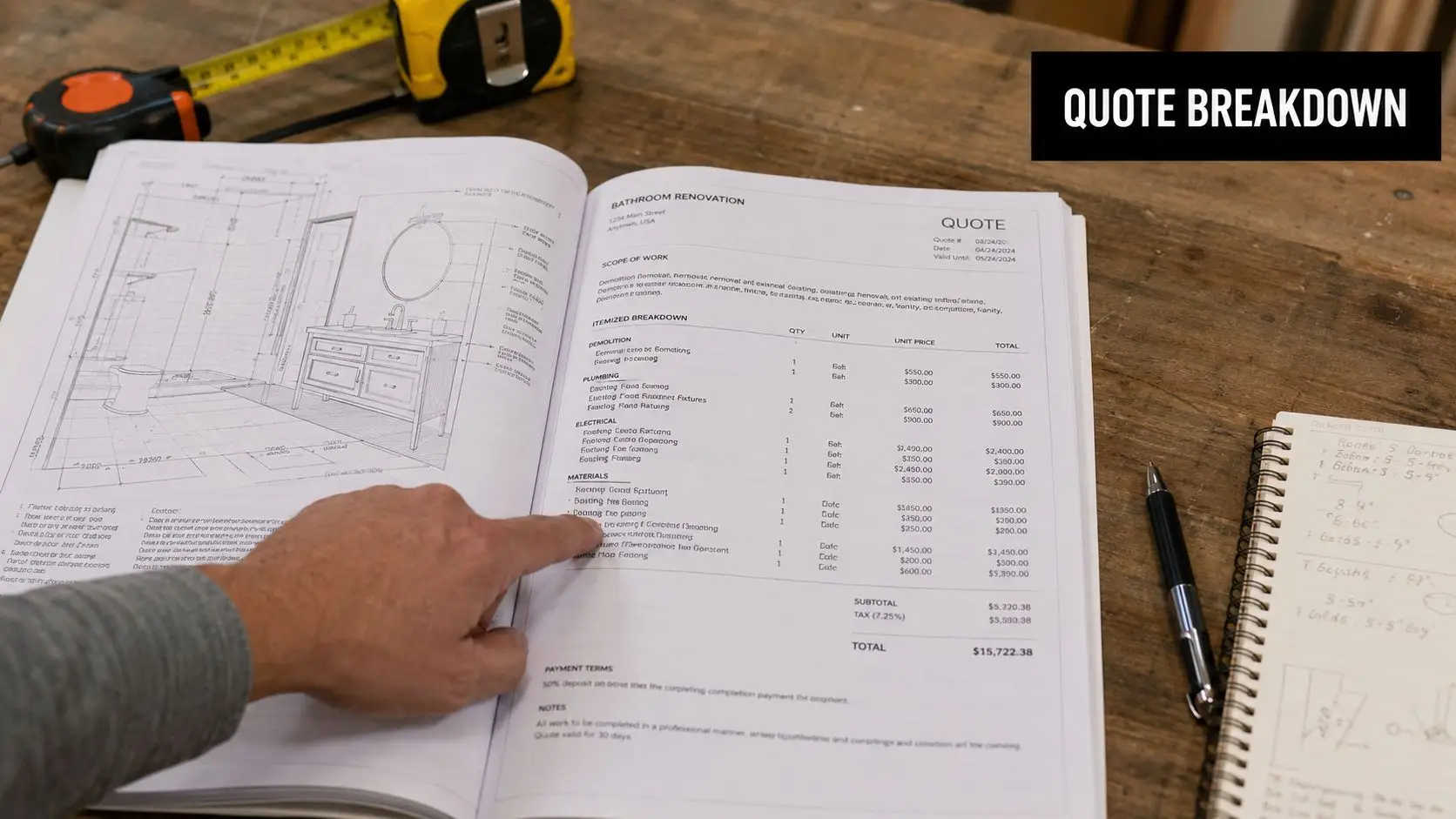
One of the biggest budget drivers is labour. In Australia, labour typically accounts for 40% to 50% of a full bathroom renovation budget, with the work carried out by specialised trades including plumbing, tiling, and electrical, and hourly rates often sitting between $100 and $150, according to this Australian bathroom renovation cost breakdown.
Labour is usually the largest line item
Homeowners sometimes focus on fixtures because they're easy to compare. Labour is harder to see, but it's where quality and compliance live. A bathroom has very little tolerance for shortcuts. If waterproofing fails or plumbing has to be redone, the cost of rectification usually outweighs any saving made upfront.
Here's what labour generally covers in a full renovation:
- Demolition and strip-out. Removing old fixtures, wall linings, floor finishes, and preparing the space for rebuilding.
- Plumbing rough-in and fit-off. Adjusting services, installing wastes, connecting fixtures, and making sure the room functions properly.
- Electrical work. Lighting, power points, exhausts, and any required upgrades within the room.
- Waterproofing and tiling installation. Critical stages that affect durability, maintenance, and long-term performance.
- Carpentry and finishing. Framing adjustments, wall preparation, trim work, and setting everything up so the finished room looks clean and square.
Materials can climb fast once selections change
The visible side of the quote usually includes tiles, tapware, vanity, shower fittings, screens, bath if included, mirror, accessories, and paint. This is where many projects shift from standard to premium.
Technical benchmarks from Hipages' bathroom renovation pricing guide put builders at $2,300 to $4,600 per square metre, tilers at $35 to $120 per square metre with an average of $60 per square metre, and waterproofing at $500 to $750. The same source notes installation benchmarks such as $350 for a bath and $275 to $450 for a vitreous china toilet, with premium tile selections like handmade Spanish white gloss subway tiles at $86 per square metre and artisan ceramic wall tiles at $159 per square metre.
A quote usually shifts upward for one of three reasons:
| Cost area | What keeps it controlled | What pushes it up |
|---|---|---|
| Layout | Existing plumbing positions stay in place | Fixtures move and services need rerouting |
| Finishes | Standard, readily available selections | Imported, handmade, or artisan materials |
| Construction | Straightforward replacement | Corrective work, access issues, or wall and floor remediation |
Practical rule: Spend carefully on the things that are hard to replace later, such as waterproofing, tile installation, and in-wall plumbing work. Save money on items that can be upgraded later, such as mirrors or accessories.
Permits and compliance aren't optional extras
Not every bathroom project needs the same approvals, but where permits apply, they need to be budgeted accurately. Permit costs can range from $500 to $1,000 for basic renovations and can increase for more extensive structural changes, as noted in the earlier cost breakdown source. If a quote looks lean, check whether these items are included, excluded, or still subject to confirmation.
A good quote doesn't just tell you the price. It shows the logic behind the price.
Key Factors That Influence Your Final Renovation Quote
Two bathrooms can look similar on a plan and still land at very different price points. The final number is shaped by choices you can control, plus site conditions you often can't see until demolition begins.
Scope changes everything
The biggest pricing fork in the road is whether you're replacing like for like or reworking the room. Keeping the same layout is usually the cleaner path because existing plumbing and drainage points remain where they are. Once the toilet shifts, the shower expands, or the vanity wall changes, the build becomes more involved.
Material selection has the next biggest impact. Standard finishes can produce a clean, polished result. Premium surfaces, feature tiles, custom joinery, and bespoke detailing move the project into the realm of designer bathrooms. That can be worthwhile, but it needs to be intentional.
A larger room doesn't just use more tile. It often encourages more features, more fixtures, and more visual detailing. That's why bathroom size and specification tend to rise together.
The hidden Victorian cost many guides skip
For Victorian homes, especially older stock, demolition risk needs to be part of the budget from the start. A broad national average won't capture what happens when a bathroom is opened up and hidden issues are discovered.
According to this cost analysis focused on Australian renovation risks, a 12% to 25% contingency is often required for Melbourne homes where asbestos or structural issues appear after demolition, and asbestos testing alone can cost $300 to $500 for pre-1990 homes.
That matters because many Victorian suburbs have exactly that housing profile. Older sheet linings, underlay, backing materials, and patched-over renovation layers can all change the job once the strip-out starts.
If your home was built before 1990, treat demolition as an investigation phase as much as a construction phase. The room you see today may not reflect the work needed underneath.
What usually catches homeowners off guard
These are the issues that commonly alter the quote after the initial concept stage:
- Older substrates. Walls and floors may need levelling or replacement before waterproofing and tiling can begin.
- Past poor workmanship. Hidden leaks, patch repairs, and non-compliant previous work often only show up after removal.
- Access constraints. Tight hallways, upper-storey locations, and difficult parking or material handling can affect labour time.
- Selection creep. A project starts with tidy, practical goals, then shifts toward premium surfaces and upgraded fixtures.
What works and what doesn't
What works is making major decisions early. Lock the layout, confirm fixture types, choose tile ranges, and allow for demolition risk before construction starts. What doesn't work is beginning with a low headline budget and hoping the details sort themselves out later.
That's where many budget blowouts start. Not with one big mistake, but with several smaller assumptions that weren't tested properly at the beginning.
Sample Bathroom Renovation Budgets for Victoria
A budget range becomes easier to understand when it's attached to a real type of room. The examples below aren't fixed quotes. They're planning scenarios that help frame what different investment levels usually achieve in Victoria.
What each budget tier tends to buy
| Bathroom Size | Budget Tier (Functional & Tidy) | Standard Tier (Quality & Style) | Premium Tier (Designer Finishes) |
|---|---|---|---|
| Small bathroom or ensuite | Best suited to a straightforward update with practical fixtures, simple tiles, and minimal layout change | Allows better fixture quality, more polished detailing, and a stronger finish selection | Supports custom detailing, statement surfaces, and a more tailored look |
| Medium family bathroom | Works when the layout remains efficient and the brief is focused on function | Often the sweet spot for owner-occupiers wanting durability and style | Suits feature lighting, premium tile choices, and refined joinery |
| Large bathroom or main suite | Requires disciplined scope to stay economical | Gives room for a balanced design with stronger visual impact | Most likely to support high-spec modern bathrooms with layered materials and a luxury feel |
For homeowners trying to map out likely ranges before briefing a builder, a bathroom renovation cost calculator can help organise early assumptions around scope and finish level.
Small bathroom scenario
A compact ensuite usually rewards restraint. The strongest budget outcomes come from retaining the existing footprint and choosing easy-to-maintain finishes. For practical bathroom renovations, these approaches often yield the best results. Good lighting, a clean vanity, and well-laid tiles can make a small room feel far more expensive than it is.
The mistake is trying to force too many features into a tight space. Oversized niches, bulky vanities, or complicated tile patterns can make the room feel crowded and increase labour at the same time.
Medium bathroom scenario
A mid-sized family bathroom tends to be the most balanced project type. There's enough room to improve storage, shower comfort, and circulation without every design move becoming expensive. Many homeowners pursue new bathroom ideas in these situations, but the projects that hold the budget best are the ones where those ideas are filtered through practical use.
A strong standard-tier renovation here often beats a stretched premium brief. Better planning, coherent finishes, and smart fixture choices usually deliver more value than scattered luxury upgrades.
Large bathroom scenario
A larger bathroom can justify bolder design choices, but only if the room will use them well. Double vanities, freestanding baths, layered lighting, and feature tiling can all work beautifully when the layout supports them.
Big bathrooms don't automatically need big spending. They need proportion, function, and finishes that suit the home rather than overpower it.
The most successful premium projects aren't just expensive. They're edited. That's what separates a polished result from a room full of costly decisions that don't quite connect.
Smart Ways to Manage Your Budget and Increase Value
The goal isn't to spend the least. It's to spend where the money will hold its value. Cheap bathrooms often cost more later through repairs, dated finishes, or rework. Well-planned bathrooms usually feel better to use and stand up better over time.

A useful rule of thumb from this Australian renovation value guide is to keep renovation spending at no more than 5% to 10% of your home's total value to avoid overcapitalisation. The same source notes that, for investors, a functional and modern bathroom upgrade can increase rental value by 15% to 20%.
Spend on the hard-to-fix items first
If the budget is under pressure, protect the parts of the renovation that affect performance and longevity:
- Waterproofing and installation quality. These aren't glamour items, but they determine whether the bathroom lasts.
- Good layout decisions. A room that works properly every day gives more value than an expensive fixture in the wrong spot.
- Durable surfaces. Mid-range tiles and fixtures with solid everyday performance often outlast cheaper options and avoid the premium surcharge of highly specialised selections.
Save where upgrades are easier later
There are also places where restraint usually makes sense:
- Accessory choices. Mirrors, towel rails, and styling elements can often be upgraded later.
- Vanity complexity. A clean standard vanity can look sharp if the proportions are right.
- Feature overload. Too many statement elements can make the room feel busy and drive labour costs up.
For a more practical planning approach, this guide on how to budget a bathroom remodel is a useful way to think through trade-offs before committing to selections.
Value depends on the property, not just the bathroom
Owner-occupiers and investors should think differently. If you're renovating your own long-term home, comfort and daily function matter as much as pure return. If the property is an investment, the best spending usually sits in durable, broad-appeal upgrades that photograph well, rent well, and don't introduce maintenance headaches.
What doesn't work is chasing high-end finishes in a property that won't support them. What does work is matching the bathroom standard to the home, the suburb, and the likely buyer or tenant.
The SitePro Process A Clear Path to Your New Bathroom
Most renovation stress comes from uncertainty. Not knowing what's included, not knowing who is coordinating trades, and not knowing how many decisions are still unresolved once demolition starts. A structured process reduces that uncertainty before it turns into cost variation.
An end-to-end model works best because one team carries the job from concept through construction and finishing. That means the layout, materials, buildability, and sequencing are considered together rather than passed between disconnected trades. It's also why working with registered builders unlimited matters for full-scale renovation work where accountability and compliance need to stay clear from start to finish.
Why the process affects cost certainty
A professional process usually includes early site assessment, measured planning, design development, selection review, clear quoting, and coordinated delivery. Each step removes guesswork. If a client wants modern bathrooms with cleaner lines, more storage, or stronger material contrast, those decisions are easier and cheaper to resolve before construction begins.
3D design also has practical value. It's not just for presentation. It helps homeowners test new bathroom ideas, understand proportions, and avoid expensive mid-project changes once waterproofing, tiling, and fit-off are underway.
The cheapest variation is the one that never happens because the decision was resolved properly before work started.
What de-risks a renovation
A dependable renovation pathway usually includes:
- Defined scope early. Fewer assumptions mean fewer disputes and fewer surprises.
- Selections made before demolition. That reduces rushed decisions and availability issues.
- One point of responsibility. Coordination stays tighter when one builder manages the whole sequence.
- Transparent allowances. Homeowners can see what's fixed, what's excluded, and where genuine risk sits.
That's how a new bathroom moves from idea to finished room without the process becoming harder than it needs to be.
Frequently Asked Questions About Bathroom Renovations
What's the difference between a cosmetic update and a full renovation
A cosmetic update changes the visible finishes without rebuilding the room in a major way. A full renovation strips out the old bathroom and rebuilds it with new construction work, services, waterproofing, and fixtures. If you're comparing prices, make sure you're comparing the same scope. A cheap refresh and a full strip-out aren't the same project.
Do I need council approval in Victoria
Some bathroom projects won't need the same level of approval, while others may trigger permit requirements, especially if structural changes are involved. The safest approach is to confirm this before work starts and make sure any permit-related costs are clarified in the quote rather than assumed away.
Why do quotes vary so much between builders
The gap usually comes down to scope clarity, labour assumptions, material allowances, compliance inclusions, and how demolition risk has been addressed. A lower quote isn't always a better quote. It may exclude things that another builder has priced properly.
When should I lock in fixtures and finishes
As early as possible. Selections made before construction help avoid delays, rushed substitutions, and cost variations. That's particularly important when the design includes feature tiles, custom joinery, or more detailed finish requirements.
What's the best way to avoid a budget blowout
Start with a realistic scope, keep layout changes disciplined, allow for hidden conditions in older Victorian homes, and don't make major design decisions after the build is underway. Most blowouts don't happen because bathrooms are impossible to price. They happen because too much is left unresolved.
If you're planning a bathroom renovation in Highett or across Victoria and want a clearer path from concept to completion, SitePro Bathrooms can help you scope the work properly, visualise the outcome, and build with confidence.