
Maximise Every Inch of Your Bathroom
You open the vanity and something falls out. The benchtop is crowded with skin care, spare toilet paper is wedged beside the loo, and the shower niche, if you have one at all, is doing very little heavy lifting. That's the reality in a lot of compact bathrooms. In a small ensuite or family bathroom, poor storage turns ordinary routines into constant tidying.
Small bathroom storage ideas work best when they solve two problems at once. They need to create usable room for daily items, and they need to make the bathroom feel calmer instead of tighter. That means choosing the right mix of built-in and retrofit storage, then matching it to the room's layout, wall construction, moisture levels, and how much disruption you're willing to take on.
These 8 solutions are the ones that repeatedly earn their keep in real bathroom renovations across Victoria. Some are quick additions you can fit in an afternoon. Others are worth folding into full bathroom renovations so the storage feels like part of the architecture, not an afterthought. I've included the practical side too: sizing cues, material choices, installation cautions, and where registered builders such as SitePro Bathrooms make the difference between a neat idea and a properly finished result.
1. Floating Shelves and Wall-Mounted Storage
Floating shelves are one of the fastest ways to add storage without shrinking the room visually. In small bathrooms, floor space is precious, so moving towels, daily toiletries, and spare products onto the wall often gives the biggest improvement for the least disruption.
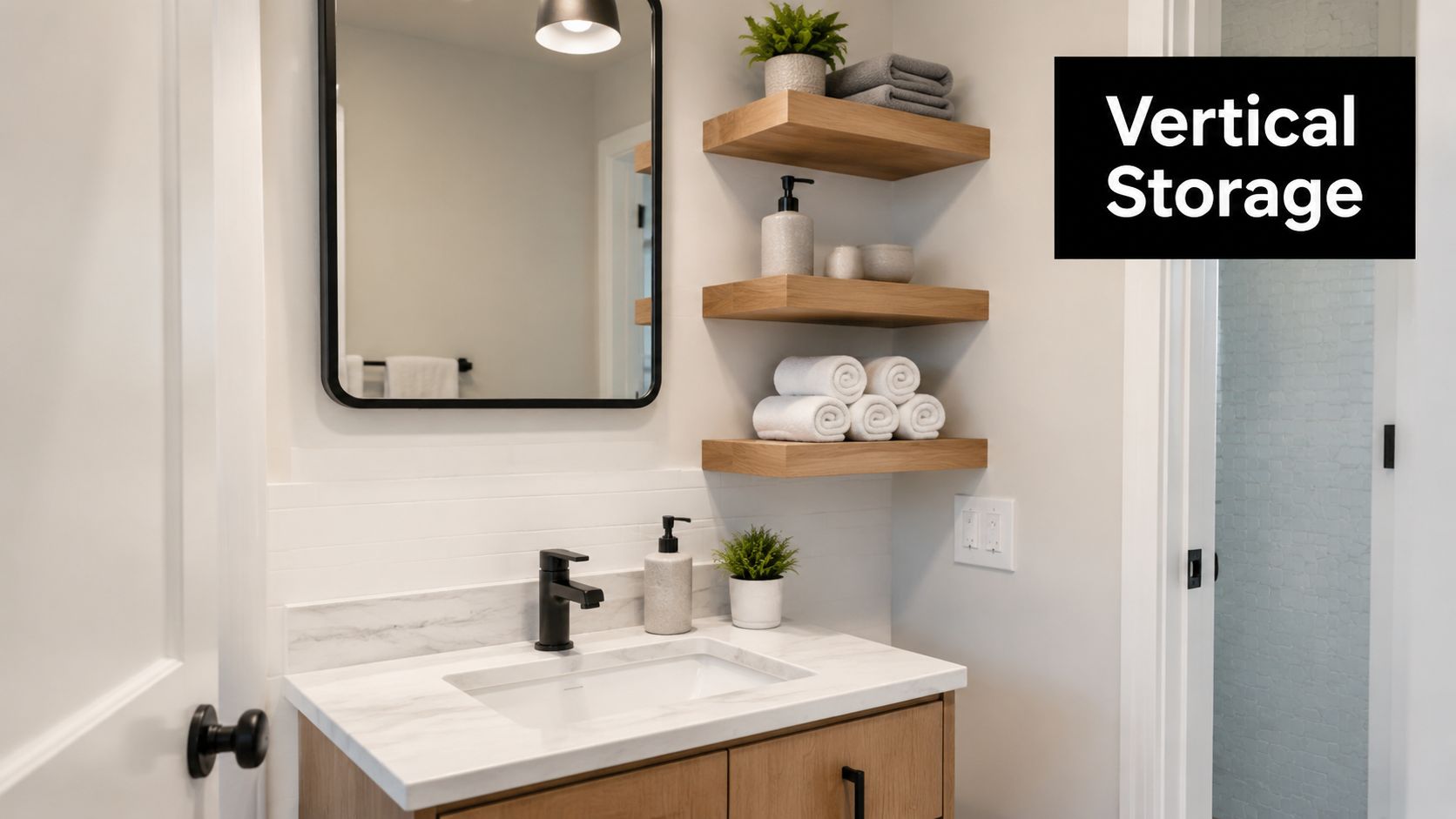
Open shelving suits modern bathrooms because it keeps the lines light. I've seen this work particularly well above a toilet, beside a vanity, or on the blank wall opposite the shower where there's enough clearance to move comfortably. If you're planning a compact layout, these small-space bathroom design ideas show where wall storage can work without making circulation awkward.
What works best
Glass shelves stay visually quiet and resist moisture well. Powder-coated metal brackets are reliable in humid rooms, and sealed timber can look excellent if it's finished properly and kept away from constant splash zones. In a Highett-style contemporary renovation, a pair of oak-look shelves above a stone vanity can soften a room full of tile and chrome.
According to Highgrove Bathrooms, vertical storage solutions such as over-toilet shelves can increase usable storage capacity by up to 40% in small bathrooms without expanding the footprint, which is exactly why wall-mounted storage is so effective in tight rooms (Highgrove Bathrooms on clever storage ideas).
Practical rule: Don't install floating shelves just because a wall is empty. Install them where your hand naturally reaches during the morning routine.
Trade-offs and installation tips
Floating shelves look clean, but they can become visual clutter if every item is left exposed. Use them for neat, repeatable categories: rolled towels, matching canisters, a tray for skin care, or spare hand towels. Don't use them as a dumping zone for half-used products and random packaging.
A few details matter:
- Fix into something solid: Stud fixing is best. Heavy-duty anchors can work, but they're a fallback, not the first choice.
- Leave useful spacing: Enough height between shelves makes bottles easy to grab and easy to clean around.
- Use moisture-safe finishes: Raw timber swells and stains fast in a bathroom.
- Add light carefully: LED strip lighting under a shelf can lift the whole vanity area, but keep wiring coordinated during renovation works.
If the shelves sit on a tiled wall, I'd rather coordinate drilling and fixing with the renovation team than risk cracked tiles later.
2. Over-the-Toilet Storage Units
The wall above the toilet is usually underused, yet it's one of the most practical storage zones in the room. If you need a spot for spare toilet paper, guest towels, wipes, or cleaning products, an over-the-toilet unit often does the job without touching the vanity footprint.
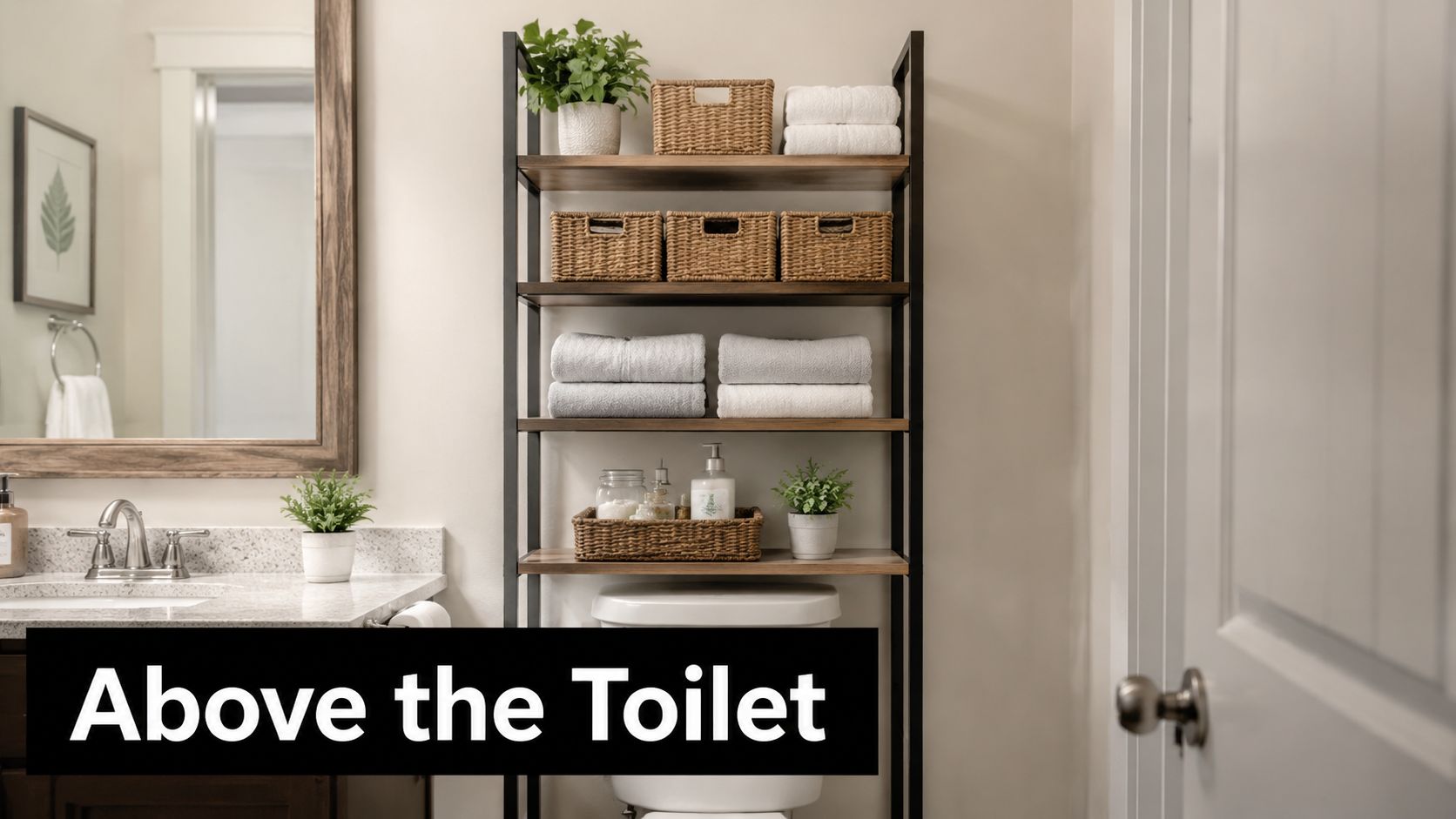
This is one of the easiest small bathroom storage ideas to retrofit. Freestanding units are useful in rentals or when you want storage now and a full renovation later. Wall-mounted cabinets above the cistern look cleaner and are easier to keep hygienic around the base.
Open shelves or closed cabinet
Open shelving works if your styling is disciplined. A few matching baskets, folded towels, and one decorative item can look polished. Once you start stacking mixed packaging, the area feels busy quickly.
Closed units hide mess better. They also suit family bathrooms where not everything needs to be on display. I usually prefer doors if the unit will hold cleaning products, backups, or personal items.
If the toilet wall is the only free wall in the room, use it properly. Don't waste it on decor when the bathroom is short on storage.
Common mistakes to avoid
The first mistake is buying the unit before measuring. Check ceiling height, cistern depth, button access, and whether the lid can still lift if needed. Leave enough room to clean around the toilet and enough breathing space so the storage doesn't feel like it's hanging over your head.
The second mistake is loading the highest shelf with heavy items. Keep bulkier supplies lower and lighter items higher for stability. In family bathrooms, over-the-toilet shelving is a good spot for backup stock, while everyday items stay closer to the vanity.
Material choice matters too:
- Powder-coated metal: durable and neat for contemporary spaces
- Bamboo or sealed timber: warmer look, but only if the finish is bathroom-safe
- Laminate cabinetry: easiest to coordinate with bathroom renovations and existing joinery
This option isn't as integrated as built-in joinery, but it's fast, useful, and often the best answer when the layout leaves no spare floor area.
3. Recessed Medicine Cabinets and Niche Storage
If you want storage that doesn't push into the room, recessed storage is hard to beat. It's one of the smartest inclusions in bathroom renovations because the storage sits inside the wall cavity instead of occupying visual or physical space.
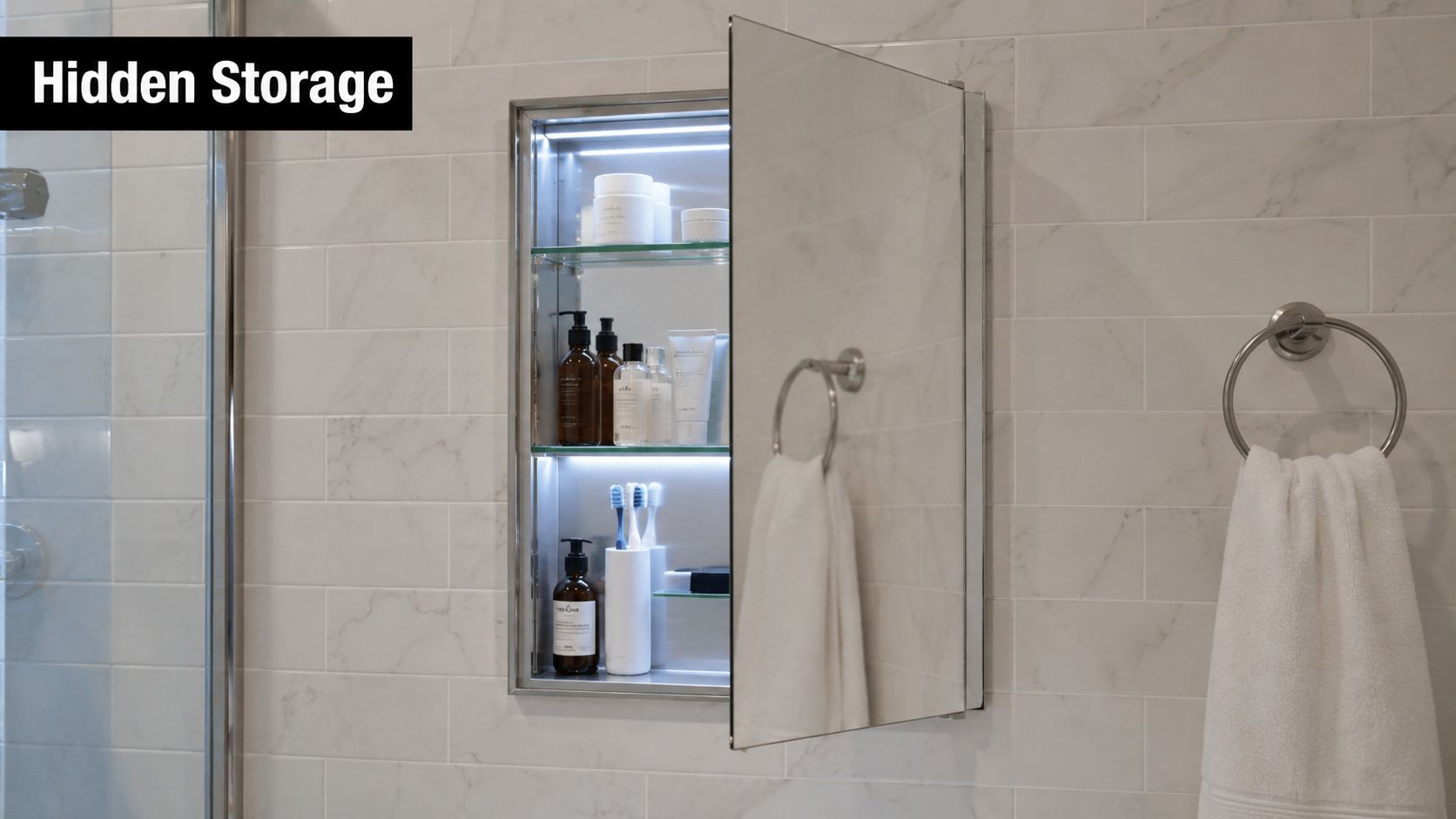
A recessed medicine cabinet above the vanity can replace a standard mirror while hiding toothbrushes, medicines, and grooming products. In showers, tiled niches stop bottles collecting on the floor or hanging from caddies. These details are common in designer bathrooms because they do useful work without adding bulk.
Built-in storage that earns its place
This is one area where planning early matters. The wall needs enough cavity depth, and the builder has to work around plumbing, wiring, and framing. One source notes that custom recessed wall niches and pull-out storage columns are recommended by 68% of Victoria-based renovators for compact spaces, and that these niches need a minimum wall cavity depth of 90mm, with reinforced backing supporting 12kg per linear metre in humid environments (ServiceSeeking on functional small bathroom storage).
Another Australian reference notes that recessed shower niches in designer bathrooms often use a minimum depth of 100mm, which is a useful reminder that the ideal niche size depends on the bottles you use and the wall construction available (Little Aussie on storage for small bathrooms).
Where it pays off
A mirrored cabinet above a compact vanity is usually the highest-value built-in storage in the room. It gives you reflection, concealed storage, and a cleaner benchtop all at once. In a shared bathroom, a double-width recessed cabinet can separate daily items by user without extra joinery below.
For shower niches, I'd focus on location before size. A beautifully tiled niche placed directly in the splash line or at an awkward height becomes annoying quickly.
A few rules help:
- Align with tile set-out: It looks intentional and avoids ugly cuts.
- Check bottle heights first: Tall pump bottles catch people out.
- Waterproof meticulously: Niches are part of the wet area, not a decorative add-on.
- Use recessed cabinets where swing space is comfortable: Door clearance still matters.
This is a builder-led solution. If you're already opening walls, it's one of the best new bathroom ideas to integrate properly rather than trying to retrofit later.
4. Corner Storage Solutions and Carousel Organisers
Corners are where storage either gets clever or gets wasted. In compact bathrooms, a corner vanity shelf, a corner cabinet, or a rotating organiser inside the vanity can recover awkward space that flat shelving can't use well.
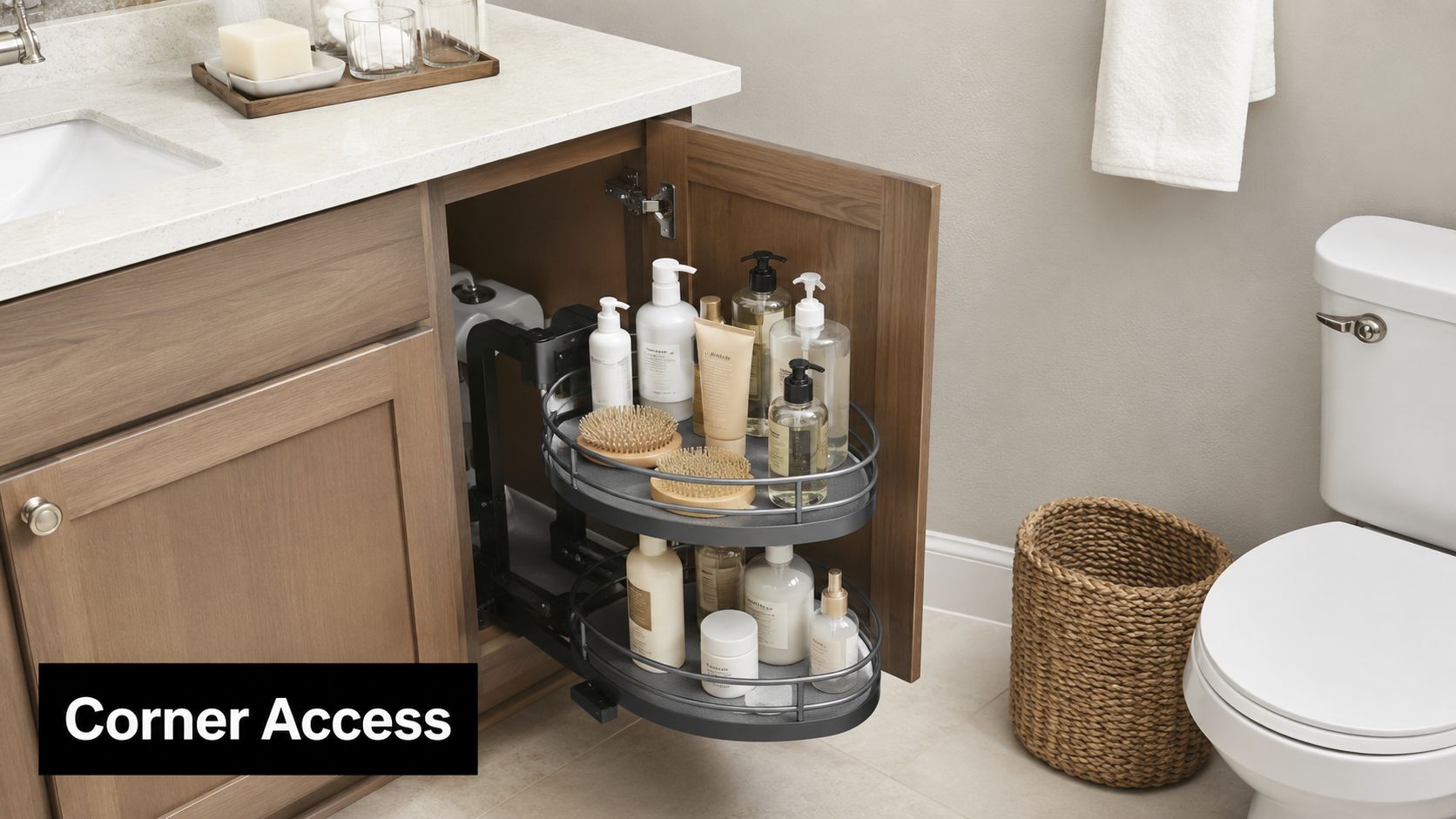
Carousel organisers are especially useful under sinks where plumbing eats the centre of the cabinet and leaves dead zones to either side. A rotating unit lets you reach the back without unloading the front every time. In tighter room shapes, the right corner strategy can be the difference between a vanity that works and one that constantly feels cramped.
If you're still deciding whether a corner vanity or angled joinery makes sense, these small bathroom layout dimensions are worth checking before you lock anything in.
Best use cases
I like carousel storage for categories that are hard to stack neatly. Hair products, backup toiletries, skin care, and first-aid items all suit rotating access better than deep fixed shelving. In family bathrooms, they also help stop duplicate buying because you can see what's in the cabinet.
Freestanding corner shelves can work, but they often look temporary unless the room has enough breathing room around them. Built-in corner joinery feels stronger in full bathroom renovations, especially where every millimetre matters.
The trade-off nobody mentions
Rotating storage sounds brilliant until the clearance is wrong. If the vanity door opening is too narrow, or the plumbing traps the organiser, the mechanism becomes more frustrating than useful.
Keep these points in mind:
- Measure the usable opening, not just the cabinet size: Hardware and hinges reduce access.
- Store light items up high: Upper corner shelves aren't the place for heavy cleaning bottles.
- Choose rust-resistant hardware: Cheap rotating mechanisms don't last well in damp cabinetry.
- Don't force a carousel into every vanity: Sometimes simple pull-out baskets are better.
Corner storage works best when it solves an access problem, not just a space problem.
A neat corner shelf in the shower can also be effective, but in wet areas I generally prefer a built-in niche unless the renovation scope is very limited.
5. Drawer Dividers and Vanity Organisation Systems
A good vanity can still behave badly if the drawers are just open boxes. Without internal organization, many bathrooms become dysfunctional. People add storage but never create order inside it, so the room still feels messy even when there's technically enough capacity.
Drawer dividers fix that. They turn one chaotic drawer into zones for daily grooming, skin care, dental items, medications, hair tools, and spare stock. In practice, this is one of the most affordable upgrades in the whole room, and one of the most effective.
Why organised storage feels bigger
This isn't just about tidiness. A 2024 University of Melbourne study cited by Bathroom Accessories Australia found that bathrooms with unorganised storage were rated 32% less satisfying by occupants, even when the square footage was identical, which lines up with what many homeowners feel when benchtops and drawers are cluttered (Bathroom Accessories Australia on smart storage solutions).
That's why vanity organisation should be treated as part of the design, not an optional add-on. In modern bathrooms, the drawer interior is doing just as much work as the external finish.
How to set drawers up properly
The best setups separate daily-use items from backup stock. Your morning and night products should live in the easiest-to-reach drawer. Refills, travel items, and less-used tools can sit lower or further back.
I'd usually organise a vanity like this:
- Top drawer: daily grooming, toothbrushes, skin care, deodorant
- Middle drawer: makeup, shaving gear, hair products
- Lower drawer: backup toilet paper, hand towels, bulk items
- Hidden insert or tray: medications or sharp tools, away from younger children
Use dividers that won't absorb moisture. Acrylic, sealed bamboo, and quality polymer inserts all work. Add non-slip liners first so trays don't shift whenever the drawer opens.
For bathroom renovations, this is worth discussing before the vanity is ordered. Deep drawers can store more, but shallow upper drawers often work better for everyday visibility. If the joinery is custom, planning appliance storage for hair dryers and straighteners from the start saves a lot of awkward retrofitting later.
6. Vertical Wall Pockets and Over-Door Storage
Not every bathroom needs construction work. Sometimes the room just needs more places to put things now. Vertical wall pockets and over-door organisers are the fast, low-commitment answer, especially for renters, guest bathrooms, and children's bathrooms that seem to accumulate products overnight.
These systems use surfaces that are usually ignored: the back of the door, the inside of a cabinet, or a narrow wall beside the vanity. They won't give you the polished look of custom joinery, but they can recover a surprising amount of practical storage.
Where these shine
I recommend them when the bathroom is missing linen storage or when the vanity is too small for the household. An over-door rack can hold towels or robes. Pocket organisers can store hair products, wipes, spare soap, cleaning cloths, or bath toys in a way that keeps them visible.
They're also useful for rental properties. One verified source states that 44% of Victorian rental properties underwent bathroom upgrades in 2024, while a 2025 JTW study reported that 73% of landlords in Victoria abandon storage upgrades because they fear breaching tenancy agreements. The same source highlights the value of non-invasive storage that avoids drilling or permanent alterations (Bathroom Accessories Australia on rental-ready bathroom storage gaps).
If you're aiming for a stronger design language long term, a feature like a mid-century modern bathroom vanity can eventually absorb some of what these temporary organisers are doing.
What to buy and what to skip
Clear pockets are useful because you can see everything quickly. Fabric organisers look softer but can hold moisture longer if ventilation is poor. Metal over-door hooks are durable, though they need enough door clearance to avoid rubbing on the frame.
A few practical notes:
- Use them for light items: Don't overload door-mounted storage.
- Check door swing carefully: The organiser shouldn't stop the door opening fully.
- Keep categories simple: One pocket for dental, one for hair, one for extras.
- Clean them often: Temporary storage gets grubby faster than built-in cabinetry.
This approach isn't elegant in every setting, but it's flexible, cheap to trial, and often the smartest stopgap before a full renovation.
7. Pedestal Sink Alternatives with Built-In Storage
Pedestal basins look light, but they usually sacrifice the very thing a small bathroom needs most. Storage. If a compact bathroom has a pedestal sink and nowhere else for toiletries, spare rolls, or cleaning supplies, replacing the basin with a small vanity is often the single most impactful change you can make.
Wall-hung vanities are the strongest option in many modern bathrooms because they free up floor area visually while adding drawers or shelving underneath. That combination makes the room feel more open and more useful at the same time.
Better than a pedestal for everyday use
This isn't just about adding a cupboard. The right sink unit can improve flow around the room, hide plumbing, and reduce benchtop clutter. A narrow wall-mounted vanity with one deep drawer and one shelf often outperforms a larger bulky unit because it stores what you use without swallowing the room.
One verified source notes that modular storage units with pull-out drawers beneath bathtubs can store up to 25 litres of cleaning supplies and towels, and credits Registered Builders Unlimited with recommending this type of integrated storage for compact spaces (Budget Box on small bathroom storage ideas). The same principle applies under the basin. Integrated storage beats decorative emptiness in a small bathroom almost every time.
When to involve registered builders
Once plumbing moves or cabinetry becomes built-in, this stops being a simple styling upgrade. Registered builders are worth engaging when the waste position, waterproofing, wall fixing, or tile layout needs proper coordination. That's particularly true in older homes, where wall condition and existing pipe locations can limit the vanity size more than people expect.
A few selection rules help:
- Choose moisture-resistant carcass materials: Treated board, marine-grade components, or quality engineered products last better.
- Keep kick-free designs where possible: Wall-hung units make cleaning easier.
- Prioritise drawers over cupboards: Drawers give better access in shallow vanities.
- Leave service access: Future plumbing maintenance shouldn't require joinery demolition.
This is one of the most practical new bathroom ideas if your current basin offers no storage at all. In full bathroom renovations, it's often the first layout decision I'd revisit.
8. Tiered Shelf Systems and Storage Ladders
Not every small bathroom wants more cabinetry. Sometimes a lighter, more decorative storage piece suits the room better. Tiered shelves and leaning ladders can add vertical storage for towels, baskets, and a few daily items without making the space feel boxed in.
These pieces work best when the bathroom already has core storage covered and needs overflow capacity, or when the room has an awkward spare corner that can't take conventional joinery. In styled designer bathrooms, a ladder shelf can soften a room full of hard surfaces and add a bit of warmth.
When freestanding storage works
A timber ladder beside a bath can hold towels beautifully. A narrow powder-coated shelf in a corner can carry baskets of toilet paper, guest items, or skin care. These are useful pieces in ensuites where you want the room to stay visually open.
Still, freestanding storage needs discipline. It's easy for a ladder shelf to become a staging point for clutter because there are no doors to hide anything.
Keep the bottom shelf for the heaviest items and the top shelves for light, infrequently handled pieces. That's what keeps these units safe and visually balanced.
Picking the right piece
The finish has to suit humidity. Sealed timber, bamboo designed for wet rooms, and rust-resistant metal all work. Cheap painted furniture from dry areas of the house usually won't.
Placement matters more than people think:
- Use corners first: They preserve circulation.
- Avoid door swing zones: A beautiful ladder in the wrong spot becomes a daily obstacle.
- Add baskets for small items: Open shelves need containment to look tidy.
- Limit what's on display: Towels, one tray, one basket. More than that starts looking crowded.
This is one of the more flexible small bathroom storage ideas because it doesn't require drilling or demolition. It also suits phased projects, where you've completed the main renovation and want to add a softer layer of functional styling afterwards.
8-Option Small Bathroom Storage Comparison
| Item | Implementation complexity | Resource requirements | Expected outcomes | Ideal use cases | Key advantages |
|---|---|---|---|---|---|
| Floating Shelves and Wall-Mounted Storage | Low–Medium (anchoring to studs/anchors) | Minimal tools and materials; $100–$400 per shelf | Open vertical storage, minimalist look, limited weight capacity | Small modern bathrooms, display of towels/toiletries | Space-saving, easy to install, cost-effective |
| Over-the-Toilet Storage Units | Low (freestanding or simple wall-mount) | Unit purchase and basic assembly; $80–$300 | Efficient above-toilet storage, easily accessible, can look crowded if overfilled | Tight bathrooms, renters, budget renovations | Affordable, small footprint, no major renovation |
| Recessed Medicine Cabinets and Niche Storage | High (requires wall framing and professional install) | Skilled labor, possible electrical/plumbing coordination; $400–$1,200 | Seamless built-in storage, concealed items, polished aesthetic | Major renovations, luxury/small bathrooms needing integrated storage | Concealed storage, adds architectural value, dual-purpose mirror |
| Corner Storage Solutions and Carousel Organizers | Medium (measurement and fitting required) | Moderate cost and possible custom fitting; $150–$450 | Maximizes corner dead space, rotating access to back items | Under-sink corners, compact layouts where corners are wasted | Efficient corner use, improved access, organized storage |
| Drawer Dividers and Vanity Organization Systems | Low (simple install or inserts) | Low cost; $50–$250 depending on customization | Highly organized drawers, better visibility and routine efficiency | Vanities with drawers, users wanting tidy, non-structural upgrades | Cost-effective, customizable, improves daily use |
| Vertical Wall Pockets and Over-Door Storage | Very low (no-drill or hanging) | Very low cost; $25–$120, no professional installation | Quick, visible storage; temporary solution with limited load capacity | Renters, temporary needs, small bathrooms needing immediate storage | Non-permanent, inexpensive, easy to install |
| Pedestal Sink Alternatives with Built-In Storage | High (plumbing integration and custom install) | Professional installation and plumbing work; $600–$1,500 | Integrated concealed storage with modern sink aesthetic | Renovations aiming to add sink storage and improve resale | Combines sink and storage, modern look, conceals clutter |
| Tiered Shelf Systems and Storage Ladders | Low (freestanding, no install) | Low to moderate cost; $80–$300 | Decorative vertical storage, open display, limited concealed capacity | Styling-focused bathrooms, renters, display of towels/plants | Attractive, movable, dual-purpose décor and storage |
Bring It All Together
The best storage plan usually isn't a single hero feature. It's a combination. A recessed medicine cabinet clears the vanity top. Drawer organisers make the vanity usable. Shelves above the toilet recover dead wall space. A wall-hung vanity replaces a pedestal basin that never carried its share of the load. Once these moves start working together, the bathroom feels larger because it functions better.
That's the part many people miss. Storage isn't only about fitting more in. It's about reducing friction in the room. You want fewer items left on the basin, fewer bottles on the shower floor, and fewer awkward reaches into dark cabinet corners. Good storage shortens the morning routine, simplifies cleaning, and makes the whole bathroom read as calmer and more deliberate.
Some solutions are easy to test. Over-door organisers, freestanding over-toilet units, and tiered shelving can be added quickly and moved if they don't suit the space. Others are worth doing once, properly, during bathroom renovations. Recessed niches, medicine cabinets, vanity replacements, and integrated joinery all depend on wall structure, waterproofing, plumbing, and tile layout. That's where registered builders and a coordinated renovation team matter.
SitePro Bathrooms is well placed for that kind of work. The company handles the process from concept and 3D design through construction and finishing, which is exactly what compact bathrooms need. In small rooms, storage decisions affect everything else: mirror position, lighting, tap placement, circulation, and what sort of vanity or shower screen the room can comfortably take. A disconnected approach usually leads to compromises. A coordinated approach gives you storage that looks built-in because it was planned that way.
If you're weighing up new bathroom ideas for a cramped ensuite, updating a family bathroom, or preparing an investment property for a smarter refresh, start with a clear storage wishlist. List what has to live in the room every day, what can be stored elsewhere, and which problems are really layout problems in disguise. That exercise alone often shows whether you need a simple retrofit or a more complete redesign.
Then take the next step with SitePro Bathrooms. A builder-led consultation can help you decide which small bathroom storage ideas belong in a quick upgrade and which ones should be integrated into complete modern bathroom renovations for a cleaner, longer-lasting result.