
A full bathroom renovation doesn't automatically pay for itself at sale. That advice confuses a room buyers notice with a project that reliably adds its full cost to the sale price. For Highett homeowners, the smarter question is whether the bathroom is merely dated, visibly defective, or already good enough to present well.
The answer usually points to one of three choices: prepare the bathroom for sale, repair specific problems, or renovate fully. Choose based on local comparable properties, the likely buyer and what the bathroom communicates during an inspection, not on a universal return-on-investment promise.
The Question Most Sellers Ask the Wrong Way
A bathroom renovation can be the wrong purchase just before a sale. Asking “Will a new bathroom pay for itself?” encourages sellers to price a project before establishing whether the room needs one. Start with the objection you need to resolve. Australian guidance on renovation costs and resale value gives useful context for renovation spending, but broad recovery estimates cannot forecast the result for your particular home.
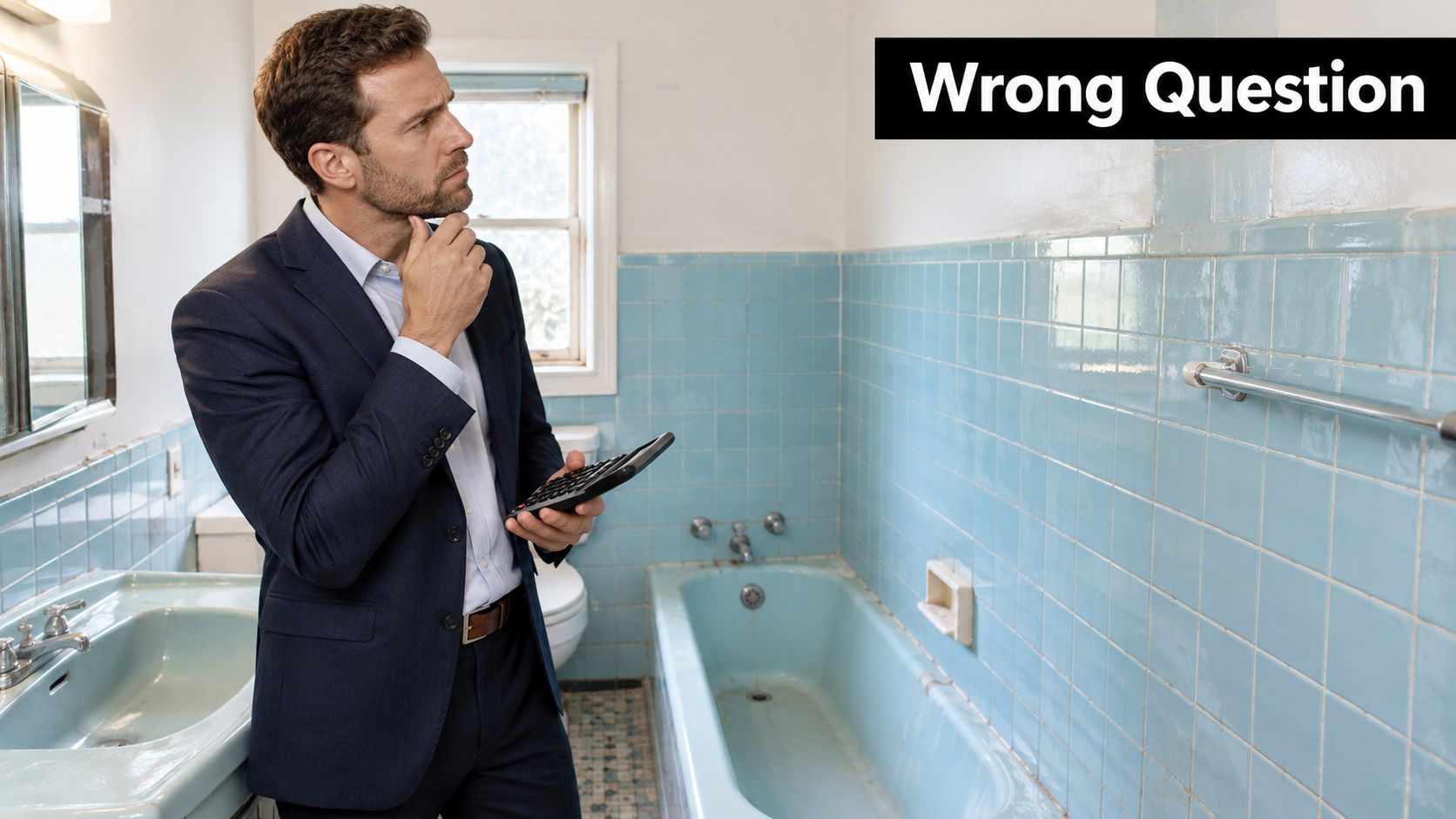
Dated isn't the same as defective
Old colours, dated fittings and a plain vanity are presentation issues. Clean the room thoroughly, remove clutter and address tired finishes before considering demolition. A serviceable bathroom deserves a restrained sale-preparation budget.
Leaks, water damage, failed waterproofing, persistent mould and poor drainage require a different response. Identify the cause before paying for cosmetic work. Covering a symptom leaves the underlying problem in place and gives buyers a reason to question the property's condition. An unusable layout also deserves closer assessment because cleaning and new fittings cannot correct it.
The useful version of is it worth renovating a bathroom before selling? is: what work will remove a genuine buyer objection?
Set the scope before choosing finishes
Choose sale prep for a functional room that presents poorly. Choose targeted repair when a specific defect can be addressed without rebuilding the bathroom. Reserve a full renovation for problems whose repair demands broader work, or a layout that prevents the room functioning properly.
In Victoria, compliance and builder registration requirements belong in that scope decision. Establish which requirements apply before committing to work, rather than treating every bathroom job as a cosmetic refresh.
Judge the room in its local context
A Highett townhouse and a larger Pakenham family home need different assessments; the dedicated discussion of Highett and wider Victoria explains the local factors. Keep the spending decision tied to what buyers will encounter during inspection: a clean, usable room, a repair concern or a bathroom needing substantial work.
What Australian Renovation ROI Actually Looks Like
Budget for partial recovery, not a windfall. A renovation's apparent resale contribution measures only part of its value to a seller. Better presentation can build buyer confidence and reduce objections, but those benefits don't establish that the sale price will cover the work.
Australian estimates of renovation resale recovery put recovery for a mid-range bathroom costing approximately $15,000–$30,000 at around 60%–75%, implying $9,000–$22,500 in resale contribution before selling costs, finance or unexpected construction expenses.
| Bathroom renovation cost | Estimated recovery | Approximate resale contribution |
|---|---|---|
| $15,000 | 60%–75% | $9,000–$11,250 |
| $20,000 | 60%–75% | $12,000–$15,000 |
| $30,000 | 60%–75% | $18,000–$22,500 |
These estimates are a budgeting reference, not a valuation of your home. Using that range, the middle example produces $12,000–$15,000 in apparent resale value, leaving part of the renovation bill unrecovered. Borrowing costs and overruns widen that gap. Don't approve a full rebuild on the assumption that buyers will reimburse you.
Spend to resolve a real objection
Use the recovery gap to test three spending options: sale prep, targeted repair and full renovation. The strongest choice removes the buyer objection with the least unnecessary work. A broader project needs a stronger justification than a preference for new finishes.
- Repair defects: Spend on identifying and correcting the cause of leaks, water damage or drainage problems. Cosmetic improvements cannot substitute for that work.
- Improve the experience: Put presentation spending into grout, lighting, ventilation, storage and visibly worn fixtures where they weaken buyer appeal.
- Limit premium choices: Require a clear reason for designer finishes or reconfiguration. Luxury spending can deliver weaker percentage returns when comparable homes don't support a premium.
For a Highett seller, the budget must also account for applicable Victorian compliance and builder registration requirements. Assess those before comparing project costs.
Apply the same spending discipline to other rooms. A guide to assessing whether a kitchen remodel is a good investment offers a useful comparison: judge the work by its cost, purpose and likely buyer appeal rather than assuming renovation automatically creates profit.
How Highett and Wider Victoria Shape the Decision
There's no single bathroom standard that suits every Victorian property. In Highett and greater Melbourne, the right scope depends on how your home compares with similar listings, what buyers in its price bracket expect and whether the bathroom has a genuine problem. Treat local evidence as the guide, not a generic renovation percentage.
The dated bathroom in an otherwise competitive home
A full renovation may be justified if the bathroom looks markedly behind comparable properties and that contrast is likely to weaken buyer interest. That doesn't mean choosing premium finishes by default. Keep the design broad in appeal, make the layout practical and spend on issues buyers would otherwise have to address. Check whether the home's price bracket supports the proposed finish before committing to a complete rebuild.
The family home with an acceptable bathroom
A strategic refresh is usually the stronger choice when the room works, but looks tired. Clean thoroughly, repair visible wear, update lighting and replace only the fixtures that clearly undermine the presentation. If comparable family homes already show well-maintained bathrooms, aim to meet that standard without trying to outbuild the market.
Some buyers will value a bathtub; others may focus on easy cleaning, ventilation, storage or a layout that works for everyday use. Modern bathrooms don't need elaborate finishes to feel current. They need to be clean, functional and well maintained.
The already-renovated property
Don't renovate a bathroom that already compares well with local alternatives. Spend the money where buyers will notice a genuine shortcoming, or put it towards presentation elsewhere. Staging, landscaping or a straightforward clean may be more useful than replacing finishes that are already sound.
Local test: Ask an agent to identify comparable listings and explain what buyers have responded to. If feedback points to cleanliness or a minor defect, a full renovation is the wrong tool.
Pay attention to agent feedback and how comparable properties are performing, including whether their bathrooms appear similar in age and condition. Without reliable local evidence, don't assume a renovation will lift the price. The strongest case is a clear mismatch between your bathroom and what buyers can see nearby.
Three Paths to Choose From Before You List
Don't reduce the decision to renovate or do nothing. Choose between sale preparation, targeted repair and a full renovation. Each suits a different bathroom, and each should be scoped against your budget, timeline and the problems you need to solve.
Path one, sale preparation
Choose this when the bathroom functions properly and the main issue is presentation. Deep clean, remove mould safely, refresh grout, reseal tired edges, touch up paint and replace a visibly worn tap or showerhead. Improve lighting and clear away clutter. This path avoids turning a cosmetic problem into a construction project.
Australian buyer survey data highlights why cleanliness deserves attention: 43% of buyers said they'd avoid inspecting a home that looked unclean, while 61% of those who inspected an unclean property said they'd bid lower. Australian buyer survey on cleanliness and property inspections
Path two, targeted functional repair
Use this when a specific defect is likely to worry buyers. Fix plumbing problems, repair damaged fixtures, address failed waterproofing and correct drainage or ventilation issues as appropriate. Get the cause assessed, then document the work. Cosmetic cover-ups aren't a substitute for repairs that address water entry or deterioration.
Path three, full renovation
Consider a full renovation when the bathroom is visibly dated and defective, or when its layout materially limits use. This is the largest commitment, so it needs a clear scope, documented budget and enough time to finish and check the work before listing. A project's best-case contribution depends on local buyer expectations; no path guarantees full cost recovery.
| Option | Best suited to | Budget and timing | Main aim |
|---|---|---|---|
| Sale preparation | Functional bathroom with cosmetic wear | Keep work limited; allow time for cleaning and touch-ups | Improve presentation |
| Targeted repair | Visible or consequential defect | Scope to the repair; schedule trades and inspection | Resolve an objection |
| Full renovation | Bathroom is a major functional or presentation problem | Obtain a detailed quote and allow a longer construction window | Bring the room in line with buyer expectations |
Choose the smallest path that fully addresses the problem. Don't take on a full renovation just because the room isn't your preferred style.
Victorian Rules That Quietly Decide Your Project
Compliance affects whether a pre-sale bathroom upgrade is a manageable improvement or an avoidable risk. In Victoria, regulated plumbing work generally includes replacing or relocating sanitary fixtures and altering sanitary plumbing. A like-for-like replacement in the same location may be exempt from a plumbing permit, but that doesn't make every bathroom job permit-free. Victorian plumbing permit guidance
Check the scope and who's doing the work
In Victoria, a bathroom renovation costing more than $10,000 generally requires the contractor to be registered with the Building and Plumbing Commission. Some single-trade jobs, such as tiling, painting, plumbing, electrical work or glazing, are exempt from that registration requirement. If the project combines multiple building skills, registration is required once the combined work exceeds the threshold. A major domestic building contract is also required for work involving more than one trade above that threshold, even if the project is split across smaller agreements. Victorian guidance on registered builders and building contracts
For a coordinated renovation, check that the builder's registration class covers the proposed scope. Victoria recognises Domestic Builder–Unlimited registration, which allows a builder to carry out, manage or arrange subcontractors for all domestic building work. Verify the registration rather than assuming a trade credential or application covers a project that involves multiple trades or broader building work. How Victorian builders obtain registration
Keep proof of the hidden work
A finished bathroom can look excellent and still raise concerns if the buyer can't verify what sits behind the tiles. Keep plumbing compliance certificates, waterproofing records, invoices, plans and permit or inspection documents. Photograph the waterproofing membrane before tiling, retain product and installer details, and keep the paperwork together for sale enquiries. A clear compliance trail gives buyers something concrete to review.
Wet-area performance matters more than a fashionable tile. Victorian guidance identifies AS 3740:2021 as the applicable domestic wet-area waterproofing standard, with shower walls waterproofed to at least 1,800 mm above the floor substrate and shower-area floor falls typically between 1:80 and 1:50 towards the waste. Verify the waterproofing, drainage and ventilation rather than relying on appearance alone. Victorian wet-area waterproofing guidance
If you're unsure what approvals or documentation apply to your proposed work, check the relevant Victorian building permit requirements before construction begins. Shortcuts can leave a seller explaining undocumented work when buyers conduct due diligence.
How Two Highett Sellers Would Spend $25,000
The same budget can solve very different problems. Consider two illustrative sellers, both preparing Highett homes for sale. Their choices show why the question isn't which finishes cost more, but what the existing bathroom needs to do for the property.
The investor's two-bedroom unit
The investor keeps the existing layout and prioritises durability. The scope covers compliant waterproofing, easy-clean finishes, a broadly appealing vanity and stronger lighting to make the compact room feel brighter. The choices aim to remove maintenance concerns and make the bathroom look cared for, rather than create a luxury feature that the unit's buyer may not value.
The investor gets a detailed quote before committing and checks whether the work fits the property's likely price bracket. A bathroom renovation cost calculator can help organise a preliminary scope, but the actual cost depends on site conditions and the work specified. The investor keeps records of the completed work for buyer questions.
The family's weatherboard
The owner-occupier has a bathroom that feels cramped and lacks useful storage. The proposed scope considers a layout change, a freestanding bath, a walk-in shower and improved storage. These features may suit the family's idea of a more usable room, but they also carry the risk of spending on personal preferences that comparable buyers may not value equally.
Before proceeding, the owner should test whether the layout problem is serious enough to justify reconfiguration and whether local comparisons support that level of finish. Keep plumbing locations where practical, and make sure the design solves a clear need rather than adding statement pieces.
Neither seller should assume the $25,000 will be recovered in full. Their final sale prices, buyer feedback and time on market can't be predicted from the project budget alone. One renovation responds to likely objections in a compact unit; the other spends more on functionality and features. That's the useful comparison: match the work to the property and its likely buyer, then assess quotes against local evidence.
Your Pre-Sale Bathroom Decision Checklist
Before committing to bathroom renovations, settle the problem you're paying to solve. A clean, functional room may need careful preparation, not construction. A defect needs a repair plan. A full renovation needs a budget, a documented scope and enough time to complete and inspect the work before photography and buyer viewings.
Run this check before booking work
- Compare local homes: Check comparable listings and sales, then ask an agent what buyers have objected to in similar properties.
- Choose the smallest effective scope: Pick sale preparation, targeted repair or a full renovation based on the bathroom's actual condition.
- Set the budget before design: Cost certainty matters. A reported Australian homeowner survey found 28% didn't know their renovation's eventual cost, 17% expected to spend between $20,000 and $50,000, and 74% planned to put their home on the market within the following 12 months. Treat those figures as historical context, not a budget for your project. Reported Australian renovation survey
- Prioritise broad usability: Choose neutral finishes, practical storage, good lighting and ventilation. Consider level access, circulation and reinforcement for future support rails where appropriate. Guidance on accessible bathroom design
- Keep the compliance trail: Retain invoices, plumbing certificates, permits, waterproofing records and stage photographs.
Rising living costs have influenced renovation decisions: Australian bathroom survey reporting found that 89% of respondents named rising living costs as a top concern, 49% had delayed renovations and 28% had reduced their scope. The same reporting noted that features that save on household bills were popular. Don't treat that as proof of a sale premium. It's a reason to favour durable, easy-care and water-efficient choices over costly styling that doesn't solve a buyer concern. Australian bathroom survey reporting
If the scope involves layout, multiple trades or design choices you're unsure about, request a staged quote and a design consultation before signing. SitePro Bathrooms offers consultation and measurement, 3D design and coordinated renovation work in Highett. Leave enough time for the work, any rectification and proper photography. If the bathroom only needs a deep clean and a few minor repairs, do that instead.
Get a local assessment before you spend: compare your bathroom with similar homes, identify the problem buyers will see, then request a quote for the smallest scope that fixes it. If there is no clear defect or competitive gap, clean and present the room well, and put the renovation budget elsewhere.