
In Victoria, bathroom waterproofing defects can be pursued for up to 10 years from completion under statutory protections, even if a contractor's stated warranty is shorter. That protection isn't an automatic promise that every claim will succeed: you still need evidence that the work was defective or non-compliant and that the claim fits the relevant legal framework.
You spot a damp patch beside the shower, notice a musty smell, or find a tile lifting months after the renovation. You reach for the contractor's details and realise the handover pack is missing, or the advertised “10-year warranty” doesn't explain what happens next. In practice, the strength of your protection depends less on a reassuring phrase in a quote than on how the wet area was specified, installed, documented and signed off.
The Bathroom Waterproofing Warranty Most Homeowners Misunderstand
A contractor's written warranty and your legal rights are two separate things. The warranty is a private promise, bounded by whatever terms the contractor wrote into it. Statutory protections sit underneath it, and they can apply even when the contractor's paperwork is brief, vague or long gone. Homeowners who conflate the two usually discover the difference at the worst moment: when the leak appears.
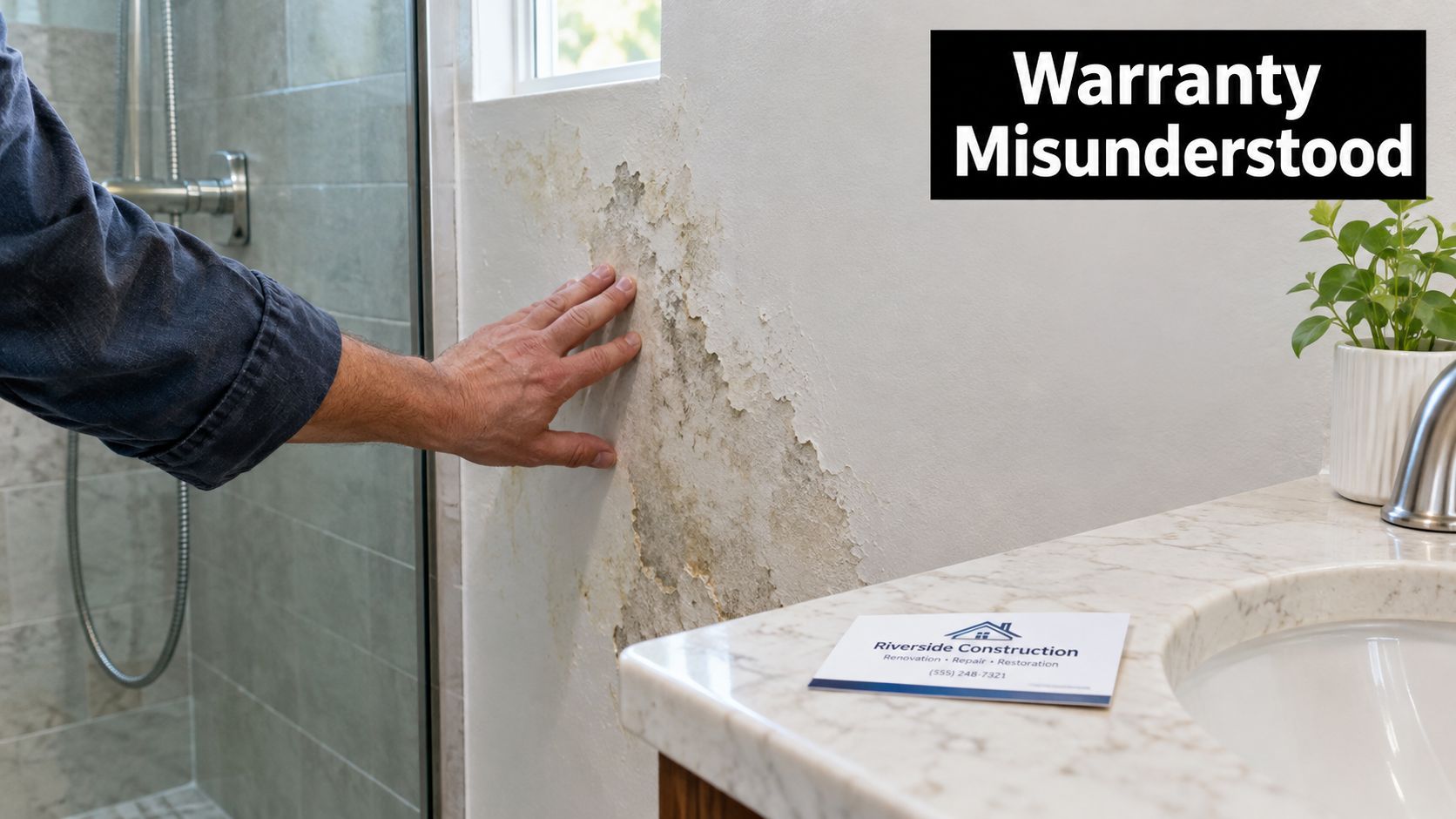
Why two similar leaks can lead to different outcomes
Two homeowners can have the same shower leak and completely different prospects. One produces a signed scope, permit records, product details and photographs of the membrane before tiling. The other has a verbal assurance and a finished tiled surface that hides everything an assessor needs to see.
The paperwork gap decides the dispute before it starts.
Waterproofing failures are usually hidden. Water travels behind tiles and damages plasterboard, framing, cabinetry or finishes before a stain becomes visible. A final inspection of the tiled room tells you nothing about how the membrane was detailed at a pipe penetration or wall-to-floor junction.
Your protection works as three overlapping layers: the installer's workmanship promise, the manufacturer's product warranty and your statutory rights. Each addresses a different kind of failure, and none substitutes for the others. Victorian guidance holds registered building practitioners responsible for ensuring waterproofing complies with applicable building requirements, while statutory protection can apply to defects within the relevant legal framework.
Practical rule: Treat the warranty as a compliance file, not a sentence in the contract. If the installation can't be traced back to its scope and evidence, expect a harder dispute.
What a Bathroom Waterproofing Warranty Actually Covers
“Waterproofing warranty” can describe several different promises. Separate them before signing, because a membrane product defect, an installation failure and a broader building defect aren't necessarily dealt with by the same party.
A manufacturer's product warranty concerns the membrane or other supplied product, subject to its terms. It won't automatically establish that the product was installed correctly. The installer's workmanship warranty concerns the quality of the work performed, including preparation and detailing. A product can be sound while the application is defective, or the application can follow instructions while a product issue remains in dispute.
Statutory protection sits alongside private promises
Victorian domestic-building implied warranties require work to be done in a proper and workmanlike manner, with suitable materials, reasonable care and skill, and in compliance with applicable laws. Those warranties apply to domestic building work even when the project cost is low or no written contract exists. Consumer Affairs Victoria's guidance on implied warranties and domestic building insurance
That makes the legal framework a backstop, not a replacement for a clear contract. The contract should say what the contractor is responsible for, while product documents should identify the system and its conditions. Ask whether the private warranty covers only membrane defects or also consequential damage to building materials and finishes. Don't assume those are included just because the document uses broad wording.
Australian Consumer Law guarantees for supplied products may also be relevant, but they're distinct from a contractor's workmanship promise and from domestic-building protections. Keep the documents together and identify which party supplied and installed each component. If a contractor disappears or a manufacturer disputes responsibility, the full record helps establish what was promised, what was installed, and what failed.
The Compliance Test Behind a Defensible Warranty
A warranty that says only “the bathroom is waterproof” doesn't tell you whether the work followed a compliant method. A defensible claim needs a benchmark: the nominated compliance pathway, the applicable standard, the wet-area scope, and evidence that the installer followed the specified system.
Under NCC 2022, wet-area provisions sit in Volume Two, Part H4 and Housing Provisions Part 10.2. Where AS 3740 is used as the Deemed-to-Satisfy pathway, the associated Housing Provisions clauses must also be met. A contractor shouldn't cherry-pick convenient clauses from different pathways and call the result compliant. The NCC guidance on waterproofing houses sets out the relevant requirements, including waterproofing the shower floor, shower-wall junctions, floor-and-wall junctions and penetrations. Shower walls must generally be waterproof to at least 1,800 mm above the floor substrate.
Check the details water can bypass
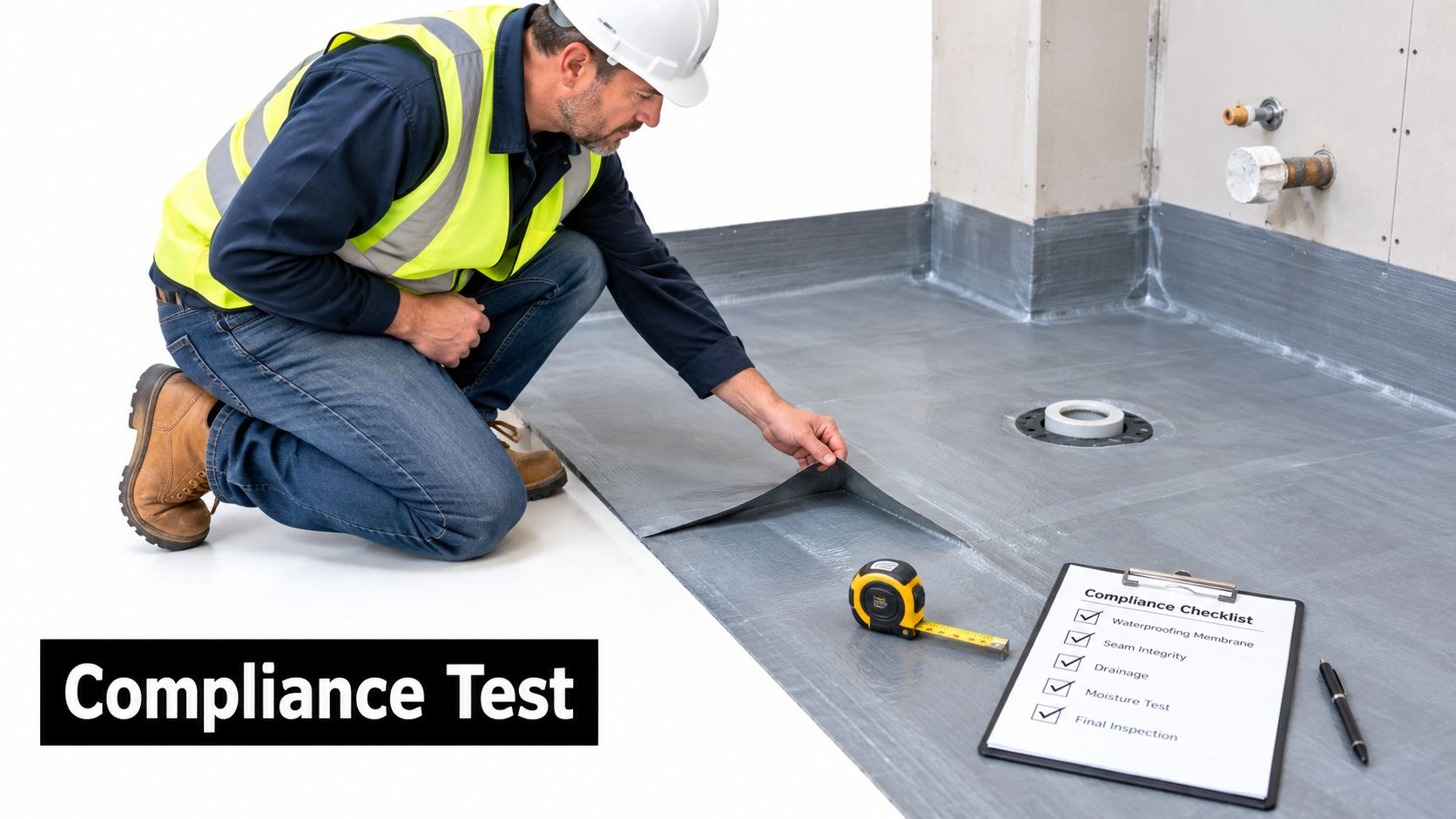
The critical evidence is often at the junctions, not across the broad middle of the shower floor. A pipe penetration, waste, hob transition or wall-to-floor junction can let water past tile finishes and into moisture-sensitive elements. If that detail fails, the key question is whether the design and installation met the applicable requirements, not whether the tiles look tidy.
Before tiling, records should show the substrate was suitable and prepared, compatible primer and bond breakers were used, penetrations were detailed, and the membrane followed the nominated system's instructions. Photographs taken at this stage are more useful than a later image of finished tiles because the waterproofing layer is still visible.
The approved design, nominated NCC pathway, applicable AS 3740 requirements and documented installation sequence should guide any assessment. For homeowners comparing requirements and practical installation considerations, SitePro Bathrooms' overview of Australian waterproofing standards is a useful project reference. Don't accept a warranty document that names no system, identifies no scope and offers no record of how the hidden work was completed.
Typical Warranty Durations and Where They Actually Start
A homeowner calls the builder two years after handover. The shower leaks into the bedroom wall. The builder says his workmanship promise expired. The homeowner assumes she has no claim. She is wrong on two counts: the workmanship term was never the only clock running, and the statutory protection she needs was tied to completion, not to any promise the builder made.
That confusion happens because product coverage, a contractor's workmanship promise and statutory rights are three separate warranties with different terms, starting points and proof requirements. Read each document on its own terms. A headline duration on a product brochure tells you nothing about the rest of the job.
For the statutory layer, as noted earlier, Victorian law can protect owners against waterproofing defects for up to 10 years from completion, and that protection can follow the property to a later owner. The duration looks generous on paper. It helps you only if you can prove the defect and pin down the completion date.
Three Overlapping Warranty Clocks After a Bathroom Renovation
| Coverage Layer | Typical Duration | Trigger | Common Exclusions |
|---|---|---|---|
| Product warranty | Set by the product documents; check the written terms | A product defect covered by the manufacturer's conditions | Installation faults, incompatible components or use outside the stated conditions |
| Installer workmanship | Set by the contract; never accept a verbal estimate | A failure caused by the contractor's installation work | Later damage, unauthorised alterations or work outside the agreed scope |
| Victorian statutory protection | Up to 10 years from completion, where applicable | A defect or non-compliant work within the relevant legal framework | Claims that cannot establish a relevant defect or meet legal requirements |
Two habits decide whether these clocks protect you. First, ask what event starts each period: a product document may run from purchase or installation, while statutory protection runs from completion. Second, treat the duration itself as the easy part. Actual protection is the compliance record behind the work: the scope, the named membrane system, the pre-tiling photos and the documented completion date. Keep the signed contract, invoices, product information and handover records in one file. Without them, a valid claim becomes an argument about memory.
Building a Handover File That Actually Protects You
A strong handover file is the evidence behind your bathroom waterproofing warranty. Build it while work is underway, not after a leak appears. Once tiles cover the membrane, the most useful installation details may be hidden.
Collect records before work begins
Start with a signed scope that describes the wet-area work, membrane system, substrate preparation, penetrations, junction treatments, drainage falls and any exclusions. Keep the permit documents and the details of the practitioner responsible for the building work. In Victoria, a bathroom renovation costing more than $10,000 must generally be managed by a builder registered with the Building and Plumbing Commission, and Consumer Affairs Victoria advises using a written major domestic building contract for renovations above $10,000. Consumer Affairs Victoria's guide to builders and other building practitioners
Photograph the work before it disappears
Ask for records of substrate preparation and the membrane before tiling. The file should identify the membrane system and product information, primer and bond breaker details, product batch or lot details where available, installer records, and confirmation that drainage falls and penetrations were addressed. Keep any waterproofing certificate or inspection record with the photographs.
Then confirm the handover date and who to contact if moisture appears. Ask the contractor to clarify whether the warranty covers only membrane defects or also damage to plasterboard, framing, cabinetry and finishes. A leak can cause damage outside the tiled surface, so the distinction matters.
Modern bathrooms and designer bathrooms often include concealed services, altered wall positions and extensive joinery. Those choices can make later leak tracing more complicated, which is a reason to strengthen the records, not avoid the design. Use a bathroom renovation checklist to organise the decisions and documents before construction. Store copies somewhere you can access even if the contractor closes or changes hands.
What Voids a Bathroom Waterproofing Warranty in Practice
A long warranty doesn't protect work that someone later damages. One of the most common traps is an alteration made after handover, followed by a leak that neither the original contractor nor the later tradesperson documented properly.
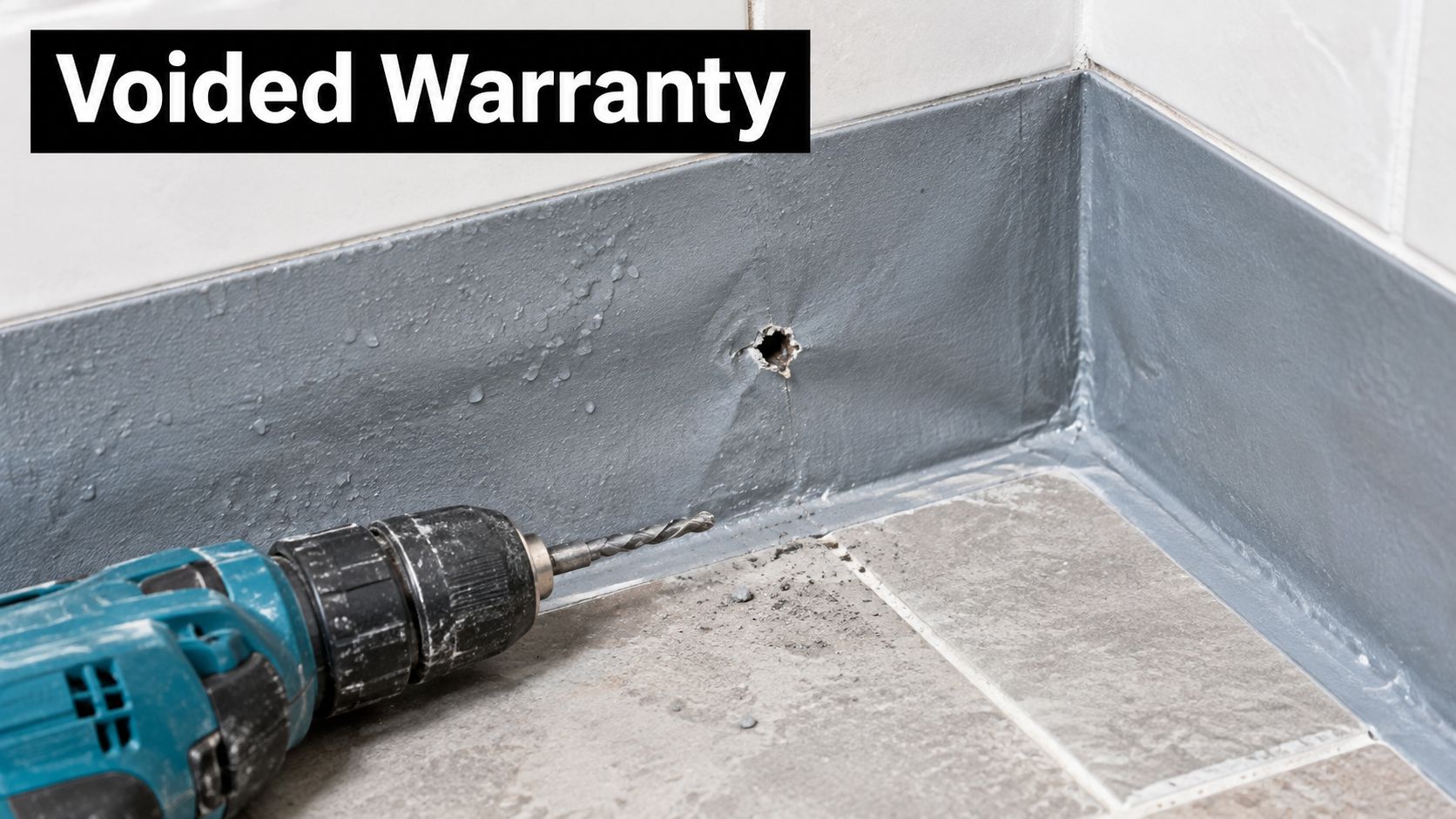
A new screw hole for a shower screen, a replacement fixture or a plumbing alteration can disturb a waterproofed area. If a later tradesperson drills through a tiled wall or changes a waste, the original installer may reasonably question whether the failure arose from the original work or the later change. The answer depends on the facts and warranty terms, so don't assume any alteration automatically cancels every right.
Define the boundary before another trade works
The NCC requires shower floors, shower walls to at least 1,800 mm above the substrate, wall junctions, wall-to-floor junctions and penetrations to be waterproof. Timber-based floors must be waterproof rather than merely water-resistant. The NCC Housing Provisions for wet-area waterproofing
Before later work begins, get written approval where the contract requires it. Have the new tradesperson identify what they'll drill into, cut, remove or reconnect, and ask them to record the work with photographs. If a body corporate or landlord arranges changes, keep the work order and completion details alongside the original handover file.
The contract should distinguish defects in the original membrane from damage caused by subsequent alterations, and explain how the parties will assess a disputed cause. That's fair to the contractor and useful to the homeowner. Keep a simple record of who worked on the wet area and what they changed.
Making a Warranty Claim That Actually Wins
When you find moisture damage, protect the evidence before anyone removes tiles or opens a wall. A rushed repair can make it harder to identify where water entered and whether the cause was an installation defect, a later alteration or another issue.
Put the facts on record
Photograph the visible damage and note when you first saw it, where it appears, and whether it changes. Keep the original images and write a short timeline. If you can see active water, take sensible steps to limit further damage, but document the condition before repairs alter the evidence.
Next, email the contractor with a clear description and request an inspection. Attach relevant photographs and ask for a written response. Keep the message, delivery details and any reply. Allow reasonable access to inspect, and don't authorise destructive work before the cause has been recorded unless urgent work is needed to prevent further damage.
A clear timeline and a set of dated photographs are more useful than an angry phone call no one can later verify.
Bring the contract, scope, permit records, product specification, waterproofing certificate and pre-tiling photographs to the discussion. Those documents help compare the installed work with the agreed scope and compliance pathway. A photograph of a stain alone may show damage, but it won't necessarily establish how the water got there.
If the contractor doesn't respond or the dispute remains unresolved, Victorian owners may pursue free conciliation through the Building and Plumbing Commission, apply to VCAT, or consider consumer-guarantee remedies. Victorian guidance on disputes about building work A short private warranty period doesn't necessarily erase longer statutory rights, and a contractor's absence doesn't by itself prove that a claim succeeds. Get advice on the remedy that fits your circumstances and keep every communication in writing.
Questions to Ask Before You Sign the Renovation Contract
Good design starts with a clear brief, but attractive new bathroom ideas don't protect you from a leak. Whether you're planning modern bathrooms, a compact ensuite or highly customised designer bathrooms, ask how the hidden work will be specified and evidenced before you commit.
Use these questions to test the proposal:
- Who holds responsibility? Ask for the registered practitioner's details and the relevant registration class. A single-trade exemption shouldn't be confused with authority to take responsibility for a complete renovation. Victorian guidance lists certain work performed only as a single trade as exempt from the builder-registration requirement, but a full bathroom project commonly coordinates several trades. Consumer Affairs Victoria's registration guidance
- What exactly is included? Require a written scope that identifies the substrate, membrane system, penetrations, junctions, drainage falls and any exclusions.
- Which compliance pathway applies? Ask the builder to state the nominated pathway and applicable standard, and to explain how the installation will be recorded.
- What will I receive at handover? Confirm you'll get product information, certificates or inspection records, the completion date and photographs taken before tiling.
- What does the private warranty cover? Clarify whether it applies to membrane defects, installation faults and resulting damage to other building materials.
- What happens after later alterations? Ask how written approval and records will be handled if another tradesperson modifies the wet area.

A registered builder, a documented scope and a traceable handover make the warranty more useful than a long promise with vague exclusions. For more context on checking responsibility, read about why using a registered builder matters for your bathroom renovation. SitePro Bathrooms provides coordinated bathroom renovation services, including concept development, design, construction and finishing, with handover records forming part of the practical discussion to have with any renovation provider.
Before you sign, ask the builder to put the answers in writing. Then keep the signed contract, compliance records and photographs together from the first day of work. That's the protection you can still use when the tiles are finished and the contractor's verbal reassurance is long forgotten.
If you're planning a bathroom renovation in Highett or elsewhere in Victoria, organise your scope, registration checks and waterproofing documentation before work starts. Ask your prospective builder for a written proposal that names the compliance pathway and explains exactly what you'll receive at handover.