
Temporary Bathroom During Renovation: Options and Costs
You've chosen the tiles, the builder's discussing demolition, and then someone asks where everyone will shower on Monday morning. If you're renovating your only bathroom, that question needs an answer before the toilet comes out, not after the skip arrives.
A temporary bathroom during renovation should be planned as a working service, with water, waste disposal, safe access and someone responsible when something fails. For homeowners in Highett and greater Victoria, the right arrangement depends on the construction sequence, household routines and whether the home is owner-occupied or rented.
Temporary Bathroom Options Compared
Temporary bathroom options at a glance
| Option | Works best when | Main cost driver | Setup time | Key check |
|---|---|---|---|---|
| Portable toilet and shower unit | No other bathroom in the home | Hire period and delivery access | Days, once booked | Power, drainage and waste route approved |
| Temporary plumbing to a laundry or basin | Works are staged and one wet area must stay usable | Licensed plumbing and certification | Weeks of planning | Licensed plumber and compliance certificate |
| Neighbour, family, nearby gym or garage | Short, low-risk stages | Travel time and access agreement | Immediate once agreed | Written agreement with access times |
| Keep the existing bathroom running | Demolition can be sequenced around it | Staging, dust control and cut-over timing | Planned before demolition | Cut-over date agreed with the builder |
Treat the cost column as a quote checklist, not a published price range. The setup timings are planning allowances to confirm with the people supplying and connecting the facilities, not delivery promises.
Choose around the hardest daily task
A portable toilet and shower unit makes sense when the household needs complete facilities at home throughout a substantial rebuild. Its main trade-off is convenience against placement and servicing: a unit that fits in the driveway still needs a safe resident route and access for waste removal.
Temporary plumbing in a laundry can keep washing indoors and avoid trips outside. However, a basin alone doesn't replace a shower or toilet, and an improvised shower over an unprotected laundry floor isn't a suitable shortcut. Have the plumber assess the complete arrangement before committing.
Borrowed facilities suit short, predictable interruptions. Confirm keys, opening hours, privacy and whether children can use them, rather than relying on a casual offer. A garage only counts as an option if it already contains suitable facilities or can accommodate an approved installation.
Keeping the existing bathroom operational avoids hiring a separate unit, but it can complicate trade access. Agree exactly which fixtures remain connected and when the builder can remove them.
Compare the whole cost
Request an itemised hire quote covering delivery, weekly hire, service visits, waste removal and collection. Ask a licensed plumber for a fixed price for temporary connections and disconnection, with exclusions clearly stated. Compare that total against the days of lost bathroom use it prevents.
If the household can't reliably shower or use a toilet beyond a brief interruption, I'd start by pricing a complete portable unit. An occupied rental requires a different assessment because an informal arrangement elsewhere may not preserve the required amenity.
If staying home looks impractical, Stay Norwich Apartments' guide can help you compare places to stay during renovations. Use it to consider accommodation logistics, rather than assuming temporary facilities are always the cheaper overall choice.
Rules and Builder Terms to Lock In First
A household can have a temporary bathroom ready and still face a compliance problem if the setup is unsuitable for the property. Check the rules that apply, then put the responsibilities and timing in writing.
Under Consumer Affairs Victoria's rental minimum standards, bathrooms in covered rental agreements must have a sink, a shower or bath, and reasonable hot and cold water. Renters can request urgent repairs if the property falls below minimum standards during a tenancy.
Requirements by case
| Case | What must be in place | Check before demolition |
|---|---|---|
| Owner-occupier | A practical working toilet and clear access route | Agree the cut-over date with your builder |
| Occupied rental | Sink, shower or bath, and reasonable hot and cold water | Written agreement with the rental provider |
| Shower in a temporary setup | Applicable water-efficiency rating | Confirm suitability with the supplier |
| Altered plumbing requiring certification | Licensed plumber issues a compliance certificate | Record who supplies it and when |
| Replacement toilet in a rental or strata | Approved sewerage or wastewater connection | Confirm council, lease and approval requirements |
| Structural changes | Registered builder and building permit | Permit issued before work starts |
Rental showers require a 3-star water-efficiency rating unless impracticable. For an owner-occupied home, the table's working-toilet row is a practical planning baseline.
Put responsibilities in writing
For Victorian bathroom renovations costing more than $10,000, Consumer Affairs Victoria's builder guidance says a builder must hold the relevant BPC registration and use a written major domestic building contract. Structural work requires registration and a building permit regardless of price. If you're comparing builders, check the actual registration category and scope.
Hobless (walk-in) layouts need the waterproofing membrane extended to at least 1,800 mm above the finished tiled floor under the NCC wet-area provisions.
Put the temporary arrangement in the project scope: who supplies and removes the unit, arranges certification, handles breakdowns, and pays for extensions. For broader guidance on local permits and plumbing for remodels, check how local requirements may affect the work; Victorian rules govern this project.
SitePro Bathrooms provides bathroom renovation project management, from demolition and plumbing through waterproofing, tiling, fixture installation and final finishes. Confirm that the temporary facilities, access, servicing and removal dates are also assigned in the written project terms.
Match the Setup to Each Renovation Stage
The temporary arrangement must cover the whole period the bathroom is unavailable, not just demolition. Don't book collection against the hoped-for tiling finish; connect it to the point when the permanent fixtures have been tested.
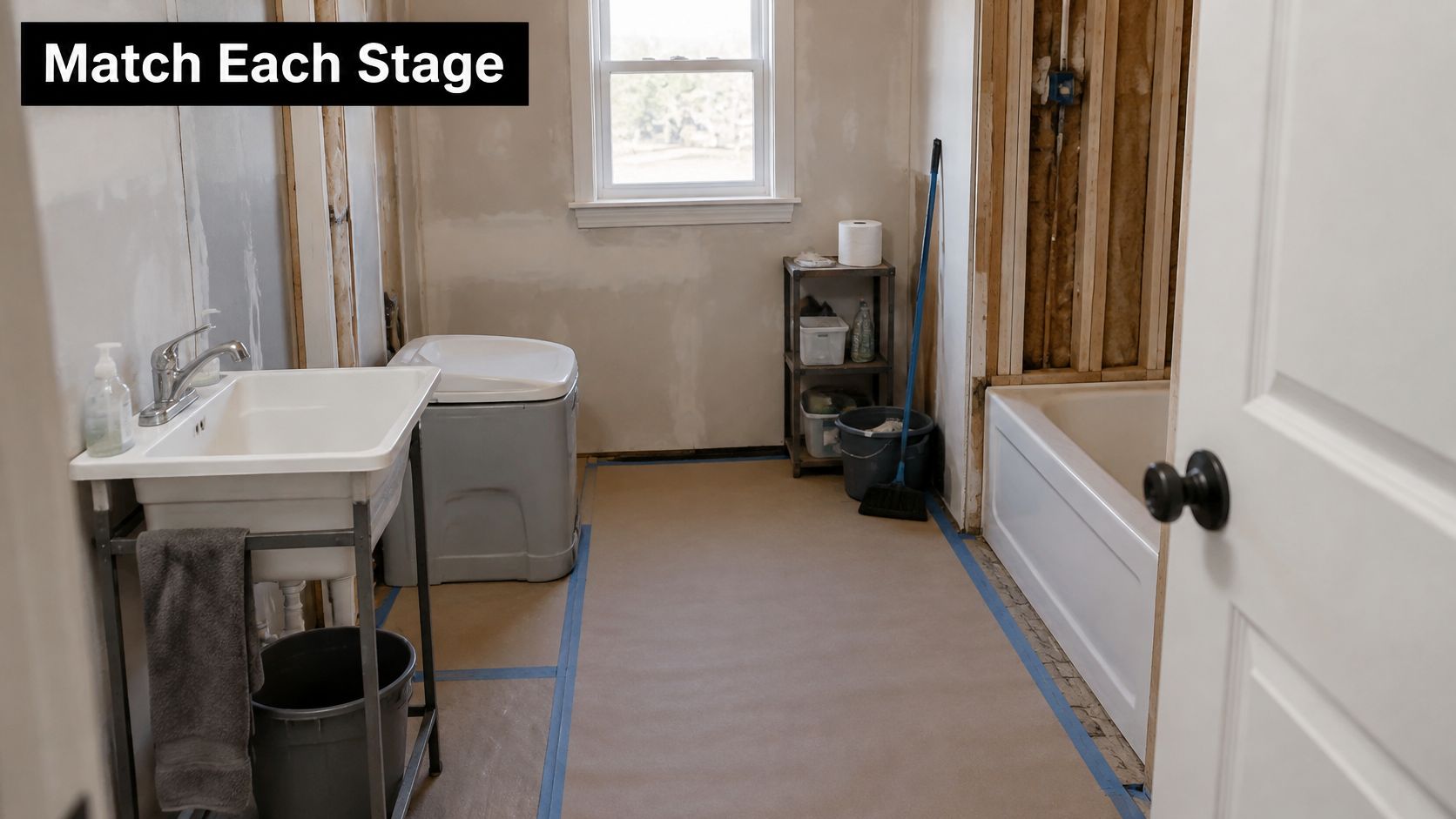
Renovation stage and temporary bathroom need
| Stage | Bathroom out of use? | Temporary arrangement needed |
|---|---|---|
| Consultation and design | No | Confirm the setup and its start date |
| Demolition | Yes | Alternative bathroom working before strip-out |
| Framing and structural work | Yes | Keep the alternative and access route for the whole stage |
| Plumbing and electrical rough-in | Yes, for wet areas | Licensed work; temporary power kept out of wet areas |
| Waterproofing and tiling | Yes | Ventilation and drying time before showering |
| Fixture installation and final finishes | Partly | Test permanent fixtures before moving back |
Schedule around service availability
During consultation, add a target end date and a release condition beside each stage. Demolition requires the alternative to be operational; framing requires the access route to survive changes to walls, floors and material storage.
Rough-in can affect services outside the bathroom. Heatwave Air Conditioning, Plumbing, & Electric's explanation of home remodel plumbing rough-in costs helps distinguish service work from fixture installation, but use your Victorian contractor's scope for budgeting.
Waterproofing and tiling aren't a suitable window for occasional showers in the unfinished room. Let the contractor confirm when the completed assembly is ready, rather than judging it by whether tiles look dry.
In most cases, homeowners can stay home during our renovations, although the bathroom is out of use and there may be noise and dust. If you're considering renovating a bathroom in stages, establish which facilities remain usable between stages.
For occupied rentals, include the Consumer Affairs Victoria rental minimum standards checklist in the planning paperwork. Stage completion doesn't excuse an interruption to required amenities.
How to Set Up a Temporary Bathroom Step by Step
Arrange the installation as a controlled handover between the household, builder and licensed trades. Plumbing and electrical rough-in is licensed work that repositions services for the new bathroom, so the temporary installation must be coordinated with it.
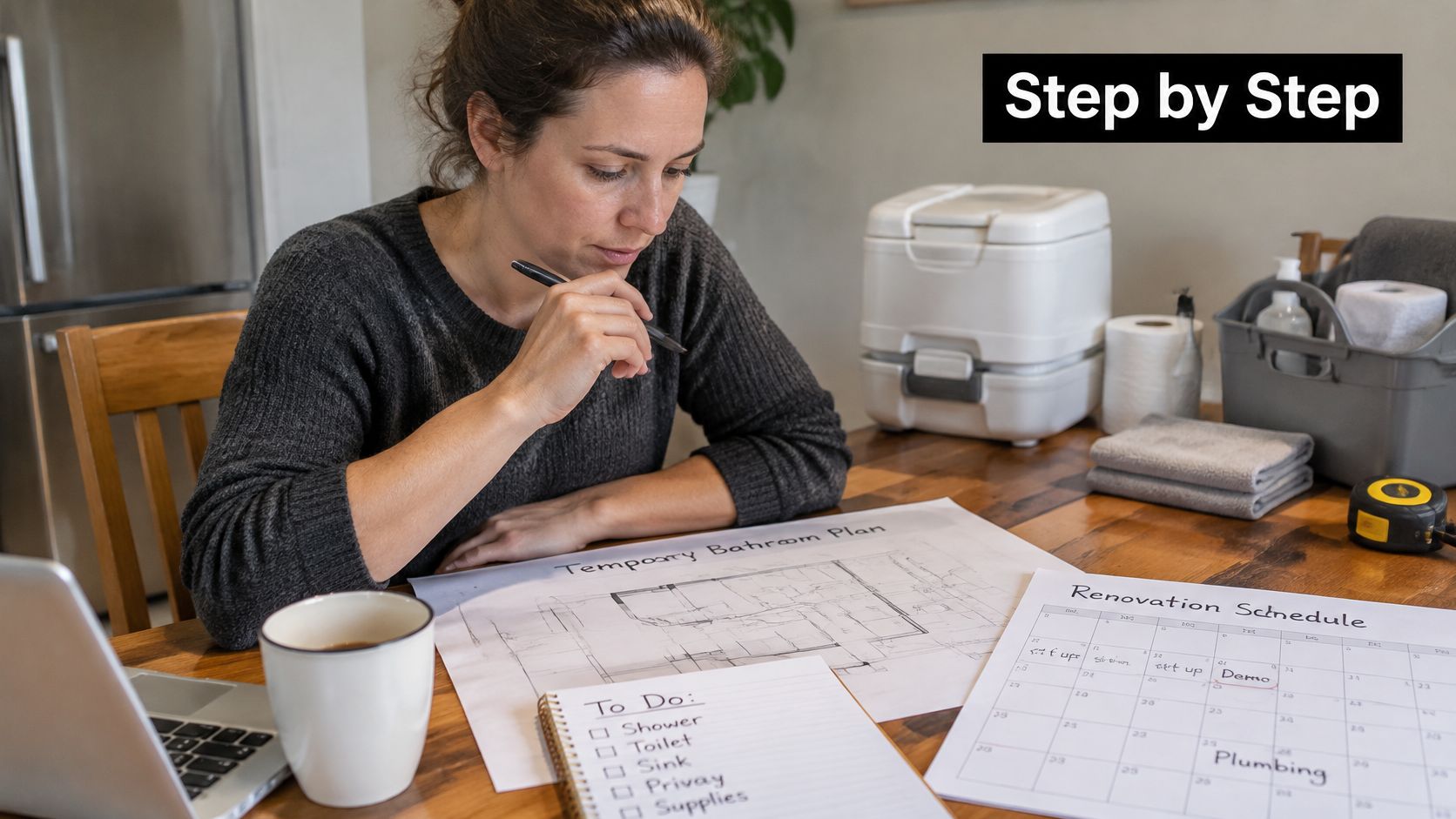
Write the work sequence. Record stage dates and the point when the existing toilet stops being usable. Avoid a schedule that says only demolition starts Monday, without identifying the service cut-over.
Prepare the alternative before disconnection. Have the unit delivered and its location assessed while existing facilities remain available. If you're borrowing facilities, obtain the key and confirm access hours. The common failure is assuming a booking confirmation means the household already has a usable toilet.
Separate residents from construction. Barricade the work zone with a controlled entry point and preserve a clear route. Keep tiles, tools and packaging out of hallways, stairs, exits and fire-equipment areas.
Isolate services under trade control. Arrange water and electrical shutdowns, then have the relevant trades isolate and lock out services before cutting or connecting. Nobody should rely on an unverified assumption that a pipe or cable is dead.
Install and certify temporary connections. Have licensed trades verify water, drainage, electrical and hazardous-material conditions, then install and test supply, drainage, leaks and electrical protection, keeping RCD-protected power out of wet areas. Under the Victorian framework described by the Building and Plumbing Commission, prescribed plumbing work includes work exceeding $750, with the compliance certificate generally due within five days of completion.
Check the complete service. Confirm the toilet, handwashing point and lighting are reachable and the waste route is approved. A shower that drains isn't enough if wastewater disposal or safe access remains unresolved.
Document the handover. Photograph the setup and record isolation times, emergency contacts and the person responsible for breakdowns. Keep those details accessible outside the work zone so a night-time failure doesn't turn into a search through building paperwork.
Keeping Hygiene and Daily Life Workable
A portable bathroom becomes difficult to live with when cleaning, supplies and household routines have no clear owner. Set a simple maintenance schedule before demolition, and agree who handles household cleaning and who arranges servicing.
Stock the hygiene kit
- Toilet paper: Store spare rolls in a closed, dry container beside the facility.
- Handwashing: Provide flowing potable water and soap at the handwashing point.
- Hand sanitiser: Keep alcohol-based sanitiser available for times when the handwashing point is temporarily out of service.
- Hand drying: Supply paper towels or a suitable air dryer.
- Waste tank: Follow the supplier's emptying schedule and arrange an earlier service if the tank reaches its stated capacity.
- Cleaning: Keep suitable cleaning supplies outside children's reach and follow the product directions.
For rental properties, check the minimum standards for rental properties in Victoria before choosing the temporary arrangement.
Protect the household routine
Keep the construction zone separate from occupied rooms. Fit plastic sheeting at the work-zone doorway without blocking the agreed exit route, and remove dust from the resident access route rather than sweeping it towards bedrooms.
Plan for daily use, especially at night. Keep ventilation openings clear, light the entire route including steps and changes in level, and set shower times around children's routines and shift work. Arrange pet washing separately so it does not block household shower access.
A carry caddy keeps toiletries together. Give each person a dry place for clothes and towels, or these items can end up cluttering the temporary space. The guide to living in a house during renovation covers ways to organise occupied rooms around construction.
A clean, reachable bathroom matters most after dark.
Test the Temporary Bathroom Before Demolition
Before demolition starts, run a full-day rehearsal with the permanent bathroom out of use. Keep it intact as a fallback until the test passes. This checks whether the setup works for the household, including child access, a place for dry clothes and a shower schedule that fits around work.
Use it like an ordinary day
Test the morning routine. Use the temporary toilet and handwashing facilities, then follow the household's expected shower sequence. Check that water drains without pooling and the hot supply stays steady.
Repeat access at midday and after dark. Carry the towels and children's clothing you'll need. Check that doors, gates and lighting work along the route, without requiring anyone to enter the construction zone.
Check the route during site activity. Confirm with the builder where deliveries and materials will go. A route that is clear during an empty-site inspection may be blocked when demolition equipment arrives.
Record failures and assign fixes. Note leaks, pooling, access problems and missing supplies, then name who will address each one. After a fix, repeat the task that failed and confirm it works.
Set a clear pass standard
The arrangement passes when everyone can use the facilities without relying on the permanent bathroom's tap, light, toilet or shower. Keep a record of the test and any corrections alongside the project paperwork.
Consumer Affairs Victoria's renovation checklist explains that homeowners remain responsible for checking approval requirements, even when a builder manages an application, and that required permits must be issued before work begins.
Contact SitePro Bathrooms to arrange an on-site consultation and measurement before setting your demolition date. Discuss your renovation goals, layout and budget, including how your new bathroom ideas affect the construction sequence and temporary facilities. Free quotes are available for bathroom renovation projects, so you can plan the rebuild and household arrangements together. Do not start strip-out until the rehearsal passes.