
Standard Cupboard Depth: Complete Guide for Australian Homes
Standard base cupboard depth in Australian kitchens is approximately 600 mm finished, including the doors, while wall cupboards are typically 300–350 mm deep. These are preferred conventions, not mandatory dimensions, so the right depth depends on the room, appliances, users and clearances.
You may be measuring a kitchen wall, comparing vanity ideas for a bathroom renovation, or standing in a compact Victorian home wondering why a cabinet marked “600 mm deep” appears to consume more space than expected. The confusion usually starts when a plan shows the cabinet carcass but the finished room has doors, benchtop overhangs, handles, plumbing gaps and appliance tolerances.
That hidden difference matters. A few centimetres can affect whether a dishwasher sits neatly under the benchtop, whether a bathroom door clears a vanity, or whether two people can pass comfortably through a narrow kitchen. Standard cupboard depth is a useful starting point, but it only works when you know exactly what the measurement includes.
Why Cupboard Depth Matters More Than You Think
A homeowner might measure from the wall to the front edge of an existing cabinet and record the result as the required depth. The new plan then specifies a carcass of similar size, but the finished doors project further, the benchtop extends beyond the cabinet front, and the handles become the final obstruction. The drawing may look correct while the actual walkway becomes noticeably tighter.
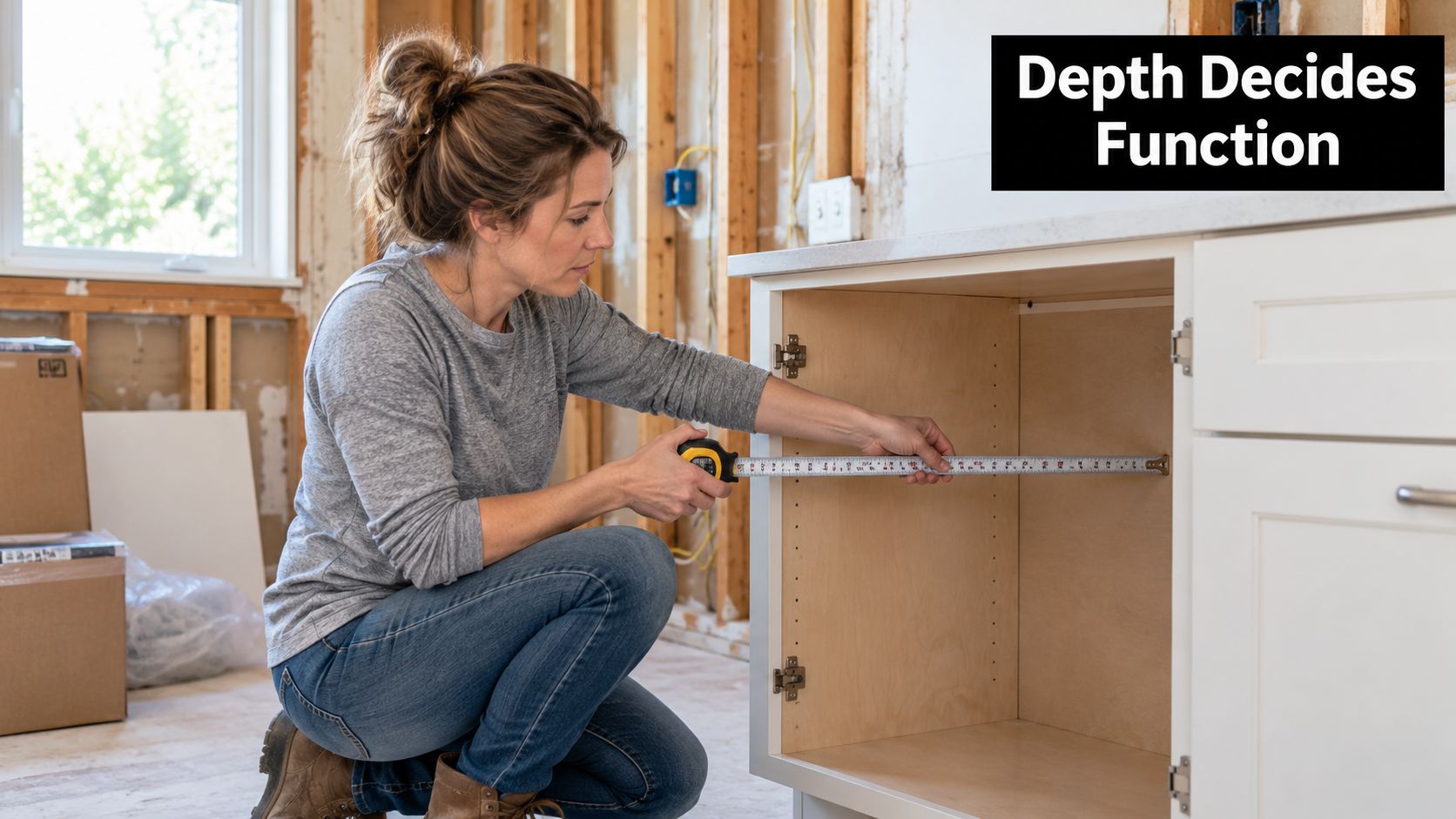
That mistake is common because Australian cabinetry uses several related measurements. The carcass depth describes the cabinet box. The finished cabinet depth includes the door or drawer front. The benchtop depth includes the work surface and its front overhang. Handles and service voids may sit outside all three.
Three measurements that control the room
Australian kitchen guidance places the foundational reference point for a floor or base cupboard at approximately 600 mm finished depth, measured from the front of the cabinet to the back. That generally includes the door or drawer front but excludes handles. The carcass itself is often about 560 mm deep, with the remaining depth allowing for the front and alignment with the benchtop. Australian cabinet dimension guidance also describes floor-cabinet widths in 150 mm increments, such as 300, 450, 600, 750 and 900 mm, which lets designers combine standard modules efficiently.
These are manufacturing conventions rather than compulsory dimensions. A compact Victorian kitchen may need a shallower run, while an uneven wall, deep sink or unusual appliance may justify a deeper unit. The measurement should serve the room, not the other way around.
Practical rule: Measure the complete projection, not just the box. Include doors, drawers, benchtop, handles and any service space behind the cabinet.
The same principle applies to a bathroom vanity. A vanity can look slim in a 3D concept but create a difficult pinch point once the basin, tapware, drawer fronts and door swing are installed. Before approving a layout, compare the finished projection with the clear floor area and the movement path into the room. A useful reference for coordinating the work surface is this guide to standard benchtop height.
Why the distinction prevents expensive rework
An appliance opening may be deep enough for the carcass but not deep enough for the appliance connection, ventilation requirement or door movement. A handle can collide with an opposite wall or another door. An end panel can finish short of the benchtop, leaving a visible misalignment that wasn't apparent on a basic floor plan.
The safest specification states the measurement in full. Write “600 mm overall finished depth excluding projecting handles” rather than “600 mm cupboards”. That wording gives the cabinetmaker, benchtop fabricator and installer the same reference point.
Base Cupboard Depth Decoded
For most Australian kitchens, the practical base-cupboard benchmark is approximately 600 mm overall depth, including the cabinet front but not projecting handles. It coordinates with the common 600 mm benchtop format and is sized around familiar under-bench appliances. Australian kitchen sizing guidance identifies a typical dishwasher cut-out depth of about 580 mm, which is why reducing the cabinet depth without checking the appliance can create problems.
The number becomes clearer when separated into layers:
- Carcass depth: often around 560 mm.
- Finished cabinet depth: the door or drawer front brings the cabinet close to 580 mm.
- Benchtop depth: the remaining allowance within the approximate 600 mm format provides a small front overhang and tolerance around handles.
The exact construction varies, but the planning lesson is consistent. A nominal cabinet size doesn't tell you how far the completed installation will project into the room.
Why appliances dictate the benchmark
Dishwashers and other under-bench appliances need a correctly sized opening, connection space and installation clearance. If custom cabinetry is made shallower, the appliance may project beyond the doors, sit awkwardly behind the benchtop line, or require a revised connection arrangement. A deeper cabinet can also create issues if the appliance door, adjacent drawer or end panel doesn't align.
Don't finalise the cabinet order from a nominal dimension alone. Use the appliance manufacturer's installation sheet and confirm the required depth, ventilation, service space and door movement. The same approach applies to ovens, integrated bins, sinks and plumbing components.
A shallow base unit can work well in a narrow kitchen, laundry or apartment, but it should be designed as a complete system. The benchtop, drawers, sink, splashback and appliance opening must all follow the revised line. Trimming the cabinet box while keeping standard doors and appliances often produces the worst of both options, reduced storage without a clean finished alignment.
What the room actually consumes
The cabinet projection affects more than the straight walkway. Open dishwasher doors occupy the circulation zone. Drawer fronts need clearance to pull out fully. Handles can catch clothing or strike an opposite cabinet. A benchtop overhang may be comfortable at one end but create a conflict beside a doorway.
Before selecting a deeper base, mark the full finished line on the floor with tape. Include the door front, handle projection and benchtop edge. Open the nearby doors and drawers, then walk through the space while another person stands at the preparation area. This simple mock-up often reveals a problem earlier than a polished drawing.
For homeowners comparing layouts, kitchen cabinet sizes should be treated as a starting point for coordination, not as permission to ignore the actual room. Standard modules help control cost and simplify installation, but compact spaces often reward carefully adjusted dimensions.
A 560 mm carcass isn't a 560 mm room projection. The finished installation is the dimension that affects your knees, doors and walking path.
Wall Cupboard and Overhead Storage Depths
Wall cupboards need a different approach from base units. Australian overhead cupboards commonly range from approximately 300–450 mm deep, with 300–350 mm frequently used as the standard planning range. Australian overhead cupboard guidance explains the ergonomic reason for the reduced depth. Wall units need to store plates, glasses and pantry goods without projecting so far into the preparation area that they reduce head clearance.
The external depth isn't the usable shelf depth. Cabinet backs, sides and doors reduce the clear internal space, with approximately 280 mm identified as a useful internal-clearance benchmark in Australian kitchen sizing guidance. That can be ample for ordinary kitchenware, but it won't suit every appliance, oversized serving dish or deep storage container.
Measure from the finished face
Measure an existing wall cupboard from the wall to the front of the door, then record the internal shelf depth separately. If you only measure the shelf, you may underestimate the space occupied by the sides, back and door. If you measure only the external box, you may overestimate what can be stored.
When planning new units, check four points:
- Front projection: Include the door or lift-up front.
- Internal clearance: Allow for the back panel and cabinet construction.
- Head position: Consider where people stand while chopping, washing and reaching.
- Adjacent conflicts: Check windows, rangehoods, tall cabinets, doors and light switches.
A 300 mm wall cupboard usually feels lighter and keeps the work zone visually open. Increasing the depth can add capacity, but it also brings the front edge closer to the user's head and shoulders. That trade-off is particularly important above a busy preparation area or in a narrow galley kitchen.
Choose storage around reach, not volume
Deep overhead storage looks efficient on a plan because it creates more shelf area. In use, rear items may become difficult to see and reach, especially for shorter users or anyone with limited shoulder movement. The result can be a cupboard that technically holds more but gets used less effectively.
The same logic applies to height. Frequently used plates, glasses and cooking supplies should sit where the household can reach them comfortably. Reserve harder-to-access areas for occasional items, and use internal organisation to prevent the rear of the cupboard becoming a dead zone.
Wall units may be deeper where the room is generous or where a specific storage need justifies the change. They shouldn't automatically match the base-cupboard depth. Base units sit below the work surface and can be approached from above. Overheads occupy the user's face and shoulder zone, so their depth has a direct ergonomic effect.
When Standard Depth Is Not the Right Choice
A standard cupboard depth can look fine on a plan, then feel oversized once plaster, tile, doors, handles and walking space are all counted. In older Victorian kitchens and bathrooms, that difference between the nominal cabinet size and the room it consumes is often what makes the layout work or fail.
The standard size suits many rooms, but it is not the automatic best choice. A deep overhead can push the front edge into the user zone. A deep base unit can also force more bending and longer reaches if the storage relies on shelves instead of drawers.
That matters most in tight renovations.
Australian accessibility guidance focuses on circulation space, suitable storage heights, operable doors and adaptability for people with different strength, dexterity and mobility needs. It also refers designers to AS 1428.1, AS 1428.2 and AS 4299 as relevant standards. Australian accessibility guidance supports designing around the person using the room, rather than assuming one nominal depth will suit every household.
Compare the practical options
| Space Type | Recommended Depth | Best For |
|---|---|---|
| Compact kitchen base | Shallower than the standard benchmark where required | Preserving circulation in narrow rooms |
| Conventional kitchen base | Approximately 600 mm finished | Coordinating benchtops and under-bench appliances |
| Kitchen wall cupboard | Approximately 300–350 mm | Everyday plates, glasses and pantry goods |
| Deeper overhead storage | Up to approximately 450 mm where justified | Larger rooms and specific storage requirements |
| Bathroom or laundry unit | Confirmed through room and appliance measurements | Balancing storage, plumbing and movement |
Shallower cabinetry often earns its place beside a doorway, along an irregular wall or in a narrow galley where every millimetre affects movement. You give up some internal volume, but you gain a clearer route through the room and fewer knocks at hips, shoulders and handles. In many renovations, that trade-off is worthwhile because the room gets easier to use every day.
Storage efficiency is not just about depth. Internal fit-out changes the result. Full-extension drawers, pull-outs and adjustable shelves usually make better use of a reduced cabinet than a deeper box with hard-to-reach rear space. Where a shallower base unit is the right call, drawer proportions change too. See our guide to standard kitchen drawer depth.
Match the cabinet to the user
For ageing-in-place work, households with mixed heights, or anyone using a mobility aid, test reach and approach before cabinetry is locked in. A full-depth cabinet with a fixed back shelf can store more on paper and less in practice. A shallower unit with drawers often gives better day-to-day access. In a bathroom, I regularly find that a compact vanity works better than a larger model that narrows the approach to the basin or crowds the toilet pan and shower screen.
More storage isn't automatically better storage. The useful capacity is what people can reach, identify and return without strain.
Mock up the finished projection before you commit. A taped floor line, a cardboard cabinet face or a 3D model will show you far more than a plan view. SitePro Bathrooms provides concept development and detailed 3D design as part of its renovation service, which helps homeowners check proportions, clearance and access before construction starts.
Bathroom and Laundry Unit Depth Considerations
Bathrooms and laundries rarely have the spare floor area of a generous kitchen. A vanity, toilet, shower screen, washing machine and door can all compete for the same narrow movement path. Standard kitchen cupboard depth therefore shouldn't be transferred directly into a wet-area design without checking the finished projection.
Compact ensuite vanities often need a shallower solution, while a family bathroom may have room for a more substantial unit. The choice affects basin size, drawer capacity, plumbing access, towel storage and the distance between the vanity front and nearby fixtures. In modern bathrooms and designer bathrooms, the visual appeal of a deep floating vanity can be strong, but the room still has to work when the door is open and two people are moving through it.
Laundries are appliance-led
Laundry cabinetry should be designed around the actual washing machine and dryer installation requirements. The cabinet depth needs to accommodate the appliances, hoses, power connections, ventilation and any doors or benchtops that sit in front of them. A sink unit may need a different internal arrangement because the plumbing occupies the space that would otherwise be available for drawers.
Don't assume a machine that fits within the cabinet depth can be enclosed safely. Confirm the manufacturer's required clearances, door movement and ventilation before designing overheads or a continuous benchtop. A shallow benchtop may work over one appliance configuration but fail when machines are stacked, integrated or placed beside a deep sink.
Renovation design and Victorian requirements
Cupboard depth is only one part of a bathroom renovation. In Victoria, a project costing more than $10,000 generally requires the contractor to be registered with the Building and Plumbing Commission, and the threshold includes labour and materials. Registration is also required for structural work or work requiring a building permit, regardless of project value. Victorian guidance on builders and tradespeople also makes clear that homeowners remain responsible for checking required planning and building permits.
A larger project may involve demolition, carpentry, waterproofing coordination, tiling, cabinetry and plumbing. Ask who is managing each trade and how the finished vanity or laundry unit will coordinate with waterproofing, pipe locations and access panels.
A Domestic Builder, Unlimited, or DB-U, registration is broader than a limited trade registration. A registered practitioner can personally carry out, manage or arrange subcontractors for all domestic building work, subject to the relevant approval. For a multi-trade bathroom project, confirm that the practitioner has received BPC approval before work starts, rather than relying on a submitted application. The Victorian registration checklist provides the relevant registration information.
Verifying Your Cupboard Depth Before You Commit
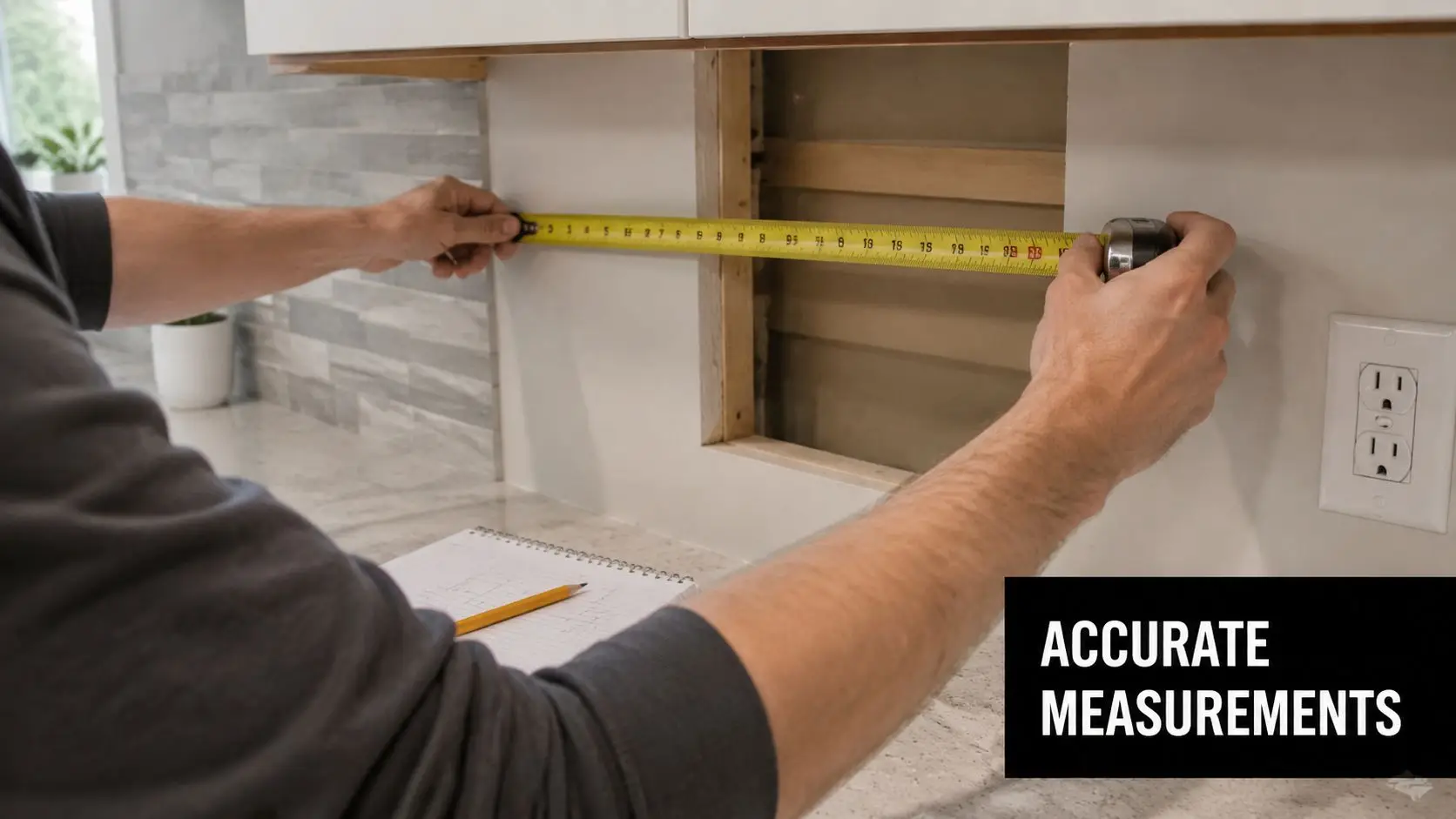
A good plan begins with measurements taken from the finished room, not just a catalogue dimension. Before approving cabinetry, record the wall condition, floor line, appliance requirements and every item that projects into the room.
Use this verification sequence
- Measure the wall in several places. Check for uneven plaster, tiles, cornices, skirtings and wall irregularities. The narrowest usable point may control the design.
- Record carcass, finished cabinet and benchtop depths separately. Add doors, drawer fronts, handles and the benchtop overhang rather than treating them as one unexplained number.
- Measure appliances at the installation point. Include doors, hoses, plugs, pipes, service voids and ventilation requirements.
- Mark the finished line on the floor. Use tape or a temporary board to show the proposed cabinet face and benchtop edge.
- Open everything. Test drawers, dishwasher doors, washing-machine doors, bathroom doors and nearby cupboards at the same time.
- Review access in a 3D model or mock-up. Check reach, head clearance and the path around the cabinet, not just the elevation.
Before you order, ask for the finished projection in writing. “Standard depth” isn't precise enough for a tight Victorian renovation.
Keep the appliance installation documents with the final cabinet drawings. If the design changes from the standard benchmark, note the revised depth, internal clear space and any effect on adjoining panels or services. A careful check before construction is far cheaper than altering a cabinet run after benchtops, tiles and plumbing are complete.
For Victorian bathroom renovations involving more than one trade and costing over $10,000, a written major domestic building contract is required before work starts. Victorian contract guidance also explains that only registered builders can enter this type of contract and obtain the required domestic building insurance for work over $16,000. Where a building permit is required, the owner must arrange the appropriate surveyor process and written authority if a builder is helping with the application. Victorian plans and permits guidance explains that a building permit is written approval confirming that the plans and specifications comply with building regulations.
If you're planning a kitchen, laundry or bathroom renovation in Highett or greater Victoria, contact SitePro Bathrooms to discuss the finished cupboard depth, appliance clearances, 3D layout and project requirements before construction begins. Bring your room measurements and appliance specifications so the design can be tested against the space, not just selected from a standard size chart.