

You're probably in the middle of it now. Tiles saved to a mood board, tapware options open in six browser tabs, and a running debate in the household about whether to go classic or low-maintenance. For years, one of the standard questions in bathroom renovations was simple: marble or quartz?
That used to be a fair question.
If you were planning modern bathrooms or higher-end designer bathrooms in Victoria, engineered quartz often sat in the practical corner, while marble carried the visual appeal. One promised consistency and easier day-to-day care. The other brought movement, depth, and the kind of natural variation that gives a room real character.
Then Australia changed the conversation.
Homeowners looking at new bathroom ideas in Highett and across Victoria now have to make material decisions in a very different market. The old comparison still matters from a design and performance point of view, but it no longer works as a straight shopping exercise for new projects. The legal position changed, and that has real consequences for what can be specified, fabricated, supplied, and installed.
That shift has caught plenty of people off guard. They've fallen in love with a bathroom vanity look online, only to discover the material behind it isn't an option for a compliant new renovation here anymore. So the better question in 2026 isn't just marble or quartz. It's what gives you the look, durability, compliance, and long-term value you need in a Victorian home today.
The Renovation Dream Meets a New Reality
A lot of renovation decisions begin the same way. A homeowner wants a bathroom that feels cleaner, calmer, and more considered than what they've got now. They start collecting new bathroom ideas. Maybe it's a fluted vanity, brushed brass tapware, or full-height stone on the shower wall. The surface choice usually becomes the turning point because it affects the look, the budget, and how the room performs every day.
For a long time, marble and quartz sat at opposite ends of that decision. Marble appealed to people who wanted authenticity and a softer, more natural finish. Quartz appealed to people who wanted a neater, more uniform surface that could handle a harder-working routine. In family homes, especially, that sounded like an easy trade.
It isn't anymore.
What changed for Victorian homeowners
The biggest difference is that the material conversation now sits inside a compliance conversation. That matters whether you're planning a compact ensuite refresh or a larger renovation tied into kitchens and bathrooms at the same time.
Australia became the first country globally to implement a ban on all engineered stone, which primarily consists of quartz, effective July 1, 2024, and that ban prohibits the use, supply, and manufacture of engineered stone materials across the nation, including Victoria, according to the AIHA summary of Australia's engineered stone ban.
That means the old showroom comparison doesn't tell the full story anymore. You're not just choosing between two surfaces on appearance and maintenance. You're choosing from the materials that can be used for a compliant new project.
Practical rule: If a renovation decision was routine before mid-2024, check that it's still legal and available before you design around it.
Why this matters in real projects
This shift has changed how selections happen on site. Instead of asking whether engineered quartz beats marble for a vanity top, the better discussion is where marble works best, where other natural materials may be smarter, and how to detail the room so it still suits your household.
That's especially relevant in bathroom renovations where every material is doing more than one job. It has to look right, cope with moisture, fit the style of the home, and hold up to the way the room is used in practice. A surface that works beautifully on a feature wall may be the wrong choice for a benchtop edge around hair tools, toothpaste, and cosmetics.
For anyone planning modern bathrooms in Victoria now, the new standard is practical selection. Not trends for their own sake. Not old assumptions carried forward. Just materials that make sense in the post-2024 Australian market.
Marble and Quartz At a Glance
Before looking at what the ban means in practice, it helps to understand why this was such a common comparison in the first place. Marble and engineered quartz solved different problems, and that's why homeowners often ended up torn between them.
Here's the quick version.
Quick Comparison Marble vs Engineered Quartz (Pre-Ban)
| Feature | Natural Marble | Engineered Quartz (Pre-2024 Ban) |
|---|---|---|
| Material type | Natural stone | Engineered composite |
| Appearance | Unique veining and natural variation | More controlled and consistent appearance |
| Hardness for high-traffic bathroom vanity use | Mohs 3 to 4 | Mohs 7 |
| Scratch and abrasion resistance | Lower resistance in hard-working vanity zones | Higher resistance to daily styling tools and cosmetic wear |
| Reaction to acids | Prone to etching from common bathroom acids | Resistant in normal household bathroom use |
| Porosity | Porous natural material that needs care | Non-porous engineered composition |
| Sealing | Usually part of good maintenance practice | Doesn't require periodic sealing in the same way |
| Best visual role | Luxury statement surfaces, feature applications | Clean-lined practical work surfaces |
| Current status in Australia for new projects | Available | Banned engineered stone category |
In the Australian market, for high-traffic bathroom vanity applications, engineered quartz has a Mohs hardness rating of 7, while natural marble sits between 3 and 4, making quartz 75% harder, according to Forever Built's quartz vs marble comparison.
What marble brings to a renovation
Marble is a natural stone, and that matters visually. No two slabs are exactly the same. The veining shifts, the background tone changes, and the finish can feel crisp or soft depending on the cut and treatment. In bathrooms, that gives the room depth that manufactured materials often struggle to copy convincingly.
The trade-off is that marble asks more of the homeowner. It's softer than engineered quartz and more vulnerable to etching and marking in the wrong location. In practical terms, that means it rewards good design placement.
Why quartz became so popular before the ban
Engineered quartz was popular because it offered predictability. The composition noted in the source above describes it as an engineered mix of 90 to 93% crushed stone with 7 to 10% polymer resin, which is part of why it became known for consistency and resistance in high-touch areas.
For many households, especially busy family homes, that combination was attractive. It suited vanity tops, integrated basins, and other areas where people wanted a durable, easy-to-manage finish.
Marble wins on individuality. Pre-ban quartz won on predictability. That's why the choice was never only about style.
Today, though, that older comparison mainly helps with understanding the trade-offs. It doesn't restore engineered quartz as a legal option for a new Australian renovation.
The 2024 Engineered Stone Ban Explained
The most important fact for any homeowner planning a renovation in Victoria is straightforward. Engineered stone is no longer part of the standard specification conversation for new work.
What the ban actually means
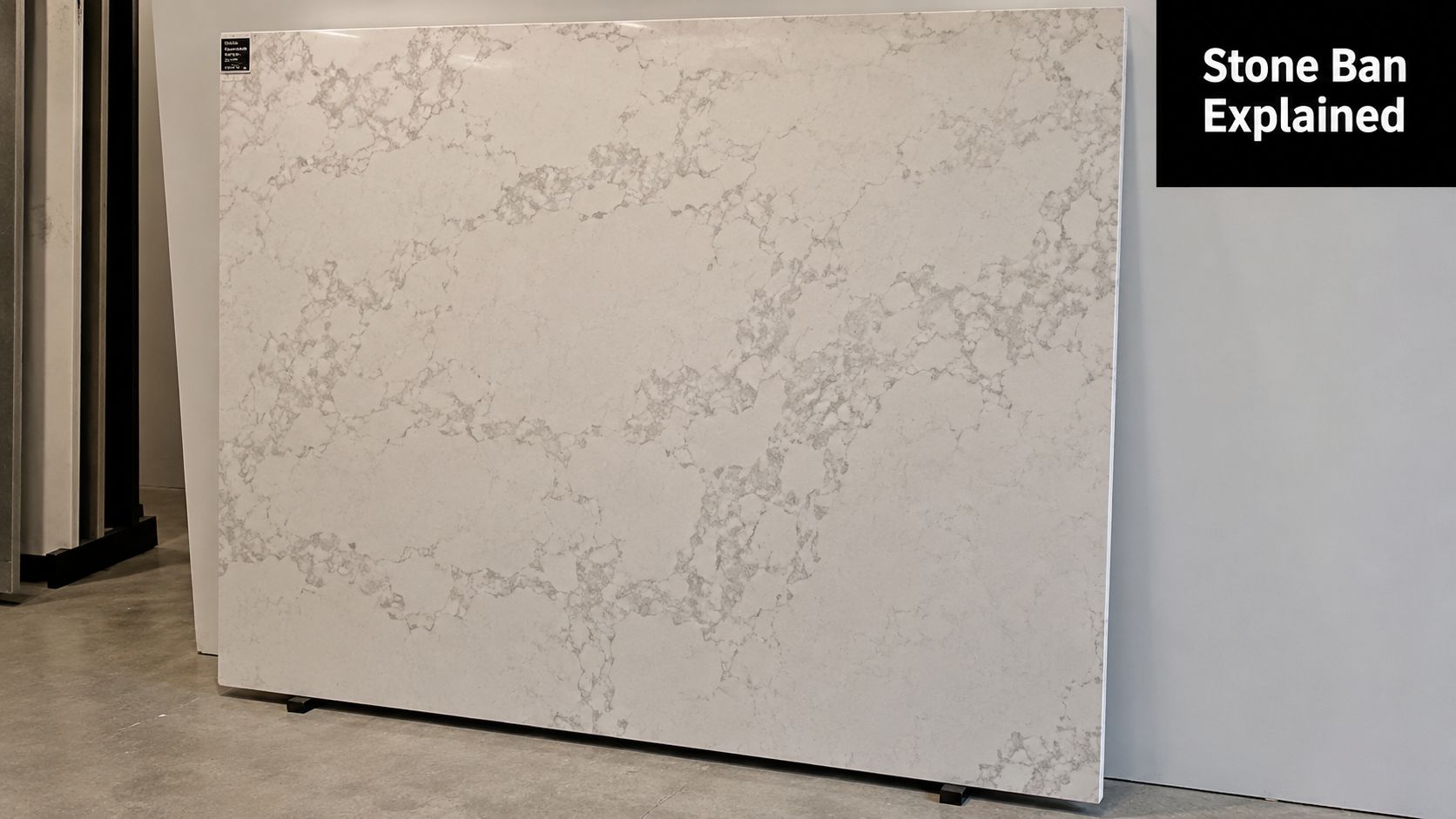
Australia became the first country globally to implement a full ban on all engineered stone, primarily quartz, effective July 1, 2024. The ban prohibits the use, supply, and manufacture of engineered stone materials across the entire country, including Victoria, as outlined in the AIHA coverage of the national engineered stone ban.
For homeowners, the practical effect is simple. If you're renovating now, you can't treat engineered quartz as a normal benchtop option for a new compliant project. That removes one half of the old marble or quartz debate.
If you're still weighing broader surface choices, it helps to understand the compliant alternatives through guides on kitchen benchtop materials, because the right replacement depends on where the surface is going and how hard it will be used.
Why Australia made the change
The ban wasn't a style decision. It was a health and safety decision.
The reason given was the severe health risk associated with silica dust exposure during cutting and processing. That dust can cause silicosis, a fatal lung disease. From a building point of view, that matters well beyond the workshop. It changes what responsible specification looks like. A material isn't only judged by how it performs after installation. It also has to be considered in terms of how it's fabricated and handled before it ever reaches the home.
What this changes on a real job
At this point, clients usually need the straight answer. No, the old assumption that engineered quartz is the practical default for a vanity top doesn't hold anymore. No, leftover stock isn't a loophole for a new project. The regulation applies across the material lifecycle, including supply and installation after the commencement date.
That forces a more thoughtful process, which is a good thing if it's handled properly.
Instead of repeating old habits, renovation planning now needs to answer three practical questions:
- Where will the surface be used. A vertical feature wall and a heavily used vanity top are not the same specification problem.
- How much wear will it take. Daily family use, occasional guest use, and premium showcase bathrooms all need different thinking.
- What's the best compliant material for that zone. In many projects, that points away from a one-material-everywhere approach.
The ban didn't just remove a product category. It pushed better material planning to the front of the renovation process.
For Victorian homeowners, that's the key shift. The question isn't how to keep choosing the old favourite. It's how to build a room that still looks excellent, performs properly, and stays compliant.
A Room by Room Guide to Using Marble
Once engineered quartz drops out of the equation for new projects, marble becomes less of a luxury wildcard and more of a serious design tool. The key is using it where it performs well and not forcing it into every role just because you love the look.
Marble in bathrooms
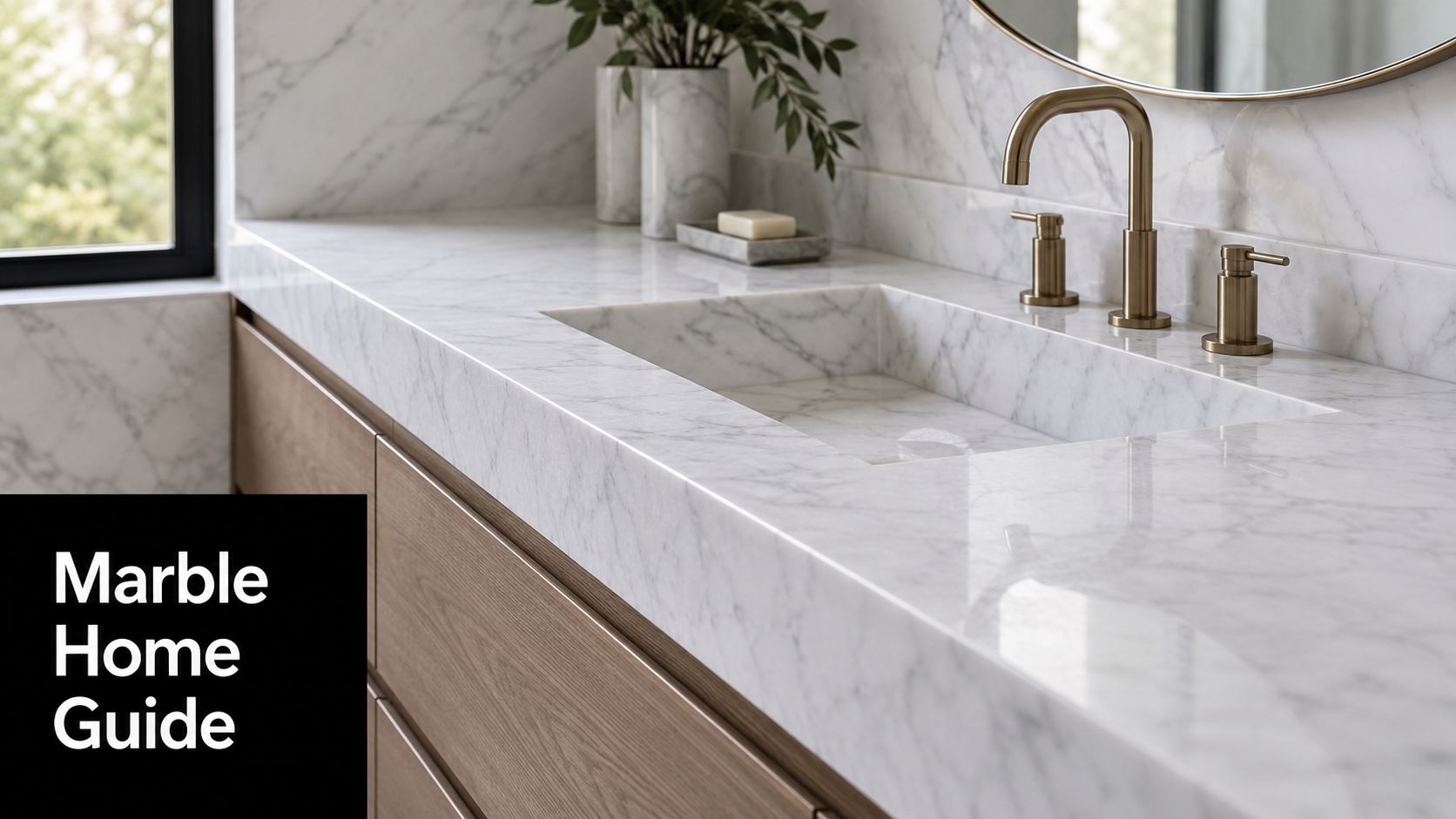
Bathrooms are where marble can be brilliant, provided the specification is disciplined. In the AU region, engineering guidance recommends using marble for vertical wall cladding and low-touch feature walls, while quartz was previously recommended for high-touch vanity countertops and integrated basins, according to the engineering guide on quartzite vs marble for high-end bathrooms.
That older split still gives useful design logic even though the quartz side of it is no longer available for new Australian work. The lesson is the important part. Marble performs best in protected or lower-contact bathroom zones.
In practical terms, marble works well in:
- Feature walls where the veining can do the visual heavy lifting
- Shower wall cladding when detailed and maintained properly
- Powder room splashbacks where impact and product exposure are lower
- Low-touch vanity surrounds in bathrooms that aren't under constant family pressure
If you're exploring bathroom styling options, a look at kitchen benchtop styles can be useful too, because edge profiles, slab layouts, and finish choices often translate well into vanity and wall design decisions.
Where marble struggles in wet zones
Marble is porous. That doesn't make it a bad bathroom material. It means the details matter.
A bathroom vanity used by adults who wipe surfaces down, store products neatly, and don't leave acidic spills sitting around is very different from one used by school-aged kids during a weekday rush. Toothpaste, skincare, cosmetics, wet razors, and hair tools create a much harder environment than a showroom display suggests.
That's why some of the best marble bathrooms use restraint. Instead of trying to put the same slab on every horizontal surface, the room is designed so marble carries the luxury in the visual zones while tougher compliant alternatives handle the rougher tasks elsewhere.
On site advice: The best marble bathrooms rarely depend on marble doing everything. They rely on marble doing the right things.
Marble in kitchens
Kitchens ask different questions. Here, marble's appeal often comes from its natural pattern and its ability to age with the home rather than feeling overly manufactured. It also has one practical upside that gets overlooked in generic low-maintenance discussions. The source material on family use notes marble's superior heat resistance and repairability, which is part of why it can still suit active households when owners understand the care involved, as discussed in the marble vs quartz countertop analysis.
That doesn't mean marble is carefree. It isn't. Benchtops in cooking zones need realistic expectations about staining risk, acid sensitivity, and visible wear over time. But if a household values a lived-in natural finish and is happy with the maintenance routine, marble can still be a very strong kitchen material.
A few kitchen-specific realities matter:
- Hot cookware isn't the main risk. Acidic food prep and neglected spills are usually the bigger issue.
- Repairs are possible. Marble can often be refinished in ways that suit owners who value longevity over perfection.
- Patina is part of the result. Some people love that. Some don't. It's worth being honest before you commit.
Best uses in modern bathrooms and designer bathrooms
Marble still has a clear place in modern bathrooms and designer bathrooms because it solves a visual problem better than most materials. It adds movement without clutter. It can anchor a pared-back palette. It also works with the earthy tones and organic textures that shape many new bathroom ideas in Australia for 2025, alongside water-saving fixtures such as low-flow showerheads and dual-flush toilets, according to Beau Reno's 2025 bathroom trends overview.
The marble applications that usually work best are:
- Large-format wall slabs for a continuous, quieter look with fewer visual breaks
- Book-matched feature walls where the stone pattern becomes the focal point
- Vanity splashbacks that bring luxury without exposing the material to the harshest wear
- Niche detailing and trim elements where small amounts of marble lift the whole room
When marble is placed well, the room feels richer without becoming fragile. When it's overused in the wrong zones, homeowners end up managing the material instead of enjoying the renovation.
Budgeting and Installing Your Marble Features
The design side is the enjoyable part. Budget and installation are where the renovation becomes real.
Marble should be treated as a material decision and a workmanship decision together. The slab itself matters, but the result, and thus the success or failure of many bathroom renovations, depends just as much on template accuracy, substrate preparation, edge finishing, handling, sealing, and how the joins are planned.
Where marble sits inside renovation budgets
In Victoria, a basic bathroom remodel averages about $18,500, while simple bathroom renovations across Australia typically cost $15,000 to $25,000, according to the SitePro guide to simple bathroom renovation costs.
For broader market context, modern and designer bathrooms in Australia commonly fall into these price bands: $8,000 to $15,000 for budget refreshes, $15,000 to $35,000 for standard mid-range projects, and $35,000+ for premium bathrooms. In Melbourne, mid-range costs for an 8 m² bathroom run from $22,000 to $38,500, based on the Melbourne apartment bathroom renovation pricing guide.
That tells you where marble usually fits. It's rarely the right choice for a bare-bones cosmetic refresh. It becomes more realistic in standard and premium projects where the budget allows for better fabrication, careful detailing, and surrounding finishes that match the quality of the stone.
If you're trying to map selections to a workable spend, start with a proper bathroom remodel budget plan before locking in slab choices.
Why installation matters more than people expect
Marble is heavy, brittle at vulnerable points, and unforgiving of poor support. A good install protects both the visual finish and the long-term performance of the room.
The problems usually don't come from the obvious places. They show up in unsupported overhangs, weak corners around cut-outs, uneven wall lines behind slab cladding, poorly planned joins, and rushed sealing. In bathrooms, they also appear where the design ignores water movement and cleaning patterns.
That's why installation should be handled by the right level of licensed professional. In Australia, registered builders unlimited refers to a building practitioner registration that allows residential building work without a monetary cap on project value. The same source notes that bathroom renovations exceeding $26,000 should be conducted by licensed professionals with full regulatory accountability, as explained in this overview of bathroom renovation costs and builder registration.
What works and what doesn't
A useful way to think about marble installation is to separate smart investment from false economy.
Works well
Accurate slab planning: Vein direction, cut placement, and edge treatment are resolved before fabrication.
Targeted use: Marble is allocated to the zones where it adds the most impact and least maintenance stress.
Skilled installation: The support, substrate, waterproofing relationships, and final sealing are treated as part of one system.Usually causes problems
Forcing marble into every surface: That often creates avoidable maintenance headaches.
Choosing on sample only: Small hand samples don't show movement, tone shifts, or how a full slab will read in the room.
Treating stone install like ordinary joinery work: It isn't. Tolerances, weight, and finishing requirements are different.
Cheap stone decisions often become expensive corrections. Good planning costs less than replacing cracked pieces, reworking joins, or living with a result that never looked right.
Our Final Verdict for Your Home Renovation
The old marble or quartz debate made sense when both products were available for normal specification. In Australia now, that's no longer the reality for new work. The smarter question is which compliant surface gives you the right balance of beauty, performance, and long-term value.
If you care most about appearance
Marble still leads. If you want depth, natural veining, and a finish that doesn't look mass-produced, it remains one of the strongest choices available. In the right location, it gives modern bathrooms and designer bathrooms a level of character that's hard to fake.
This is especially true when the room design is disciplined. Use marble where the eye lands first, and don't ask it to be the answer to every practical problem.
If you care most about long-term value
Marble deserves more credit here than it usually gets. The resale side of the conversation is often oversimplified. The stronger long-view argument is that marble can be indefinitely restored and appreciates with age, potentially adding greater long-term property value in Victoria's premium housing markets, according to this analysis of marble's resale value longevity.
That won't make marble right for every home. But for owners thinking beyond short-term convenience, restorability matters. A surface that can be renewed has a different kind of lifespan from one that is only attractive while factory-fresh.
If you've got a busy household
Prioritize honesty over aspiration. If the bathroom gets hammered every morning, if products are left out, and if no one wants to think about surface care, then marble should be used selectively rather than everywhere. Put it where it can shine without becoming a burden.
That's the practical conclusion in Victoria after the ban. The conversation has shifted from marble or quartz to marble or other natural stones, with the final answer depending on where the material is going and how your home runs.
A good renovation doesn't chase an old favourite that no longer fits the market. It uses the right material in the right place and gets the detailing right from the start.
If you're planning bathroom renovations in Highett or greater Victoria and want clear advice on compliant materials, layout, budgeting, and finishes, SitePro Bathrooms can help you plan your renovation from concept through to completion.