
Timeless Bathroom Design Guide for Victorian Homes
The worst advice about a bathroom is that timeless means beige, safe, and forgettable. In real Australian homes, especially where humidity, hard water, and daily wear are part of the job, a bathroom stays current because it's easy to clean, structurally sound, and built from finishes that don't age badly. Trendy tiles can look sharp for a season. A room that wipes down quickly, drains properly, and doesn't grow mould in the corners lasts for years.
That's the practical test. A timeless bathroom design isn't a style mood, it's a maintenance outcome, backed by choices that still make sense when the novelty wears off and the cleaning starts getting real.
What Timeless Bathroom Design Actually Means
Timelessness gets reduced to neutral colour and a few polite fittings, but that's too shallow for a room that lives in steam, soap residue, and constant traffic. A bathroom isn't a living room with a sink in it. It's a wet working space, and the things that last are the things that resist wear, clean easily, and don't depend on a passing style to look intentional.
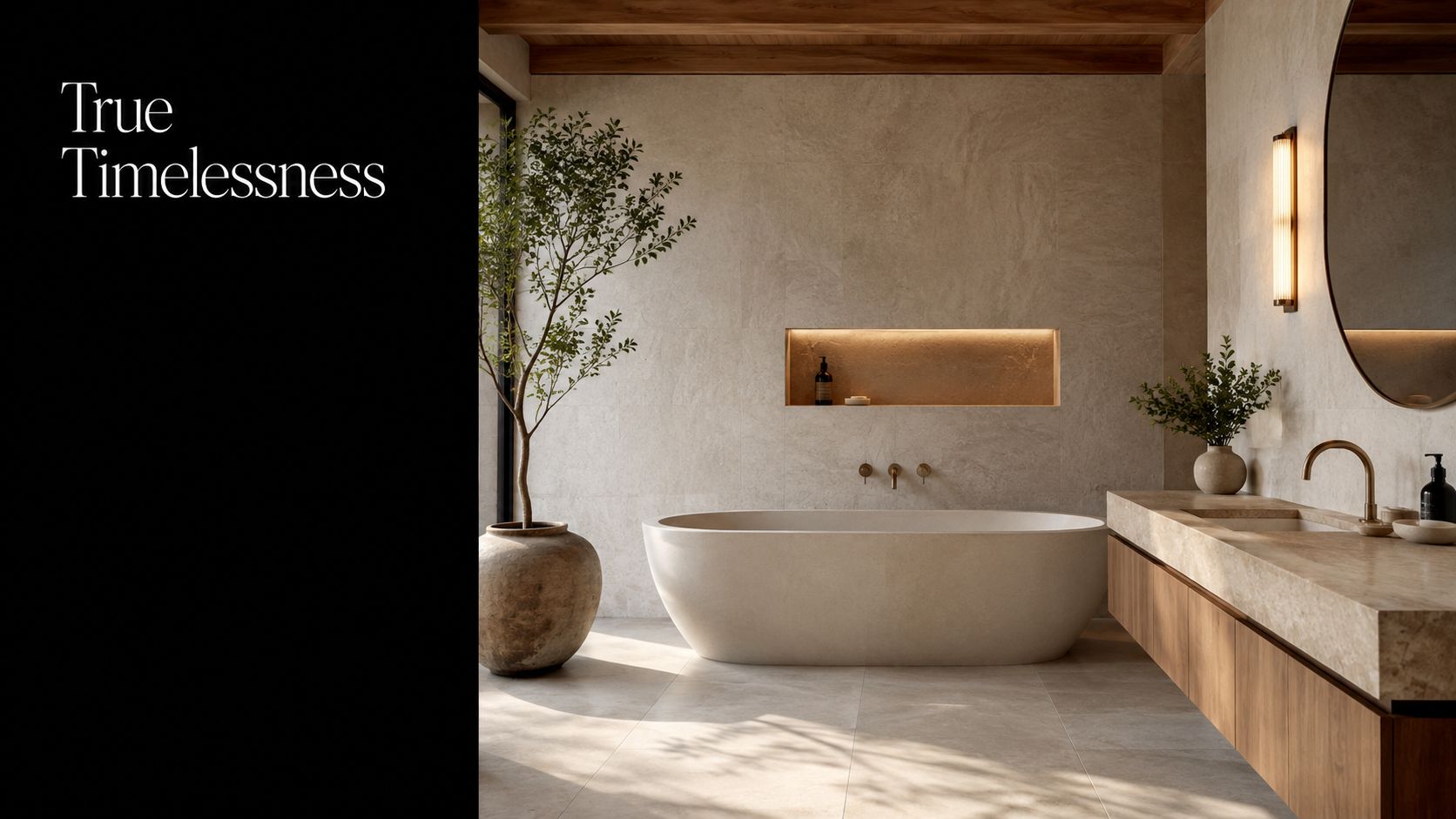
Cleanability beats decoration
A bathroom that stays attractive over time is usually the one with fewer places for grime to settle. That means simple junctions, low-porosity surfaces, and details that don't trap soap scum in decorative grooves. In practice, a room with visual restraint also tends to have less maintenance, which is why it reads as timeless long after trend-led rooms start looking tired.
Practical rule: if a feature makes weekly cleaning harder, it's probably working against timelessness.
The 2023 U.S. Houzz Bathroom Trends Study found 44% of renovators chose a timeless design, which is a useful directional benchmark. The more relevant point for Victoria is that bathrooms are among the most frequently renovated rooms because they wear hard, and durable, neutral choices usually age better than highly specific styling.
That's why a timeless bathroom design in Australian homes should be judged by service life, not just by colour chart restraint. If the room still feels sensible after years of humidity, hard water, and regular use, it's timeless. If it only looks good in a render, it isn't.
Navigating Australian Climate and Water Standards
Australian bathrooms don't age in a vacuum. Water quality, humidity, and product standards all shape what survives, what stains, and what starts looking scruffy long before the rest of the house does. In Victoria, that matters even more because homes often need to bridge older stock, modern compliance, and the realities of everyday cleaning.
The WELS scheme has been operating in Australia since 2005. That's important because efficient fittings are no longer an exotic choice or a compromise on appearance. They're part of the normal product range, and they've pushed the market toward taps, showers, and toilets that can be selected for performance without forcing a visual gimmick.
Choose for the water you actually have
Hard water changes the way a bathroom ages. Mineral buildup shows up on glass, tapware, and shower surfaces, and humidity pushes mould risk into corners, seals, and poorly ventilated areas. That means the smartest finish is often the one that's least fussy to maintain, not the one that photographs best on day one.
Timelessness in Victoria should be built around three questions:
- Will this surface show mineral deposits quickly?
- Can it be wiped down without special products?
- Does the detailing leave any traps for moisture?
If the answer to any of those is no, the finish probably won't stay elegant for long.
The national water-efficiency framework has also normalised low-flow fixtures, so homeowners can choose restrained, durable-looking fittings without stepping outside the mainstream. That pairing matters. Efficient fixtures with simple geometry, white or stone-like surfaces, and clean linework usually survive changing tastes better than anything overly sculpted or decorative.
Bathrooms don't need to look “eco”. They need to perform well, then keep looking calm after years of use.
Selecting Durable Materials and Fixtures
Material selection is where most bathroom projects either settle into long-term ease or drift straight into maintenance pain. People often obsess over tile patterns and forget the bigger question, which is how the room will clean, dry, and wear over a decade. In a humid climate, the materials that look modest at first often outlast the louder options.
A useful rule is to keep the room to three dominant materials, which helps avoid visual clutter and keeps the design coherent. One material can carry the floor, one can define vanity or cabinetry, and one can handle the shower or wall surface. That's enough variety to feel finished without creating a patchwork that dates quickly.
Build the room around fewer transitions
Every extra grout joint, trim change, or decorative seam gives moisture another place to settle. Larger-format surfaces and integrated fixtures reduce that burden, which is why they're so useful in real bathrooms. The result isn't just a neater look, it's a room that ages more evenly.
There's a practical sizing benchmark in compact Australian bathrooms too. Premium acrylic bath forms often follow classic local proportions such as 59 3/4 in (1514 mm) long and 30 in (762 mm) wide (product reference). Those proportions matter because they fit traditional bathroom layouts without forcing awkward circulation or oversized fittings.
For showers, low-profile detailing helps a lot. A 65 mm-deep shower base is a useful market benchmark (shower reference), because the low step height supports simpler geometry and easier cleaning. That kind of detail reads as contemporary now, but it doesn't lock the room into a fad.
If you're choosing tiles, focus on the practical role they play rather than the fashion label attached to them. See the material logic in how to choose bathroom tiles.
A good bathroom doesn't need to shout. It needs to hold its shape visually while staying easy to wash, dry, and repair.
Planning Layouts and Essential Lighting
A bathroom can have excellent finishes and still feel tired if the layout fights daily use. Poor circulation, bad mirror light, and cramped fixture placement make a room feel old long before the materials fail. That's why layout and lighting are not decorative extras, they're the backbone of whether the room still feels right in five or ten years.
Separate functions so the room works harder
Where space allows, separating the bath and shower keeps the room calmer and more flexible. It also reduces the feeling that every use of the room has to happen in the same cramped corner. In smaller homes, that separation doesn't always mean fully distinct zones, but it does mean avoiding arrangements where one fixture blocks another.
The best layouts are honest about how people move. If the vanity door clashes with the shower screen, or if the toilet is the first thing you see from the entry, the room can still be stylish and yet feel awkward every day. That friction gets read as “dated” fast, even when the surfaces are brand new.
Lighting deserves the same discipline. A timeless bathroom uses natural light, task lighting, and ambient light together so the room works in the morning, at night, and under cloudy conditions. Sconces or mirror lighting help with grooming, while softer ambient light keeps the room usable without turning it into a harsh box.
Good bathroom lighting isn't about drama. It's about seeing your face, your finishes, and your floor clearly enough that the room stays useful.
The design guidance for timeless bathrooms consistently recommends keeping the palette to a few materials and balancing them with lighting that supports both function and calm (Homes & Gardens). That aligns with the practical reality on site. The cleaner the layout, the less visual correction the space needs later.
For a tighter layout, the planning logic behind designing an ensuite is especially relevant. A small room doesn't forgive bad spacing, and it definitely doesn't forgive bad light.
Building to Code and Using Registered Builders
A bathroom that looks good but fails on compliance isn't timeless. It's a repair job waiting to happen. Moisture control, drainage, and safe construction aren't optional details in Australian bathrooms, because the room is treated as a wet area under the National Construction Code (NCC context).
That classification matters. It means the room has to be designed and built to manage water properly, which pulls waterproofing, surface detailing, and slip considerations into the centre of the job. You can't fix those after the tiles go down.
Why licensing matters in real renovations
Bathroom renovations in Victoria can trigger building and trade obligations depending on scope. Once the job includes structural work, waterproofing, plumbing, or substantial alteration, it stops being a simple cosmetic refresh and starts requiring the right registrations and permits. The builder and tradesperson have to match the class of work.
That's why working with registered builders unlimited is not bureaucratic fussiness, it's risk management. If the room leaks, the damage doesn't stay neatly inside the bathroom. It spreads into framing, adjoining rooms, and insurance headaches.
Here's the blunt version. If someone wants to skip compliance to save time, they're usually borrowing trouble from the future.
A timeless bathroom is built on structure first, then finish. The best tile in the world won't rescue poor waterproofing, bad drainage falls, or sloppy penetrations around fixtures. Licensed, scope-appropriate trades are the invisible part of a renovation that makes the visible part last.
If the wet-area work is wrong, the style won't matter for long.
Maximising Value and Avoiding Costly Mistakes
A lot of bathroom budgets get wasted on decisions that look expensive but don't improve the room's life. Boutique tile, special finishes, and novelty shapes can all consume money without improving resale or day-to-day comfort. The smarter spend is usually on layout efficiency, storage, and components that can be repaired or cleaned easily.
Bathroom upgrades remain one of the more common renovation projects in Australian housing, and the market keeps rewarding function over decoration. That doesn't mean luxury details have no place. It means they need to earn it by making the room better to use.
Compare the decisions that hold value
A budget-conscious, resale-focused bathroom often wins when it gives the owner a sensible layout, enough storage, and finishes that don't look fragile. A designer bathroom can still work, but only when the detail is disciplined and the materials don't create upkeep problems. The expensive mistake is paying for style that forces future replacement.
Common missteps are easy to spot:
- Overly specific tile choices, which date quickly and are harder to match later.
- Poor storage planning, which makes the vanity area look cluttered even when the room is new.
- Feature-heavy finishes, which can be harder to clean in hard-water or humid conditions.
- Ignoring repairability, which turns a small fault into a bigger renovation later.
A bathroom can stay timeless on a sensible budget if the bones are right. That means a layout that flows, storage that hides daily clutter, and surfaces that don't punish the owner for living in the house.
The planning logic behind how to plan a bathroom renovation is strongest when it starts with function, not finish order. If the room works on paper, the styling has room to breathe. If it doesn't, no tile choice will save it.
Working with SitePro Bathrooms in Victoria
Most bathroom failures start with the same pattern. The homeowner chooses finishes first, then discovers the room needs structural changes, better ventilation, better storage, or a different layout entirely. By the time the problem is obvious, the budget is already stretched and the design has lost coherence.
That's why a design-to-build process matters. A local team that handles concept development, detailed 3D drawings, construction, and finishing can keep the room aligned from the first measure-up to the final handover. In practice, that reduces the usual disconnect between what looks good on screen and what works once plumbing, waterproofing, and circulation are all in play.
A firm like SitePro Bathrooms works in Highett and greater Victoria, which makes it a practical option for homeowners who want a coordinated renovation rather than a collection of disconnected trades. That matters most in bathrooms, where the order of operations is just as important as the finish selection.
The people who get the best result usually aren't chasing the flashiest concept. They're choosing a builder who can turn clean lines, efficient planning, and durable detailing into a room that still feels calm after years of use. That's the promise of timelessness. Not perfection on day one, but a bathroom that keeps working without asking for constant apology.
If you're planning bathroom renovations in Victoria, book a consultation with SitePro Bathrooms, review recent project examples, and ask for a 3D layout before anything gets ordered. That's the fastest way to test whether your idea is timeless or just temporarily attractive.