

Lighting Bathroom Vanity: Your 2026 Design Guide
You can have a beautiful bathroom and still hate using it every morning. The mirror fogs, the face half in shadow, the razor catches under poor light, and the room looks polished only until you stand at the vanity. That's why lighting bathroom vanity areas properly is never a finishing touch, it's a core part of the renovation itself.
A good vanity setup changes how the whole room works. It affects grooming, comfort, and the way your finishes read in real life, not just in a render. In bathroom renovations, this is often the difference between a room that looks acceptable and one that feels properly designed.
Why Your Vanity Lighting Is More Than Just a Fixture
A vanity light does more than fill a wall with brightness. It sets the tone for shaving, makeup, skincare, hair checks, and every close-up task that exposes weak planning quickly. If the mirror throws glare or the ceiling light cuts shadows across your face, the room can still look polished while failing in daily use.
In an Australian bathroom renovation, the vanity area needs to be planned as the main task zone. Side sconces are commonly mounted around 165–180 cm from the floor and spaced about 70–76 cm apart so the light lands on the face rather than the mirror, while fixtures above a mirror are often set around 200 cm above floor level (Houzz AU). Those placements are not decorative detail, they shape how the room performs every day.
Practical rule: if the face is the subject, the light should behave like a portrait setup, not a ceiling wash.
The trade-offs show up fast on site. A single centre fitting is simple to install, but it usually gives the least flattering result at the mirror. A properly planned vanity setup needs to work with mirror size, benchtop height, wall finishes, and the rest of the bathroom lighting so the room reads as one finished composition. In a high-end renovation, that coordination starts in the 3D design stage and carries through to handover with a registered builder, because the final result depends on the lighting being resolved before the walls are closed up.
Choosing Your Vanity Lighting Fixtures
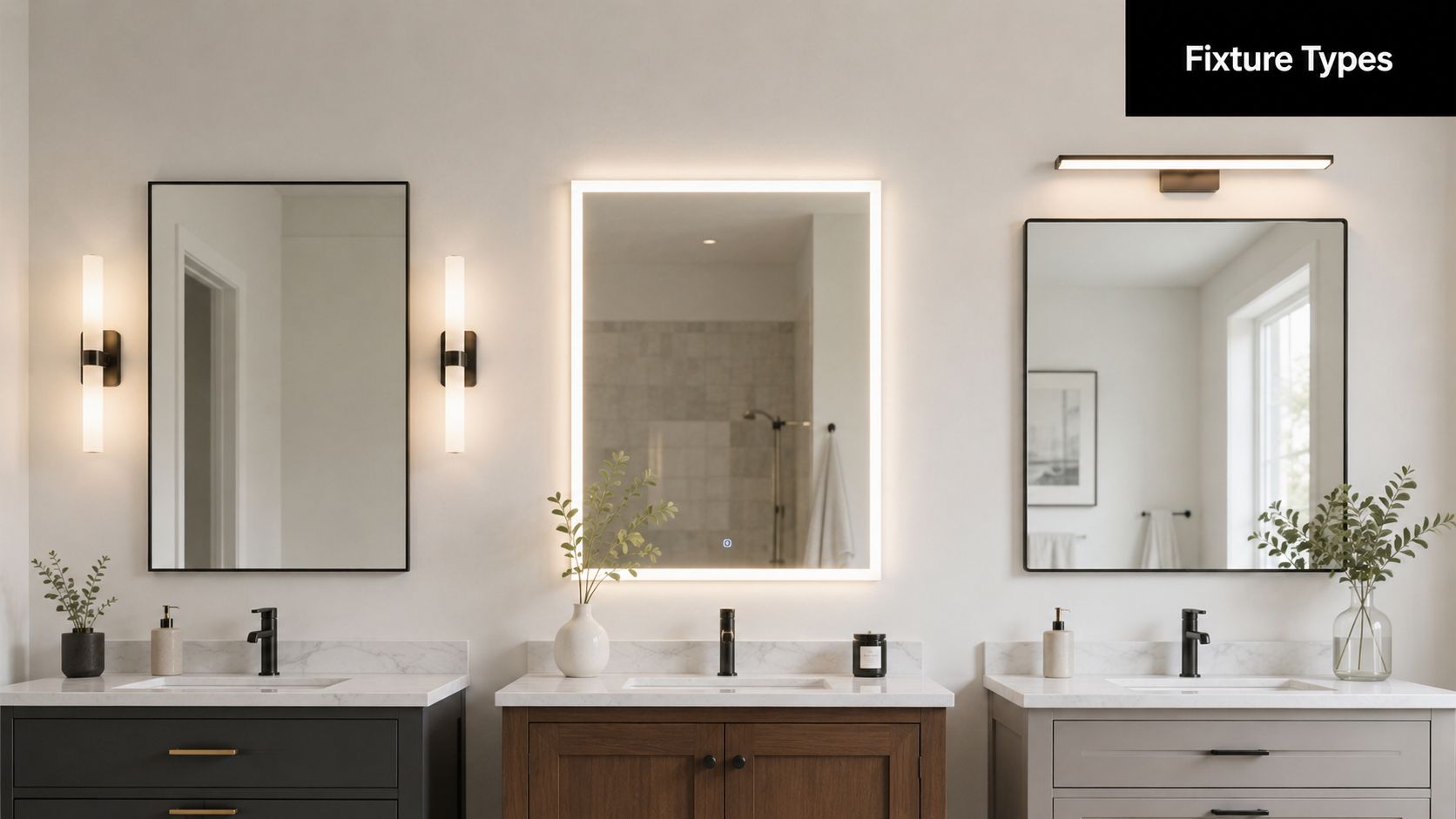
The right fixture depends on how the bathroom is used, how much wall space you have, and how much visual clutter you can tolerate. In modern bathrooms and designer bathrooms, the fixture choice also needs to match the joinery, mirror shape, and the overall finish of the room.
| Fixture Type | Best For | Light Quality | Style |
|---|---|---|---|
| Side-mounted sconces | Grooming, makeup, shaving, and smaller mirrors | Even, flattering, and strong at face level | Classic, balanced, architectural |
| Integrated lit mirrors | Minimalist bathrooms and compact ensuites | Clean and direct, with a sleek overall look | Streamlined, modern, low-visual-noise |
| Overhead vanity bars | Simple upgrades and wider mirrors | Useful, but more prone to facial shadowing if poorly placed | Straightforward, contemporary, practical |
Side-Mounted Sconces
Sconces on both sides of the mirror are the most reliable option when you want flattering face light. They work because they bring illumination in from the sides, which reduces the hard shadow under the nose, chin, and eyes that a single overhead source creates. In a compact bathroom, that matters more than the fixture's style language.
This is also where finish choice matters. A brass pair can warm up a room with classic detailing, while matte black reads cleaner and more graphic. The key is that side lighting supports the mirror rather than competing with it.
Integrated Lighting in the Mirror
Integrated mirrors are popular in new bathroom ideas because they reduce visual clutter. They suit wall-hung vanities, slim tile layouts, and rooms where the mirror needs to feel almost invisible. The trade-off is that the light is often very controlled, so you need to check whether the distribution suits the face, not just the glass surface.
They're strongest in compact bathrooms where wall space is tight or where the design calls for a neat, built-in look. They're less forgiving if the room already has a lot of hard surfaces, because over-bright reflective surfaces can start to feel harsh.
Overhead Vanity Bars
An overhead bar is the easiest shape to understand and often the simplest to retrofit. It can work well over a single basin if the size and position are handled carefully, but it's rarely the most flattering option on its own. If this is the only fitting in the room, the face usually pays the price.
For a vanity, the best-looking light is rarely the one that disappears most quietly. It's the one that does the job without making the mirror feel overexposed.
The right choice isn't about chasing a trend. It's about matching the fixture type to the bathroom's geometry, finish level, and daily use. In a coordinated renovation, that choice should be made alongside the mirror, vanity, and electrical layout, not after the tiler has finished.
Perfect Placement and Mounting Heights
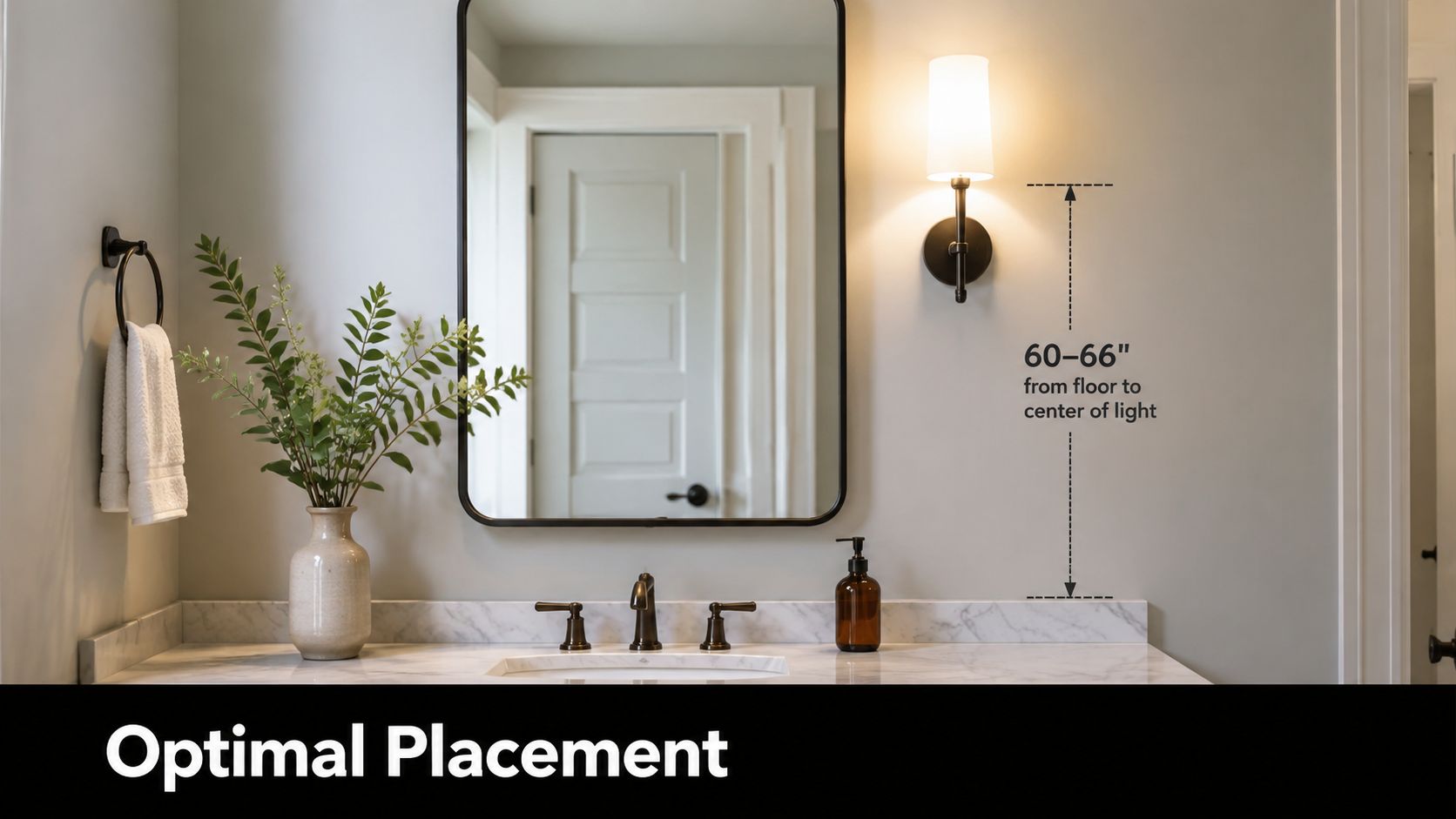
A vanity light that looks right on paper can still fail on site if the height is set from the wrong reference point. In a real renovation, the finished bench, mirror size, wall finish, and light fitting all have to be locked in together, because the placement is judged from the completed setup, not a rough estimate. For that reason, bench height needs to be confirmed early before the electrician sets out the lights or the cabinetmaker finalises the mirror line.
Australian bathroom practice usually places side sconces around 165–180 cm from the floor and about 70–76 cm apart, so the light spreads across the face instead of reflecting straight back off the mirror. Fixtures above the mirror are commonly set around 200 cm above floor level. Those numbers work because they support the mirror without crowding it, and they leave enough room for the fitting to look intentional rather than squeezed in.
Why the Geometry Matters
Light performs best at face level because it crosses the features instead of washing down from above. That cross-lighting reduces shadows and makes the mirror practical for shaving, makeup, and close grooming. A ceiling fitting can still help with general room light, but it should not be expected to do the vanity's job.
The biggest mistake is choosing the fixture before the mirror size is fixed. Once the mirror changes, the spacing changes with it. If the light point is locked in too early, the final result can leave awkward gaps, fittings too close to the glass, or a layout that feels slightly off even if every measurement was technically “close enough”.
The best vanity layout is the one that feels obvious once it is installed.
A good builder and electrician also need to account for the mirror edge, the wall finish, and the clearance around shaving cabinets or frameless mirrors. That level of coordination is what gives a bathroom a high-end finish. It is not about a dramatic fitting. It is about the small decisions that keep the light centred, deliberate, and flattering from the first set-out through to handover.
Getting the Light Right with Lumens and Colour
Brightness and colour quality are not the same thing. Lumens tell you how much light you're getting, while colour temperature tells you whether that light feels warm or cool. CRI tells you how accurately the light renders skin tone and finishes, which is why a pretty bulb can still be the wrong bulb for the vanity.
A stronger vanity spec for Australian homes uses 2700K–4000K with CRI 90+, plus about 800–1,600 total lumens at the vanity, which gives strong task lighting without forcing the whole room to feel overlit (Fat Shack Vintage). That range is useful because it supports grooming without turning the bathroom into a clinical space.
Reading the Specs Without Guesswork
Think of it this way. Lumens is quantity, Kelvin is character, and CRI is accuracy. You need all three working together if the vanity is going to look and perform well.
A warm tone can feel comfortable at night, but if it's too warm, skin and finishes can read muddy. A cooler tone can feel crisp, but if it goes too cool or the CRI is weak, the room starts to look flat and unforgiving. The right middle ground depends on the bathroom's materials, but the target range above gives a practical starting point.
Here's the trade-off. A brighter vanity doesn't automatically mean better grooming light if the colour quality is poor. The room may be more illuminated, but the face can still look dull or uneven in the mirror.
Use case rule: makeup, shaving, and skincare need accurate colour first, then brightness second.
In bathroom renovations, the product sheet matters as much as the finish schedule. A fixture that looks clean on the wall still needs to deliver the right output at the face. If it doesn't, the vanity ends up looking expensive but working badly.
Safety and Compliance in Australian Bathrooms
Bathroom lighting has to survive moisture, not just style pressure. For Australian bathrooms, the basin area is treated as a Zone 2 risk envelope, so fittings near the mirror need the relevant IP protection. IP44 is generally acceptable, and IP65 is a stronger sealed option for wet areas (Mint Lighting).
Downlight placement in a bathroom has to respect those same wet-area constraints, especially when the ceiling layout is doing part of the vanity's job. That's why compliance isn't just an electrical issue, it's a design issue too.
What the Rating Actually Means
An IP rating tells you how well a fitting is protected against solids and moisture. In practical terms, a bathroom light isn't just being judged by how bright it is or how nice it looks. It also needs to be positioned so it suits the wet-area envelope around the basin and mirror.
That changes the way you choose side lights, over-mirror fittings, and anything close to splash exposure. Decorative fittings can still be used, but only if they're specified correctly for the space. The best-looking light in the wrong zone is a poor choice.
A qualified electrician should confirm the fitting location against the room layout before walls are closed. In a proper renovation, the waterproofing, tiling, and electrical plan all need to line up. If they don't, the result can be a compromised finish or a fixture that feels like an afterthought.
The safest approach is simple. Choose compliant fittings first, then design around them. That's what separates a polished renovation from one that merely looks polished on day one.
Styling Your Vanity Lighting with Examples
Modern Australian bathroom design is moving toward wall-hung vanities, frameless glass showers, large-format tiles, matte finishes, and smart mirrors with defog and lighting controls. Lighting needs to fit that language, not fight it.
Mid-century styling can still work in a bathroom when the mirror, vanity, and light finish are coordinated carefully. The right fixture turns the vanity into part of the room's design story instead of a separate add-on.
A classic bathroom might use a pair of warm-toned sconces beside a framed mirror, with the brass finish echoing tapware or cabinet handles. That creates a layered, established feel, especially when the room has stone or timber notes. In a minimalist ensuite, a slim backlit mirror can keep the wall quiet while still giving the face even illumination.
An industrial-inspired room often works better with a straight bar light or compact metal fittings, especially if the vanity is floating and the tiles are large-format. The line of the light helps anchor the mirror visually. A matte black finish can sharpen that effect without making the room feel heavy.
The most successful vanity lighting usually repeats one finish already present in the room, then stops there.
Smart mirrors suit modern bathrooms because they integrate function without adding bulk. They're a strong fit where cleaning lines matter and where the design is meant to feel light, not crowded. The mistake is treating style and performance as separate decisions. At the vanity, they're the same decision.
Integrating Lighting into Your Renovation Plan
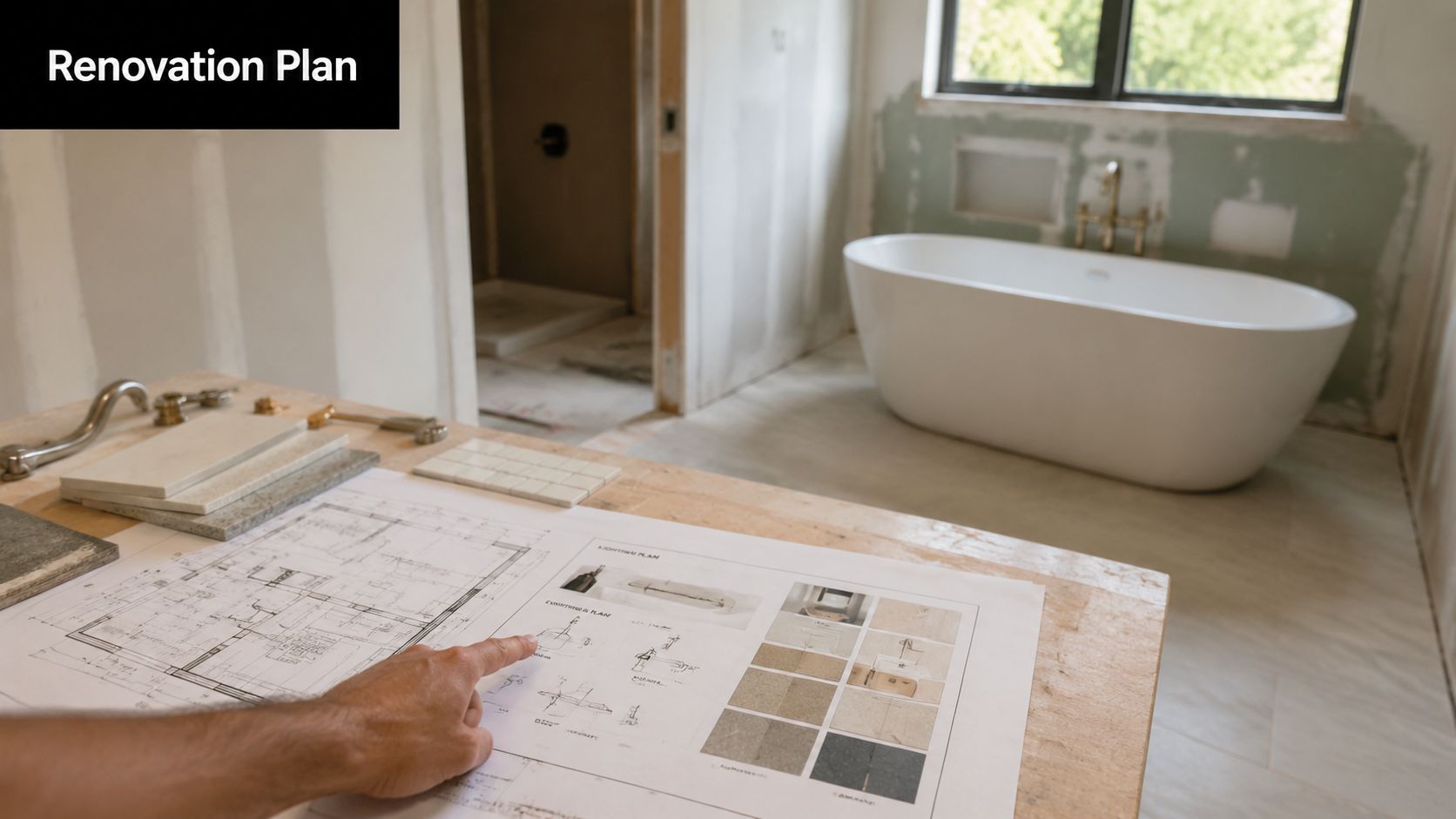
Vanity lighting works best when it is built into the renovation plan before rough-in, not chosen at the end after the mirror has already been ordered. In bathroom renovations, the wall lining, waterproofing, mirror size, and wiring path all need to line up. A 3D design stage helps because you can see whether the light sits correctly over the basin, whether the mirror proportion feels right, and whether a bar, sconce, or integrated mirror suits the room.
In Victoria, a major domestic building contract is required for most domestic building work worth more than A$10,000. That affects vanity lighting because once a bathroom renovation moves past a basic cosmetic update, the paperwork, builder engagement, and coordination become part of the job, not an afterthought.
What to Lock In Early
A builder and electrician need the final mirror width, vanity height, and fitting type before the walls are sealed. If those details are unclear, the wiring can end up in the wrong place. That often forces awkward centring, visible patching, or a fixture that does not light the face properly.
A coordinated service helps with that. SitePro Bathrooms handles concept development, detailed 3D design, construction, and finishing in one process, which makes it easier to align the lighting with the rest of the room instead of trying to fit it in later.
Use the renovation timeline to your advantage:
- Fix the mirror and vanity sizes early. Light placement depends on both, not just the wall space.
- Choose the fixture type before electrical rough-in. Side sconces, bars, and lit mirrors all need different clearances.
- Confirm compliance before tiling starts. Wet-area placement affects product choice and position.
- Test the final effect at handover. The vanity should read cleanly in both bright and low-light use.
That approach keeps the lighting tied to the room's layout, so the finished bathroom feels planned rather than patched together. It is a small detail on paper, but in the room it is usually the difference between an average vanity wall and one that feels properly finished.
If you are planning bathroom renovations in Victoria and want the vanity lighting handled as part of the build, not as a last-minute add-on, book a consultation with SitePro Bathrooms and bring your mirror, vanity, and lighting ideas into the same design conversation before work starts.