

Stunning Bathroom Renovation Before and After Gallery
You're probably standing in a bathroom that no longer works for the way you live. The shower sprays where it shouldn't. Storage is never enough. The tiles date the whole room, and every morning starts with some version of compromise.
That's why bathroom renovation before and after stories are so compelling. The change is immediate. You can see what's possible in one glance. In Australia, the renovation boom accelerated from 2020, and bathroom upgrades became one of the most common projects as homeowners focused on comfort, functionality, liveability and property value, as noted in this renovation trend summary.
The problem is that most galleries stop at the pretty photo. They rarely show why the room worked better afterwards, what had to be fixed behind the walls, or how the owners managed the disruption while the work was underway.
Beyond the Pinterest Board Real Bathroom Transformations
A good before-and-after project starts with frustration, not styling. In older Victorian homes, that frustration usually looks familiar. A cramped ensuite where the door collides with the vanity. A family bathroom with nowhere to put towels. A shower recess that has been resealed three times and still smells damp in winter.
The after photo matters because it proves the room can change. But the transformation usually comes from decisions you can't spot at first glance. Better layout. Better storage. Better lighting placement. Correct falls. Cleaner junctions. A room that's easier to clean and easier to use.
One of the easiest ways to judge whether a transformation feels real is to look at projects from homes like yours, in suburbs like yours. A local example such as this Sandringham bathroom renovation project is often more useful than a polished overseas image because it reflects the room sizes, housing stock and practical constraints Victorian homeowners face.
What the best after photos don't hide
The strongest modern bathrooms aren't just visually lighter and more refined. They solve a specific daily problem.
- Small rooms need visual relief: Wall-hung joinery, clear shower screens and large-format tiles can reduce visual clutter.
- Busy households need order: Storage has to be designed around what people keep in the room.
- Older bathrooms need technical correction: If moisture damage, failed membranes or poor ventilation exist, finishes alone won't fix the problem.
A bathroom can look expensive and still perform badly. The rooms that age well are the ones planned from the substrate out.
That's the standard worth aiming for. Not just a nicer bathroom, but a room that feels calm at 7 am and still holds up years later.
Case Study The Compact Ensuite Makeover
The brief for this ensuite was simple on paper and hard in practice. The owners wanted it to feel larger, cleaner and easier to use, without the room physically becoming bigger. That's a common request in ensuite bathroom renovations, because the footprint is usually fixed and every millimetre matters.
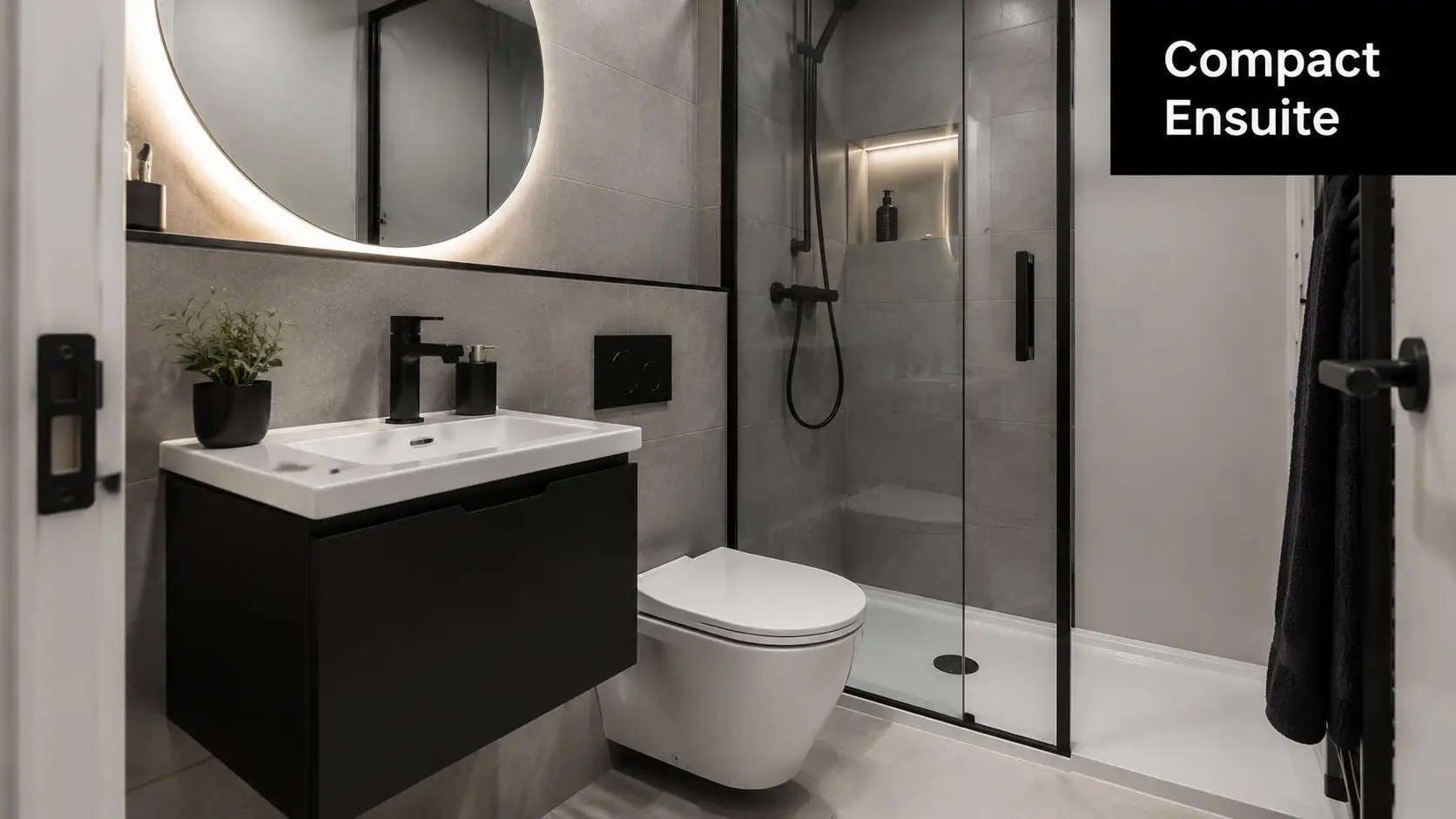
Before the renovation, the room felt boxed in. The vanity sat heavily on the floor, the shower framing chopped up the sightlines, and the storage solution was really just a collection of products trying to compensate for a weak layout. Nothing was catastrophic. It was just frustrating, every day.
What changed in the layout
The most effective move was not adding more items. It was removing visual obstacles.
We shifted the room toward a simpler composition with a wall-mounted vanity, a more open shower enclosure and finishes that reflected light rather than absorbing it. In small ensuites, that combination does a lot of work. The floor area reads more clearly, cleaning becomes easier, and the room feels less busy even when the footprint stays the same.
A proper design phase is where these gains happen. Before any demolition, we tested placement, clearances and proportions so the owners could see how the room would function, not just how it would look. If you're planning a compact space, this guide to designing an ensuite is useful because the success of an ensuite almost always comes down to layout discipline.
The trade-offs that mattered
This project involved the kind of choices that separate a nice image from a good renovation result.
| Decision | What worked | What didn't |
|---|---|---|
| Vanity style | Wall-hung design opened up the room visually | Bulky cabinetry would have made the room feel tighter |
| Shower screen | Frameless or low-visual-weight glazing kept sightlines open | Heavy framing would have segmented the room |
| Tile selection | Calm, consistent finishes reduced visual noise | Too many feature surfaces would have shrunk the space |
| Storage | Drawers and mirrored storage kept essentials hidden | Open shelves would have looked cluttered quickly |
The owners were living in the home during the works, and that changed the planning conversation. In Melbourne homes, disruption is often the question that matters most. Guidance around bathroom makeovers regularly misses this point, but for lived-in homes, clear scheduling and communication with your builder are critical when you'll be without a usable ensuite, as discussed in this article on bathroom makeover disruption.
Practical rule: If the room is small, don't try to make it interesting by adding more. Make it better by removing friction.
Why the after feels different
The finished room didn't rely on a dramatic colour statement. Its strength was restraint. Better proportions, cleaner lines and hidden storage made the ensuite feel composed instead of cramped.
That's often the most satisfying kind of bathroom renovation before and after. The owners don't walk in and think about a feature tile first. They notice that the room finally works.
Case Study Reimagining the Family Bathroom
A family bathroom carries a different kind of pressure. It doesn't just have to look good after handover. It has to survive school mornings, late-night baths, wet floors, forgotten towels and constant use by people with different routines.
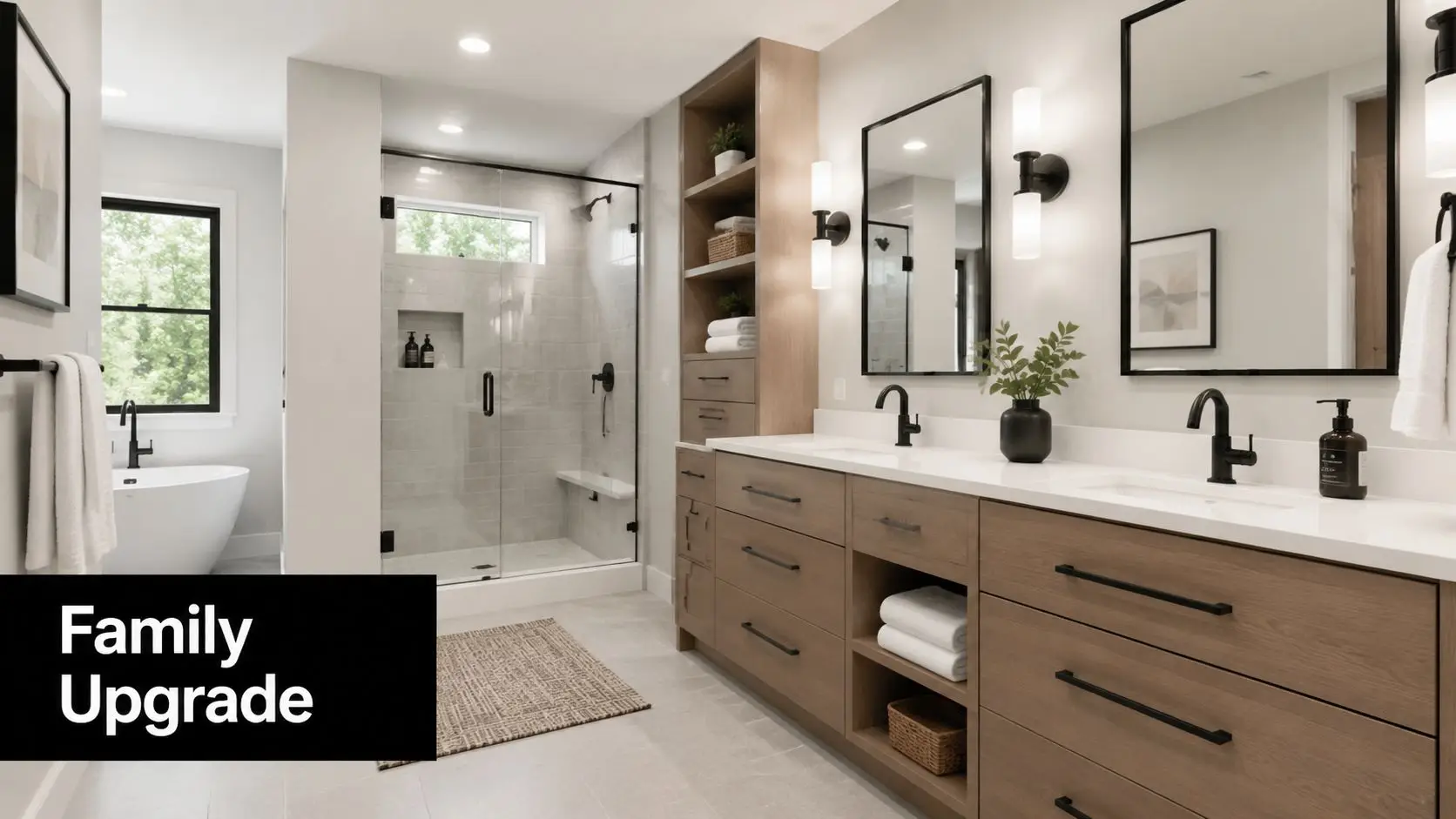
In this project, the original room had the usual signs of strain. The bath-shower combo was doing too much. Bench space was limited. Storage overflowed into nearby cupboards because the bathroom couldn't hold what the household used every day. The room wasn't short on fittings. It was short on logic.
Designing for traffic, not just style
The central problem was congestion. Two people couldn't comfortably use the room at once, and the cleaning burden was higher than it needed to be because the room had too many awkward surfaces and not enough integrated storage.
The redesign focused on separation of functions. A double vanity gave the room a proper preparation zone. A walk-in shower reduced the visual and practical clumsiness of climbing into a bath for daily use. A freestanding bath gave the family a dedicated place for bathing children or winding down, instead of forcing one fixture to cover every need.
Those choices only work when they suit the household. In some family homes, keeping a shower-over-bath arrangement is still the smart move if the room is tight and the users need flexibility. In this case, the space allowed for clearer zoning, so it made sense to divide those functions.
Materials that earn their keep
Family bathrooms need materials that can handle repetition. The right selection isn't always the most ornate one.
We leaned into finishes that were easy to wipe down, durable under regular use and unlikely to date quickly. Joinery had to conceal the visual noise of family life. Fixtures had to feel solid in the hand. Ventilation had to be treated as part of the design, not an afterthought, because a beautiful bathroom loses its appeal quickly if moisture lingers.
The design priorities looked like this:
- Storage near the point of use: Drawers near the vanity, not linen stored elsewhere.
- Surfaces with simple upkeep: Cleaner lines meant fewer grime traps.
- Comfort under pressure: Enough room for more than one person to move without collision.
- Lighting with purpose: Task lighting at the vanity, softer ambient light elsewhere.
When a family bathroom works well, people stop talking about it. The morning routine becomes smoother, and that's the real luxury.
The before-and-after shift
The most noticeable change after completion wasn't just visual scale. It was rhythm. The room no longer forced everyone into the same narrow corner of the plan.
A key distinction separates designer bathrooms from decorative bathrooms. Design isn't about adding a fashionable object and hoping it lifts the room. It's about matching the room to behaviour. In family bathroom renovations, that means understanding how people queue, where clutter builds up, what gets wet, and which surfaces become annoying to clean after the novelty wears off.
For homeowners collecting new bathroom ideas, this type of project is worth studying because it shows a principle that applies well beyond one house. The right family bathroom isn't the one with the most features. It's the one where every feature has a job.
Case Study The Luxury Master Bathroom Retreat
Luxury bathrooms fail when they confuse cost with atmosphere. A premium room isn't memorable because every finish is expensive. It's memorable because the room feels deliberate from the first step inside.
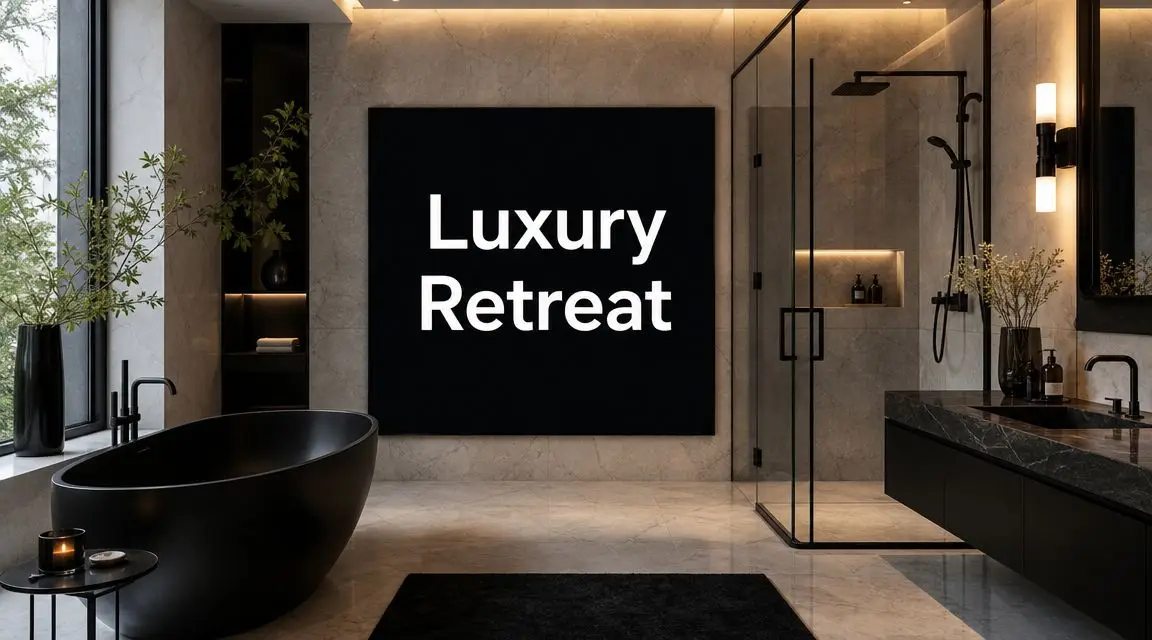
This master bathroom started as a standard, serviceable space with little sense of hierarchy. The layout was conventional, the lighting was flat, and the room didn't feel like a retreat. It did the basics, but it didn't create any experience around them.
What makes a bathroom feel high-end
In this renovation, the mood came from composition. The bath was given presence, not just placement. Joinery was treated as furniture, not storage boxes. Lighting was layered so the room could feel bright during the morning routine and softer at night.
Natural stone, brushed brass tones, generous mirrors and custom cabinetry all played a part, but the key move was how those elements related to each other. Good luxury design doesn't rely on one statement piece. It relies on consistency.
A few principles guided the room:
One focal point should lead the room
In this case, the bath anchored the view and established the tone immediately.Texture should do more than colour
Richness often comes from surface quality, depth and reflectivity rather than strong colour contrast.Storage must disappear into the architecture
Nothing breaks a spa-like mood faster than visible clutter.
The details clients remember later
The most valued parts of a luxury bathroom are often not the ones people mention at the start of planning. They're the details they discover in daily use.
A well-positioned niche that doesn't interrupt the wall pattern. Joinery that operates silently and fits the room perfectly. Lighting that flatters rather than glares. Warmth underfoot. A vanity area where grooming feels composed instead of rushed.
Those are the moves that turn modern bathrooms into personal retreats.
Luxury is rarely about adding more items. It's about reducing compromise.
Where premium bathrooms can go wrong
There are a few repeat mistakes in high-end projects.
| Common mistake | Better approach |
|---|---|
| Prioritising statement finishes over layout | Resolve circulation and fixture placement first |
| Overloading the palette | Keep materials restrained and let texture carry the room |
| Treating lighting as a late selection | Plan task, ambient and accent lighting together |
| Forgetting maintenance | Choose premium materials that suit how the room will be cleaned and used |
That's why the strongest bathroom renovation before and after results in this category don't feel theatrical. They feel settled. The room becomes quieter, more customized and more restorative.
For clients seeking designer bathrooms, that's usually the brief. Not to impress guests for ten seconds, but to create a room that supports slower, better moments every day.
Bringing Your New Bathroom Ideas to Life
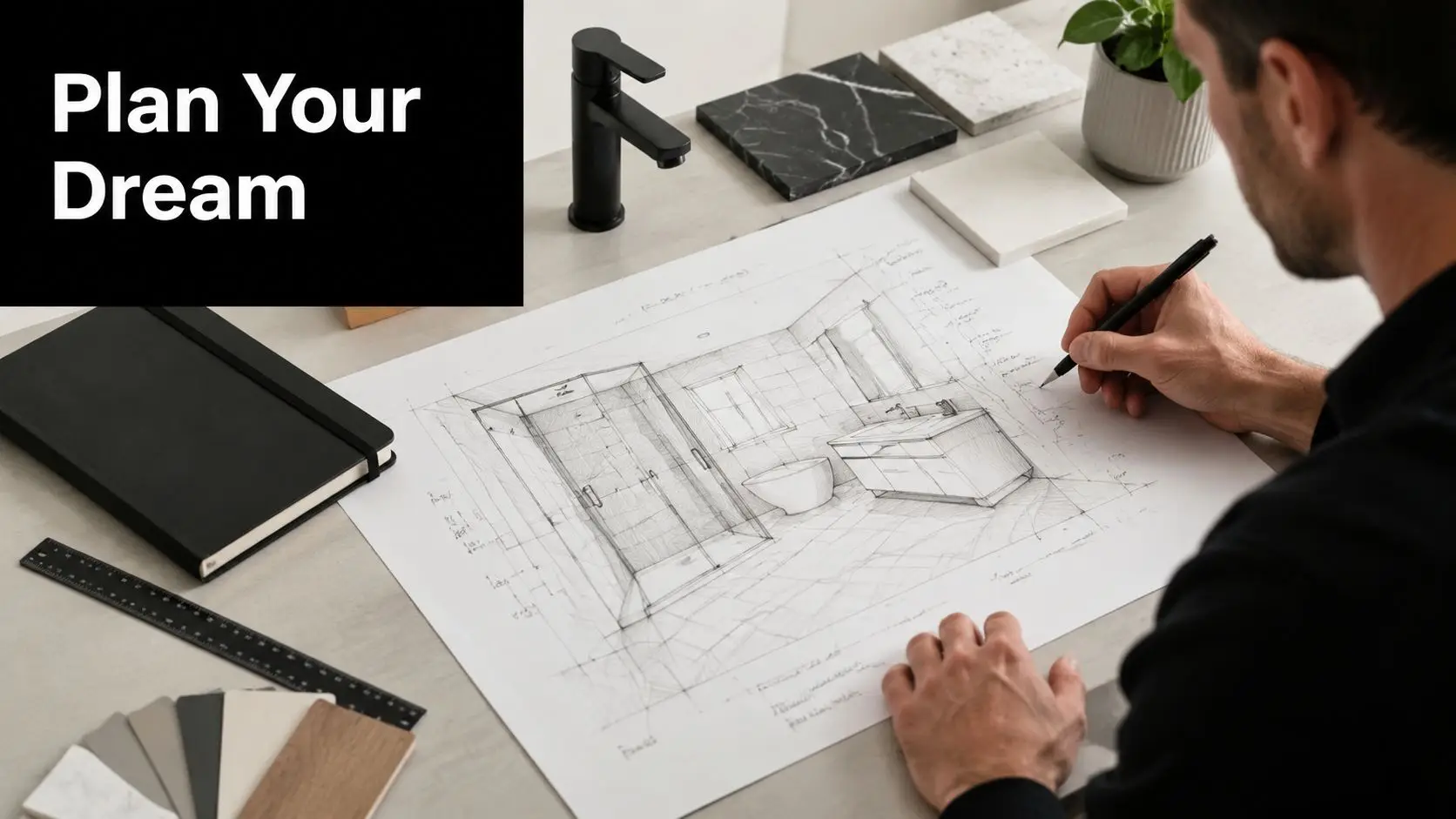
The difference between a renovation that photographs well and one that performs well comes down to planning. New bathroom ideas are easy to collect. The hard part is filtering them through your room size, your building type and the way you live.
Start with the non-negotiables
Before choosing tiles, tapware or mirror shapes, define what the bathroom must do better than it does now.
Maybe the room needs safer access. Maybe storage is the problem. Maybe the shower leaks, the ventilation is poor, or the layout wastes space. Those are design issues, not just construction issues, and they need to be solved first.
For Victorian homeowners, there's also a compliance layer that can't be treated casually. Any bathroom renovation involving changes to plumbing, drainage or waterproofing is considered building work and requires a registered building practitioner. Waterproofing must comply with the National Construction Code and AS 3740, as explained in this summary of bathroom renovation compliance.
That requirement shapes the whole project. It affects who should do the work, how the work is sequenced and what should be documented during the build.
Think like a designer, not a shopper
Most problems in bathrooms don't come from bad products. They come from disconnected decisions.
Use this sequence instead:
- Define the room's job: Ensuite, family bathroom, investment property or master retreat all demand different choices.
- Map movement first: Doors, vanity depth, shower entry and circulation should be resolved before finishes.
- Build storage into the plan: Don't assume baskets and accessories will solve poor joinery.
- Choose finishes by maintenance level: The right surface depends on who will clean it and how often.
- Protect the invisible layer: Membranes, substrate preparation, falls and ventilation are not optional upgrades.
If you're weighing delivery options, one practical route is an end-to-end service that includes design visualisation and coordinated construction. For example, why using a registered builder matters for your bathroom renovation sets out the compliance and accountability side of that decision, and SitePro Bathrooms also offers a 3D design stage that helps homeowners test layout ideas before construction begins.
What works in modern bathrooms right now
The most successful modern bathrooms aren't trend-heavy. They're edited.
Current preferences lean toward calmer palettes, integrated storage, generous mirrors, walk-in showers, cleaner junctions and fittings that feel refined without being fussy. But style only delivers lasting value when the room is durable.
A practical planning checklist helps:
| Priority | Why it matters |
|---|---|
| Waterproofing and substrate condition | Protects the room from hidden failure |
| Ventilation | Helps control moisture and maintenance issues |
| Layout clarity | Improves everyday use more than any finish upgrade |
| Storage design | Keeps the after photo looking good in real life |
| Fixture quality and fit | Supports durability and comfortable use |
Good bathroom renovations don't start with colour. They start with performance, then turn that performance into a room that looks effortless.
Your Bathroom Renovation Questions Answered
Most homeowners don't need more inspiration by this point. They need straight answers. These are the questions that come up in real consultations, usually after people have saved dozens of modern bathrooms and started wondering how the process works.
How long does a bathroom renovation take
The honest answer is that it depends on the scope, access, product selections and the condition of the room once demolition begins. A cosmetic update is very different from a full rebuild that changes layout, plumbing positions or fixes hidden defects.
The mistake people make is planning only for the best-case scenario. Older bathrooms can reveal damaged substrate, failed waterproofing or ventilation issues once opened up. That's why the build program should include sequencing, approvals where needed and clear communication about decision points.
A realistic program is more valuable than an optimistic one. It gives you a better chance of managing the disruption without frustration.
Can we stay at home during the works
Often, yes. But staying in the home and staying comfortable are not the same thing.
If the bathroom being renovated is your only bathroom, living through the works becomes much harder. If it's an ensuite and there's a second bathroom available, the disruption is more manageable. The right answer depends on who lives in the home, whether there are children, whether anyone works from home, and how much site activity the household can absorb.
A few practical considerations help:
- Access to another bathroom: This is the first question to settle.
- Dust and noise tolerance: Demolition, cutting and deliveries affect the home beyond the bathroom itself.
- Daily routines: School mornings and work calls rarely pair well with unpredictable site access.
- Decision availability: Someone needs to be reachable if an on-site issue requires fast approval.
Do I need a registered builder
If the renovation changes plumbing, drainage or waterproofing, this is not optional in Victoria. The registered practitioner requirement exists for a reason. Bathrooms fail most often in the hidden layers, not at the vanity top.
Homeowners sometimes focus heavily on finishes because they're visible and enjoyable to choose. But the long-term success of the room sits underneath them. If the technical work is weak, the after photo has a short shelf life.
What should I spend money on first
Start with the items that affect durability and daily use. Structure, waterproofing, drainage performance, ventilation and layout all come before decorative upgrades.
After that, spend where touch and repetition matter. Vanity storage, quality tapware, lighting placement and shower function will shape your experience of the room more than a fashionable accent ever will.
Will the renovation improve value beyond appearance
Yes, but the strongest gains usually come from function, not just styling. The best bathroom renovations improve water and energy efficiency as well as aesthetics. Choosing WELS-rated taps, showerheads and toilets can reduce household water consumption, while better ventilation can lower moisture-related maintenance. Those choices support lower running costs and can strengthen resale appeal, as outlined in this discussion of efficient bathroom upgrades.
What should I have ready before requesting a quote
You don't need a perfect brief. But you do need clarity on a few basics.
- Know the main problem: Lack of storage, poor layout, leaks, dated finishes or all of the above.
- Save examples with a reason: Don't just save images you like. Note what you like about them.
- List who uses the room: A guest bathroom and a family bathroom should not be designed the same way.
- Be honest about priorities: If durability matters more than visual drama, say so early.
The best consultation starts with a real conversation about how the room is failing now and what the new one has to do better.
If you're comparing bathroom renovation before and after ideas, look past the styling first. Ask what changed in the layout, what was fixed behind the walls, how the disruption was managed, and whether the finished room will still perform years from now. That's where the real value sits.