
Is your morning routine a cramped shuffle in a dated bathroom? You're not alone. Plenty of Australian homes still have bathrooms that work on paper but feel awkward in daily life. Storage is tight, ventilation is poor, and the layout often reflects an older way of living rather than how families use the space now.
That's why good bathroom renovations start with function, not just finishes. The best results come from choosing new bathroom ideas that suit the room size, the people using it, and the budget you're comfortable with. In Australia, renovation guidance commonly groups projects into three broad tiers: about $8,000 to $15,000 for a cosmetic refresh, $15,000 to $35,000 for a mid-range renovation, and $35,000+ for a high-end bathroom. One Australian industry source also cites the Housing Industry Association's average bathroom renovation cost at around $26,000, which is a useful benchmark when weighing a refresh against a full redesign (Australian bathroom renovation cost guide).
For homeowners in Victoria, that matters because labour, waterproofing, plumbing compliance, demolition, and tiling can take a bigger share of the budget than people expect. A small room doesn't always mean a cheap renovation. Fixed trade costs still apply, especially when the work needs to meet Australian Standards and local requirements, as noted in this Australian bathroom ideas guide for Victoria-focused planning.
If you're planning bathroom renovation ideas australia style, with a mix of practicality and design, these are the approaches that consistently deliver.
1. Spa-Inspired Wet Room Design
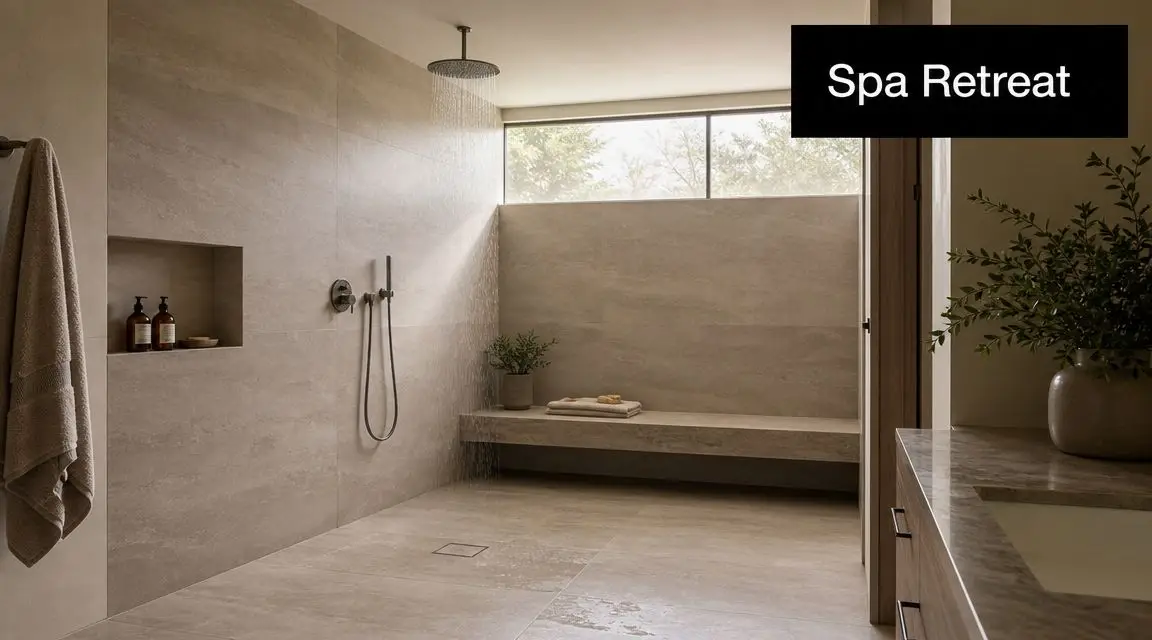
A wet room can make a bathroom feel bigger, calmer, and more architectural. Instead of breaking the room into small zones with a shower base and bulky framing, the space reads as one continuous surface. That's why this style works well in contemporary Melbourne homes, coastal renovations, and designer bathrooms where the brief is clean and minimal.
It only works when the construction is right. In Victoria, where winter mornings are cold and bathrooms stay damp for longer, poor drainage and weak ventilation show up fast. If the falls aren't correct or the waterproofing is rushed, the room won't feel luxurious for long.
What makes it work
The most successful wet rooms keep the layout simple. A frameless glass panel, a linear drain, and one consistent floor tile usually give the best result. Moroccan-inspired feature tiles, stone-look porcelain, or textured neutral finishes can add character without making the room feel busy.
Practical rule: Treat a wet room as a technical build first and a style decision second.
A few trade-offs matter here:
- Open feel: A wet room removes visual barriers and helps small or medium bathrooms feel more generous.
- Higher build precision: The waterproofing, floor preparation, and drainage have to be planned early.
- Better for low-clutter households: If everyone leaves products on the floor, the clean spa look disappears quickly.
In homes around Highett and Bayside, this style often suits clients who want a calm retreat rather than a family bathroom packed with storage.
Where people get caught out
The mistake is assuming a wet room is easier because it looks simpler. It isn't. It needs proper moisture management, a fan that clears humidity effectively, and materials that won't become slippery or tired-looking after heavy use.
Heated towel rails are worth considering in Melbourne conditions because they improve comfort and help towels dry faster. And before the floor tile is chosen, the plumbing and drainage positions need to be locked in. A 3D design process can assist with this, allowing you to sort out screen lines, drain placement, and circulation before the build starts.
2. Dual Vanities with Under-Mount Storage
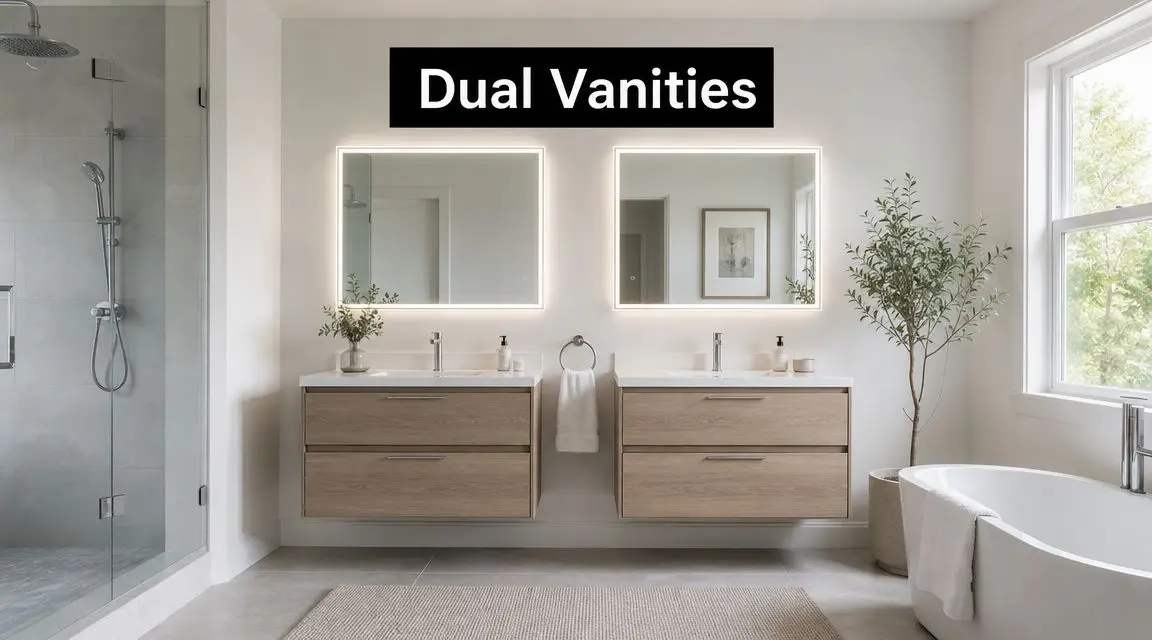
If two people use the bathroom at the same time every morning, a dual vanity can remove a lot of friction from daily life. This isn't only about luxury. In family homes, it's one of the most practical modern bathrooms upgrades you can make when the room width allows it.
The best setups don't just duplicate basins. They build in storage underneath so the bench stays clear and each person has their own zone. Floating vanities in white oak, walnut, or a smooth painted finish work well because they keep the floor visible and make cleaning easier.
Better for families than oversized single vanities
A long single vanity with one basin can look tidy in photos, but it often underperforms in a busy house. Two stations usually function better than one oversized centre basin because both users get mirror access, power access, and bench space without crowding.
In Victorian homes, this is especially useful in larger family bathrooms and main ensuites where the room needs to do more than look good.
- Cleaner routines: Separate stations reduce product sprawl and elbow clashes.
- Smarter storage: Deep drawers below each basin are usually more useful than a mix of shallow cupboards.
- Better lighting control: Motion-sensor vanity lighting can improve convenience during early starts and night use.
If the room can't comfortably support two users standing side by side, forcing in a double vanity often makes the whole bathroom feel compromised.
What to specify properly
Countertops need to be durable. Engineered stone alternatives, porcelain surfaces, and other hard-wearing benchtop materials are usually the safer choice in a busy bathroom than softer finishes that mark easily. Hardware should match the rest of the room, but function comes first. Soft-close drawers, practical divider inserts, and mirror positions matter more than decorative handles.
This layout also benefits from proper ventilation around the vanity zone. In humid bathrooms, mirrors fog, drawers hold moisture, and joinery ages faster when the air doesn't clear properly. That's one of those details clients rarely notice in the showroom but definitely notice after handover.
3. Sustainable and Water-Efficient Fixtures
Water-efficient bathrooms used to look like a compromise. That's changed. Current Australian bathroom design guidance for 2026 points to practical specification choices that support performance without making the room feel stripped back, including 5-star WELS-rated taps and showerheads, smart exhaust fans, sensor lighting, touchless taps, and digital showers with preset temperatures.
That's a strong direction for bathroom renovations in Victoria, where efficiency and moisture control both matter. A bathroom should feel easy to use day after day. It shouldn't rely on wasteful fittings or poor ventilation to seem comfortable.
Where sustainable choices actually help
Good sustainable selections do more than save water. They can improve hygiene, reduce condensation problems, and make the bathroom easier to maintain. Touchless taps are useful in powder rooms and family homes. Smart exhaust fans help remove humid air before it turns into mould around silicone joints and ceilings.
For clients thinking long term, materials matter too. SitePro Bathrooms' guide to sustainable construction and eco-friendly materials is a useful starting point when you want the renovation to balance finish, durability, and environmental impact.
A practical specification list often includes:
- Water-efficient tapware: Choose fittings that perform well under everyday use, not just on a product sheet.
- Moisture control upgrades: Smart fans and well-placed ventilation are as important as the tile selection.
- Hands-free convenience: Touchless fixtures can improve cleanliness in high-use bathrooms.
The trade-off to understand
Some homeowners focus heavily on visible eco features and ignore the basics. That's backwards. If the waterproofing, extraction, and product quality aren't sound, the renovation won't age well no matter how efficient the fixtures are.
The better approach is to build sustainability into the whole room. Efficient tapware, responsible materials, and strong ventilation should be part of the concept from the beginning, not extra items added right at the end.
4. Heated Floors and Towel Rails
Melbourne bathrooms can look polished and still feel miserable in winter. Cold tiles, damp towels, and a room that never quite dries out can ruin an otherwise good renovation. Underfloor heating and heated towel rails solve a real comfort problem, not just a design one.
This is one of the easiest upgrades to justify in a Victorian climate because you notice it every day. Clients usually think of it as a luxury item at first. Once they've lived with it, they tend to treat it as part of the bathroom's basic usability.
A comfort upgrade that earns its place
Electric under-tile heating suits many bathroom-only renovations because it can be installed within a standard bathroom build sequence. Hydronic systems can make sense when they're part of a wider whole-home heating strategy. Which route works best depends on the house and the scope of works.
Heated towel rails are even simpler. In compact bathrooms and apartments, they do double duty by warming towels and helping the room feel drier between uses.
A bathroom that looks high-end but stays cold and damp isn't finished properly for Melbourne living.
What to consider before you commit
These systems need planning with the electrician and tiler early in the project. Thermostat location, wall space for rails, and the tile layout all affect the final result. It's also worth thinking about how the room is insulated. Heat added to a poorly detailed bathroom won't perform as well as heat added to one that's been planned properly.
This idea works particularly well in:
- Family bathrooms: Better comfort during early starts and winter school mornings.
- Ensuites: Warm floors add noticeable comfort in smaller footprints.
- Apartments: Towel rails can improve drying in rooms with less natural airflow.
For modern bathrooms, it's one of those additions that doesn't dominate the aesthetic but lifts the whole experience.
5. Large-Format Tiles and Minimal Grout Lines
Step into a small Melbourne bathroom with too many grout joints and the room can feel busy before you even turn the light on. Large-format tiles fix that fast. They give the eye fewer breaks, make walls and floors read as broader surfaces, and cut down the amount of grout that needs ongoing cleaning.
This look suits a lot of Australian homes, especially where bathrooms are compact and every visual decision affects how spacious the room feels. In Victoria, it also has a practical upside. Less grout means fewer joints holding moisture, soap residue, and mould in a damp room.
Bigger tiles look simple, but they need tighter planning
Large-format tiles only work well when the set-out is resolved early. Tile joints should line up with the vanity, shower niche, tapware, and screen edges where possible. If that planning is missed, the finished bathroom ends up with thin tile slivers, awkward cuts, and a layout that looks unsettled.
I usually advise clients to choose the tile after the room layout is close to locked in, not before. That gives the builder and tiler room to set out the space properly instead of forcing the room to suit a tile size that fights the design.
A strong result usually comes from a few clear choices:
- Matte or low-sheen floor tiles: Better underfoot grip and a quieter finish visually.
- Porcelain in light or mid tones: Helps the room feel brighter without showing every mark.
- Consistent joint lines: Cleaner sightlines across the floor, walls, and shower area.
- Full-height waterproofing and substrate prep: Larger tiles show defects quickly, so the base has to be true.
The trade-off is installation tolerance
Bigger tiles are less forgiving than standard formats. If a wall is out, you see it. If the floor falls poorly, you feel it. Lippage stands out more because the surface is cleaner and the grout joints are tighter.
That matters in older Victorian homes, where walls and floors are rarely perfectly straight once demolition starts. We often find that the best-looking large-format bathroom is the one that allowed extra time for screeding, straightening, and set-out before a single tile went down.
For homeowners considering this finish, our guide to installing large-format porcelain tiles explains what needs to happen behind the scenes for the result to look sharp and last well. It's also the kind of detail we test early in our 3D design process, because tile size affects everything from niche proportions to drain placement.
6. Statement Lighting and Mirror Features
Lighting changes how every bathroom finish reads. A tile that looks flat under harsh downlights can look warm and textured under layered lighting. A vanity that feels ordinary can become a focal point when the mirror and lighting are planned together.
Many bathroom renovations often fall short. The joinery and tapware get all the attention, but the lighting ends up being generic. That's a missed opportunity, especially in designer bathrooms where atmosphere matters as much as function.
Layer the light, don't rely on one fitting
A bathroom needs ambient light for the room overall, task light at the vanity, and a little accent lighting if you want depth. Backlit mirrors, wall sconces, and carefully placed ceiling lights usually give a much better result than one bright fitting trying to do everything.
Large framed mirrors also help compact rooms feel larger. Black-framed mirrors suit sharper contemporary schemes. Brass-rimmed arches and soft-edged mirrors work well in warmer interiors with timber, stone, or brushed metals.
The mirror isn't just a reflective surface. In many bathrooms, it's the visual anchor above the vanity.
Common wins and common mistakes
The biggest win is placing light where people need it most. Vanity lighting should flatter the face and reduce shadows. Warm white lighting usually feels more comfortable in bathrooms designed as retreat spaces.
The common mistakes are predictable:
- Too much overhead glare: Bright ceiling-only lighting makes the room feel clinical.
- Mirror too small for the vanity: The proportions look off immediately.
- No night-time lighting option: A softer circuit or integrated mirror light makes a bathroom easier to use after dark.
For Australian homes chasing modern bathrooms that still feel warm, this is one of the most cost-effective upgrades in visual terms. Good lighting makes every other material look better.
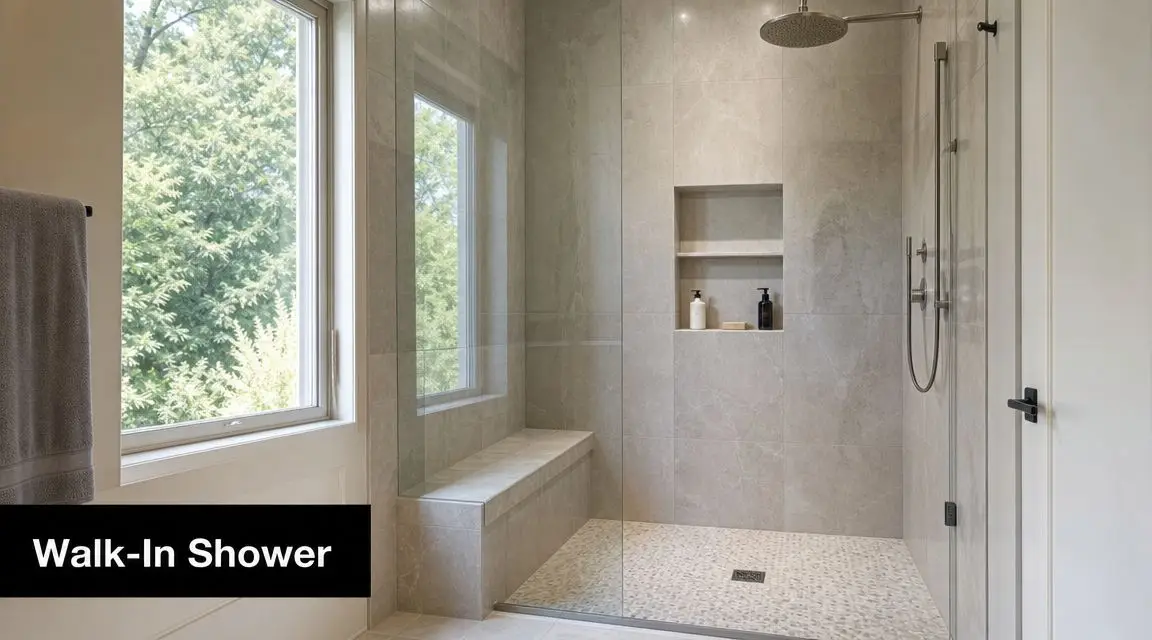
7. Walk-In Showers with Niche Storage and Seating
A walk-in shower is one of the safest bets in bathroom renovation ideas australia searches because it solves both style and function in one move. It looks contemporary, improves access, and removes the visual heaviness of a boxed-in shower enclosure.
The version that performs best includes built-in storage and somewhere to pause. A niche keeps bottles off the floor. A compact bench or ledge adds comfort and can make the shower more practical for different ages and mobility needs.
Build storage into the structure
Freestanding caddies and corner baskets usually spoil a clean shower design. They collect grime and make a new build feel temporary. Recessed niches look more integrated and are easier to keep tidy when they're positioned to suit the plumbing and tile layout.
A seat can be subtle too. It doesn't have to turn the room into an accessibility fit-out. In many family and main bathrooms, a simple built-in bench makes shaving, washing children, or just using the space more comfortably much easier.
Useful details to get right include:
- Tile selection underfoot: Slip resistance matters more in a walk-in shower because the floor zone reads as open.
- Niche placement: It should be easy to reach without sitting directly in the water line.
- Ventilation nearby: Open showers release more moisture into the room, so extraction needs proper attention.
Why this works well in Victoria
Bathrooms in Melbourne often need to balance compact footprints with daily practicality. A walk-in shower helps circulation, especially when paired with wall-hung vanities and frameless glass. It also suits the current move toward simpler layouts in smaller family bathrooms and ensuites.
The only caution is splash control. Open designs need enough room and the right screen placement, otherwise the floor outside the shower gets wetter than it should. In such scenarios, layout experience matters more than inspiration photos.
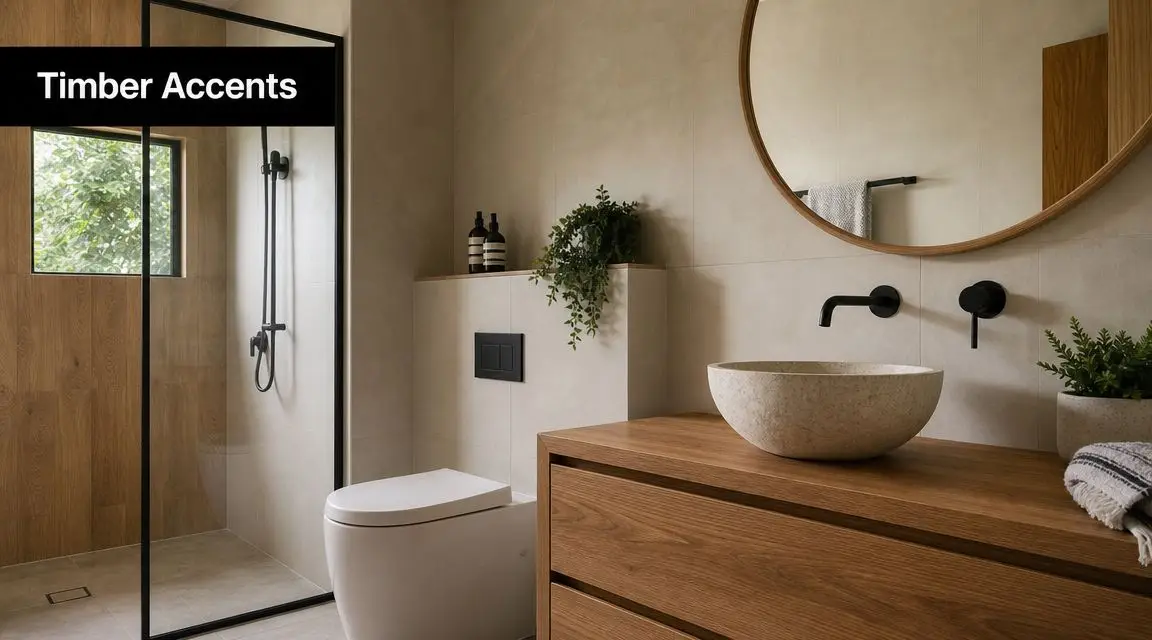
8. Timber Accents and Natural Materials
Bathrooms can become too hard-edged if every surface is glossy, cold, and uniform. Timber accents fix that. They add warmth, soften the acoustics a little, and stop a modern bathroom from feeling sterile.
This works especially well in Victoria, where many homeowners want a space that feels calm and residential rather than overly commercial. Timber-look finishes, natural stone, and textured materials suit both contemporary homes and period renovations that need a modern update without losing character.
Warmth without making the room high-maintenance
Timber vanities, timber-framed mirrors, and shelving details are often enough. You don't need to cover the whole room in timber to get the effect. Blackbutt tones, Tasmanian oak looks, and darker walnut finishes all work, depending on whether the palette is coastal, minimalist, or more dramatic.
Natural stone can also bring depth, but it requires realistic expectations. Stone needs care. Some clients love that. Others are better off with porcelain that gives a similar look with less maintenance.
A balanced material palette often looks like this:
- Timber on joinery: Adds warmth where people see and touch it most.
- Stone or stone-look surfaces: Good for texture and visual weight.
- Modern fixtures in contrast: Matte black, brushed nickel, or warm metallic finishes stop the room feeling rustic.
What doesn't work
The common mistake is choosing beautiful natural finishes without planning for moisture. In bathrooms, every material needs to cope with steam, splashes, and cleaning products. Timber vanities should be properly sealed. Stone should be chosen with maintenance in mind. Floors often work better in timber-look porcelain than real timber because they're more stable and practical.
This style suits homeowners who want designer bathrooms with a more grounded, liveable feel. It's less about trend-chasing and more about creating a room that still feels inviting years later.
9. Compact Ensuite Design and Space Optimisation
A compact ensuite usually fails for one reason. The room is drawn to fit fixtures, instead of being planned around how people move.
In Victorian homes, that problem shows up all the time. Period renovations often inherit awkward door swings, narrow wall lengths, and plumbing positions that limit what can go where. Newer townhouses have a different issue. The footprint is tighter from the start, so every choice has to earn its place.
The best small ensuites feel calm because the layout is disciplined. Keep circulation clear from the door to the shower. Reduce visual interruptions. Choose fittings that suit the room instead of forcing full-size products into a space that cannot carry them well.
The layout carries the room
A corner or walk-in shower often gives better movement than a bulky rectangular enclosure. Wall-hung vanities can help, but only if the depth is controlled. I often see vanities selected for storage first, then regretted because they pinch the walkway and make the room feel cramped every day.
Door planning matters just as much. A cavity slider or an outward-opening door can recover usable space, but it needs to be resolved early with framing, services, and privacy in mind. In older Melbourne homes, that early coordination also helps avoid expensive rework once walls are opened up.
Storage should be built into the plan, not added as an afterthought. Recessed shaving cabinets, in-wall niches, and joinery above the toilet usually work harder than extra freestanding pieces.
In a tight ensuite, 20 or 30 millimetres in the wrong place can be the difference between a room that feels efficient and one that feels irritating.
Practical choices that hold up in small spaces
These are the moves that usually deliver the best result:
- Use one clear focal line: Align the vanity, mirror, and shower screen so the room appears uncluttered when you enter.
- Keep fixture projections tight: Shorter-depth vanities, toilets, and tapware placements improve movement.
- Build storage upward: Vertical joinery adds function without taking up valuable floor area.
- Use large mirrors carefully: They can improve light and apparent width, especially in ensuites with limited natural light.
- Limit material changes: Too many tile breaks, trims, and feature finishes can make a small room feel chopped up.
Material selection still matters, but practicality comes first here. In Victoria's cooler months and humid periods, compact ensuites need reliable extraction and moisture-resistant finishes because steam builds up faster in a smaller volume of space. That is one reason I prefer simple detailing and easy-to-clean surfaces in these rooms. They age better and are easier to maintain.
For homeowners working through ensuite design ideas for Australian homes, 3D design is especially useful in compact layouts. A plan can look workable on paper and still feel wrong once you account for body movement, mirror position, towel reach, and how the room feels with the door open.
9-Point Comparison of Australian Bathroom Renovation Ideas
A comparison table is useful at this stage because good bathroom ideas can look equally appealing on Pinterest and still perform very differently once budget, layout, ventilation, and day-to-day use come into play. In Victoria, I'd also weigh each option against winter comfort, moisture load, and how much construction work the room can realistically accommodate.
| Design | Implementation complexity | Resource requirements | Expected outcomes | Ideal use cases | Key advantages |
|---|---|---|---|---|---|
| Spa-Inspired Wet Room Design | High, requires professional waterproofing and drainage work | Skilled trades, waterproof membranes, sloped substrates, ventilation | Spa-like, open-plan bathroom, improved accessibility and perceived space | Modern homes, compact bathrooms seeking luxury, aging-in-place conversions | Unified look, easy cleaning, adds property value |
| Dual Vanities with Under-Mount Storage | Medium, plumbing complexity and wider layout needed | Two vanity units, additional plumbing runs, cabinetry hardware | Improved morning flow and organisation, balanced symmetrical look | Family bathrooms, master ensuites with sufficient width | Reduces bottlenecks, increases storage, strong resale appeal |
| Sustainable & Water-Efficient Fixtures | Low to Medium, mostly fixture upgrades, some plumbing rework | WELS-rated taps and showers, dual-flush toilets, optional rainwater or greywater systems | Lower water usage and bills, regulatory compliance and eco appeal | Drought-prone regions, eco-conscious homes, cost-saving renovations | Significant water savings, rebates may apply, market differentiator |
| Heated Floors & Towel Rails (Climate Comfort) | Medium to High, electrical or hydronic installation and controls | Heating mats or pipes, thermostats, electrician or plumber, insulation | Consistent warmth, reduced condensation, improved comfort and luxury feel | Cold climates, high-end bathrooms, homes with elderly or young children | Improved comfort, helps reduce mould risk, feels like a premium upgrade |
| Large-Format Tiles & Minimal Grout Lines | Medium, requires expert tiling to avoid lippage | Oversized porcelain or ceramic tiles, precise substrate prep, skilled installers | Continuous contemporary look, easier cleaning, visually larger rooms | Contemporary renovations, open-plan bathrooms, bathrooms with underfloor heating | Fewer grout lines, lower maintenance, polished professional finish |
| Statement Lighting & Mirror Features | Medium, strategic wiring and fixture placement required | Quality LED fixtures, smart mirrors, electrician, dimming controls | Better ambience, stronger task lighting, clear visual focal points | Luxury designs, hotel-style bathrooms, small spaces needing depth | Mood control, energy-efficient options, improves design impact |
| Walk-In Showers with Niche Storage & Seating | Medium to High, waterproofing, bench and niche construction | Frameless glass, drainage upgrades, tiling, integrated seating, optional jets | More comfortable showering, built-in storage, improved accessibility | Master bathrooms, accessible designs, spa-like renovations | Integrated storage, seating for safety, simpler cleaning |
| Timber Accents & Natural Materials | Medium, careful material selection and sealing required | Sustainably sourced timber, natural stone, sealants, skilled joinery | Warm, natural finish with tactile quality and a more premium feel | Transitional and contemporary homes, high-end renovations, local sourcing | Natural warmth, sustainability signal, premium sensory appeal |
| Compact Ensuite Design & Space Optimisation | Low to Medium, careful planning and bespoke solutions | Compact fixtures, wall-hung systems, vertical storage, frameless glass | Functional small bathrooms that feel more spacious and organised | Apartments, rental properties, small ensuites and guest bathrooms | Cost-effective, efficient use of space, improves market competitiveness |
On site, the right choice usually comes down to what problem needs solving first. If the bathroom feels cold for half the year, heating may deliver more day-to-day value than an expensive feature wall. If the room is tight and hard to clean, larger tiles, a walk-in shower, or better storage will often outperform more decorative upgrades.
This is also where 3D design helps. At SitePro Bathrooms, we use it to test whether an idea that looks good in isolation still works once clearances, door swings, vanity depth, shower set-out, and storage access are all accounted for.
Bring Your Designer Bathroom to Life
A good bathroom renovation isn't only about choosing attractive finishes. It's about making sure the room works every day, in every season, for the people who use it. That means thinking carefully about layout, storage, ventilation, waterproofing, heating, and materials before any tile goes on the wall.
For Victorian homeowners, that practical side matters even more. Melbourne's cooler months and humid bathrooms can expose weak detailing quickly. A room that's poorly ventilated, awkwardly planned, or built around the wrong priorities can look impressive at handover and still become frustrating to live with. The opposite is also true. A well-planned bathroom, even without extravagant finishes, usually feels better because the basics are right.
That's where realistic budgeting matters. As noted earlier, Australian renovation costs are often grouped by clear tiers, from cosmetic updates through to high-end projects, and the final figure depends heavily on scope. In real bathroom renovations, a substantial part of the spend often goes into demolition, waterproofing, plumbing, tiling, electrical work, and compliance, not just the vanity, tapware, and tiles people first notice. That's one reason planning needs to start with what the room must do, then move into how it should look.
If you're weighing new bathroom ideas, start by being honest about the room you have. Is the issue storage, layout, ventilation, comfort, or all of the above? Do you want a family bathroom that handles daily traffic better, a compact ensuite that feels larger, or one of those designer bathrooms that balances warmth with clean lines? The right answer usually isn't the most dramatic one. It's the one that fits the house, the users, and the budget.
Registered builders unlimited who specialise in bathroom renovations bring value here because they can connect the design decisions to the construction detail. That's the gap many homeowners run into. The inspiration is easy to find. The hard part is knowing what will work in your room, in your home, and in Victoria's conditions.
SitePro Bathrooms is one option for homeowners who want that process handled end to end, from concept development and 3D design through to construction and finishing. A 3D design service is especially useful because it helps test layout, storage, tile set-out, and circulation before work begins. That reduces guesswork and gives you something more practical than a mood board.
If you're ready to move from inspiration to a workable plan, the next step is simple. Get the room assessed properly, define the scope clearly, and build the design around how you live. That's how modern bathrooms stop being ideas and become spaces that add comfort, function, and long-term value.