

The usual advice is to choose stone for durability and laminate to save money. That skips the first question Victorian renovators need to answer: which stone can be supplied and installed? A premium-looking sample isn't enough to establish a product's legal status, suitability or installed cost.
A useful stone vs laminate benchtop comparison separates natural stone from existing engineered stone, then considers how you cook, where water collects and what you're prepared to maintain. Laminate can be more than a budget fallback. It can also offer a simpler procurement route, leaving more of your renovation budget available for cabinetry, waterproofing and ventilation.
Stone and Laminate Benchtops Side by Side
Hard natural stone generally offers better heat and scratch tolerance, while laminate offers a lower-cost starting point and a broad printed range. However, marble and granite shouldn't be treated as interchangeable, and existing engineered stone belongs in a different purchasing category.
Stone and laminate benchtops compared on core criteria
| Criterion | Natural stone | Engineered stone (existing only) | Laminate |
|---|---|---|---|
| Heat resistance | High in suitable stone; hot pans rarely mark some finishes, but protection is still needed | High relative to laminate, existing installs only; protect resin-bound surfaces from hot cookware | Low to moderate, use trivets |
| Scratch resistance | High in harder stone; granite rarely scratches in normal use, marble is softer | High, but not scratchproof | Moderate, scratches and chips show |
| Water and stain resistance | Porous unless appropriately sealed; marble stains more easily | Very low porosity | Good when seams and edges are sealed; the core can swell if water enters |
| Repairability | Can be honed or polished by a specialist | Limited, specialist repair only | Scratches are hard to fix; panel replacement is common |
| Appearance range | Natural veining, unique patterns | Consistent, engineered patterns | Wide printed range, including stone and timber looks |
| Legal availability in Australia | Available | Supply and installation prohibited from 1 July 2024, according to the national workplace relations ministers' statement | Available |
What the differences mean beside a sink
Heat resistance isn't permission to put every hot saucepan directly on a surface. For daily cooking, use trivets and chopping boards regardless of the material, and obtain the care instructions for the actual product rather than relying on a category-wide rating.
Around the sink, the distinction is between surface resistance and assembly resistance. A laminate face can shed splashes while a poorly protected joint lets water reach the core; sealed natural stone still needs prompt spill removal, particularly with marble.
Practical rule: Choose the material and the joint details together. A good surface can't compensate for an exposed cut edge or a badly positioned seam.
Appearance also deserves a full-size comparison. Natural veining won't necessarily repeat across separate pieces, while printed finishes need deliberate alignment at joins and exposed ends.
For suitable stone, durability and specialist restoration are the strongest arguments. For laminate, price and simpler installation are the advantages. The better choice follows the way you'll use the benchtop, not a universal ranking of premium and budget materials.
Which Stone You Can Still Buy in Victoria
A quote that says only stone benchtop doesn't identify what you're buying. It could describe natural stone, porcelain, sintered material or an artificial product, and those labels don't establish the same legal position.
The Australian Government's engineered-stone prohibition guidance explains that manufacture, supply, processing and installation of covered engineered-stone benchtops, panels and slabs were prohibited nationally from 1 July 2024, with imports prohibited from 1 January 2025. The covered artificial material contains at least 1% crystalline silica by weight and combines natural stone with resins, pigments or other chemical constituents.
The distinction starts with composition, not colour or pattern.
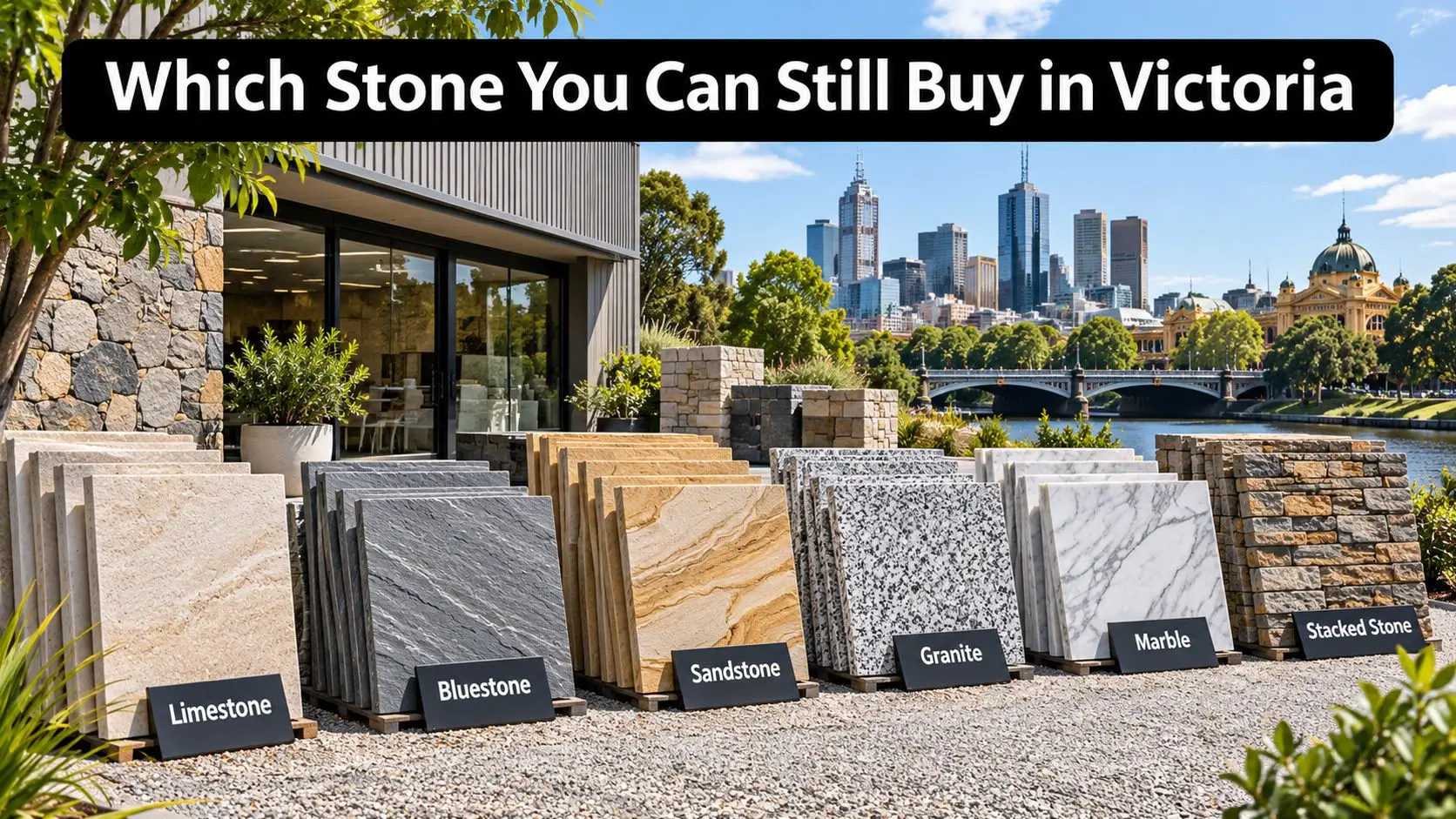
Legal availability isn't the same as fabrication safety
That government guidance notes that engineered stone can contain up to 97% crystalline silica. Cutting, grinding, drilling and polishing can generate respirable dust associated with silicosis, which makes fabrication and installation methods central to the decision.
A finished benchtop sitting undisturbed in a home isn't the same exposure situation as machining it. Don't interpret the prohibition as a reason to cut out an existing surface yourself.
Natural stone remains outside this specific ban, but fabricators still need appropriate dust controls when machining silica-containing materials such as granite. The Australian Government's engineered-stone ban FAQs also distinguish resin-free porcelain and sintered stone from prohibited engineered stone.
Compare the named product, not its marketing label
For broader ownership considerations, Interiors by DeX's guide to stone costs and maintenance for kitchens offers useful context. Our marble or quartz comparison can help frame appearance preferences, but neither an older comparison nor a stone-like finish establishes current compliance.
Before ordering, obtain written confirmation that the proposed surface is natural stone or another legally compliant product. Laminate avoids the engineered-stone classification question, although its cutting and installation still require suitable working practices.
Use the final checklist to document the material, composition and installer's process before signing.
Real Cost of Stone and Laminate Benchtops
Price is where the compliance difference becomes practical. Laminate has a published market range, legally installable stone needs a product-specific quotation, and prohibited engineered stone has no price at all.
Indicative material prices for benchtops in Australia, 2026
| Material | Indicative price (AUD, material only) |
|---|---|
| Laminate benchtop, published range A | 250–650 per square metre |
| Laminate benchtop, published range B | 120–350 per square metre |
| Stone-look laminate | 120–440 per lineal metre |
| Mineral-stone overlay | 700–1,200 per square metre |
| Natural stone | Product-specific quotation required |
| Engineered stone | Not available for new installation |
These published ranges disagree, particularly for laminate. They are indicative material-only comparisons rather than interchangeable installed quotations, and the mineral-stone overlay category can't stand in for a natural-stone price.
The units matter as much as the figures. A lineal-metre quotation needs a stated depth before it can sit beside a square-metre rate, and neither unit tells you whether delivery, cut-outs or removal is included.
A worked material-only example
Take a straight benchtop 3 metres long and 0.6 metres deep, an area of 1.8 square metres. Applying the table's laminate range gives roughly AUD 450–1,170 for material, while the overlay range gives AUD 1,260–2,160, before labour and fabrication.
These are arithmetic illustrations, which are not the same as project estimates. Sheet or slab layout, minimum orders, wastage and the suitability of an overlay for the existing substrate can all change what you purchase.
Compare quotations against the same drawing, the same material specification and the same list of inclusions. A cheaper supply-only figure isn't a cheaper completed benchtop.
What belongs outside the material allowance
An installed quotation should separate the surface from the work needed to fit it:
- Fabrication: Edge profiles, joins, sink openings, tap holes and cooktop cut-outs.
- Site work: Removal and disposal of the old benchtop and, where required, the splashback, plus access, delivery and cabinetry preparation.
- Making good: Splashback adjustments, wall repairs, plastering, floor levelling and any affected floor finishes.
- Services: Plumbing and electrical work where fixtures or appliances are disconnected, upgraded or relocated.
Our guide to the cost of a new kitchen places the benchtop within the wider renovation budget. SitePro Bathrooms provides an itemised quotation covering labour, materials, fixtures, finishes and a projected timeline, so a finish upgrade is priced separately from additional construction work.
Durability Against Heat, Scratches and Water
The material name matters less than the combination of surface, edge, cut-out and support. That holds for every compliant stone a Victorian supplier can still offer, and for laminate. Assess those elements together, particularly beside the cooktop and sink, rather than judging durability from an uncut showroom sample.
A photograph can illustrate the hazards, but it isn't a performance test for the stone you're buying.
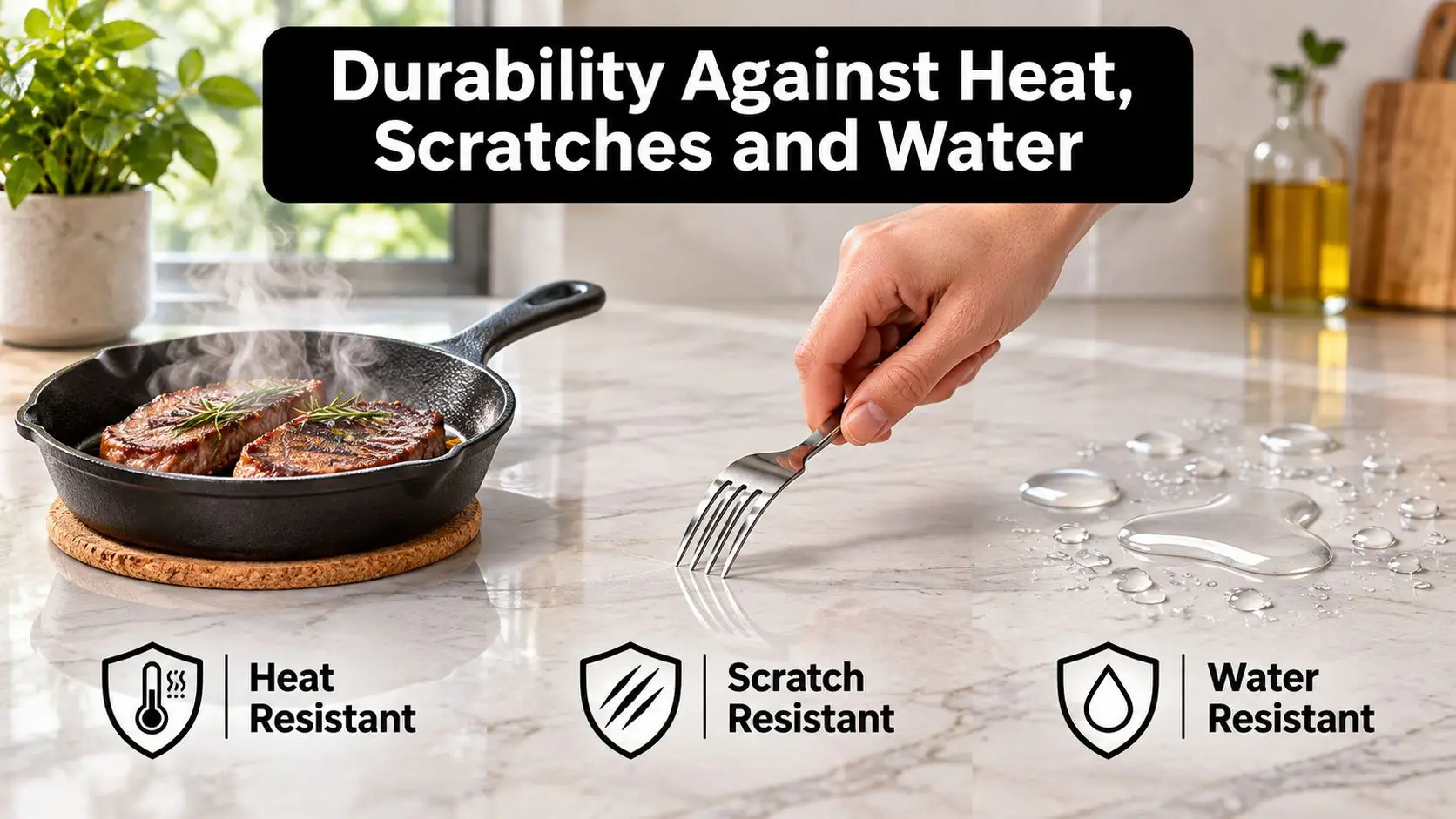
Heat and impact need separate precautions
Stone tolerates more heat than laminate, yet the failure mode is thermal shock rather than temperature alone. A very hot object placed on a cool slab forces one small area to expand faster than the surface around it, and the resulting stress can crack or mark the stone. Gradual warmth and a sudden temperature change are different problems, which is why a sample can pass a warm-mug test and still be vulnerable to a pan taken straight off the cooktop.
With laminate, direct heat can scorch the decorative surface or weaken the bond beneath it. Position kettles, benchtop ovens and other heat-producing appliances according to their installation instructions rather than assuming a nearby strip of benchtop is protected.
Hardness doesn't eliminate impact damage either. A heavy pot striking an exposed stone edge can chip it, and laminate corners can reveal damage to the decorative layer or core. Edges and corners, rather than the open face, are where both materials concentrate the risk.
Water damage starts at vulnerable details
Natural stone's absorption and chemical sensitivity aren't identical problems, and treating them as one leads to the wrong fix. Sealing can help manage staining, but it won't make marble immune to acid etching from lemon juice or wine. A dull etched patch sits on the surface and needs different treatment from an absorbed stain, so a stone that performs well against water can still mark badly against acid.
For laminate the risk profile inverts. The decorative face resists water, so the durability variable sits in how each cut edge, penetration and junction is detailed rather than in the surface itself.
A family-kitchen scenario
Consider a hypothetical family using the same sink and cooktop daily over five years. Well-detailed laminate can remain serviceable with protective habits, while repeated soaking at a failed joint can force local replacement. A suitable natural stone offers restoration options, yet still needs protection from impact, staining and thermal shock.
This isn't a lifespan forecast. It shows why installation detail and household habits can matter more than the broad material category.
With showroom permission, use a spare sample rather than a display:
- Warm-mug check: Look for marking, but don't treat this as proof of hot-pan resistance.
- Fingernail check: Lightly assess an offcut's finish and edge, recognising that this doesn't establish knife resistance.
- Seam-water check: Ask for a demonstration joint and inspect how the installer protects the exposed core; don't soak a showroom bench.
Maintenance, Repairs and Lifespan Compared
Choose the care routine you'll follow. A surface that looks ideal on handover day can become frustrating if its cleaning restrictions or repair options don't suit your household.
Natural stone rewards the right treatment
Use a soft cloth and a cleaner suitable for the particular stone, commonly a pH-neutral formulation. Wipe spills promptly, avoid abrasive pads and don't use acidic descalers on marble.
Resealing should follow the stone and sealer supplier's instructions, informed by absorption, wear and use. An annual check is a useful household reminder, but it isn't evidence that every stone needs resealing on the same schedule.
Specialists can assess whether honing, polishing, stain treatment or chip repair is appropriate. Renue Systems Four Points' service to restore natural stone in hotel lobbies illustrates the distinction between routine cleaning and professional restoration, although a domestic benchtop needs its own assessment.
Existing engineered stone needs a work plan
Routine care may be straightforward, but repair isn't only a cleaning decision. Find a specialist who can identify the material and establish the requirements for the proposed work before anyone drills, grinds or polishes it.
Don't assume a replacement section will be obtainable because the original colour once appeared in a catalogue. Restricted supply, matching difficulties and the condition of adjoining pieces all affect the repair plan.
Laminate is simple to clean, harder to refinish
Use mild detergent and a soft cloth, then dry joints and edges. Avoid abrasive scourers and don't try to sand a scratch out of the decorative layer.
Small cosmetic treatments may disguise damage, but they won't rebuild a swollen core. A replacement panel or section can be more practical than attempting an invisible patch, especially when the pattern is discontinued.
Repair budgeting: Compare the full repair scope, including access, disconnection of fixtures and making good, rather than the cosmetic treatment alone.
Natural stone can offer a long service life when its condition permits restoration. Laminate may need replacement sooner under persistent moisture or rough use, but neither material has a reliable universal lifespan or repair price.
Keep a simple maintenance calendar:
- Daily care: Clean spills and dry wet joints rather than leaving them for a scheduled clean.
- Monthly review: Clean beneath movable appliances and inspect tap bases and exposed edges.
- Annual stone check: Review the finish and sealing requirements against the supplier's instructions.
- Annual laminate check: Inspect seams, edging and splashback junctions for lifting, gaps or swelling.
Renovation Cases and the Better Choice for Each
The better choice follows the ownership plan and failure risk, not just the room's style. These are practical starting points, subject to the actual product, installation detail and quotation.
Better benchtop choice by renovation case
| Renovation case | Better fit | Main reason |
|---|---|---|
| Rental property refresh | Laminate | Lower outlay and easier replacement between tenants |
| Heavy-use family kitchen | Natural stone, sealed | Better heat and scratch tolerance with a suitable hard stone |
| Budget kitchen with gentle use | Laminate with sealed seams | Lower cost where heat and knocks are limited |
| Bathroom vanity | Laminate or compliant stone | Water exposure makes sealed edges and waterproofing the priority |
| Strata or body corporate project | Laminate or compliant stone | Specify a consistent finish and predictable upkeep across units |
Before replacing a sound kitchen, it can help to compare Melbourne kitchen resurfacing options through Western Bathroom Renovations. Distinguishing a cosmetic refresh from replacement prevents you from paying to remove serviceable components without a clear reason.
Bathroom vanities need a whole-room decision
For bathroom renovations, a water-resistant vanity top doesn't replace compliant wet-area construction. The basin cut-out, tap penetrations and wall junction need suitable detailing, while floor and wall waterproofing must address the room independently.
The Victorian Building and Plumbing Commission's wet-area waterproofing guidance identifies AS 3740 as an accepted compliance pathway for domestic wet areas and requires membranes to demonstrate compliance with AS/NZS 4858:2004. Coordinate the vanity with the waterproofing design rather than assuming stone makes the surrounding construction waterproof.
This matters when assessing new bathroom ideas such as open showers, floating vanities and minimal splashbacks. The clean lines associated with modern bathrooms and designer bathrooms still need accessible joints, appropriate basin placement and a plan for splashing.
Specify for the people using the room
Our Monash University bathroom renovations used materials designed to withstand heavy traffic. The relevant principle for a household or body corporate is to select finishes for the expected use, not to assume that a commercial-looking surface automatically suits every room.
Have a registered builder coordinate layout and waterproofing where the vanity forms part of a wider renovation. Keep the material decision connected to the basin, cabinetry, ventilation and adjacent finishes.
For a long-term family home, natural stone can support a premium presentation, but don't count on a guaranteed resale return. Laminate is often the more proportionate choice for a short-term or budget-led renovation.
Confirm the Material Before You Sign the Quote
A sample establishes appearance. The quotation needs to establish the product, scope and responsibility. Keep the drawings, material documentation and installation proposal together so changes don't get agreed verbally and lost. A kitchen consultation typically covers your vision, lifestyle requirements, budget and timeframe, with accurate measurements of the existing space taken on site, and it should leave written answers rather than verbal assurances.
For stone specifically, the paperwork carries extra weight because the legal question sits upstream of the design one. Engineered stone containing crystalline silica faces restrictions in Victoria that laminate does not raise. Laminate is therefore a simpler compliance route, not only a budget fallback, since its specification involves no silica classification and no controlled fabrication regime.
Complete the pre-order checks
Name the exact material. Record the manufacturer, range, colour, finish, thickness and edge construction. Stone or laminate alone isn't a sufficient specification.
Document composition and origin. For an engineered or stone-look product, request silica content, country of manufacture and written confirmation of its legal classification. A low-silica marketing label isn't a compliance assessment.
Record the fabrication process. Establish where cutting, grinding and polishing will occur, what dust controls the installer uses and who manages any work on the existing surface.
Match price to scope. Check labour, materials, fixtures, finishes, exclusions and projected timeline. The guide to how to quote a kitchen renovation helps organise these decisions.
Verify builder registration. Consumer Affairs Victoria's building-practitioner guidance states that registration is required for domestic building work costing more than $10,000, including labour and materials, and for work requiring a building permit regardless of cost. Registration must be approved before work begins; a pending application is not sufficient. When comparing registered builders unlimited, check the formal Domestic Builder Unlimited (DB-U) class, which allows the practitioner to carry out, manage or arrange the work involved in whole bathroom renovations, including demolition, carpentry, waterproofing, tiling, plumbing and electrical trades. Applicants must nominate the relevant class and code and provide evidence of required insurance.
Confirm the workmanship warranty. Get the installer's warranty terms in writing and keep them separate from the material manufacturer's conditions, since each covers a different failure.
Make the specification the final decision
Keep unresolved items visible before accepting the order, particularly final dimensions, cabinetry support and responsibility for adjacent repairs. An itemised quotation that leaves any of these open invites a variation claim later.
SitePro Bathrooms professionally measures, fabricates and installs kitchen benchtops, with itemised quotations covering labour, materials, fixtures, finishes and a projected timeline. Whatever supplier you choose, the order is only ready to sign once the document names the material, its silica status where relevant and the installer's proposed process in full.