

Modern Kitchen Benchtop Styles for 2026
Most advice about kitchen benchtop styles still starts with colour, veining, or what looks expensive. That's the wrong starting point for a Victorian renovation.
A benchtop isn't just a finish. It's the hardest-working surface in the kitchen, one that has to survive heat, water, cleaning chemicals, dropped items, school lunches, rushed dinners, and years of daily use. In older homes, it also has to fit existing wall lines, legacy cabinetry depths, uneven floors, and layouts that weren't designed for today's appliances.
That matters because Australia is overwhelmingly a renovation market, not a blank-canvas market. The 2021 ABS Census counted 10,852,207 private dwellings nationwide and 2,106,925 in Victoria. In practical terms, most kitchen benchtop decisions are being made inside established homes where space, access, budget, and disruption all affect what works.
Choosing Your Kitchen Benchtop in a New Era
A good benchtop choice balances four things at once. Appearance, durability, maintenance, and fit for the house you own. If one of those gets ignored, the problems usually show up fast.
In renovation work, the benchtop often carries more visual weight than clients expect. Cabinet doors can be changed later. Wall paint can be updated. Splashbacks can be replaced. The benchtop is different. It sets the tone of the kitchen, influences the edge detail, affects sink selection, and often determines whether the room feels current or dated.
Why retrofit realities matter
In a Victorian home, the kitchen rarely behaves like a showroom display. Existing windows lock in bench heights. Old services affect sink position. Tight access can limit slab handling. Some clients want an island look in a room that really needs a more practical galley layout. That's why material choice has to be grounded in construction reality.
The current market has also changed. Homeowners who previously would have defaulted to engineered stone now need to think more carefully about alternatives, compliance, fabrication details, and long-term upkeep.
Practical rule: Choose your benchtop style after you've considered how you cook, how much maintenance you'll tolerate, and how the material will be fabricated in your actual kitchen.
What usually works better than trend chasing
The strongest selections tend to come from a short checklist:
- Daily use first: A family kitchen needs different performance from a lightly used apartment kitchen.
- Edge and corner safety: Sharp visual details often look good in photos but wear poorly in busy homes.
- Repair expectations: Some surfaces age gracefully. Others show every mistake and are harder to restore.
- Whole-home consistency: Kitchen finishes often set the palette for later updates, including bathroom renovations.
That last point gets missed. Clients planning a staged renovation often start with the kitchen, then carry those material cues into modern bathrooms, new bathroom ideas, and even more polished designer bathrooms later on. When the palette is thought through early, the whole home feels more resolved.
The 2024 Benchtop Shift What It Means for You
The biggest change in benchtops since 2024 has nothing to do with colour, veining, or edge profiles. It is the engineered stone ban.
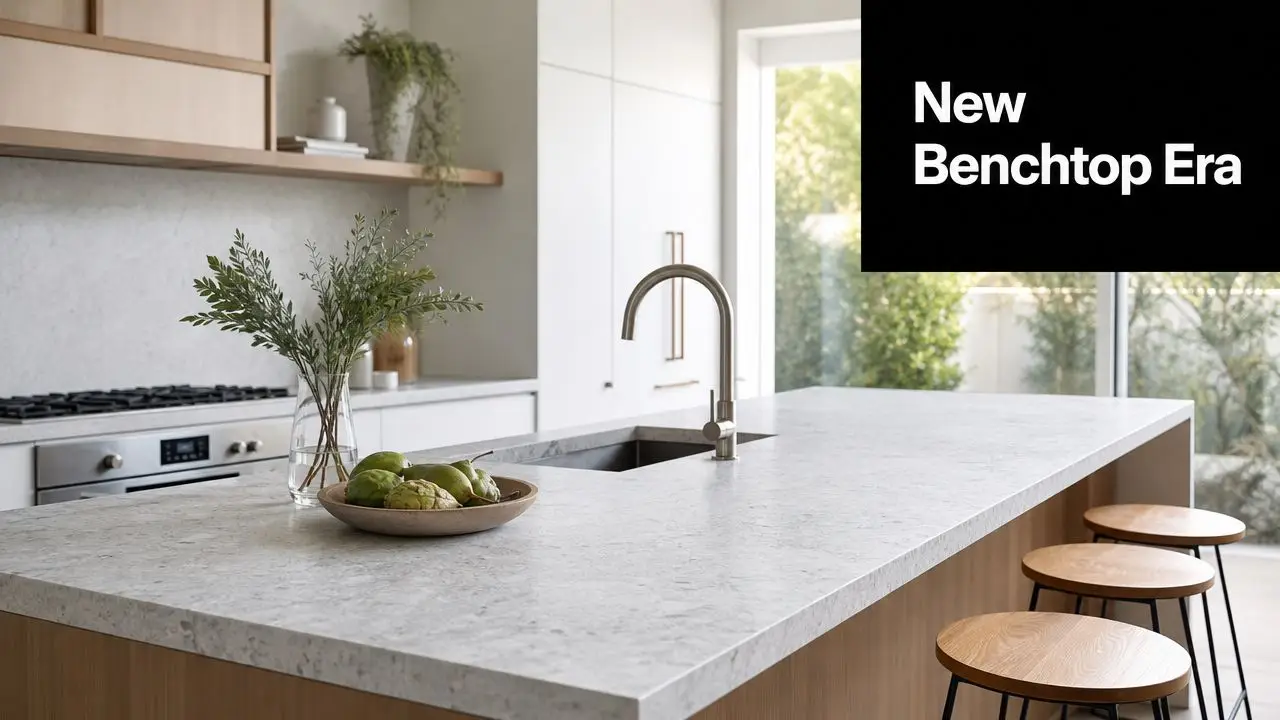
From 1 July 2024, Australia banned the manufacture, supply, processing and installation of engineered stone. For Victorian homeowners, that changes the selection process straight away. The old default is gone, and the better question now is simple. Which legal alternative gives you the look you want without creating avoidable cost, breakage risk, sealing work, or installation headaches later on?
What changed in practical terms
In real projects, this has shifted attention toward a tighter group of compliant materials:
- Porcelain and sintered surfaces for sharp, thin stone-look designs
- Natural stone for genuine variation and a higher-end finish
- Modern laminates for controlled budgets and solid day-to-day performance
- Solid surface materials for low-porosity benches with refined joins
- Timber for warmth and a softer, lived-in look
That does not mean every replacement suits every kitchen.
Porcelain can look excellent, but it needs careful handling and good support at edges and cut-outs. Natural stone brings character, but some stones ask for more sealing and more owner discipline. Laminate still earns its place in many Victorian homes because it is forgiving on budget and easier to replace if the kitchen is likely to be updated again in stages.
Why the shift has improved decisions
This change has forced better conversations early. Clients now ask about scorch marks, chips on external corners, staining around sinks, drainer grooves, slab thickness, and whether a waterfall panel is worth the extra spend.
Those are the questions that save money.
Before the ban, a lot of selections stopped at appearance. Post-2024, benchtops need to be treated as a working surface first and a style feature second. That usually leads to smarter choices in family kitchens, rental properties, and long-term owner-occupier homes where maintenance and repair matter just as much as first impressions.
The best stone-look result now usually comes from choosing the right compliant material for the job, not from trying to copy an old specification detail for detail.
What Victorian homeowners should do now
Keep the decision process tight:
- Decide on the finish direction first. Stone-look, timber, or a cleaner solid-colour surface.
- Be honest about upkeep. Some materials forgive neglect. Others do not.
- Check that your preferred edge, sink detail, overhang, and span suit the material you are pricing.
- Confirm the quote includes fabrication complexity, not just the slab itself.
That last point catches people out. A sample can look perfect, then become expensive once cut-outs, exposed ends, polishing, support requirements, appliance clearances, and on-site access are factored in.
In the current Australian market, compliant choice matters. So does buildability. The right benchtop now is not the one that was popular two years ago. It is the one that suits your kitchen plan, your budget, and the way you will live with it.
A Practical Guide to Modern Benchtop Materials
Material choice carries more weight now because the old default of engineered stone is off the table in Australia. That has pushed Victorian homeowners toward a smaller group of compliant options, each with clear trade-offs in fabrication, maintenance, edge durability, and cost once installation is included.
One of the quickest ways to sort them is by porosity. Less porous surfaces usually cope better with food stains, oils, and everyday cleaning. More porous materials can still perform well, but they ask more from the owner, especially around sealing, wiping habits, and sink areas.
Benchtop Material At-a-Glance Comparison
| Material | Cost Bracket | Durability | Heat Resistance | Stain Resistance | Maintenance Level |
|---|---|---|---|---|---|
| Porcelain or sintered surface | Mid to high | Strong for everyday use, but edge impacts need care | High | Strong | Low to moderate |
| Natural stone | High | Strong, but depends on stone type and sealing | High | Variable, depends on sealing | Moderate to high |
| Laminate | Low to mid | Good for many family kitchens | Moderate | Good in normal use | Low |
| Timber | Mid to high | Can wear well, but marks more easily | Lower than stone-look options | Variable | Moderate to high |
| Stainless steel | Mid to high | Tough, but dents and scratches show | High | Strong | Low to moderate |
| Solid surface or acrylic | Mid to high | Good, with repair potential in some situations | Moderate | Strong due to non-porous surface | Low |
Porcelain and sintered surfaces
Porcelain and sintered products are the closest fit for many clients who still want a refined stone-look kitchen after the 2024 ban. They suit slim profiles, resist staining well, and handle heat better than many budget alternatives.
They do have limits. The slab can be very hard, but exposed corners and narrow edge details are still vulnerable to impact. In practical terms, that means a busy family island with sharp external corners needs more thought than a display kitchen in a showroom. I usually steer clients toward softened edges and details that give the fabricator enough material to work with safely.
These surfaces also pair well with full-height wall finishes if you want a cleaner look through the cooking zone. If you are weighing that up, this guide on a kitchen splashback or backsplash decision helps clarify where the spend makes sense.
Natural stone
Natural stone still earns its place, but it should be chosen for its character, not because people assume it is the easiest premium option. It gives variation, depth, and a less uniform finish than most manufactured alternatives.
That variation is also the risk. Some stones are more porous than clients expect, some darken around wet zones if maintenance slips, and some finishes show etching or marks sooner than people were promised at selection stage. In older Victorian homes, natural stone can look excellent with traditional joinery or warmer timber floors, but it is usually a better fit for owners who will keep up the sealing and accept that the surface may age unevenly.
Laminate
Laminate still does a lot of heavy lifting in real renovations. It is cost-effective, predictable to install, and available in finishes that look far better than many people remember.
It also solves practical problems. In budget-conscious projects, it can free up money for better cabinet hardware, improved lighting, or appliance upgrades that clients notice every day. In retrofit work, laminate is often easier to detail around walls that are not perfectly square, and replacement down the track is usually less painful than replacing a brittle slab product.
The compromise is heat and edge wear. Put a hot pan on it or let water work into a damaged seam, and its limits show quickly.
Timber
Timber brings warmth fast. In the right kitchen, that matters more than chasing a cold stone-look finish.
It suits period homes, softer colour palettes, and spaces where a lived-in result is part of the brief. It also works well as a feature zone, such as an island or a breakfast section, rather than across every bench if the owners are nervous about upkeep.
The trade-off is simple. Timber marks, moves, and changes colour over time. Around sinks and dishwashers, poor detailing or missed maintenance will show. Some owners like that patina. Others are frustrated within the first year because they wanted warmth without the care that comes with it.
Timber is a good choice for clients who want texture and accept wear. It is a poor choice for clients who want a surface to stay visually uniform with minimal effort.
Stainless steel and solid surface
These materials solve different problems, and both deserve more attention than they usually get.
Stainless steel suits hard-working kitchens where hygiene, heat tolerance, and easy wipe-down matter more than hiding scratches. It is common in serious cooking spaces for a reason. The downside is visual softness. It dents, it shows abrasion, and it can feel too commercial if the rest of the kitchen is trying to be warm or traditional.
Solid surface or acrylic is often overlooked in the post-ban conversation, but it remains a practical compliant option. It is non-porous, easy to clean, and useful where clients want a continuous look with less obvious joins and integrated sink possibilities. Heat resistance is not at stone level, so it needs sensible use, but in many family homes it offers a good balance of upkeep, repairability, and clean-lined appearance.
Matching Benchtop Style to Your Kitchen Design
A benchtop sample never tells the full story. What matters is how the slab reads at room scale, where the joins fall, how the edge catches light, and whether the finish suits the way a Victorian home is used.
I tell clients to stop asking which benchtop style is fashionable and start asking which one fits the kitchen they are building. That usually leads to better decisions.
In a compact kitchen, visual restraint does more work than a dramatic slab. Pale tones, quiet movement, and a slimmer-looking profile can make a narrow room feel wider and less crowded. Heavy veining, thick edge builds, and strong colour contrast often shrink the space, especially in galley layouts or older homes with limited natural light.
A simple approach usually performs best in smaller rooms:
- Lighter surfaces help reflect light and keep tight work zones from feeling boxed in.
- Simple edge profiles keep cabinet lines clean and are less likely to date quickly.
- Moderate patterning gives interest without turning the benchtop into the only thing you see.
Open-plan kitchens need a different response. Here, the island is often read more like furniture than joinery, so the benchtop has to work from multiple angles. Waterfall ends, a thicker mitred look, or a full-height matching wall finish can all be effective, but only if the material suits the fabrication detail and the budget allows for the extra labour.
That is where poor selections usually show up. A bold stone-look surface may look impressive on a sample or showroom island, then feel overworked once it sits beside timber floors, pendant lights, and a busy splashback. In many Victorian renovations, the better result comes from giving one surface the lead role and keeping the rest quieter.
Detailing matters as much as colour. For stone-look materials and other hard surfaces, eased edges with a small radius are better practice than sharp arrises because they reduce chipping risk at corners and around sink cut-outs. Proper support at undermount sinks and dishwashers matters as well. These are the details that affect whether a benchtop still looks good after years of hard use.

Carrying the palette into bathrooms
The kitchen usually sets the tone for the rest of the renovation. Benchtop colour influences splashbacks, floor tile warmth, tapware finishes, and later vanity selections. If those decisions are made separately, the house can feel pieced together rather than planned.
Homeowners renovating both kitchen and bathroom often get a better result by setting the material direction early. A warm timber or soft beige benchtop can support a more relaxed bathroom palette. A pale mineral or porcelain look often suits cleaner, sharper bathroom joinery. If you are weighing the wall finish at the same time, this guide to splashback or backsplash choices is a practical place to start.
The goal is not perfect matching. It is consistency. In the post-2024 Australian market, with many Victorian homeowners reassessing old engineered stone assumptions, the best kitchens are usually the ones where style, compliance, and day-to-day practicality are resolved together.
Beyond Aesthetics Durability Maintenance and Cost
A benchtop decision usually goes wrong in one of two ways. Homeowners either buy on appearance alone, or they focus so hard on the sticker price that they miss what the surface will cost them over the next ten years.
That matters even more in the post-2024 Australian market. With engineered stone off the table for many projects, Victorian homeowners are now comparing porcelain, sintered stone, stainless steel, timber, laminate, and natural stone more carefully. The better question is simple. Which material will still suit the way your household lives after the novelty wears off?
What long-term cost really means
The purchase price is only the starting point. The total cost includes:
- Cleaning effort: Some materials wipe down easily every day. Others need more care around staining, sealing, or preserving the finish.
- Visible wear: Scratches, chips, etching, scorch marks, and edge damage show up differently depending on the material and colour.
- Repairability: A benchtop that can be repaired in one area often holds its value better than one that needs full replacement after a single bad impact.
- Disruption: If repairs are difficult, a minor defect can turn into lost kitchen access, extra trade visits, and added labour.
This is why I push clients to compare ownership, not just installation. A cheaper top that stains easily or cannot be repaired cleanly can cost more in frustration and replacement.
Common failure points in real kitchens
Wear is rarely spread evenly.
Sink cut-outs, drainer zones, and the edge beside a dishwasher usually show age first. Island corners take regular knocks from stools, school bags, and trays. Dark matte finishes often show fingerprints, dust, and wipe marks more than expected. Timber can look excellent, but around wet areas it needs consistent care or it starts to age unevenly.
A durable benchtop is one whose weak points are acceptable for your household, not one with the strongest showroom story.
Natural stone still appeals to many owners for its character, but it comes with trade-offs. Some stones etch from acidic spills. Some mark more easily than buyers expect from a polished sample. Porcelain and sintered surfaces are often strong performers for heat and stain resistance, but edge damage can be harder to disguise if it does happen. Laminate remains one of the most cost-effective options for many Victorian renovations, especially where budget discipline matters, but it will not tolerate heat or heavy impact like harder materials.
How value changes from one household to another
A family kitchen usually benefits from a surface that is forgiving, easy to clean, and not precious. An investor or landlord often gets better value from predictable upkeep and straightforward replacement options. An owner-occupier renovating a long-term home may decide that extra maintenance is acceptable if the material gives the right look and can be maintained properly.
There is no universal best choice. There is only the right compromise for the job.
If you are still setting the renovation budget, this guide to the cost of a new kitchen renovation helps put the benchtop decision in context with cabinetry, appliances, plumbing, and labour.
A practical selection method is to rank four things in order: upkeep, resistance to damage, repair options, and appearance. Once clients do that, the shortlist usually becomes much clearer.
Your Renovation with a Registered Builder
Benchtop selection often looks simple until it reaches site. Then the real coordination starts.
A registered builder unlimited doesn't just help choose a material. They manage how that choice affects cabinetry tolerances, sink installation, plumbing set-out, appliance fit, splashback sequencing, access for delivery, and the timing of every trade that follows. In a renovation, those moving parts matter as much as the slab itself.

Why this matters on real jobs
The most expensive mistakes usually happen in translation. A client chooses a benchtop style from a sample. The cabinet layout changes slightly. The sink spec changes later. The overhang becomes larger. The support detail doesn't follow. By install day, the design intent and the build reality no longer match.
That's where builder-led coordination earns its keep.
- Design intent stays buildable: Edge profiles, thickness build-ups, and joins get reviewed before fabrication.
- Trades work in sequence: Cabinetmaker, plumber, electrician, tiler, and benchtop installer aren't guessing each other's tolerances.
- Compliance is tracked: Material choices and installation details stay aligned with current requirements.
- Variations are controlled: Problems are picked up earlier, when they're cheaper to solve.
The value of end-to-end planning
This is also why 3D design has become so useful in renovation work. It helps clients test proportion, colour temperature, and profile thickness before money is committed to fabrication.
For homeowners planning kitchens and bathroom renovations together, one option is SitePro Bathrooms' registered builder guidance, which outlines how builder-led coordination supports renovation projects from design through handover.
The same process that improves kitchen outcomes also helps with modern bathrooms and more custom designer bathrooms. Services, waterproofing interfaces, cabinetry lines, and finish schedules all benefit when one team is responsible for coordination rather than leaving every trade to interpret drawings independently.
Making Your Final Benchtop Decision
The right benchtop isn't the one that looks best in a showroom. It's the one that still suits your home after daily use, cleaning, and normal wear.
If you're narrowing down kitchen benchtop styles for a Victorian renovation, ask yourself:
- How much maintenance will I realistically keep up with?
- Do I want natural character, or do I want consistency?
- Will this edge detail survive the way my household uses the kitchen?
- Am I choosing for my own lifestyle, a rental, or future resale?
- Does this finish work with the rest of the home, including future bathroom renovations?
A durable, cost-effective choice usually comes from being honest about those answers. Some households are happiest with low-fuss laminate or solid surface. Others want the warmth of timber or the depth of natural stone and accept the upkeep that comes with it. There isn't one correct material. There is only the material that fits the job properly.
If you're planning a kitchen update, a full home refresh, or pairing the project with new bathroom ideas, get the benchtop decision resolved early. It influences more of the renovation than is often expected.
For customized advice on layout, materials, and coordinated kitchen or bathroom renovations, speak with a registered builder before you lock in the finish schedule. That's usually the point where style becomes a workable plan.