
Small Bath Renovation Cost in Highett: A Practical Guide
A small bathroom renovation in Highett and greater Victoria usually costs roughly A$8,000 to A$20,000 for a cosmetic-to-mid-range project. A full rebuild regularly crosses A$20,000 once plumbing, waterproofing and tiling are included.
You're probably looking at a tired bathroom that still functions, but no longer feels clean, practical or worth keeping. Perhaps it's a compact 1990s ensuite with dated tiles, a swollen vanity and a shower that wastes space. The temptation is to ask for the cheapest quote. The better question is, what scope does that quote cover?
A small room can need extensive work behind the walls. The footprint may stay unchanged, yet plumbing relocation, substrate repairs, waterproofing, electrical upgrades and premium finishes can turn a modest refresh into a substantial rebuild. Current Australian guides place small bathroom projects in a broad range, from about A$6,000 to A$14,000 in some cases, while the national average bathroom renovation is about A$26,000, with common projects ranging from A$8,000 to A$35,000 or more according to Australian bathroom renovation cost guidance.
What a Small Bathroom Renovation Really Costs in Highett Today
A Highett homeowner comparing a vanity replacement with a complete strip-out must separate room size from project complexity. A four-square-metre bathroom can cost more than a larger room when trades work through narrow access, repair damaged substrates or reroute services.
For a small Highett bathroom, allow approximately A$8,000 to A$20,000 for cosmetic through mid-range work in 2026. A A$6,000 refresh is possible when the layout, services, waterproofed substrate and major fixtures remain sound. Once the scope includes complete waterproofing, plumbing changes, extensive tiling or higher-spec fixtures, the budget commonly reaches A$20,000 to A$28,000-plus. Victorian guidance places full renovations at A$15,000 to A$35,000, standard projects around A$20,000 to A$32,000, and small ensuites around A$12,000 to A$20,000 in Victoria bathroom renovation cost guidance.
Start with the work behind the tiles
A surface-level project can retain the shower position, toilet, waste lines, electrical points and waterproofed substrate. Replacing the vanity, mirror, lighting, screen, paint and fittings can still produce a major visual improvement without paying for a full rebuild.
A complete renovation follows a different cost path. Demolition reveals wall and floor condition, trades adjust services, and a compliant wet-area system is installed before tiling and fit-off. Victorian compliance requirements therefore affect more than the visible finishes. They also add licensed trade time, inspection points and coordination between trades.
Practical rule: Treat the first quote as a scope document, not a price tag. If it does not state what happens to waterproofing, plumbing, electrical work, demolition and waste, you have not compared quotes properly.
Why Highett quotes can exceed cheap national estimates
Highett sits in the Melbourne metropolitan market, and compact bathrooms often demand careful storage, precise fitting and higher finish standards. Older Bayside homes can add access problems, uneven substrates and concealed defects that a short inspection misses.
National figures provide orientation, not a Highett budget. A low-cost estimate may cover a cosmetic update, while a local quotation includes licensed trades, compliant wet-area preparation and a full strip-out. Those scopes produce different prices, even when both are called a small bathroom renovation. Use the scope, Victorian requirements and condition behind the tiles to judge whether a quote belongs closer to A$6,000 or A$20,000-plus.
Price Bands for Small Bathrooms Across Victoria
A small Highett bathroom can sit near A$6,000 or rise beyond A$20,000, depending on what the quote includes. Published Victorian renovation benchmarks place cosmetic or limited refits around A$8,000 to A$15,000, while full renovations commonly reach A$15,000 to A$35,000 and may exceed A$40,000 for higher-spec work. Certified waterproofing is commonly priced around A$600 to A$1,500, tiling supply and installation around A$50 to A$120 per square metre, and licensed plumbing and electrical work around A$2,000 to A$5,000, according to Victorian renovation cost benchmarks.
For Highett planning, use three practical bands. They are not promises. They show what a contractor is offering and help separate a A$6,000 refresh from a A$20,000-plus rebuild.
Small Bathroom Renovation Price Bands in Victoria
| Band | Price Range (AUD) | Typical Inclusions | Best For |
|---|---|---|---|
| Cosmetic refresh | A$6,000 to A$9,000 | Visible fixture replacements, paint, mirror, limited tiling, existing layout retained | Sound bathrooms, rentals and sale preparation |
| Mid-range strip-out | A$10,000 to A$18,000 | Demolition, new vanity, shower works, substantial tiling, compliant wet-area preparation and limited service updates | Homeowners wanting a durable functional upgrade |
| Full rebuild | A$18,000 to A$28,000-plus | Full strip-out, renewed waterproofing, plumbing and electrical coordination, extensive tiling and upgraded finishes | Older bathrooms, layout problems and long-term homes |
The first band applies only when the existing room is sound. Failed waterproofing or damaged wall substrate turns a cosmetic cover-up into false economy. Victorian compliance requirements can push the scope higher once wet-area work, licensed trades and inspection points are involved.
The middle band suits many sensible Highett renovations. Keep the plumbing broadly in place, then improve storage, lighting and shower function without rebuilding every service. This controls disruption while still delivering a durable result.
The upper band describes reconstruction, not decoration. Recent Australian cost guidance also highlights the gap between a basic refresh and a small full renovation, particularly when plumbing relocation, waterproofing, access and older building conditions expand the scope, as outlined in the 2026 Australia bathroom renovation cost guide.
Where Every Dollar Goes in a Small Bathroom Budget
A compact Highett bathroom can look simple on paper, then absorb the budget through work hidden behind the tiles. The difference between a A$6,000 refresh and a A$20,000-plus rebuild usually comes from demolition, waterproofing, substrate repairs, plumbing and Victorian compliance, not the mirror or tap finish.
These planning allowances show where the money goes. They are individual cost centres, so a quotation may combine or overlap them. Access, product choice, room condition and the extent of wet-area work will set the final total.
| Line Item | Low (AUD) | High (AUD) | % of Mid-Range Budget |
|---|---|---|---|
| Demolition and disposal | A$800 | A$1,500 | Qualitative allocation |
| Waterproofing and wet-area preparation | A$1,200 | A$2,500 | Qualitative allocation |
| Wall and floor tiling, including substrate | A$2,500 | A$6,000 | Qualitative allocation |
| Plumbing rough-in and fit-off | A$2,000 | A$5,000 | Qualitative allocation |
| Shower screen | A$600 | A$1,800 | Qualitative allocation |
| Vanity and basin | A$600 | A$3,500 | Qualitative allocation |
| Bath if retained | A$800 | A$2,500 | Qualitative allocation |
| Tapware and fittings | A$400 | A$2,000 | Qualitative allocation |
| Lighting and electrical | A$400 | A$1,200 | Qualitative allocation |
The percentage column stays qualitative because the scope changes the total. Waterproofing, tiling and plumbing routinely consume most of the working budget before a homeowner selects a mirror, towel rail or decorative finish. Licensed trades, required preparation and inspection points can push those costs higher in Victorian wet areas.
The expensive work is mostly invisible
Demolition covers protection, removal, loading, disposal and cleaning. A narrow Highett side passage can make rubble removal and material handling slower, adding labour without changing the finished appearance.
Waterproofing deserves firm scrutiny. Membrane application, junction treatment, falls, penetrations, substrate preparation and curing all affect the result. A cheap allowance may leave out preparation or certification, so ask exactly what the quote includes. Tile size, layout and substrate condition also affect the bathroom tiling costs.
Keep the plumbing close to its existing position when the layout already works. That decision protects the budget while leaving room to improve storage, lighting and shower function.
Fixtures create the visible finish
A standard vanity can keep supply and installation predictable. Bespoke storage, stone surfaces and unusual dimensions add both material cost and fitting time, especially in a tight room.
The same principle applies to the shower screen, tapware and lighting. Spend on components exposed to daily moisture and repeated use. A durable tap cartridge and well-planned basin usually provide more practical value than an expensive decorative fitting. A small bathroom earns its budget through reliable construction first, then through finishes that suit the way the room is used.
Hidden Cost Drivers That Quietly Blow Out Small Bath Budgets
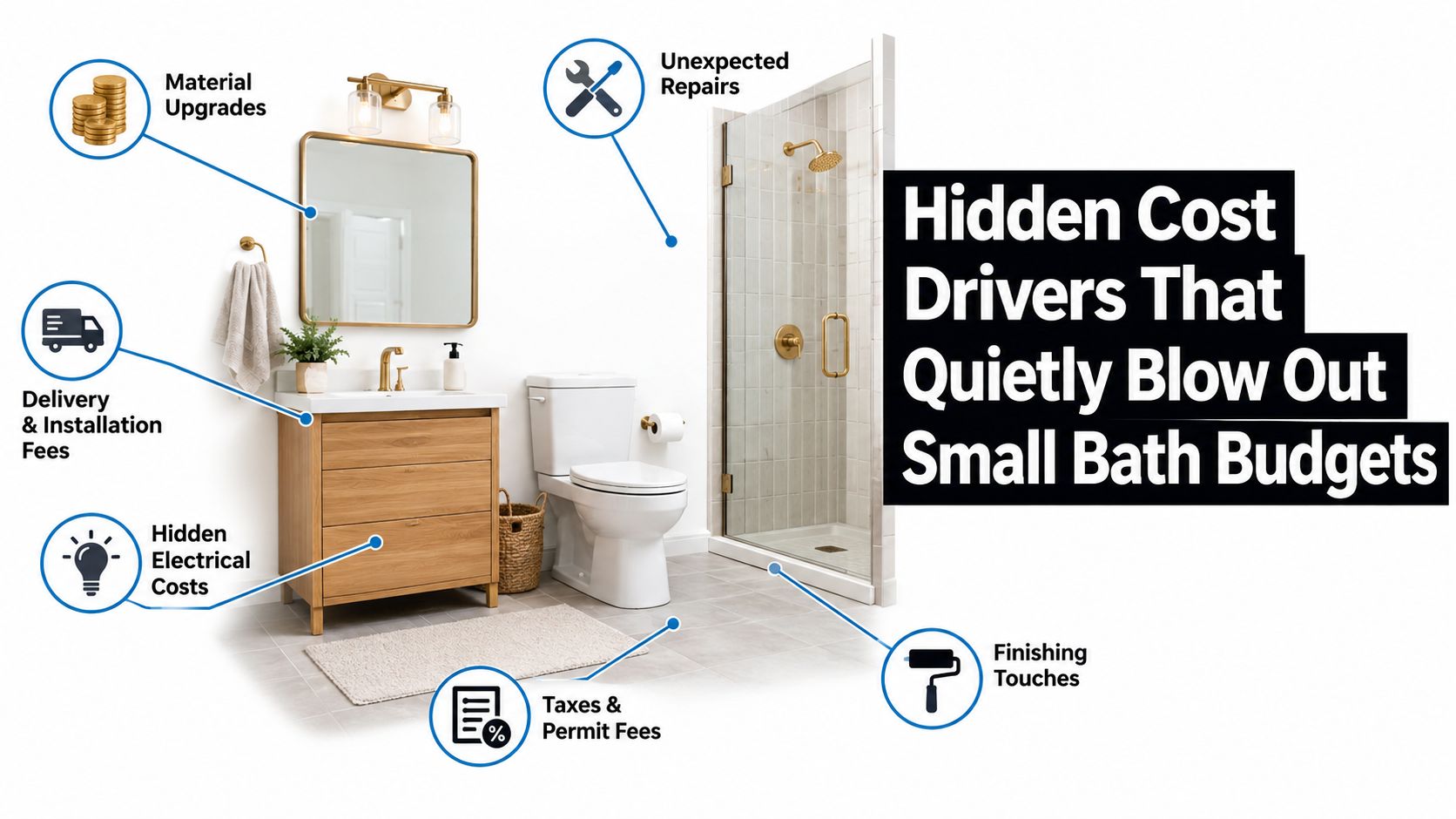
The most dangerous assumption is that a small bathroom has a small risk profile. In older Highett homes, the room can be compact while the work behind it is complex.
Plumbing relocation sits near the top of the list. In a 1960s weatherboard, moving a shower or toilet even 600 millimetres can add approximately A$1,500 to A$3,500 once a licensed plumber reroutes supply and waste lines and the waterproofing is reinstated. That allowance is supported by the Victorian cost guidance referenced earlier, but your contractor still needs to inspect the existing route before confirming it.
What demolition can reveal
Timber rot under an old bath, corroded copper pipework and concrete slab edges can all change the work sequence. Each issue may add anything from a half-day to two days of labour, depending on how much access the repair requires.
Narrow corridors and side passages create a second problem. Deliveries, protection, material handling and skip access are harder when tradespeople can't move products directly to the work area. A newer estate may offer easier access for the same size bathroom.
The room is small. The risk isn't.
Other warning signs include asbestos sheeting in pre-1990 wet areas, outdated electrical arrangements and failed waterproofing discovered after demolition. These issues aren't reasons to avoid renovation. They are reasons to inspect properly and keep a contingency rather than treating the first visible price as the final budget.
For waterproofing questions, use a contractor who can explain the preparation, membrane system, inspection process and compliance documentation. This bathroom waterproofing cost guide is useful when checking whether a quote has allowed for more than a quick surface application.
I recommend a 15 to 20 percent contingency for a small bathroom where demolition may expose unknown conditions. It protects the schedule and prevents a homeowner from choosing inferior materials or abandoning necessary repairs when the walls come off.
Cosmetic Refresh Versus Full Strip-Out and How to Choose
A cosmetic refresh changes what you see. A full strip-out changes what the room is made of. That distinction matters more than the number of square metres.
A refresh usually retains the existing layout and services. It may replace the vanity, basin, mirror, tapware, screen and lighting, with paint or limited tile work over a sound substrate. For a small Highett bathroom, that type of project generally sits around A$6,000 to A$10,000, depending on product choices and the amount of labour involved.
A full strip-out removes the room back to its underlying structure or slab. It may replace rough-in services, rebuild the wet area, correct falls and retile the whole space. That scope commonly lands around A$14,000 to A$20,000-plus, with premium finishes or hidden damage pushing it higher.
Refresh vs Strip-Out at a Glance
| Factor | Cosmetic Refresh | Full Strip-Out |
|---|---|---|
| Existing layout | Retained | Can be reconfigured |
| Waterproofing | Relied on if sound, or selectively addressed | Replaced as part of the rebuild |
| Plumbing | Positions usually remain | Rough-in can be renewed or moved |
| Disruption | Lower | Higher |
| Best fit | Rental, sale preparation or newer bathroom | Long-term home, leaks, mould or poor layout |
| Design freedom | Limited by existing services | Broad, subject to budget and compliance |
Ask three questions before choosing:
- How old is the waterproofing? If its history is unknown and the room shows movement, mould or leaks, a cosmetic cover-up deserves serious suspicion.
- Are the plumbing positions working? Keeping them in place saves money. Moving them for a better layout can be worthwhile, but price it before selecting fixtures.
- How long will you stay? A rental or sale preparation needs controlled presentation. A home you'll occupy for ten years or more deserves durable wet-area work.
Premium tiles and fittings can push a refresh towards its upper limit without fixing underlying defects. Conversely, a strip-out can remain in the mid-range if you use standard tile formats, an in-stock vanity and restrained tapware while protecting the technical work that keeps the room dry.
Victorian Building Rules Every Highett Homeowner Must Know
A small Highett bathroom can move from a $6,000 refresh to a $20,000-plus rebuild once demolition, waterproofing, tiling, plumbing, electrical work and structural changes enter the scope. Victorian compliance thresholds apply to the total domestic building work, not just the room's floor area.
In Victoria, work costing more than A$10,000 requires a written major domestic building contract, and the builder must be registered with the Building and Plumbing Commission for work above that threshold. If the project exceeds A$16,000, the builder must provide current domestic building insurance before taking a deposit or starting work. These requirements are set out in Victorian domestic building guidance for bathroom renovation contracts and insurance.
Structural work requires a registered builder regardless of cost. That includes altering walls, structural elements or load-bearing components. Confirm whether the proposed layout affects any of these before accepting a low quote.
Documents to request before work starts
- Written contract: Check the scope, inclusions, exclusions, variation process and payment stages.
- Builder registration: Confirm the registration of the person or business responsible for the domestic building work.
- Domestic building insurance: For projects above the relevant threshold, request evidence before paying a deposit or allowing work to begin.
- Waterproofing documentation: Ask who will perform or supervise the work and which compliance certificate you will receive.
- Plumbing certificate: A licensed plumber should complete the work and lodge the required compliance certificate.
- Electrical safety certificate: Wet-area electrical work must be completed by a licensed electrician with the appropriate Certificate of Electrical Safety.
A quote under A$10,000 is not automatically improper. It may cover a limited trade job. If it claims to deliver a complete bathroom rebuild, ask what has been excluded. Common omissions include waterproofing certification, licensed trade work, demolition, waste disposal and written warranty protection.
Review the practical building permit requirements for bathroom renovations before signing. Do not accept a verbal promise that permits, certificates or insurance paperwork will be sorted out later. Get each requirement documented before work begins.
Smart Budgeting Tips and Modern Bathroom Ideas Worth the Spend
A small Highett bathroom can look finished while still hiding expensive defects. Set the technical allowance first, then choose the feature tile. I recommend keeping a 15 percent contingency for problems behind tile and plaster. Confirm the plumbing positions before ordering finishes. This sequence protects the budget because changing services after product selections often means paying for both new materials and extra labour.
Current Australian trend frameworks identify directions such as Contemporary Classics, Modern Australian, Wellness Sanctuary, White On White and Colour Drenching. The Modern Australian direction suits a compact room particularly well, using natural textures, earthy tones, hazy greens and sunbaked neutrals to add warmth without visual clutter. Review published Australian bathroom trend directions for palette ideas, then choose finishes that suit your room, budget and maintenance expectations.
Spend for reliability and save on decoration
Put money into the parts that protect the room and affect daily use. Fluted glass fronts, a considered paint colour and a well-proportioned mirror can give modern bathrooms a stronger visual identity without a fully custom fit-out. Micro-cement-inspired finishes can create a continuous surface, but the installer must specify the substrate and wet-area system. The finish is not a replacement for waterproofing.
Curved shower screens and brushed-brass showers can suit the right design, yet they may add product, fabrication and installation costs without improving function. In a tight bathroom, a standard screen with clear access often gives better value than an elaborate curve. Use the saving on waterproofing, ventilation or storage instead.
| Budget Item | Recommendation | Why |
|---|---|---|
| Waterproofing | Splurge | It protects the structure and is difficult to correct after finishes are installed |
| Plumbing layout | Spend strategically | Keeping positions controls cost, but a poor layout affects daily use |
| Tapware cartridges | Buy durable | Repeated use exposes weak components quickly |
| Vanity | Save with a quality standard unit | In-stock storage can provide function without bespoke fabrication |
| Tile selection | Choose standard formats | Reliable supply and simpler installation help control costs |
| Shower screen | Match the space | Sliding or standard systems can preserve clearance in compact rooms |
| Lighting and exhaust | Spend where performance matters | Good ventilation and lighting affect comfort and maintenance |
| Decorative finishes | Set a limit | Premium colour and hardware can absorb budget without solving technical issues |
A coordinated renovation service can align design, construction and finishing. SitePro Bathrooms provides concept development, 3D design, construction and finishing for bathroom and kitchen projects in Highett.
Before signing with a Highett tradesperson, ask what happens if demolition reveals failed waterproofing or structural damage. Ask which certificates, registrations and insurance documents you will receive before final payment. Vague answers indicate that the scope and risk allowances are incomplete.
Choose the scope first, lock the services second and select finishes third. That order keeps a small bathroom budget focused on compliance, durability and daily function before decoration.
If your Highett bathroom needs an honest scope review, contact SitePro Bathrooms for a consultation and 3D design discussion. Bring your preferred layout, photos of the existing room and target budget. Request a written quotation that separates cosmetic work, full strip-out items, compliance documentation, allowances and potential variations.