

How to Hire a Contractor for Kitchen Remodel
You've saved kitchen images, compared colours, and started imagining where the coffee machine will sit. Then the practical questions arrive. Which contractor can manage the carpentry, plumbing, electrical work, cabinetry and tiling? Is the quote complete? Does the project need a permit? What happens if the scope changes after demolition?
Learning how to hire a contractor for kitchen remodel work in Victoria means looking beyond attractive portfolios and low prices. Your contractor must understand the legal requirements, explain the scope clearly, coordinate the trades, and handle problems professionally. The right hiring decision protects your home, money and time before construction begins.
Your Kitchen Dream Starts with the Right Partner
A kitchen renovation often begins with excitement. You might have a folder full of warm timber finishes, stone surfaces, clever storage and open-plan layouts. The mood changes when three quotes arrive with different inclusions, unfamiliar contract terms and no obvious explanation for why one price is lower than the others.
That uncertainty is normal, but it shouldn't control the project. A kitchen remodel isn't just a collection of cabinets. It can involve demolition, carpentry, plumbing, electrical work, appliance connections, splashback installation, flooring, painting and final adjustments. When several trades are involved, one person needs to own the coordination instead of leaving you to resolve gaps between subcontractors.
The first contractor meeting should therefore be more than a conversation about style. It should reveal how the contractor thinks. Do they ask about the existing layout, walls, services, access and finish quality? Do they identify approval questions early? Do they explain what they manage directly and what they subcontract? A contractor who focuses only on the finished photograph may not be prepared for the conditions behind the walls.
Practical rule: Choose the contractor who makes the project clearer, not the one who makes the promise sound easiest.
Victoria adds a legal layer that generic renovation advice often misses. Consumer Affairs Victoria says a written contract is essential for building works, and a major domestic building contract is required before work starts when the project involves more than one trade and is worth more than $10,000. The paperwork must describe the work, identify the parties, include the builder's registration number and state the contract price, as explained in Consumer Affairs Victoria's building contract guidance.
That means hiring starts with compliance, not with a handshake. A contractor who can't provide the required registration and contract information shouldn't be invited to solve the rest of the renovation.
Laying the Groundwork Before You Search
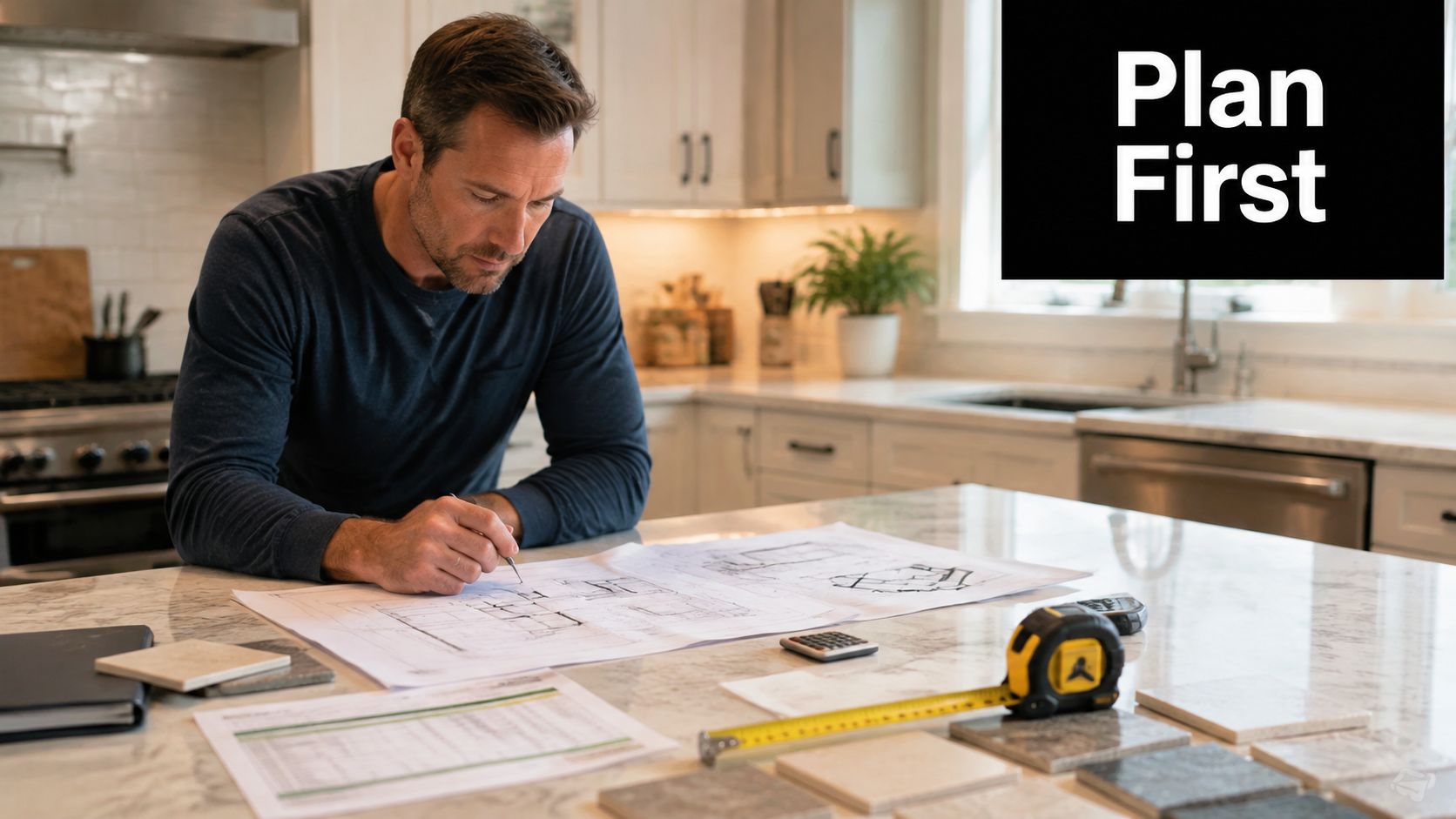
The best contractor can't produce a reliable quote from a vague wish list. Before contacting builders, decide what the kitchen must achieve, what can wait and which choices are still open.
Define the work before discussing price
Write a short project brief covering:
- Layout: State whether you want to retain the current footprint, move appliances, remove cabinetry or alter walls.
- Services: Note any planned changes to plumbing, electrical circuits, lighting, gas, ventilation or appliance locations.
- Cabinetry: Record whether you expect standard modules, custom cabinetry, pantry storage, an island or integrated appliances.
- Finishes: List preferred benchtop, splashback, flooring, handles, tapware and paint finishes.
- Practical constraints: Mention access, parking, working hours, household occupancy and protection for adjoining rooms.
- Non-negotiables: Separate essential outcomes from features you can remove if the price or construction complexity rises.
Use design references to identify patterns rather than copy a photograph blindly. Looking at new bathroom ideas, modern bathrooms and designer bathrooms can help you create a consistent style across the home, particularly when a kitchen renovation forms part of a broader upgrade. Warm tactile finishes, timber, natural stone, curved details and softer neutral palettes are also appearing in contemporary bathroom design coverage, which can inform a cohesive material direction without forcing the kitchen to look like a showroom. See examples of these warmer bathroom design directions for inspiration.
Understand the Victorian approval question
Many kitchen remodels in Victoria don't automatically require a building permit. Ordinary work often avoids a permit when it doesn't affect the building's structural soundness, but that isn't permission to assume the project is exempt. A registered building surveyor provides written approval where a permit is required, and building work generally must not begin until the necessary approval is in place, subject to an exemption.
Ask each contractor to assess the scope against the existing building. The conversation should cover:
- whether walls are being removed, opened or altered
- whether plumbing is moving or being newly installed
- whether electrical systems or safety-critical elements are changing
- whether the floor area, structure, fire safety or heritage controls are affected
- who will confirm the permit position and arrange approvals if they apply
The local Victorian building permit guidance explains why the scope needs to be checked rather than guessed. A contractor who says, “No permit needed,” without asking what you're changing hasn't completed a meaningful assessment.
Before requesting proposals, read a practical guide to kitchen renovation costs and use it to organise your priorities. It won't replace a project-specific quote, but it will help you identify whether a contractor has omitted a trade, finish or preparation task.
Decide whether you need one coordinator
You can manage separate trades yourself, but that shifts responsibility for sequencing, access, measurements, defects and communication onto you. A coordinated contractor is usually more suitable when the project combines several trades or when you can't supervise the site closely. DIY can still work for selected tasks, provided the contract clearly states who supplies, installs and guarantees each part.
Finding and Vetting Potential Contractors
A polished kitchen portfolio can hide weak administration, unclear responsibilities and poor defect follow-up. Start with contractors who regularly complete kitchen renovations in your area, then test how they work before requesting a final quote. Referrals and local industry contacts are useful starting points, but every candidate still needs independent verification.
Use a verification checklist
Complete these checks before shortlisting a contractor:
- Confirm registration: For Victorian domestic building work valued at more than $10,000, a registered builder is required. Verify the contractor's registration using the official details they provide and the applicable Victorian register. The legal threshold and contract expectations are set out in Consumer Affairs Victoria's building contract checklist.
- Match the legal entity: Check that the business name, registration details and name proposed for the contract refer to the same responsible party. Ask who will be legally accountable for the work.
- Check insurance evidence: Request current documents showing the cover that applies, including public liability and any domestic building insurance required for the project. Confirm exclusions and who is insured.
- Review comparable work: Look for kitchens with similar access conditions, layouts, cabinetry requirements and service changes. Prioritise construction details and consistent workmanship, not only staged photographs.
- Ask for references: Speak with recent clients about communication, site care, variations, defects and whether the contractor returned after handover when problems arose.
- Test the process: Ask who will be your regular contact, how progress is reported, how changes are approved and how delays are communicated.
- Confirm trade coordination: Establish which work the contractor's team performs and which work is assigned to other trades. Responsibility for each task should be clear.
Ask questions that expose risk
A serious contractor will inspect the existing kitchen rather than prepare the entire proposal from photographs. Ask what they need to confirm before ordering materials, how they protect an occupied home, how demolition and installation will be sequenced, and how they handle uncertainty discovered after work begins.
Listen for specific answers. “We'll sort it out on site” might describe a minor detail, but it should not replace a documented scope. “The price includes everything” is incomplete unless the contractor defines what that includes.
Use this contractor selection criteria checklist to organise your comparisons. Look for a contractor who identifies unknowns, records decisions and gives you time to approve changes. Renovation work can expose concealed conditions, so the quality of the response matters as much as the initial promise.
Also ask for evidence of how the contractor manages occupied properties. Confirm working hours, dust control, protection for nearby rooms, temporary access arrangements and the process for reporting damage. These details affect daily disruption and often reveal whether the contractor has a controlled site process.
Before accepting a candidate, compare what each person has agreed to do, who will perform regulated trade work and how decisions will be recorded. Keep those answers with your project notes so they can be checked against the written proposal and contract.
Decoding Quotes and Signing the Contract
A quote becomes useful when its assumptions are visible. Two contractors can offer the same total while treating demolition, waste removal, cabinetry hardware, appliance installation, electrical upgrades, painting and final cleaning differently. Those differences often appear later as variations.
Request a detailed written proposal from each contractor and compare the documents line by line. The lowest figure is not automatically the best choice. The stronger proposal is the one that matches your agreed scope, identifies exclusions and shows where costs could change.
Compare like with like
Use a comparison table while reviewing proposals. The entries are prompts for your own quotes, not market prices.
| Item / Phase | Contractor A Quote | Contractor B Quote | Contractor C Quote |
|---|---|---|---|
| Site preparation and protection | Included or excluded | Included or excluded | Included or excluded |
| Demolition and waste removal | Scope and allowance | Scope and allowance | Scope and allowance |
| Cabinetry and hardware | Specification and allowance | Specification and allowance | Specification and allowance |
| Benchtop and splashback | Material and installation | Material and installation | Material and installation |
| Plumbing and electrical work | Trades and inclusions | Trades and inclusions | Trades and inclusions |
| Flooring, painting and finishing | Areas covered | Areas covered | Areas covered |
| Appliances and connections | Supply or install responsibility | Supply or install responsibility | Supply or install responsibility |
| Variations and provisional sums | Process and assumptions | Process and assumptions | Process and assumptions |
| Programme and milestones | Stated dates or stages | Stated dates or stages | Stated dates or stages |
A low quote may reflect a narrower scope rather than better efficiency. Check whether each contractor has allowed for the same materials, quantities, preparation and installation standards. Confirm whether allowances are realistic, fixed, or subject to later selection.
Provisional sums require particular care. If one proposal lists several allowances while another names products, quantities and labour, the totals cannot be compared fairly until those assumptions are clarified.
Read the contract as a risk-control document
Once you have chosen a contractor, examine the contract details that control decisions and payments. The scope should identify the work covered, the specifications to be used, exclusions, drawings and any allowances. Confirm that these documents are attached or clearly incorporated, rather than relying on a separate conversation or an informal quote.
Use the official contract requirements checklist to check the document before signing. Pay close attention to the payment schedule, start conditions, expected completion arrangements and the procedure for approving changes.
The variation clause should state how a change is requested, priced and approved, and whether it changes the programme. It should also identify who can authorise the work. Keep approval in writing. A message or signed variation should record the revised scope, cost and timing before the contractor proceeds.
Check allowances and concealed conditions
Ask what happens if demolition reveals damaged framing, unsuitable plumbing or electrical work that requires attention. The contract should provide a method for documenting the issue, obtaining a price and deciding whether the additional work proceeds. This gives you a clear choice instead of an unexplained invoice at the end.
Review each allowance before signing. Ask when the amount will be replaced by an actual product or trade price, who pays any difference, and whether installation is included. Appliance connections, benchtop cut-outs, splashback preparation and cabinetry adjustments are common areas for unclear responsibility.
Check payment staging and defects
Payments should follow the agreed stages and the work completed. Ask what evidence marks each milestone, which materials are being ordered, and how incomplete or defective work affects the next payment. Do not pay for a stage that has not been delivered to support the contractor's cash flow.
The contract should also explain how defects are reported, inspected and rectified, including the applicable defect liability period. Record problems promptly with photographs and written descriptions. Keep the signed contract, approved variations, invoices and payment receipts together so the agreed position remains clear if a dispute develops.
Managing the Renovation from Start to Finish
Signing the contract doesn't remove your role. It changes your role from selecting a contractor to managing decisions, records and approvals. Homeowners who establish a simple communication routine usually have a better chance of identifying small problems before they become expensive disagreements.
Set one communication system
Nominate one primary contact and agree how updates will be sent. A short weekly meeting, written progress summary or shared decision record can cover completed work, upcoming activities, required selections, variations, access issues and payments. Keep important approvals in writing, even if the initial discussion happens on site.
The contractor should also explain how the home will be protected. Agree on dust control, floor protection, temporary access, material storage, rubbish removal and daily site security. These details affect your experience of the renovation and should not be left to assumptions.

Control decisions and payments
Kitchen projects contain many decisions, including handles, tapware, lighting positions, appliance dimensions, splashback materials and paint colours. Set dates for those selections so the contractor can order materials and coordinate trades. Late decisions can affect both availability and sequencing, even when the original design is sound.
Use a simple variation record with:
- the requested change
- the reason for it
- the additional or reduced cost
- the effect on the schedule
- the approval date and names of both parties
Pay according to the signed schedule, not according to pressure. If a milestone is incomplete, ask the contractor to identify what remains and record the agreed path to completion. A clear record protects both sides and keeps payment discussions tied to delivered work.
For a more detailed operating framework, use these project management essentials for staying on schedule and under budget.
Deal with defects promptly
Don't wait until the final day to mention a defect. Photograph the issue, describe where it appears, state what you believe needs correction and send the notice formally to the builder. Consumer Affairs Victoria advises homeowners to document defects, write formally to the builder and escalate to the Building and Plumbing Commission if the matter remains unresolved, as described in its guidance on disputes, defects and delays.
That process also explains why communication should be a hiring benchmark. Ask prospective contractors how they record defects, who returns to rectify them and how they close out unresolved items. A contractor's response before you hire often tells you more than a polished portfolio.
Red Flags and Frequently Asked Questions
A contractor doesn't need to have an answer for every unknown at the first meeting. They do need to be open about uncertainty, scope, approvals and responsibility. Walk away when the commercial pressure is stronger than the documentation.
Red flags worth taking seriously
- Pressure to sign immediately: A contractor who discourages independent review may be trying to prevent comparison.
- Unclear registration details: Don't proceed while the legal identity or registration information remains vague.
- A fragmented contract: Splitting one multi-trade project into smaller packages can create responsibility gaps and may be intended to avoid the applicable threshold.
- A vague quote: “Complete kitchen renovation” isn't enough. You need materials, labour, exclusions and assumptions.
- Large unexplained upfront demands: Ask what the payment covers, when materials are ordered and which contract stage authorises it.
- Verbal-only changes: If the contractor won't document variations, you won't have a reliable cost or scope record.
- No defect process: A contractor who becomes defensive when asked about callbacks and rectification is creating avoidable risk.
- Permit certainty without inspection: A confident answer given without understanding the walls, services or safety impacts isn't a proper assessment.
Frequently asked questions
How long does a typical kitchen remodel take?
There isn't a reliable single duration for every kitchen. The programme depends on design readiness, approvals, product availability, demolition findings, trade sequencing and how quickly you make selections. Ask for a staged programme rather than an optimistic start and finish promise.
Do the same hiring principles apply to bathroom renovations?
Yes. Bathrooms also combine building, plumbing, waterproofing, electrical and finishing work. Victorian bathroom renovations over $10,000 require a Registered Builder, while plumbing must be completed by a registered or licensed plumber, so the same registration, scope and contract discipline applies.
Are new bathroom ideas relevant when planning a kitchen?
They can be useful for establishing a whole-home material language. Warmer finishes, tactile surfaces, curved forms, floating vanities and softer neutral palettes are associated with current modern bathrooms, while larger-format tiles and features such as double vanities, heated towel rails, in-floor heating and rainfall showers are highlighted in Australian bathroom trend coverage. Use those references to guide your broader style, not to substitute for a kitchen-specific plan.
What protections should Victorian homeowners ask about now?
From 1 July 2026, Victorian builders must have domestic building insurance for work over $20,000. New domestic building contract laws passed in 2025 are due to take effect by 1 December 2026, so ask the contractor how the current and upcoming requirements affect insurance, payment staging and contract terms. Confirm the position applicable to your project before signing, using Consumer Affairs Victoria's practitioner guidance.
Your next step is simple. Write the scope, identify the decisions you've already made, and ask vetted Victorian contractors to inspect the kitchen and respond in writing. If you want a coordinated design and construction conversation, SitePro Bathrooms provides kitchen renovation consultations, detailed design and quotations covering the planned scope, materials, fixtures, finishes and programme. Contact the team to arrange a site assessment and ask the questions that need answering before you commit.