
You're standing in a Melbourne kitchen, looking at a bathroom that still works but doesn't feel worth keeping. The tiles are tired, the shower's awkward, and the vanity looks like it belongs in a different decade. If you're weighing luxury bathroom renovations Melbourne homeowners live with every day, the first question isn't which tapware looks nicest. It's whether your brief is a genuine premium renovation, or a standard bathroom renovation dressed up with expensive finishes.
That distinction matters because the numbers change fast. In Melbourne, premium and luxury bathrooms are commonly priced around A$35,000 to A$50,000+, with some guides extending to A$36,750–A$57,750 and even A$68,250–A$84,000 at the top end, depending on layout changes and specification (luxury bathroom renovation cost guide). The national average sits at about A$26,000, so a luxury brief is usually well above a standard fit-out (Australian renovation market report 2026).
What a Luxury Bathroom Renovation Really Means in Melbourne
A luxury bathroom in Melbourne is not just a prettier bathroom. It's a room where the layout has been considered properly, the wet zones are larger, the storage is built in, and the finish level is high enough that the room still feels deliberate five years later. If you're keeping the same plumbing footprint and upgrading the vanity, tiles, and tapware, that's a refresh. If you're changing how the room works, that's a premium renovation.
For a lot of couples in Bayside or the inner suburbs, the decision starts with one simple frustration. The bathroom may be functional, but it's cramped, dark, or badly zoned. That's where luxury bathroom renovations Melbourne homeowners usually go beyond cosmetic work, they reconfigure the room so the shower, bath, vanity, and circulation all make sense together.
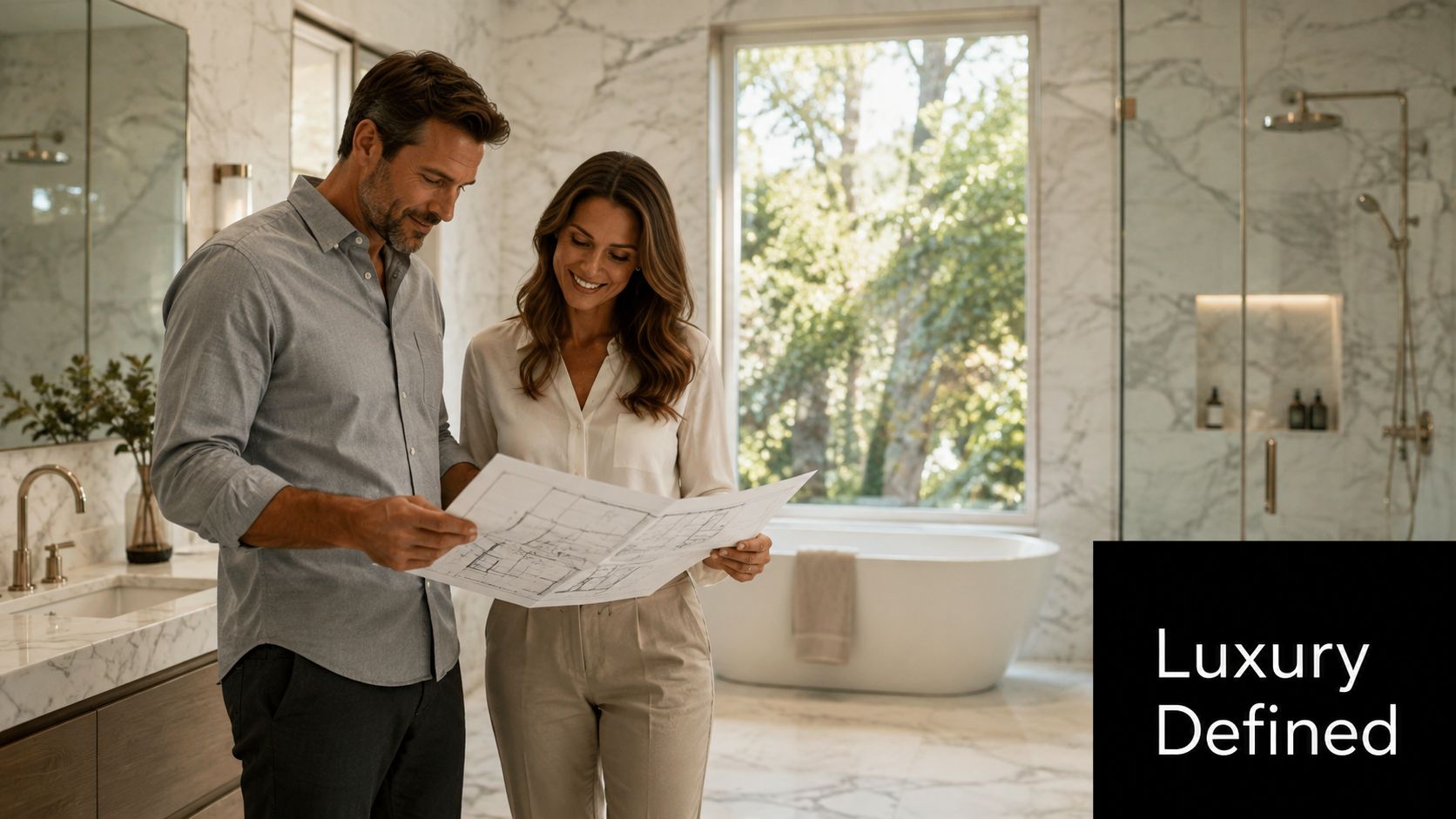
The difference between a refresh and a luxury brief
A refresh keeps the structure intact. You swap finishes, update fittings, and leave the bones alone. That keeps cost and disruption down, but it also means you're living with the same layout problems.
A luxury brief changes the bones. That can mean a walk-in shower, a freestanding bath, architectural joinery, floor-to-ceiling storage, or a wider vanity that finally gives two people enough room to get ready without elbowing each other. In practice, luxury is about the room doing more work and looking calmer while it does it.
Practical rule: if you're moving plumbing, changing the shower size, or adding custom joinery, you're not in cosmetic territory anymore.
The right way to judge your brief is simple. Ask yourself whether you want the bathroom to look better, or whether you want it to function better as well. Luxury work usually does both. That's why it costs more, and that's why the contractor conversation has to start with layout, not finishes.
Design Styles and Trends Shaping New Bathroom Ideas
Melbourne buyers don't all want the same bathroom, but the strongest briefs usually fall into a few clear styles. Hotel-style ensuites are common because they make a home feel more polished. Minimalist modern bathrooms stay popular because they're easy to live with. Spa-inspired wet rooms suit homeowners who want a softer, more relaxed mood. Period homes need a more careful hand, because the bathroom has to respect the house rather than fight it.
The style you choose changes the specification immediately. A minimalist room might use large-format tile, a pared-back vanity, and a limited palette. A more expressive designer bathroom usually adds custom joinery, bespoke lighting, feature tile cuts, and stronger architectural detailing. Those choices are not just aesthetic, they affect labour, sequencing, and cost.
Match style to the room you actually have
Small ensuites usually work best when you keep the design clean and disciplined. Large-format surfaces, wall-hung storage, and simple detailing help the room feel bigger without pretending it's larger than it is. Family bathrooms can take more visual weight, so a freestanding bath or a bolder vanity feels natural instead of crowded.
For period homes, the safest move is restraint. Keep the room sympathetic to the house, then lift the specification through quality materials and sharp execution. That gives you a bathroom that feels luxurious without looking disconnected from the rest of the property.
A good way to think about new bathroom ideas is to separate trend from durability. Matte finishes, natural stone looks, and concealed storage have staying power. Overly decorative tile patterns and highly fashionable colours date faster. Use the trend in one controlled place, then keep the rest of the room timeless.
Luxury should feel calm, not loud. If every surface is competing for attention, the room will age badly.
If you're choosing between styles, start with use case. An ensuite for two busy adults should prioritise routine and storage. A family bathroom needs durability and easy cleaning. A Bayside or inner-suburb showpiece can afford a little more drama, but only if the room still works on Monday morning.
Realistic Cost Ranges and Budgets for Melbourne Projects
Luxury bathroom pricing in Melbourne is where wishful thinking stops. If you want a room that feels properly high-end, budget like a serious homeowner, not like someone hoping to get away with a cosmetic refresh. Melbourne luxury bathroom work is commonly priced at about A$35,000 to A$50,000+, with some breakdowns running to A$36,750–A$57,750 and top-end projects reaching A$68,250–A$84,000. That sits well above the Australian average bathroom renovation of about A$26,000 (Australian renovation market report 2026). A luxury bathroom is a different tier altogether.
The reason is simple. High-end bathrooms absorb more labour, more coordination, and more specification-sensitive materials. In luxury cost breakdowns, labour and project management commonly consume 30% to 35% of the budget. After that, the money goes into waterproofing, tiling, custom joinery, tapware, and glazing, the parts of the room that make it feel expensive because they are expensive.
Use the home-value rule before you get carried away
The safest budgeting rule is plain enough. Keep the renovation within 5% to 10% of a home's value if you want to avoid overcapitalisation. Using the cited average home value of AUD 1,045,400, that points to roughly AUD 52,270 to AUD 104,540 as a broad ceiling for a sensible renovation budget. That is a ceiling, not a target. Start there, then decide what the room needs.
This matters most in Melbourne's higher-value suburbs. People overspend when they confuse luxury with excess. A bathroom does not need every premium feature to feel high-end. It needs a tight brief, good execution, and finishes that suit the property.
| Indicative Melbourne Luxury Bathroom Budgets | Typical Scope | Best Fit |
|---|---|---|
| A$35,000 to A$45,000 | Premium finishes, considered layout, quality fixtures, minimal structural change | Homeowners wanting a strong upgrade without overreaching |
| A$45,000 to A$60,000 | More custom joinery, better stone or tile specification, upgraded glazing, more complex detailing | Homes where the bathroom needs to feel bespoke |
| A$60,000+ | Structural changes, top-end finishes, larger wet zones, more bespoke fabrication | Higher-value homes where the bathroom is part of the property's presentation |
For a local starting point, the Melbourne bathroom cost guide is useful before you sit down with a builder. The question is not whether you can spend more. It is whether the extra spend changes the room in a way that justifies the cost.
Project Stages and Timelines From Demolition to Handover
A luxury bathroom in Melbourne runs on order, not optimism. Once demolition starts, every trade depends on the one before it, and that is why a proper program matters as much as the finishes. If a builder promises a high-end result on a squeezed timeline, expect rushed coordination, poor sequencing, or both.
The work begins with strip-out and site protection. After that comes substrate preparation, any framing changes, rough-in plumbing, and electrical. Waterproofing sits in the middle of the job, not the end, and it has to be checked before tiling starts. Upper-storey bathrooms and bathrooms built over timber or particleboard substrates need the entire bathroom floor waterproofed under AS 3740 guidance, while shower wall waterproofing must run to at least 1800 mm above the finished floor or 50 mm above the shower rose, whichever is higher (waterproofing compliance guide).
That sequence is where a lot of Melbourne homeowners get caught out. They focus on the look, then discover the timing problems come from the hidden work, not the visible finishes. Stone has to be measured, cut, and delivered. Glass needs lead time. Tapware and other fit-off items can hold up the finish if they are ordered late.
Where schedules usually slip
The delays are usually predictable. Custom glass takes time. Stone fabrication takes time. Specific tapware can sit in transit longer than expected. If those items are not locked in early, the crew finishes the messy work and then waits for final fit-off pieces.
That is why a coordinated builder matters. A design-and-build approach keeps the program tighter because one team is managing measurements, lead times, trades, and inspection points. SitePro Bathrooms uses that kind of end-to-end process, including 3D design before demolition, which helps resolve layout decisions before anyone starts stripping tiles off the wall.
Lock in the layout, cabinetry, and fixtures before strip-out. Changing your mind mid-build is the fastest way to add cost and delay.
For a practical sense of how long a full bathroom project usually takes, the bathroom remodel timeline guide is worth reading before you sign anything. The straight answer is simple. Luxury bathrooms take time because each stage depends on the one before it, and the best results come from disciplined sequencing, not a rushed finish.
Council and Permit Rules Across Victoria
A luxury bathroom can run cleanly on paper and still turn messy fast if the permit side is ignored. The line between a simple refresh and regulated building work is easy to cross in Melbourne. Replace fixtures like for like and keep the structure, plumbing layout, and waterproofing scope unchanged, and you may avoid a building permit. Start changing walls, shifting pipes, or working over a suspended or timber floor, and you are into permit territory.
Waterproofing sits at the centre of the compliance and cost conversation. AS 3740 requires the shower wall to be waterproofed to at least 1800 mm above the finished floor or 50 mm above the shower rose, whichever is higher, and bathrooms on upper levels or over timber substrates need full bathroom floor waterproofing. That extra scope is not just paperwork. It adds prep time, more labour, and more room for mistakes if the work is rushed.
Who needs a registered builder
Once the job includes structural changes, load-bearing walls, or major layout work, you want a registered builder unlimited on the job, not a tradesperson managing it from the side. That credential matters because the structural work, waterproofing continuity, and final sign-off all have to line up.
A practical checklist keeps the decision clear:
- Probably no permit: like-for-like replacement, cosmetic updates, straightforward fixture swaps.
- Definitely check first: plumbing moves, wall changes, suspended floors, timber substrates, or anything affecting structural components.
- Definitely needs a registered builder and permit process: structural alterations, load-bearing work, or full premium reconstructions that go beyond a simple refit.
Do the checking before demolition starts. Once walls are open, every oversight costs more. In higher-value Melbourne suburbs, that matters even more, because the wrong compliance call can push a bathroom past the point where it adds value. A luxury bathroom should sit comfortably inside the usual 5 to 10 percent home-value rule, not blow through it because the permit side was handled late.
Choosing the Right Contractor and Avoiding Common Pitfalls
The contractor you choose will decide whether your luxury bathroom feels calm or chaotic. A good shortlist starts with one basic filter, real experience in high-end bathroom renovations, not just general building work. From there, insist on a written scope, a proper timeline, and a contract that spells out exclusions instead of hiding them.
A registered builder unlimited is the right conversation when the job touches structure or load-bearing changes. You also want clarity on who handles waterproofing inspection, who orders long-lead items, and who signs off the final fit-off. If the answer to those questions is vague, keep looking.
Questions worth asking in the first meeting
- How do you manage long-lead items? You're listening for a plan, not a shrug.
- Who coordinates waterproofing and inspection? The answer should be named, not implied.
- What happens if something hidden turns up after strip-out? Good builders explain variation handling upfront.
- Can I see recent local work? You want completed bathrooms, not just polished marketing photos.
- What warranty terms are included? If they dodge this, that's a warning sign.
Red flags are easy to spot once you know what to look for. Vague quotes, large upfront demands, no written contract, and reluctance to share references usually mean trouble later. If the builder can't explain why a particular fixture choice affects cost, they probably don't have control over the job.
Use online reviews as a starting point, not the final word. Then visit a completed bathroom in person if you can. You'll learn more from the grout lines, the edge details, and the way the cabinetry sits than you will from a dozen glowing comments. If you want a working checklist for this stage, the bathroom remodel contractor guide is worth having open while you compare quotes.
Local Project Examples That Bring the Brief to Life
A compact inner-city ensuite usually starts with a cramped footprint and ends with a cleaner routine. The right move is often to keep the layout controlled, use a wall-hung vanity, and choose finishes that visually open the room without crowding it. Luxury isn't about scale, it's about discipline.
A suburban weatherboard family bathroom often needs a different answer. The brief usually includes better storage, a more practical shower zone, and a layout that stops people queueing in the hallway every morning. That kind of project sits in the middle of the premium band because the room has to work hard, not just look polished.
A higher-value Bayside home can justify a more expressive designer bathroom. A freestanding bath, bespoke joinery, stronger material selection, and more refined lighting can all make sense when the bathroom is part of the property's broader presentation. The risk is overdoing it, so the design still needs restraint.
Here's the useful takeaway. Compact ensuite, family bathroom, and designer makeover are three different jobs. They should not be priced, specified, or judged the same way. If you're speaking to a builder, describe your room as one of those three archetypes before you talk about fixtures. You'll get a far better quote.
The best project brief is the one that names the room's job before it names the tiles.
If you're comparing options, treat each quote as a test of understanding. A builder who immediately jumps to finishes without asking how the room is used hasn't understood the brief yet.
Your Next Step Toward a Tailored Quote
Before you ask for pricing, make four decisions. First, whether this is a luxury brief or a standard bathroom renovation. Second, your realistic budget band. Third, whether permit or registered-builder involvement is likely. Fourth, which two or three builders are worth speaking to.
Come to the first conversation prepared. Bring measurements or a floor plan, photos of the existing bathroom, a clear list of must-haves and nice-to-haves, and a straight answer on timing. If you want a smoother process, ask for end-to-end design and construction with 3D visualisation so the room is resolved before demolition starts.
Luxury bathroom renovations in Melbourne reward good planning and punish vague thinking. Get the brief right, and the room changes the way the home feels every day. If you're ready to move from ideas to numbers, request a quote from a specialist renovation team and give them the facts upfront, because that's how you get a design that fits the house, the budget, and the way you live.