

You're standing in a dated 1990s Highett bathroom with two tile samples in your hands. One is bright white and familiar. The other is matte black, dramatic, and difficult to ignore. The Pinterest images make the dark option look effortless, but your real question is more practical: will it still look good after hard-water marks, soap film, wet towels, children, pets, and several years of ordinary use?
That's the right question. Bathroom tiles black should be assessed as a maintenance and compliance decision before they're treated as a colour choice. The tile's finish, tested slip rating, grout, lighting, ventilation, cleaning routine and installation quality will determine whether the result feels considered or becomes a daily source of frustration.
Why Homeowners Are Choosing Black Bathroom Tiles in 2026
Black bathrooms have become more appealing because they create immediate depth. A dark wall behind a floating vanity can make pale stone, warm timber and brushed metal feel more deliberate. In bayside renovations, black is also being used alongside matte tapware, fluted glass and warmer timber vanities, replacing the colder, purely white bathroom aesthetic.
Australian trade coverage reports that richer, darker bathroom palettes are gaining popularity as homeowners move towards texture and spa-inspired luxury rather than sleek white rooms. The same coverage identifies material changes following the 1 July 2024 engineered-stone ban, with interest shifting towards natural stone, concrete benchtops and concrete-look basins. Australian trade coverage of darker bathroom palettes and material choices
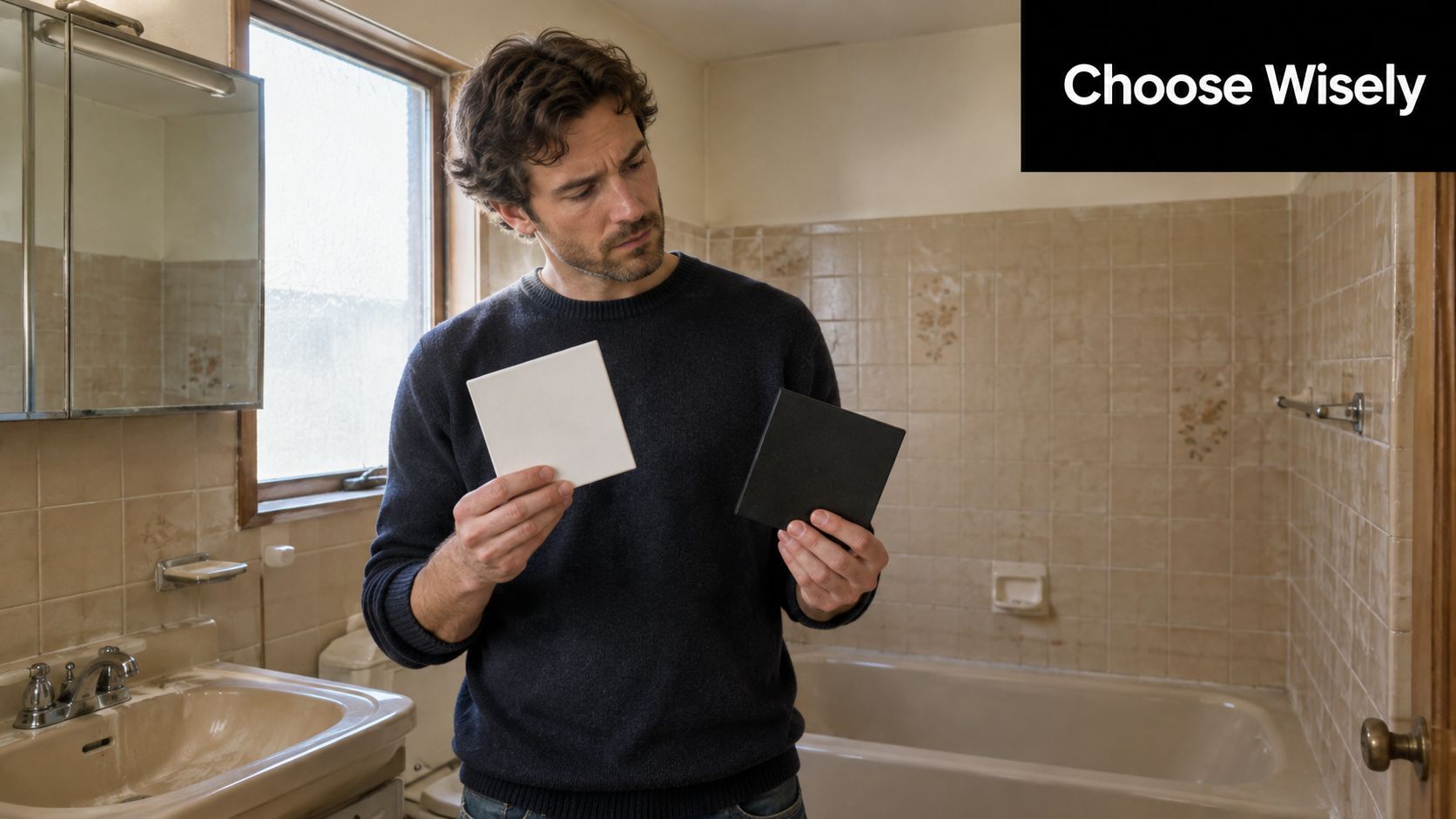
The Pinterest image versus the occupied bathroom
An all-black bathroom photographs well because the room is styled, dry and carefully lit. A Highett family bathroom has different conditions. Soap film gathers around tapware, mineral spotting appears on dark surfaces, and lint from towels or clothing becomes much easier to see. Strong natural light can make every dried droplet stand out, while poor ventilation leaves residue on textured finishes.
That doesn't make black a poor choice. It means the colour amplifies everything around it. A mismatched grout, weak vanity lighting or unsuitable sealant becomes more obvious against black than against a forgiving warm neutral.
Recent Australian trend reporting describes continued interest in dark finishes, while also identifying a move towards warm neutrals, large-format porcelain and textured surfaces that reduce grout lines and support comfortable underfoot finishes. Australian bathroom tile trend coverage
Practical rule: If you love black but dislike frequent wiping, use it where it has visual impact without placing it on every high-contact surface.
The other decision is safety. A black tile must be selected by its measured wet slip classification, not by how textured or secure it appears in a showroom. Victorian renovation planning also needs to account for who's legally permitted to carry out the work. Those checks should happen before the tile order, not after the design has been finalised.
Styles and Finishes Worth Specifying
A showroom sample can look convincing under bright display lighting and still be wrong for your bathroom. Start by separating material, surface finish and edge profile, then match each to the location where it will perform.
Natural stone
Honed bluestone and granite bring variation that manufactured tiles can't fully reproduce. Subtle pitting, tonal movement and a developing patina can suit a heritage-style Highett home, particularly with a timber vanity and aged metalware. The trade-off is care. Around shower niches, tap penetrations and splash zones, natural stone needs careful sealing and a routine that respects the product.
Honed stone is best reserved for owners who accept ongoing maintenance. It can be a strong powder-room floor or a restrained feature surface, but it isn't the sensible default for a busy family shower.
Porcelain finishes
Matte porcelain is the practical starting point for a main bathroom floor. Look for a vitrified product with a tested wet rating suited to the exact zone, not a product described as “non-slip”.
Lappato porcelain has a partially polished surface. It reflects more light than matte tile and can bring depth to a wall, but the surface may show water marks more readily and shouldn't be assumed suitable for a shower floor.
Full polished porcelain gives the strongest reflective effect. It works on a dry vanity wall or decorative splashback, but a glossy black tile generally isn't the floor choice I'd make for a wet barefoot area.
Soft-touch and structured finishes offer a more tactile appearance. They can add grip and reduce the visibility of fine scratches, although texture may hold soap residue and grout haze. That's a maintenance exchange, not a free improvement.
Colour, size and edge
Charcoal often gives a softer result than true black, particularly in a small ensuite or a room with limited daylight. Veined marble-look porcelain creates movement and can make a black wall less visually flat, while a solid basalt-look tile delivers a quieter architectural effect.
Pressed-edge tiles suit relaxed, heritage-inspired floors because their slight edge variation supports a softer, less rigid pattern. Rectified porcelain has cleaner edges and tighter joint potential, making it effective for large-format feature walls where you want the black surface to read as a broad plane.
Fluted black ceramic is particularly effective behind a vanity in a powder room. It gives the wall shadow and texture without committing the entire wet room to a surface that may be demanding to clean.
Choose the finish for the zone first. A beautiful wall tile isn't automatically a safe floor tile, and a grippy floor tile may be unnecessarily difficult on a full-height wall.
Don't rely on an assumed price band without a current quote. Tile cost varies with material, format, finish, stock availability and installation complexity, so compare complete supply-and-lay pricing rather than the sample price alone.
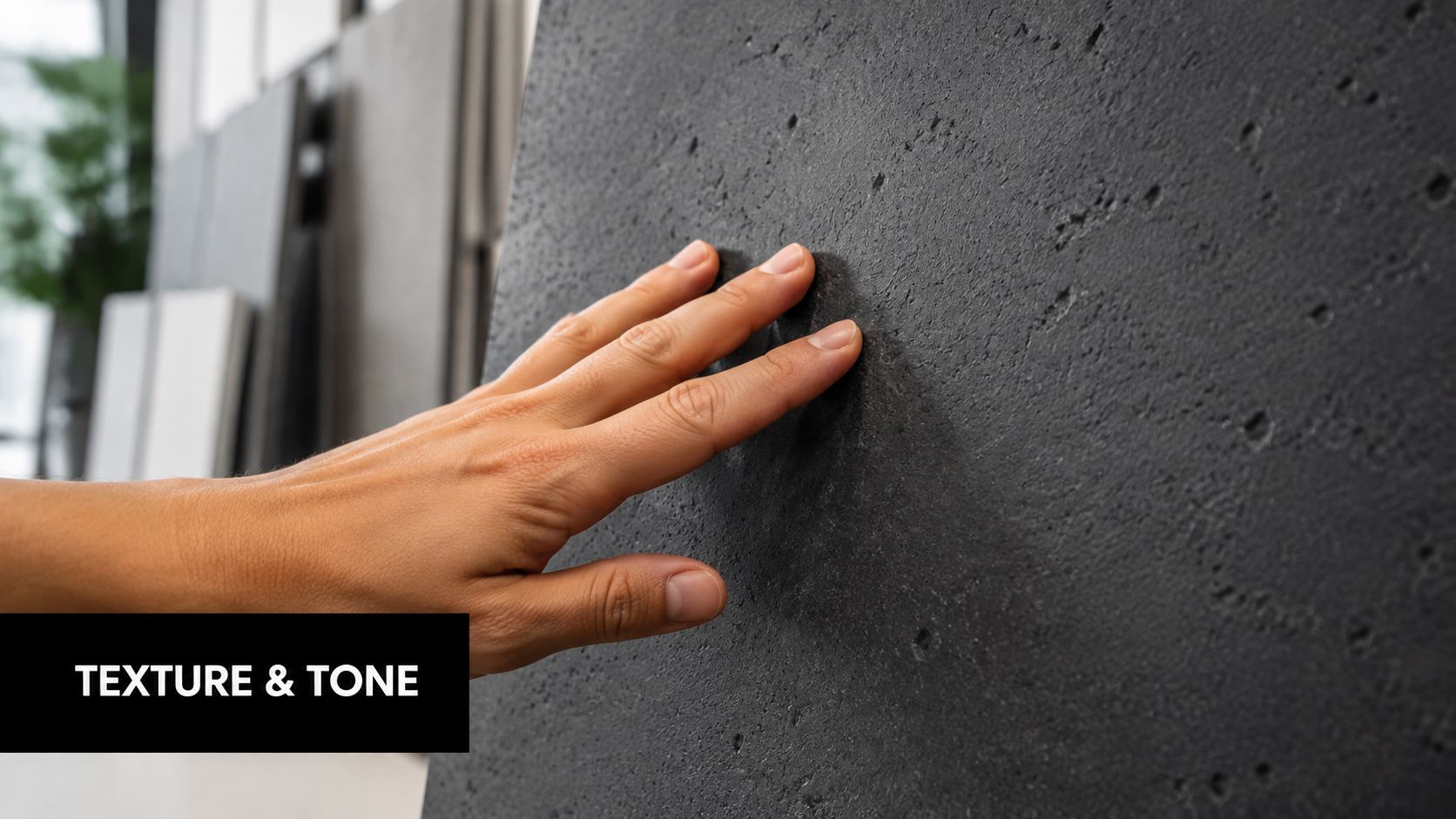
Slip Ratings and Safety on Bathroom Floors
Colour comes after safety. Under AS 4586, wet-area floor surfaces are assessed by slip resistance testing, and bathroom specifications commonly use P-ratings to identify performance in wet barefoot conditions. General bathroom floors are commonly specified at P3 minimum, while shower floors often require a higher barefoot wet rating such as P4 or P5. AS 4586 information from Standards Australia
The pendulum test assesses how a surface behaves under controlled wet conditions. The resulting P-rating gives the designer, builder and homeowner a measurable basis for selection. A black tile can look convincingly textured under showroom lights, but dark colour can visually flatten the surface and conceal moisture. That visual impression isn't a safety rating.
A glossy black porcelain tile may be unsuitable for a wet bathroom floor if its tested classification is too low. Matte or structured porcelain may perform better, but the product certificate must confirm the result. A tile marketed for walls may not be designed for floor loading or barefoot wet traffic.
Match the rating to the zone
| Black Tile Finish | Typical P-Rating | Recommended Bathroom Zone |
|---|---|---|
| Glossy black porcelain | Often P1 to P2, verify the certificate | Dry wall surfaces and decorative splashbacks |
| Matte vitrified porcelain | Can achieve P3 or higher, verify the certificate | General bathroom floors where the rating is suitable |
| Structured or micro-matt porcelain | May achieve P4 or P5, verify the certificate | Shower floors when the tested classification matches |
| Decorative black wall tile | Not assumed suitable for flooring | Vanity walls, feature walls and splashbacks |
The exact requirement also depends on the floor design. A hob-less shower needs carefully formed falls to the waste and a continuous transition between areas. Ramps, thresholds and shower entries can change how water moves across the surface, so the tiler shouldn't make layout decisions before the substrate, drainage and waterproofing details are confirmed.
The NCC Volume Two wet-area provisions also matter to the overall bathroom build. Ask for the tile's test documentation and discuss the intended zone with the contractor. CodeMark certification, where applicable to the relevant product category, can support documentation, but it doesn't remove the need to confirm the tile's actual use, installation system and wet-area compliance.
For a practical selection process, use this guide to choosing bathroom tiles alongside the product certificate. A wet bare-foot sample test can reveal texture and comfort, but it's only a practical check. It doesn't replace formal testing.
Pairing Black Tiles with Fixtures, Lighting and Colour
Black tiles don't have one fixed appearance. Their undertone changes with the surfaces and light around them. The same 600 x 600mm black tile can look calm and architectural beside a white basin in a federation-style Highett home, then feel much heavier beside a moody charcoal vanity in a new build.
Tapware changes the temperature
Matte black tapware creates a low-contrast, tonal bathroom. That can be stylish, but it also risks merging the fittings into the background. Brushed brass introduces warmth and gives black a more decorative, residential character. Chrome reflects the room and provides a sharper, brighter contrast. Brushed nickel is quieter than chrome and sits comfortably with charcoal, timber and warm stone.
Lighting can shift the tile's perceived colour. Warm 3000K LED downlights tend to pull black towards charcoal or brown-grey, especially beside timber. Cooler 4000K lighting can make the same tile read more inky or blue-grey. Always view samples under the proposed lighting rather than making a decision beneath a showroom's general illumination.
| Tapware Finish | Lighting at 3000K Warm | Lighting at 4000K Cool | Best Paired With |
|---|---|---|---|
| Matte black | Soft, tonal and restrained | Sharper, darker and more graphic | Pale stone, timber or a light mirror |
| Brushed brass | Rich and warm | More defined, with stronger contrast | Timber veneer and warm neutral walls |
| Chrome | Reflective and bright | Crisp and contemporary | White basins and pale terrazzo |
| Brushed nickel | Muted and balanced | Clean without looking stark | Charcoal, greige and natural textures |
Give the eye somewhere to rest
A timber veneer vanity can stop black tile from feeling severe. White stone creates a strong graphic contrast, while a concrete-look laminate supports an industrial scheme but may produce too much grey if the floor and walls are also dark.
Layering black across the floor, wall, vanity, mirror frame and tapware is a common mistake. One light-reflective surface, such as a pale terrazzo benchtop or a generous mirror splashback, can return light to the room and prevent the overall effect from becoming visually closed.
Australian trend reporting identifies Contemporary Classics, Modern Australian, Wellness Sanctuary, White On White and Colour Drenching as current bathroom directions. Modern Australian is described as a locally curated approach by designers and architects, which helps explain why black is increasingly being softened with timber, stone and tactile finishes rather than used as a single uninterrupted block. Australian bathroom trend directions from Reece
Layout, Tile Size and Grout Choices
Tile format changes the perceived proportions of a room, but it doesn't override poor planning. A 300 x 600mm black tile introduces more joints and can make a compact ensuite feel structured. A 600 x 600mm format gives a calmer grid. Large-format 900 x 900mm or 1200 x 600mm tiles can reduce visual interruption, provided the walls, floor levels, access and tiler's equipment can accommodate them.
Small mosaics need more caution than their popularity suggests. The additional grout lines can create a grey haze across a black floor, particularly when soap residue and dust settle into the joints. Mosaics are still useful in shower floors because their smaller pieces can follow falls and create a detailed surface, but the grout becomes a major part of both the appearance and the maintenance plan.
Let the pattern set the mood
A brick layout softens black because the staggered joints break up the mass. Stack bond makes the room feel more ordered and harder-edged, which suits a contemporary scheme. Herringbone adds movement and works well on a vanity wall or a restrained feature section, but it increases cutting and alignment requirements.
Grout deserves a sample board of its own:
- Matching black grout creates a near-slab, although shade variation and application marks can become visible.
- White grout frames every tile and gives the wall a graphic, gallery-like quality, but it demands careful cleaning.
- Mid-grey grout is more forgiving visually and can moderate the contrast, though it may dull the clarity of a strongly designed black layout.
Waterproofing and falls must be resolved before the layout is locked. AS 3740 requirements affect substrate preparation, membrane detailing, penetrations and drainage, so the pattern shouldn't dictate a cut that compromises the wet-area build-up. The same principle applies when using large-format bathroom tiles. The format needs to suit the room and installation system, not just the visualisation.
Cleaning and Maintenance in Hard-Water Areas
Dark tile behaves a little like a black car. A polished surface reflects every calcium drip, while a honed surface disguises some droplets but can hold residue in its pores and texture. In Melbourne's bayside homes, hard-water spotting, soap film and lint are practical considerations, not minor styling details.
Australian tile-care guidance recommends wiping surfaces after use, maintaining strong ventilation, using bathmats to reduce standing water and choosing mild cleaners rather than abrasive products that may damage the grout or tile surface. Australian bathroom tile cleaning guidance
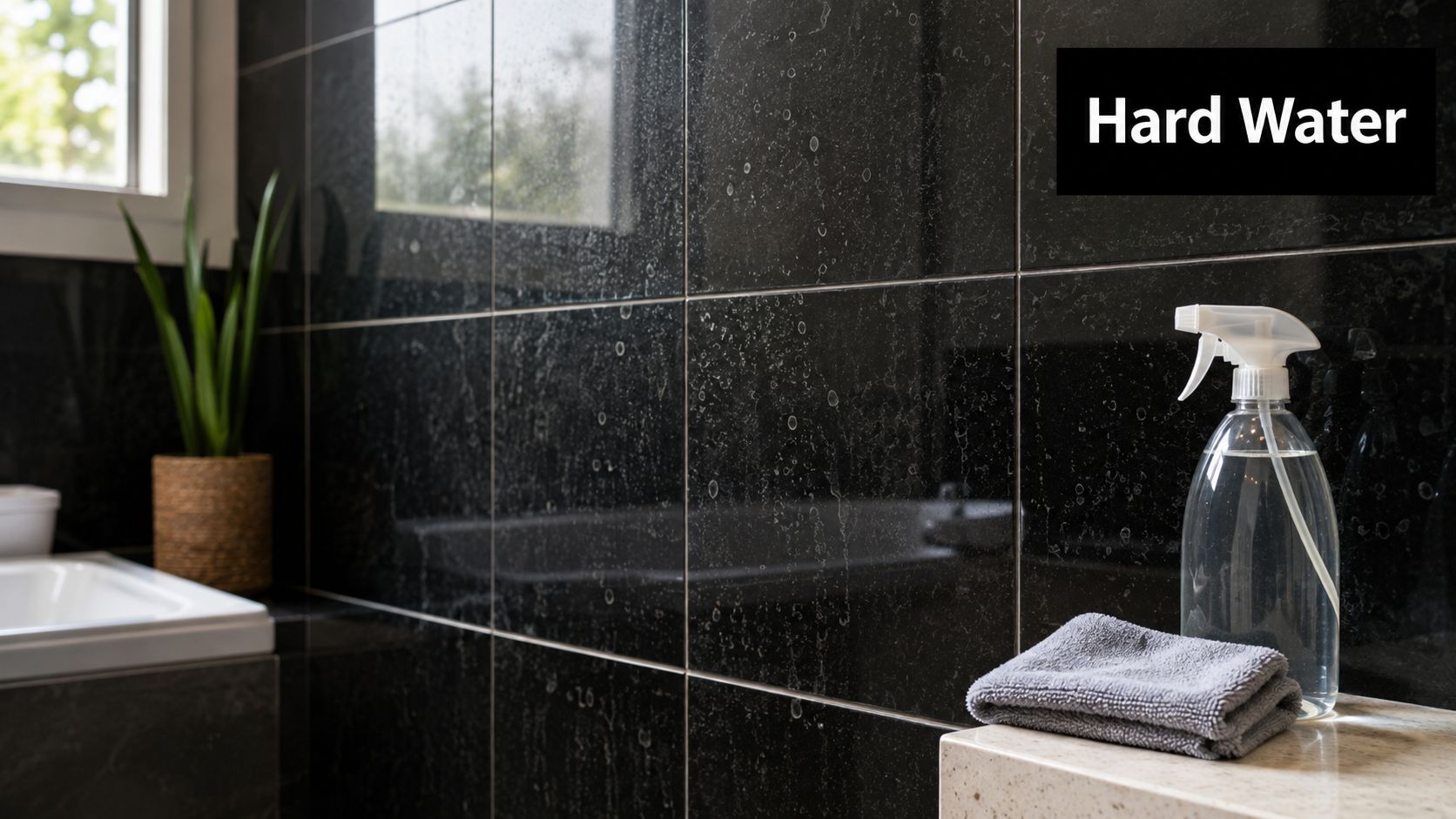
Match the routine to the finish
For polished black porcelain, use a microfibre squeegee after showering and wipe visible droplets before they dry. A pH-neutral cleaner used during routine cleaning is safer than aggressive scrubbing, which can leave fine marks or disturb the grout surface. The appearance standard is high, so this finish suits homeowners who enjoy a carefully maintained room rather than those who want the bathroom to look untouched between cleans.
Honed black stone needs more attention to sealing. Products such as honed basalt or bluestone should follow the manufacturer's sealer instructions, with resealing scheduled according to the product, use and observed water absorption. Don't assume a natural-stone tile has the same care requirements as porcelain.
Textured and fluted finishes hide individual droplets better, but their recesses catch soap, hair and grout haze. Use a soft brush where the manufacturer permits it, rinse thoroughly and avoid abrasive powders. A shower niche, ledge and the area behind a wall-mounted basin usually deserve extra attention because residue settles there first.
Black also reveals household debris quickly. Pet hair, towel fibres, dust and footprints may be visible within hours, particularly on smooth floor tiles. Young children and shedding pets don't rule out black, but they do make a full-room dark floor a higher-maintenance commitment.
Use this floor tile grout cleaning guide for the jointed areas, then confirm product-specific instructions before applying any cleaner or sealer.
| Finish | Maintenance demand | Suitable tolerance |
|---|---|---|
| Polished porcelain | High visibility of spotting | Owners willing to wipe frequently |
| Matte porcelain | Moderate, with good everyday practicality | Most main bathrooms |
| Honed natural stone | High, including sealing and stain care | Detail-focused owners |
| Structured porcelain | Moderate to high, depending on texture depth | Homes prepared for brushing and rinsing |
Planning a Highett or Victoria Renovation the Right Way
A black tile order doesn't make a renovation compliant. The legal and technical decisions sit behind the finish, and they need to be documented before demolition begins.
In Victoria, work valued at more than $10,000 must be carried out by a Registered Builder, according to Victorian bathroom renovation guidance. Bathroom and kitchen work must also comply with plumbing rules, and plumbing tasks require licensed plumbers. Victorian bathroom renovation questions and building requirements
Connect the paperwork to the design
A fully tiled shower needs a compliant water-resistant and waterproofing system beneath the visible tile. A black feature wall still sits over that system, so a dramatic finish doesn't reduce the importance of membrane detailing. If the vanity moves and the drainage or water connections change, a licensed plumber needs to carry out that work.
Before approving the order, confirm:
- The design freeze includes tile format, grout colour, niche positions, shower falls, waste location and fixture penetrations.
- The tile documentation identifies the intended floor or wall use and provides the relevant slip-performance information for wet zones.
- The builder and trades are appropriately registered or licensed for the work they're undertaking.
- The waterproofing stage is documented before tiling covers the membrane and junctions.
- The substrate and falls are checked before large-format or patterned tiles are cut.
- The grout and silicone are allowed to cure according to the product instructions before the room returns to normal use.
- The handover file includes invoices, product details, care instructions, waterproofing records and any relevant certificates.
Sequencing affects the final appearance as much as compliance. A rushed tile layout can leave narrow cuts around a niche. A late fixture change can force new penetrations through a finished surface. Black tile exposes those compromises because uneven lines and patching are more visible against a dark field.
Keep the documents. Future owners, insurers and warranty conversations are better served by a clear record of who did the work, what products were installed and how the wet area was constructed.
A coordinated renovation service can connect concept development, 3D design, construction and finishing. SitePro Bathrooms is one local option that provides those stages as part of its renovation work, including bathroom tiling and large-format tile projects. The important point isn't the company name. It's choosing a process that keeps design, compliance and installation decisions in the same conversation.

Where Black Works Best and Where to Avoid It
Black earns its place when it creates contrast, focus or depth without making every surface responsible for carrying the room. A powder room is often the safest place to be ambitious because it has less continuous shower exposure and usually a simpler cleaning pattern. A fluted black ceramic vanity splashback can provide the drama of a dark scheme while keeping the main floor lighter and easier to manage.
A single feature wall opposite a window can also work well. Natural light gives the tile something to respond to, while a pale basin, mirror or stone surface keeps the composition open. Behind a floating vanity, black provides a grounded backdrop and lets the joinery become the warmer, tactile element.
Strong applications
- Powder-room walls: Use texture, fluting or a bold layout where the surface can be appreciated without full-room wet-area maintenance.
- Vanity splashbacks: Pair black with a pale basin, warm timber or reflective mirror to create a defined focal point.
- A single shower wall: Keep the floor independently specified for slip performance and choose a wall finish for its visual contribution.
- Light-filled bathrooms: Let daylight balance the depth of the tile, but still inspect samples for spotting under actual use conditions.
Applications that deserve caution
A full-room dark floor in a windowless ensuite can feel enclosed and will show lint, hair and footprints quickly. Large-format black matte tiles in a home with young children may require more cleaning than the household wants to provide, especially where the finish has enough texture to hold residue.
An all-black shower is another high-maintenance choice. Soap residue, limescale and towel fibres can become visible within hours, and a dark glossy floor may fail the practical safety test even if it looks sleek. The better solution is often a black wall with a lighter or carefully rated floor, or a charcoal floor with a more forgiving tonal range.
Modern bathrooms and designer bathrooms don't need to rely on maximum darkness. Current Australian direction is moving towards warm neutrals such as putty, mushroom, bone, greige, sandy off-whites and warm taupe, while features including rainfall shower heads with handheld attachments, double vanities, heated towel rails, in-floor heating and steam showers are being incorporated into renovation briefs. Australian bathroom trends for 2026
Before you sign off on bathroom tiles black, book a design consultation, bring your grout and fixture preferences, and request a sample board viewed under your actual lighting. Ask for the slip-rating documentation for every proposed floor tile, confirm the cleaning requirements for the chosen finish, and have the waterproofing and plumbing sequence explained in writing. That small amount of scrutiny is what separates a dramatic bathroom from an expensive daily headache.
If you're planning bathroom renovations in Highett or greater Victoria, contact SitePro Bathrooms to discuss your layout, tile samples, lighting and compliance requirements. Bring photos of the existing room and the finishes you're considering, then request a coordinated design and renovation plan before ordering any black tile.