
You're probably in the same spot as many Victorian homeowners. You've saved a folder full of bathroom inspiration, you know you want something cleaner and calmer than a standard white box renovation, and one feature keeps showing up: a sculptural tub with simple lines, warm finishes around it, and a room that feels both retro and current.
That pull makes sense. A mid century modern bathtub sits in a sweet spot between statement piece and practical fixture. It can soften a hard-edged room, anchor the layout, and give older homes a design language that feels more intentional than trend-driven. The challenge is that online inspiration rarely shows what happens behind the walls, under the floor, or at the bathroom door where a large tub still has to get inside the house.
In Victorian homes, that gap matters. Period homes and post-war homes often ask for different solutions, but both can benefit from the same discipline: choose a style with staying power, then adapt it to modern building standards, modern waterproofing, and how people live. That's why the mid-century look keeps resurfacing in bathroom renovations. It isn't fussy, it isn't overloaded, and it works well when you want a room to feel organised rather than decorated.
A good result starts by separating the look from the fantasy. The best mid-century bathrooms aren't just beautiful. They're easy to clean, easy to move through, and shaped around what the room can realistically support. If you're still deciding on colours, finishes, or overall direction, looking through bathroom decor ideas for Australian homes can help clarify what feels timeless versus what only looks good in a photo.
Introduction Embracing Timeless Bathroom Design
A homeowner might begin with one simple goal: replace an outdated bath and freshen the room. Then the scope expands. The vanity feels too bulky. The tiles feel cold. The layout wastes space. Before long, the project isn't about swapping fixtures. It's about creating a bathroom that feels composed.
That's where mid-century modern design earns its place. It gives you a framework, not just a mood board. Clean lines, uncluttered surfaces, practical storage, and a tub that looks deliberate rather than ornamental. For homeowners searching for new bathroom ideas, that combination is powerful because it avoids both extremes. It doesn't feel old-fashioned, and it doesn't feel sterile.
Why the style still works
The appeal isn't nostalgia alone. Mid-century bathrooms suit the way people want to use a bathroom now. They favour openness, visual calm, and materials that read as durable rather than delicate. In a family home, that usually translates into better daily use. In a smaller room, it can make the space feel lighter without stripping away warmth.
A well-chosen tub doesn't carry the whole room by itself. It works because the vanity, tapware, tile scale, and circulation all support the same idea.
The bathtub becomes the centrepiece because it expresses the style so clearly. A freestanding oval, a low-profile built-in, or a softened rectangular form can all work. The common thread is restraint. If the tub shape is strong, the rest of the room should settle around it.
What homeowners often get wrong
Most mistakes happen when the tub is chosen first and the room is forced to suit it later. That's when circulation tightens, storage disappears, and the bathroom starts looking like a showroom photo copied into the wrong footprint.
The better approach is to ask a few grounded questions early:
- How do you bathe now. Quick practical baths for children, long soaking baths, or mostly showers with a bath as a secondary feature.
- How much floor area can the room spare. A freestanding bath needs breathing room around it to look right.
- What should the room feel like. Warm timber-led, crisp architectural, or softly retro.
- What standard must it meet. Daily family use, guest bathroom expectations, or a future-proofed design with easier access.
That's the core promise of this style. It gives you a timeless visual language, but it only succeeds when beauty and function stay linked.
The Hallmarks of Mid-Century Modern Bathroom Style
Mid-century modern isn't a catch-all term for any bathroom with a timber vanity and a curved bath. It has a specific design logic. In Australia, it's best understood as a post-World War II design response from the 1945 to late 1970s period, with an emphasis on clean lines and materials such as metal, glass, and plastic. The look was shaped by practicality, not ornament, and that's part of why it still feels current. The background on that era and material shift is outlined in this history of Danish and mid-century design influences.
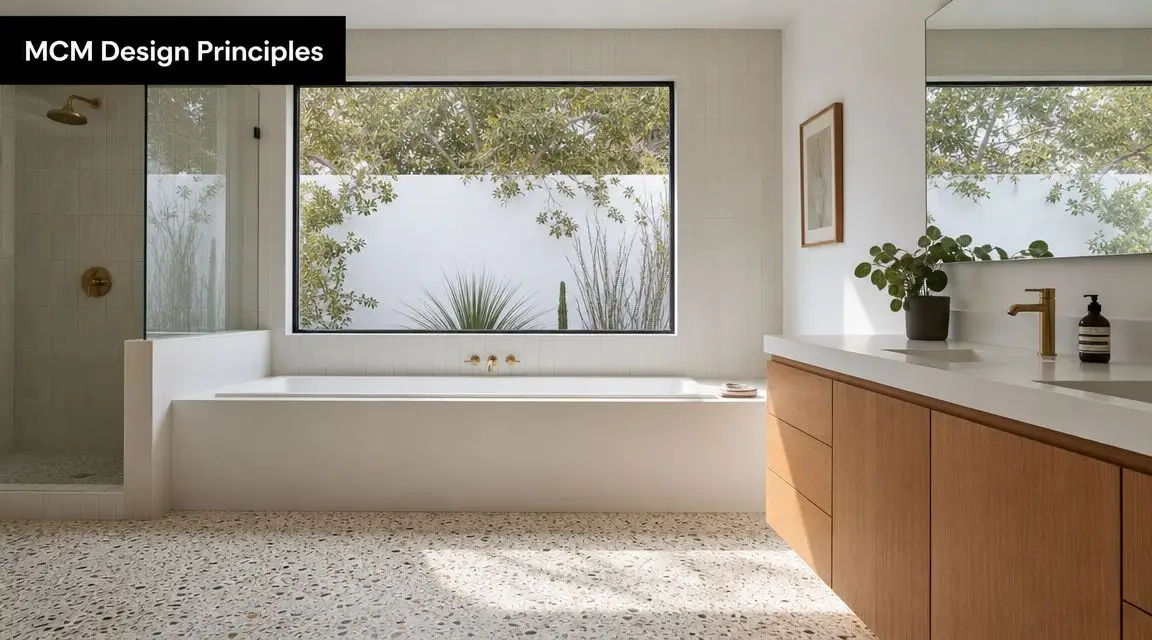
That same historical thread matters for bathtubs. The aesthetic developed around the modern enamel-coated cast iron tub, first standardised in 1883, which made durable and easier-to-clean bath fixtures practical for later homes. In other words, the style was never about lavish detailing. It was about modern living becoming more achievable.
What defines the look
A proper mid-century bathroom usually includes a few recognisable traits:
- Clean geometry. Not severe, but disciplined. Lines are simple, and the room avoids visual clutter.
- Organic contrast. Straight edges are often balanced with curved mirrors, rounded tubs, or softer lighting forms.
- Warmth through material. Timber tones, tactile surfaces, and muted earthy colours keep the room from feeling clinical.
- Minimal ornament. The design relies on proportion and finish, not decorative extras.
Many so-called modern bathrooms tend to drift away from the style. They might be sleek, but they miss the warmth. Mid-century rooms need some softness and some human scale. A cold monochrome palette with oversized glossy surfaces can feel contemporary, but it won't necessarily feel mid-century.
The role of functionality
The style came out of a period that valued practical living. That means function shouldn't be hidden as an afterthought. Floating vanities, open visual lines, and simple storage solutions fit the aesthetic because they make a bathroom easier to use.
A few elements usually work well:
- Wall-hung or visually light vanities that keep more floor visible
- Frameless glass where a shower screen is needed
- Simple tapware silhouettes rather than ornate traditional fittings
- Limited material changes so the room feels calm instead of busy
Practical rule: If every item in the room is trying to be the statement piece, the bathroom loses the mid-century character immediately.
What feels authentic in a Victorian renovation
Victorian homeowners often worry that a mid-century look will clash with the house. In practice, it can work extremely well if you avoid turning the bathroom into a movie set. The goal isn't strict historical recreation. It's a designer bathroom that borrows the era's discipline and ease.
That usually means choosing a restrained bath shape, a vanity with warm natural character, and finishes that don't fight each other. Authenticity comes less from copying a decade and more from respecting the principles that made the style durable in the first place.
Choosing Your Perfect Mid-Century Modern Bathtub
The tub is the anchor, but not every tub that looks right on a screen works in a real renovation. The best choice depends on how much space you have, how you use the bathroom, and how much visual weight the room can carry.
A mid century modern bathtub generally falls into two broad categories. There's the freestanding sculptural bath that acts as the hero, and there's the integrated bath that keeps the room tighter and more architectural. Both can suit the style. They solve different problems.
Freestanding or built-in
A freestanding tub usually gives the strongest mid-century expression. It reads as furniture-like, especially when paired with a floating vanity and pared-back wall finishes. In a larger room, that's often the right move.
In a tighter footprint, it can backfire. You lose practical floor area around the bath, cleaning gets harder if clearances are too tight, and the tub can dominate a room that really needs storage or circulation more than sculpture.
A built-in or alcove tub can be the smarter choice when:
- The bathroom is compact and every centimetre needs to work
- You need a shower over bath arrangement or a more family-focused layout
- The room already has strong architectural features and doesn't need another focal point
- You want the bath to support the room rather than lead it
Material matters more than many buyers expect
Material changes how the bath feels, how it performs, and what the installation asks of the house. For Australian renovations, a sound specification is often a freestanding acrylic or cast-stone tub with enough internal volume for a proper soak without becoming excessive. Common modern bathtubs hold around 80 gallons (302 L), while a typical bath uses 35 to 50 gallons (132 to 189 L), according to bathtub dimensions and capacity guidance. That affects hot water demand and filling behaviour, so the material choice shouldn't be made on appearance alone.
Mid-Century Modern Bathtub Material Comparison
| Material | Heat Retention | Weight | Maintenance | Typical Cost |
|---|---|---|---|---|
| Acrylic | Good for everyday use. Often improved further by quality construction | Lighter and easier to handle on site | Easy to clean, generally straightforward to maintain | Usually more budget-friendly |
| Cast stone | Typically feels more substantial and holds warmth well | Heavier than acrylic | Smooth finish, but correct cleaning products matter | Usually positioned in a higher price range |
| Enamelled cast iron | Traditionally solid and durable | Very heavy, often the hardest to bring into older homes | Hard-wearing surface, but chips need attention | Often premium once product and installation demands are considered |
How I'd narrow it down
If the priority is a strong visual statement with easier installation, acrylic is often the practical winner. If the priority is tactile quality and a more substantial feel, cast stone often justifies the extra planning. Cast iron suits some projects, but it asks a lot from access, structure, and labour.
Ask yourself three things before deciding:
- Will this bath still make sense after the novelty wears off
- Can the room support the shape without becoming awkward
- Does the rest of the renovation budget still work once the tub is selected
The best tub usually isn't the most dramatic one. It's the one that makes the whole room feel resolved.
Practical Planning for Your Bathtub Installation
A bath can look perfectly proportioned in a showroom and still be wrong for your home. Installation planning is where many bathroom renovations either stay on track or start generating expensive corrections.

The first check is basic but often skipped. Measure not only the bathroom, but also the path into it. Door openings, hallway turns, stair access, and wall projections can all become the actual limiting factor. A tub that fits the room on paper may still be impossible to deliver without damage or major inconvenience.
Clearance is part of the design
Mid-century bathrooms work best when they feel open. That effect comes from disciplined spacing, not from empty styling. Design guidance recommends at least 15 inches (381 mm) from either side of the toilet to the centreline, with 36 inches total toilet niche width preferred for comfort, as outlined in this mid-century bathroom design guide. The same guidance stresses strong ventilation to manage humidity and protect finishes.
Those numbers matter because a beautiful bathroom still has to function when someone is stepping out of the bath, opening a vanity drawer, or helping a child at the basin. Tight clearances quickly make a space feel cheap, no matter how refined the fixtures are.
Check these before you approve the layout
- Bath access zone. Make sure entry and exit feel stable, not squeezed beside a vanity corner or toilet pan.
- Toilet spacing. Respect the recommended clearances so the room doesn't become uncomfortable in daily use.
- Screen and door swing. A bath edge, shower screen, and room door can clash if they're all competing in the same space.
- Ventilation path. Moisture control protects timber looks, painted finishes, and general longevity.
Good bathroom planning isn't about fitting everything in. It's about making every movement in the room feel natural.
Water volume and hot water reality
A larger soaking tub changes the demands on the plumbing system. As noted earlier, common modern bathtubs can hold 302 L, and a typical bath uses 132 to 189 L when filled for use. That has a direct effect on fill time, hot water availability, and whether the water temperature stays comfortable through the fill.
If the selected tub is generous in capacity, you may need to review hot water access and the strategy for delivering stable mixed water. In such cases, homeowners benefit from experienced trades and, in many projects, from understanding why using a registered builder matters for your bathroom renovation. The visual choice and the technical system have to be solved together.
Structure and moisture control
Heavy tubs, water load, and occupant load all sit on one floor system. In older homes, especially where bathrooms have been altered before, that deserves proper assessment. The same goes for ventilation. A mid-century palette often includes warm timber tones and refined finishes, and they won't look good for long if steam lingers and moisture sits where it shouldn't.
The smartest bathtub choice is the one the room can support physically, hydraulically, and spatially.
Integrating Your Tub into a Bathroom Renovation
A bathtub replacement is rarely just a bathtub replacement. Once the old fixture comes out, the room often reveals why the bath looked awkward in the first place. Plumbing may sit in the wrong position, the floor may need correction, waterproofing may be due for a full rebuild, and the layout may need to shift to make the new bath work properly.
That's especially true when you're fitting a mid-century shape into an Australian renovation. A frequently missed issue is practicality. Inspiration images tend to show large rooms with generous empty floor space, but many Victorian homes need careful redesign so a sculptural tub doesn't compromise circulation or accessibility. That fit-out reality is highlighted in this overview of mid-century bathtub practicality.
The real project sequence
In a properly managed renovation, the bath decision affects several stages:
Demolition and strip-out
The old room is removed so the actual substrate, plumbing positions, and any hidden issues can be assessed.Layout confirmation
At this stage, a bath stays, shifts, or gets replaced with a different type because the room's best use becomes clearer.Plumbing rough-in
Freestanding baths often need different waste and tap arrangements from built-in units. That can mean more floor planning than homeowners expect.Waterproofing and levelling
A freestanding bath especially needs a properly prepared base. If the floor falls away or the waterproofing detail is rushed, the final finish suffers.Tiling, fit-off, and final placement
The visible stage looks simple, but it only works well when the hidden work has been coordinated carefully.
Where projects commonly go wrong
The most common problem isn't bad taste. It's underestimating what the chosen bath asks of the room. A freestanding filler might end up in an awkward position. A bath may look balanced in elevation drawings but crowd the circulation path in real life. Or the room may lose practical storage because too much area has been handed over to the feature piece.
For homeowners looking at registered builders unlimited and qualified trades, the value is straightforward. Compliance, sequencing, and accountability matter more when plumbing, structure, waterproofing, and finish quality all intersect in one compact space.
The best renovation results don't happen because the bath looked good in a brochure. They happen because every trade solved the same layout problem in the same way.
A mid-century bathroom should feel effortless. Getting there usually isn't effortless at all. It takes coordination.
Styling and Pairing for a Cohesive Look
Once the tub is in place, the room still needs visual discipline. Mid-century style falls apart when the supporting finishes pull in unrelated directions. A sculptural bath with ultra-ornate tapware, oversized stone veining, and high-gloss cabinetry won't read as coherent. It will read as several trends sharing one room.
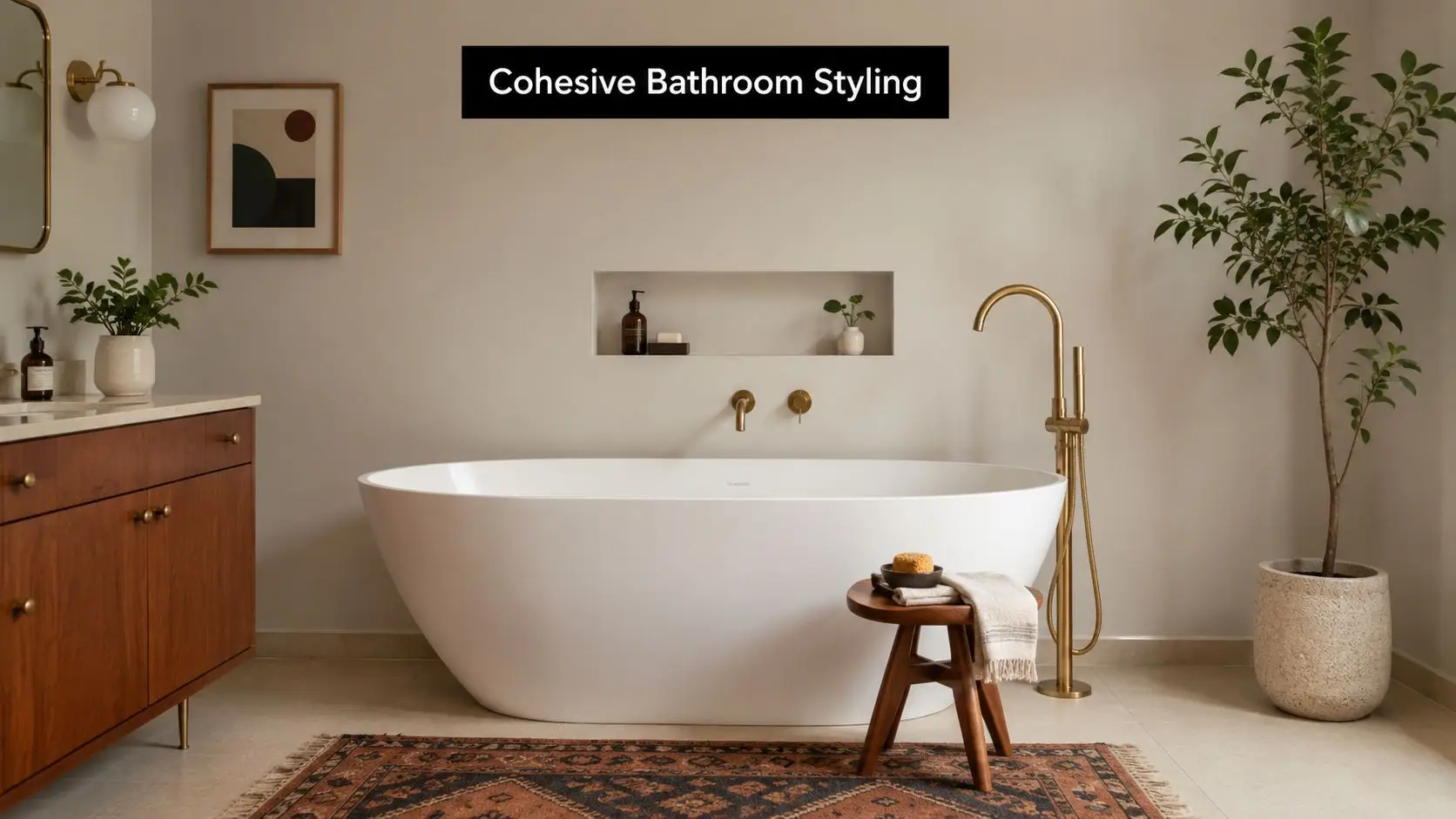
The strongest pairings usually rely on contrast with restraint. A white bath against warm timber-look porcelain. A soft terrazzo floor under a simple floating vanity. Brass or chrome tapware that adds definition without dragging the room into either industrial or traditional territory.
Tiles that support the bath
Tile choice should frame the tub, not compete with it. For many designer bathrooms, that means one quiet field tile and one material with character.
Good options include:
- Simple ceramic wall tiles for a crisp backdrop
- Terrazzo-style flooring for period flavour without fussiness
- Timber-look porcelain where you want warmth without real timber maintenance concerns
- Geometric feature use in moderation, such as a niche, splashback, or small floor zone
If you're refining combinations, guidance on choosing bathroom tiles can help narrow down what works visually and practically in wet areas.
Tapware, colour, and furniture tone
The vanity often determines whether the room feels authentically mid-century or just broadly contemporary. Warm timber tones usually help, especially if the grain is visible and the form is simple. Floating vanities work particularly well because they keep sightlines clear.
Tapware and accessories should follow the same discipline:
- Brushed brass adds warmth and suits earthy palettes
- Polished chrome keeps the room crisp and timeless
- Matte black can work, but it's easiest to overdo in a mid-century scheme
For colour, think muted and grounded. Off-white, clay, olive, ochre, soft teal, warm beige, and walnut-adjacent tones all sit comfortably in this style. One accent usually reads better than three.
Small details that lift the room
The finishing layer matters more than people expect. A mirror with a gentle curve, a wall light with a simple globe form, or a timber stool beside the bath can reinforce the style without cluttering the room.
A few details worth considering:
- Keep accessories sparse so the architecture and materials stay visible
- Choose soft textiles in earthy or neutral tones rather than bright pattern overload
- Use greenery carefully if the room has natural light and enough ventilation
- Repeat one finish across hardware so the room feels organised
A cohesive bathroom doesn't need more features. It needs fewer competing decisions.
That's what makes the mid-century look so effective. It feels designed, but it doesn't feel overworked.
Your Highett Bathroom Renovation Partner
A mid-century bathroom looks simple when it's done well. Behind that calm finish sits a lot of decision-making. The tub has to suit the room. The layout has to support movement. The plumbing, waterproofing, and construction all have to line up with the design intent.
That's where a local renovation specialist makes the process easier. For homeowners in Highett and across Victoria, SitePro Bathrooms delivers end-to-end bathroom renovations with a focus on planning, build quality, and practical outcomes. That matters when you're trying to turn inspiration into a room that is practical in an existing home.

The advantage of a coordinated team is consistency. Design choices, fixture selection, layout planning, and on-site execution are handled as one connected job rather than a string of disconnected decisions. That's particularly valuable when a mid century modern bathtub is central to the renovation, because style, structure, and services all need to support the same final result.
If you're exploring new bathroom ideas, updating one tired room, or planning a full renovation with the guidance of experienced designers and builders, SitePro Bathrooms offers that local expertise. You can browse completed projects, review the renovation approach, and take the next step through SitePro Bathrooms.
A well-designed mid-century bathroom doesn't chase attention. It earns it through proportion, clarity, and smart planning. If that's the kind of room you want, start with the bathtub, but don't stop there. The best results come when every surrounding decision is just as deliberate.