

Water Saving Shower Heads: The Complete Guide for 2026
Your shower is probably the last fixture you think about when the water bill lands, yet it's often the one that gives the biggest payback when you renovate. In a Victorian home, that matters even more. Old bathrooms can hide thirsty fittings, uneven pressure, and hot-water waste that adds up fast, so a smarter shower head isn't a gimmick, it's a practical upgrade that belongs near the top of any bathroom renovation list.
The mistake most homeowners make is assuming water saving shower heads mean a weak, miserable rinse. They don't have to. The right model is a balance of flow rate, nozzle engineering, and pressure compensation, and that balance is exactly what separates a satisfying bathroom from one people complain about every morning.
Why Water Saving Shower Heads Matter for Your Bathroom
A lot of homeowners notice the problem in the same way. The bill rises, the bathroom feels dated, and suddenly the shower becomes the obvious place where water is disappearing. That's not a bad instinct. Showering is one of the largest indoor uses of household water, so a fixture swap can make a real difference without tearing the whole bathroom apart.

For Victorian homeowners planning bathroom renovations, this is one of the cleanest wins. A better shower head can reduce shower water use by around 20% or more when you move from a standard fixture to an efficient model, with bigger savings as the rating rises, according to Australian guidance tied to the WELS framework. That's why the upgrade belongs in the same conversation as tiles, vanities, and waterproofing, not as an afterthought.
The other reason it matters is simple. You don't need a full plumbing overhaul to start seeing the benefit. In many homes, the right replacement is a focused change that improves the bathroom's water-efficiency profile immediately, while also setting the tone for modern bathrooms that feel considered instead of wasteful.
Practical rule: If the shower is old, inconsistent, or obviously over-delivering water, fix that first. It's one of the fastest ways to improve daily comfort and lower consumption at the same time.
For homeowners exploring new bathroom ideas, that makes the shower head a design decision as much as a utility decision. A remodel that ignores flow rate is leaving money and water on the table. A remodel that gets it right starts with the fixture that gets used every day.
If you're thinking about broader sustainability choices across a renovation, this overview on eco-friendly materials and sustainable construction fits neatly beside the plumbing decisions.
Understanding WELS Ratings and Flow Rate Standards
The benchmark that matters in Australia is the Water Efficiency Labelling and Standards, or WELS, framework. Shower heads sold in the market are rated from 0 to 6 stars, and the scheme uses a maximum flow-rate threshold of 9 litres per minute for standard showerheads, with higher-star products delivering progressively lower consumption, according to the technical reference in the WELS material. That's the number homeowners should use to compare products, not the glossy wording on the box.
Think of WELS the way you'd think about the star rating on an appliance. More stars mean less water use, and the label gives you a simple, local comparison point that's useful during a renovation. In practice, it turns shower-head selection into a measurable decision, because flow rate, star rating, and expected water use can all be weighed before you buy.
| WELS Star Ratings and Flow Rates | ||
|---|---|---|
| WELS Star Rating | Flow Rate (L/min) | Estimated Water Savings |
| 0 to 6 stars | Up to 9 | Higher stars mean lower consumption |
That table is intentionally simple, because the label itself is the point. You're not guessing whether a product is efficient. You're checking the rating and the flow rate, then deciding whether it suits the bathroom you're building.
WELS matters even more in Victoria because it gives homeowners a locally recognised standard during renovations. Marketing language is cheap. A label tied to tested flow performance is not. When you're specifying fixtures for modern bathrooms, WELS lets you compare options with confidence rather than buying a product because the packaging says “eco” in large letters.
The smart move is to treat the label as the starting point, not the whole story. A good shower head should earn its rating and still feel right in daily use.
For anyone planning bathroom renovations, that's the benefit. WELS takes the shower head out of the world of vague claims and puts it into the world of design criteria. Once you start choosing fixtures that way, the whole bathroom gets easier to plan.
Shower Head Technologies and How They Perform
Not every water-saving shower head works the same way, and that's why pressure complaints are so common after a retrofit. The trick is to match the technology to the way your home behaves, especially in older Victorian houses where supply pressure can vary. A good low-flow head doesn't just reduce water. It manages how water leaves the nozzles.
Aerating, laminar, and restrictor designs
Aerating models mix air into the water stream. That can make the spray feel fuller even when the actual flow is lower, which is why they're often a solid choice when the homeowner wants a softer but still satisfying shower. Laminar-flow designs send out individual streams, which can reduce heat loss and feel more direct. Low-flow restrictor models reduce volume, which is the bluntest approach and often the easiest to get wrong.
The best choice depends on how the bathroom is supplied. Gravity-fed systems, mains-pressurised systems, and older pipework won't all react the same way. A head that feels fine in one house can feel thin in another if the internals aren't designed for pressure variation.
Why comfort comes down to nozzle design
People often have the big fear wrong. Low-flow does not automatically mean weak spray. Nozzle size, the number of holes, and pressure-compensated internals all affect how the shower feels. Research on showerhead testing in other markets found that models with more, smaller holes and a higher resistance factor performed better for comfort while still saving energy, which is exactly the sort of engineering Victorian homeowners should care about.
The logic is straightforward. If the showerhead maintains spray coverage and force across changing pressure, the experience stays usable. If it doesn't, people notice immediately, and the retrofit gets blamed instead of the bad product choice.
Choose for spray quality first, then check the efficiency label. If a head saves water but makes the shower feel erratic, it's the wrong fixture for the room.
If you're refining the layout of an ensuite, this piece on designing an ensuite pairs well with the technical side, because style and performance need to line up in the same room.
For designer bathrooms, I'd be blunt. Don't buy by appearance alone. A polished finish is nice, but the internals are what decide whether the shower feels premium or cheap after installation. In real homes, that's the difference that matters.
Real Water and Energy Savings You Can Expect
The savings are not abstract. Flow rate reduction scales directly with water use, so when you cut output at the showerhead, you cut what has to be heated too. That's the part many homeowners miss. A shower upgrade is not just a water bill decision, it's an energy decision because hot water is part of every minute spent under the spray.
A useful technical reference is simple. Reducing flow from a conventional 2.5 GPM to 2.0 GPM cuts water use by 20%, and lower-flow products often operate around 1.5 to 1.8 GPM while still being designed for spray force and coverage, according to the EPA WaterSense showerhead specification. That matters because lower flow only helps if the shower still works properly in daily use.
The same WaterSense material is clear that high-performing low-flow heads aren't just restricted devices. They have to be independently certified for spray force, spray coverage, and pressure compensation, with a minimum spray-force requirement of 2.0 oz (0.56 N) at 20 psi and testing at 20, 45, and 80 psi. That's why a well-chosen head can save water without turning every shower into a compromise.
Behaviour matters too. A peer-reviewed study found that shortening a shower from 20 to 10 minutes saves 70 to 200 litres each time, depending on showerhead flow rate, and shortening from 10 to 5 minutes saves 35 to 100 litres each time. The same study estimated that reducing shower frequency by one shower per week can cut annual water use by 3,640 litres with a 7 L/min showerhead, 5,200 litres with a 10 L/min showerhead, and 10,400 litres with a 20 L/min showerhead. Those are behavioural savings, but they show how quickly shower habits multiply.
| Shower change | Water effect |
|---|---|
| 20 to 10 minutes | 70 to 200 litres saved each time |
| 10 to 5 minutes | 35 to 100 litres saved each time |
| One fewer shower per week | 3,640 to 10,400 litres saved per year, depending on flow rate |
A better shower head and a shorter shower are a strong combination. One changes the fixture, the other changes the routine, and both pull in the same direction.
For homeowners budgeting bathroom renovations, that matters because it helps justify the upgrade in practical terms. The right head can reduce hot-water demand enough to matter for bills, especially in households where showering is frequent and the hot-water system is working hard.
Choosing the Right Shower Head for Your Victorian Home
Start with pressure, not style. If your home has inconsistent pressure, or the shower feels uneven now, you need a head with pressure-compensated internals. That's the feature that protects you from the common “it looks efficient, but it feels rubbish” problem. In older Victorian homes, that one detail is often the difference between a successful retrofit and a regret.
What to check before you buy
- WELS label first: Use the star rating and flow rate as your baseline, not the packaging claims.
- Spray performance: Look for evidence that the head has been tested for spray force and coverage, not just restricted flow.
- Pressure compatibility: Make sure the design suits gravity-fed or mains-pressurised conditions if your home is sensitive to pressure changes.
- Nozzle engineering: Favour heads with thoughtful hole layout and pressure-compensated internals over simple flow restriction.
- Visual fit: Pick a finish and shape that suits the room, whether you're aiming for modern bathrooms or more refined designer bathrooms.
The goal is to stop thinking about shower heads as one-size-fits-all items. They aren't. A good product in one home can be the wrong choice in another if the plumbing, pressure, and shower habits don't match.
A useful filter is this. If the shower head is only marketed as “water saving” but doesn't give clear performance information, leave it on the shelf. If the specification shows the flow rate, pressure behaviour, and certification logic, you've got something worth considering.
For homeowners sketching new bathroom ideas, design and engineering meet. The fixture needs to look right, but it also needs to rinse properly, feel comfortable, and suit the household's daily routine. That's the test, not the showroom pitch.
Installation and Retrofit Considerations for Renovations
A simple shower-head swap can be straightforward, but don't treat every job as DIY if the rest of the bathroom is being changed too. If you're only replacing the head and the thread matches the existing arm, the work is usually simple. If the renovation includes pipework changes, pressure regulation adjustments, or a broader rework of the shower plumbing, bring in a licensed plumber and, where relevant to the project scope, registered builders unlimited.
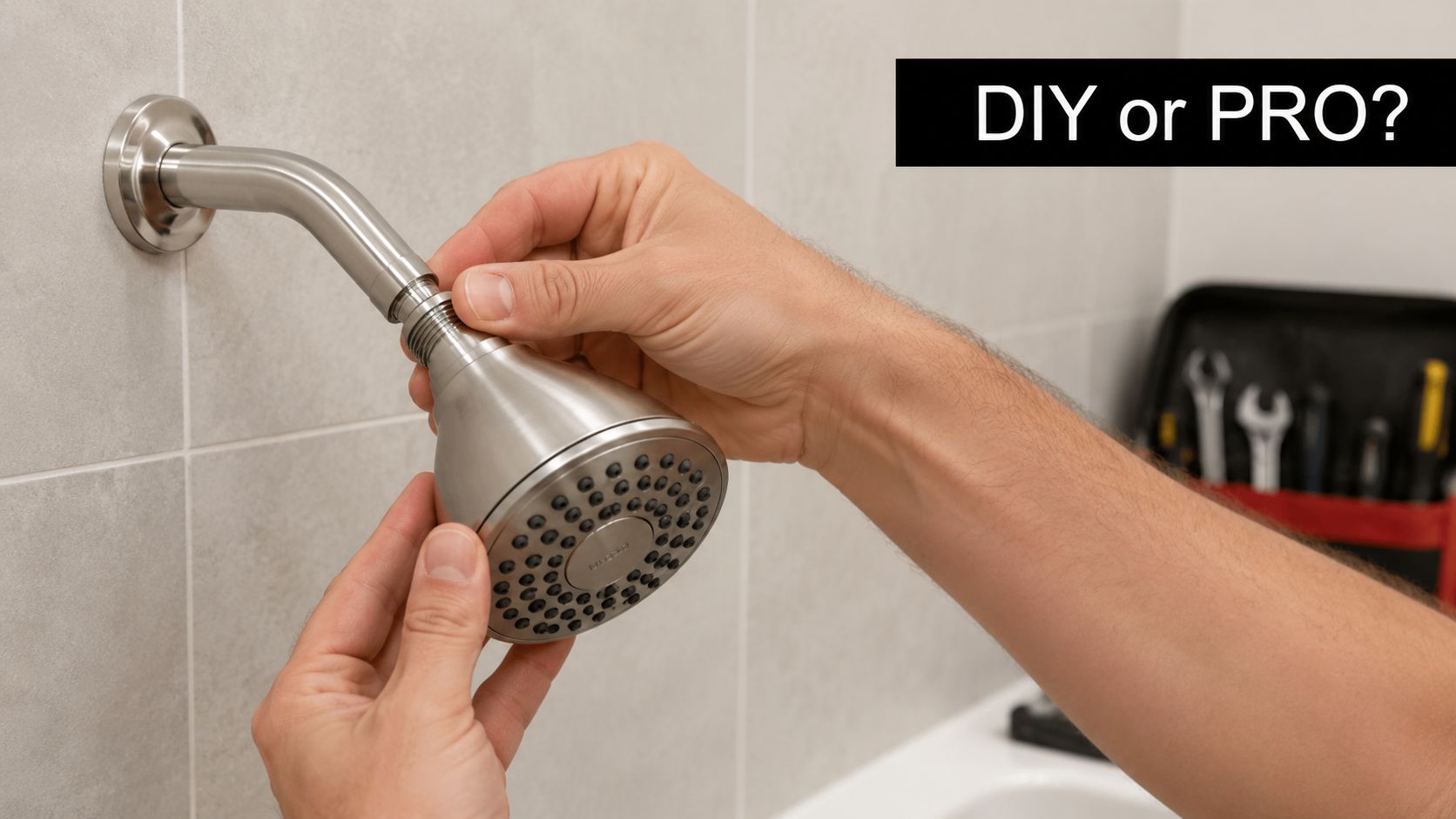
The first check is physical compatibility. Confirm the shower arm thread matches, make sure the new head seats properly, and seal it correctly so you don't end up with leaks that cancel out the water-saving benefit. After installation, test the spray pattern, check for drips, and stand under the shower long enough to judge whether the coverage feels even, not just whether water is coming out.
Fit the fixture into the renovation, not the other way around
The best renovation outcomes come from coordination. A shower head shouldn't be chosen in isolation, then forced into the room after the tiles and tapware are set. It should be part of the wider visual and functional plan, which is why many homeowners use bathroom renovation planning guidance before buying fixtures.
That matters for sequencing too. If you're coordinating 3D design, tile selection, and tapware finish, the shower head needs to sit comfortably inside that palette. A chrome head in one room, a brushed finish in another, or a bulkier profile in a compact ensuite can change the whole feel of the space.
Install it, test it, then judge it in the room it will live in. A shower head that looks ideal on paper still has to work in the actual bathroom.
For a retrofit, my advice is simple. If the job is only a head swap, keep it tight and clean. If the renovation touches the plumbing, treat the shower head as one element in a complete system, because that's how you avoid pressure problems later.
Transform Your Bathroom with SitePro Bathrooms
If you're serious about a better bathroom, treat the shower head as part of the whole renovation, not a bolt-on purchase. That's where a coordinated team makes a real difference. SitePro Bathrooms works end-to-end, from concept development and 3D design through construction and finishing, so the fixture choices, layout, and style all land together instead of fighting each other.
That approach suits Victorian homeowners who want a bathroom that's practical every day and polished in the final result. It also suits compact ensuites, family bathrooms, and designer bathrooms where the details matter just as much as the main finishes. A good renovation doesn't just look new, it feels better to use, and the shower is one of the first places you notice that.
SitePro Bathrooms is based in Highett and focuses on turning bathrooms into functional, beautiful spaces that add value and comfort. If you're comparing new bathroom ideas, refining a renovation brief, or trying to decide whether a water-saving upgrade belongs in the plan, their process gives you a clear path from idea to completed room.
Explore past projects, read client testimonials, and request a quote if you're ready to move. Whether you're updating a compact ensuite or undertaking a full bathroom transformation, a well-planned renovation should deliver clear communication, reliable timelines, and workmanship that exceeds expectations.