
Modern Cabinets Kitchen Ideas for Stylish Homes
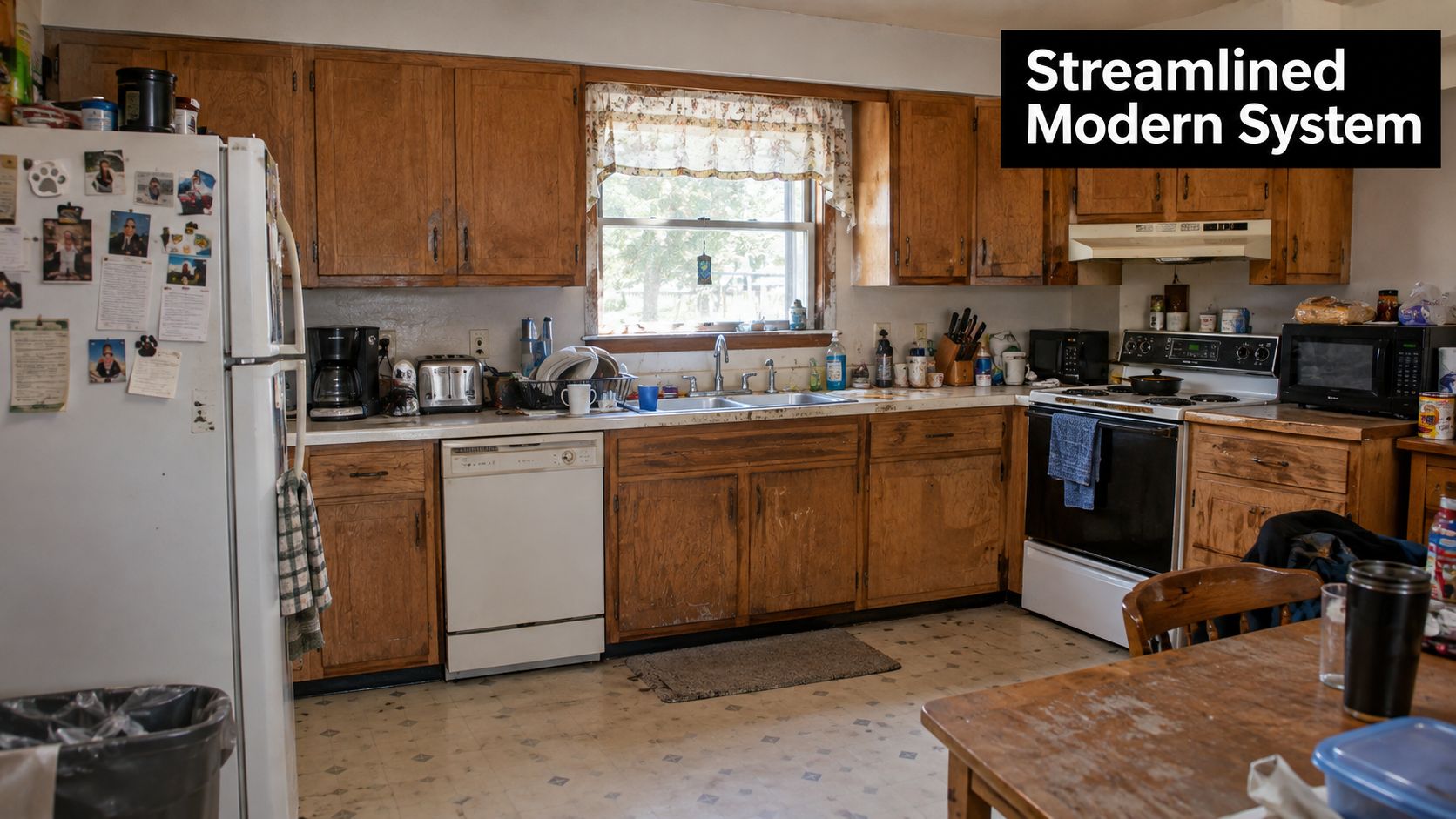
You're standing in a dated kitchen with a crowded benchtop, awkward cupboards and nowhere sensible to put the appliances. The room may still look serviceable, but every meal involves extra steps, doors collide, and the visual noise makes the whole home feel less organised. That's the point at which many homeowners search for modern cabinets kitchen ideas, expecting a colour recommendation when decision is much broader.
Modern cabinetry is a coordinated system of storage, workflow, materials, hardware and installation. The finish matters, but so do the board inside the doors, the way drawers carry weight, the sealing around exposed edges and the accuracy of the installation. Those choices also influence nearby spaces, including bathroom renovations, because a whole-home renovation looks more deliberate when kitchens and bathrooms share a practical design language.
Introduction to Modern Kitchen Cabinets Today
Leah begins her renovation with a familiar problem. Her old kitchen has timber doors, a few deep cupboards and a benchtop buried under mail, small appliances and food containers. She first asks for white slab doors because she likes the calm look of modern kitchens. After the layout is mapped, the issue becomes clear: plates, pans and cleaning products are competing for the same storage zones.
That shift changes the brief. Modern doesn't mean white, handleless or expensive. It means every cabinet has a clear role, the fronts create orderly lines, and the room supports daily movement. A modern cabinets kitchen can use warm timber veneer, soft neutral laminate or a deeper colour. The finish needs to suit the household, while the overall arrangement remains purposeful.
Cabinets deserve attention early because they occupy much of the room's visual field and represent a major part of the project value. Australia's kitchen cabinets market was estimated at USD 83 million in 2025 and projected to reach USD 98 million by 2032, with growth of about 2.4% CAGR, according to the Australia kitchen cabinets market outlook. The same source reported that cabinets represented 53.74% of value in 2025 within the broader Australian kitchen furniture market, making them its largest product category.
Modern means coordinated, not merely minimal
A strong result joins appearance with construction. A clean door profile can make a compact room feel calmer, while a well-planned drawer stack removes the frustration that prompted the renovation. Cabinet decisions also set a useful design direction for bathroom vanities, laundry storage and other built-in joinery. Matching every room is unnecessary, but consistent colours, proportions and durability expectations help the whole-home renovation feel planned rather than pieced together.
Practical rule: Choose the cabinet system around your routines first, then use colour and finish to express your style.
Australian renovation choices show why white remains a practical reference point. Houzz Australia reported that 59% of Australian renovators chose white kitchen cabinets, while the average kitchen renovation spend was $19,300. Its Australian renovation findings placed average spending at $22,600 for large kitchens over 10 square metres and $14,600 for small kitchens under 10 square metres. These figures do not set your budget, but they show why cabinet planning belongs near the start of the renovation, before decorative decisions and before bathroom work is coordinated around the same practical priorities.
What Makes Cabinets Modern and How They Work
Modern cabinetry usually starts with the door. Flat-panel, or slab, fronts remove the raised profiles and decorative grooves associated with traditional joinery. The result resembles a custom suit rather than an off-the-rack outfit. The individual pieces may be modular, but consistent gaps, aligned rails and carefully selected proportions make the finished wall feel custom.
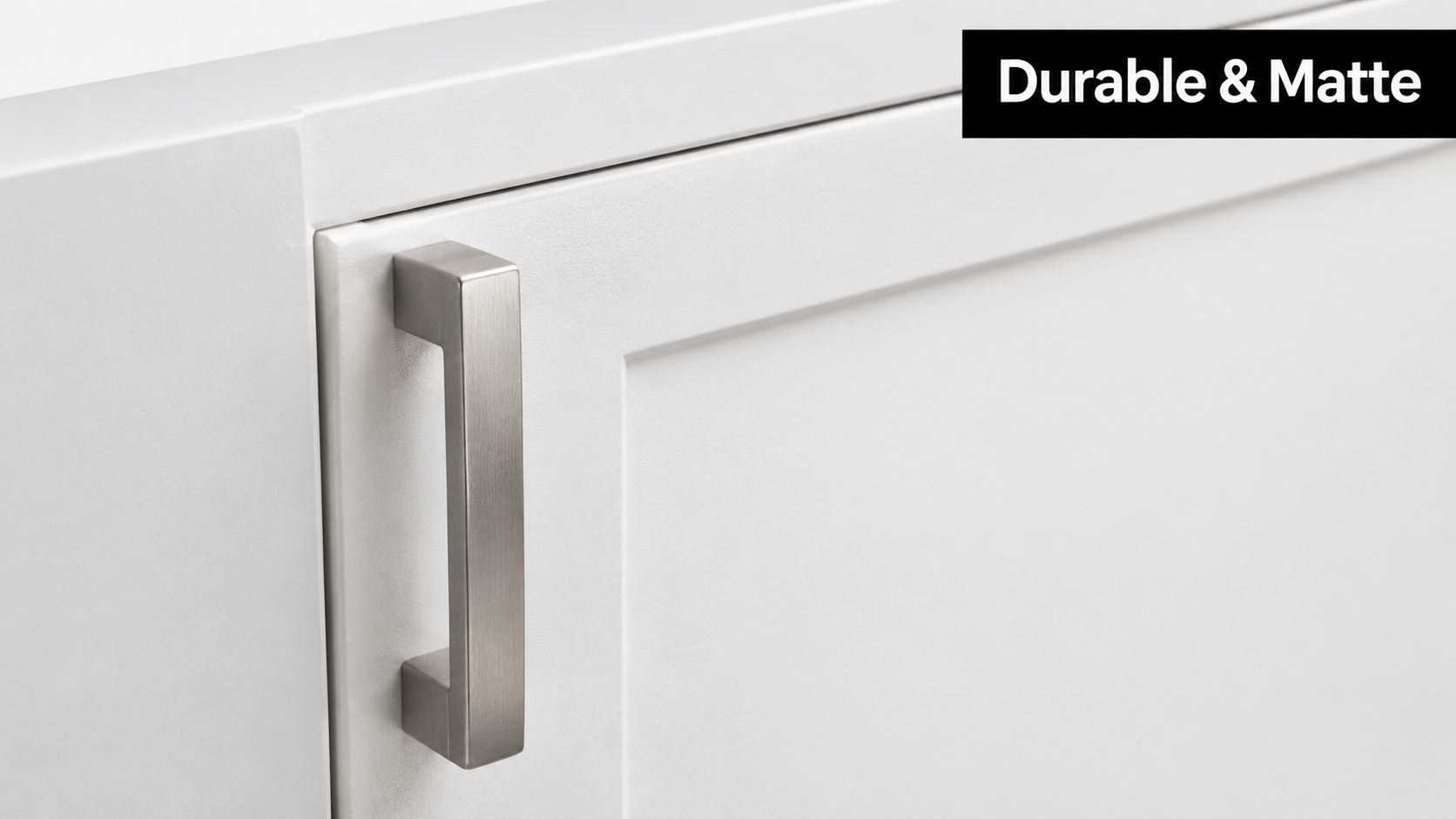
Handleless rails, recessed pulls and small horizontal handles keep the eye moving across the room. Visible hardware can still work, particularly when it repeats elsewhere, but it should look intentional rather than added as an afterthought. Integrated appliances extend the same idea by allowing the refrigerator, dishwasher or rangehood to sit behind matching panels where the layout and appliance specifications permit it.
Start with proportion and ergonomics
A modern kitchen can look elegant in a drawing and still feel uncomfortable in use. Work through these practical checks:
- Measure the room accurately. Record wall lengths, ceiling height, window positions, door swings, service points and any changes in floor level.
- Map appliance clearances. Cabinet doors, drawer fronts and appliance doors need room to open without blocking a passage or another work zone.
- Review working height. Australian kitchens commonly use base cabinet bodies around 720 mm high and 560 mm deep, with a plinth and benchtop bringing the working height to roughly 900 mm, as outlined in guidance on standard Australian kitchen cabinet sizes.
- Coordinate the installation. A level benchtop depends on more than the cabinet box. Floor conditions, wall alignment, fixing points and the final benchtop thickness all interact.
The relevant Australian standard is AS 4386:2018, which sets minimum requirements for the design, manufacture and installation of cabinetry in the built environment, including kitchens and built-in furniture. The AS 4386:2018 standard information matters because cabinet performance depends on construction and installation tolerances, not just the selected dimensions.
Know which style you're naming
Modern refers to a defined design language built around simplicity, function and clean lines. Contemporary describes what feels current, so it can combine modern slab fronts with warm timber, patterned surfaces or details borrowed from other styles. Hamptons kitchens usually introduce more traditional cues, such as framed or panelled doors, stronger moulding and a lighter coastal character.
You don't need to use the labels perfectly when briefing a designer. Bring examples and describe what you want to feel, such as quiet, warm, or family-friendly. Then ask how those preferences will affect maintenance, storage and cost.
Materials Finishes and Hardware That Last
The cabinet door is the visible part, but the substrate and edge treatment often decide how the kitchen copes with moisture, heat and daily impact. A useful specification separates four layers: the carcass, the door or drawer front, the surface finish and the hardware. Judging only the colour is like choosing a car by its paint while ignoring the engine.
Engineered board is common in modern cabinetry because it creates stable, consistent panels. In wet-prone parts of a home, ask for a moisture-resistant grade and check where exposed edges are sealed. Poorly sealed edges can allow moisture to reach the board, particularly beneath sinks, beside dishwashers or near a bathroom vanity.
Compare the visible finishes
- Matte laminate hides some fingerprints and gives a soft, low-glare appearance. It's often forgiving in busy family kitchens, although textured surfaces can hold dust in their pattern.
- Gloss surfaces reflect light and can brighten a compact room. They also reveal smudges, fine scratches and unevenness more readily, so cleaning becomes part of the visual maintenance.
- Textured laminate adds warmth and tactile interest without requiring natural timber. Check the grain direction and cleanability before using it across large areas.
- Timber veneer offers natural variation and can connect a kitchen with flooring, shelving or bathroom joinery. It needs a compatible protective finish and careful control of moisture.
- Two-pack painted finishes allow a broad colour range and a refined appearance. They can create a beautiful result, but the specification should address touch-up expectations and the risk of impact damage.
Modern materials also need an indoor-air-quality conversation. A 2023 technical data sheet for moisture-resistant MDF reported a total VOC emission rate below 0.005 mg/m²/hr and a formaldehyde emission rate of 0.017 mg/m²/hr. The MR MDF technical data sheet provides those reported emission figures. For a Victorian home or compact apartment, specify low-emission board, seal exposed edges fully and confirm that adhesives and coatings are compatible.
Hardware controls the daily experience
A door that looks simple still depends on accurate hinges. Soft-close hinges reduce slamming, while full-extension drawer runners let you reach the back of a drawer instead of unloading the front first. Heavy cookware calls for a drawer system designed for the load, not a lightweight runner selected only because it costs less.
Handle choice also affects cleaning. Recessed profiles create a clean appearance, but crumbs can collect in the channel. Small pulls are easy to replace and can provide a clearer grip for wet hands. Before approving the sample, open the doors with one hand, test the drawer reach and wipe the surface with the cleaning products you already use.
For a fuller comparison of board types and surface options, review this guide to kitchen cabinet materials. Ask the renovator to identify the board grade, edge sealing method, hinge adjustment range, drawer load specification and care instructions in writing.
Layout and Storage That Fits How You Cook
A kitchen can look impressive in a showroom yet feel awkward at home. If the fridge, preparation area, cooktop, oven and sink sit in the wrong sequence, every meal creates extra walking and crossing paths. Plan storage around the way food moves through the room, from bringing ingredients in to preparing, cooking, washing and putting items away.
Watch your current kitchen during a normal week. Note where parcels land, where chopping happens, which cupboard becomes a dumping zone and which appliance remains on the benchtop. These observations reveal more than copying a display kitchen designed for another household.
Match the plan to the room
An L-shaped kitchen can separate preparation and cleaning while leaving one side open to a dining or living area. A galley kitchen places storage and work surfaces opposite each other, so passage width, door swings and appliance clearances need careful checking. An island adds preparation space and drawers, but its footprint should improve the workflow rather than narrow the room. A peninsula can provide a useful landing zone where a freestanding island would make movement feel cramped.
Integrated zones keep visual clutter under control because the cabinet plan gives common objects a specific home. A tall pantry can hold dry goods, a drawer near the cooktop can keep utensils within reach, and an appliance garage can store smaller equipment between uses. Storage works like a well-organised toolkit. Each item is easiest to use when it sits beside the task that needs it.
Use the storage type as a decision
| Storage Feature | Best For | Cost and Maintenance Trade-off |
|---|---|---|
| Wide drawer stacks | Pots, pans, plates and everyday cookware | Usually increases hardware and cabinet cost, but improves visibility and access |
| Pull-out pantry | Narrow wall spaces and organised dry-goods storage | Makes contents easier to reach, though runners add moving parts to maintain |
| Corner drawers or carousel systems | Recovering difficult corner space | Can improve access, but complex mechanisms require careful installation |
| Appliance garage | Concealing small appliances on the benchtop | Keeps the room visually calm, but needs ventilation and suitable power planning |
| Tall utility cabinet | Brooms, cleaning products and household supplies | Uses vertical space efficiently, but should include secure, moisture-aware storage |
| Integrated bin drawers | Sorting waste close to preparation and cleaning zones | Convenient for daily use, but needs regular cleaning and accurate clearance planning |
Keep access ahead of appearance
Concealed storage only helps when you can reach it without moving several other items. Keep frequently used cookware and ingredients within comfortable reach, reserve high or deep cupboards for occasional equipment, and separate cleaning products from food storage. A designer can also check whether your preferred kitchen cabinet sizes suit the room before you commit to a front style.
Cabinet decisions also affect later rooms. The clearances, moisture planning and storage habits established in the kitchen can guide bathroom upgrades, where vanity depth, drawer access and cleaning space must work together. Discussing both rooms with a registered builder can help coordinate plumbing, electrical work and cabinetry, reducing the risk that one renovation creates problems for another.
A quiet kitchen isn't an empty kitchen. It's a room where necessary items have a planned place and can be retrieved without disrupting the next task.
Budgeting Costs and Value for Modern Cabinets
Cabinet budgeting becomes clearer when you separate what you see from the work that makes it operate properly. The final price can change with the kitchen's size, drawer quantity, board and finish specifications, hardware grade, integrated appliances, benchtop coordination, and plumbing or electrical changes. Installation also matters. A cheaper cabinet package loses value if doors need repeated adjustment or the benchtop cannot be fitted neatly.
For a practical breakdown of the factors behind cabinet pricing, see this guide to the cost of kitchen cabinets. Use it to build a realistic allowance, then ask each contractor which parts are included. Cabinetry, installation, preparation and related trades may appear as separate costs, so comparing only the cabinet figure can give a misleading impression.
Divide the brief before comparing quotes
Start with must-haves: safe installation, suitable moisture resistance, enough drawer capacity, appliance clearances, and a layout that supports the way you cook. Nice-to-haves may include an appliance garage, interior organisers, feature lighting, or a specialised corner mechanism. Long-term priorities include durable runners, replaceable hardware, sealed edges, and finishes that match your tolerance for cleaning.
A useful test is to ask which features affect daily work and which mainly affect appearance. A well-installed carcass and dependable runners can improve the kitchen every day, while a decorative detail may have less practical value.
Request quotes that list cabinetry, hardware, installation, demolition, plumbing, electrical work, benchtops, splashbacks, and finishing separately. Ask what assumptions sit behind each allowance, especially where walls or floors may need preparation. A clear quote lets you compare different solutions without mistaking a lower starting figure for a lower final cost.
Budget the whole home intelligently
Kitchen decisions often happen alongside bathroom renovations, laundry work, or flooring upgrades. The broader Australian full bathroom renovation spend is estimated at $10,221 to $20,443, with a midpoint of $15,332, and the same scope is reported as about 28% more expensive in Darwin than Hobart, according to the Australian renovation market cost report. Location, access, and service changes can affect how you distribute the renovation budget.
This is why whole-home planning matters. Kitchen plumbing routes, electrical capacity, moisture management, and cabinetry decisions can influence a later bathroom upgrade. Working with a registered builder helps coordinate these trades, much like arranging the pieces of one plan instead of solving each room in isolation.
Choose the cabinet elements you will touch every day before paying for decorative features that may date quickly. A calm finish, sound hardware, and careful installation can keep contributing long after a short-lived colour trend loses its appeal.
Small Kitchens Visual Inspiration and Bathroom Crossover
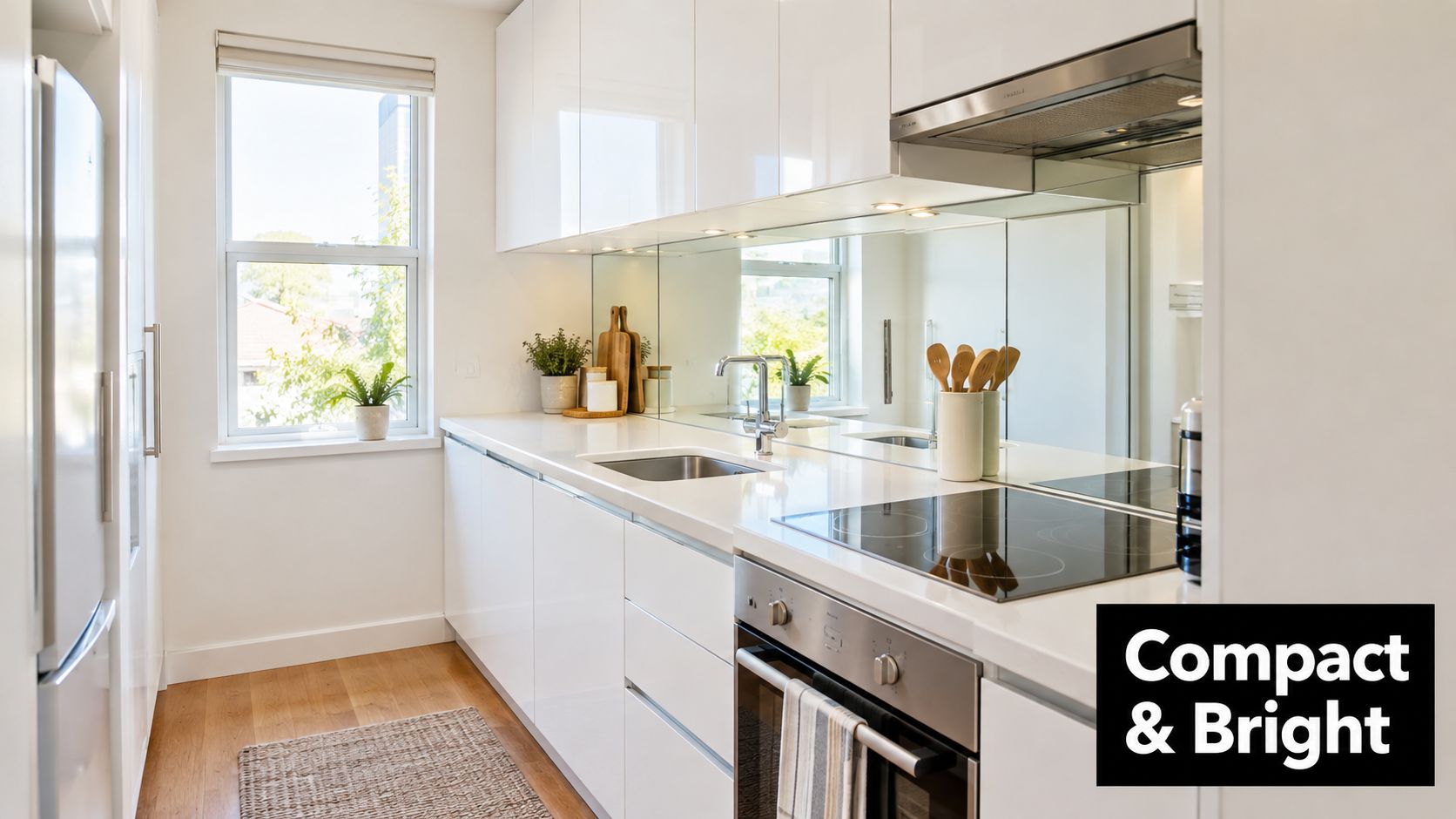
A compact kitchen doesn't need more visual activity. It needs stronger hierarchy. Light cabinet colours can reflect available light, while slim profiles and uninterrupted runs reduce the number of lines competing for attention. Warm neutrals are useful when a stark white room feels cold, and a carefully chosen two-tone arrangement can separate tall storage from the lower work zone without making the room feel divided.
Make the walls work harder
Use vertical storage for items that don't need daily access, and reserve the most convenient drawers for cooking essentials. A mirrored or reflective splashback can visually extend a narrow room, while integrated lighting under wall cabinets removes shadows from the preparation surface. If you're renovating a rental property, a restrained palette and replaceable handles can deliver a polished result without making future repairs unnecessarily complicated.
Two-tone cabinetry can also solve a practical problem. A durable, darker finish on the lower cabinets may tolerate busy foot traffic, while a lighter upper run keeps the eye lifted. The transition should align with a real architectural or functional boundary, such as the benchtop, appliance bank or ceiling line.
Carry the logic into bathrooms
The same principles apply to modern bathrooms. A flat-panel vanity echoes the kitchen's slab-front simplicity, and a wall-hung cabinet can make the floor easier to clean where the construction allows it. Designer bathrooms don't have to rely on elaborate decoration. They can feel considered through consistent hardware, warm neutral tones, concealed storage and lighting placed for real routines.
Australian inspiration galleries reflect that range. Houzz Australia lists 164,479 contemporary bathroom photos and includes ideas such as flat-panel cabinets, curbless showers, vessel sinks, open showers and double vanities in its bathroom design ideas. Australian House & Garden also presents more than 40 bathroom design ideas spanning small, modern, coastal and farmhouse styles in its bathroom inspiration collection.
A cohesive home doesn't require identical rooms. Repeat one or two decisions, such as a warm timber note, brushed metal hardware or a low-clutter cabinet profile, then adapt the materials to each room's moisture and cleaning demands.
Working With a Renovator From 3D Design to Handover
A cabinet renovation runs more smoothly when the design is resolved before demolition begins. Start with a measured site visit, then review the proposed layout, appliance locations, storage types, finishes, lighting and service changes together. A detailed 3D design can reveal a crowded passage, an awkward door swing or an island that blocks the cooking route before those issues become expensive site changes.
Check the working process
Ask how the quote describes materials, installation, preparation work, variations and exclusions. Confirm who coordinates the cabinet installer, plumber, electrician, benchtop fabricator and finishing trades. These people work to connected dimensions, so a change to the sink position or cabinet depth can affect several later tasks.
A practical renovation sequence usually includes:
- Concept development, based on your household routines, property constraints and whole-home priorities.
- Detailed design, with cabinet elevations, appliance positions, finishes and service locations resolved.
- Pre-construction checks, including site measurements, product confirmation and access planning.
- Construction and installation, with plumbing, electrical work, cabinetry and surfaces coordinated in the correct order.
- Finishing and handover, including adjustments, cleaning, defect review and care instructions.
In Victoria, understand what registration means before signing a building contract. The Building and Plumbing Commission registers individual builders, not businesses or companies, and one key category is Domestic Builder, Unlimited. Victorian guidance explains that registered builders unlimited can personally carry out, manage or arrange subcontractors for all components of domestic building work. Verify the relevant registration details and confirm which person holds responsibility for the work.
Look at completed projects, read testimonials and ask how communication works when a site condition changes. SitePro Bathrooms provides concept development, detailed 3D design, construction and finishing for kitchen and bathroom projects, so it can be one option to discuss when you want a coordinated renovation process. Request a quote that reflects your actual room, storage needs and preferred level of finish, rather than accepting a generic allowance.
A well-managed handover should leave you with adjusted doors, aligned drawers, documented care instructions and a clear process for raising any outstanding items. That final attention is what turns an attractive cabinet plan into a kitchen that works reliably every day.
If your kitchen feels cluttered, uncomfortable or dated, start with a practical design review rather than choosing a door colour in isolation. Explore completed renovation projects, prepare a list of your storage and workflow problems, then contact SitePro Bathrooms to request a quote for a coordinated kitchen or bathroom renovation in Highett and greater Victoria.